Original Research Article
Knowledge and attitude on human papilloma virus among adolescent
girls in school students at Puducherry
D. Arunachalam*, G. Subash Chandrabose
INTRODUCTION
Human papillomavirus is one of the most common causes of sexually transmitted infections.1 Cervical cancer is ranked as the second most common cancer among women worldwide and is a major cause of female mortality.2 About 50–80% of sexually active women are exposed to at least one HPV type during their lifetime.3-5 The peak incidence of HPV infection occurs in most populations within 5–10 years of the first sexual experience and the highest prevalence rates are seen in women aged 20–24 years.6,7 The worldwide incidence of
cervical cancer is approximately 510,000 new cases annually, with approximately 288,000 deaths worldwide.8 The cervical cancer occurs early and strikes at the productive period of a woman's life. The incidence rises in 30-34 years of age and peaks at 55-65 years, with a median age of 38 years (age 21-67 years).9 The approximately, suggest that more than 80% of the sexually active women obtain genital HPV by 50 years of age. Hence, the initiation of a vaccine beside HPV has stimulated much pleasure as well as contest. The HPV disease show to be an essential factor in the growth of almost all cases (90%) of cervical cancer. HPV vaccines
ABSTRACT
Background: Human papillomavirus (HPV) is one of the most common causes of sexually transmitted infections. About 50–80% of sexually active women are exposed to at least one HPV type during their lifetime.
Methods: A descriptive study to assess the knowledge and attitude on human papilloma virus among adolescent girls belonging to selected school at Puducherry. The objectives of the study were to assess the knowledge and attitude regarding HPV among adolescent girls. Adolescent girls were selected on the basis of convenient sampling technique. Structured teaching program were provided for 60 adolescent girls. Questionnaires are given to the students, collected and data were analyzed using the SPSS version 20.0 software.
Results: The data will be collected from adolescent girls in the age group of 13-18 years among selected school students. The results found that majority of adolescent girls having inadequate knowledge (56.7%). There are 36.7% of adolescent girls having moderately adequate knowledge and only 6.6% of adolescent girls are having adequate knowledge on HPV.
Conclusions: The majority of the girls having poor knowledge and attitude on HPV. The students need to be encouraged to engage in safe sexual practice to prevent and reduce risk of HPV infection. They have suggested that awareness effective and cost effective in improving the knowledge and attitude on human papilloma virus and can be implemented in daily living to have a healthy life.
Keywords: Human papilloma virus, Adolescent girls, Knowledge, Awareness
Department ofCommunity Medicine, Aarupadai Vedu Medical College and Hospital, Puducherry, India
Received: 05 January 2018
Revised: 18 January 2018
Accepted: 21 January 2018
*Correspondence:
Dr. D. Arunachalam,
E-mail: [email protected]
Copyright: © the author(s), publisher and licensee Medip Academy. This is an open-access article distributed under the terms of the Creative Commons Attribution Non-Commercial License, which permits unrestricted non-commercial use, distribution, and reproduction in any medium, provided the original work is properly cited.
effective against the two strains of this large family of viruses that currently causes approximately 70% of cases of cervical cancer. Since the vaccines only cover some of the cancer causing high vaccination to an advanced stage. Adolescence is a period of transition to adult life, in which sexual maturation occurs and it is a unique phase of life during which a child goes through tremendous physical, emotional and social changes. The present day adolescent is considered to be more knowledgeable about world affairs. In today’s scenario both the parents are employed to fulfill the increasing demands to maintain the socio economic status in society, the adolescents hardly receive the guidance of the elders which they need now more than at any other stage in their life unfortunately, Indian schools and colleges do not impart a proper education about growing self to these adolescents.10 Hence they depend mainly on their peers, magazines, internet, porn sites and other networking sites for gaining knowledge, these young people engage in sexual activities, rendering themselves vulnerable to venereal diseases and risk for human papilloma virus infection.11
The Indian women facial appearance has 2.5% increasing lifetime risk and 1.4% increasing death risk from cervical cancer. At any given time, about 6.6% of women in the wide-ranging population are expected to harbor cervical HPV disease. In India, HPV serotypes 16 and 18 report for almost 76.7% of cervical cancer. Warts have been reported in 2-25% of sexually transmitted disease clinic attendees in India; however, there is no data on the burden of anogenital warts in the general communication. By 2030, cervical cancer is expected to kill over 474,000 women per year over 95% of these deaths are expected to be in low- and middle-income countries.12,13 HPV immunization programs face several challenges. First, it is not completely apparent who should obtain the vaccine. The females have a propensity to become infected with HPV soon after they become sexually active, so it makes sense to vaccinate them at a moderately early age, before they become sexually active. It is not yet known, however, whether they will require booster shots later in life or whether a catch-up vaccination movement for older, sexually active women can decrease cancer rates. According to WHO, the level of sexual activity of a person will affect the risk of acquiring HPV infection. Intercourse at an early age, multiple sexual partners, unprotected sex and sex with uncircumcised men, have been found to increase the risk of contracting HPV infection.14 There are additional factors that increase the risk of developing cervical cancer after contracting HPV infection.15 These include smoking, oral contraceptive use, high parity, and infection with other sexually transmitted diseases such as human immuno deficiency virus, herpes, chlamydia, gonorrhoea, and syphilis. The objectives of the study were to assess the knowledge and attitude regarding human papilloma virus among adolescent girls belonging to selected school at Puducherry.
METHODS
A cross-sectional study carried out the knowledge and attitude regarding human papilloma virus among adolescent girls belonging to selected school at Puducherry. The study was analyzed in the rural field area of Kirumampakkam and Bahour in the Union Territory of Puducherry. In this study was carried out from six month in the duration of June 2018-November 2018. The data will be collected from 60 adolescents in the age group 13-18 years. It includes research approach, research design, and population. Study settings, sample
size and sampling technique, development and
description of tools, data collection method and plan for data analysis. The sample processes of selecting a portion of population represent entire population. In this study convenient sampling technique was used to select the adolescent girls attending in Dr. Ambedkar Girls Higher Secondary School at Puducherry. At the selected schools, girls between 10 and 20 years were randomly selected from secondary classes of these schools until the calculated sample size was reached. Analysis is the process of categorizing, ordering, manipulating and summarizing the data to obtain answers to research questions. The purpose of analysis is to reduce data to intelligible and interpretable from the relations of research problems can be studied and tested. The collected information is organized, tabulated. Analyzed and interpreted using descriptive and inferential statistics. The data were analyzed by using SPSS version 20 with both descriptive and inferential Statistics. In particular, Chi-square statistics were used to estimate the degree of correlation between the variables and nature of the independent variables in this study. If the probability value is less than 0.05 which considered statistically significant.
Statistical analysis
The collected information is organized, tabulated. Analyzed and interpreted using descriptive and inferential statistics. The data were analyzed by using SPSS version 20 with both descriptive and inferential Statistics. The results were shown as mean and standard deviation. The statistical data were analyzed by using ANOVA. The chi-square test were used to estimate the degree of correlation between the variables and nature of the independent variables in this study. The results were considered as statistically non-significant and the p values were found to be <0.05 in a confidence interval of 95%.
RESULTS
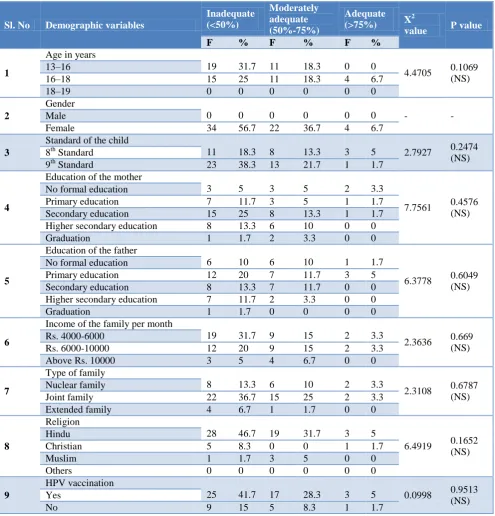
16-18 years old and there are no children are between 18-19 years old. The distribution of children according to their gender. It shows all of the children are Females (100%). The majority of the children are 9th standard (63.3%). There are 36.7% of the children are studying 8th standard. The distribution of children according to the education of their mother. It shows that majority of the mothers had Secondary Education (40%). There are 23.4% of the mothers had higher secondary education and 18.3% of the mothers had primary education. Similarly 13.3% of the mothers didn’t have any formal education and only 5% mothers are graduates. The majority of the fathers had primary education (36.7%).
There are 25% of the fathers had secondary education and 21.7% of the fathers had no formal education. Similarly 15% of the fathers had higher secondary education and only 1.6% of the fathers are graduates. The half of the children had Rs. 4000-6000 as their family income per monthly. Also there are 38.3% of children had Rs. 6000-10000 as their monthly income and 11.7% of the children had above Rs. 10000 as their family monthly income. In type of family, it shows that majority of children had joint family (65%). There are 26.7% of children had nuclear family and 8.3% of the children had extended family.
Table 1: Association of demographic variables with level of knowledge on school students.
Sl. No Demographic variables
Inadequate (<50%)
Moderately adequate (50%-75%)
Adequate
(>75%) X
2
value P value
F % F % F %
1
Age in years
19 31.7 11 18.3 0 0
4.4705 0.1069
(NS) 13–16
16–18 15 25 11 18.3 4 6.7
18–19 0 0 0 0 0 0
2
Gender
0 0 0 0 0 0 - -
Male
Female 34 56.7 22 36.7 4 6.7
3
Standard of the child
11 18.3 8 13.3 3 5 2.7927 0.2474
(NS) 8th Standard
9th Standard 23 38.3 13 21.7 1 1.7
4
Education of the mother
3 5 3 5 2 3.3
7.7561 0.4576
(NS) No formal education
Primary education 7 11.7 3 5 1 1.7
Secondary education 15 25 8 13.3 1 1.7
Higher secondary education 8 13.3 6 10 0 0
Graduation 1 1.7 2 3.3 0 0
5
Education of the father
6 10 6 10 1 1.7
6.3778 0.6049
(NS) No formal education
Primary education 12 20 7 11.7 3 5
Secondary education 8 13.3 7 11.7 0 0
Higher secondary education 7 11.7 2 3.3 0 0
Graduation 1 1.7 0 0 0 0
6
Income of the family per month
19 31.7 9 15 2 3.3
2.3636 0.669
(NS) Rs. 4000-6000
Rs. 6000-10000 12 20 9 15 2 3.3
Above Rs. 10000 3 5 4 6.7 0 0
7
Type of family
8 13.3 6 10 2 3.3
2.3108 0.6787
(NS) Nuclear family
Joint family 22 36.7 15 25 2 3.3
Extended family 4 6.7 1 1.7 0 0
8
Religion
28 46.7 19 31.7 3 5
6.4919 0.1652
(NS) Hindu
Christian 5 8.3 0 0 1 1.7
Muslim 1 1.7 3 5 0 0
Others 0 0 0 0 0 0
9
HPV vaccination
25 41.7 17 28.3 3 5 0.0998 0.9513
(NS) Yes
Sl. No Demographic variables
Inadequate (<50%)
Moderately adequate (50%-75%)
Adequate
(>75%) X
2
value P value
F % F % F %
10
Source of previous knowledge of
HPV 4 6.7 3 5 0 0
3.7522 3.7101
(NS) Television
Newspaper 7 11.7 6 10 2 3.3
Family 11 18.3 7 11.7 0 0
School 12 20 6 10 2 3.3
p>0.05 level of non-significant; p<0.05 level of significant. (S-Significant, NS-Not Significant).
The distribution of children according to their religion. It shows that majority of children were Hindus (83.3%). There are 10% of children were Christians and 6.7% of children were Muslims. The majority of children had HPV vaccination (75%). 25% of children didn’t have HPV vaccination. The according to the source of previous knowledge of HPV. It shows that majority of children have school as their source of knowledge of HPV (33.3%). 30% of children had family as their source of knowledge and 25% of children had newspaper as their source of knowledge of HPV. It shows that the majority of children having Inadequate knowledge (56.7%). There are 36.7% of children having moderately adequate knowledge and only 6.6% of children are having adequate knowledge. The mean knowledge score of children. It shows that mean and standard deviation of knowledge score is 13±3.1889. The score is ranged between 8–20. Mean percentage is 52%.
DISCUSSION
The adequate knowledge and attitude about HPV vaccination are essential prerequisites for healthcare professionals to provide patient education about HPV16. Increasing uptake of HPV vaccines should be a priority in developing countries since they contribute to 88 per cent of global cervical cancer burden. A descriptive study was carried out to assess the knowledge and attitude on Human papilloma virus among adolescent girls. The samples were selected by convenient sampling technique. The study was conducted in Dr. Ambedkar Government Higher Secondary School at Puducherry. The collected data were analyzed by using descriptive and inferential statistics. This study was conducted to assess the knowledge and attitude on Human papilloma virus among adolescent girls. This study was undertaken to examine the knowledge, perception, practices, and experiences of adolescent females between the ages of 13-18 years. This study is cross sectional using a non-experimental descriptive survey research. The morbidity and mortality associated with genital HPV induced lesion and poor immunity conferred by natural infection have led to search for prophylactic vaccine. The development of HPV vaccine has shown an advancement of fight against cervical cancers.17-19
Knowledge about HPV vaccination
Knowledge about socio-demographic variables
In present study, the results shows that half of the adolescent girls are between 13-16 years old (50%) and other half the adolescent girls is between 16–18 years old (50%) and there are no adolescent girls are between 18-19 years. In similar study from India conducted on female dental students only 18% of the study population had high level of total correct knowledge, but majority of them (63%) had average level of correct total knowledge.33 The analysis of chi- square value was 4.4705 with the p=0.1069 which is not significant.34 This reveals that there is no association between the level of knowledge and sex. Analysis of the participants according to their standard, majority of adolescent girls studying in 9th standard (38.3%) and there are 18.3% of adolescent girls are studying in 8th standard. The analysis of chi-square value was 2.7927 with the ‘p’ value 0.2474 which is not significant.35 This reveals that there is no association between the level of knowledge and standard of the child. The study results according to the type of family shows that 65% of the study participants belongs to joint family and 26.7% of the study participants belongs to nuclear family and 8.3% of the study participants belongs to extended family. The analysis of chi- square value was 2.3108 with the p=0.6787 which is not significant. This reveals that there is no significant association between type of family and level of knowledge. The study analysis according to religion shows that majority of the participants belongs to Hindu (83.3%), 10% belongs to Christian, 6.7% belongs to Muslim. The chi- square value was 6.4919 with the ‘p’ value 0.16532 which is not significant. This reveals that there is no association between religion and knowledge. The chi–square value reveals that there is no significant association with any demographic variables and the level of knowledge.36,37
CONCLUSION
It concluded that the knowledge levels of the adolescent girls aged between 13 and 18 years about HPV and HPV vaccine were not sufficient. The majority of the girls having poor knowledge and attitude on HPV. To evaluate assessment, planning of appropriate education programs in schools and informing educators about HPV in a more detailed way may increase awareness. This study suggested that awareness effective and cost effective in improving the knowledge and attitude on Human papilloma virus and can be implemented in daily living to have a healthy life. The educational materials used for scientific knowledge on the causes and prevention of cervical cancer.
Funding: No funding sources Conflict of interest: None declared
Ethical approval: The study was approved by the Institutional Ethics Committee
REFERENCES
1. Saswati T, Satyajit M, Muthulakshmi M, Jamuna
RR. Knowledge, attitude towards human
papillomavirus and HPV vaccine among medical students of a tertiary care teaching hospital in India.
Int J Reprod Contracept Obstet Gynecol.
2015;4(6):1771-4.
2. Human Papilloma Virus vaccines. WHO position paper. Wklyepidemicol Rec. 2009;84:118-31. 3. Cates W. Estimates of the incidence and prevalence
of sexually transmitted diseases in the United States: American Social Health Association Panel. Sex Transm Dis. 1999;26(4):S2–S7.
4. Baseman JG, Koutsky LA. The epidemiology of human papilloma virus infections. J Clin Virol. 2005;32(1):S16–S24.
5. Keam SJ, Harper DM. Human papilloma virus types 16 and 18 vaccine. Drugs. 2008;68:359–72.
6. Dunne EF, Unger ER, Sternberg M. Prevalence of HPV infection among females in the United States. JAMA. 2007;297:813–9.
7. Munoz N, Manalastas R, Pitisuttithum P. Safety, immunogenicity, and efficacy of quadrivalent human papillomavirus (types 6, 11, 16, 18) recombinant vaccine in women aged 24–45 years:a
randomized, double-blind trial. Lancet.
2009;373:1949–57.
8. Singh N. HPV and Cervical cancer. Prospects for prevention through vaccination. Indian J Med Paediatr Oncol. 2005;26:20-23.
9. Jan MA, Goldie SJ. Introducing HPV Vaccine in
developing countries. N Engl J Med.
2007;356:1908-10.
10. Gupta VM. Adolescent’s health Indian journal of public health. 2001;97-108.
11. Shilpa S. Human papilloma virus and associated factors among. Adolescent girls Journal of Indian community medicine, 2012;42:289-307.
12. WHO/ICO Information Centre on HPV and
Cervical Cancer (HPV Information Centre). Summary report on HPV and cervical cancer statistics in India, 2007.
13. Saleem A, Tristram A, Fiander A, Hibbitts S. Prophylactic HPV vaccination:a major breakthrough in the fight against cervical cancer. Minerva Med. 2009;100(6):503-23.
14. Geeta VB, Shreya M, Madhavi G. A study on awareness of cervical cancer among women of reproductive age group in urban slums of old Hubli, Karnataka, India. Int J Community Med Public Health. 2016;3(9):2579-83.
15. Senatla KT, Dolamo BL. Knowledge Attitudes and Behavior of Parents towards Human Papillomavirus (HPV) Vaccine in Prevention of Cervical Cancer in Adolescent Girls in Botswana. Virol Immunol J. 2018;2(10):1-9.
16. Giuseppe DG, Abbate R, Liguori G, Albano L,
Angelillo IF. Human papillomavirus and
intention in adolescents and young women in Italy. Br J Cancer. 2008;99:225–9.
17. Gerend MA, Shepherd JE. Correlates of HPV knowledge in the era of HPV vaccination:a study of unvaccinated young adult women. Women Health. 2011;51(1):25–40.
18. Khan TM, Buksh MA, Rehman IU. Knowledge,
attitudes, and perception towards human
papillomavirus among university students in Pakistan. Papillomavirus Res. 2016;2:122–7. 19. Lupato V, Holzinger D, Hofler D. Prevalence and
determinants of oral human papillomavirus infection in 500 young adults from Italy. Plosone. 2017;12(1):e0170091.
20. Charakorn C, Rattanasiri S, Lertkhachonsuk AA, Thanapprapasr D, Chittithaworn S, Wilailak S. Knowledge of Pap smear, HPV and the HPV vaccine and the acceptability of the HPV vaccine by
Thai women. Asia–Pacific J Clin Oncol.
2011;7(2):160–7.
21. Juntasopeepun P, Davidson PM, Suwan N,
Phianmongkhol Y, Srisomboon J. Human
Papillomavirus Vaccination Intention among Young Women in Thailand. Asian Pacific J Cancer Prevent. 2011;12(12):3213-9.
22. Dahlstrom AL, Sundstrom K, Young C, Lundholm C, Sparén P, Tran NT. Awareness and Knowledge of Human Papilloma virus in the Swedish Adult Population. J Adolescent Health. 2012;50(2):204–6. 23. Becker-Dreps S, Otieno WA, Brewer NT, Agot K,
Smith JS. HPV vaccine acceptability among Kenyan women. Vaccine. 2010;28:4864–7.
24. Francis SA, Nelson J, Liverpool J, Soogun S, Mofammere N, Thorpe RJ. Examining attitudes and knowledge about HPV and cervical cancer risk among female clinic attendees in Johannesburg, South Africa. Vaccine. 2010;28:8026–32.
25. Coleman MA, Levison J, Sangi-Haghpeykar H. HPV vaccine acceptability in Ghana, West Africa. Vaccine. 2011;29:3945–50.
26. Wamai RG, Ayissi CA, Oduwo GO, Perlman S, Welty E, Manga S. Assessing the effectiveness of a community-based sensitization strategy in creating awareness about HPV, cervical cancer and HPV vaccine among parents in North West Cameroon. J Community Health. 2012;37:917–26.
27. Joy T, Sathian B, Bhattarai C, Chacko J. Awareness of cervix cancer risk factors in educated youth:a cross-sectional, questionnaire based survey in India, Nepal, and Sri Lanka. Asian Pac J Cancer Prev. 2011;12:1707–12.
28. Mehta S, Rajaram S, Goel G, Goel N. Awareness about Human papilloma virus and its vaccine among
medical students. Indian J Community Med. 2013;38:92-4.
29. Naki MM, Celik H, Api O, Celik H, Kars B, Yasar E. Awareness, Knowledge and attitude related to HPV infection and vaccine among non-obstetrician-gynaecologist healthcare providers. J Turkish-German Gynecol Assoc. 2010;11:16-21.
30. Durusoy R, Yamazhan M, Tasbakan MI, Ergin I, Aysin M, Pullukcu H. HPV vaccine awareness and willingness of first year students entering university in western Turkey. Asian Pac J Cancer Prev. 2010;11:1695-701.
31. Zimet GD, Weiss TW, Rosenthal SL, Good MB, Vichinin MD. Reasons for non-vaccination against HPV and future vaccination intentions among 19-26 year old women. BMC Women’s Health. 2010;10:27-32.
32. Pandey D, Vanya V, Bhagat S, VS B, Shetty J.
Awareness and Attitude towards Human
Papillomavirus (HPV) Vaccine among Medical Students in a Premier Medical School in India. Plos One. 2012;7(7):e40619.
33. Ericka C. Lambert-college students’ knowledge of human papilloma virus and effectiveness of a brief educational intervention. J Am Board Fam Pract. 2001;14(3):178–83.
34. Lee KN, Chang KHJ, Cho SS, Park SH, Park ST. Attitudes Regarding HPV Vaccinations of Children among Mothers with Adolescent Daughters in Korea. J Korean Med Sci. 2017;32:130-4.
35. Rashwan H, Lubis SH, Ni KA. Knowledge of
Cervical Cancer and Acceptance of HPV
Vaccination among Secondary School Students in Sarawak, Malaysia. Asian Pac J Cancer P. 2011;12:1837-41.
36. Christian CM, Rose IA, Kofoworola AO. Human papillomavirus (HPV) infection and vaccines: Knowledge, attitude and perception among female students at the University of Lagos, Lagos, Nigeria. J Epidemiol Global Health. 2012;2:199–206.
37. Fairuz FMJ, Mohd DMR, Ilina I, Muhammad SMA,
Nuruliza R. Knowledge, Attitude and Practice of Human Papillomavirus (HPV) Vaccination among Secondary School Students in Rural Areas of Negeri Sembilan, Malaysia. Int J Collabo Res Inter Med Pub Health. 2016;8(6);420-34.