© 2014, IJCSMC All Rights Reserved
133
Available Online atwww.ijcsmc.comInternational Journal of Computer Science and Mobile Computing
A Monthly Journal of Computer Science and Information Technology
ISSN 2320–088X
IJCSMC, Vol. 3, Issue. 7, July 2014, pg.133 – 139
RESEARCH ARTICLE
ADAPTIVE VIDEO DATA STREAMING
AND SHARING IN CLOUD
P.N.Lokeswari
1, K.ChandraSekhar
2, Mr.Sathiyaraj
31
Student, Department of CSE, Madanapalle College of Engineering & Technology, Madanapalle, India
2
Student, Department of CSE, Madanapalle College of Engineering & Technology, Madanapalle, India
3
Asst Professor, Department of CSE, Madanapalle College of Engineering & Technology, Madanapalle, India
[email protected], [email protected], [email protected]
______________________________________________________________________________
ABSTRACT: As we know that cloud is a drastic data center for outsourced data. Cloud is a familiar tool
because of its useful architectural tools. Data sharing is another common habituated property to the
common people. These data sharing include video data in social networks, this was done regularly
through mobile devices like smart phones, tablets, laptops etc. we focused on demands on video traffic
over mobile networks. Mobile network consist limited bandwidth and long buffering time. To overcome
these issues we suppose adaptive mobile video streaming, efficient social video sharing. These two
approaches show scalable results in social network environment.
Key Terms: TFRC, AMES, Vagent, TempVB, Video base (VB), secure processing, Response time
________________________________________________________________________
I. INTRODUCTION
© 2014, IJCSMC All Rights Reserved
134
through which the user can provision resources on-demand. By minimizing user involvement, automation speeds up the process and reduces the possibility of human errors. Users face difficult business problems every day. Cloud computing adopts concepts from Service-oriented Architecture that can help the user break these problems into services that can be integrated to provide a solution. Cloud computing provides all of its resources as services, and makes use of the well-established standards and best practices gained in the domain of SOA to allow global and easy access to cloud services in a standardized way. Cloud computing also leverages concepts from utility computing in order to provide metrics for the services used. Such metrics are at the core of the public cloud pay-per-use models. In addition, measured services are an essential part of the feedback loops in autonomic computing, allowing services to scale on-demand and to perform automatic failure recovery. Cloud computing is a kind of grid computing; it has evolved by addressing the QoS (quality of service) and reliability problems. Cloud computing provides the tools and technologies to build data/compute intensive parallel applications with much more affordable prices compared to traditional parallel computing techniques.
II. BACKGROUND ISSUES
Threats and opportunities of the cloud:
Critical voices including GNU project initiator Richard Stallman and Oracle founder Larry Ellison warned that the whole concept is rife with privacy and ownership concerns and constitute merely a fad. However, cloud computing continues to gain steam with 56% of the major European technology decision-makers estimate that the cloud is a priority in 2013 and 2014, and the cloud budget may reach 30% of the overall IT budget.
In the past decade, the traffic will gradually more while downloading video and uploading. Specially, over the past few years services of video loading have become ubiquitous over the mobile networks. In wired networks the video streaming is not so demanding, due to the less bandwidth and limited capacity mobile networks have been suffer from video transfer transmission . In the network operator distracted hard work to improve the bandwidth of wireless link, high video interchange load and the wireless link capacity are quickly crushing by user. Hence, this can be critical to recover the quality service for video loading when use the network and resource resourcefully. In recent times there are two facts to progress the quality service for video loading
Scalability : The extensive range of mobile devices should supported by Mobile video loading services ; That should be in different resolutions of video, different powers of computing, different wireless relations and so on.
Depending on its signal strength the mobile device existing link capacity may differ in excess of space and time. It may occur the overhead for storage and communication while storing multiple versions of the same video. Here we are using the Scalable Video Coding (SVC) technique which can encode the elevated quality video that also contains one or more subsets.
Here the subsets can be having three different features: 1. The layering image resolution for spatial scalability, 2. The layering the frame rate for temporal scalability, 3. The layering the image compression for quality scalability.
Adaptability:
© 2014, IJCSMC All Rights Reserved
135
Though most of the proposal looking for together uses the video scalable and adaptable techniques. So, each individual user needs to separately report the program status from time to the server that can modify the accessible bandwidth for each individual user. Here the as the number of users increases the server should take over the significant dispensation transparency that is one of the problem.
Here the scalable property to content service provider, and method off-load to individual users can be flexibly balanced by cloud techniques. So that, the important coincident services for video as consider in several study on mobile cloud technology have planned to produce modified intellectual users for servicing mobile users by cloud data centers.
In recent times social network services have been gradually more admired. By using SNs we will be recover the content delivery quality. Here in these SNs, the videos among friends can be shared, repost and comment by users and same group members, that can be user can watch a videos which are suggested by her friends, Users in SNSs can also follow popular videos and recent videos watched by their friends.
By the way, in order to reduce the loading time of the video we have to prefetch the video in advance or even to send the whole video to the members of the group. Then this can be automatically finished at the back ground that job can be done by the private agent. When the user clicks the video it can be playing without loading time.
Here by keeping the above objectives in mind, we plan the adaptive video loading and the framework for individual users, i.e AMES Cloud. Here this framework creates a personal agent for each individual user in cloud environment that can be divided into two sub parts:
1. AMoVs
2. ESoVs.
Here the AMoVs offers the best possible loading experiences by adaptively controlling the loading bit rate dependingon the variation of the link quality. By using scalable video coding technique the private agent will control the streaming bit rates. The link status information will always keep by the private agent. These private agents of users are energetically initiate and optimized in the cloud platform. Here the real time SVC coding is done on the cloud side resourcefully.
This cloud supports distribute video streams resourcefully by providing a 2tier structure: those are content delivery network and data center. Through this structure, with in the cloud only video sharing can be optimized. It can downloads of popular videos and reduce the unnecessary redundant videos. And the second part of AMES Cloud is ESoVs, here the popular videos can be prefetched before by the private agent. The video can be stored depending on the strength of the social links between users.
The early 2010s cloud market is dominated by software and services in SaaS mode and IaaS (infrastructure), especially the private cloud. PaaS and the public cloud are further back.
EXISTING SYSTEM
Whereas receiving video stream traffic via 3G/4G mobile networks, mobile users often suffer from lengthy buffered time and asymmetrical disturbances due to the partial bandwidth and link condition fluctuation caused by multi path fading and user mobility. Thus, it is crucial to improve the service quality of mobile video streaming while using the networking and computing resources efficiently.
PROPOSED SYSTEM
© 2014, IJCSMC All Rights Reserved
136
be significant improvement on the adaptivity of the mobile streaming. Here we implement the prototype, while overlooked the cost of programming workload in the cloud.
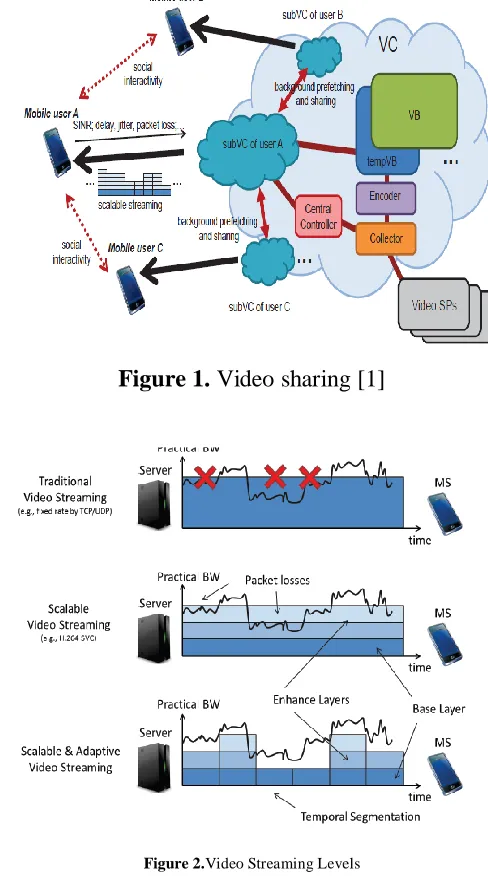
Figure 1.
Video sharing [1]
Figure 2.Video Streaming Levels
By this 2-tier storage, the AMES-Cloud can keep serving most of popular videos eternally. Note that management work will be handled by the controller in the VC.[1][3]
Sub Video Cloud
Svc is a combination of 2 types of layers called base layers and enhanced layers. Base layer provides reliability in delivery, enhanced layers provides quality link with encoding and decoding methods. Finally optimum utilization of bandwidth, sometimes data pockets were lost in transit due to low bandwidth. [5]
By implementing this model following people are involved
© 2014, IJCSMC All Rights Reserved
137
1. Admin
In this level, Admin have three sub tasks. They are,
Upload Video: Here Admin can add a new video. It’s used for user for viewing more collections.
User Details: Admin can view the user those have registered in this site.
Rate videos: This module for avoiding unexpected videos from users. After accept/reject videos then only user can/cannot view their own videos.
2. User1
In this USER1 Performs following tasks they are,
News Feed: Here user of this social site can view status from his friends like messages or videos.
Search Friends: Here they can search for a friends and send a request to them also can view their details.
Share Video:They can share videos with his friends by adding new videos also they share their status by sending messages to friends.
Update Details: In this Module, the user can update their own details.
3. User2
In this level, user can register their details like name, password, gender, age, and then. Here the user can make friends by accept friend request or send friend request.
They can share their status by messages also share videos with friends and get comments from them..
III. ADAPTIVEANDEFFICIENTVIDEOSTREAMINGANDSHARINGINCLOUD
The figure 1 shows the architecture of the adaptive and efficient way of enhancing the video streaming and sharing of video to the mobile users. The architecture was constructed based on the video service provided in cloud called as ―AMES‖. The architecture contains
A. Video service provider (VSP): the originated place of actual video data. It used the traditional video service provider. VSP can handle multiple requests at the same time, while coming to the QoS with the mobile users, the VSP does not provide service up to the mark.
B. Videocloud(VC): the cloud step up has been established with many components working together, virtually to get the original video data from the VSP and provide the reliable service to the mobile user and it also provides availability of video and makes the sharing of those videos among the users much easier.
C. Video base (VB): Video base consists of the video data that are provided as the service to the mobile users in cloud.
© 2014, IJCSMC All Rights Reserved
138
D. Temp video base(TVB): it contains the most recently accessed video data and it also contains most frequently accessed video data.E. Vagent: it is an agent created for every mobile user who requests for the video service to the video cloud.
F. Mobile users: the users who are mobile and providing the availability of the service to their location is difficult.
The video cloud provides services under two main methodologies adaptive mobile video streaming and efficient mobile video sharing. The video streaming and video sharing plays the vital role in providing the reliable service to the customers. The rate in which frames of the videos are streams determines the quality and availability of the video service. Video data are most commonly shared among the users in the network. Mobile users are most commonly found to use social networking sites more offently[6,7]. The mobile device and mobile computing provides them space to be connected on the social network. Multimedia data such as images and videos are shared among the friend and users of the social media. The request of the video and sharing of video are two main actions requested from customer. Video cloud provides platform to provide these two service in better way.
IV. CONCLUSION
Finally we conclude that this survey focused on video data streaming with effective frameworks, it works successfully with limited bandwidth. When we share the data through social networks it also requires security, by these two were in secure cloud environment.
While streaming video data user feels live experience by implementing the layers of base, enhanced in sub video clouds. Data are in the form of encoded and adaptable nature. Finally we focus cost effective data streaming with large scale networks in cloud in future means that optimal pricing in data streaming for mobile users. In this paper, we discussed our proposal of an adaptive mobile video streaming and sharing framework, called AMES-Cloud, which efficiently stores videos in the clouds (VC), and utilizes cloud computing to construct private agent (subVC) for each mobile user to try to offer “non-terminating” video streaming adapting to the fluctuation of link quality based on the Scalable Video Coding technique. Also AMES-Cloud can further seek to provide “nonbuffering” experience of video streaming by background pushing functions among the VB, subVBs and localVB of mobile users.
REFERENCES
[1] AMES-Cloud: A Framework of Adaptive Mobile Video Streaming and Efficient Social Video Sharing in the Clouds Xiaofei Wang, Student Member, IEEE, Min Chen, Senior Member, IEEE, Ted “Taekyoung”
Kwon, Senior Member, IEEE, Laurence T. Yang, Senior Member, IEEE, Victor C.M. Leung, Fellow, IEEECISCO
[2] “Cisco Visual Networking Index : Global Mobile Data Traffic Forecast Update , 2011-2016,” Tech. Rep., 2012.Y. Li, Y. Zhang, and R. Yuan, “Measurement and Analysis of a Large Scale Commercial Mobile Internet TV System,” in ACM IMC, pp. 209–224, 2011.
[3] T. Taleb and K. Hashimoto, “MS2: A Novel Multi-Source Mobile-Streaming Architecture,” in IEEE Transaction on Broadcasting, vol. 57, no. 3, pp. 662–673, 2011.
[4] X. Wang, S. Kim, T. Kwon, H. Kim, Y. Choi, “Unveiling the BitTorrent Performance in Mobile WiMAX Networks,” in Passive and Active Measurement Conference, 2011.
[5] A. Nafaa, T. Taleb, and L. Murphy, “Forward Error Correction Adaptation Strategies for Media Streaming over Wireless Networks,” in IEEE Communications Magazine, vol. 46, no. 1, pp. 72–79, 2008. [6] J. Fernandez, T. Taleb, M. Guizani, and N. Kato, “Bandwidth Aggregation-aware Dynamic QoS Negotiation for Real-Time Video Applications in Next-Generation Wireless Networks,” in IEEE Transaction on Multimedia, vol. 11, no. 6, pp. 1082–1093, 2009.
© 2014, IJCSMC All Rights Reserved
139
[8] K. Zhang, J. Kong, M. Qiu, and G.L Song, “Multimedia Layout Adaptation Through Grammatical Specifications,” in ACM/Springer Multimedia Systems, vol. 10, no. 3, pp.245–260, 2005.[9] M. Wien, R. Cazoulat, A. Graffunder, A. Hutter, and P. Amon, “Real-Time System for Adaptive Video Streaming Based on SVC,” in IEEE Transactions on Circuits and Systems for Video Technology, vol. 17, no. 9, pp. 1227–1237, Sep. 2007.