27 |
P a g e
OPTIMIZATION OF CUTTING PARAMETER OF
EN24 STEEL BY USING TAGUCHI METHOD IN
HARD TURNING
Prof. Thokale M.J.
1, Mr. Bidwai S.S.
2, Mr. Yadav S.K.
31
Asst. Prof., Department of Production Engg., AVCOE, Sangamner, (India)
2,3
Student, Department of Production Engg., AVCOE, Sangamner, (India)
ABSTRACT
Surface finish is a crucial thing during any machining processes, hence itis very essential to control the
required surface quality to have a better choice of optimized cutting parameter. The main intension is to
optimize the cutting parameter.Generally hard turningis turning process in which work material whose
hardness about 46-69 HRC are used. Thus, various sort of tipped tools are used for turning operation.
The orthogonal array, signal to noise ratio are employed to study the performance characteristics in turning
operation. To study the performance characteristics, three process parameter are mainly briefed viz speed, feed
and depth of cut. Experiments have been conducted using L9 orthogonal array under Dry turning tests which
was carried out on hardened EN24 (46 HRC) with coated carbide cutting insert on CNC machine.
The main aim is not only to increase machine utilization but also to decrease production cost and achieve best
surface finishing. From experimental results, it predicts that the feed is highly influential for good quality of a
surface.
Keywords : Hard Turning, Surface Finish, Taguchi Method,.
I INTRODUCTION
Hard turning is a machining process which is performed on materials whose hardness value ranges between
46-69HRC. For this machining process, the use of tipped as well as solid cutting inserts are suited. This machining
process exhibits unique behaviour, which is totally different than conventional turning operation. Hard turning is
different than conventional turning in the following ways:
1. Hardness of work piece 2. Cutting tools required 3. Mechanism of chip formation.
Grinding is a process which is used to produce good surface finish at high feed rates but hardturning can also be
used to produce better surface finish at higher material removal rates. This processis accomplished with small
28 |
P a g e
hard turning. Apart from this another advantages of hardturning over grinding are –low cost of equipment, lessset up time, flexibility, no use of cutting fluid.
In hardturning cutting parameters are selected on the basis of hardness of materials, surface roughness of
thework piece, etc. As material hardness is high, it results in the decrease of machining cost, savestime,
improves surface quality & also eliminates deformities in parts caused by temperature.Also surface finish is
influenced by many factor such as feed rate,speed, cutting time,cutting fluid, work piece hardness and depth of
cut, but selection of only three parameter like speed,feed,and depth of cut is made. Fabrication of complex parts
by conventional turning is much costlier and the use of hard turning for the same thing reduces cost by 30%.
Surface finish also determines the machinability of materials.Whereas Surface roughness is an important aspect
of product quality which governs performance of mechanical parts & production cost. Whenoptimization of
cutting parameter takes place, it results in the increaseof the utility for machining economics & product quality.
II
LITERATURE REVIEW
In this section the views of different authors related to optimization of cutting parameter has been reported.
Many researchers have worked on many factors of hard turning most of them were based on the cutting speed.
As reported in various works, the rangesfor speed, feed, and depth of cut selected were between 90-250 m/min.,
0.05-0.2 mm/rev, up to 0.6 mm respectively. Ilhan Asilturk & Harun Akkus studied effect of cutting parameter
on surface roughness in hard turning by using AISI4140 with coated carbide tools. They observed that the feed
rate has more significant effect on Ra & Rz[.1] Gaurav Bartarya & S.K Choudhury concluded that very few
works reported using coolant for hard turning while most works do without coolant. It was found that tools with
low CBN content provide better tool life.Also interrupted cutting provides greater tool life than continuos
cutting. Adequate machine rigidity is required to reduce the process inaccuracy.[4] Ashok Kumar Sahoo &
Bidyadhar Sahoo approached that coated insert performed better than an uncoated insert. Titanium based hard
thin films are mostly used due to better wear resistance. The specific cutting energy for the hard turning is found
to be smaller than grinding. Cutting force & surface roughness is smaller with PCBN inserts compared to
ceramics tools under same cutting environment.[7] Ucun & Aslantas determined the effect of cutting parameter
on surface roughness in hard turning by using AISI 52100 grade bearing steel with coated carbide cutting tools.
They checked machining performance with respect to tool wear & surface roughness as a result they observed
that carbide cutting tools were not suitable for higher cutting parameter values.[14] Thamizhamanii detected that
poor surface finish due to machine tool vibration & chattering, whose effects were ignored for analysis. Author
concluded that only depth of cut is significant factor which contributed to surface roughness.[15]
III EXPERIMENTAL SET UP
29 |
P a g e
Fig. 1
IV WORKPIECE MATERIAL AND METHODOLOGY
In this experiment, a work piece material made up of EN24 (45-46HRC) steel was used.Chemical composition
of EN24 material is carbon (0.36-0.44%), chromium (1-1.40%), nickel (1.3-1.7%), molybdenum (0.20-0.35%),
silicon (0.10-0.35%), manganese (0.45-0.70%), sulphur (0.040%) and phosphorus (0.035%). Work piece
material having Ø24×100 mm. The experiment was conducted on 4 Axis CNC Turn Mill Canter (3D SIEMENS
810D DMG-CTX310). The experiment was conducted under dry condition. The tool holder used was model
PCLNL 2020K12 and coated carbide (CNMG 120408) insert was used as cutting tool. ZEISS &ACCT’S(ver
5.13) surfcom 130A surface roughness tester where used for surface roughness measurement in sampling length
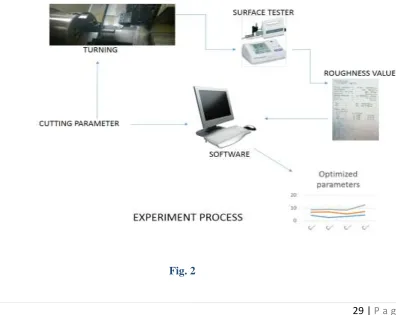
of 45mm. Experimental arrangement is as shown in in Fig.(2).
30 |
P a g e
The level of cutting parameter values were chosen from the manufacturer’s catalogue suitable for the material.These cutting parameter are as shown in the table.
Table 1
Cutting parameters for the experimentation are selected as below.
Level Cutting
speed(m/min)
Feed
(mm/rev)
Depthof
cut
(mm)
1 100 0.06 0.25
2 110 0.1 0.50
3 120 0.14 0.75
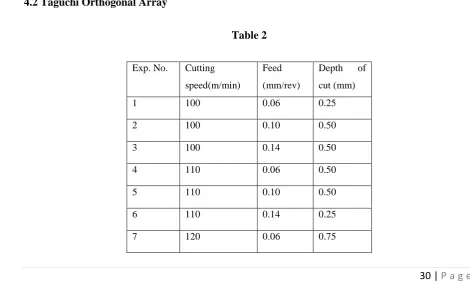
To reduce the number of experiments the taguchi method and L9 orthogonal array were employed.
4.1 Experimental design
The traditional experimental design methods are too much complex and time consuming. To overcome
limitations of traditional method the taguchi method is used. Advantages of implementation of taguchi method
are: Tofind out significant factors in a shorter time period, to decrease the cost, decrease the experimental time.
The taguchi method is mostly used to design the best process parameter to minimize the variation.
4.2 Taguchi Orthogonal Array
Table 2
Exp. No. Cutting
speed(m/min)
Feed
(mm/rev)
Depth of
cut (mm)
1 100 0.06 0.25
2 100 0.10 0.50
3 100 0.14 0.50
4 110 0.06 0.50
5 110 0.10 0.50
6 110 0.14 0.25
31 |
P a g e
8 120 0.10 0.25
9 120 0.14 0.50
Smaller is better
The S/N ratio for smaller is better used for situation where the target value is zero, such as computer response
time, automotive emission and surface roughness value.
Where, S/N ratio=Signal to noise ratio
n=no of measurements
y=measured values.
V OBSERVATION/RESULT
Table 3
After measurement of the surface roughness value we calculate S/N ratio and Means by using Minitab 17
software.
Exp.
No.
Cutting
speed(m/min) Feed(mm/rev) Doc(mm) Ra(µm) Rz(µm) s/n ratio means
1
100 0.06 0.25 0.423 3.513 -7.96578 1.968
2
100 0.1 0.5 0.435 4.213 -9.52758 2.324
3
100 0.14 0.5 0.437 4.388 -9.87789 2.4125
4
110 0.06 0.5 0.269 2.45 -4.82506 1.3595
5
110 0.1 0.5 0.328 3.075 -6.79574 1.7015
6
110 0.14 0.25 0.439 4.563 -10.2147 2.501
7
120 0.06 0.75 0.194 1.875 -2.49597 1.0345
8
120 0.1 0.25 0.275 2.875 -6.20201 1.575
9
32 |
P a g e
Fig. 3
VI CONCLUSION
The taguchi experimental design was used to obtain optimum cutting parameter on hard turning, L9 orthogonal
array was selected for three different level of cutting speed, feed& depth of cut. Nine experiments were
conducted insteadof the 27 experiments. The resultsobtained from this experiment were:
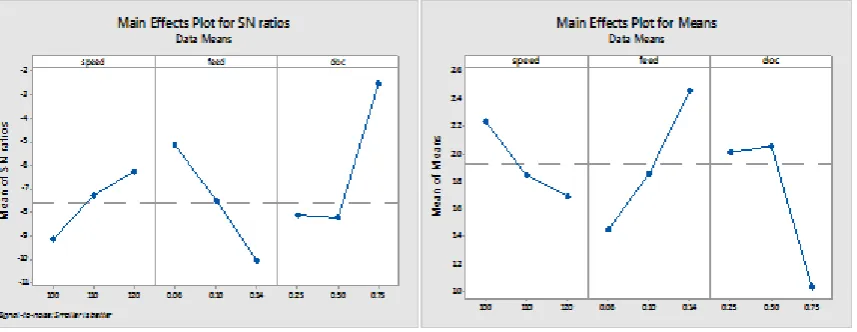
By using S/N ratio equation of “The smaller –the better”, the maximum value was obtained. Proper
cutting parameters were obtained by the maximum S/N ratio. Optimum cutting conditions which
corresponds to maximum -2.49 S/N value of the smaller Ra value for the smaller surface roughness in
hard turning (3-1-3) was found to be 120m/min for cutting speed, 0.06 mm/rev for the feed rate,
o.75mm for the depth of cut.
The feed rate was themost influential factor for the quality of surface roughness in hard turning.
With increase in the feed rate the quality of surface finish decreases.
The best surface roughness was obtained at the lower feed rates and higher cutting speeds.
Throughthis study satisfying results wereachieved and it would have wide range of applications in the
future industrial and academic studies.
VII ACKNOWLEDGEMENT
This research work was completed in the laboratory of Nashik Engineering Cluster , Nashik. The authors would
like to thank the Prof. V. B. Shinde, HOD, Production Engg. Dept. for the support and guidance of Prof. Shirish
33 |
P a g e
REFERENCES
1) Ilhn Asilturk, Harun Akkus “Determining the Effect of Cutting Parameter on Surface Roughness in
Hardtuning Using the Taguchi Method”measurement 44(2011)1697-1704.
2) Rahul Davis, Vikrant Singh, Shaluza Priyanka “Optimizationof Process Parameter of Turning
Operation of EN24 Steel Using Taguchi Design of Experiment Method”WCE 2014 vol.2.
3) Krishnakant, Jatin taneja, Mohit Bector, Rajesh Kumar “Application of Taguchi Method for
Optimizing Turning Process by the effect of Machining Parameters”(IJEAT) ISSN:2249-8958,vol.2.
4) Gaurav Bartarya, S.K Chaudhury “State of the art in hard turning” International Journal of Machine
Tools & Manufacture 53(2012)1-14.
5) Vipindas M.P, Dr.Govind P “Taguchi-Based Optimization of Surface Roughness in CNC Turning
Operation” IJLTET ISS: 2278-621X Vol.2.
6) Mahendra Korat, NeerajAgrawal “Optimization of Different Machining Parameter of EN24 Alloy Steel
in CNC Turning By use of taguchi Method” (IJERA) ISSN: 2288-9622 Vol.2.
7) Ashok kumar sahoo &Bidyadhar sahoo “ Experiment investigation on machinability aspect in hard
turning of AISI 4340 steel using uncoated & multilayer coated carbide insert” measurement 45(2012)
2153-2165
8) D.Singh,p.v Rao, “A surface roughness prediction model for hard turning process”
Int.J.Adv.mfg.32(11-12) (2007)115-1124
9) A Hascalik,U.caydas” optimization of turning parameters for surface roughness & tool life based on
the Taguchimethod” Int.j.adv mfg. Tech 38(2008) 896-903
10) Sijo M.T,&Biju N “Taguchi Method for optimization of cutting parameter in turning operation” proc.of
.int.conf.on adv. in mech Engg (2010).
11) Puneet mangla,Nishant kr.singh,Yashvir Singh “ study of effect of turning parameters on work piece
hardness using Taguchi method” ICAM,pp 695-700.
12) Mahapatra S.S, et al “parametric Analysis & optimization of cutting parameters for Turning operation
based on Taguchi method”, proc to Int.conf on global mfg. & innovation” July-27-29, 2006.
13) Raghuwanshi B.S, “A course in work shop Tech vol 2”, Dhanpat Rai & company pvt.ltd.2009.
14) I.ucun, K.aslantas, “investigation of performance of carbide cutting tool in turning hardened 52100 tool
steel” ,IATS’09,Karabuk ,turkey ,2009,pp.1-6.