Authenticated Key Exchange
Zilong Wang and Honggang Hu
Key Laboratory of Electromagnetic Space Information, Chinese Academy of Sciences,
School of Information Science and Technology, University of Science and Technology of China,
Hefei, China, 230027 {[email protected]
Abstract. Lattice-based cryptographic primitives are believed to have the property against attacks by quantum computers. In this work, we present a KEA-style authenticated key exchange protocol based on the ring learning with errors problem whose security is proven in the BR model with weak perfect forward secrecy. With properties of KEA such as implicit key authentication and simplicity, our protocol also enjoys many properties of lattice-based cryptography, namely asymptotic efficiency, conceptual simplicity, worst-case hardness assumption, and resistance to attacks by quantum computers. Our lattice-based authenticated key exchange protocol is more efficient than the protocol of Zhang et al. (EUROCRYPT 2015) with more concise structure, smaller key size and lower bandwidth. Also, our protocol enjoys the advantage of optimal online efficiency and we improve our protocol with pre-computation.
Keywords: lattice-based cryptography, authenticated key exchange, post-quantum cryptography, ring-LWE
1
Introduction
1.1 KE and AKE
Key exchange (KE) is one of the most fundamental cryptographic primitives. In practice, a common secret key (session key) generated by their personal keys (static key) should be shared with KE before the session starts, as the network is considered to be insecure. The communication data will later be transmitted on a trusted channel established with the session key. An authenticated key exchange (AKE) is quite similar to KE while AKE provides authentication which can avoid man-in-the-middle attack.
communication overhead and makes the protocol more complicated. The IKE [22], SIGMA [24], SSL [16], TLS [13], JFK [2] are all explicit AKEs. Implicit AKE achieves authentication by ingenious design of the algebraic structure. The KEA [33], OPACITY [32], MQV [29], HMQV [23] and OAKE [34] are families of implicitly AKE.
Intuitively, an AKE is secure if no probabilistic polynomial time (PPT) ad-versary is able to extract any useful information from the data exchanged during the session. Formally, the widely used security models for AKE include the BR model [4, 35], the CK model [10] and the ACCE model [20]. The BR model, which is introduced by Bellare and Rogaway, is an indistinguishability-based security model. The CK model, which accounts for scenarios in which the adversary can obtain information about a party’s static secret key or a session state, inherit-s from Krawczyk’inherit-s SIGMA family of protocolinherit-s. The ACCE model iinherit-s a variant of the BR model which has separated properties for entity authentication and channel security.
Another property of AKE protocols is perfect forward secrecy (PFS). PFS requires that an adversary who corrupts one of the parties can not destroy the security of previous sessions. However, Krawzcyk [23] showed that no 2-pass AKE protocol can achieve PFS. Alternatively, he presented a notion of weak perfect forward secrecy (wPFS) which says that the session key of an honest session remains secure if the static keys are compromised after the session is finished.
1.2 Lattice-Based Cryptosystems and Key Reused Attack
It is important to construct protocols based on lattice problems as lattice-based cryptography is believed to resist quantum computers attacks. For instance, a post-quantum cryptography competition is held by NIST to advance the process of post-quantum cryptography standard.
The most widely used lattice problem to construct lattice-based cryptography is the learning with errors (LWE) problem which was first proposed by Regev [31] as an extension of learning parity with noise (LPN) problem [5]. Later in [28], Lyubashevsky et al. introduced the ring-LWE which is the ring -based analogue of LWE, and proved the hardness of ring-LWE. (ring-)LWE has attracted a lot of attention in theories and applications due to its good asymptotical efficiency, strong security, and exquisite construction. LWE has been used to construct public-key encryption [19, 26, 31], identity-based encryption [1, 11], key exchange [3, 7, 14, 35, 21], and fully homomorphic encryption [8, 9], etc.
1.3 Techniques and Relation to KEA
The key idea behind our protocol, which was firstly proposed by Linder et al. [26], is that the two parties share a common secret:I(x, y) =xAy, wherexand y∈Znq are the static keys of two parties, andAis randomly chosen fromRnq×n.
The definition of ring-LWE indicates that it will bring some small errors during the session. These small errors may be beneficial in security, but they make the protocol incorrect. A common method to deal with these errors is reconciliation mechanism which was first proposed by Ding et al. [14] and soon improved with a more bandwidth-efficient and unbiased one presented by Peikert [30]. In [3], Erdem et al. proposed a more efficient reconciliation mechanism based on a varying error distribution at the expense of security. In [21], Jin et al. formalized reconciliation mechanism as a black-box called key consensus (KC) and gave the upper bound on parameters for any KC. What’s more, they designed a KC called OKCN which can achieve the upper bound.
Our AKE protocol is inspired by KEA which was designed by the NSA and later standardized by the NIST. However, they are very different in the underlying algebraic structures. In the original KEA protocol, the shared key is HK(Ay⊕Xb). Later in [25], Lauter et al. improved the original KEA with
a provably secure version KEA+. Throughout our work, we simply refer KEA to the provably secure version KEA+. Formally, let G be a cyclic group with generatorg ∈G and|G|=n. Randomly choose si, sj ∈ {1, ..., n} as the static
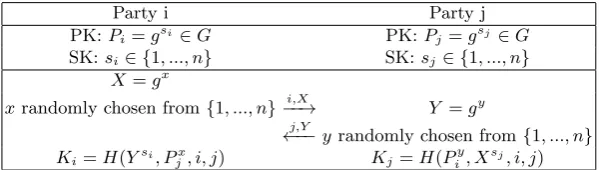
keys of Partyiand Partyj. The specification of KEA is given in Fig. 1, where H is a hash function.
Party i Party j
PK:Pi=gsi ∈G PK:Pj=gsj ∈G
SK:si∈ {1, ..., n} SK:sj∈ {1, ..., n}
X=gx
xrandomly chosen from{1, ..., n}−−→i,X Y =gy j,Y
←−−yrandomly chosen from{1, ..., n}
Ki=H(Ysi, Px
j, i, j) Kj=H(P y i, X
sj, i, j)
Fig. 1.Specification of KEA
As shown in [34], KEA enjoys the advantage of optimal online efficiency. The separation of two exponentiations, which allow off-line pre-computation, makes KEA much more desirable for deployments on low-power devices, such as smart cards and phones over wireless setting. Take Partyias an example, Partyi pre-computesX andPx
j before session starts, wherejis one of the potential parties
which Partyimay communicate with.
rateα, higher security level can be achieved with a smallerqas the security of (ring-)LWE is partially dependent on the ratio ofq andα.
In KEA, the Xsj =gxsj do not reveal any information about s
j evenx is
chosen by adversary. However, it is well-known that the Regev’s encryption [31] is not chosen-ciphertext attack (CCA) secure. This vulnerability was utilized by Ding et al. [15] who show an attack depends on the leakage of signal function [14]. The adversary can extract the static key of target party after 2q queries. But this type of attack is inefficient to our protocol for two reasons: 1) Similar as PKI, the public keys of parties will be updated periodically, and there are no enough queries for adversary to extract the static keys; 2) The signal function in our protocol is probabilistic polynomial time algorithm. It is more difficult for adversary to decide the period of the signal value during the attack.
1.4 Related Works and Our Contributions
The raise of attention to post-quantum cryptography stimulates more construc-tions of lattice-based AKE protocols in the last few years. A passive-secure KE protocol based on (ring-)LWE, which was proposed by Ding et al., is translated from standard Diffie-Hellman protocol [14]. The most significant contribution of Ding’ work is that they proposed the concept of reconciliation mechanism to deal with the errors. Fujioka et al. [17] proposed a generic construction of AKE from CCA secure KEMs, which can be proven secure in the CK+ model. However, their construction was just of theoretic interest. In [18], Fujioka et al. gave a more practical AKE protocol which can be constructed from any one-way CCA secure KEM in the random oracle model. In [30], Peikert presented an efficient key encapsulation mechanism (KEM) based on ring-LWE, and then translated it into an AKE protocol using the SIGMA-style structure. After that, Bos et al. [7] utilized Peikerts KEM as a DH-like KE protocol, and integrated it into the TLS protocol. Strictly speaking, their protocol is not a lattice-based AKE protocol because classical signatures were employed to provide explicit authentication. Alkim et al. [3] then improved the performance of Peikert’s KEM to make the AKE protocol more practical, and their new protocol that called NewHope was applied to the Google’s browser Chrome. It is the first post-quantum AKE pro-tocol adopted by real world. Zhang et al. [35] proposed the first lattice-based implicit AKE whose structure is similar as HMQV. In [21], Jin et al. introduced the notion of key consensus (KC) as a tool and presented generic constructions of KE based on KC.
A rough comparison of lattice-based AKEs is given in Table 1. A more de-tailed comparison between our protocols and the protocol in [35] is showed in Table 2 as they are very similar and are all implicit AKE protocols.
1.5 Organization
Table 1.Comparison of lattice-based AKEs.
Protocols KEM/PKE Signature Message-pass Security Num. of Rings
Fujioka [7] CCA - 2-pass CK+ 7
Fujioka [3] OW-CCA - 2-pass CK+ 7
Peikert [30] CPA EUF-CMA 3-pass SK-security >2(1)
Bos [7] CPA EUF-CMA 4-pass ACCE 2
Alkim [3] CPA EUF-CMA 4-pass - 2 +x(2)
Zhang [35] - implicit 2-pass BR with wPFS 2
Ours - implicit 2-pass BR with wPFS 2
(1)2 ring elements for KEM and more for the concrete lattice-based signatures. (2)
The actual number of ring elements depends on the signature, and it can be a traditional signature, sox≥0
Table 2. Comparison between ours and Zhang’s protocol [35] with 80 bits security. mult. refers to the total number of multiplications over rings.
Protocols n α logqmult. pk sk init. msg resp. msg Zhang [35] 1024 3.397 45 4 5.625 KB 1.5 KB 5.625 KB 5.75 KB
Section 3 1024 3.192 30 3 3.75 KB 0.75 KB 3.75 KB 4 KB Section 4 1024 3.192 30 1 3.75 KB 0.75 KB 3.75 KB 4 KB
for the Internet is considered. In the last section, we analyze the concrete choices of parameters along with the consideration of their security.
2
Preliminaries
2.1 Notation:
Letκbe the security parameter. Bold capital letters denote matrices. Bold low-ercase letters denote vectors. For any integerq, letZq denote the quotient ring
Z/qZ. We usea←rB to denote thatais an element randomly chosen fromB,
where B is a distribution or a finite set. When we say that a function f(x) is negligible, we mean that for everyc >0, there exists aX satisfies:f(x)<1/xc
for allx > X. The statistical distance between two distributions,X andY, over some finite setS is defined as:
∆(X, Y) = 1 2
X
s∈S
|P r(X =s)−P r(Y =s)|.
2.2 Lattice and Gaussian Distributions
A lattice always connects to a matrixB, and it is finitely generated as the integer linear combinations of the column vectors of B={b1, ...,bk}:
L=L(B) ={
n
X
i=1
zibi:zi∈Z}.
The integer n is called the rank of the basis, and it is an invariant of the lat-tice. For any positive integer nand reals >0, define the Gaussian function of parametersas:
ρs(x) =exp(−πkxk/s2).
We define a Gaussian distribution over latticeLas: Ds(x) =ρs(x)/ρs(L).
whereρs(L) =Px∈Lρs(x).
Fact 1 Let χ denote the Gaussian distribution with standard deviation σ and mean zero. Then, for all C >0, it holds that:
P r(e←rχ:|e|> C·σ)≤
2
C√2πexp(−C 2/2).
This fact shows that the samples fromχare around mean with very high prob-ability. Specially, forC= 10, the probability is less than 2−70.
Fact 2 Let x, y ∈ R be two polynomials whose coefficients are distributed ac-cording to a discrete Gaussian distribution with standard deviation σ and τ, respectively. The individual coefficient of the x·y is then normally distributed with standard deviationστ√n, where n is the degree of the polynomial.
Let the integer n be a power of 2. For any positive integer, we define the ring R=Z[x]/(xn+ 1), and R
q =Zq[x]/(xn+ 1). Obviously, the discrete Gaussian
distribution over the ringR can be naturally defined as the distribution of ring elements whose coefficients are distributed according to the discrete Gaussian distribution overZn. Consequently, for anyx∈Rq, we definex←rχαthat we
samplexwhose coefficients are distributed according toχα.
Define Rq as above. For any s ∈ Rq, the ring-LWE distribution As,χ over
Rq ×Rq is sampled by choosinga←rRq at random, choosinge←rχand eis
independent ofa, and outputting (a, b=s·a+e mod q).
Definition 1. LetAs,χbe defined as above. Given m independent samples(ai, bi)
∈ Rq×Rq where every sample is distributed according to either: (1) As,χ for
a uniformly random s←r Rq (fixed for all samples), or (2) the uniform
distri-bution, no PPT algorithm can distinguish, with non-negligible probability, which distribution they are chosen from.
Lemma 1. (Hardness of the Ring-LWE Assumption) Letnbe a power of 2 and αbe a real number in(0,1). LetqandRq be defined as above. Then there exists
a polynomial time quantum reduction fromO(√n/α)−SIV P in the worst case to average-case ring-LW Eq,β, whereβ =αq·(n`=log(n`))1/4.
In [28], Lyubashevsky et al. showed that the ring-LWE assumption still holds even ifsis chosen according to the error distributionχβ rather than uniformly.
2.3 Reconciliation Mechanism
Reconciliation mechanism was first proposed by Ding et al. [14] and later be reconstructed by a series of works [3, 21, 30]. It enables two parties to extract identical information from two “almost” same elements σ1 and σ2 ∈ Zq. In
our protocol, the reconciliation mechanism OKCN [21] is adopted, and a brief description of OKCN is given as follows.
The OKCN consists of two algorithms (Con, Rec) which have parameters q (dominating security and efficiency), m (parameterizing range of consensus key), g (parameterizing bandwidth), andd (parameterizing error rate). Define params= (q, m, g, d, aux) whereaux = (q0 =lcm(q, m), α =q0/q, β =q0/m). The probabilistic polynomial time algorithm Con takes a security parameter (σ1, params = (q, m, g, d)) as input and outputs (k1, ω) where k1 ∈ Zm is the
shared value and ω ∈ Zg is the signal that will be publicly delivered to the
communicating peer. The deterministic algorithmRec, on input (σ2, ω, params), outputs k2 which is identical to k1 with overwhelming probability. The details of OKCN are presented in Algorithm 1.
Algorithm 1Reconciliation Mechanism: OKCN 1: functionCon(σ1, params)
2: e←[−b(α−1)/2c,bα/2c] 3: σA= (ασ1+e)mod q0
4: k1=bσA/βc
5: ω=b(σAmod β)g/βc ∈Zg 6: return(k1, ω)
7: end function
8: functionRec(σ2, ω, params)
9: k2=bασ2/β−(ω+ 1/2)/gemod m
10: returnk2
11: end function
Lemma 2. For OKCN: 1) k1 and ω are independent, and k1 is uniformly distributed over Zm, whenever σ1 ← Zq; 2) If the system parameters satisfy
2.4 Security Model
The BR security model, which is one of the most common models for KE proto-col, is usually strong enough for many practical applications. It was first proposed by Bellare and Rogaway in [4], and later in [6], the BR model was extended to adapt to the public-key setting.
A protocol is a pair of functionsP = (Π,G), whereΠ specifies how parties behave and G generates keys for each party. For an AKE protocol, defineN to be the maximum number of parties in the AKE protocol. Each party is iden-tified by an integer i ∈ {1,2,3, ..., N}. A single run of the protocol is called a session. A session starts with message (ID, I, i, j) or (ID, R, j, i, Xi), whereID
is the identification of the protocol, and I and R stand for the party’s roles. We define session identifier for the session activated by message (ID, I, i, j) as sid= (ID, I, i, j, Xi, Yj) and session identifier for the session activated by
mes-sage (ID, R, j, i, Xi) assid= (ID, R, j, i, Xi, Yj). A session is said to be
complet-ed when its owner successfully computes a session key. The matching session of sid= (ID, I, i, j, Xi, Yj) is the session with identifiersidf = (ID, R, j, i, Xi, Yj).
We adopt the technique in [35] to describe the adversarial capabilities: an adversary, A, is a PPT Turing Machine taking the security parameter 1k as
input. We allowAto make six types of queries to simulate the capabilities ofA in the real world.
– Send0(ID, I, i, j) :Aactivates Partyias an initiator. The oracle returns a messageXi intended for Party j.
– Send1(ID, R, j, i, Xi):Aactivates Partyjas a responder using messageXi.
The oracle returns a messageYj intended for Partyi.
– Send2(ID, R, i, j, Xi, Yj) : A sends Party i the message Yj to complete a
session previously activated by aSend0(ID, I, i, j) query that returnedXi. – SessionKeyReveal(sid) : The oracle returns the session key in the session
sidif it has been generated.
– Corrupt(i): The oracle returns the static secret key of Party i. A party whose key is given toAin this way is called dishonest; a party who does not compromise in this way is called honest.
– T est(sid∗) : The oracle chooses a bit b←r{0,1}. If b= 0, it returns a key
chosen uniformly at random; if b= 1, it returns the session key associated withsid∗. We only allowA to query this oracle once, and only on afresh
sessionsid∗.
Definition 2. (Freshness): Letsid∗= (ID, I, i∗, j∗, Xi, Yj)or(ID, R, j∗, i∗, Xi, Yj)
be a completed session with initiator Party i∗ and responder Party j∗. We say that sid∗ is fresh under the following conditions:
(1) Ahas not made a SessionKeyRevealquery onsid∗.
(2) Ahas not made aSessionKeyReveal query on sid∗’s matching session. (3) Neither Party i∗ nor Party j∗ is dishonest if sid∗’s matching session does
Security Definition: The adversary A can make any sequence of queries to the first five oracles above. After that A can make a query to test on a fresh session. Then Aoutputs a guessb0 forb. We define the advantage of A:
AdvAID=|P r(b0 =b)−1/2|.
Definition 3. (Security): An AKE protocol ID is secure under the following conditions:
(1) Two honest parties get the same session key with overwhelming probability. (2) For any PPT adversaryA,AdvID,Ais negligible.
3
The KEA-style Authenticated Key Exchange
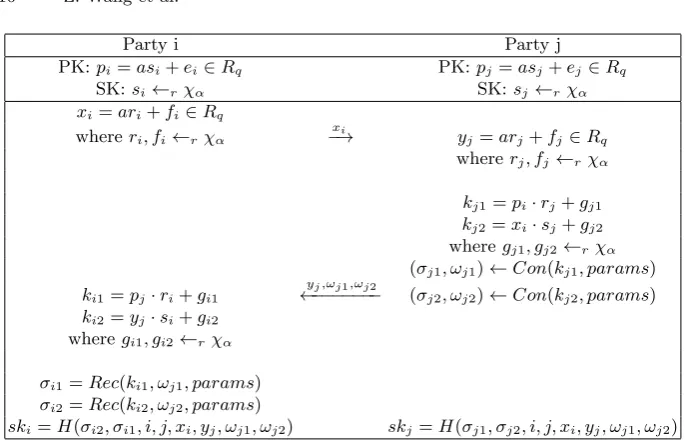
In this section, we describe our protocol in details. Letn be a power of 2. De-fine ring Rq = Zq[x]/(xn+ 1). Let H : {0,1}∗ → {0,1}κ be a hash function
to derive session keys, where κis the length of the session key. In our protocol, this hash function is simulated by a random oracle. Letχαbe a discrete
Gaus-sian distribution with parameter α∈R+. Let a∈R
q be the public parameter
uniformly chosen fromRq. Suppose Party i is the initiator, and Party j is the
responder. Let si ←r χα be the static secret key of Party i, andpi =asi+ei
is the public key of Party i, where ei ←r χα. Similarly,sj ←r χα is the
stat-ic secret key of Partyj, and Partyj’s public key ispj=asj+ej, whereej←rχα.
Initiation:Initiator iproceeds as follows to activate the session: a. Sample ri, fi←rχα, and computexi=ari+fi;
b. Sendxi to Partyj.
Response:After receivingxi from Partyi, Partyj proceeds as follows:
1. Sample rj, fj←rχα, and computeyj=arj+fj;
2. Samplegj1, gj2←rχα, and computekj1=pi·rj+gj1andkj2=xi·sj+gj2;
3. Compute (σj1, ωj1)←Con(kj1, params) and (σj2, ωj2)←Con(kj2, params); 4. Party j derives his session keyskj =H(σj1, σj2, i, j, xi, yj, ωj1, ωj2);
5. Sendyj, ωj1, ωj2 to Partyi.
Finish:After receivingyj, ωj1, ωj2 from Partyj, Partyiproceeds as follows: c. Samplegi1, gi2←rχα, and computeki1=pj·ri+gi1, ki2=yj·si+gi2;
d. Computeσi1=Rec(ki1, ωj1, params) andσi2=Rec(ki2, ωj2, params), then
Party i Party j PK:pi=asi+ei∈Rq PK:pj=asj+ej∈Rq
SK:si←rχα SK:sj←rχα
xi=ari+fi∈Rq whereri, fi←rχα
xi
−→ yj=arj+fj∈Rq whererj, fj←rχα
kj1=pi·rj+gj1
kj2=xi·sj+gj2
wheregj1, gj2←rχα (σj1, ωj1)←Con(kj1, params)
ki1=pj·ri+gi1
yj,ωj1,ωj2
←−−−−−−− (σj2, ωj2)←Con(kj2, params)
ki2=yj·si+gi2
wheregi1, gi2←r χα
σi1=Rec(ki1, ωj1, params)
σi2=Rec(ki2, ωj2, params)
ski=H(σi2, σi1, i, j, xi, yj, ωj1, ωj2) skj=H(σj1, σj2, i, j, xi, yj, ωj1, ωj2)
Fig. 2.Our AKE protocol from ring-LWE
3.1 Analysis of the Protocol
Theorem 1. (Correctness) For appropriately chosen parameters, both parties compute the same session key with overwhelming probability, which meansski=
skj.
Proof. To show ski=skj, it is sufficient to show thatσi1=σj2 andσi2 =σj1 according to the way the session keys are computed. We just need to show that ki1is closed tokj2andki2is closed tokj1. Due to the symmetry, we only estimate the size ofkki2−kj1k.
ki2−kj1= ((arj+fj)si+gi2)−((asi+ei)rj+gj1)
= (fjsi−eirj) + (gi2−gj1). (1)
According to Lemma 2, if kki2−kj1k <
(g−1)q−gm
2gm , we have σi2 = σj1.
Sim-ilarly, we have σi1 = σj2. Here we just need to know if q is big enough, then the inequality can be satisfied. The concrete parameters will be considered in
Section 5.
Theorem 2. (Security) Let n, q, α be defined as above. Let H be a random oracle. If ring-LW Eq,α is hard, then the proposed AKE is secure.
The proof of Theorem 2 appears in Appendix, and a proof sketch is given as follows.
game is computationally indistinguishable with the output in the last game, and AdvIDA of last game is negligible. Here are the basic ideas.
a. (Pi, a) (with secretsi) and (Pj, a) (with secretsj) are ring-LWE pairs. Given
Pi andPj,Acannot get any information aboutsi andsj.
b. (xi, a) (with secretri) and (yj, a) (with secretrj) are ring-LWE pairs. Given
xi andyj,Acannot get any information aboutri andrj.
c. Due to the nice properties of ring-LWE,kj1,kj2, ki1, ki2are randomly dis-tributed inRq.
d. The distribution ofωj1andωj2 reveals no information aboutkj1 andkj2.
These together indicate that the shared session key is secure. That is to say, the session key is uniformly random and independent of the messages exchanged
during the session.
4
Efficient AKE with Pre-Computing
In this section, we consider the pre-computation to make our AKE protocol more efficient for the Internet. As we see, the most inefficient operation in our protocol is the multiplication over a ring. Inspired by KEA, we show that it is possible to pre-compute something off-line in our protocol, which can reduce the number of multiplication over a ring on-line. DefineN is the maximum number of parties, and [N] :={0, ..., N−1}. Letsi ←rχαbe the static secret key of Partyi, and
pi=asi+ei is the public key of Partyi, whereei←rχα. Similarly,sj ←rχαis
the static secret key of Partyj, and Partyj’s public key ispj=asj+ej, where
ej ←rχα. We give the description of our pre-computing version AKE protocol: Off-line: Take Party i as an example. Party i chooses ri, fi ←r χα, and
com-putesxi=ari+fi andk j
i1=pj·ri+gi1for every j∈[N]/i. Partyiholds the TableTi which stores theN values (xi and k
j
i1for j∈[N]/i) computed above. Similarly, forj∈N/i, Partyjexecutes the same as Partyi, and holds its Table Tj.
On-line: Suppose Partyi is a initiator and Partyj is a responder.
Initiation:Partyi proceeds as follows to activate the session: a. Look up the Table Ti forxi.
b. Sendxi to Partyj.
Response:After receivingxi from Partyi, Partyj proceeds as follows:
1. Look up the table Sj foryj;
2. Sample gj1, gj2←rχα, and computekj2=xi·sj+gj2. Look up the Table
Tj forkj1=kji1;
3. Compute (σj1, ωj1)←Con(kj1, params) and (σj2, ωj2)←Con(kj2, params);
4. Party j derives his session keyskj =H(σj1, σj2, i, j, xi, yj, ωj1, ωj2);
Finish:After receivingyj, ωj1, ωj2 from Partyj, Partyiproceeds as follows: c. Samplegi1, gi2←r χα, and computeki2 =yj·si+gi2. Look up the Table
Ti forki1=kji1;
d. Computeσi1=Rec(ki1, ωj1, params) andσi2=Rec(ki2, ωj2, params), then
Partyiderives his session keyski=H(σi2, σi1, i, j, xi, yj, ωj1, ωj2);
In practice, the numberN is not very big. Therefore, the size of Table Ti isN
ring elements, which is small. Table lookups have advantages in efficiency over multiplication over rings. There is only 1 multiplication in our protocol compared with 3 multiplications in the protocol from Section 3 and 4 multiplications in the protocol from [35].
5
Parameters and Conclusions
To maintain the property of correctness, according to the conclusion of Theo-rem 1,kki2−kj1k<
(g−1)q−gm
2gm must be satisfied, that is to say:
(fjsi−eirj) + (gi1−gj1)<
(g−1)q−gm
2gm . (2)
Combine the Fact 1 and Fact 2, with high probability, we have: (fjsi−eirj) + (gi1−gj1)≤(kfjsik+keirjk+kgi1k+kgj1k)
≤(6α2√n+ 6α2√n+ 6α+ 6α) = 12(α2√n+α).
So we have the inequality:
q >24gm(α
2√n+α)
g−1 . (3)
As recommended in [26, 31], it is necessary to set the Gaussian parameterαas:
α≥8/√2π . (4)
To estimate the concrete security of our protocol, we consider the approach of [12], which investigates the two most efficient ways to solve the underlying (ring-)LWE problem, namely the embedding attack and the decoding attack. The embedding attack is more efficient than the decoding attack when the ad-versary only has access to a few samples. In our protocol, the decoding attack is more efficient as mis close to the optimal dimensionpnlg(q)/lg(δ)). Thus we concentrate on the decoding attack.
from [26] or [27]. The output is a set of vectors closed to the target vector. There is a continuous correspondence between the success probability of returning the actual closest vector and the Hermite factor. In our analysis, we follow the ap-proach proposed by Lindner et al. [26] to predict this success probability, and the runtime of lattice reduction algorithm is predicted byT(δ) = 1.8/lg(δ)−110. Above all, the candidates of our parameters are given in Table 3. The size ofskis the value of expectation computed using Fact 1 (sk∈(−10α,10α) with high probability).
Table 3.Candidates of our parameters.
n m g α log qSecurity pk sk init. msg resp. msg |K|
1024 24 21 3.192 32 80 4 KB 0.75 KB 4 KB 4.25KB 2KB 1024 22 21 3.192 24 132 3 KB 0.75 KB 3 KB 3.25 KB 0.5KB 1024 21 21 3.192 18 190 2.25 KB 0.75 KB 2.25 KB 2.5 KB 0.125KB
References
1. Agrawal, S., Boneh, D., Boyen X.: Efficient Lattice (H)IBE in the Standard Model. In: Gilbert H. EUROCRYPT 2010. LNCS, vol. 6110, pp. 553-572. Springer, Berlin, Heidelberg (2010)
2. Aiello, W., Bellovin, S., M., Blaze, M., Canetti, R., Ioannidis, J., Keromytis, A. D., Reingold, O.: Just fast keying: Key agreement in a hostile internet. ACM Trans. Inf. Syst. Secur. 7,2, pp. 242-273 (2004)
3. Alkim, E., Ducas, L., Poppelmann, T., Schwabe, P.: Post-quantum key exchange-a new hope. In: USENIX Security Symposium. pp. 327-343 (2016)
4. Bellare, M., Rogaway, P.: Entity Authentication and Key Distribution. In: Stinson D.R. (eds) CRYPTO 1993. LNCS, vol 773, pp. 232-249. Springer, Berlin, Heidelberg (1993)
5. Berlekamp, E., R., McEliece, R., J., Van Tilborg, H., C.: On the inherent intractabil-ity of certain coding problems. IEEE Transactions on Information Theory, 24.3, pp. 384-386 (1978)
6. Blake-Wilson, S., Johnson, D., Menezes, A.: Key Agreement Protocols and Their Security Analysis. In: Darnell M. (eds). Cryptography and Coding 1997. LNCS, vol 1355, pp. 30-45. Springer, Berlin, Heidelberg (1997)
7. Bos, J., Costello, C., Naehrig, M., Stebila, D.: Post-quantum key exchange for the TLS protocol from the ring learning with errors problem. In: IEEE Symposium on Security and Privacy, pp. 553-570 (2015)
8. Brakerski, Z., Vaikuntanathan, V.: Efficient fully homomorphic encryption from (standard) LWE. SIAM Journal on Computing, 43.2, pp. 831-871 (2014)
10. Canetti, R., Krawczyk, H.: Analysis of key-exchange protocols and their use for building secure channels. In: Pfitzmann B. (eds). EUROCRYPT 2001. LNCS, vol 2045, pp. 453-474. Springer, Berlin, Heidelberg (2001)
11. Cash, D., Hofheinz, D., Kiltz, E., Peikert, C.: Bonsai trees, or how to delegate a lattice basis. Journal of cryptology, 25.4. pp. 601-639 (2012)
12. Dagdelen, O., Bansarkhani, R.E., Gopfert, F., Guneysu, T., Oder, T., Poppelmann, T., Sanchez, A.H., Schwabe, P.: High-speed signatures from standard lattices. In: Aranha D., Menezes A. (eds). LATINCRYPT 2014. LNCS, vol 8895, pp. 84-103. Springer, Cham (2014)
13. Dierks, T., Allen, C.: The TLS protocol version 1.0 (1999)
14. Ding, J., Xie, X., Lin, X.: A Simple Provably Secure Key Exchange Scheme Based on the Learning with Errors Problem.http://eprint.iacr.org/2012/688 15. Ding, J., Alsayigh, S., Saraswathy, R. V., Fluhrer, S., Lin, X.: Leakage of signal
function with reused keys in RLWE key exchange. In Communications (ICC), 2017 IEEE International Conference. IEEE. (2017)
16. Freier, A., Karlton, P., Kocher, P.: The secure sockets layer (SSL) protocol version 3.0 (2011)
17. Fujioka, A., Suzuki, K., Xagawa, K., Yoneyama, K.: Strongly Secure Authenticated Key Exchange from Factoring, Codes, and Lattices. In: Fischlin M., Buchmann J., Manulis M. (eds) Public Key Cryptography C PKC 2012. Lecture Notes in Computer Science, vol 7293. Springer, Berlin, Heidelberg (2012)
18. Fujioka, A., Suzuki, K., Xagawa, K., Yoneyama, K.: Practical and post-quantum authenticated key exchange from one-way secure key encapsulation mechanism. In: ASIACCS 2013, pages 83C94 (2013)
19. Gentry, C., Peikert, C., Vaikuntanathan, V.: Trapdoors for hard lattices and new cryptographic constructions. In Proceedings of the fortieth annual ACM symposium on Theory of computing (STOC ’08). ACM, New York, NY, USA. pp. 197-206 (2008) 20. Jager, T., Kohlar, F., Schage, S., Schwenk, J.: On the security of TLS-DHE in the standard model. In: Safavi-Naini R., Canetti R. (eds). CRYPTO 2012. LNCS, vol 7417, pp. 273-293. Springer, Berlin, Heidelberg (2012)
21. Jin, Z., Zhao, Y.: Optimal Key Consensus in Presence of Noise.http://eprint. iacr.org/2017/1058
22. Kaufman, C.: Internet key exchange (IKEv2) protocol (2005)
23. Krawczyk, H.: HMQV: A high-performance secure Diffie-Hellman protocol. In: Shoup V. (eds). CRYPTO 2005. LNCS, vol 3621, pp. 546-566. Springer, Berlin, Heidelberg (2005)
24. Krawczyk, H.: SIGMA: The ’SIGn-and-MAc’ approach to authenticated Diffie-Hellman and its use in the IKE protocols. In: Boneh D. (eds). CRYPTO 2003. LNCS, vol 2729, pp. 400-425. Springer, Berlin, Heidelberg (2003)
25. Lauter, K., E., Mityagin, A.: Security analysis of KEA authenticated key exchange protocol. In: Yung M., Dodis Y., Kiayias A., Malkin T. (eds). PKC 2006. LNCS, vol 3958, pp. 378-394. Springer, Berlin, Heidelberg (2006)
26. Lindner, R., Peikert, C.: Better key sizes (and attacks) for LWE-based encryption. In: Kiayias A. (eds). CT-RSA 2011. LNCS, vol 6558, pp. 319-339. Springer, Berlin, Heidelberg (2011)
27. Liu M., Nguyen P.Q.: Solving BDD by Enumeration: An Update. In: Dawson E. (eds) Topics in Cryptology C CT-RSA 2013. CT-RSA 2013. Lecture Notes in Computer Science, vol 7779. Springer, Berlin, Heidelberg (2013)
29. Menezes, A., Qu, M., Vanstone, S.: Some new key agreement protocols providing mutual implicit authentication. In: SecondWorkshop on Selected Areas in Cryptog-raphy (1995)
30. Peikert, C.: Lattice cryptography for the internet. In: Mosca M. (eds). PQCrypto 2014. LNCS, vol 8772, 197-219. Springer, Cham (2014)
31. Regev, O.: On lattices, learning with errors, random linear codes, and cryptogra-phy. Journal of the ACM, 56.6, pp. 34 (2009)
32. Saint, E., L., Fedronic, D., Liu, S.: Open Protocol for Access Control Identification and Ticketing with Privacy. OPACITY protocol specification 2011
33. Skipjack, N.: KEA algorithm specifications (1998)
34. Yao, A., C., C., Zhao, Y.: OAKE: A new family of implicitly authenticated Diffie-Hellman protocols. In Proceedings of the 2013 ACM SIGSAC conference on Com-puter and communications security (CCS ’13). ACM, New York, NY, USA, pp. 1113-1128 (2013)
35. Zhang, J., Zhang, Z., Ding, J., Snook, M., Dagdelen, ¨O.: Authenticated Key Ex-change from Ideal Lattices. In: Oswald E., Fischlin M. (eds). EUROCRYPT 2015. LNCS, vol 9057, pp. 719-751. Springer, Berlin, Heidelberg (2015)
Appendix: Proof of Theorem 2
The strategy of our proof is from [35]. First of all, we classify all the adversaries into five types, which give a complete description of all situations. Let M = ploy(n) be the maximum number of sessions for each party. We distinguish the five types of adversaries as:
– TYPE I: sid∗= (ID, I, i∗, j∗, xi∗,(yj∗, ωj∗1, ωj∗2)) is the test session, and
yj∗ is output by a session activated at Partyj∗by aSend1(ID, R, j∗, i∗, xi∗)
query.
– TYPE II:sid∗= (ID, I, i∗, j∗, xi∗,(yj∗, ωj∗1, ωj∗2)) is the test session, and
yj∗is not output by a session activated at Partyj∗by aSend1(ID, R, j∗, i∗, xi∗)
query.
– TYPE III:sid∗= (ID, I, j∗, i∗, xi∗,(yj∗, ωj∗1, ωj∗2)) is the test session, and
xi∗is not output by a session activated at Partyi∗by aSend0(ID, I, i∗, j∗,)
query.
– TYPE IV:sid∗= (ID, I, j∗, i∗, xi∗,(yj∗, ωj∗1, ωj∗2)) is the test session, and
xi∗ is output by a session activated at Party i∗ by a Send0(ID, I, i∗, j∗,)
query, but i∗ either never completes the session, or i∗ completes it with exactyj∗.
– TYPE V: sid∗= (ID, I, j∗, i∗, x
i∗,(yj∗, ωj∗1, ωj∗2)) is the test session, and
xi∗ is output by a session activated at Party i∗ by a Send0(ID, I, i∗, j∗,)
query, buti∗completes the session with anothery,j6=yj∗.
Lemma 3. Let n be a power of 2, q is a prime satisfying q = 1mod2n, real β =ω(αγn√nlog n). Then, if ring-LW Eq,α is hard, the proposed AKE is secure
against any PPT T ypeI adversaryAin the random oracle model.
Proof of Lemma 3:A simulatorSwill be constructed to answer the queries from A. After a sequence of games,Game m for 0≤m≤4, we show that the advantage of A is negligible. In Game0, S executes as the original protocol, while the last game Game4 is a fake one with randomly and independently chosen session key for the test session. The security is established by showing that any two consecutive games are computationally indistinguishable. As any two consecutive games are very similar, we only show the difference between two games by framing them.
Game 0: S uses the original protocol to simulates the security game for A. S choosesi∗,j∗←r{1, ..., N},mi∗, mj∗←r{1, ..., M}, and supposes the sid for the
test session issid∗ = (ID, I, i∗, j∗, xi∗,(yj∗, ωj∗1, ωj∗2)), where xi∗ is output by
themi∗-th session of Partyi∗, andyj∗is output by the mj∗-th session of Party
j∗ activated by a Send1(ID, R, j∗, i∗, xi∗) query. Then, S chooses a ←r Rq,
generates static public keys for all parties. Besides, S maintains a table L for the hash function H to serve as a random oracle. After that, S answers A’s queries as follows:
– H(in): If there does not exist a tuple (in, out) in L, choose an invertible elementout∈χγ at random, and add (in, out) into L. Then, returnout to
A.
– Send0(ID, I, i, j) :Aintends to activate a new session with Party j, and S proceeds as follows:
a. Sampleri, fi←rχα, and computexi=ari+fi;
b. Sendxi to Partyj.
– Send1(ID, R, j, i, xi):S computesskj as follows:
1. Samplerj, fj ←rχα, and computeyj =arj+fj;
2. Sample gj1, gj2 ←r χα, and compute kj1 = pi ·rj +gj1 and kj2 = xi·sj+gj2;
3. Compute (σj1, ωj1)←Con(kj1, params) and (σj2, ωj2)←Con(kj2, params);
4. Partyj derives his session keyskj=H(σj1, σj2, i, j, xi, yj, ωj1, ωj2); 5. Sendyj, ωj1, ωj2to Partyi.
– Send2(ID, I, i, j, xi,(yj, ωj1, ωj2)):S proceeds as follows:
c. Samplegi1, gi2←rχα, and computeki1=pj·ri+gi1,ki2=yj·si+gi2;
d. Computeσi1 =Rec(ki1, ωj1, params) and σi2=Rec(ki2, ωj2, params), then Partyiderives his session keyski=H(σi2, σi1, i, j, xi, yj, ωj1, ωj2); – SessionKeyReveal(sid): After receivingsidfromA,S returnsski if the
session key ofsidhas been generated.
– Corrupt(i): Return the static secret keysi of Party itoA.
– T est(sid): The input of this query issid= (ID, I, i, j, xi,(yj, ωj1, ωj2). After
receivingsidfromA, firstly,Sshould make sure that (i, j) = (i∗, j∗);xiand
yj are output by the mi∗-th session of Party i∗ and the m∗-th session of
Partyj∗ respectively. If not,S aborts. ElseS chooses a random b∈ {0,1}. S returnsski ofsidifb= 1, else returns sk
0
We defineEQU ALi as the event thatAoutputsb∗andb∗=binGame i. Then
we consider the probability thatS will not abort inGame0. Claim 1. P r(Swill not abort) = 1/M2N2.
Proof. i∗andj∗are randomly chosen from{1, ..., N}, andmi∗ andmj∗are
ran-dom chosen from {1, ..., M} byS, which are independently from the view ofA. So the probability that (i, j) = (i∗, j∗), and xi andyj are output by themi∗-th
session of Party i∗ and the m∗-th session of Party j∗ respectively is 1/M2N2.
Game 1: In Game 1, S behaves almost the same as in Game 0, except the computation ofski
– Send2(ID, I, i, j, xi,(yj, ωj1, ωj2)): If (i, j)6= (i∗, j∗), orxi is not thes∗i-th
session ofi∗,Sbehaves the same as inGame2. Else if (yj, ωj1, ωj2) is output
by thes∗j-th session of Partyj∗, S directly setsski=skj and return it toA,
where skj is the session key of sid = (ID, R, j, i, xi,(yj, ωj1, ωj2)). Other-wise, S samples gi1, gi2 ←r χα, and computes ki1 = pj ·ri +gi1, ki2 = yj ·si+gi2. Finally, it computes σi1 = Rec(ki1, ωj1, params) and σi2 = Rec(ki2, ωj2, params), and derivesski=H(σi2, σi1, i, j, xi, yj, ωj1, ωj2).
Claim 2. P r(EQU AL1) =P r(EQU AL0)−negl(κ)
Proof. In the second case, it is just a conceptual change ofGame0 due to the
correctness of the protocol.
We know that yj is output by the s∗j-th session of Party j∗. But we
n-ever know whether (ωj1, ωj2) = (ω0j1, ω0j2). But for convenience, we suppose (ωj1, ωj2) = (ω0j1, ω0j2), and we consider the situation (ωj1, ωj2)6= (ωj01, ωj02) lat-er. We defineQlas the event in GameGame lthat: 1) (yj, ω0j, ω0j2) is output by thes∗j-th session of partyj∗ but (ωj, ωj2)6= (ω0j, ω0j2), and 2)Amakes a query toH that is exactly used to generate the session keyski for thes∗i-th session of
partyi∗.
Game2:S behaves almost the same as inGame1except in the follow case:
– Send0(ID, I, i, j) :If (i, j)6= (i∗, j∗), or it is not thes∗i-th session ofi∗,S
behaves the same as inGame1. Otherwise, S proceeds as follows: a. Sampleri, fi←rχα;
b. Randomly chooses xi←rRq ;
c. Sendxi toA.
– Send1(ID, R, j, i, xi): If (i, j)6= (i∗, j∗), or it is not thes∗j-th session ofj∗,
S behaves the same as inGame2. Otherwise, S computesskj as follows:
1. Randomly chooses yj←rRq ;
3. Compute (σj1, ωj1)←Con(kj1, params) and (σj2, ωj2)←Con(kj2, params);
4. Partyj derives his session keyskj=H(σj1, σj2, i, j, xi, yj, ωj1, ωj2);
5. Sendyj, ωj1, ωj2to Partyi.
– Send2(ID, I, i, j, xi,(yj, ωj1, ωj2)): If (i, j)6= (i∗, j∗), orxi is not thes∗i-th
session ofi∗, or (yj, ωj1, ωj2) is output by the s∗j-th session of Party j∗, S
behaves the same as inGame1. Otherwise, S proceeds as folllows c. Randomly chooseski1, ki2←rRq ;
d. Computeσi1 =Rec(ki1, ωj1, params) and σi2=Rec(ki2, ωj2, params),
then Partyiderives his session keyski=H(σi2, σi1, i, j, xi, yj, ωj1, ωj2);
Claim 3. : If ring-LW Eq,α is hard, we have P r(Q2) = P r(Q1)−negl(κ), and P r(EQU AL2|¬Q2) =P r(EQU AL1|¬Q1)−negl(κ).
Proof. SinceH is a random oracle, the event Qi (i= 1,2) is independent from
the distribution of the corresponding ski. In addition, under the ring-LW Eq,α
assumption, we havexi=ari+fiandyj =arj+fj inGame1 are
computation-ally indistinguishable from uniform distribution overRq, soP r(Q2) =P r(Q1).
SupposeQi (i= 1,2) does not happen,Agains no information aboutskiwhich
meansP r(EQU AL2|¬Q2) =P r(EQU AL1|¬Q1)−negl(κ). Game3:S behaves almost the same as inGame2except in the follow case:
– Send1(ID, R, j, i, xi): If (i, j)6= (i∗, j∗), or it is not thes∗j-th session ofj∗,
S behaves the same as inGame2. Otherwise, S computesskj as follows:
1. Randomly choosesyj←rRq;
2. Randomly chooseskj1, kj2←rRq ;
3. Compute (σj1, ωj1)←Con(kj1, params) and (σj2, ωj2)←Con(kj2, params);
4. Partyj derives his session keyskj=H(σj1, σj2, i, j, xi, yj, ωj1, ωj2);
5. Sendyj, ωj1, ωj2to Partyi.
Claim 4. : If ring-LW Eq,α is hard, we haveGame2andGame3are
compu-tationally indistinguishable. In particular, we haveP r(Q3) =P r(Q2)−negl(κ) andP r(EQU AL3|¬Q3) =P r(EQU AL2|¬Q2)−negl(κ)
Proof. It is easy to identify thatkj1andkj2are ring-LW Eq,αsamples. Under the
ring-LW Eq,α assumption, we havekj1 andkj2 inGame2 are computationally indistinguishable from uniform distribution overRq.
Now it is enough to show that the eventQ3is happen with negligible prob-ability:
Claim 5. We haveP r[Q3] = 2−n+negl(κ).
Proof. Letki1,l andki2,l be the element computed byS for thes∗i-th session at
party i∗ in Game l, and kj1,l and kj2,l be the element computed by S for the
s∗j-th session at partyj∗. By the correctness of the protocol, we have thatki1,1= kj1,1+ ˆg1 and ki2,1 = kj2,1+ ˆg2 for some ˆg1,g2ˆ with small coefficients. As we have proven that the view of the adversary beforeQlhappens is computationally
still holds for some ˆg10,g2ˆ0with small coefficients. InGame3,kj1,3 andkj2,3are randomly chosen from Rq, and under the property of OKCN in Lemma 2, we
have that the adversary makes a query toH that is exactly used to generate the session keyski for thes∗i-th session of partyi∗ is 2−
n+negl(κ).
Claim 6. P r[EQU AL3|¬Q3] = 1/2 +negl()
Proof. Let (yj, ωj1, ωj2) be output by the s∗j-th session of Party j, and j =
j∗. (yj, ω , j1, ω
,
j2) be the message that is used to complete the test session. We conclude the proof by the following two cases:
– ωj = ω ,
j: Since kj1 and kj2 is randomly chosen from Rq, so σj1, σj2 ∈ {0,1}n is random duo to the property of reconciliation mechanism. Thus,
the probability that A has made a query H with the exact (σj1, σj2) is
2−n+negl(κ).
– ωj6=ωj,: According to Claim 5,Awill never make a queryH with the exact
(σj1, σj2).
Combining the Claim 1 to Claim 6, we have that Lemma 3 follows.
Similarly, it’s simple to show that our protocol is security against adversary of TYPE II, TYPE III, TYPE IVandTYPE V. As we know, These five types of adversaries give a complete partition of all the adversaries, it’s sufficient