A Minimum Error Weighting Combination Strategy for Chinese
Semantic Role Labeling
Tao ZhuangandChengqing Zong
National Laboratory of Pattern Recognition Institute of Automation, Chinese Academy of Sciences
{tzhuang, cqzong}@nlpr.ia.ac.cn
Abstract
Many Semantic Role Labeling (SRL) combination strategies have been pro-posed and tested on English SRL task. But little is known about how much Chi-nese SRL can benefit from system combi-nation. And existing combination strate-gies trust each individual system’s output with the same confidence when merging them into a pool of candidates. In our ap-proach, we assign different weights to dif-ferent system outputs, and add a weighted merging stage to the conventional SRL combination architecture. We also pro-pose a method to obtain an appropriate weight for each system’s output by min-imizing some error function on the devel-opment set. We have evaluated our strat-egy on Chinese Proposition Bank data set. With our minimum error weighting strat-egy, theF1 score of the combined result
achieves80.45%, which is 1.12%higher
than baseline combination method’s re-sult, and 4.90% higher than the best
in-dividual system’s result.
1 Introduction
In recent years, Chinese Semantic Role Labeling has received much research effort (Sun and Juraf-sky, 2004; Xue, 2008; Che et al., 2008; Ding and Chang, 2008; Sun et al., 2009; Li et al., 2009). And Chinese SRL is also included in CoNLL-2009 shared task (Hajiˇc et al., CoNLL-2009). On the data set used in (Xue, 2008), theF1 score of the SRL
results using automatic syntactic analysis is still in low 70s (Xue, 2008; Che et al., 2008; Sun et
al., 2009). As pointed out by Xue (Xue, 2008), the SRL errors are mainly caused by the errors in automatic syntactic analysis. In fact, Chinese SRL suffers from parsing errors even more than English SRL, because the state-of-the-art parser for Chinese is still not as good as that for En-glish. And previous research on English SRL shows that combination is a robust and effective method to alleviate SRL’s dependency on pars-ing results (M`arquez et al., 2005; Koomen et al., 2005; Pradhan et al., 2005; Surdeanu et al., 2007; Toutanova et al., 2008). However, the ef-fect of combination for Chinese SRL task is still unknown. This raises two questions at least: (1) How much can Chinese SRL benefit from combi-nation? (2) Can existing combination strategies be improved? All existing combination strate-gies trust each individual system’s output with the same confidence when putting them into a pool of candidates. But according to our intuition, dif-ferent systems have difdif-ferent performance. And the system that have better performance should be trusted with more confidence. We can use our prior knowledge about the combined systems to do a better combination.
use multiple parse trees to generate multiple SRL outputs. Whereas the shallow parsing based sys-tem only produce one SRL output. After merging all SRL outputs, we use greedy and integer lin-ear programming combination methods to com-bine the merged outputs.
We have evaluated our combination strategy on Chinese Propbank data set used in (Xue, 2008) and get encouraging results. With our minimum
error weighting (MEW) strategy, the F1 score
of the combined result achieves 80.45%. This
is a significant improvement over the best re-ported SRL performance on this data set, which is74.12%in the literature (Sun et al., 2009).
2 Related work
A lot of research has been done on SRL combina-tion. Most of them focused on English SRL task. But the combination methods are general. And they are closely related to the work in this paper.
Punyakanok et al. (2004) formulated an Integer Linear Programming (ILP) model for SRL. Based on that work, Koomen et al. (2005) combined sev-eral SRL outputs using ILP method. M`arquez et al. (2005) proposed a combination strategy that does not require the individual system to give a score for each argument. They used a binary clas-sifier to filter different systems’ outputs. Then they used a greedy method to combine the can-didates that pass the filtering process. Pradhan et al. (2005) combined systems that are based on phrase-structure parsing, dependency parsing, and shallow parsing. They also used greedy method when combining different outputs. Surdeanu et al. (2007) did a complete research on a variety of combination strategies. All these research shows that combination can improve English SRL per-formance by 2∼5 points on F1 score. However,
little is known about how much Chinese SRL can benefit from combination. And, as we will show, existing combination strategies can still be im-proved.
3 Individual SRL Systems
3.1 Full Parsing Based System
The full parsing based system utilize full syn-tactic analysis to perform semantic role labeling.
We implemented a Chinese semantic role label-ing system similar to the one described in (Xue, 2008). Our system consists of an argument identi-fication stage and an argument classiidenti-fication stage. In the argument identification stage, a number of argument locations are identified in a sentence. In the argument classification stage, each location identified in the first stage is assigned a semantic role label. The features used in this paper are the same with those used in (Xue, 2008).
Maximum entropy classifier is employed for both the argument identification and classification tasks. And Zhang Le’s MaxEnt toolkit1is used for
implementation.
3.2 Shallow Parsing Based System
The shallow parsing based system utilize shal-low syntactic information at the level of phrase chunks to perform semantic role labeling. Sun et al. (2009) proposed such a system on Chinese SRL and reported encouraging results. The sys-tem used in this paper is based on their approach. For Chinese chunking, we adopted the method used in (Chen et al., 2006), in which chunking is regarded as a sequence labeling task with IBO2 representation. The features used for chunking are the uni-gram and bi-gram word/POS tags with a window of size 2. The SRL task is also re-garded as a sequence labeling problem. For an argument with label ARG*, we assign the label B-ARG* to its first chunk, and the label I-ARG* to its rest chunks. The chunks outside of any argu-ment are assigned the label O. The features used for SRL are the same with those used in the one-stage method in (Sun et al., 2009).
In this paper, we employ Tiny SVM along with Yamcha (Kudo and Matsumoto, 2001) for Chi-nese chunking, and CRF++2for SRL.
3.3 Individual systems’ outputs
The maximum entropy classifier used in full pars-ing based system and the CRF model used in shal-low paring based system can both output classi-fication probabilities. For the full parsing based system, the classification probability of the ar-1http://homepages.inf.ed.ac.uk/lzhang10/maxent toolkit
.html
gument classification stage is used as the argu-ment’s probability. Whereas for the shallow pars-ing based system, an argument is usually com-prised of multiple chunks. For example, an argu-ment with label ARG0 may contain three chunks labeled as: B-ARG0, I-ARG0, I-ARG0. And each chunk has a label probability. Thus we have three probabilities p1, p2, p3 for one argument. In this
case, we use the geometric mean of individual chunks’ probabilities (p1 ·p2 ·p3)1/3 as the
ar-gument’s probability.
As illustrated in Figure 1, in an individual sys-tem’s output, each argument has three attributes: its location in sentence loc, represented by the
number of its first word and last word; its semantic role labell; and its probabilityp.
Sent:
Args: [ ARG0 ] [pred] [ ARG1 ]
loc: (0, 2) (4, 7)
l: ARG0 ARG1
p: 0.94 0.92
Figure 1: Three attributes of an output argument: locationloc, labell, and probabilityp.
So each argument outputted by a system is a triple(loc, l, p). For example, the ARG0 in
Fig-ure 1 is((0,2),ARG0,0.94). Because the outputs
of baseline systems are to be combined, we call such triple acandidatefor combination.
4 Approach Overview
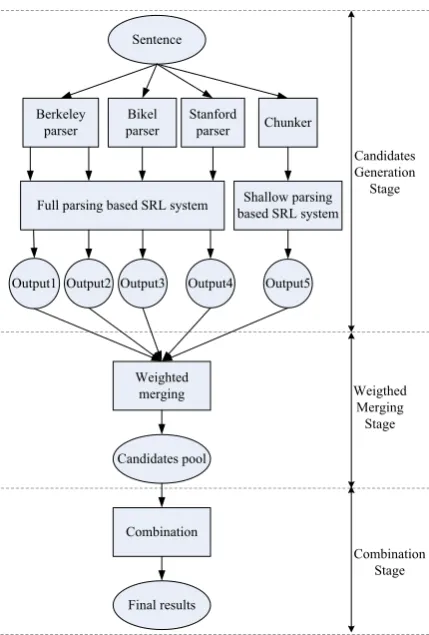
As illustrated in Figure 2, the architecture of our system consists of a candidates generation stage, a weighted merging stage, and a combination stage. In the candidates generation stage, the baseline systems are run individually and their outputs are collected. We use 2-best parse trees of Berkeley parser (Petrov and Klein, 2007) and 1-best parse tree of Bikel parser (Bikel, 2004) and Stanford parser (Klein and Manning, 2003) as inputs to the full parsing based system. The second best parse tree of Berkeley parser is used here for its good quality. So together we have four different out-puts from the full parsing based system. From the shallow parsing based system, we have only one output.
Sentence
Weighted merging
Full parsing based SRL system Shallow parsing based SRL system Berkeley
parser
Bikel parser
Stanford
parser Chunker
Output1 Output2 Output3 Output4 Output5
Candidates pool
Combination
Final results
Candidates Generation Stage
Weigthed Merging Stage
Combination Stage
Figure 2: The overall architecture of our system.
In the weighted merging stage, each system output is assigned a weight according to our prior knowledge obtained on the development set. De-tails about how to obtain appropriate weights will be explained in Section 6. Then all candidates
with the same loc and l are merged to one by
weighted summing their probabilities. Specifi-cally, suppose that there aren system outputs to
be combined, with thei-th output’s weight to be wi. And the candidate in the i-th output withloc
andlis(loc, l, pi)(If there is no candidate withloc
andlin thei-th output,pi is 0.). Then the merged
candidate is(loc, l, p), wherep=Pni=1wipi.
5 Combination Methods
5.1 Global constraints
When combining the outputs, two global con-straints are enforced to resolve the conflict be-tween outputs. These two constraints are:
1. No duplication: There is no duplication for
key arguments: ARG0∼ARG5.
2. No overlapping: Arguments cannot overlap with each other.
We say two argument candidatesconflictwith each other if they do not satisfy the two constraints above.
5.2 Two combination methods
Under these constraints, two methods are explored to combine the outputs. The first one is a greedy method. In this method, candidates with probabil-ity below a threshold are deleted at first. Then the remaining candidates are inspected in descending order according to their probabilities. And each candidate will be put into a solution set if it does not conflict with candidates already in the set. This greedy combination method is very simple and has been adopted in previous research (Prad-han et al., 2005; M`arquez et al., 2005).
The second combination method is integer lin-ear programming (ILP) method. ILP method was first applied to SRL in (Punyakanok et al., 2004). Here we formulate an ILP model whose form is different from the model in (Punyakanok et al., 2004; Koomen et al., 2005). For convenience, we denote the whole label set as{l1, l2, . . . , ln}. And
letl1∼l6stand for the key argument labels ARG0
∼ARG5 respectively. Suppose there arem differ-ent locations, denoted as loc1, . . . , locm, among
all candidates in the pool. And the probability of assigninglj tolociispij. A binary variablexij is
The objective of the ILP model is to maximize the sum of arguments’ probabilities:
max
where T is a threshold to prevent including too
many candidates in solution. T is similar to the
threshold in greedy combination method. In this paper, both thresholds are empirically tuned on development data, and both are set to be0.2.
The inequalities in equation (2) make sure that eachlocis assigned at most one label.
∀1≤i≤m:
n
X
j=1
xij ≤1 (2)
The inequalities in equation (3) satisfy the No duplicationconstraint.
For any location loci, let Ci denote the index
set of the locations that overlap with it. Then the No overlappingconstraint means that if loci
is assigned a label, i.e.,Pn
j=1xij = 1, then for
any k ∈ Ci, lock cannot be assigned any label,
i.e.,Pn
j=1xkj = 0. A common technique in ILP
modeling to form such a constraint is to use a suf-ficiently large auxiliary constantM. And the
con-straint is formulated as:
∀1≤i≤m: X In this case, M only needs to be larger than the number of candidates to be combined. In this pa-per, M = 500is large enough. And we employ
lpsolve3to solve the ILP model.
Note that the form of the ILP model in this paper is different from that in (Punyakanok et al., 2004; Koomen et al., 2005) in three as-pects: (1) A special label classnull, which means no label is assigned, was added to the label set in (Punyakanok et al., 2004; Koomen et al., 2005). Whereas no such special class is needed in our model, because if no label is assigned to loci,
Pn
j=1xij = 0 would simply indicate this case.
This makes our model contain fewer variables. (2) Without null class in our model, we need to use a different technique to formulate the No-overlapping constraint. (3) In order to compare
with the greedy combination method, the ILP model in this paper conforms to exactly the same constraints as the greedy method. Whereas many more global constraints were taken into account in (Punyakanok et al., 2004; Koomen et al., 2005).
6 Train Minimum Error Weights
The idea of minimum error weighting is straight-forward. Individual outputs O1, O2, . . . , On
are assigned weightsw1, w2, . . . , wnrespectively.
These weights are normalized, i.e.,Pn
i=1wi = 1.
An output’s weight can be seen as the confidence we have in that output. It is a kind of prior knowl-edge we have about that output. We can gain this prior knowledge on the development set. As long as the data of the development set and the test set are similar, this prior knowledge should be able to help to guide SRL combination on test set. In this section, we discuss how to obtain appropriate weights.
6.1 Training model
Suppose the golden answer and SRL result on de-velopment set aredandrrespectively. Anerror functionEr(r, d)is a function that measures the
error contained in r in reference to d. An error function can be defined as the number of wrong arguments inr. It can also be defined using
preci-sion, recall, orF1score. For example,Er(r, d) =
1−P recision(r, d), orEr(r, d) = 1−F1(r, d).
Smaller value of error function means less error in
r.
The combination process can also be seen as a function, which maps the outputs and weights to the combined result r: r = Comb(On
1, wn1).
Therefore, the error function of our system on de-velopment set is:
Er(r, d) =Er(Comb(O1n, w1n), d) (5)
From equation (5), it can be seen that: Given de-velopment setd, if the outputs to be combinedO1n
and the combination methodCombare fixed, the error function is just a function of the weights. So we can obtain appropriate weights by minimizing the error function:
ˆ
w1n= arg min
wn
1
Er(Comb(On1, wn1), d) (6)
6.2 Training algorithm
Algorithm 1Powell Training Algorithm. 1:Input: Error functionEr(w). 2: Initializendirectionsd1, . . . ,dn, and
a start pointwinRn.
3: Set termination thresholdδ.
4:do:
5: w1 ←w
6: fori←1, . . . , n:
7: αi ←arg min
α f(wi+αdi)
8: wi+1 ←wi+αidi
9: dn+1←wn+1−w
10: α∗←arg min
α f(w+αdn+1)
11: w0 ←w+α∗dn+1
12: ∆Er←Er(w)−Er(w0)
13: i←arg max
1≤j≤nEr(wj)−Er(wj+1)
14: if(α∗)2
≥ Er(wi)∆−ErEr(wi+1): 15: forj ←i, . . . , n:
16: dj ←dj+1
17: w←w0
18:while∆Er > δ
19:Output: The minimum error weightsw.
There are two difficulties to solve the optimiza-tion problem in equaoptimiza-tion 6. The first one is that the error function cannot be written to an
analyt-ical form. This is because the Comb function,
which stands for the combination process, cannot be written as an analytical formula. So the prob-lem cannot be solved using canonical gradient-based optimization algorithms, because the gradi-ent function cannot be derived. The second diffi-culty is that, according to our experience, the er-ror function has many local optima, which makes it difficult to find a global optima.
To resolve the first difficulty, Modified Powell’s method (Yuan, 1993) is employed to solve the op-timization problem. Powell’s method is a heuris-tic search method that does not require the objec-tive function to have an explicit analytical form. The training algorithm is presented in Algorithm 1. In Algorithm 1, the line search problem in steps 7 and 10 is solved using Brent’s method (Yuan, 1993). And the temination thresholdδ is
To resolve the second difficulty, we perform multiple searches using different start points, and then choose the best solution found.
7 Experiments
7.1 Experimental setup
We use Chinese Proposition Bank (CPB) 1.0 and Chinese Tree Bank (CTB) 5.0 of Linguistic Data Consortium corpus in our experiments. The train-ing set is comprised of 648 files(chtb 081.fid to chtb 885.fid). The development set is comprised of 40 files(chtb 041.fid to chtb 080.fid). The test set is comprised of 72 files(chtb 001.fid to chtb 040.fid and chtb 900.fid to chtb 931.fid).
The same data setting has been used in (Xue, 2008; Ding and Chang, 2008; Sun et al., 2009). Sun et al. (2009) used sentences with golden seg-mentation and POS tags as input to their SRL system. However, we use sentences with only golden segmentation as input. Then we perform automatic POS tagging using Stanford POS tag-ger (Toutanova et al., 2003). In (Xue, 2008), the parser used by the SRL system is trained on the training and development set plus 275K words of broadcast news. In this paper, all parsers used by the full parsing based system are trained on the training set plus the broadcast news portion of CTB6.0. And the chunker used in the shallow parsing based system is trained just on the training set.
7.2 Individual outputs’ performance
In this paper the four outputs of the full parsing
based system are represented by FO1∼FO4
re-spectively. Among them, FO1 and FO2 are the outputs using the first and second best parse trees of Berkeley parser, FO3 and FO4 are the outputs using the best parse trees of Stanford parser and Bikel parser respectively. The output of the shal-low parsing based system is represented by SO. The individual outputs’ performance on develop-ment and test set are listed in Table 1.
From Table 1 we can see that the performance of individual outputs are similar on development set and test set. On both sets, the F1 scores of
individual outputs are in the same order: FO1 >
FO2>SO>FO3>FO4.
Data set Outputs P(%) R(%) F1 FO1 79.17 72.09 75.47
FO2 77.89 70.56 74.04
development FO3 72.57 67.02 69.68
FO4 75.60 63.45 69.00
SO 73.72 67.35 70.39
FO1 80.75 70.98 75.55
FO2 79.44 69.37 74.06
test FO3 73.95 66.37 70.00
FO4 75.89 63.26 69.00
SO 75.69 67.90 71.59 Table 1: The results of individual systems on de-velopment and test set.
7.3 Combining outputs of full parsing based system
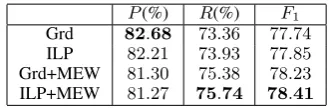
In order to investigate the benefit that the full parsing based system can get from using multi-ple parsers, we combine the four outputs FO1∼ FO4. The combination results are listed in Ta-ble 2. In taTa-bles of this paper, “Grd” and “ILP” stand for greedy and ILP combination methods re-spectively, and “+MEW” means the combination is performed with MEW strategy.
P(%) R(%) F1 Grd 82.68 73.36 77.74
ILP 82.21 73.93 77.85
Grd+MEW 81.30 75.38 78.23
ILP+MEW 81.27 75.74 78.41
Table 2: The results of combining outputs of full parsing based system on test set.
Er FO1 FO2 FO3 FO4 Grd 1−F1 0.31 0.16 0.30 0.23
ILP 1−F1 0.33 0.10 0.27 0.30 Table 3: The minimum error weights for the re-sults in Table 2.
From Table 2 and Table 1, we can see that, with-out MEW strategy, theF1 score of combination
result is about2.3%higher than the best
individ-ual output. With MEW strategy, the F1 score is
improved about0.5%further. That is to say, with MEW strategy, the benefit of combination is im-proved by about 20%. Therefore, the effect of
MEW is very encouraging.
Here the error function for MEW training is chosen to be 1 − F1. And the trained weights
separately. In tables of this paper, the columnEr
corresponds to the error function used for MEW strategy.
7.4 Combining all outputs
We have also combined all five outputs. The sults are listed in Table 4. Compared with the re-sults in Table 2, we can see that the combination results is largely improved, especially the recall.
P(%) R(%) F1 Grd 83.64 75.32 79.26
ILP 83.31 75.71 79.33
Grd+MEW 83.34 77.47 80.30
ILP+MEW 83.02 78.03 80.45
Table 4: The results of combining all outputs on test set.
From Table 4 and Table 1 we can see that with-out MEW strategy, the F1 score of combination
result is about 3.8%higher than the best
individ-ual output. With MEW, theF1score is improved
further by more than 1%. That means the bene-fit of combination is improved by over25%with
MEW strategy.
Here the error function for MEW training is still
1−F1, and the trained weights are listed in
Ta-ble 5.
Er FO1 FO2 FO3 FO4 SO Grd 1−F1 0.23 0.12 0.23 0.20 0.22
ILP 1−F1 0.24 0.08 0.22 0.21 0.25 Table 5: The minimum error weights for the re-sults in Table 4.
7.5 Using alternative error functions for minimum error weights training
In previous experiments, we use 1−F1 as error
function. As pointed out in Section 6, the def-inition of error function is very general. So we have experimented with two other error functions, which are 1−P recision, and1−Recall.
Ob-viously, these two error functions favor precision and recall separately. The results of combining all five outputs using these two error functions are listed in Table 6, and the trained weights are listed in Table 7.
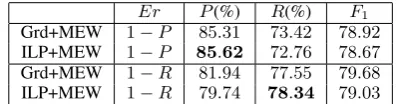
From Table 6 and Table 4, we can see that when
1−P recison is used as error function, the
pre-Er P(%) R(%) F1 Grd+MEW 1−P 85.31 73.42 78.92
ILP+MEW 1−P 85.62 72.76 78.67
Grd+MEW 1−R 81.94 77.55 79.68
ILP+MEW 1−R 79.74 78.34 79.03 Table 6: The results of combining all outputs with alternative error functions.
Er FO1 FO2 FO3 FO4 SO Grd 1−P 0.25 0.24 0.22 0.22 0.07
ILP 1−P 0.30 0.26 0.20 0.15 0.09
Grd 1−R 0.21 0.10 0.17 0.15 0.37
ILP 1−R 0.24 0.04 0.10 0.22 0.39 Table 7: The minimum error weights for the re-sults in Table 6.
cision of combination result is largely improved. But the recall decreases a lot. Similar effect of the error function1−Recallis also observed.
The results of this subsection reflect the flex-ibility of MEW strategy. This flexflex-ibility comes from the generality of the definition of error func-tion. The choice of error function gives us some control over the results we want to get. We can define different error functions to favor precision, or recall, or some error counts such as the number of misclassified arguments.
7.6 Discussion
In this paper, the greedy and ILP combination methods conform to the same simple constraints specified in Section 5. From the experiment results, we can see that ILP method generates slightly better results than greedy method.
In Subsection 7.4, we see that combining all outputs using ILP method with MEW strategy yields4.90% improvement onF1 score over the
best individual output FO1. In order to under-stand each output’s contribution to the improve-ment over FO1. We compare the differences be-tween outputs.
LetCO denote the set of correct arguments in
an outputO. Then we get the following statistics
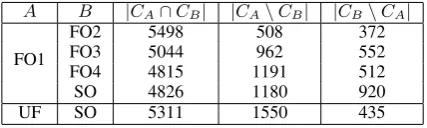
when comparing two outputs A and B: (1) the
number of common correct arguments in A and
B, i.e.,|CA∩CB|; (2) the number of correct
ar-guments inAand not inB, i.e.,|CA\CB|; (3) the
number of correct arguments inB and not in A,
some outputs on test set are listed in Table 8. In this table, UF stands for the union of the 4 outputs
FO1∼FO4.
A B |CA∩CB| |CA\CB| |CB\CA|
FO2 5498 508 372
FO3 5044 962 552
FO4 4815 1191 512
FO1
SO 4826 1180 920
UF SO 5311 1550 435
Table 8: Comparison between outputs on test set.
From Table 8 we can see that the output SO has 4826 common correct arguments with FO1, which is relatively small. And, more importantly, SO contains 920 correct arguments not in FO1, which is much more than any other output con-tains. Therefore, SO is more complementary to FO1 than other outputs. On the contrary, FO2 is least complementary to FO1. Even compared with
the union of FO1 ∼ FO4, SO still contains 435
correct arguments not in the union. This shows that the output of shallow parsing based system is a good complement to the outputs of full parsing based system. This explains why recall is largely improved when SO is combined in Subsection 7.4. From the analysis above we can also see that the weights in Table 5 are quite reasonable. In Ta-ble 5, SO is assigned the largest weight and FO2 is assigned the smallest weight.
In Subsection 7.3, the MEW strategy improves the benefit of combination by about20%. And in
Subsection 7.4, the MEW strategy improves the benefit of combination by over25%. This shows
that the MEW strategy is very effective for Chi-nese SRL combination.
To our best knowledge, no results on Chinese SRL combination has been reported in the litera-ture. Therefore, to compare with previous results, the top two results of single SRL system in the literature and the result of our combination sys-tem on this data set are listed in Table 9. For the results in Table 9, the system of Sun et al. uses sentences with golden POS tags as input. Xue’s system and our system both use sentences with automatic POS tags as input. The result of Sun et al. (2009) is the best reported result on this data set in the literature.
POS P(%) R(%) F1 (Xue, 2008) auto 76.8 62.5 68.9
(Sun et al., 2009) gold 79.25 69.61 74.12
Ours auto 83.02 78.03 80.45
Table 9: Previous best single system’s results and our combination system’s result on this data set.
8 Conclusions
In this paper, we propose a minimum error weighting strategy for SRL combination and in-vestigate the benefit that Chinese SRL can get from combination. We assign different weights to different system outputs and add a weighted merg-ing stage to conventional SRL combination sys-tem architecture. And we also propose a method to train these weights on development set. We evaluate the MEW strategy on Chinese Propbank data set with greedy and ILP combination meth-ods.
Our experiments have shown that the MEW strategy is very effective for Chinese SRL combi-nation, and the benefit of combination can be im-proved over25%with this strategy. And also, the
MEW strategy is very flexible. With different def-initions of error function, this strategy can favor precision, or recall, orF1 score. The experiments
have also shown that Chinese SRL can benefit a lot from combination, especially when systems based on different syntactic views are combined. The SRL result with the highestF1 score in this
paper is generated by ILP combination together with MEW strategy. In fact, the MEW strategy is easy to incorporate with other combination meth-ods, just like incorporating with the greedy and ILP combination methods in this paper.
Acknowledgment
References
Daniel Bikel. 2004. Intricacies of Collins Parsing Model. Computational Linguistics, 30(4):480-511.
Wanxiang Che, Min Zhang, Ai Ti Aw, Chew Lim Tan, Ting Liu, and Sheng Li. 2008. Using a Hybrid Con-volution Tree Kernel for Semantic Role Labeling.
ACM Transactions on Asian Language Information Processing, 2008, 7(4).
Wenliang Chen, Yujie Zhang, and Hitoshi Isahara. 2006. An empirical study of Chinese chunking. In
Proceedings of COLING/ACL-2006.
Weiwei Ding and Baobao Chang. 2008. Improving Chinese Semantic Role Classification with Hierar-chical Feature Selection Strategy. InProceedings of EMNLP-2008.
Jan Hajiˇc, Massimiliano Ciaramita, Richard Johans-son, Daisuke Kawahara, Maria Ant`onia Mart´ı, Llu´ıs M`arquez, Adam Meyers, Joakim Nivre, Sebastian Pad´o, Jan ˇStˇep´anek, Pavel Straˇn´ak, Mihai Surdeanu, Nianwen Xue and Yi Zhang. 2009. The CoNLL-2009 Shared Task: Syntactic and Semantic Depen-dencies in Multiple Languages. In Proceedings of CoNLL-2009.
Dan Klein and Christopher D. Manning. 2003. Accu-rate unlexicalized parsing. InProceedings of ACL-2003.
Peter Koomen, Vasin Punyakanok, Dan Roth, and Wen-tau Yih. 2005. Generalized Inference with Multiple Semantic Role Labeling Systems. In Pro-ceedings of CoNLL-2005 shared task.
Taku Kudo and Yuji Matsumoto. 2001. Chunking with Support Vector Machines. In Proceedings of NAACL-2001.
Junhui Li, Guodong Zhou, Hai Zhao, Qiaoming Zhu, and Peide Qian. 2009. Improving Nominal SRL in Chinese Language with Verbal SRL Information and Automatic Predicate Recognition. In Proceed-ings of EMNLP-2009.
Llu´ıs M`arquez, Mihai Surdeanu, Pere Comas, and Jordi Turmo. 2005. A Robust Combination Strat-egy for Semantic Role Labeling. InProceedings of EMNLP-2005.
Slav Petrov and Dan Klein. 2007. Improved Inference for Unlexicalized parsing. InProceedings of ACL-2007.
Sameer S. Pradhan, Wayne Ward, Kadri Hacioglu, James H. Martin, and Daniel Jurafsky. 2005. Se-mantic Role Labeling Using Different Syntactic Views. InProceedings of ACL-2005.
Vasin Punyakanok, Dan Roth, Wen-tau Yih, and Dav Zimak. 2004. Semantic Role Labeling via Integer Linear Programming Inference. InProceedings of COLING-2004.
Honglin Sun and Daniel Jurafsky. 2004. Shallow semantic parsing of Chinese. In Proceedings of NAACL-2004.
Weiwei Sun, Zhifang Sui, Meng Wang, and Xin Wang. 2009. Chinese Semantic Role Labeling with Shal-low Parsing. InProceedings of EMNLP-2009.
Mihai Surdeanu, Llu´ıs M`arquez, Xavier Carreras, and Pere R. Comas. 2007. Combination Strategies for Semantic Role Labeling. Journal of Artificial Intel-ligence Research (JAIR), 29:105-151.
Kristina Toutanova, Aria Haghighi, and Christopher D. Manning. 2008. A Global Joint Model for Se-mantic Role Labeling. Computational Linguistics, 34(2): 145-159.
Kristina Toutanova, Dan Klein, Christopher Manning, and Yoram Singer. 2003. Feature-Rich Part-of-Speech Tagging with a Cyclic Dependency Net-work. InProceedings of HLT-NAACL-2003.
Nianwen Xue. 2008. Labeling Chinese Predicates with Semantic Roles. Computational Linguistics, 34(2): 225-255.