9
Comparative Study Of Various Image Compression
Algorithms: A Review
Ms. S.A.Pachare
1, Prof. S.S.Thakare
2Electronics engineering1,2,P.G.Scholar1 Assistant Professor2 Email: [email protected]1 ,[email protected]2
Abstract-.Compression of image is a technique that is used to recognize internal data redundancy and to signify its compact representation. Compression of image is a necessary and effective topic of research in the image processing domain. Earlier used algorithms for image compression, like JPEG and JPEG2000, depend on the block diagram of encoder/decoder. The fixed transform matrixes like wavelet transform and discrete cosine transform (DCT) [11], together with quantization and entropy coder are used to compress the image. However, they are not expected to be an optimal and flexible image coding solution for all types of image content and image formats [11]. A compression of image is important in the applications image processing like storing of data, classification of image, recognition of image etc. Then, diverse research articles have proposed to retain the topics of image compression. However deep learning has much potential to enhance the performance in various tasks of computer vision. Therefore, the review is to study and demonstrate the image compression algorithm using the deep learning.
Keywords- image compression, image processing, deep learning.
1. INTRODUCTION
The most important role of image compression is in the sending and space requires in storing the images and data. Usually the data related with visual information is so large that its storage requires huge memory and its transmission requires high bandwidths. Image compression means effectively coding of digital images to minimize the bits desired to show an image. This compression enables image transmission at very low bandwidths and decreases the space needed for storage of this data.
The image compression is divided into two types lossy and lossless compression algorithms. A lossless compression algorithm reproduced the original image completely same without loss of any information. The lossless compression has applications in where loss of data is undesirable, for example, text data and medical images. In the lossy compression the reproduced image is not like the original image. Certain information is vanished in the coding process. These algorithms provide a way of trade-off among the image quality and the amount of compression. The objective is to attain more compression without much declination in image quality. Motivation obtained by the latest research in deep learning based compression of image methods which shows great improvements in quality of image, savings in storage, and bandwidth reduction. And it is well establishes from 2006, where lots of stages of non-linear processing of information in categorized architectures are utilized for pattern classification and for feature learning.
2. SURVEY ON IMAGE COMPRESSION
TECHNIQUES
Image compression is done by using various algorithms which define below.
2.1. Compression artifacts reduction by
convolutional network
In paper [3] the author proposed the compression artifacts like blocking artifacts, ringing effect, blurring which occurred due to traditional image compression method like JPEG compression are removed using deep convolutional network. To date deep leaning has shown magnificent outcomes on both high and low level vision problems. Firstly SR-CNN is proposed, however the SR-CNN is a 3 layer network is not convenient approach in restoring the compressed images. So to remove the undesired artifacts SR-CNN is made up of submerging more than one feature enhancement layers afterward the first layer for cleaning the noisy features improved model named as artifacts reduction convolutional neural network exceptionally effective in reducing blocking artifacts while keeping edge pattern and sharp details. The network has four convolutional layers, each layer have a specific operation. The layers are extraction of feature, enhancement of feature, mapping and reconstruction.
2.2. Image compression algorithm with
auto-encoder using deep neural network
The aim of the paper [1] is to obtain the low dimensional image for the application such as image classification, visualization, communications, and storage of the data of high dimension. The proposed algorithm consists of five parts: 1. raw image dataset 2. image compression with auto-encoder algorithm 3. compressed image output 4. image decoding 5. decoded image.
10
2. Proposed image compression algorithm: The proposed image compression algorithm not only reduces the dimensionality but also automatically encode the image by using deep neural network algorithm. The construction of this DNN is done with the help of non-recurrent three layer neural network that trains the weights until reaching the optimal hidden neurons. This non-recurrent three layer network is used to train the data.
3. Compressed image output: The compressed image output with good quality depends on the quantity of non-recurrent three layer neural network. So the algorithm might use many units of non-recurrent three layer neural network to acquire lower image dimensionality.
4. Image decoding: The compressed image output with auto-encoder will be decoded by multilayer feed- forward neural network [1].
2.3.Lossless compression of curated erythrocyte
images using deep auto-encoder for malaria infection diagnosis
In paper [2] the author proposed the extraction of region of interest from whole slide image and achieved high lossless compression on interested region which is typically blood cells which are red in the case of malaria diagnosis. They show that infected cells are varies from normal cells, in that infected cells have the purple ring from characteristics of a parasite being present. Therefore this is a similar characteristics having all cells which are infected can be learned automatically, then they eliminate the redundancy of the inter-image to again enhance compression performance for this sake they consider deep learning technique.
Methodology: Stacked auto-encoder and their variants are essence artificial neural network that accomplish unsupervised learning on the input data. In encoding phase, learning of low- dimensional representations of the input data is done through training the neural network. After that these learned representation are used to reconstruct the original data. A deep neural network can be constructed by concatenating multiple auto-encoders. Stacked auto-encoder considers the non- linearity of image data and is capable of extracting features in a hierarchical manner. All these properties allow for very large dimensionality reduction of input image, while preserving will be discriminative features.
The stacked auto-encoder use the set of images mixed with non-infected and infected cells [2]. But this alternative scheme gives lower compression. Hence the separate coding scheme for infected and non-infected cells of stacked auto-encoder is used. This separate coding scheme is expected since cells having related features of the similar class perhaps learned easily by stacked auto-encoder. For comparison three lossless compression methods are applied on test images which are JP2K-LM, JPEG-LS and CALIC [2]. This comparison shows that stacked auto-encoder gives good compression performance.
2.4.A remote sensing image compression
method suited to space born application
In paper [5] the author proposed the method of compression scheme based on overlap blocks and gives the solution on the problem of big size remote sensing image which taking up large cache. In most of the algorithm for compression of images like remote sensing image, the method that combines SPIHT with DPCM has advantages such as high compression efficiency, high image restoration quality and moderate speed but the algorithm requires the whole image or a large image block as processing unit, which needs a large amount of memory, unfavorable to space-borne application of the algorithm. Three methods are used:
1. Lifting wavelet transform 2. Overlapping block technology 3. Encoding algorithm of blocked image
2.5.Reducing the dimensionality of data with neural network
In paper [6] the author proposed the method for dimensionality reduction is principal component analysis which used an adaptive multilayer encoder network to transform data of high-dimensional into a code of low dimensional and decoder network to retrieve the data from code. But it is tough to optimize weights in non-linear auto-encoder that have multilayer hidden layer. Therefore an ensemble of images can be modeled using two layer network called RBM. The two layers are visible units and hidden units. Where pixels corresponds to RBM’s visible units for the reason that their states were observe, the features detectors corresponds to hidden units. Three steps are done in neural network first is pre-training, second is unrolling and third is fine tuning used by back- propagation of error derivative [6].
2.6.Towards image understanding from deep
compression without decoding
11
2.7.Application of deep belief network in image
semantic analysis and lossy compression for transmission
In paper [7] the author proposed a method of deep machine learning and their application in reduction of dimension and compression which is lossy. There is present a compatible and well formulated mathematical model describing how DBN’s work. For learning presented training sets with or without a supervisor like adaptive system are used. The knowledge acquired in this manner is used to classify hand-written digits, stored in a database; then compress and shape the explored, abstract information for the transmission purposes.
2.8.Image compression: wavelet transform
using radial basis function (RBF) neural network
In paper [8] the proposed methodology is depend on the fusion of wavelet and vector quantization and wavelet for image compression. A compression of image based on fusion of wavelet transform and vector quantization is proposed by using RBF neural network.
The whole process of compression is divided into following steps,
a) generation of Codebook (training stage) b) the original image encoding and c) image decoding
2.9.Compression technique on MR image-a
comparative study
In paper [10] the author proposed eight compression algorithms were compare on 200 and more MR images for the evaluation of quality and also the performance of it.
[image:3.595.97.503.564.763.2]Five performance metrics are considered to compute the performance of each compression technique viz. compressed file size, mean square error (MSE), compression ratio, peak signal to noise ratio (PSNR), and mean structure similarity index metrics (MSSIM) [10].
Various compression techniques are as follows: 1. Wavelet based compression using sub-band coding 2. Wavelet based compression using level dependent threshold
3. Wavelet based compression using set partition in hierarchical tree method
4. Singular value decomposition 5. Discrete cosine transform 6. Vector quantization 7. Neural network
8. Block truncation coding
2.10. Image compression using artificial neural network
In paper [9] the author proposed a compressing of image algorithm based on of back propagation network is developed which is used once image pre-processing is done. Firstly the image acquisition is done after that segmentation and pre- processing of image is done. In which the image is broken into sub images i.e 2-D images are converted to 1-D images and this images fed to neural network. The next step is preparation of training pair in which paradigm test images are identified and exclusion of similar training pair is done. The next step is the compression of image with artificial neural network trained by back propagation algorithm. The last stage is the image reconstruction i.e decompression. This image compression technique gives promising results than conventional transform based compression technique.
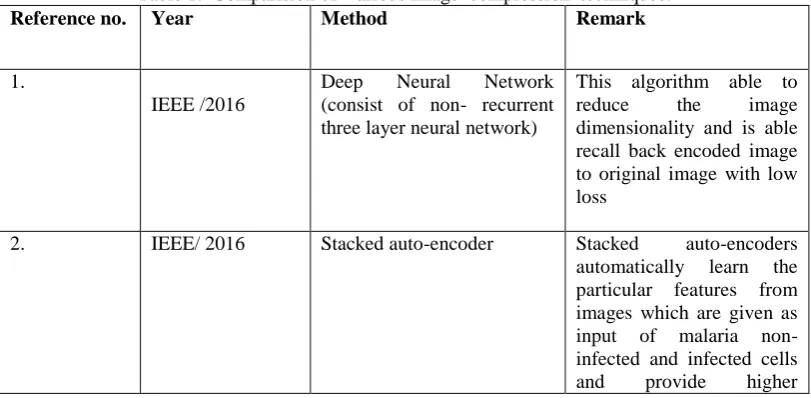
3. TABLE
There are lots of improvements up to latest dated in the field of image compression techniques. As move towards the next techniques there are some advantages over the previous one and also some drawbacks of the previous method are tried to remove in the next upcoming method. The comparison of the image compression algorithms given in the following table:
Table 1. Comparision of various image compression techniques.
Reference no. Year Method Remark
1.
IEEE /2016
Deep Neural Network (consist of non- recurrent three layer neural network)
This algorithm able to reduce the image dimensionality and is able recall back encoded image to original image with low loss
12
compression.
3. IEEE/ 2015 Artifacts reduction
convolutional neural network
Effective in dealing with various compression artifacts
4. ICLR /2018 Convolutional auto-encoder The combine training of compression and inference DNN models gives synergistic improvements in both compression
quality and
Classification/segmentation accuracy.
5. IEEE/ 2011 Lifting scheme and overlap blocking technique
The proposed algorithm has advantage of saving memory and raising calculation speed and the class of reconstructed image is much better than direct block compression algorithm
6. AAAS/2008 Restricted Boltzmann
Machine network
Very effective non-linear dimensionality reduction
7. IEEE /2013 Deep belief network Significantly decrease the number of dimensions and performs some kind of lossy compression
8. IEEE /2012 Radial Basis Function neural network
The quality of compressed image has increased and also the compression ratio of proposed approach is high.
9. IEEE/ 2010 Artificial neural network based on back propagation algorithm
Artificial neural network approach when applied to image compression can give satisfactory results than compared to the traditional compression techniques.
4. CONCLUSION
In this paper the review of various compression of image techniques are studied and compared. The main purpose of the image compression to obtain less storage and low bandwidth which is satisfied by the deep learning as compared to machine learning and conventional image compression technique by comparing the results of above mentioned papers. In the deep learning, it learns features and classifies automatically which is the advantage deep learning. Also accuracy is the main advantage of deep learning.
REFERENCES
[1] Adna Sento, “Image compression with auto-encoder algorithm using deep neural network”, The 2016 Management and Innovation Technology International Conference, pp 99-103
13
[4] Robert Torfason, Fabian Mentzer, Eirikur Agustsson, Michael Tschannen, Radu Timofte, Luc Van Gool “Towards image understanding from deep compression without decoding” , Published as a conference paper at ICLR 2018, pp 1-17
[5] Yu Yanxin, Song Xue “A remote sensing image compression method suited to space-borne application” , 2011 International Conference on Computer Science and Network Technology, pp 1132-1135
[6] G.E. Hinton and R. Salakhutdinov, “Reducing the Dimensionality of Data with Neural Networks”, 2008 Science, vol. 313, pp 504-507
[7] T. Orłowski, “Application of deep belief networks in image semantic analysis and lossy compression for transmission”, Signal Processing Symposium (SPS), 2013, Serock, 2013, pp 1-5
[8] G Boopathi Dr.S.Arockiasamy, “Image compression: wavelet transform using radial basis function(RBF) neural network”,2012 IEEE pp 340- 344
[9] Pachara V Rao,Suhas Madhusudna,Nachiketh S.S,Kusuma Keerthi , “Image compression using artificial neural network”, 2010 Second International Conference Machine Learning and Computing, pp 121-124
[10] J. Papitha, G. Merlin Nancy and D. Nedumaran, “Compression technique on MR image-a comparative study”, 2013 International conference on Communication and Signal Processing
[11] Zhengxue Cheng, Masaru Takeuchi, Jiro Katto, Heming Sun, “ Deep convolutional autoencoder based lossy image compression”,2018 IEEE