Learning How to Simplify From Explicit Labeling of
Complex-Simplified Text Pairs
Fernando Alva-Manchego1 and Joachim Bingel2 and Gustavo H. Paetzold1 Carolina Scarton1 and Lucia Specia1
1Department of Computer Science, University of Sheffield, UK 2Department of Computer Science, University of Copenhagen, Denmark {f.alva,g.h.paetzold,c.scarton,l.specia}@sheffield.ac.uk
Abstract
Current research in text simplification has been hampered by two central problems: (i) the small amount of high-quality par-allel simplification data available, and (ii) the lack of explicit annotations of simplifi-cation operations, such as deletions or sub-stitutions, on existing data. While the re-cently introduced Newsela corpus has al-leviated the first problem, simplifications still need to be learned directly from par-allel text using black-box, end-to-end ap-proaches rather than from explicit anno-tations. These complex-simple parallel sentence pairs often differ to such a high degree that generalization becomes diffi-cult. End-to-end models also make it hard to interpret what is actually learned from data. We propose a method that decom-poses the task of TS into its sub-problems. We devise a way to automatically identify operations in a parallel corpus and intro-duce a sequence-labeling approach based on these annotations. Finally, we provide insights on the types of transformations that different approaches can model.
1 Introduction
Text Simplification (TS) is the task of reducing the complexity of a text without changing its meaning. Simplification can be applied at various linguistic levels, from lexical substitution to more global op-erations such as sentence splitting, paraphrasing or the deletion or reordering of entire clauses.
Existing corpora for TS generally come in one of two variants. The first focuses on very spe-cific sub-problems, such as sentence compression
FA and JB contributed equally to this paper.
(Bingel and Søgaard, 2016) or the identification of difficult words (Paetzold and Specia, 2016a), and typically encodes relevant simplification op-erations as discrete labels on tokens. The other variant includes more general, higher-level types of simplifications that often entail the rephras-ing or re-structurrephras-ing of sentences, with content added or removed. These “natural” simplifications are often created for end-users rather than for re-search purposes. Examples of the latter simplifi-cation resources include the Newsela (Xu et al.,
2015) and Simple English Wikipedia corpora (Zhu et al.,2010;Coster and Kauchak,2011b). These resources generally encode interdependencies be-tween different types of simplification better than single-purpose resources and may thus seem fa-vorable for learning simplifications. However, the freedom given to editors and lack of explicit la-bels on the modifications performed makes gen-eralization much more difficult, especially when existing resources are relatively small in compari-son to corpora for other text-to-text problems like machine translation (MT). Nevertheless, these cor-pora have been extensively used to learn phrase-based statistical and neural models for end-to-end TS systems that bear resemblance to MT mod-els (Specia, 2010; Zhu et al., 2010; Coster and Kauchak, 2011b; Wubben et al., 2012; Narayan and Gardent,2014;Xu et al.,2016;Zhang and La-pata,2017;Zhang et al.,2017;Nisioi et al.,2017).
Adaptability and interpretability MT-style models are essentially black boxes that offer little or no control over the way in which a given input is modified. Additionally, in most cases the types of modifications that are actually learned are limited to paraphrasing of short sequences of words. We believe a middle ground is missing in terms of resources and approaches for TS, where models are learned from a more informed labeled
dataset of natural simplifications, and can then be applied in a controlled way, e.g., in adaptive simplification scenarios that prioritize different ways of simplifying (e.g. compression or sentence splitting) depending on a particular user’s needs.
The only previous work on TS via explicitly predicting simplification operations is that by Bin-gel and Søgaard(2016), who create training data from comparable text to label entire syntactic units and train a sequence labeling model to predict deletions and phrase substitutions in a complex sentence. Our approach is different in that it cap-tures a larger variety of operations in a more global fashion, by using sentence-wide word alignments rather than surface heuristics. Furthermore, we use a more reliable (professionally created) corpus and our approach is more flexible as we do not rely on syntactic parse trees at test time.
Contributions This paper introduces the fol-lowing main contributions: (1) We provide an in-depth analysis on the potential and limitations of the dominant approach to TS: end-to-end MT-style models; (2) We devise a method to automatically identify specific simplification operations in aligned sentences from complex-to-simple simplification corpora. This results in a corpus that can be used to study how human experts perform simplification tasks, as well as to train simplification models to address specific problems; and(3)We propose a sequence labeling model built from such a corpus to predict which simplification operations should be performed as a first step for a complete simplification pipeline. This approach is highly modular: once operations are identified, different methods can be applied to cover each simplification operation. We show that this operation-based TS approach is able to produce simpler texts than end-to-end models. The code for extracting the simpli-fication operations is available at https://
github.com/ghpaetzold/massalign,
while our sequence labeling model is released
at https://github.com/jbingel/
ijcnlp2017_simplification.
2 Related Work
In what follows we give a brief description of pre-vious work on statistical and neural models for TS. We first compare methods using versions of Simple English Wikipedia data (Zhu et al.,2010;
Coster and Kauchak, 2011b), before considering
recent work that relies on the professionally edited Newsela corpus (Xu et al.,2015).
Simple English Wikipedia Zhu et al. (2010) propose a syntax-based translation model for TS that learns operations over the parse trees of the complex sentences. They outperform sev-eral baselines in terms of Flesch index. Coster and Kauchak (2011b) train a phrase-based ma-chine translation (PBMT) system and obtain sig-nificant improvements in terms of BLEU ( Pap-ineni et al., 2002) over a baseline. Coster and Kauchak (2011a) extend a PBMT model to in-clude phrase deletion and outperformCoster and Kauchak(2011b).Wubben et al.(2012) also train a PBMT system for TS with a dissimilarity-based re-ranking heuristic, outperforming Zhu et al.
(2010) in terms of BLEU. Narayan and Gardent
(2014) built TS systems by combining discourse representation structures with a PBMT model, which outperforms previous approaches.Xu et al.
(2016) modify a syntax-based MT system in or-der to use a new metric – SARI – for optimization and to include special rules for paraphrasing. Al-though their system does not outperform previous work in terms of BLEU, it achieves the best results according to SARI and human evaluation. Zhang et al.(2017) train a lexically constrained sequence-to-sequence neural network model for TS, based on the encoder-decoder architecture for MT. The system outperforms baseline systems (including a PBMT system) in terms of BLEU. Finally,Nisioi et al. (2017) propose a model for TS that is able to perform lexical replacements and content re-duction. They use a neural encoder-decoder ap-proach where they combine pre-trained (general domain and in-domain) word embeddings for the source and target sentences. They also perform beam search, finding the best beam size using ei-ther BLEU or SARI. Their best model outper-forms previous PBMT-based approaches in terms of BLEU.
Newsela corpus To the best of our knowledge,
BLEU and SARI, but no insights are given with respect to the transformations that are actually learned or how distant from the original sentences the simplifications are. They also experiment with the Simple Wikipedia corpus, yet do not outper-formNarayan and Gardent(2014) on this data.
The neural end-to-end model we implement as a baseline in this paper is equivalent to that inZhang et al.(2017) without the lexical constraints, while the statistical model is equivalent to the one in
Coster and Kauchak(2011b).
3 Simplification via End-to-End Models
In addition to requiring large amounts of train-ing data, MT-based approaches to TS are limited because of their black-box way of addressing the problem. As we are going to show in this sec-tion, standard end-to-end systems without special adaptation to TS do not succeed in learning alter-native formulations of the original text. With a few exceptions (by the neural model), they tend to re-peat the original text. We conjecture that this is be-cause, for most original-side material, TS corpora do not consistently enough offer alternative sim-plified formulations: in the majority of instances, most words are kept as in the original.
To study the potential and limitations of end-to-end translation models for TS, we build models us-ing state-of-the-art MT-based approaches and the Newsela corpus, arguably the most reliable (pro-fessionally created) and realistic (aimed at a target audience rather than research) resource to date.
The Newsela Corpus.1 Newsela is a
multi-comparable corpus where each document comes in up to six levels of simplicity, from 0 (original) to 5 (simplest). In our experiments, we only use sentence pairs stemming from adjacent levels of simplicity within the same document.2
Translation approaches require data aligned at the sentence level. Given the original Newsela
1The Newsela Article Corpus was downloaded from
https://newsela.com/data, version 2016-01-29.
2The motivations for only using adjacent levels are (i) that
we assume that these are not “naturally” created (i.e. an ex-pert would not start from an original text and directly generate a level 5 text, but rather go from 0 to 1, 1 to 2, ..., 4 to 5), and (ii) that the high degree of linguistic and stylistic differences between non-adjacent levels makes learning even more com-plex. For example, the average edit distance for sentences in the 0-1 group is 0.19, while for sentences in the 0-5 group, it is 0.65. As far as the first reason is concerned, note that we could not find any publicly available simplification guidelines for the Newsela corpus.
corpus, which only aligns different versions of the same document, we first align sentences us-ing the algorithms described in (Paetzold and Spe-cia,2016b). Their algorithms search for the best alignment path between the paragraphs and sen-tences of parallel documents based on TF-IDF co-sine similarity and an incremental vicinity search range. They address limitations of previous strate-gies (Barzilay and Elhadad, 2003; Coster and Kauchak, 2011b; Smith et al., 2010; Xu et al.,
2015; Bott and Saggion, 2011) by disregarding the need for (semi-) supervised training, allow-ing long-distance alignment skips, and capturallow-ing N-to-N alignments. The alignments produced are categorized as:
• Identical: The alignment is one-to-one and the sentences are exactly the same (96,909 pairs across all adjacent levels).
• 1-to-1: The alignment is one-to-one and the original-simplified sentences are different (130,790 pairs across all adjacent levels). • Split: The alignment is 1-to-N (42,545 pairs
across all adjacent levels).
• Join: The alignment is N-to-1 (7,962 pairs across all adjacent levels).
Translation Models. We built two types of models using state-of-the-art MT-based ap-proaches: a phrase-based statistical MT model using Moses (Koehn et al., 2007),3 and a neural
MT model using Nematus (Sennrich et al.,2017).4
The Neural Text Simplification tool (NTS) made available byNisioi et al.(2017) was also used for comparison.5
For our translation-based experiments, we con-sider two combinations of sentence alignments, using (i) only one-to-one alignments (1-to-1) (130,970 sentence pairs), and (ii) all alignments (all), i.e., the entire sentence-aligned corpus with identical, 1-to-1, split and join alignments (278,206 sentence pairs). The first type of data (1-to-1) is the focus of this paper (see§4). The latter variant is included in the experiments for compar-ison, in particular to address the question whether more (but not necessarily better) data can aid data-intensive translation-based approaches. For all
3We follow instructions fromhttp://www.statmt.
org/moses/?n=Moses.Baseline
4We use a vocabulary size of30,000and the same
param-eters as inSennrich et al.(2016).
Hyp vs. Ref Hyp vs. Orig
System BLEU↑ TER↓ BLEU TER %Same↓ SARI↑ Moses (all) 69.64 30.20 98.77 0.41 93.03 27.45 Nematus (all) 36.46 52.66 45.40 42.30 21.60 22.91
NTS (all) 68.35 31.37 90.52 7.19 72.91 27.36
[image:4.595.114.485.65.220.2]Moses (1-to-1) 57.79 40.19 98.30 0.86 89.50 24.58 Nematus (1-to-1) 46.90 52.84 76.29 20.10 30.45 29.89 NTS (1-to-1) 53.79 45.24 77.63 16.70 42.76 30.44 Silver operations (1-to-1) 67.33 22.66 61.63 26.01 10.83 61.71 Predicted operations (1-to-1) 41.37 48.72 59.71 25.24 14.06 31.29
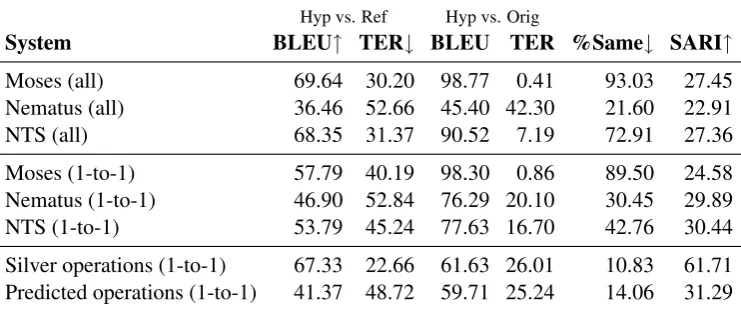
Table 1: Performance of translation-based and operation-based TS models (using silver or predicted operation labels, with only DELETION and REPLACE applied). Metrics are BLEU and TER between
simplified version (Hyp) and reference (Ref) or original version (Orig), the percentage of sentences copied from the input (%Same), and SARI for the simplifications.
experiments, the respectively used data was first randomly split into training (80%), development (10%) and test (10%) sets and normalized for en-tities (incl. names, locations, numbers).
Simplification Quality. The first and second sections of Table1show the results of translation-based systems according to several metrics: simi-larity metrics commonly used in MT, comprising BLEU (Papineni et al., 2002) and TER (Snover et al.,2006, minimum edit distance), as well a spe-cific text simplification metric, SARI (Xu et al.,
2016). SARI measures how good the words added, deleted and kept by a simplification system are, af-ter comparing the produced output to the original sentence and the simplification reference(s). It is similar to BLEU but rewards copying words from the original sentence. According to experiments performed byXu et al.(2016), SARI is the met-ric that best correlates with human judgments of simplicity.
For both “all” and “1-to-1” variants, the BLEU and TER scores between hypotheses and refer-ences are worse for Nematus, showing that a base-line neural model tends to be more aggressive and potentially generate noisier modifications than Moses equivalents. To measure how strongly the various approaches modify the input sentences, these scores are also reported between the gener-ated simplifications and the original inputs. Again, these metrics are worse for Nematus-based els, showing that they indeed perform more mod-ifications on the sentences. Moses in turn is very conservative, keeping 90-93% of the test sentences
exactly in their original version. SARI shows low scores for all systems. NTS is also conservative in the “all” variant (attested by the high BLEU score between hypotheses and original sentences). For “1-to-1”, NTS produces more simplifications, di-verging more from the original sentences.
Sentence-level Operations. Interestingly, even though Moses and Nematus are trained on the same data, they differ substantially with respect to what they can learn. This is demonstrated by an automatic inspection we conducted on the simpli-fications produced by both systems trained over all types of sentence alignments, i.e. including sen-tence splits and joins.
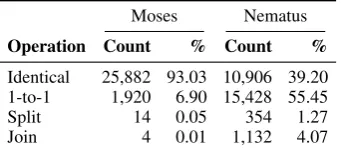
Table 2 reports the count and proportion of instances in the test set representing types of sentence-level transformation between the origi-nal and simplified sentence. It can be noted that Moses is much more conservative than Nema-tus and simply tends to copy the original as the output (“Identical” cases). However, as the ma-jority (57%) of aligned sentences in the profes-sional Newsela simplifications are edited, we do not consider copying a valid “simplification” in most cases. Note also that Moses displays an ex-cessively high BLEU score between the original and hypothesis sentences (98.77), while the simi-larity between the original and reference sentences is much lower (71.57).
accu-Moses Nematus
Operation Count % Count %
Identical 25,882 93.03 10,906 39.20 1-to-1 1,920 6.90 15,428 55.45
Split 14 0.05 354 1.27
[image:5.595.97.268.63.138.2]Join 4 0.01 1,132 4.07
Table 2: Count and proportion of instances af-fected by each type of simplification transforma-tion performed by Moses and Nematus.
rate way. However, the proportion of such cases is very low (0.05% and 1.27% for Moses and Ne-matus, respectively) compared to the proportion in the gold data (13.5%) of the sentence pairs contain at least one split.
Moses only joins sentences in four cases, but these are all spurious instances where a period is incorrectly removed. Nematus is more successful at learning this type of operation. In most cases, it discards entire clauses that contain less relevant content. For example, it simplifies the sentence “Lincoln often cried in public and recited sad po-etry, according to Joshusa Wolf Shenk, who wrote a book called Lincoln’s Melancholy” to “Lincoln often cried in public and recited sad poetry”. We also find a few examples where the content that is not discarded is rewritten to some extent, mostly for grammaticality. The Nematus simplification of “Frank was what the instructors called a ‘rock star’; he emerged as a leader who worked hard to keep the group together” onto “Frank was a leader who worked hard to keep the group together” is a good example of that.
When it comes to 1-to-1 transformations, which can include a number of different operations (see §4), most transformations made by Nematus con-sist of segment deletions, some of which are paired with localized segment rewritings. As for Moses, most 1-to-1 outputs are identical to the original ex-cept for a few spurious typographic and punctua-tion changes. Because of that, Nematus simplifi-cations are in average four tokens shorter than both complex originals and Moses simplifications.
A strong limitation of both models is their in-ability to address lexical complexity, performing very few lexical replacements. Most of the sen-tences that are lexically simplified have only one word replaced by another that does not preserve its original meaning. Take, for example, the word clearsin the sentence “It clears the way for troops on the ground with its huge bullets”, which was
replaced by gathers by Nematus, and the word agribusiness, which was replaced by offering by Moses in sentence “Older brother Nate has taken college courses on livestock raising and agribusi-ness”. Some of these issues become more evident in the human evaluation we performed comparing both end-to-end systems to our proposed approach (§5.2).
4 Simplification via Sequence Labeling
Our approach to TS differs from translation-based models by explicitly predicting a set of operations to be applied at different positions in a complex sentence. Concretely, we tackle simplification as a sequence labeling problem, predicting opera-tions at the token level and applying them down-stream. As there are no high-quality and large-scale resources from which such operation se-quences could be learned, we first generate train-ing data as explained below.6
4.1 Generating Training Data
Given 1-to-1 sentence pairs, our method for data generation identifies deletions, additions, substi-tutions, rewrites (replacing or adding non-content words), and reorderings performed between sen-tences pairs.
Automatic operation annotation. The annota-tion process uses the following set of operaannota-tion la-bels: DELETE (D),REPLACE (R), andMOVE (M)
in the original (source) sentence; ADD(A) in the
simplified sentence; andREWRITE(RW) in both.7
We first generate word alignments between the original and simplified sentences using the aligner by Sultan et al. (2014). Based on these align-ments, we perform a word-level annotation for la-bels DELETE and REPLACE. Our heuristics are
that if two words are aligned and are not an exact match, then the corresponding label isREPLACE.
If a word in the original sentence is not aligned, it
6For the experiments with the proposed TS approach, only
1-to-1 alignments are suitable. It is indeed not realistic to expect that complex operations that involve significant struc-tural changes (e.g., splitting or joining sentences) could be modeled using sequence labeling approaches. For such com-plex operations, we believe explicitly representing the sen-tences’ syntactic structures and learning abstract syntactic transformation rules (e.g. as inWoodsend and Lapata(2011) orFeblowitz and Kauchak(2013)) would be more advisable. However, we note that, as previously shown, translation-based end-to-end approaches also fail to learn such complex operations.
7Target-side annotations serve for analysis; they are
Figure 1: Example of automatic labeling based on word alignments between an original (top) and a simplified (bottom) sentence in the Newsela corpus. Unaligned words on the original side receive label ‘D’ (DELETE), while words that are aligned to a different form receive ‘R’ (REPLACE). Aligned words
without an explicit label receive a ‘C’ label (COPY). Sentences are from the Newsela Article Corpus.
Figure 2: Example of automatic annotation for la-belMOVE(‘M’). Sentences are from the Newsela
Article Corpus.
must be aDELETE, and if a word in the simplified
sentence is not aligned, it is anADD. In any other
case, the word receives label C (COPY) or O (not
part of a simplification operation) in the original or simplified sentence, respectively. For details, see Algorithm1in the supplementary material. Figure
1presents an example for our automatic labeling approach. We considerREWRITElabels as special
cases of REPLACE where the words involved are
isolated (not in a group of same operation labels) and belong to a list of non-content words.
Finally, we label reorderings (MOVE) by
de-termining if the relative index of a word (con-sidering preceding or following deletions and ad-ditions) in the original sentence changes in the simplified one (Algorithm 2). See Figure 2 for an example. Words or phrases that are kept, re-placed or rewritten, may be subject to reorder-ings, such that a token may have more than one label (e.g. REPLACE and MOVE). For
that, we extend the set of operations by the compound operationsREPLACE+MOVE(RM) and REWRITE+MOVE(RWM).
Evaluation of automatic labels. To test our al-gorithms, we compare their output to manual an-notations for 100 sentences from level pair 0-1 of the Newsela corpus. The manual annota-tions were performed by four proficient English speakers. For 30 of those sentences, we calcu-lated the pairwise inter-annotator agreement be-tween annotators, yielding an average kappa value
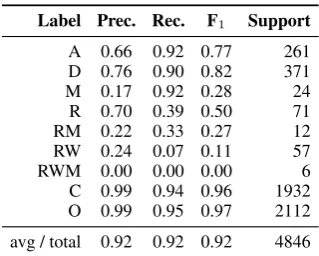
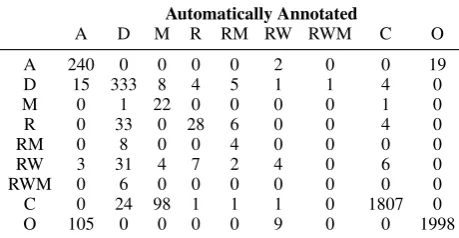
of 0.57. We obtain an accuracy of 0.92 for all la-bels, and a micro-averaged F1score of 0.70 for all positive labels (i.e. excluding ‘C’ and ‘O’). Ta-ble 3 presents details on the performance of our annotation algorithms over the identified opera-tions. Of the positive labels, the algorithms anno-tate most accurately additions and deletions. Ac-cording to the confusion matrix in Table 4, the relatively low ability of capturing replacements is due to labeling them as deletions. This is mainly caused by word miss-alignments and by parser er-rors that our heuristics cannot recover from. The same logic applies for labelsREPLACE+MOVEand REWRITE+MOVE. We are also able to capture
mostMOVEments (high recall), but our reordering
heuristic still requires improvement.
Label Prec. Rec. F1 Support A 0.66 0.92 0.77 261 D 0.76 0.90 0.82 371
M 0.17 0.92 0.28 24
R 0.70 0.39 0.50 71
RM 0.22 0.33 0.27 12
RW 0.24 0.07 0.11 57
RWM 0.00 0.00 0.00 6
[image:6.595.336.496.436.564.2]C 0.99 0.94 0.96 1932 O 0.99 0.95 0.97 2112 avg / total 0.92 0.92 0.92 4846
Table 3: Per-label performance of automatic anno-tation of operations.
Automatically Annotated
A D M R RM RW RWM C O
A 240 0 0 0 0 2 0 0 19
D 15 333 8 4 5 1 1 4 0
M 0 1 22 0 0 0 0 1 0
R 0 33 0 28 6 0 0 4 0
RM 0 8 0 0 4 0 0 0 0
RW 3 31 4 7 2 4 0 6 0
RWM 0 6 0 0 0 0 0 0 0
C 0 24 98 1 1 1 0 1807 0
[image:7.595.72.302.64.183.2]O 105 0 0 0 0 9 0 0 1998
Table 4: Confusion matrix of true (rows) and au-tomatically annotated (columns) operations on the manually annotated data.
alignments between original and simplified words to apply the actual operations. This is what we re-fer to assilver operations in Table1. Using the automatic labeling would lead to much more accu-rate and less conservative simplifications than all translation-based approaches: it achieves the high-est SARI and BLEU scores, and the lowhigh-est rate of copied input sentences among all systems tested using the 1-to-1 alignments. Therefore, the chal-lenges now are (i) to predict such labels (§5.1), and (ii) to devise high-performing TS modules to ap-ply simplification operations for each type of label (§4.2).
4.2 Application of Operations
For our experiments (§5), we consider two of the operations that our algorithms can identify with high precision: DELETE andREPLACE.8
Apply-ing deletions is straightforward and amounts to simply omitting the respective token when gener-ating the hypothesis sentence. For the REPLACE
operation, we use the supervised Lexical Simpli-fication approach of Paetzold and Specia(2017). Their simplifier generates candidate substitutions for target words using parallel complex-to-simple corpora and retrofitted context-aware word em-bedding models, selects the ones that fit the con-text of the target word through the unsupervised boundary ranking approach, then ranks candidates using a supervised neural ranking model trained
8We focus on this subset of operations since we currently
lack good models to apply to the remaining operations.ADD, for example, would presume access to an external resource such as a knowledge base that would serve as a basis for in-ferring added content (which is oftentimes background infor-mation, for example an explanation that a certain person has a certain function). The results we obtain can thus be viewed as a lower bound on the simplification quality that can be ex-pected from a model that integrates other operations.
over manually annotated simplifications. It also performs a final confidence check step: the target is only replaced by the highest ranking candidate if the trigram probability of two words preceding the target is higher for the candidate.
5 Experiments
Based on the automatic annotation procedure out-lined above, we generate sequence annotations of 1-to-1 simplification operations in the Newsela corpus. On this data, we explore the questions (i) whether we can predict simplification operations to be performed on unseen data, and (ii) to what degree the prediction of these operations allows us to generate good simplifications.
5.1 Prediction of Simplification Operations To predict simplification operations for each input word, we train a bidirectional recurrent neural net-work, with an initial embedding layer of size 300 and two hidden LSTM (Long-Short Term Mem-ory) layers of size 100. The training is done us-ing Keras (Chollet, 2015), with a batch size of 64, categorical cross-entropy loss and a dropout rate of 0.2 after the hidden layers. We optimize the model with Adagrad (Duchi et al.,2011). We monitor the tagging accuracy on held-out develop-ment data and employ early stopping when the de-velopment loss increases. We repeat this process ten times with random initializations and select the best model based on development set accuracy.
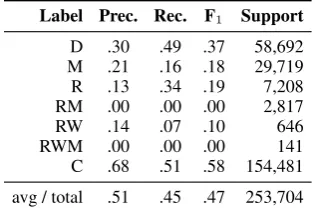
Table 5 shows that the LSTM model does not predict the silver labels very well. In particular, the model is relatively conservative with respect to the prediction of simplification operations, and tends to overpredict the majority class (i.e., to copy a to-ken).9 DELETEis the operation that our model
pre-dicts best. Table6shows the relative confusion of predicted operations versus the silver labels, and confirms that the main error type of our system is to keep a token rather than performing some sim-plification operation on it. We also see a tendency for other operations to be predicted as deletions.
The results in the lower part of Table 1 (“Pre-dicted operations (1-to-1)”), however, show that even though the operation predictions are far from the silver labels, our system is able to generate simple output by only applying the DELETE and
9By weighting the loss function by the ground truth class
Label Prec. Rec. F1 Support D .30 .49 .37 58,692 M .21 .16 .18 29,719 R .13 .34 .19 7,208 RM .00 .00 .00 2,817
RW .14 .07 .10 646
RWM .00 .00 .00 141
[image:8.595.102.260.63.169.2]C .68 .51 .58 154,481 avg / total .51 .45 .47 253,704
Table 5: Per-label performance of automatic oper-ation prediction with the LSTM model.
Predicted
D M R RM RW RWM C
D .49 .06 .07 .00 .00 .00 .38 M .41 .16 .05 .00 .00 .00 .38 R .23 .05 .34 .00 .00 .00 .38 RM .32 .09 .21 .00 .00 .00 .38 RW .38 .00 .00 .00 .07 .00 .54 RWM .62 .03 .00 .00 .04 .00 .32 C .33 .09 .06 .00 .00 .00 .51
Table 6: Confusion matrix of true (rows) and pre-dicted (columns) operations on the test data.
REPLACE operations. In particular, our method
achieves a better SARI score than all the baseline systems on the 1-to-1 alignments. As we consider the extrinsic evaluation of the final TS results to be more indicative of the quality of our model than its intrinsic evaluation in the sequence labeling task, we view this as a positive result.
5.2 Human Evaluation
We finally conduct a human evaluation of 100 sim-plifications produced by five simplifiers:
• The experts’Referencesimplification. • TheMosessimplifier (1-to-1).
• TheNematussimplifier (1-to-1). • TheNTSsimplifier (1-to-1).
• OurSequence Labeling (SL)simplifier.
Human evaluators (four NLP experts) are given the original sentence and the simplification in each of the above versions, and are asked to judge each of them with respect to their grammaticality (G), meaning preservation (M) and simplicity (S), us-ing a Likert scale between 1 (worst) and 5 (best) for each aspect. We define “simplicity” as the ex-tent to which the sentence was simpler than the original and thus easier to understand. A control
set of 20 sentences is evaluated by all annotators in order to compute inter-annotator agreement.
G M S
[image:8.595.90.273.215.317.2]Reference 5.00±0.0 4.45±0.9 2.70±1.3 SL 4.16±1.0 3.91±1.1 1.66±0.9 Nematus 4.49±0.9 3.99±1.2 1.46±0.9 Moses 4.98±0.2 4.99±0.1 1.14±0.4 NTS 4.75±0.6 4.08±1.26 1.53±1.0 Fleiss’ Kappa 0.372 0.457 0.342
Table 7: Average scores and standard deviation for grammaticality (G), meaning preservation (M) and simplicity (S) for the systems evaluated. The last row shows the inter-annotator agreement scores in terms of Fleiss’ Kappa.
Table7 illustrates the average scores and stan-dard deviations obtained by each system according to each criterion. As expected, the Moses simpli-fier obtains the highest grammaticality and mean-ing preservation scores, but the lowest simplicity scores, given that it tends to merely reproduce the input. Although Nematus and NTS manage to ob-tain slightly higher simplification scores, they still average very close to the lower end of the simplic-ity scale. Our SL approach, in turn, shows signifi-cantly higher simplicity scores than the other sys-tems (according to at-test withp <0.05). Its less conservative edits, however, may in some cases come at the cost of lower scores for grammati-cality and meaning preservation. The last row in Table7shows the values of inter-annotator agree-ment in terms of Fleiss’ Kappa for each evaluation aspect. Table8exemplifies some of the sentences for which our system was rated better and worse than the baselines. It is important to mention that, although the first two reference simplifications in Table 8 feature only minor punctuation changes, only 2,538 references (0.8%) in the dataset are of this type.
6 Conclusions and Further Work
SL better than other Moses, Nematus and NTS
O Kyarra Garrett has learned how to take blood pressure and perform CPR – and she is not even out of high school yet.
R Kyarra Garrett has learned how to take blood pressure and perform CPR, and she is not even out of high school yet.
M Kyarra Garrett has learned how to take blood pressure and perform CPR – and she is not even out of high school yet.
N UNK Garrett loves out to take blood pressure and perform, and she is not even out of high school yet.
T Chance Garrett has learned how to take blood pressure.
L Kyarra Garrett has learned how to take blood pressure and perform CPR. O in her mind she stops at particular locations to pick up the correct cookie crumbs. R in her mind, she stops at particular locations to pick up the correct cookie crumbs. M in her mind she stops at particular locations to pick up the correct cookie crumbs. N she stops at particular locations to pick up the correct cookie UNK.
T in her mind she stops at particular locations to pick up the correct cookie momentum. L in her mind she stops at particular areas to pick up cookie crumbs.
SL worse than Moses, Nematus or NTS O despite the limitations, Palestinian cooking is not without its fans. R despite the limitations, Palestinian cooking has its fans.
M despite the limitations, Palestinian cooking is not without its fans. N Palestinian cooking is not without its fans.
T even Palestinian cooking is not without its fans.
L despite the limitations, Palestinian cooking is not without its fans.
O “we always thought there has to be a more efficient way of doing this,” Zach Fiene said. R he said he always thought there had to be a better way of doing it.
M “we always thought there has to be a more efficient way of doing this,” Zach Fiene said.
N “we always thought there has to be a more efficient way of doing this,” said Zach Ghani, who is the 18-year-old said.
[image:9.595.67.528.66.525.2]T Zach Fiene said there has to be a more efficient way of doing this. L “we always thought there has to be more efficient way doing this said.
Table 8: Example including original (O) and reference (R) sentences from the Newsela Article Corpus, and outputs generated by Moses (M), Nematus (N), NTS (T) and our sequence labeling approach (L).
The experiments reported here cover only dele-tions and lexical substitudele-tions as operadele-tions.
Our approach has several theoretical advantages over end-to-end translation models, including eas-ier interpretability of the types of simplification learned, as well as the possibility for late decoding for adaptive simplification. In practical terms, we showed that our system outperforms translation-based approaches on a number of metrics and overcomes the problems of excessive repetition of the original content.
According to human evaluation, our system achieves higher simplicity scores than the base-line systems, although this comes at the cost of
slightly lower meaning preservation and grammat-icality. We hypothesize that some of the problem-atic cases stem from not realizing the addition op-eration. In general, our approach will likely profit from good models for the remaining operations, especially those that can also operate on spans of several tokens, making research on such models a natural direction for further work.
Acknowledgements
References
Dzmitry Bahdanau, Kyunghyun Cho, and Yoshua Bengio. 2014. Neural machine translation by jointly learning to align and translate. CoRR, abs/1409.0473.
Regina Barzilay and Noemie Elhadad. 2003.Sentence alignment for monolingual comparable corpora. In
Proceedings of EMNLP, pages 25–32.
Joachim Bingel and Anders Søgaard. 2016. Text Sim-plification as Tree Labeling. InProceedings of ACL, pages 337–343.
Stefan Bott and Horacio Saggion. 2011. An unsu-pervised alignment algorithm for text simplifica-tion corpus construcsimplifica-tion. InProceedings of MTTG, pages 20–26.
Franc¸ois Chollet. 2015. Keras. https://github.
com/fchollet/keras.
William Coster and David Kauchak. 2011a. Learning to simplify sentences using wikipedia. In Proceed-ings of the Workshop on Monolingual Text-To-Text Generation, pages 1–9.
William Coster and David Kauchak. 2011b. Simple English Wikipedia: a new text simplification task. InProceedings of ACL, pages 665–669.
John Duchi, Elad Hazan, and Yoram Singer. 2011. Adaptive subgradient methods for online learning and stochastic optimization. Journal of Machine Learning Research, 12:2121–2159.
Dan Feblowitz and David Kauchak. 2013. Sentence simplification as tree transduction. InProceedings of the PITR Workshop, pages 1–10.
Philipp Koehn, Hieu Hoang, Alexandra Birch, Chris Callison-Burch, Marcello Federico, Nicola Bertoldi, Brooke Cowan, Wade Shen, Christine Moran, Richard Zens, Chris Dyer, Ondˇrej Bojar, Alexandra Constantin, and Evan Herbst. 2007. Moses: Open source toolkit for statistical machine translation. In
Proceedings of ACL - Demonstration Session, pages 177–180.
Shashi Narayan and Claire Gardent. 2014.Hybrid sim-plification using deep semantics and machine trans-lation. InProceedings of ACL, pages 435–445.
Sergiu Nisioi, Sanja ˇStajner, Simone Paolo Ponzetto, and Liviu P. Dinu. 2017. Exploring neural text sim-plification models. In Proceedings of ACL, pages 85–91.
Gustavo H. Paetzold and Lucia Specia. 2016a. Se-meval 2016 task 11: Complex word identification. InProceedings of the 10th SemEval, pages 560–569. Gustavo Henrique Paetzold and Lucia Specia. 2016b. Vicinity-driven paragraph and sentence alignment for comparable corpora.CoRR, abs/1612.04113.
Gustavo Henrique Paetzold and Lucia Specia. 2017. Lexical simplification with neural ranking. Pro-ceedings of EACL, pages 34–40.
Kishore Papineni, Salim Roukos, Todd Ward, and Wei-Jing Zhu. 2002. BLEU: a method for automatic evaluation of machine translation. InProceedings of ACL, pages 311–318.
Rico Sennrich, Orhan Firat, Kyunghyun Cho, Alexan-dra Birch, Barry Haddow, Julian Hitschler, Marcin Junczys-Dowmunt, Samuel L¨aubli, Antonio Valerio Miceli Barone, Jozef Mokry, and Maria Nadejde. 2017. Nematus: a toolkit for neural machine trans-lation. InProceedings of the Software Demonstra-tions of EACL, pages 65–68, Valencia, Spain. ACL.
Rico Sennrich, Barry Haddow, and Alexandra Birch. 2016. Edinburgh neural machine translation sys-tems for wmt 16. In Proceedings of WMT, pages 371–376.
Jason R Smith, Chris Quirk, and Kristina Toutanova. 2010. Extracting parallel sentences from compara-ble corpora using document level alignment. In Pro-ceedings of NAACL, pages 403–411.
Matthew Snover, Bonnie Dorr, Richard Schwartz, Lin-nea Micciulla, and John Makhoul. 2006. A study of translation edit rate with targeted human annotation. InProceedings of AMTA, pages 223–231.
Lucia Specia. 2010. Translating from complex to sim-plified sentences. InComputational Processing of the Portuguese Language, pages 30–39. Springer.
Md Sultan, Steven Bethard, and Tamara Sumner. 2014. Back to basics for monolingual alignment: Exploit-ing word similarity and contextual evidence. TACL, 2:219–230.
Kristian Woodsend and Mirella Lapata. 2011. Learn-ing to simplify sentences with quasi-synchronous grammar and integer programming. InProceedings of EMNLP, pages 409–420.
Sander Wubben, Antal van den Bosch, and Emiel Krahmer. 2012. Sentence simplification by mono-lingual machine translation. InProceedings of ACL, pages 1015–1024.
Wei Xu, Chris Callison-Burch, and Courtney Napoles. 2015. Problems in current text simplification re-search: New data can help.TACL, 3:283–297.
Wei Xu, Courtney Napoles, Ellie Pavlick, Quanze Chen, and Chris Callison-Burch. 2016. Optimizing statistical machine translation for text simplification.
TACL, 4:401–415.
Xingxing Zhang and Mirella Lapata. 2017. Sentence simplification with deep reinforcement learning. In
Yaoyuan Zhang, Zhenxu Ye, Yansong Feng, Dongyan Zhao, and Rui Yan. 2017. A constrained sequence-to-sequence neural model for sentence simplifica-tion.CoRR, abs/1704.02312.