43
Design and Evaluation of Approaches to Automatic
Chinese Text Categorization
Jyh-Jong Tsay and Jing-Doo Wang
*Abstract
In this paper, we propose and evaluate approaches to categorizing Chinese texts, which consist of term extraction, term selection, term clustering and text classification. We propose a scalable approach which uses frequency counts to identify left and right boundaries of possibly significant terms. We used the combination of term selection and term clustering to reduce the dimension of the vector space to a practical level. While the huge number of possible Chinese terms makes most of the machine learning algorithms impractical, results obtained in an experiment on a CAN news collection show that the dimension could be dramatically reduced to 1200 while approximately the same level of classification accuracy was maintained using our approach. We also studied and compared the performance of three well known classifiers, the Rocchio linear classifier, naive Bayes probabilistic classifier and k-nearest neighbors(kNN) classifier, when they were applied to categorize Chinese texts. Overall, kNN achieved the best accuracy, about 78.3%, but required large amounts of computation time and memory when used to classify new texts. Rocchio was very time and memory efficient, and achieved a high level of accuracy, about 75.4%. In practical implementation, Rocchio may be a good choice.
Keywords: Term Clustering, Term Selection, Text Categorization.
1. Introduction
In recent years, we have seen a tremendous growth in the number of online text documents available on the Internet, in digital libraries and news sources. Effective location of information in these huge resources is difficult without good indexing as well as organization of text collections. Automatic text categorization, which is defined as the task of assigning predefined class (category) labels to free text documents, is one of
*
Department of Computer Science and Information Engineering, National Chung Cheng University, Chiayi, Taiwan 62107, ROC. E-mail: {tsay,jdwang}@cs.ccu.edu.tw
Computational Linguistics and Chinese Language Processing
Vol. 5, No. 2, August 2000, pp. 43-58
the main techniques that are useful both in organizing and in locating information in these huge collections.
Many approaches to text categorization and web page classification have been proposed [2,9,12,20]. Most of them have been evaluated using English texts. Evaluation of these approaches using texts in Chinese and other oriental languages has been limited. In [22], Yang et al. proposed and evaluated several approaches to Chinese text categorization. The number of training and testing documents used was 2306, and the number of extracted terms used was 4711. Yang's work was quite preliminary and achieved classification accuracy of only about 67%. Since then, tremendous advances have been made in categorization techniques [20]. Most of the recently proposed techniques have not been evaluated using Chinese texts.
The objective of this study was to design and evaluate approaches to categorizing Chinese texts. In particular, we implemented and evaluated approaches which consist of the following processes: term extraction, term selection, term clustering and text classification. Note that in Chinese texts, although a sentence is composed of a sequence of terms, no white spaces are inserted to separate terms from each other. Term extraction which segments sentences into term sequences is a difficult task [5]. Several approaches have been proposed to extract terms from Chinese texts [4,13]. In this paper, we propose a scalable approach [17] which is based on String B-trees proposed in [7] and is capable of handling huge numbers of text documents. Our approach uses frequency counts to identify possible term boundaries as proposed in [13] and is able to identify new terms which occur very often in Chinese texts.
However, the number of terms in Chinese can be very large. It is very easy to encounter 106 or even more terms in moderately-sized collections. The huge number of possible terms results in very high dimensionality when documents was presented in a vector space model and makes many machine learning algorithms impractical. To reduce the dimension to a practical level, we propose to perform term selection and term clustering on extracted terms. In particular, we use the χ2
statistic[16] to select terms that are highly correlated to class categories. In [16], we presented an extensive comparison of several measures for term selection in Chinese text categorization, such as the odds ratio, information gain, mutual information, and χ2
statistic. Experimental results shows that the χ2
statistic approach achieves the best performance. Notice that in term selection, if only a small number of terms is selected, a document may contain very few or even none of the selected terms, and thus will be classified into the default class. On the other hand, a large number of selected terms make automatic categorization computationally impractical. We thus allow a large number of terms to be selected and then perform term clustering to group similar terms into clusters.
Design and Evaluation of Approaches to Automatic Chinese Text Categorization 45
Experimental results show that the level of classification accuracy could be maintained while the dimension was reduced to 1200 by selecting 90000 terms first and then clustering them into 1200 clusters. Notice that term selection and term clustering also can compeensate for imprecision in term extraction as erroneous terms can be dropped out during term selection or grouped with more significant terms through term clustering. In addition to term selection and term clustering algorithms, there are others which can be applied to reduce the level of dimensionality, such as Principle Component Analysis (PCA) [6]. PCA is an unsupervised dimensional reduction technique, whereas distributional clustering is supervised and can take advantage of class labels to concentrate effort on the specific task of categorization. We expect distributional clustering to perform well in the context of text categorization.
In this paper, we also compare extensively three well-known classifiers, including the Rocchio linear classifier [12], naive Bayes probabilistic classifier, and k-nearest neighbor (kNN) classifier [20]. We observed in an experiment that the classification accuracy of Rocchio and kNN improved slightly as the dimension was reduced to 1200 by means of term selection and term clustering but that the accuracy of the naive Bayes classifier dropped slightly. This might have been due to the fact that term clustering refines the shapes of each cluster but distorts the distribution of each term. Overall, kNN achieved the best accuracy, about 78.3%, but required large amounts of computation time and memory when used to classify new texts. Rocchio is very time and memory efficient, and achieves accuracy of about 75.4%, which is slightly worse than kNN.
Recently, Huang et al. [10] evaluated the weight matrix approach, which estimates the relative importance of the keywords in each class and classifies a test news to the class that maximizes the sum of the weights of keywords appearing in that news. Although they achieved about 88% classification accuracy, their experiment was different from ours as well as those used in much related research [3,22]. First, the training news did not come from the same news source as the test news, but come from a thesaurus [19] that was carefully built by linguistic specialists. Second, the test news was classified by readers who could employ logic that was close to that assumed by the classification algorithms but different from that employed by the editors. Third, a piece of test news could be assigned to multiple classes when it covered topics from different classes. In fact, for a collection of 1136 news items, 1380 class labels were assigned, which indicates that about 20% of the test news iteems had multiple class labels. However, in the CNA news collection used in this study, each news items had exactly one predefined class no matter how many topics it covered. It is not clear whether or not the weight matrix approach can achieve the same performance when all the differences are removed.
The remainder of this paper is organized as follows. Section 2 sketches the String B-tree approach to term extraction. Section 3 describes theχ2
conduct categorization, the cosine similarity between each
D
i and X is calculated. The trainingdocuments are sorted using the cosine similarity metric in descending order. Then the k top-ranking documents are selected. The final score of the request document X when compared to each class is calculated by summing the cosine similarity metric of these k selected documents and their class association. The class with the highest score is assigned to X. We have performed an experiment using different values of k, including 5, 10, 15, 20, 30, 50, 100, 150, 200 and 300. The best choice of k in our experiment is 15 when n = 90000 and is 10 when n = 1200.
6. Experimental Results
In our experiment, we used Chinese news articles from the Central News Agency (CNA)[1]. We used news articles spanning a period of one year, from 1/1/1991 to 12/31/1991, to extract terms. News articles from the six-month period 8/1/1991 to 1/31/1992 were used as training data to train classifiers. The testing data consisted of news articles from the one-month period 2/1/1992 to 2/28/1992. All the news articles were preclassified into 12 classes, listted in Figure 1. Note that the number of texts used was far larger than that employed in previous related researches [10,22]. As a result, the conclusions drawn based on our experimental results are believed to be more reliable.
Figure 1 The distribution of CAN news articles.
The news articles were not uniformly distributed over the classes, as shown in Figure 1. We, thus,
measure the classification accuracy at both micro and macro levels. Three performance measures were
240, 360, 600, 900, 1200, 1800, 2400, 3600 and 4800. We choose a c value of 1200 because kNN and Rocchio achieved the best performance when c was 1200, as shown in Figure 4.
Design and Evaluation of Approaches to Automatic Chinese Text Categorization 53
Figure 4 MicroAccuacy comparison(term clustering).
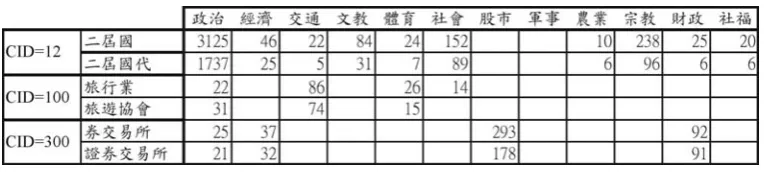
Figure 6 Term frequencies in each class.
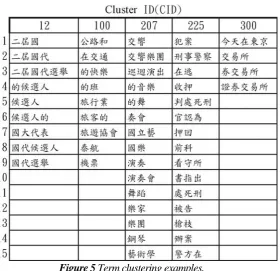
Figure 5 shows some examples of term groups. In addition to clustering similar terms to reduce the dimension, term clustering can also cluster redundant substrings that are erroneously identified during term extraction into the group that contains their original terms. For example, as shown in Figure6,”二屆國” and “二屆國代” are clustered into group 12; “證券交易所” and “券交易所” are clustered into group 300. On the other hand, the averaging statistics of similar words may result in more robust estimates. For example, “旅行業”(a travel agent) and “旅遊協會”(a travel agency association) are similar words and are clustered into group 100.
In [2], Baker claimed that performance can be improved by means of term clustering when training
data is sparse because by averaging statistics of similar words, more robust estimates can be obtained. This
was confirmed by our experiment. Note that our training data was quite sparse as the average number of
none-zero items in training vectors was 106 when n is 90000, and was 79 when c is 1200. The memory space could be reduced by 25% 0.25)
106 79 106
( − = , and the averaged statistics of terms were more robust
estimates when the percentage of none-zero items increased from 0.12%(=106/90000) to 6.58%(=79/1200)
due to term clustering.
6.2 Classifiers Comparison
Design and Evaluation of Approaches to Automatic Chinese Text Categorization 55
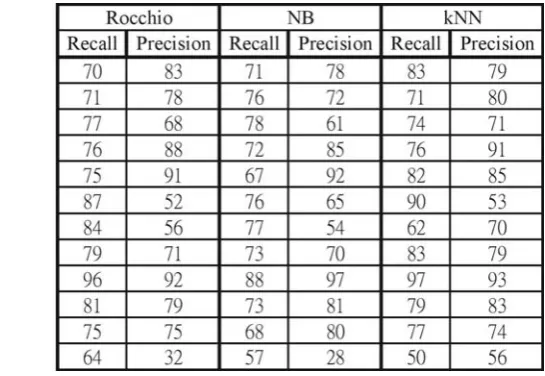
Figure 7 Recall(%)/precision(%) comparison(n=90000).
Figure 8 Recall(%)/precision(%) comparison(n=1200).
class Military (軍事). Note that the class Politics (政治) and the class Military (軍事) were highly correlated, as observed in [17], and that the class Politics (政治) was 5 times larger than the class Military (軍事).
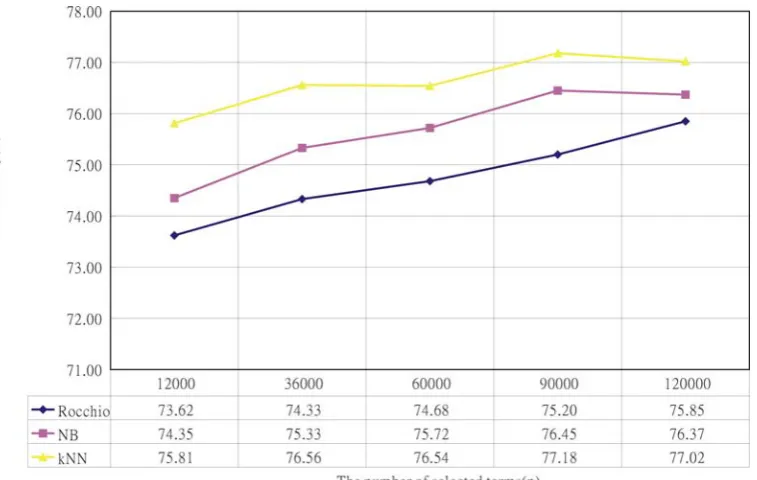
In practical implementation, Rocchio could be a good choice. Rocchio is quite time and memory efficient because the time and memory requirements for the classification process are proportional to the number of classes. However, the time and memory requirements for kNN are proportional to the number of training documents. Rocchio is more noise tolerant than kNN and NB, as shown by the fact that the performance of kNN and NB worsened but the performance of Rocchio improved when n was changed from 90000 to 120000, as shown in Figure 3. Rocchio produced slightly worse MicroAccuracy results than kNN did, but can be improved to produce results approaching the performance of kNN by taking more than one representative to represent each class in [17].
7. Conclusions
In this paper, we have proposed and evaluated approaches to categorizing Chinese texts, which consist of term extraction, term selection, term clustering and text classification. For term extraction, we have proposed an approach based on String B-trees. It is scalable and is capable of handling very large numbers of text collections. We use the χ2
statistic to perform term selection and use distributional clustering to perform term clustering to reduce the dimension of the vector space. Although many redundant terms are identified as significant terms during the term extraction process, the combination of term selection and term clustering somehow can compensate for this drawback by either filtering them out or clustering them into the group containing their original terms. Results of an experiment on a CNA news collection shows that the dimension could be reduced from 90000 to 1200 while approximately the same level of classification accuracy was maintained. We have also studies and compared the performance of three well known classifiers, the Rocchio linear classifier (Rocchio), naive Bayes (NB) probabilistic classifier and k-nearest neighbors (kNN) classifier, when they were applied to categorize Chinese texts. Overall, kNN achieved the best accuracy, about 78.3%, but required large amounts of computation time and memory to classify new texts. Rocchio was very time and memory efficient, and achieved accuracy of about 75.4%. In practical implementation, Rocchio may be a good choice. In addition, we have recently shown [17] that the performance of the Rocchio linear classifier can be improved to approximate that of kNN by taking multiple representative vectors to represent one class.
Acknowledgements
Design and Evaluation of Approaches to Automatic Chinese Text Categorization 57
References
[1] Central News Agency. http://www.can.com.tw/index.html
[2] Douglas Baker and Kachites McCallum. “Distributional clustering of words for text classification.” In Proceedings of the 21th Ann Int ACM SIGIR Conference on Research and Development in Information Retrieval (SIGIR’98), pages 96-103. 1998.
[3] Chen Chun-Liang and Lee-Feng Chien. “PAT-tree-based online corpus collection and classification.” In The Fourth International Workshop on Information Retrieval with Asian Languages(IRAL’99), pages 78-82. 1999.
[4] Chien Lee-Feng. “PAT-Tree-Based keyword extraction for Chinese information retrieval.” In Proceedings of the 20th Ann Int ACM SIFIR Conference on Research and Development in Information Retrieval(SIGIR’97), pages 50-58. 1997.
[5] Chien Lee-Feng and Hsiao-Tieh Pu. “Important issues on Chinese information retrieval.” In Computation Linguistics and Chinese Language Processing, pages 205-221. 1996.
[6] S.C. Deerwester, S.T. Dumais, T.K. Landauer, G.W.Furnas, and R.A. Harshman. “Indexing by latent semantic analysis.” Journal of the American Society for Information Science, 41(6):391-407. 1990. [7] Paolo Ferragina and Roberto Grossi. “The String B-tree: A new data structure for string search in
external memory and its application.” Journal of ACM, 46(2):236-280. 1999.
[8] William B.Frakes and Rick Kazman. Information Retrieval Data Structures Algorithm. Prentice Hall, Englewood Cliffs, New Jersey 0732. 1992.
[9] Marko Frobelink and Dunja Mladenic. “Turning yahoo into an automatic web-page classifier.” In Proceedings of the 13th European Conference on Aritficial Intelligence, pages 473-474. 1998. [10] Huang Sen-Yuan, Yi-Ling Chou, and Ja-Chen Lin. “Automatic classification for news written in
Chinese.” Computer Processing of Oriental Languages, 12(2):143-159. 1998.
[11] Leonard Kaufman and Peter J. Rousseeuw. “Finding Groups in Data Analysis : An Introduction to Cluster Analysis.” John Wiley and Sons,Inc., New York. 1990.
[12] David D. Lewis, Robert E. Schapire, James P. Callan, and Ron Papka. “Training algorithms for linear text classifiers.” In Proceedings of the 19th Ann Int ACM SIFIR Conference on Research and Development in Information Retrieval (SIGIR’96), pages 298-306. 1996.
[13] Lin Yih-Jeng, Ming-Shing Yu, Shyh-Yang Hwang, and Ming-Jer Wu. “A way to extract unknown words without dictionary from Chinese corpus and its applications.” In Research on Computational Linguistics Conference (ROCLING XI), pages 217-226. 1998.
[14] Tom M. Mitchell. Machine Learning. The McGraw-Hill Companies, Inc. 1997 .
[15] Amitabh Kumar Singhal. “Term Weighting Revisited. “ PHD theses, Cornell University. 1997. [16] Tsay Jyh-Jong and Jing-Doo Wang. “Term selection with distributional clustering for Chinese text
categorization using n-grams.” In Research on Computational Linguistics Conference XII, pages 151-170. 1999.
[18] Jyh-Jong Tsay and Jing-Doo Wang. “A scalable approach for Chinese term extraction.” In 2000 International Computer Sympoyium(ICS2000), Taiwan, R.O.C, pages 246-253. 2000.
[19] R.C.Yang. The Thesaurus of Daily Wordings. Book-Spring Publishing Company, Taiwan. 1995. [20] Yang Yiming and Xin Liu. “A re-examination of text categorization methods.” In Proceedings of the
22th Ann Int ACM SIFIR Conference on Research and Development in Information Retrieval(SIGIR’99),pages 42-49. 1999.
[21] Yang Yiming and Jan O.Pedersen. “A comparative study on feature selection in text categorization.” In Proceedings of the Fourteenth International Conference on Machine Learning(ICML’97), pages 412-420. 1997.