WEB-based listening test system for speech synthesis and speech conversion
evaluation
Laurent Blin, Olivier Boeffard and Vincent Barreaud
IRISA - Institut de Recherche en Informatique et Syst`emes Al´eatoires Universit´e de Rennes 1, Enssat, Lannion, France
{Laurent.Blin,Olivier.Boeffard,Vincent.Barreaud}@univ-rennes1.fr Abstract
In this article, we propose a web based listening test system that can be used with a large range of listeners. Our main goals were to make the configuration of the tests as simple and flexible as possible, to simplify the recruiting of the testees and, of course, to keep track of the results using a relational database. This first version of our system can perform the most widely used listening tests in the speech processing community (AB-BA, ABX and MOS tests). It can also easily evolve and propose other tests implemented by the tester by means of a module interface. This scenario is explored in this article which proposes an implementation of a module for Comparison Mean Opinion Score (CMOS) tests and conduct of such an experiment. This test allowed us to extract from the BREF120 corpus a couple of voices of distinct supra-segmental characteristics. This system is offered to the speech synthesis and speech conversion community under free license.
1.
Introduction
The quality of synthesised speech or speech conversion can be rated on various levels: its intelligibility, its naturalness and, in the case of voice conversion, its proximity to a target voice. The Blizzard Challenge (Black and Tokuda, 2005), for instance, compares corpus based speech synthesis sys-tems with a set of tests designed to evaluate the speech quality on these levels. These tests are described as fol-lows. To measure the similarity of two voices, the ABX test is frequently used (Duxans et al., 2004). For this test, the testee listens to three sentences (A, B and X) and de-cides which one of A or B is closest to X. Classically, X is a converted voice and A (respectively B) is the source (respectively target) voice (Kain, 2001). This test is widely used but has a fault: it cannot state if the converted voice is distinguishable from the target voice (which is the goal of voice conversion). In order to obtain this information, sim-ilarity tests (AB-BA, pair comparison) must be performed. For this test, the testee listens to pairs of voices saying dif-ferent sentences and grades their similarity on a defined scale (Duxans et al., 2004). Finally, to measure the natu-ralness and the intelligibility of a voice, the Mean Opinion Score (MOS) test is used (Suendermann et al., 2005),(ITU-T, 1996). Other tests can be performed to assess the intel-ligibility of a voice, such as the Standard Segmental Test, or the Diagnostic Rhyme Tests (Franc¸ois, 2002),(Jekosch, 1993).
Setting up these tests faces some important logistical con-straints: the gathering of listeners, the necessary audio hardware, the amount of time needed to realize the test and to process the results, etc. Therefore, making perceptive tests easier to perform would be help many research works. For instance, the Blizzard Challenge went beyond the ge-ographical restraints using telephone communications for the testee sessions. In the same way, we propose a web based listening test system to ease such a task. The ele-ments of the test (number of testees, audio stimuli to be used, etc.) are described with the help of a simple inter-face, while the testees can connect to the platform on the
web and realize the test from anywhere at any time. Section 2. of this document introduces the platform. Sec-tion 3. presents the software design, while secSec-tion 4. de-scribes a first experiment and its results.
2.
System description
The proposed system is designed to accept a large number of listeners. The test scenarios are deliberately made ex-tensible. Even if we propose the use of AB-BA, ABX and MOS type tests, the system can easily be extended to deal with other tests by adding the corresponding modules, as described in section 4. More classically, the test parame-ters (such as the required number of testees, the number of speech files to be tested, etc.) are totally configurable by the tester.
2.1. Test design
The system manages testees and tests through panels. A panel corresponds to a group of testees to which the sys-tem suggests different sessions, i.e. different versions of the same test (some different stimulis with the same eval-uation goal). To avoid a bias in the results of the test, the sizeMof the panel is defined in the test configuration by its conceptor. It can be adapted to the number of test sentences available.
A session is considered invalid as long as the testee has not finished it. A test is not finished until all testees have com-pleted their tasks, and statistical results can’t be obtained until then.
A single test therefore is formulated as M sessions, each session being composed of N steps. A step is a question
asked of the testee. It is composed of pstimuli (typically sentences) the testee must listen to (for an AB test,2stimuli are used; for an ABX test,3stimuli; and for a MOS test,1 stimulus).
session 1 testee 1
result 1
Test audio files
logging in
t e s t i n g configuring
Back-Office Front-Office
Figure 1: Platform workflow
Moreover, a testee can pause his session at anytime and resume it automatically, and, the system can ensure that two testees do not undertake the same session of a test, if that is required. Finally, the software is able to suggest more than one perceptive test, possibly of different kind, to the same testee, if several unfinished tests are available on the platform.
2.2. Testee access
The interface with the testees is also flexible. In order to reach a large number of testees, the interface of the system is web based, running inside a standard web browser. This allows the testee to work from his own computer when he is free, and it does not imply special software to be installed. Obviously, this kind of interface does not permit the tester to control the listening test conditions. That is why the tes-tee is asked to provide information about his own listening conditions for them to be taken into consideration during the result evaluation if necessary. If accoustic test control is crucial, it is of course possible to gather the testees in a same physical place, providing each one with a computer to record his perceptive choises.
Whatever the listening conditions are, the system keeps track of testees, tests, sessions and results. This is done via a relational database. Flexibility is again built in the database, the number of tables and their structure being hid-den behind an interface of simple accessor methods.
3.
Software design
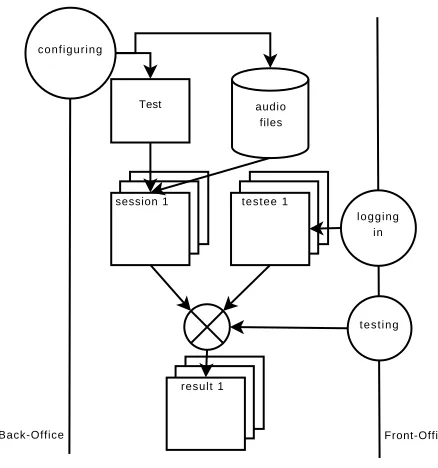
Figure 1 represents the posssible interactions of the tester and the testees on the System. This is done through two interfaces: the back and front office. The system soft-ware was written in Perl. The portability of this language, its platform independence and its easy integration in an Apache HTTP server were the main factors influencing this choice. The system is based on two widely used Perl mod-ules: the CGI module for the web interface control, and the
DBI module for the connection with the relational database management system. The way the software is implemented allows the system administrator to use any type of database.
3.1. Test configuration description
A test configuration file must describe a test dynamically. For instance, its structure must be independent of the (con-version or synthesis) system that generated the speech to be evaluated. Therefore, it must be possible for an operator to create it via a text editor . The grammar of this configura-tion file is very simple, it relies on the AppConfig Perl lib. This class controls the entry types of the configuration file. The configuration information includes:
• the name of the test author, date of origination, de-scription of the test objectives;
• the test type (AB, ABX, MOS; expandable);
• the number M of requested testees to compose a panel;
• the numberNof steps one testee should perform dur-ing a test session;
• the ordering of the stimuli (fixed, random or using graeco-latin squares);
• one (MOS tests), two (AB tests) or three (ABX tests) groups of addresses to the audio stimuli composing the test:
– these groups are introduced by a brief description of the experiment which created this set of stim-uli;
– for AB and ABX tests, the stimuli of rank iin each group are to be submitted together during the test.
The test is then introduced to the platform back-office: the configuration file is analysed to feed and set the database. Figure 2 is a screen shot of the back office. On this screen, the tester can upload a new test and monitor ongoing tests (validity of panels, etc...). M sessions are then generated composed ofN steps, each one confronting one or more acoustic stimuli (chosen among the ones provided) accord-ing to the test type. The first half of figure 1 illustrates this main back-office operation.
3.2. Testee interface
From the testee viewpoint, the system is accessible using a simple web navigator. The acoustic stimuli are transmit-ted using basic HTML 4.0 with minimum control options and no specific audio player defined (tested on Firefox 2.0 and Internet Explorer). Therefore the testee’s default audio player is automatically selected. If no player is available, the onus is on the testee to install one.
This configuration results in easy installation of the system by the test manager and simple access to the tests for testees in diverse locations.
Figure 2: The tester can monitor ongoing tests and create new test instances
Figure 3: The platform proposes several tests to the listen-ers
the platform, or log in if he(she) returns. During the first operation, the testee fill in some personal data as his(hers) mother tongue, age, location, etc... Afterwards, the testee can perform one session of the tests selected by the system (see figure 3). Note that a testee cannot perform the same test twice.
The answers to each of the questions are recorded along with a reference to the current session and on the testee’s identity. Figure 4 is a screen shot of question ask to the testee during a test.
When the number of valid sessions of a test reaches the
Figure 4: A step in the subjective evaluation
quota fixed by the author of the test, it is no longer accessi-ble by the testees: the panel is completed.
3.3. Database content
The system database consists of six tables:
1. a user table for the testee references (identity, age, sex, listening conditions, etc.);
2. a test table for the test references (type, creation date, description, etc.);
3. an audio table for the acoustic stimuli references used in the tests (file path, experiment belonging, etc.);
4. a panel table to tie some user groups to the different available tests, and to record how complete each test is;
5. a session table to set the identity and order of the acoustic stimuli to be submitted to a given testee for a given test;
6. a result table to record the testee choices at each step.
The test, audio, panel and session table data are set during the test configuration file analysis, while the user and result table data are recorded at registration time and during the tests themselves.
4.
Perceptive test experiment
This test platform has been used for a study we are con-ducting on speech conversion from a supra-segmental view-point. The goal of the test was to extract from all the pairs of speakers available in the BREF120 corpus (Lamel et al., 1991) the one showing the greatest prosodical differ-ence among the largest amount of sentdiffer-ences. This pair of speakers should be used later in the study to evaluate supra-segmental conversion methods.
4.1. CMOS Test
The goal of the planned experiment does not exaclty fit the workframes of the common AB-BA, ABX or MOS evalua-tions. Indeed, our goal here is to assess the supra-segmental difference between two speeches (prosody, elocution rate, etc.). So we added a CMOS type of test (Comparison Mean Opinion Score) (ITU-T, 1996) to the platform with its as-sociated Perl module. Its integration was made easy since this new module only had to implement a standardized in-terface. This interface gathers three functions. The first function manages the way the audio file paths mentionned in the configuration files are stocked in the database. The second function handles each step (the question to be asked to the testee and the possible choices). The last function exploits the results and presents them.
During a CMOS type test, the testees have to extract a pair of voices from a set of given pairs. The set is limited in size and described in the test configuration file (as illus-trated by figure 5). For each session, the testee evaluates the dissemblance degree of the two voices being presented at each step. The question asked is: “Would you qualify the
Speakers 0 1 2 3 4 wtd mean
JNF(5) JMF(2) 4 3 0 0 0 0.43
I8F(2) JMF(2) 2 2 1 0 0 0.80
IYF(7) IZF(5) 3 2 2 0 0 0.86
I9F(7) JNF(5) 2 0 2 0 0 1.00
IIF(7) JWF(5) 2 7 0 1 0 1.00
IBF(5) JOF(7) 1 4 0 1 0 1.17
J9F(7) K3F(6) 2 4 2 0 1 1.33
IEF(6) JSF(6) 3 3 3 2 0 1.36
J5F(5) JZF(5) 1 5 1 0 1 1.38
JLF(6) JKF(6) 1 2 1 1 0 1.40
I9F(7) JMF(2) 2 1 1 0 1 1.40
JXF(7) JWF(5) 0 6 1 2 0 1.56
I8F(2) I9F(7) 1 3 1 2 0 1.57
IIF(7) JXF(7) 2 4 1 3 1 1.73
J6F(6) K0F(6) 1 2 3 2 0 1.75
I3F(3) I2F(7) 1 5 1 3 1 1.82
JPF(5) JOF(7) 1 3 1 2 1 1.88
I5F(2) JHF(2) 1 1 3 1 1 2.00
IBF(5) JPF(5) 0 4 4 4 0 2.00
I1F(7) JIF(7) 0 3 3 2 1 2.11
IXF(7) IWF(5) 0 1 1 2 0 2.25
ICM(7) IDM(6) 5 3 1 0 0 0.56
I6M(6) JJM(7) 3 4 1 0 0 0.75
ICM(7) JQM(5) 1 4 1 0 0 1.00
IHM(7) IGM(7) 4 5 2 0 1 1.08
K6M(7) JCM(7) 3 2 2 1 0 1.13
J7M(7) K1M(7) 3 2 3 0 1 1.33
IDM(6) JQM(5) 1 3 3 1 0 1.50
I0M(6) I7M(7) 0 3 0 3 0 2.00
ISM(7) ITM(7) 0 1 3 3 2 2.67
Table 1: CMOS test results, discrimination of native speaker vs native speaker (top: female speakers; bottom: male speakers)
Speaker 0 1 2 3 4 wtd mean
J8F(6) K2F(2) 2 3 0 0 0 0.60
IFM(7) JTM(6) 10 2 0 0 0 0.17
IHM(7) JUM(7) 8 3 1 0 0 0.42
JFM(7) JEM(7) 6 2 0 1 0 0.56
IGM(7) JVM(7) 3 3 2 0 0 0.88
JVM(7) JUM(7) 2 3 2 2 0 1.44
IHM(7) JVM(7) 0 5 0 0 0 1.00
K7M(6) JDM(7) 0 3 2 0 0 1.40
IGM(7) JUM(7) 0 1 1 1 0 2.00
I4M(7) JGM(7) 0 2 3 1 3 2.56
Table 2: CMOS test results, discrimination of native speaker vs non-native speaker (top: female speakers; bot-tom: male speakers)
6.
References
A.W. Black and K. Tokuda. 2005. The blizzard challenge-2013 2005: Evaluating corpus-based speech synthesis on common datasets. In EUROSPEECH, pages 77 – 80, Lisbon, Portugal, September.
H. Duxans, A. Bonafonte, A. Kain, and J.P.H. Van Santen.
2004. Including dynamic and phonetic information in voice conversion systems. In International Conference
on Spoken Language Processing.
H. Franc¸ois. 2002. Synth`ese de la parole par con-cat´enation d’unit´es acoustiques : construction et ex-ploitation d’une base de parole continue. Ph.D. thesis,
Universit´e de Rennes 1.
ITU-T. 1996. Itu-t recommendation p.800: Methods for subjective determination of trnasmission quality. U. Jekosch. 1993. Speech quality assessment and
evalu-ation. In Proceedings of Eurospeech 93, pages 1387 – 1394.
A. Kain. 2001. High Resolution Voice Transformation. Ph.D. thesis, OGI School of Science and Engineering at Oregon Health and Science University,.
L. Lamel, J.-L. Gauvain, and M. Eskenazi. 1991. Bref, a large vocabulary spoken corpus for french. In European
Conference on Speech Communication and Technology,
pages 505–508, 24-26 September.
D. Suendermann, A. Bonafonte, H. Duxans, and H. Hoege. 2005. Tc-star: Evaluation plan for voice conversion technology. In DAGA 2005, 31st German Annual