Mining the Correlation between Human and Automatic Evaluation
at Sentence Level
Yanli Sun
School of Applied Language and Intercultural Studies, Dublin City University
Abstract
Automatic evaluation metrics are fast and cost-effective measurements of the quality of a Machine Translation (MT) system. However, as humans are the end-user of MT output, human judgement is the benchmark to assess the usefulness of automatic evaluation metrics. While most studies report the correlation between human evaluation and automatic evaluation at corpus level, our study examines their correlation at sentence level. In addition to the statistical correlation scores, such as Spearman's rank-order correlation coefficient, a finer-grained and detailed examination of the sensitivity of automatic metrics compared to human evaluation is also reported in this study. The results show that the threshold for human evaluators to agree with the judgements of automatic metrics varies with the automatic metrics at sentence level. While the automatic scores for two translations are greatly different, human evaluators may consider the translations to be qualitatively similar and vice versa. The detailed analysis of the correlation between automatic and human evaluation allows us determine with increased confidence whether an increase in the automatic scores will be agreed by human evaluators or not.
1. Introduction
It is widely recognized that evaluation plays an important role in the development of language technologies. In the area of Machine Translation (MT), there are two types of commonly used evaluation methods. While human evaluation is still the most important means of providing valuable feedback on the further development of an MT system, its cost, labour-intensive and highly subjective characteristics have led to the popularity of automatic evaluation metrics, such as BLEU (Bilingual Evaluation Understudy) (Papineni et al. 2001), Precision and Recall (Turian et al. 2003), TER (Translation Error Rate) (Snover et al. 2006) etc. According to Coughlin (2001), automatic metrics have the advantages of high speed, convenience and comparatively lower-cost. However, as humans are the end-users of MT, human judgement is ultimately the benchmark to assess the usefulness of automatic metrics. How good an automatic metric is depends on its correlation with human evaluation. Two major forms of human evaluation in the area of MT are: scoring, which requires human evaluators to assign two scores (usually 1 to 5) representing the fluency and accuracy of a translation (LDC, 2005); and ranking, which asks human evaluators to compare the translations from different MT systems and assign rankings to them. The problem of scoring is that even with a clear guideline at hand, human evaluators still find it hard to assign appropriate scores to a translation. Ranking, on the other hand, is found to be quite intuitive and reliable (Vilar et al., 2007). Callison-Burch et al. (2008) concluded from their study that ranking was more reliable compared to scoring. Duh (2008) also pointed out that ranking could simplify the decision procedures for human evaluators compared to assigning scores.
Depending on the type of human evaluation used, the correlation between automatic and human evaluation is measured either by Pearson's correlation coefficient or Spearman's correlation coefficient. The correlation value
ranges from -1 to 1 representing negative correlation to perfect positive correlation.
As automatic metrics are more effective at corpus level, more effort has been taken on finding out which automatic metric correlates better with human evaluation at corpus level. Nevertheless, increasing attention is being paid to correlation at sentence level. According to Lin and Och (2004), high sentence level correlation of automatic and human evaluation is crucial for machine translation researchers. Russo-Lassner et al. (2005) also pointed out that automatic metrics of high sentence level correlation could “provide a finer-grained assessment of translation quality” and could also “guide MT system development by offering feedback on sentences that are particularly challenging”(p3).
This paper extends the research on correlation at sentence level, aiming at finding out which automatic metric correlates better with human evaluation in terms of Chinese translation from English; and our second aim is to investigate how big a difference between two automatic scores has to be in order to reflect the qualitative changes of the translations. The remainder of the paper is organized as follows: Section two introduces the experiment setting; Section three reports the correlation level between automatic and human evaluation at sentence level; Section four examines the detailed difference between the judgement of automatic evaluation and human evaluation; and Section five summarizes the findings and points out future research questions.
2. Experiment Setting
Altogether 570 sentences were randomly selected as the test sample. The Chinese reference of the test sample was extracted from the company’s Translation Memory. Four MT systems (one Rule-Based system and three Statistical-Based systems) were employed to translate the test sample into Chinese for comparison. Both human and automatic evaluations were applied in order to rank the quality of the output from the four systems. Four professional translators were employed to rank the outputs from 1 to 4 (1 being the best, 4 being the worst) sentence by sentence. BLEU, TER and GTM (General Text Matcher, an implementation of precision and recall) were used to get the automatic scores of each translation at both corpus level and sentence level. The reasons for using these three metrics are: first, they can be used (and have been used) to evaluate Asian language outputs (in this paper, Chinese); second, they are among the most widely used metrics in the area; third, they are relatively easy and cost-effective to use. There are also many other automatic metrics, such as Meteor (Banerjee & Lavie, 2005),TERp (Snover et al., 2009), etc. However, additional conditions are needed to get the best advantage from these metrics. For example, Meteor functions better with a database of synonyms, such as the WordNet for English; TERp requires paraphrases which also function as “synonyms” of phrases. Since these resources for Chinese were not available in our pilot project, these metrics were not employed in this paper. The next section compares the scores from the automatic metrics with the rankings from human evaluators to check how consistent the two evaluation methods are at sentence level with detailed analysis followed in section four.
3. Correlation Check
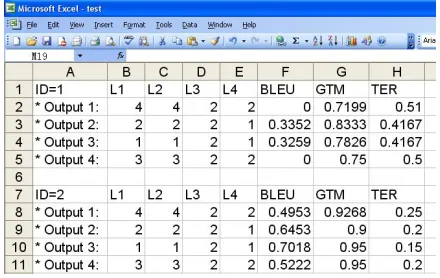
The correlation between automatic evaluation and human evaluation at sentence level was obtained following the practice of Callison-Burch et al. (2008). As mentioned earlier, we have 570 source English sentences to be translated by four MT systems into Chinese. Therefore, for each source English sentence, four translations can be produced which are ranked by four professional translators and scored by three automatic evaluation metrics. In other words, there are 570 groups (with four items per group) each of which contains four columns of rankings from the four human evaluators and three columns of scores from the three automatic metrics. Figure 1 below shows a sample of the final results sheet. L1, L2, L3, L4 in Figure 1 refer to the four human evaluators respectively.
Figure 1: Sample of the Final Results Sheet
One approach to computing the correlation is Spearman's ranking correlation coefficient (ρ). The process of getting Spearman’s ranking correlation is as follows: first, the scores assigned by the automatic metrics should be converted into rankings as well; second, for each of the 570 groups, calculate the p value between each automatic metric and each human evaluator using the four items; third, average all the p values to get the mean p value between each metric and each human. Table 1 below reports the correlation values using this method.
L1 L2 L3 L4 Average
GTM 0.32 0.50 0.14 0.26 0.30
TER 0.33 0.48 0.12 0.24 0.29
BLEU 0.34 0.44 0.13 0.26 0.29
Table 1: Spearman’s Correlation between Automatic and Human Evaluation
However, the validity of this approach was questioned by Callison-Burch et al. (2008) who claimed that getting the general correlation value by averaging the p values from a limited number of (here only four) items is not appropriate. Instead, in their study, they conducted pair-wise comparison of any two outputs, examining whether the automatic scores were consistent with human rankings given any two outputs (that is the higher-ranked system received a higher score). Following this approach, the 570 groups were expanded into 3420 pairs (each of the 570 groups can be expanded into 6 pairs). For each automatic metric, the total number of consistent evaluations was divided by the total number of comparisons to get a percentage. Table 2 reports the consistency.
L1 L2 L3 L4 Average
GTM 0.61 0.68 0.71 0.66 0.66
TER 0.58 0.64 0.70 0.64 0.64
BLEU 0.51 0.55 0.65 0.59 0.56
Table 2: Consistency of Automatic Evaluation with Human Evaluation
Table 2 indicates that these automatic metrics could correctly predict the human rankings of any pair of translations more than half the time. GTM correlates better with human evaluation than BLEU and TER at sentence level in Chinese output evaluation. Similar findings have been reported by Cahill (2009) in German evaluation which compared 6 metrics including the three metrics used in this paper. Besides, Agarwal and Lavie (2008) also mentioned that GTM and TER could produce more reliable sentence level scores than BLEU.
4. Further Analysis
Workshop on Statistical Machine Translation, Columbus, Ohio, June, pp. 70-106.
Coughlin, D. (2001). 'Correlating Automated and Human Assessments of Machine Translation Quality'. In Proceedings of MT Summit IX, Santiago de Compostela, Spain, September, pp. 63-70.
Duh, K. (2008). 'Ranking vs. Regression in Machine Translation Evaluation'. In Proceedings of the Third Workshop on Statistical Machine Translation, Columbus, Ohio, June, pp.191–194.
Koehn, P., Hoang, H., Birch, A., Callison-Burch, C., Federico, M., Bertoldi, N., Cowan, B., Shen, W., Moran, C., Zens, R., Dyer, C., Bojar, O., Constantin, A.& Herbst, E. (2007). "Moses: Open Source Toolkit for Statistical Machine Translation". In Proceedings of Annual Meeting of the Association for Computational Linguistics (ACL), demonstration session, Prague, June, pp.177-180.
King, J. E. (2004). 'Software Solutions for Obtaining a Kappa-type Statistic for Use with Multiple Raters'. Presented at the Annual Meeting of the Southwest Educational Research Association, Dallas, TX. Landis, J.R. & Koch, G.G. (1977). 'The Measurement of
Observer Agreement for Categorical Data.' Biometics, 33:159-174.
LDC (2005). Linguistic Data Annotation Specification: Assessment of fluency and adequacy in translations. http://projects.ldc.upenn.edu/TIDES/tidesmt.html. Lin, C. & Och, F.J. (2004). 'ORANGE: A Method for
Evaluating Automatic Evaluation Metrics for Machine Translation'. In Proceedings of the 20th International Conference on Computational Linguistics, Geneva, Switzerland, August, pp. 501-508.
Papineni, K., Roukos, S., Ward, T., & Zhu, W. (2001). 'BLEU: A Method for Automatic Evaluation of Machine Translation'. Research Report RC22176 (W0109-022), IBM T.J.Watson Research Center, September.
Russo-Lassner, G., Lin, J. & Resnik, P. (2005). 'A Paraphrase-Based Approach to Machine Translation Evaluation'. Technical report, University of Maryland, College Park.
Snover, M., Dorr, B., Schwartz, R., Micciulla, L. & Weischedel, R. (2006). 'A Study of Translation Edit Rate with Targeted Human Annotation'. In Proceedings of AMTA, Cambridge, MA, August, pp.223-231.
Snover, M., Madnani, N., Dorr, B.J. & Schwartz, R. (2009). 'Fluency, Adequacy, or HTER? Exploring Different Human Judgments with a Tunable MT Metric'. In Proceedings of the EACL-2009 Workshop on Statistical Machine Translation (WMT09), Athens, pp. 259-268.
Turian, J.P., Shen, L., & Melamed, I.D. (2003). 'Evaluation of Machine Translation and its Evaluation'. In Proceedings of the MT Summit IX, New Orleans, LA, September, pp. 386-393.