On Complex Word Alignment Configurations
Miriam Kaeshammer and Anika Westburg
University of D¨usseldorf
Universit¨atsstraße 1, 40225 D¨usseldorf, Germany [email protected],[email protected]
Abstract
Resources of manual word alignments contain configurations that are beyond the alignment capacity of current translation models, hence the termcomplex alignment configuration. They have been the matter of some debate in the machine translation community, as they call for more powerful translation models that come with further complications. In this work we investigate instances of complex alignment configurations in data sets of four different language pairs to shed more light on the nature and cause of those configurations. For the English-German alignments from Pad´o and Lapata (2006), for instance, we find that only a small fraction of the complex configurations are due to real annotation errors. While a third of the complex configurations in this data set could be simplified when annotating according to a different style guide, the remaining ones are phenomena that one would like to be able to generate during translation. Those instances are mainly caused by the different word order of English and German. Our findings thus motivate further research in the area of translation beyond phrase-based and context-free translation modeling.
Keywords:word alignment, machine translation, complexity
1.
Introduction and Motivation
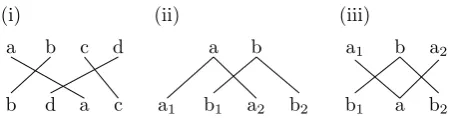
A word alignmentrepresents translational equivalence of words or phrases in a sentence pair (or paragraph pair) by a set of links between source and target words. It is a cen-tral concept of statistical machine translation (SMT), where translation models are commonly learned on the basis of word alignments (e.g. Koehn et al. (2003)), or they are in-duced jointly with the alignments (e.g. Marcu and Wong (2002)). The most prominent paradigms of translation models are phrase-based approaches (Koehn et al., 2003) and tree-based approaches that employ some form of a synchronous context-free grammar (SCFG) (Chiang, 2007; Zollmann and Venugopal, 2006; Hoang and Koehn, 2010), in particular inversion transduction grammar (ITG) (Wu, 1997). Such synchronous translation grammars also induce alignments between the words of a parallel text when ap-plying a synchronous rule during parsing (Wu, 1997). The space of alignments that can be generated with the mentioned translation grammars is limited. Inside-out alignments (IO), discussed in Wu (1997), are beyond the alignment capacity of SCFG of rank 2 (henceforth 2-SCFG) and ITG of any rank, but they can be generated by a standard phrase-based decoder due to its reordering component. Cross-serial discontinuous translation units (CDTU) (Søgaard and Kuhn, 2009) and bonbon config-urations (Simard et al., 2005) can be induced by neither phrase-based nor SCFG-based translation systems. The un-derlying assumption thereby is that atranslation unit(TU), containing the transitive closure of some set of nodes of the bipartite alignment graph, represents minimal translational correspondence. An adequate translation grammar should thus be able to generate each translation unit separately. Figure 1 schematically depicts those three well-known complex alignment configurations. The inside-out align-ment (i) consists of four translation units (a,b,candd), while (ii) and (iii) are formed by two discontinuous trans-lation units each that are intertwined.
(i)
a b c d
b d a c
(ii)
a b
a1 b1 a2 b2 (iii)
a1 b a2
b1 a b2
Figure 1: Complex alignment configurations: (i) IO; (ii) CDTU; (iii) bonbon. Source words are shown on the top, target words at the bottom. The configurations can also occur upside-down.
Knowing of the limitations of the alignment space of cur-rent translation models, their empirical adequacy has been put into question. In several studies, the empirical align-ment capacity of various formalisms with respect to man-ually aligned data has been investigated in different setups (Wellington et al., 2006; Søgaard and Kuhn, 2009; Søgaard and Wu, 2009; Søgaard, 2010; Kaeshammer, 2013). They show that the complex alignment configurations occur rel-atively frequently. For instance, Wellington et al. (2006) found that 5% of their English-Chinese sentence pairs con-tain inside-out alignments, and Kaeshammer (2013) reports that 5.5% of the sentence pairs in an English-German data set and 9% in an Spanish-French data set cannot be in-duced with an SCFG of rank 2, which is the formalism behind the prevalent hierarchical phrase-based translation grammars (Chiang, 2007).
the EU ’s budget planning must be flexible enough to cope with unforeseen expenditure
der EU-Haushaltsplan muss flexibel genug sein , um unvorhergesehene Ausgaben decken zu k¨onnen
Figure 3: IO alignment due to an annotation error:unforeseen - EU-Haushaltsplan(en-de, sent. 183)
I have a question concerning the last comment made by the Commissioner
Zur letzten Bemerkung der Frau Kommissarin m¨ochte ich ihr eine Frage stellen
Figure 4: CDTU;Commissioner - ihris correctly aligned according to the Blinker guidelines (en-de, sent. 887)
The subject1813 Menschenand the prepositional phrasein 31 L¨andern are located in the middle field of the German sentence. Together with the verbs, they are ordered in such a way that an IO alignment is created. Figure 6 shows a similar example, but where the German sentence is verb-final since it is a subordinate clause. The complementizer is usually analysed as filling the left bracket. Here, the sub-ject (die israelischen Streitkr¨afte), a prepositional phrase (aus einer Stadt) and a reflexive pronoun (sich), elicited by the fact that the English verb withdrawtranslates into the German reflexive verb sich zur¨uckziehen, are located in the German middle field. Together with the finite verb, the IO alignment is created. Even though not shown in the examples, the German initial field can also be involved in creating IO alignments.
A related phenomenon is the translation of an English verb into a German separable particle verb. While the core of the German finite verb remains in the left sentence bracket in main clauses, the particle is found at the end of the clause in the right sentence bracket. Together with the English verb, this configurations forms a DTU which, in combina-tion with the other arguments and modifiers of the clause, can lead to an IO alignment or IO-DTU.
While56.5%of the aforementioned IO alignments and IO-DTUs occur with fairly literally translated TUs that differ in their ordering (as in the sentence pairs in Figure 5, 6 and 7), the rest is part of rather free translations or freely trans-lated TUs, sometimes crossing clause boundaries. Figure 8 shows an example. Free translations also give rise to a few CDTUs and bonbon alignments.
A question that often arises when considering the complex alignment configurations is whether they are essential for translation. For the examples of IO/IO-DTU alignments due to different word orders of literally translated TUs on the clause level, we therefore additionally investigated the sentence pairs according to the following criterion: Given one sentence of the sentence pair (e.g. English) as input to a translation system, and given that the translation model yields the provided target (e.g. German) translations of each TU, is the provided target (e.g. German) sentence the only valid translation?
Consider Figure 5 as an example. When translating from English to German, a German sentence with the vided TUs but with a simpler alignment could be pro-duced, e.g. 1999 wurden 1813 Menschen in 31 L¨andern hingerichtet. The same holds for the other direction, e.g.in
31 countries, 1813 people were executed in 1999. In con-trast to that, given the German sentence in Figure 6 as input, and given that the model provides the shown English TUs, the English sentence in Figure 6 is the only valid transla-tion, due to the strict English word order. Only the prepo-sitional phrase from a city could potentially be placed at the beginning of the clause. However, it is very marked in this position and it therefore obtains a strong focus which it does definitely not have in the original sentence.
Figure 7 shows an IO alignment which involves a focus ad-verb (also/auch). The complicacy of this is that it is often impossible to unambiguously determine the focus denoted by the adverb in a single sentence (Sudhoff, 2010). Since our data sets neither include context beyond the aligned sentence pair nor intonation information, we are not able to judge whether a reordering of the involved constituents would lead to an equally good translation (without com-plex alignment). In the given sentence pair, for the direc-tionen→de, it is for instance grammatical to placeauchat the very beginning or end of the middle field, which would simplify the configuration. However, this probably changes the focus, so we decide against making a statement about alternative translations via a different word ordering. A fur-ther complication is that in some sentence pairs, the focus denoted by a focus adverb in the English sentence is ob-viously different than in the German sentence. Negation particles and their scope are similar to the focus adverbs. Under the given criterion, for 48.6%of the IO/IO-DTUs caused by word order, an equally good translation with-out complex configuration can be found when translating from English to German. For the remaining ones, a differ-ent translation would involve possible scope/focus changes. In the other direction (de→en), 31.4% of the cases can be simplified, and 28.6% involve a possible change in scope/focus. Remarkably, in 40% of the cases, the word order that involves the IO/IO-DTU is the only possible one, given the criterion defined above.
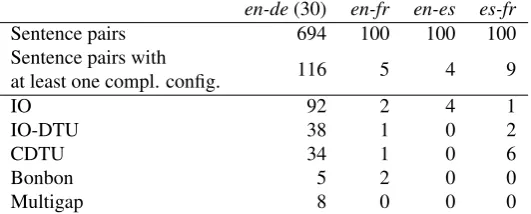
en-de(30) en-fr en-es es-fr
Sentence pairs 694 100 100 100
Sentence pairs with
116 5 4 9
at least one compl. config.
IO 92 2 4 1
IO-DTU 38 1 0 2
CDTU 34 1 0 6
Bonbon 5 2 0 0
Multigap 8 0 0 0
Table 1: Data characteristics and frequency of the complex alignment configurations (number in parentheses: sentence length cut-off)
en-de(30) en-fr en-es es-fr
(I) Error 0.115 0.000 0.000 0.000
(II) Artifact 0.328 0.167 0.000 0.111
(III) Correctly aligned 0.557 0.833 1.000 0.889
from (III)
IO 0.822 0.200 1.000 0.125
IO-DTU 0.096 0.200 0.000 0.125
CDTU 0.068 0.200 0.000 0.750
Bonbon 0.014 0.400 0.000 0.000
Table 2: Ratio of the classes of complex alignment configurations
IO-DTU together with the verb.
3.3.2. English-French
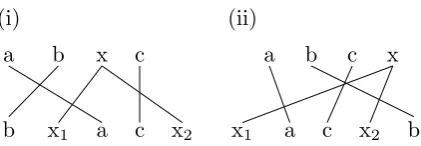
The en-fr data of course includes the often cited bonbon alignment due to the French two-part negation that frames the finite verb, and a verbal DTU with the gap on the En-glish side that is usually elicited by the use of an auxiliary because of the negation. Figure 9 (top half) shows an ex-ample from the data set.
If the French negation occurs in combination with a com-plex French verbal unit, e.g. in a compound tense, a CDTU is formed, sinceneprecedes the verbal TU andpas inter-rupts it.
CDTUs and bonbon alignments caused by the French nega-tion can generally not be resolved by reordering in analogy to the IO/IO-DTU alignments, because of the strict rules of placement of negation in relation to verbs in the involved languages. For generating these configurations, translations models beyond phrase-based and SCFG-based models are thus necessary. Further considerations about the translation of these structures are presented in Section 4.
The IO/IO-DTU configurations in theen-frdata are again caused by different word orders. They involve an adverb, which is placed at the beginning of the sentence in English, but between the finite and the non-finite verb in French compound tenses. They are either free translations, or, if not, a different word order without the complex configura-tion is possible.
3.3.3. English-Spanish
All complex alignment configurations in theen-esdata are IO alignments. Most of them reside in rather free transla-tions. The one that is created by a relatively literal trans-lation is shown in Figure 10. It is caused by the different adjectival placement in English and Spanish (pre-nominal vs. post-nominal) and the fact that the adverbial phraseto
a certain extent is located on the clause level in English, but within the noun phrase in Spanish. In this case, a more direct translation that does not require an IO alignment is possible in both translation directions.
3.3.4. Spanish-French
In the es-fr data, all CDTUs involve a French two-part negation. We observe two different phenomena. First, if the French verb is complex, e.g. in a compound tense, the sec-ond part of the negation (pas) is placed after the finite verb, thus creating a cross-serial DTU. The same phenomenon is also found in theen-frdata, see Section 3.3.2. Second, Spanish usually does not realize pronouns in subject posi-tion. The French pronoun is then aligned to the verbal TU. In combination with a negation, the first part of the nega-tion (ne) interrupts this verbal TU, creating a CDTU. An example is shown in Figure 9 in the lower half.
Just as in the en-fr data, the IO/IO-DTU configurations are also due to different word orders involving adverbial phrases. In the French sentences, the adverbials are placed between the finite and the infinite verb, while in Spanish they are found at the beginning of the sentence or on the right of the verb. One of the configurations occurs in a rather free translation, the other in sentences that could be reordered for a simpler alignment, but possibly involving a change of focus.
4.
Discussion
The results of the investigation show that, while only very few of the complex alignment configurations are true anno-tation errors, many can be argued away with reference to other annotation guidelines. The remaining ones are those of interest for translation modeling.
con-in 1999 , 1813 people were executed con-in 31 countries
1999 wurden in 31 L¨andern 1813 Menschen hingerichtet
lb rb
Figure 5: IO alignment due to different word orders; verb-second clause in German (en-de, sent. 119)
. . . that Isreali forces have withdrawn from a city
. . . dass sich die israelischen Streitkr¨afte aus einer Stadt zur¨uckgezogen haben
lb rb
Figure 6: IO alignment due to different word orders; verb-final clause in German (en-de, sent. 306)
I also wish to praise the Presidency for its hard work
Ich m¨ochte die Pr¨asidentschaft auch f¨ur ihre umfangreiche Arbeit loben
lb rb
Figure 7: IO alignment due to different word orders, includes a focus adverb (en-de, sent. 389)
It is estimated that since 1987 , two million children have been killed in armed conflict
Seit 1987 wurden etwa 2 000 000 Kinder in bewaffneten Konflikten get¨otet
Figure 8: IO alignment due to different word orders in a rather free translation (en-de, sent. 876)
We have not yet moved on to . . .
Nous n ’ en sommes pas encore `a . . .
A´un no hemos llegado a . . .
Figure 9: Bonbon alignment and CDTU due to French two-part negation (en-fr-es, sent. 13)
This is therefore , to a certain extent , an unnecessary debate
En consecuencia , es un debate en cierta medida innecesario
Figure 10: IO alignment due to modifier placement (en-es, sent. 59)
figurations. When thinking about this question, it is im-portant to keep the following points in mind: Translation is concerned with producing a good/correct output string, not with producing a correct alignment. This means that generating a specific alignment is not necessarily important for generating a specific translation. It might even happen that a system produces a translation that corresponds to a complex alignment configuration on the surface, without
actually having generated this complex configuration.
Jo˜ao de Almeida Varelas Grac¸a, Joana Paulo Pardal, Lu´ısa Coheur, and Diamantino Ant´onio Caseiro. 2008b. Multi-language word alignments annotation guidelines. Technical report, Soken Language Systems Laboratory, Lisboa, Portugal.
Hieu Hoang and Philipp Koehn. 2010. Improved transla-tion with source syntax labels. In Proceedings of the Joint Fifth Workshop on Statistical Machine Transla-tion and MetricsMATR, pages 409–417. Association for Computational Linguistics.
Tilman H¨ohle. 1983. Topologische Felder. Ph.D. thesis, Universit¨at zu K¨oln.
Maria Holmqvist and Lars Ahrenberg. 2011. A gold stan-dard for English–Swedish word alignment. In Proceed-ings of the 18th Nordic Conference of Computational Linguistics NODALIDA 2011, pages 106–113.
Miriam Kaeshammer. 2013. Synchronous linear context-free rewriting systems for machine translation. In Pro-ceedings of the Seventh Workshop on Syntax, Seman-tics and Structure in Statistical Translation, pages 68–77. Association for Computational Linguistics.
Philipp Koehn, Franz Josef Och, and Daniel Marcu. 2003. Statistical phrase-based translation. In Proceedings of the 2003 Conference of the North American Chapter of the Association for Computational Linguistics on Hu-man Language Technology, pages 48–54. Association for Computational Linguistics.
Patrik Lambert, Adri`a Gispert, Rafael Banchs, and Jos´e B. Mari˜no. 2005. Guidelines for word alignment evalua-tion and manual alignment. Language Resources and Evaluation, 39:267–285.
Lieve Macken. 2010. An annotation scheme and gold stan-dard for Dutch-English word alignment. InProceedings of the Seventh International Conference on Language Resources and Evaluation (LREC’10).
Gideon Maillette de Buy Wenniger, Maxim Khalilov, and Khalil Simaan. 2010. A toolkit for visualizing the co-herence of tree-based reordering with word-alignments.
The Prague Bulletin of Mathematical Linguistics, pages 97–106.
Daniel Marcu and William Wong. 2002. A phrase-based, joint probability model for statistical machine transla-tion. In Proceedings of the Conference on Empirical Methods in Natural Language Processing, pages 133– 139. Association for Computational Linguistics. I. Dan Melamed. 1998. Annotation style guide for the
Blinker Project. Technical Report IRCS-98-06, Univer-sity of Pennsylvania.
Franz Josef Och and Hermann Ney. 2000. Improved statis-tical alignment models. InProceedings of the 38th An-nual Meeting of the Association for Computational Lin-guistics, pages 440–447. Association for Computational Linguistics.
Sebastian Pad´o and Mirella Lapata. 2006. Optimal con-stituent alignment with edge covers for semantic pro-jection. InProceedings of the 21st International Con-ference on Computational Linguistics and 44th Annual Meeting of the ACL, pages 1161–1168.
Michel Simard, Nicola Cancedda, Bruno Cavestro, Marc
Dymetman, Eric Gaussier, Cyril Goutte, Kenji Yamada, Philippe Langlais, and Arne Mauser. 2005. Translat-ing with non-contiguous phrases. InProceedings of Hu-man Language Technology Conference and Conference on Empirical Methods in Natural Language Processing (HLT/EMNLP), pages 755–762.
Anders Søgaard and Jonas Kuhn. 2009. Empirical lower bounds on alignment error rates in syntax-based ma-chine translation. InProceedings of the Third Workshop on Syntax and Structure in Statistical Translation (SSST ’09). Association for Computational Linguistics. Anders Søgaard and Dekai Wu. 2009. Empirical lower
bounds on translation unit error rate for the full class of inversion transduction grammars. InProceedings of the 11th International Conference on Parsing Technologies, pages 33–36.
Anders Søgaard. 2008. Range concatenation grammars for translation. InProceedings of Coling 2008: Companion volume: Posters.
Anders Søgaard. 2010. Can inversion transduction gram-mars generate hand alignments? InProccedings of the 14th Annual Conference of the European Association for Machine Translation (EAMT).
Stefan Sudhoff. 2010. Focus Particles in German: Syntax, Prosody, and Information Structure. Benjamins. Heike Telljohann, Erhard W. Hinrichs, Sandra K¨ubler,
Heike Zinsmeister, and Kathrin Beck. 2012. Stylebook for the T¨ubingen Treebank of Written German (T¨uBa-D/Z). Technical report, Seminar f¨ur Sprachwissenschaft, Universit¨at T¨ubingen, January.
Benjamin Wellington, Sonjia Waxmonsky, and I. Dan Melamed. 2006. Empirical lower bounds on the com-plexity of translational equivalence. In Proceedings of the 21st International Conference on Computational Lin-guistics and 44th Annual Meeting of the Association for Computational Linguistics, pages 977–984.
Dekai Wu. 1997. Stochastic inversion transduction gram-mars and bilingual parsing of parallel corpora. Compu-tational linguistics, 23(3):377–403.