Temporal Relation Classification using a Model of Tense and Aspect
Leon Derczynski University of Sheffield [email protected]
Robert Gaizauskas University of Sheffield [email protected]
Abstract
Determining the temporal order of events in a text is difficult. However, it is crucial to the extraction of narratives, plans, and context. We suggest that a simple, estab-lished framework of tense and aspect pro-vides a viable model for ordering a sub-set of events and times in a given text. Using this framework, we investigate ex-tracting features that represent temporal information and integrate these in a ma-chine learning approach. These features improve event-event ordering.
1 Introduction
It is important to understand time in language. The ability to express and comprehend expressions of time enables us to plan, to tell stories, and to dis-cuss change in the world around us.
When we automatically extract temporal infor-mation, we are often concerned with events and times – referred to collectively as temporal inter-vals. We might ask, for example, “Who is the current President of the USA?.” In order to ex-tract a single contemporary answer to this ques-tion, we need to identify events related to persons becoming president and the times of those events. Crucially, however, we also need to identify the ordering between these events and times, by as-signing a temporal relation type (from e.g. Allen (1983)). This last task,temporal relation typing, is challenging (UzZaman et al., 2013; Bethard et al., 2015), and is the focus of this paper.
When events are expressed as verbs, tense and aspect are used to convey temporal features of these events. Thus, it is intuitive that tense and aspect will be of value in determining the type of temporal relation that holds between two verb events, and evidence in human-annotated corpora supports this intuition.
Event-event relations are often the hardest to la-bel (Derczynski, 2015). Around 45% of links in TempEval-3 (UzZaman et al., 2013) event-event ordering tasks cannot reliably be labelled automat-ically.
Temporal relations involving at least one argu-ment with tense or aspect information are preva-lent. Verb-verb links make up around a third of TimeBank’s temporal relations,1and tensed verb-verb links the largest share of that set, so of all verb-verb relations, the majority are between two tensed verbs.
Data-driven approaches to the relation typing task are hampered in two ways. Firstly, there is a shortage of ground truth training data. This leads to low volumes of instances for many combina-tions of tense and aspect values for pairs of events, hampering automatic hypothesis learning (Lapata and Lascarides, 2006). Secondly, the range of tense and aspect expression in TimeML is rela-tively limited, describing three “tenses”2(past and past participle, present and present participle, and future) and three “aspects” (none, perfective and progressive). This markup language may be insuf-ficiently descriptive to capture relations implied by variations in linguistic use of tense and aspect.
Reichenbach (1947) offers a theoretical frame-work for analysis of tense and aspect that can be used to predict constraints on temporal orderings between verb events based on their tense and as-pect, and also between times and tensed verbs. Applying Reichenbach’s framework requires tense and aspect information, which may yet be usefully available in existing corpora.
In this paper, we describe an approach to us-ing Reichenbachs model to generate features for
1TimeBank is a corpus semantically annotated for tempo-ral information in TimeML (Pustejovsky et al., 2003; Puste-jovsky et al., 2004)
2In TimeML v1.2, the tense attribute of events has values that are conflated with verb form. This conflation is depre-cated in newer versions of TimeML, post-TimeBank.
a machine learning approach to temporal relation typing and report an experiment showing it brings modest improvement.
2 Reichenbachian Tenses
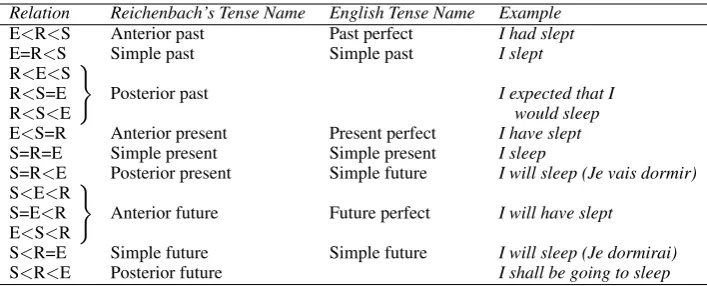
Reichenbach details nine tenses (see Table 1). The tenses detailed by Reichenbach are past, present or future, and may take a simple, anterior or posterior form. In English, these apply to single finite verbs and to verbal groups consisting of head verb and auxiliaries. The tense system describes abstract time points for each tensed verb – event timeE, speech/utterance timeS, and reference time R – and how they may interact, both for a single verb and with other events.
In Reichenbach’s view, different tenses specify different relations betweenE, R andS. Table 1 shows the six tenses conventionally distinguished in English. As there are more than six possible or-dering arrangements ofS,EandR, some English tenses might suggest more than one arrangement. Reichenbach’s tenses also suffer from this ambi-guity when converted toS/E/Rstructures, albeit to a lesser degree. When following Reichenbach’s tense names, it is the case that for past tenses, R
always occurs beforeS; in the future,Ris always after S; and in the present, S and R are simul-taneous. Further, “anterior” suggestsEbeforeR, “simple” thatRandEare simultaneous, and “pos-terior” that E is after R. The flexibility of this framework is sufficient to allow it to account for a very wide set of tenses, including all those de-scribed by Song and Cohen (1988), and this is suf-ficient to account for the observed tenses in many languages. Past, present and future tenses imply
R < S,R=SandS < Rrespectively. Anterior, simple and posterior tenses implyE < R,E =R
andR < Erespectively. 2.1 Verb Interactions
While each tensed verb involves a speech, event and reference time, multiple verbs may share one or more of these points. For example, all narrative in a news article usually has the same speech time (that of document creation). Further, two events linked by a temporal conjunction (e.g. after) are very likely to share the same reference time. Basic methods of linking between verb events or linking verbs to fixed points on a time scale are described below.
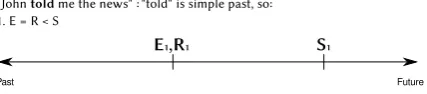
Figure 1: An example of permanence of the reference point.
2.2 Special Properties of the Reference Point The reference pointRhas two special uses. These relate to verbs in the sametemporal contextand to the effect of time expressions on verbs. Reichen-bach relies on a notion of “same temporal context” without ever defining it precisely. It could be sim-ilar to the concept put forward by Dowty (1986) with temporal discourse interpretation princi-ple(TDIP). Below we operationalise the concept in several ways to mean either “same sentence” or “adjacent sentence pairs”, though other interpreta-tions are also possible.
Permanence Firstly, when sentences are com-bined to form a compound sentence, tensed main verbs interact, and implicit grammatical rules re-quire tenses to be adjusted. These rules operate such thatRis the same in all cases in the sequence. Reichenbach names this principlepermanenceof the reference point. Figure 1 contains an example of this principle.
Relation Reichenbach’s Tense Name English Tense Name Example E<R<S Anterior past Past perfect I had slept E=R<S Simple past Simple past I slept R<E<S)
R<S=E Posterior past I expected that I
R<S<E would sleep
E<S=R Anterior present Present perfect I have slept S=R=E Simple present Simple present I sleep
S=R<E Posterior present Simple future I will sleep (Je vais dormir) S<E<R)
S=E<R Anterior future Future perfect I will have slept E<S<R
S<R=E Simple future Simple future I will sleep (Je dormirai) S<R<E Posterior future I shall be going to sleep
Table 1: Reichenbach’s tenses; from Mani et al. (2005)
e1↓; e2→ Sim Past Pos Past Ant Pres Sim Pres Ant Fut Sim Fut Sim Past vague after vague after after after Pos Past before vague vague vague after after Ant Pres vague vague vague after vague after Sim Pres before vague vague overlap vague after Ant Fut before before vague vague vague after Sim Fut before before before before before vague
Table 2: Verb-verb event orderings based on the Reichenbachian tenses that map directly to those in TimeML. Cell values describe thee1[rel]e2relationship.
In Example 1, the reference point is determined positionally with an explicit time (10 o’clock). (1) It was 10 o’clock, and Sarah had brushed
her teeth.
The verb group had brushed is anterior past tense; that is,E < R < S. The event is complete before the reference time – that is, at any point until10 o’clock– and so the relation between the event and timex can be determined (brushed BE -FORE10 o’clock).
2.3 Feature Extraction
Two interpretations of the model are used in fea-ture extraction. Firstly, a simple view is taken as-suming permanence of the reference point. This provides a constraint dependent on the pairing of Reichenbachian tenses used, and is detailed in Table 2. Secondly, an advanced interpreta-tion is used, following Derczynski and Gaizauskas (2013). This approach fully populates all Reichen-bachian tense combinations using Freksa’s tempo-ral semi-interval algebra (Freksa, 1992) to derive a (large) temporal constraint table, which for space reasons is omitted here.
In all cases, the gold standard tense and aspect features annotated on the events in TimeBank are used as the basis for Reichenbachian representa-tions.
3 The Framework in TLINK Typing TimeML provides some of the information that Reichenbach’s framework alone does not cater for and vice versa. A combination of the two may lead to better labelling performance, but relying on Re-ichenbach’s framework alone for rule-based tem-poral relation label constraint is insufficient. How-ever, the framework has shown to inform prior sys-tems effectively (Chambers et al., 2014). The situations we examine are those where two verb events occur in the same temporal context, where a timex directly influences a verb event, and also verb events that report other verb events.
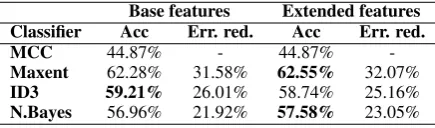
Reichenbach’s framework is used as a linguistic model that generates temporal ordering features, which are added to a base feature set. The base features are those as in Mani et al. (2007), i.e.: For each event: text; TimeML tense and aspect; modality; cardinality; polarity; event class; part-of-speech tag.
tic annotation standard. We proposed two ways of using Reichenbach’s framework to generate fea-tures for machine learning of temporal relations, which improved relation typing performance in this difficult task. The framework suggests helpful constraint of relation types in cases where verbs are in the same context, helping in the difficult task of automatic temporal relation typing.
References
J. Allen. 1983. Maintaining knowledge about
tem-poral intervals. Communications of the ACM,
26(11):832–843.
S. Bethard, L. Derczynski, J. Pustejovsky, and M. Ver-hagen. 2015. Semeval-2015 task 6: Clinical Tem-pEval. InProc. SemEval.
N. Chambers, T. Cassidy, B. McDowell, and S. Bethard. 2014. Dense event ordering with a
multi-pass architecture. Transactions of the
Asso-ciation for Computational Linguistics, 2:273–284. L. Derczynski and R. Gaizauskas. 2013. Empirical
Validation of Reichenbach’s Tense Framework. In
Proceedings of the 10th Conference on Computa-tional Semantics, pages 71–82. ACL.
L. Derczynski. 2015. Automatically Ordering Events
and Times in Text. Studies in Computational Intelli-gence. Springer.
D. Dowty. 1986. The effects of aspectual class on the temporal structure of discourse: semantics or prag-matics? Linguistics and philosophy, 9(1):37–61. C. Freksa. 1992. Temporal reasoning based on
semi-intervals. Artificial intelligence, 54(1):199–227.
M. Lapata and A. Lascarides. 2006. Learning
sentence-internal temporal relations. Journal of Ar-tificial Intelligence Research, 27(1):85–117. I. Mani, J. Pustejovsky, and R. Gaizauskas. 2005. The
Language of Time: A Reader. Oxford University
Press.
I. Mani, B. Wellner, M. Verhagen, and J. Pustejovsky. 2007. Three approaches to learning TLINKS in TimeML. Technical Report CS-07-268, Brandeis University, Waltham, MA, USA.
T. A. Miller, S. Bethard, D. Dligach, S. Pradhan, C. Lin, and G. K. Savova. 2013. Discovering narra-tive containers in clinical text.Proc. ACL, page 18. J. Pustejovsky, P. Hanks, R. Sauri, A. See,
R. Gaizauskas, A. Setzer, D. Radev, B. Sund-heim, D. Day, L. Ferro, et al. 2003. The Timebank Corpus. InCorpus Linguistics, pages 647–656.
J. Pustejovsky, B. Ingria, R. Sauri, J. Castano, J. Littman, and R. Gaizauskas. 2004. The
Specifica-tion Language TimeML. InThe Language of Time:
A Reader, pages 545–557. Oxford University Press.
H. Reichenbach. 1947. The tenses of verbs. In
Ele-ments of Symbolic Logic. Dover Publications. F. Song and R. Cohen. 1988. The interpretation of
temporal relations in narrative. In Proceedings of
the 7th National Conference of AAAI.
N. UzZaman, H. Llorens, L. Derczynski, J. Allen, M. Verhagen, and J. Pustejovsky. 2013. SemEval-2013 Task 1: TempEval-3: Evaluating Time Expres-sions, Events, and Temporal Relations. InProc.
Se-mEval, pages 1–9. Association for Computational