1295
Tagger for Polish Computer Mediated Communication Texts
Wiktor Walentynowicz Wrocław University of Science and Technology
Maciej Piasecki Wrocław University of Science and Technology
{wiktor.walentynowicz,maciej.piasecki,marcin.oleksy}@pwr.edu.pl Marcin Oleksy
Wrocław University of Science and Technology
Abstract
In this paper we present a morpho-syntactic tagger dedicated to Computer-mediated Communication texts in Polish. Its construction is based on an expanded RNN-based neural network adapted to the work on noisy texts. Among several tech-niques, the tagger utilises fastText ding vectors, sequential character embed-ding vectors, and Brown clustering for the coarse-grained representation of sentence structures. In addition a set of manu-ally written rules was proposed for post-processing. The system was trained to disambiguate descriptions of words in re-lation to Parts of Speech tags together with the full morphological information in terms of values for the different grammat-ical categories. We present also evaluation of several model variants on the gold stan-dard annotated CMC data, comparison to the state-of-the-art taggers for Polish and error analysis. The proposed tagger shows significantly better results in this domain and demonstrates the viability of adapta-tion.
1 Introduction
Morpho-syntactic disambiguation (called also morpho-syntactic tagging) is an important pre-processing step in many text pre-processing pipelines (e.g. terminology and information extraction), es-pecially in the case of highly inflected languages where tagging is tightly correlated with lemma-tisation. Work on the development of programs for morpho-syntactic disambiguaters, henceforth taggers, has been concentrated on texts written in the standard language, i.e. containing only small percentage free of jargon, extra-linguistic
elements like codes or symbols, etc. Computer-mediated communication (CMC) texts, especially texts from different kinds of social media, are writ-ten in language that ofwrit-ten is significantly different from the standard language, see Sec.3. While in the case of texts in a standard language, a state-of-the-art tagger reaches near 95% of accuracy in dis-ambiguation, taggers for CMC texts express much lower accuracy. Moreover, much fewer works are devoted to tagging CMC texts than text of the stan-dard language, while the problem of processing CMC texts is continuously growing in importance and numbers of applications. Thus, the fast growth of social media requires appropriate adaptation, or even expansion, of the tagging methods, to serve growing interest and requirements in the process-ing of texts of such kinds. Accordprocess-ing to our best knowledge, a morpho-syntactic tagger dedicated to CMC texts in the Polish language has not been yet developed or at least made publicly available. The goal of this work is a far going adaptation of a tagger for the standard Polish to the demands of CMC texts in Polish.
In the rest of the paper, first solutions for tag-ging the standard Polish language and CMC texts in general are discussed. Next, we analyse charac-teristic features of CMC texts on the basis of a col-lected CMC corpus. A tagger model is proposed. Finally, we presented evaluation of the tagger and discuss perspectives for its further development.
2 Related Works
characters replacements, abbreviated forms, URL addresses, hashtags, mentions). Most of these phenomena require specific solutions in annota-tion guidelines. Since the available data in Pol-ish is based on the sources of a different nature – they are mostly edited and officially published texts (Przepiórkowski et al., 2012) – there was a need to create a CMC corpus manually annotated with morphological information.
TheCorpus of the Colloquial Polish Language1 (CCPL) used in all experiments presented in this paper consists of 7,561 documents (402,810 to-kens). All the source texts were posted by users on online social media platforms, so they have the characteristics of user-generated content (UGC). The texts include opinions, tweets, comments, so-cial media posts and chat utterances.
The whole corpus was manually annotated with morphological information and next morpho-syntactically disambiguated by the team of pro-fessional linguists from the Wrocław University of Science and Technology. The inter-annotator agreement for various pairs of annotators was cal-culated. The results ranged from 0.91 to 0.97.
4 Tagger Model
4.1 Data and Preprocessing
National Corpus of Polish (NCP) as the basic training data, and only in some experiments we ex-panded the training data with annotated texts from social media coming from CCPL, see Section 5. This subcorpus of NCP contains a bit above 1.2 million of manually annotated and disambiguated tokens from different sources. It is commonly used as training-testing data set for a tagging task in Polish language. For the test data set we used CCPL, which is described in Section5.1.
We have decided not to apply text normalisation before tagging process in order to save as much in-formation as possible from the text structure which can be helpful in next stages of processing like sentiment recognition. Many of the methods pro-posed in literature are based on a process: nor-malisation followed by tagger application. Thus, a comparison of our solution with them is difficult, as the text tagged is different. Therefore we do not handle segmentation problems in our tagging system. To deal with typos and lack of diacritics we focus on character representation together with suffix representation and choose to use thefastText
1http://hdl.handle.net/11321/637
embedding (Bojanowski et al., 2017), because it is based on the n-gram based subword word rep-resentation. In addition, we obtained cluster in-formation to get better representation of contexts for similar words. We applied the Brown Cluster-ing algorithm (Brown et al.,1992) to group words on the basis of the one million subcorpus of NCP (Przepiórkowski et al.,2012) (this is the same data set which is used as training data). The Brown Clustering is a method of hierarchical clustering of words based on their contexts. We assumed that words belonging to the same clusters have the same probability of the contextual occurrence un-der the condition of the occurrence of preceding and following words. In principle, we want to achieve good results in spite of processing noisy textual data, due to the knowledge of their struc-ture on the coarse-grained description level based on Brown clusters of words. We assume that such representation helps to determine to which group of words an unknown or broken word may be-long to. Other elements of CMC texts are emoti-cons, URL and e-mail addresses, hashtags and user mentions. We handle these cases with hand-written rules.
In several experiments, see Section5, the evalu-ation of the whole tagging process was performed on the entire CCPL corpus, because it was not in-volved in training in those cases.
4.2 Input Text Representation
In order to improve the tagger ability to generalise over the training data, we used a representation based on distributional vector models. An input vector for a word from the processed sentence is constructed as a concatenation of several subvec-tors representing different properties of a word:
1. a morphological information vector,
2. a suffix character embedding vector,
3. a suffix index in the set of known suffixes,
4. a suffix embedding vector,
5. a word embedding vector from a fastText -based model,
6. a whole word character embedding,
7. a Brown cluster embedding vector.
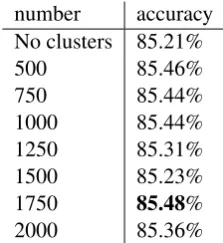
number accuracy No clusters 85.21%
500 85.46%
750 85.44%
1000 85.44%
1250 85.31%
1500 85.23%
1750 85.48%
2000 85.36%
Table 1: Influence of the number of clusters on the tagger strict accuracy.
specified for this grammatical class. In the case of the lack of a tag exactly matching the predicted one among the tags obtained from the morpholog-ical analysis, for the final tag selection, we choose a tag that is in the minimal Levenshtein distance of its form to the form of the predicted tag, i.e. the predicted tags are somehow mapped onto tags available from the morphological analysis (in the case of out-of-vocabulary words the full set of tags is assumed as the result of the morphological anal-ysis).
In order to improve an automatic tagging pro-cess, we developed and applied several rules. They specify morphological interpretations for selected words directly encountered in text. This concerns, in particular, emojis or internet addresses. In some cases a rule covers only the first characters which serve to identify the relevant word form, e.g. it was not possible to list all URL addresses but the rule using the expression [if ’https://’ in w] could be applied to all word forms that begin withhttps://).
A morphological interpretation for several word forms (or types of word forms) were assigned ir-respective of the interpretation automatically pre-dicted by the tagger. An example of such a general rule is given below:
if 0https://0in w or0http://0in w:
corrected_tag=0 subst:sg :nom:m0
The results of the first attempt to error analysis were the basis for drawing up also specific rules for the word forms tagged initially with specific morphological information, e.g.
if (w == 0jak0or w == 0tak0)
and predicted_tag== 0adv :pos0:
corrected_tag = 0adv0
settings accuracy
SCE(128) + SE(64) 86.09%
SCE(128) + SE(64) + CLE(64) 87.06% SCE(128) + SE(64) + CLE(64) + R 87.87% CE(128) + SE(64) + CLE(64) + R 87.39% CE(128) + SCE(128) + CLE(64) + R 87.67%
Table 2: CMC tagger strict accuracy in relation to the different ways of composing the input vector.
5 Evaluation
5.1 Experiments
In our research, we focused on two main aspects
• determining the best number of Brown clus-ters,
• and selecting the best possible configuration of the input vector components.
In all experiments the input vector included the components representing the morphological anal-yses and the fastText based representation of words. The fastText component vector size was fixed to 300 elements.
First, we performed tests to find the best num-ber of the Brown clusters. The results of these ex-periments are shown in Table1. The performance of the tagger is measured in the strict accuracy, i.e. only the assigned tags that completely, in rela-tion to all its components, match the tag from the manual annotation are treated as correct solutions. The results show that the addition of clustering, re-gardless of its size, improves the tagging accuracy. Finally, we set the number of clusters to 1,750 in accordance with the best result obtained during the first experiments.
Next, we performed several experiments that were aimed at investigating the influence of the different joint vector components on the tagger ac-curacy. The results of the most important ones are presented in Table2where the shortcuts mean:
SCE – suffix characters embedding,
SE – suffix embedding,
CE – character embedding,
CLE – clustering embedding,
object of inconsistency percent number of assigned categories 4.71%
base 6.80%
grammatical class 31.16%
case 14.45%
number 2.29%
gender 22.42%
rection 4.60%
person 1.41%
aspect 0.33%
human error 9.31%
other 2.53%
Table 4: Selected categories of the CMC Tagger errors.
Form Tag
a conj
mu ppron3:sg:dat:m1:ter:nakc:npraep sie adj:pl:nom:m2:pos
nie qub
spodoba fin:sg:ter:perf
i conj
po prep:loc
wezystkm subst:sg:loc:m1
Table 5: Example sentence number 1
as a corrupted form of si˛e, which is a reflexive pronoun or reciprocal participle (an component of a compound verb). The form wezystkm (i.e. in its proper form: wszystkim ‘everything’/‘all of them(case:dative)’) is an unknown (OOV) word for the morphological analyser, but our tagger made only a small mistake in the gender attribute – it should be neutral.
In the case of a sentence that is grammatically constructed correctly, like the one in Table6, our tagger works quite well. This sentence in English looks as follows: “In crediting the car purchase all went very smoothly and quite decent repay-ments.”.
6 Conclusions
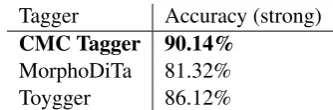
We presented that standard approaches to morpho-syntactic disambiguation must be adapted to spe-cific domains of non-standard texts, like CMC and User Generated Content texts, e.g. including so-cial media texts. Thus, we proposed significant expansions to the state-of-the-art tagger for Polish, namelyToygger, that resulted in large gain in
per-Form Tag
W prep:loc:nwok
kredytowaniu ger:sg:loc:n:imperf:aff zakupu subst:sg:gen:m3 auta subst:sg:gen:n poszło praet:sg:n:perf
bardzo adv:pos
sprawnie adv:pos
i conj
całkiem adv
przyzwoite adj:pl:nom:f:pos spłaty subst:pl:nom:f
. interp
Table 6: Example sentence number 2
formance in CMC texts, as measured on the man-ually annotated gold standard for this domain. In the proposed expansions we focused on the rep-resentation and appropriate encoding in the input vector the information about: suffix types, better word embedding models (i.e. taking into account the sub-word level) and word clusters generated on the basis of standard text, but enabling coarse-grained text representation.
In future we want to focus on improving the us-age of the morpho-syntactic information, e.g. in a form of partial recognition of possible depen-dencies. We plan to expand morphological vec-tors with the representation of the manually writ-ten constraints. We also want to work on semi-automatic extraction of contextual post-processing rules for improvement of the tagger performance. At the same time we want research how to expand representation of words on character level to get better recognition of noisy elements in text. An important challenge is handling of the segmenta-tion in a correct way or applying a more advanced normalisation process before tagging. The tag-ger is available on the open licence from: http: //hdl.handle.net/11321/634.
Acknowledgments
Marcos Zampieri, Shervin Malmasi, Preslav Nakov, Ahmed Ali, Suwon Shon, James Glass, Yves Scher-rer, Tanja Samardži´c, Nikola Ljubeši´c, Jörg Tiede-mann, Chris van der Lee, Stefan Grondelaers, Nelleke Oostdijk, Dirk Speelman, Antal van den Bosch, Ritesh Kumar, Bornini Lahiri, and Mayank
Jain. 2018.Language identification and
morphosyn-tactic tagging: The second vardial evaluation cam-paign. In Marcos Zampieri, Preslav Nakov, Nikola Ljubeši´c, Jörg Tiedemann, Shervin Malmasi, and
Ahmed Ali, editors,Proceedings of the Fifth
Work-shop on NLP for Similar Languages, Varieties and
Dialects (VarDial 2018), Association for
Compu-tational Linguistics, Santa Fe, New Mexico, USA.