Preserving a Fine-grained Access Control and Data Integrity on Cloud Storage
U.DEEPIKA1 & Y.G.Deepa2, Dr.K.Ramakrishna3 1
M-Tech Dept. of IT Sridevi Women's Engineering College Hyderabad
2
Assistant Professor Dept. of IT Sridevi Women's Engineering College Hyderabad
3
Professor & HOD, Dept. of IT Sridevi Women's Engineering College Hyderabad
Abstract
Cloud storage empowers users to store their data
remotely and enjoy the on -demand high quality
cloud applications without the burden on local
hardware and software management. The data
compromise can occur because attack by nodes
in the cloud and other users. Therefore, high
security area required protecting data in the
cloud; we introduce secure and optimal
performance approach for data manipulation in
cloud. In this methodology, when data owner
wants to send file on cloud server first file is
dividing into fragments and it then encrypted.
These encrypted fragments data over the cloud
nodes. Each node stores only one fragment of a
particular data file to make ensure even in case
that successful attack, no meaningful
information is catching to the attacker. We use
T-coloring concept for storing the fragments in
nodes and separated with certain distance to
prevent an attacker is predicting the fragments
locations. To maintain integrity we are using the
Third Party Auditor (TPA) which makes the
audit report stored file on cloud and sent it to the
data owner by mail. If attacker modified the file
then TPA sends audit report as changed file to
data owner and Proxy Agent. Finally proxy
Agent which replace the modified code with
original contents.
Keywords: cloud security, Cloud Storage,
fragmentation, Third Party Auditor (TPA),
Performance.
1.
Introduction
Cloud storage services have rapidly become
popular. Users can store their data on the cloud
and access their data anywhere at any time.
Because of user confidentiality, the data stored
on the cloud is typically encrypted and protected
from access by other users. Considering the
collaborative property of the cloud data,
attribute-based encryption (ABE) is regarded as
one of the most suitable encryption schemes for
cloud storage. Most of the planned schemes
assume cloud storage service providers or
trusted third parties handling key management
are trusted and cannot be hacked; however, in
practice, some entities may intercept
communications between users and cloud
providers to release user secrets by using
government power or other means. In this case,
encrypted data are assumed to be known and
storage providers are requested to release user
secrets. As an example, in 2010, without
notifying its users, Google released user
documents to the FBI after receiving a search
warrant. In 2013, Edward Snowden disclosed
the existence of global surveillance programs
that collect such cloud data as emails, texts, and
voice messages from some technology
companies. Once cloud storage providers are
compromised, all encryption schemes lose their
effectiveness. Though we hope cloud storage
providers can fight against such entities to
maintain user privacy through legal avenues, it
is seemingly more and more difficult.
As one example, Lava bit was an email service
company that protected all user emails from
outside coercion; unfortunately, it failed and
decided to shut down its email service. Since it
is difficult to fight against outside coercion, we
aimed to build an encryption scheme that could
help cloud storage providers avoid this
predicament. In our approach, we offer cloud
storage providers means to create fake user
secrets. Given such fake user secrets, outside
coercers can only obtained forged data from a
user’s stored cipher text. Once coercers think
the received secrets are real, they will be
satisfied and more importantly cloud storage
providers will not have revealed any real
secrets. Therefore, user privacy is still protected.
This concept comes from a special kind of
encryption scheme called deniable encryption,
first proposed in. Deniable encryption involves
senders and receivers creating convincing fake
evidence of forged data in cipher texts such that
outside coercers are satisfied. Note that
deniability comes from the fact that coercers
cannot prove the proposed evidence is wrong
and therefore have no reason to reject the given
evidence.
This approach tries to altogether block coercion
efforts since coercers know that their efforts will
be useless. We make use of this idea such that
cloud storage providers can provide audit-free
storage services. In the cloud storage scenario,
data owners who store their data on the cloud
are just like senders in the deniable encryption
scheme. Those who can access the encrypted
data play the role of receiver in the deniable
encryption scheme, including the cloud storage
providers themselves, who have system wide
secrets and must be able to decrypt all encrypted
data1. A deniable ABE scheme for cloud
storage services. ABE characteristics can be
used for securing stored data with a fine-grained
access control mechanism and deniable
encryption to prevent outside auditing. This
scheme is based on Waters cipher text policy
This scheme enhances the Waters scheme from
prime order bilinear groups to Composite order
bilinear groups. By the subgroup decision
problem assumption, this scheme enables users
to be able to provide fake secrets that seem
legitimate to outside coercers.
2.
Related Work
2.1 EXISTING SYSTEM:
There are numerous ABE schemes that have
been proposed. Most of the proposed schemes
assume cloud storage service providers or
trusted third parties handling key management
are trusted and cannot be hacked; however, in
practice, some entities may intercept
communications between users and cloud
storage providers and then compel storage
providers to release user secrets by using
government power or other means. In this case,
encrypted data are assumed to be known and
storage providers are requested to release user
secrets.Sahai and Waters first introduced the
concept of ABE in which data owners can
embed how they want to share data in terms of
encryption. There are two types of ABE,
CP-ABE and Key-Policy CP-ABE (KP-CP-ABE).Goyal et
al. proposed the first KPABE. They constructed
an expressive way to relate any monotonic
formula as the policy for user secret keys.
Bettencourt et al. proposed the first CP-ABE.
This scheme used a tree access structure to
express any monotonic formula over attributes
as the policy in the cipher text.
DISADVANTAGES OF EXISTING
SYSTEM:
It is also impractical to encrypt data many times
for many people. With ABE, data owners decide
only which kind of users can access their
encrypted data. Users who satisfy the conditions
are able to decrypt the encrypteddata.Use
translucent sets or simulatable public key
systems to implement deniability. Most deniable
public key schemes are bitwise, which means
these schemes can only process one bit a time;
therefore, bitwise deniable encryption schemes
are inefficient for real use, especially in the
cloud storage service case. Most of the previous
deniable encryption schemes are
inter-encryption independent. That is, the inter-encryption
parameters should be totally different for each
encryption operation. If two deniable
encryptions are performed in the same
environment, the latter encryption will lose
deniability after the first encryption is coerced,
because each coercion will reduce flexibility.
Most deniable encryption schemes have
decryption error problems. These errors come
from the designed decryption mechanisms.
In this work, we describe a deniable ABE
scheme for cloud storage services. We make use
of ABE characteristics for securing stored data
with a fine-grained access control mechanism
and deniable encryption to prevent outside
auditing. Our scheme is based on Waters cipher
text policy-attribute based encryption (CP-ABE)
scheme. We enhance the Waters scheme from
prime order bilinear groups to Composite order
bilinear groups. By the subgroup decision
problem assumption, our scheme enables users
to be able to provide fake secrets that seem
legitimate to outside coercers. In this work, we
construct a deniable CP-ABE scheme that can
make cloud storage services secure and audit
free. In this scenario, cloud storage service
providers are just regarded as receivers in other
deniable schemes.
ADVANTAGES OF PROPOSED SYSTEM:
Unlike most previous deniable encryption
schemes, we do not use translucent sets or
simulatable public key systems to implement
deniability. Instead, we adopt the idea proposed
with some improvements. We construct our
deniable encryption scheme through a
multidimensional space. All data are encrypted
into the multidimensional space. Only with the
correct composition of dimensions is the
original data obtainable. With false
composition, cipher texts will be decrypted to
predetermined fake data. The information
defining the dimensions is kept secret. We make
use of Composite order bilinear groups to
construct the multidimensional space. We also
use chameleon hash functions to make both true
and fake messages convincing. In this work, we
build a consistent environment for our deniable
encryption scheme. By consistent environment,
we mean that one encryption environment can
be used for multiple encryption times without
system updates. The opened receiver proof
should look convincing for all cipher texts under
this environment, regardless of whether a cipher
text is normally encrypted or deniably
encrypted. The deniability of our scheme comes
from the secret of the subgroup assignment,
which is determined only once in the system
setup phase. By the canceling property and the
proper subgroup assignment, we can construct
the released fake key to decrypt normal cipher
texts correctly.
3. Implementation
A. Owner Module
Owner module is to upload their files using
some access policy. First they get the public key
for particular upload file after getting this public
key owner request the secret key for particular
upload file. Using that secret key owner upload
B. User Module
This module is used to help the client to search
the file using the file id and file name .If the file
id and name is incorrect means we do not get
the file, otherwise server ask the public key and
get the encryption file. If you want the
decryption file means user have the secret key.
C. Deniable Encryption Module:
Deniable encryption involves senders and
receivers creating convincing fake evidence of
forged data in cipher texts such that outside
coercers are satisfied. Note that deniability
comes from the fact that coercers cannot prove
the proposed evidence is wrong and therefore
have no reason to reject the given evidence.
This approach tries to altogether block coercion
efforts since coercers know that their efforts will
be useless. We make use of this idea such that
cloud storage providers can provide audit-free
storage services. In the cloud storage scenario,
data owners who store their data on the cloud
are just like senders in the deniable encryption
scheme. Those who can access the encrypted
data play the role of receiver in the deniable
encryption scheme, including the cloud storage
providers themselves, who have system wide
secrets and must be able to decrypt all encrypted
data. We make use of ABE characteristics for
securing stored data with a fine-grained access
control mechanism and deniable encryption to
prevent outside auditing.
D. Key Distributor Module
We emphasize that clouds should take a
decentralized approach while distributing secret
keys and attributes to users. It is also quite
natural for clouds to have many KDCs in
different locations in the world. The architecture
is decentralized, meaning that there can be
several KDCs for key management. In this
module generate public key for related user
based on user/owner attribute.
E. Cloud Service Provider
Cloud storage services have become
increasingly popular. Because of the importance
of privacy, many cloud storage encryption
schemes have been proposed to protect data
from those who do not have access. All such
schemes assumed that cloud storage providers
are safe and cannot be hacked; however, in
practice, some authorities (i.e., coercers) may
force cloud storage providers to reveal user
secrets or confidential data on the cloud, thus
altogether circumventing storage encryption
scheme.
Fig 1: Access structure and attributes public
parameters.
Fig 2: File Data with Encrypted format with
fake message.
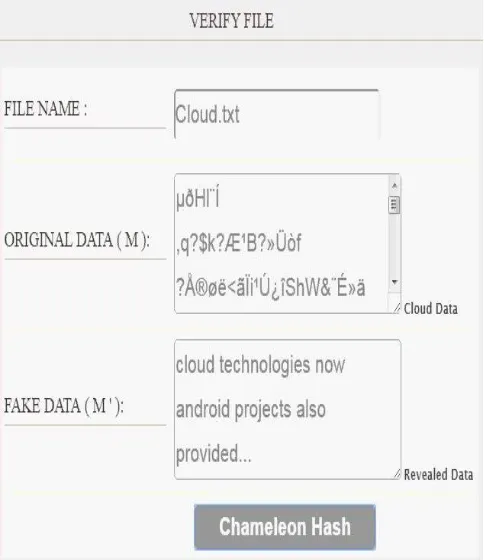
Fig 3: Verifying File Data between original
Data and Fake Data.
5.
Conclusion
A survey work carried out on deniable CP-ABE
scheme to construct an audit-free cloud storage
service. The deniability quality makes
intimidation unacceptable, and the ABE
property ensures secure cloud data sharing with
a fine-grained access control mechanism.
Planned scheme provides a potential way to
fight beside immoral interference with the
precise of confidentiality and more schemes can
be created to protect cloud user privacy.
[1]. A .Sahai and B. Waters, “Fuzzy identity
based encryption,” in Eurocrypt, 2005, pp. 457–
473.
[2]. GOYAL, O. PANDEY, A. SAHAI, AND
B. WATERS, “ATTRIBUTE-BASED
ENCRYPTION
FOR FINE-GRAINED ACCESS CONTROL
OF ENCRYPTED DATA,” IN ACM
CONFERENCE
ON COMPUTER AND COMMUNICATIONS
SECURITY, 2006, PP. 89–98.
[3]. Bowater’s, “Cipher text-policy attribute
based encryption: An expressive, efficient, and
provably secure realization,” in Public ey
Cryptography, 2011, pp. 53–70.R. E. Sorace, V.
S. Reinhardt, and S. A. Vaughn, “High-speed
digital-to-RF converter,” U.S. Patent 5 668 842,
Sept. 16, 1997.
[4]. S. Rosenberger and B. Waters,
“Attributebased encryption with fast decryption,” in Public Key Cryptography, 2013,
pp. 162–179
[5]. R. Canetti, C. Work, M. Naor, and R.
Ostrovsky, “Deniable encryption,” in Crypto,
1997, pp. 90–104./
[6]. M. D¨urmuth and D. M. Freeman,
“Deniable encryption with negligible detection
probability: An interactive construction,” in
Eurocrypt, 2011, pp. 610– 626. “PDCA12-70
data sheet,” Opto Speed SA, Mezzovico,
Switzerland.
[7]. B. Lewko, “Tools for simulating features of
composite order bilinear groups in the prime
order setting,” in Eurocrypt, 2012, pp. 318–335.
[8]. D. Boneh, R. Canetti, S. Halevi, and J. Katz,
“Chosen-ciphertext security from identitybased encryption,” SIAM J. Comput., vol. 36, no. 5,
pp. 1301–1328, 2007.
[9]. K. Liang, L. Fang, D. S. Wong, and W.
Susilo, “A ciphertextpolicyattribute-based proxy
re-encryption with chosenciphertextsecurity,”
IACR Cryptology ePrint Archive, vol. 2013, p.