Single Phase Single Stage High Power Factor
Cuk Rectifier
Siyana Ismail 1, Manjusha V.A 2
PG Student [PEPS], Department of EEE, Amal Jyothi Engineering College Kottayam, Kerala, India 1 Assistant Professor, Department of EEE, Amal Jyothi Engineering College Kottayam, Kerala, India2
ABSTRACT: A bridgeless PFC rectifier allows the current to flow through a minimum number of switching devices compared to the conventional PFC rectifier. Accordingly, the converter conduction losses can be significantly reduced and higher efficiency can be obtained, as well as cost savings. In bridgeless cuk converter, only two semiconductor devices are working during one switching cycle and hence the conduction losses are minimised. CUK PFC rectifier is designed to operate in Discontinous Conduction Mode (DCM) to achieve almost a unity power factor and low total harmonic distortion of the input current. The simulation of both the closed loop based on average current mode control and open loop bridgeless cuk converter is carried out using MATLAB simulink. The closed loop model of the bridgeless cuk converter gives a higher power factor of 0.99 and better voltage regulation.
KEYWORDS: Bridgeless rectifier, Cuk converter, low conduction losses, power factor correction (PFC)
I.INTRODUCTION
Most electronic equipment is supplied by 50 Hz utility power, and more than 50% of this power is processed through some kind of power converter. Usually power converters use a diode rectifier followed by a bulk capacitor to convert AC voltage to DC voltage.Single phase diode rectifiers are widely used for industrial applications Since these power converters absorb energy from the AC line only when the line voltage is higher than the DC bus voltage, the input line current contains rich harmonics, which pollute the power system and interfere with other electric equipment. These converters usually have a low power factor of 0.65[1]. This introduces several problems including reduction in the available power and increased losses. This process involves both nonlinear and storage elements, and results in the generation of harmonics in the line current. Because the conventional simple diode rectifier followed by a bulk capacitor cannot meet the requirements, which have stimulated the research of power factor correction techniques. The concept of power factor originated from the need to quantify how efficiently a power converter utilizes the current that it draws from an AC power system. Power factor correction is the method of improving the power factor of a system by using suitable devices. The objective of power factor correction circuits is to make the input to a power supply behave like purely resistive or a resistor When a converter has less than unity power factor, it means that the converter absorbs apparent power higher than the real power it consumes. This implies that the power source should be rated with higher VA ratings than the load needs. In addition, the current harmonics produced by converter deteriorate the power source quality, which eventually affects the other equipment.
disadvantage of discontinuous output current resulting in a relatively high output ripple. Bridgeless circuits with boost converter [5] and buck converters[4] were presented. In boost converter the dc output voltage is higher than the peak input voltage and it cannot be used for low power application such as for telecommunication [3]. By using the buck converter the input current does not track the input voltage at zero crossings of input voltage [4]. Also, buck PFC converter results in an increased total harmonic distortion (THD) and a reduced power factor. In my work bridgeless cuk rectifier is studied and simulated. The closed loop control of output voltage is done using average current mode control.
II.BRIDGELESS CUK CONVERTER
The bridgeless cuk PFC rectifier shown in figure 1 is formed by connecting two dc-dc cuk converters in parallel. Each converter can operate for each half line period. The number of semiconductors in the current flowing path is reduced to one or two. Hence the circuit efficiency is improved compared to the conventional cuk rectifier.
Figure 1: Bridgeless cuk converter[3]
The figure 1 shows the circuit diagram for bridgeless cuk converter. The Figure 2(a) shows the operation of bridgeless cuk rectifier during positive half cycle and Figure 2(b) shows the operation of bridgeless cuk rectifier during negative half cycle.
Figrure 2: Equivalent circuits(a) During positive half cycle (b)During negative half cycle[3]
Here during the positive half cycle switch Q1 is turned on. The current flowing path during this half cycle of supply
voltage is through L1, Q1, C1 and D01. Dp is active during this cycle and it connects AC source to the output. During the
through L2, Q2, C2 and D02. Dn is active during this cycle and it connects AC source to output. Here Dp or Dn connects
the output voltage bus to input and thus common mode EMI noise emission can be eliminated. Control signals for the switch Q1 and Q2 can be controlled by the same control signals and hence the control circuitry is simple.
2.1 Principle of operation
The circuit operation during the positive and negative cycle of input voltage is same. Due to this symmetry of the circuit, it is sufficient to analyze the circuit operation during any one half cycle ie, positive half cycle. The circuit is analysed based on certain assumptions:- Input voltage is sinusoidal, components are ideal, all capacitors are large enough to reduce switching voltage ripple. The converter is operated in the Discontinuous Conduction Mode (DCM). The advantages offered by DCM operation include natural near-unity power factor, the power switches are turned ON at zero current, and the output diodes (D01 and D02) are turned OFF at zero current. Thus, the losses due to the turn-ON switching and the reverse recovery of the output diodes are considerably reduced. The circuit operation is divided into three distinct operating stages during one switching period.
Stage 1: In this stage Q1 is turned on. The current VC1 will flow through the switch and hence Dp is forward biased. The diode D01 is reverse biased by reverse voltage (Vac + V0). D02 is reverse biased by output voltage V0. The current through inductors iL1 and iL01 increases linearly with input voltage. Current through inductor iL02 is zero due to constant voltage across C2. The Stage 1 operation is shown in figure 3.
Figure 3: Stage 1 operation
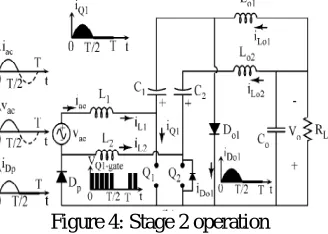
Stage 2: In this stage switch Q1 is turned off. Diode D01 is turned on to provide path for inductor currents iL1 and iL01 . Dp
is forward biased by the current iL1 . This stage ends when the current through diode D01 is zero. The Stage 2 operation
is shown in figure 4.
Figure 4: Stage 2 operation
Stage 3: During this interval both the switch and diode are revere biased. The inductors act as a current source and hence voltage across the inductors is zero. The current iL1 charges the capacitor. This stage ends when Q1 is turned on.
Figure 5: Stage 3 operation[3]
2.2 Design of the converter
The design of the converter is made as below with certain mathematical assumptions. The DCM operation is obtained with the following condition:
< =
( ( )) (1)
where Ke is a dimensionless conduction parameter and is given by:
= (2)
The values of the parasitic components are designed such that they follow the DCM condition such that < −
_ and those maximum and minimum values of Kecrit are as below:
K =
( ) and K (3)
Let input voltage Vac= 100 Vrms and Vo=48V power P=150W, the output current is given by:
P=VI; 150=48I; output current I=3.125A The output load resistance value is given by: Vo =IR; 48=3.125R; R=15.34 Ω.
Let the switching frequency be 50 kHz and output voltage should be less than 1%.
Δi < 10%I and ΔV < 5% (4)
ΔI = .
. (5)
ΔI =( ).
. (6)
ΔV = .
. . (7)
From the equations (5), (6), (7) the values of inductances and capacitances are given by: L1= L2=1mH, L01=L02=22μH, C1=C2=1μF, Cout=12000μF.
III.AVERAGE CURRENT MODE CONTROL
Figure5: Block diagram of closed loop controlled bridgeless cuk converter
In inner loop, the inductor current is compared with the reference current. The error of this comparison is processed by the different current controllers to be used to generate the gate signals of the switches. The block diagram of closed loop controlled bridgeless cuk converter is shown in Figure 5. Average current tracks the reference current with high degree of accuracy. This is especially important in high power factor converters. The average current mode control can be used to sense and control the current in any circuit branch. Fixed switching frequency and fast speed of response are other advantages of average current mode controller [8].
IV.SIMULATION AND RESULTS
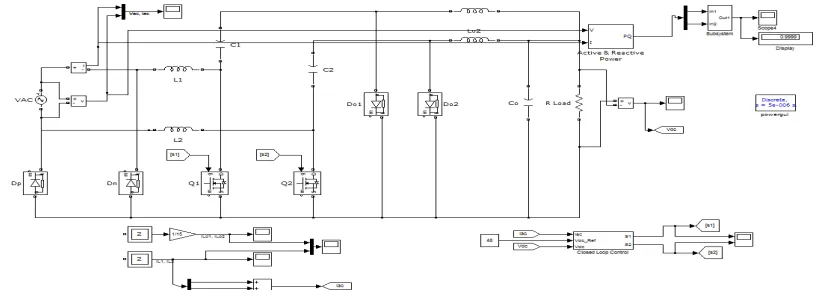
The circuit is simulated using MATLAB in Open loop mode and closed loop mode. Average current mode controller is used to stabilize the voltage. The simulink model and the simulation results of both the open loop and closed loop are shown below. Open loop bridgeless cuk converter is modeled, so the inrush current during start- up is not controlled and the output voltage is not stabilized. The inrush current and the output voltage can be controlled by using PWM of switches using closed loop control
.
Figure 6:Simulink model of bridgeless cuk converter
Figure 7:Input voltage and current waveforms The output voltage waveform for bridgeless cuk converter is shown in Figure8.
Figure 8:Output voltage of open loop model
Figure.7 shows the input voltage and input current waveforms. It is found that the phase difference between input voltage and input current is equal to zero. Here the power factor obtained is nearer to unity power factor and it is approximately 0.997. Figure 8 shows the output voltage waveform. An output voltage of approximately 48V is obtained. The output voltage will vary, if the input voltage is varied from 100V. Hence a closed loop model is developed for the bridgeless cuk converter. Simulink model of closed loop bridgeless PFC cuk converter is developed for input voltage 100V at 50Hz and output DC voltage of 48V and power rating of 150W. The output voltage is regulated by using the voltage controller loop and the shape of the input current is controlled by using the current controller loop. The PI controllers are used as the voltage controller and current controller. The simulink model of the closed loop bridgeless PFC cuk converter is shown in Figure 9
.
The input voltage and current waveforms for closed loop bridgeless cuk converter is inphase and also the input current follows the input voltage waveform
Figure 10:Input voltage and current waveforms of closed loop model
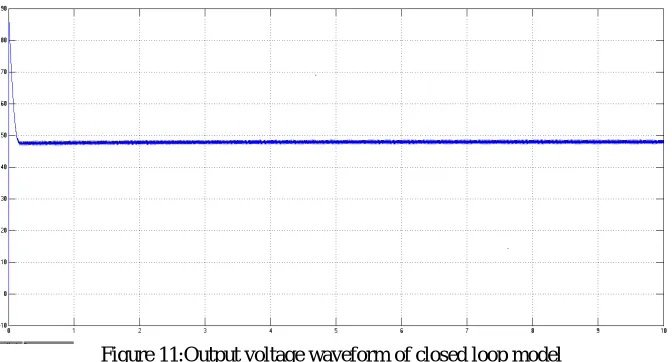
The output voltage obtained for closed loop bridgeless cuk converter is 48V and it is stabilized at 48V even when the input voltage varies in the range of 80-130V.
Figure 11:Output voltage waveform of closed loop model
The input voltage and current waveforms for the closed loop model is shown in Figure 10. The output voltage waveform for an input voltage of 110V is also shown in Figure 11.
VI.CONCLUSION
A single phase AC to DC bridgeless CUK rectifier is discussed and simulated. Performance of the converter is verified by simulation and experimental results. The bridgeless CUK rectifier is simulated in MATLAB/SIMULINK in both open loop mode and closed loop mode. The average current mode control strategy is used for the proposed circuit to improve the input power factor and to stabilize the output voltage. The closed loop model gives a power factor approximately equal to 0.999.
REFERENCES
1. R. Prasad, P. D. Ziogas and S. Manias., “A novel Passive wave-shaping method for single phase Diode Rectifiers," IEEE Transactions on Industrial Electronics, Vol. 37, no.6, pp. 521 - 530, Dec.1990.
2. Oscar Garca, Jos A. Cobos, Roberto Prieto, Pedro Alou, and Javier Uceda,“Single Phase Power Factor Correction: A Survey," IEEE Transactions on Power Electronics, Vol. 18, no.3, May 2003.
3. Fardoun, E. H. Ismail, A. J. Sabzali, and M. A. Al-Saffar, “New Efficient Bridgeless Cuk Rectifiers for PFC Applications," IEEE Transactions On Power Electronics, Vol. 27, no.7, July 2012.
4. Y. Jang and M. M. Jovanovi'c,, “Bridgeless high-power-factor buck converter," IEEE Transactions on Power Electronics, Vol. 26, no.2,pp. 602-611, February 2011.
5. L. Huber, Y. Jang, and M. Jovanovic, “Performance evaluation of bridgeless PFC boost rectifiers," IEEE Transactions on Power Electronics, Vol. 23, no.3, pp. 1381-1390, May.2008.
6. W. Wei, L. Hongpeng, J. Shigong, and X. Dianguo, “A novel bridgeless buck-boost PFC converter," Proceedings on IEEE Power Electronics, pp. 1304-1308, 2008.
7. Sabzali, E. H. Ismail, M. Al-Saffar, and A. Fardoun, “New bridgeless DCM sepic and Cuk PFC rectifiers with low conduction and switching losses,"IEEE Transactions on Industrial Applications, Vol. 47, no.2, pp. 873-881, Mar./Apr. 2011.
8. W. Tang, F. C. Lee and R. B. Ridley, “Small Signal Modeling of Average Current Mode Control,"IEEE Transactions on Power Electronics, Vol. 8, no 1, pp. 112-118,April, 1993.
![Figure 1: Bridgeless cuk converter[3]](https://thumb-us.123doks.com/thumbv2/123dok_us/7792012.1291422/2.595.194.413.527.716/figure-bridgeless-cuk-converter.webp)
![Figure 5: Stage 3 operation[3]](https://thumb-us.123doks.com/thumbv2/123dok_us/7792012.1291422/4.595.203.389.146.293/figure-stage-operation.webp)