Electric
and
T
hermoelectric
P
roperties
of
Cu
12Sb
4S
13T
etrahedrite
with
I
mpurities
KamyarRavaji*
DepartmentofMaterialScienceandEngineering,SharifUniversityofTechnology,Tehran, Iran. P.O.Box11155-9466.
RezaEzzati
ScienceandResearchBranch,IslamicAzadUniversity,Tehran,I.R.Iran
AmirHoseinMohammadi
ScienceandResearchBranch,IslamicAzadUniversity,Tehran,I.R.Iran
SeyedAmirAbbas
ScienceandResearchBranch,IslamicAzadUniversity,Tehran,I.R.Iran
Abstract
ThehighfigureofmeritandearthabundanceofCu12Sb4S13thermoelectric
ma-terials have recently attracted many attentions toward these type of complex
compounds. Intrinsic low thermal conductivity, as well as tunable electronic
transportproperties, make them suitableforthermoelectric power generation.
Inthis study, we perform a comparative theoretical study on the substituted
compounds,primarilyat theCusite includingknown tetrahedriteCu12Sb4S13,
bymeansoffirst-principles calculations. Thedensityfunctional theoryof
elec-tricstructureisappliedto investigatetheresultofsubstitution.
Keywords: Abinitiocalculation; thermoelectricmaterials; tetrahedrite
1. Introduction
The efficiency of a thermoelectric (TE) material defined by a dimensionless
figure of merit, ZT = S2κσT = P Tκ , wherein σ is the electrical conductivity, P
is power factor,S Seebeck coefficient and κ is the thermal conductivity. The
κincludes both lattice contributionκL and electronicκecontribution κL , i.e.
5
κ=κe+κL. The enhancedZT determines the productivity of a
thermoelec-tric material. The preeminent of the known TE materials have a value of ZT
to be of the order of unity at ambient condition.[1] TheZT equation implies
that finding materials with ZT more than one is an open challenge, since it
is required to satisfy the conflicting tie of high P = S2σ resembling an
in-10
sulator and simultaneously behave as a decent conductor like a metal. High
ZT indicates that a good TE material should have high electrical
conductiv-ity σ and low thermal conductivity κ leading to large phonon scattering and
small electron scattering. In last couple of years, a lot of efforts have been
made to study thermoelectric materials and develop new methods to enhance 15
the value of theZT. Multiple reports have been published by various groups
with a focus on studying atomic structure and electronic behavior leading to
low thermal conductivity[2, 3]. In addition, several studies performed on band
structure engineering to improve Seebeck coefficient and electric conductivity
and implementing nanostructure technology for decreasing the lattice thermal 20
conductivity[4, 5]. There has been some research on the effect of Kondo
corre-lations on the thermopower[6, 7, 8, 9, 10, 11, 12].
Recently, several studies focused on multiple-filled skutterudites[13, 14]. Xun
Shi et al,[14] reported that there are a few doped samples which show an
im-proved figure of merit of 1.7 at around 850 K. This ZT is one of the highest 25
value reported in skutterudites type of TE materials. Furthermore, Biswas et
al.,[15] found high-performance bulk thermoelectricsZT 2.2 value at 923 K for
p-type PbTe-SrTe doped with Na. This high value of ZT is assigned to the
hierarchical structure which enhances the phonon scattering.
velopment of capable thermoelectric materials in large scale in industrial
uti-lization. However, the search for promoting thermoelectric compounds goes
on in spite of these constraints. Lately, new natural minerals of tetrahedrite
paved the road for new successes in developing new thermoelectric materials.
Tetrahedrite (Cu12–xαxSb4S13) and tennantite (Cu12–xαxAs4S13), where αis a 35
transition metal element such as Zn, Co, Fe, Mn, and Ni, have attracted much
attention because their thermal conductivity is very low due to phonon
scat-tering by the so-called rattling motion, which is the large-amplitude atomic
motion.[16, 17, 18, 19, 20, 2]. These studies have motivated us to explore
elec-tronic and thermoelectric features of tetrahedrite family of thermoelectric ma-40
terials.
Considering a trivial ionic picture, all the copper atoms in tetrahedrites are
assumed to be monovalent and contribute just only one electron. Other divalent
substitutes like Mn provide two electrons, as S and Sb atoms provide six and
three electrons, respectively. Accordingly, from Cu12Sb4S13to Cu10Zn2Sb4S13, 45
the valence electron count enhances four electrons per unit cell.
In this work, we study and compare the electronic structure of substituted
tetrahedrite with other group of tetrahedrites substituted by some other
ele-ments. The electronic structure was obtained by implementing a DFT
calcula-tion of Wien2k program[21] and the BoltzTrap package based on the Boltzmann 50
transport theory.[22] It has already been reported that the bands crossing the
Fermi level are primarily consist up of d-orbitals of copper atoms.[23, 24, 25]
Hence, in order to determine the substitution impact of a equal amount of
dop-ing for electronic structure calculations, equal amount of d-orbital occupancy is
considered for parent compound of Cu12Sb4S13. 55
2. Methodology
First principle density functional theory (DFT) calculations were carried out
in the WIEN2k.[21] by a technique that uses Full Potential Linear Augmented
FPLAPW is implemented to investigate the transport and electronic properties 60
of the tetrahedrites while the bond lengths and structure optimizations were
done by using Pwscf method. The Generalized Gradient Approximation (GGA)
of Perdew Burke Ernzerhof (PBE)[26] was used to attain the total energy by
self consistently solving the Kohn-Sham equations.
A variable cell optimization carried out by implementing conjugate gradient 65
method as employed in Pwscf. A 9×9×9 k points mesh used in the reciprocal
space of the first Brillouin zone based on Monkhorst-Pack scheme[27] to
guar-antee a decent convergence. A plane wave cut off energy of 100 eV is applied.
The FP-LAPW method is employed as described in the WIEN2k code[21].
The standard local scheme of the exchange-correlation functional (LDA or GGA) 70
used in the first principles calculations commonly underestimate the band gap
and they can’t predict precisely the localized electrons in d orbitals and
some-times in f orbitals, in DFT calculations involving transition metals[28]. To
re-solve this problem, we have implemented the onsite Coulomb repulsion U
com-bined with Generalized Gradient Approximation (GGA) (GGA+U). Further-75
more, several physical properties such as thermopower (S) and electrical
conduc-tivityσand electron relaxation timeτhave calculated utilizing BOLTZTRAP[22]
package with various k points up to 5000 k-points. In our calculation we used
the Constant Scattering Time (τ) Approximation (CSTA) along with the Rigid
Band Approximation (RBA)[29] . The equations used in the calculations for 80
electric part of thermal conductivity (κ), electrical conductivity (σ), and
See-beck coefficient (S), obey the following relations:
σi,j=
e2τ
¯ h2 Z ∂ε ∂ki ∂ε ∂kj
[−∂fµ(T;ε)
∂ε ]∂ε (1)
κi,j=
τ
¯
h2T
Z ∂ε
∂ki
∂ε
∂kj
(ε−µ)2[−∂fµ(T;ε)
∂ε ]∂ε (2)
Si,j=
1 eT
R ∂ε ∂kβ
∂ε
∂kj(ε−µ)[
∂fµ(T;ε)
∂ε ]∂ε
R ∂ε ∂kβ
∂ε ∂ki[
∂fµ(T;ε)
∂ε ]∂ε
(3)
where εis is energy, T is the temperature,µis the chemical potential, τ is
Based on the RBA approximation, although adding some impurities to a sys-85
tem will not modify its band structure, the chemical potential will be adjusted.
This could be utilized to approximate semiconductors that are not heavily doped
in order to calculate some of the the transport properties theoretically.[30, 31,
32, 33] Nevertheless, adding some specific types of dopant will severely alter
the nature of electronic structure below and above the gap leading to resonant 90
states[34, 35] in which case the RBA approximation fail to predict precisely.[36]
According to constant scattering time approximation (CSTA), the scattering
time for an electron regardless of its energy relies only on temperature and
con-centration of electrons.[37] The CSTA approximation has effectively predicated
the thermoelectric quantities in several different materials which were in good 95
agreement with experimental reports.[38, 39]
3. Result and discussion
3.1. Ground state properties
The Cu12Sb4S13crystallize in a cubical form with space group of 217 (I¯43m)
wherein half of the Cu atoms occupy four-coordinate distorted tetrahedral sites 100
(Cu1) and other half occupy three-coordinate triangular sites (Cu2) with total
58 atoms per unit cell. Therefore, half of 24 Cu sites are occupied by twelve Cu-I
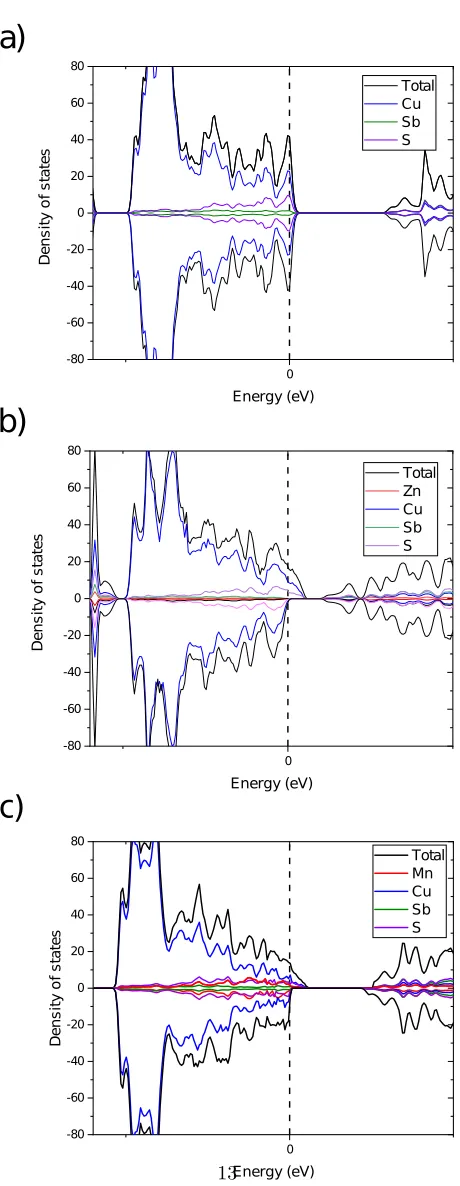
sites and other half by twelve Cu-II sites. Figure 1 shows the calculated density
of states. Spin polarization was included in the calculations. The Cu12Sb4S13
structure lead to nonmagnetic compound. However, as expected for transition 105
metals, the calculations converged to spin polarized kind of density of states
at valence band. The role of Cu-II near the Fermi level is smaller than states
formed by bonding between Cu-I and S atoms. Zinc and manganese doping
will not affect the density of states, since they are far from the Fermi level.
However, they will replace the Cu-I and loosen the Cu-II and sulfur’s bonding 110
and influence the density of states near the Fermi level. We have implemented
the space group symmetry 81, in order to enhance the symmetry and reduce
is broken into four and two where each Zn and Mn elements can be replaced in
two multiplicity positions. The calculation was carry out with considering spin 115
polarization. Force minimization was also considered during the calculations.
The derived density of state (DOS) is illustrated in figure 1. It can be
seen that the Cu states strongly hybridized with the S states which sits at the
top of the valence-band. While we we note that the chalcogen p-orbitals are
always strongly hybridized with them. Because of the existence of the insulating 120
layers, the conduction along the z-direction is almost prohibited, at least near
the valence-band top as inferred from the flat band dispersion along the Γ line
shown in figure 1). Bands exists near the top of the valence-band at Γ point.
Therefore, the valence-band structure near its edge can be regarded as
quasi-one-dimensional. Such a low dimensionality is a key aspect for obtaining a good 125
thermoelectric performance because it increases the DOS near the band edge
and therefore the PF.
The flat characteristic band feature near the Fermi level indicates favorable
thermopower (Seebeck coefficient) for TE applications. Since LDA/GGA
un-derestimate the band gaps in semiconductors and insulators, and as the studied 130
Mn have partially filled d levels, we used GGA+U method and adjusted U to
get a reasonable value of the band gap. In our calculations we have used a value
ofUM n= 0.6Ryfor the Mn d-electrons.
In order to better estimate electron relaxation timeτelectronand lattice
ther-mal conductivity, it is required to separated into following two terms 135
ZT =TσS
2
κe
1 1 + κL
κe
(4)
where, the first term TσSκ2
e can be replaced by a factor α and the second
term 1+1κL κe
can be replaced by another factorβ. DFT calculation for electrons
will produceα, while since β includesτe andκL, it cannot derived from DFT
calculations for electrons. To resolve this problem, the equation
κL
τL = 1
3CLv
2
L
τL
τe
(5)
is being used. Where,vL is the phonon group velocity,CL the specific heat of
the lattice, andτL the phonon relaxation time.
The correlation betweenκeandσis expressed by Wiedeman-Franz law which
is being used to reduceZT form
(ZT)M ax= (ZT)e=T
σS2/τe
LT σ/τe
= S
2
L (6)
Where, κe is being replaced from κe =LT σ= 2.44×10⁻²mV2/K2.
Con-sidering this assumption, DFT calculation for SeebeckScoefficient and thermal 145
and electrical conductivities will result inZT for doped tetrahedrite materials.
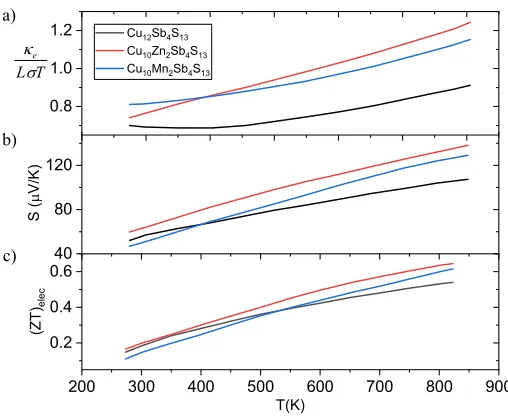
Figure 2 shows the calculatedZT,S and κe
LσT for studied materials. TheZT is
highest for Cu10Zn2Sb4S13as S.
The comparison with experimental data[20] shows that calculatedZT andS
are slightly smaller than the observed values. However, the increasing tendency 150
for S is in good agreement. Similar to S increasing trend in Lorentz number
observed which partially pulls off the effect onZT.
4. Conclusions
The structural and electronic transport properties of three doped
tetra-hedrite are studied using density functional theory. The Seebeck S coefficient 155
calculated using the BoltzTrap program is positive for all three tetrahedrite
compounds studied here. Electronic structure calculations show that all the
in-vestigated compounds are indirect band gap semiconductors, in good agreement
with earlier reports. We further calculated the thermoelectric properties of the
these compounds and compared with the available experimental reports. The 160
calculations show all the investigated compounds to be very good thermoelectric
materials for p-type doping.
5. Acknowledgment
We would like to thank the Sharif University of Technology for financial
References
[1] D. M. Rowe, CRC handbook of thermoelectrics, CRC press, 1995.
[2] N. Ghassemi, X. Lu, J. Ross, Nmr study of local structures and
anhar-monic phonon behavior in tetrahedrite thermoelectrics., in: APS Meeting
Abstracts, 2018. 170
[3] K. Suekuni, K. Tsuruta, M. Kunii, H. Nishiate, E. Nishibori, S. Maki,
M. Ohta, A. Yamamoto, M. Koyano, High-performance thermoelectric
min-eral cu12- x ni x sb4s13 tetrahedrite, Journal of Applied Physics 113 (4)
(2013) 043712.
[4] F.-H. Sun, J. Dong, H. Tang, P.-P. Shang, H.-L. Zhuang, H. Hu, C.-F. Wu, 175
Y. Pan, J.-F. Li, Enhanced performance of thermoelectric nanocomposites
based on cu12sb4s13 tetrahedrite, Nano Energy 57 (2019) 835–841.
[5] Y. Zheng, Q. Zhang, X. Su, H. Xie, S. Shu, T. Chen, G. Tan, Y. Yan,
X. Tang, C. Uher, et al., Mechanically robust bisbte alloys with superior
thermoelectric performance: a case study of stable hierarchical nanostruc-180
tured thermoelectric materials, Advanced Energy Materials 5 (5) (2015)
1401391.
[6] Z. Li, C. Xiao, H. Zhu, Y. Xie, Defect chemistry for thermoelectric
materi-als, Journal of the American Chemical Society 138 (45) (2016) 14810–14819.
[7] T. A. Costi, V. Zlati´c, Thermoelectric transport through strongly cor-185
related quantum dots, Phys. Rev. B 81 (2010) 235127. doi:10.1103/
PhysRevB.81.235127.
URLhttps://link.aps.org/doi/10.1103/PhysRevB.81.235127
[8] S. Hemmatiyan, M. R. Movassagh, N. Ghassemi, M. Kargarian, A.
Reza-khani, A. Langari, Quantum phase transitions in the kondo-necklace 190
model: perturbative continuous unitary transformation approach, Journal
[9] B. Sothmann, R. S´anchez, A. N. Jordan, Thermoelectric energy harvesting
with quantum dots, Nanotechnology 26 (3) (2014) 032001.
[10] N. Ghassemi, S. Hemmatiyan, M. Rahimi Movassagh, M. Kargarian, A. T. 195
Rezakhani, A. Langari, Quantum phase transitions in the kondo-necklace
model, in: APS Meeting Abstracts, 2015.
[11] H. Nghiem, T. Costi, Time evolution of the kondo resonance in response
to a quench, Physical review letters 119 (15) (2017) 156601.
[12] A. Bhattacharjee, B. Coqblin, Thermoelectric power of compounds with 200
cerium: Influence of the crystalline field on the kondo effect, Physical
Re-view B 13 (8) (1976) 3441.
[13] Y. Tian, A. A. Sirusi, S. Ballikaya, N. Ghassemi, C. Uher, J. H. Ross,
Charge-carrier behavior in ba-, sr- and yb-filled cosb3: Nmr and
trans-port studies, Phys. Rev. B 99 (2019) 125109. doi:10.1103/PhysRevB.99. 205
125109.
URLhttps://link.aps.org/doi/10.1103/PhysRevB.99.125109
[14] X. Shi, J. Yang, J. R. Salvador, M. Chi, J. Y. Cho, H. Wang, S. Bai,
J. Yang, W. Zhang, L. Chen, Multiple-filled skutterudites: high
thermo-electric figure of merit through separately optimizing thermo-electrical and ther-210
mal transports, Journal of the American Chemical Society 133 (20) (2011)
7837–7846.
[15] K. Biswas, J. He, I. D. Blum, C.-I. Wu, T. P. Hogan, D. N. Seidman,
V. P. Dravid, M. G. Kanatzidis, High-performance bulk thermoelectrics
with all-scale hierarchical architectures, Nature 489 (7416) (2012) 414. 215
[16] G. Slack, Solid state physics vol 34 ed h ehrenreich, F Seitz and D Turnbull
(New York: Academic) pp (1979) 1–71.
[17] N. Ghassemi, X. Lu, X. Zhou, Y. Yan, Y. Tian, J. Ross, Nmr study of doped
tetrahedrite thermoelectric materials., Bulletin of the American Physical
[18] X. Lu, D. T. Morelli, Natural mineral tetrahedrite as a direct source of
ther-moelectric materials, Physical Chemistry Chemical Physics 15 (16) (2013)
5762–5766.
[19] N. Ghassemi, X. Lu, Y. Tian, E. Conant, Y. Yan, X. Zhou, J. H. Ross Jr,
Structure change and rattling dynamics in cu12sb4s13 tetrahedrite: an nmr 225
study, ACS applied materials & interfaces 10 (42) (2018) 36010–36017.
[20] X. Lu, D. T. Morelli, Y. Xia, F. Zhou, V. Ozolins, H. Chi, X. Zhou, C. Uher,
High performance thermoelectricity in earth-abundant compounds based
on natural mineral tetrahedrites, Advanced Energy Materials 3 (3) (2013)
342–348. 230
[21] P. Blaha, K. Schwarz, G. K. Madsen, D. Kvasnicka, J. Luitz, wien2k, An
augmented plane wave+ local orbitals program for calculating crystal
prop-erties.
[22] G. K. Madsen, D. J. Singh, Boltztrap. a code for calculating band-structure
dependent quantities, Computer Physics Communications 175 (1) (2006) 235
67–71.
[23] K. Suekuni, Y. Tomizawa, T. Ozaki, M. Koyano, Systematic study of
elec-tronic and magnetic properties for cu12–x tm x sb4s13 (tm= mn, fe, co, ni,
and zn) tetrahedrite, Journal of Applied Physics 115 (14) (2014) 143702.
[24] Y. Bouyrie, C. Candolfi, V. Ohorodniichuk, B. Malaman, A. Dauscher, 240
J. Tobola, B. Lenoir, Crystal structure, electronic band structure and
high-temperature thermoelectric properties of te-substituted tetrahedrites cu 12
sb 4- x te x s 13 (0.5 x 2.0), Journal of Materials Chemistry C 3 (40) (2015)
10476–10487.
[25] X. Lu, W. Yao, G. Wang, X. Zhou, D. Morelli, Y. Zhang, H. Chi, S. Hui, 245
C. Uher, Band structure engineering in highly degenerate tetrahedrites
through isovalent doping, Journal of Materials Chemistry A 4 (43) (2016)
[26] J. Perdew, K. Burke, M. Ernzerhof, Perdew, burke, and ernzerhof reply,
Physical Review Letters 80 (4) (1998) 891. 250
[27] H. J. Monkhorst, J. D. Pack, Special points for brillouin-zone integrations,
Physical review B 13 (12) (1976) 5188.
[28] R. M. Nieminen, Topics in applied physics: Theory of defects in
semicon-ductors (2006).
[29] T. Scheidemantel, C. Ambrosch-Draxl, T. Thonhauser, J. Badding, J. Sofo, 255
Transport coefficients from first-principles calculations, Physical Review B
68 (12) (2003) 125210.
[30] L. Jodin, J. Tobola, P. Pecheur, H. Scherrer, S. Kaprzyk, Effect of
sub-stitutions and defects in half-heusler FeVSb studied by electron transport
measurements and kkr-cpa electronic structure calculations, Phys. Rev. B 260
70 (2004) 184207. doi:10.1103/PhysRevB.70.184207.
URLhttps://link.aps.org/doi/10.1103/PhysRevB.70.184207
[31] L. Chaput, P. P´echeur, J. Tobola, H. Scherrer, Transport in doped
skutteru-dites: Ab initio electronic structure calculations, Phys. Rev. B 72 (2005)
085126. doi:10.1103/PhysRevB.72.085126. 265
URLhttps://link.aps.org/doi/10.1103/PhysRevB.72.085126
[32] D. Bilc, S. Mahanti, M. G. Kanatzidis, Electronic transport properties of
pbte and agpb m sbte 2+ m systems, Physical Review B 74 (12) (2006)
125202.
[33] J. M. Ziman, Electrons and phonons: the theory of transport phenomena 270
in solids, Oxford university press, 2001.
[34] D. Bilc, S. Mahanti, E. Quarez, K.-F. Hsu, R. Pcionek, M. G. Kanatzidis,
Resonant states in the electronic structure of the high performance
ther-moelectrics a g p b m s b t e 2+ m: The role of ag-sb microstructures,
[35] S. Ahmad, K. Hoang, S. Mahanti, Ab initio study of deep defect states in
narrow band-gap semiconductors: Group iii impurities in pbte, Physical
review letters 96 (5) (2006) 056403.
[36] M.-S. Lee, S. D. Mahanti, Validity of the rigid band approximation in the
study of the thermopower of narrow band gap semiconductors, Physical 280
Review B 85 (16) (2012) 165149.
[37] K. P. Ong, D. J. Singh, P. Wu, Analysis of the thermoelectric properties of
n-type zno, physical review B 83 (11) (2011) 115110.
[38] G. K. Madsen, K. Schwarz, P. Blaha, D. J. Singh, Electronic structure and
transport in type-i and type-viii clathrates containing strontium, barium, 285
and europium, Physical Review B 68 (12) (2003) 125212.
[39] T. Bither, C. Prewitt, J. Gillson, P. Bierstedt, R. Flippen, H. Young, New
transition metal dichalcogenides formed at high pressure, Solid State
0 -80 -60 -40 -20 0 20 40 60 80 D e n s it y of s ta te s Energy (eV) Total Cu Sb S
a)
0 -80 -60 -40 -20 0 20 40 60 80 Energy (eV) Total Zn Cu Sb S D e n s it y of s ta te sb)
0 -80 -60 -40 -20 0 20 40 60 80 D e n s it y of s ta te s Energy (eV) Total Mn Cu Sb Sc)
Figure 1: Calculated total and partial density of states (DOS) of (a) Cu12Sb4S13, (b)
Figure 2: (a) The thermal conductivity divided by the electrical conductivityσ normalized to Lorenz number and temperature (b) Seebeck coefficient, and (c) (ZT)eleccalculated by the
BoltzTrap program using band structure obtained by a GGA+U calculation for Cu12Sb4S13,