THE TEXTURE AND MICROSTRUCTURE OF
MOZZARELLA CHEESE AS AFFECTED BY FAT
CONTENT, EPS PRODUCING STARTER CULTURE AND
FAT REPLACERS
A thesis submitted for the degree of Master of Science in Food
Technology
By
Raman K. Bhaskaracharya
B. Technology (Dairy Technology)
2000
School of Life Sciences and Technology
Victoria Universify of Technology
DEDICATED
TO
WER THESIS 637.30287 BHA 30001005559440
Bhaskaracharya, Raman K The texture and
ABSTRACT
The main goal of this study was to manufacture low fat mozzarella cheeses using fat
replacers having similar texture and microstmcture characteristics as fiill fat
mozzarella. To achieve this goal it was essential to analyse the texture characteristics
including hardness, cohesiveness, springiness, chewiness and gumminess of
commercial mozzarella cheeses and to study the effects of moisture, fat and protein on
these characteristics. The texture characteristics were analysed using an Insfron
Universal Testing Machine. A non-sfretching cheddar cheese was used as a standard.
The hardness and springiness were significantly higher with increased compression,
while cohesiveness reduced. Chewiness and gumminess initially increased followed
by a decrease. The cheddar cheese exhibited higher hardness compared to mozzarella
cheeses and slightly lower springiness. There was a drastic decrease in chewiness and
gumminess with increased compression in all the mozzarella cheeses. The cheddar
cheese showed significantly lower cohesiveness, which decreased with increased
compression. In general, the hardness decreased with increase in moisture content. The
springiness increased with increase in fat content while the cohesiveness increased
with increase in protein content. One of the mozzarella cheeses showed the texture
characteristics of a typical fiill fat mozzarella cheese and these characteristics were
used as a reference for fiulher studies in developing a low fat mozzarella cheese made
with fat replacers.
The microstmcture of mozzarella cheeses was also studied using a simplified method
of specimen preparation for imaging. Three batches of mozzarella cheeses were
prepared each with or without exopolysaccharide producing Streptococcus
from all the six batches to study their microstmcture. Specimens were cut from the
cheese samples, fixed in 2% glutaraldehyde, dehydrated and impregnated using 1.5%
osmium tefroxide. The specimens were dried in a critical point drying equipment,
fractured at room temperature (~20 C), sputter coated with gold and images of the
cheese specimens were taken using a scanning electron microscope. The images
showed clear intemal stmctures of the specimens. The compact protein stmcture of
cheeses interspersed with small and large voids representing location of the fat and
serum phases, respectively, was seen. The exopolysaccharide produced by the
sfreptococci appeared to be delicate and filamentous. The lactobacilli seemed to
produce the exopolysaccharide in meagre amounts. The microorganisms were found
propagating in serum channels.
The six cheese samples were also examined for their microstmcture and
exopolysaccharide produced by the starter cultures. Specimens measuring 2 x 2 x 10
mm size were cut and fixed in 2% glutaraldehyde solution, washed in cacodylate
buffer, gradually dehydrated using ethanol and cryoprotected in 2.3 M sucrose
solution. The specimens were cryofracmred in liquid nitrogen, dehydrated using
absolute ethanol and acetone solutions, mounted on aluminium stubs, sputter coated
with gold and observed under a scanning elecfron microscope followed by recording
of the images. Mozzarella cheese matrix interspersed with small and large voids
representing location of fat and serum phases, respectively, was observed. The starter
cultures were located in the serum channels. Exopolysaccharide seemed to be
primarily produced by S. thermophilus. The exopolysaccharide appeared to be delicate
in the form of thin, filamentous strands. Thick sfrands of stretched protein appear to be
sucrose as a cryoprotectant was suitable to obtain details of intemal stmcture and
exopolysaccharide produced by the starter organisms.
Mozzarella cheeses were made using milk with 4.0, 3.5, 2.5, 1.5% fat, and skim milk.
Exopolysaccharide producing S. thermophilus and L. delbrueckii ssp. bulgaricus were
used at the rate of 0.5% of each starter culture. The cheeses were analysed for their
texture characteristics using an Instron Universal Testing Machine and the data
collected using a Merlin software. Cheeses with higher fat contents showed lower
values of hardness, cohesiveness, springiness, gumminess and chewiness.
Adhesiveness values were higher for cheeses with higher fat content. The cheese made
with skim milk showed similar characteristics to that made with 1.5% fat milk after 2
weeks of storage at 4°C. These observations were similar at both levels of
compressions.
Three batches of skim milk mozzarella cheeses were prepared each with
exopolysaccharide or non-exopolysaccharide producing starter cultures. The moismre,
protein and fat contents were analysed. Texture characteristics such as hardness,
cohesiveness, adhesiveness, springiness, gumminess and chewiness were measured at
5, 12, 19 and 26 d of manufacture using Instron Universal Testing Machine by
compressing the samples to 50 and 70% of their original heights with a 500 N load cell
flat plunger attached to the Insfron. The microstmcture of the cheese samples was
examined using a scanning elecfron microscope at 28 d of manufacture. The
exopolysaccharide cheeses showed 3.25% higher moisture content than
non-exopolysaccharide cheeses. Both types of cheeses had similar protein content
decreased during storage for both types of cheeses. However, adhesiveness at 50%
compression increased during storage. Both types of cheeses showed similar hardness
and springiness values during storage, although exopolysaccharide cheeses had higher
moisture content than non-exopolysaccharide cheeses. The exopolysaccharide cheeses
showed lower values of cohesiveness and adhesiveness during storage. The
microstmcture of the cheeses showed large and small voids representing the location
of the serum and fat phases. The starter bacteria were located in semm channels. The
exopolysaccharide was in the form of filaments, which extended from the protein
matrix. The exopolysaccharide was primarily produced by S. thermophilus, which was
found in abundance. L. delbrueckii ssp. bulgaricus were few in numbers and seemed
to produce meager amount of exopolysaccharide. The exopolysaccharide cheeses were
more open and porous compared to the non-exopolysaccharide cheeses. The decrease
in cohesiveness and adhesiveness of the exopolysaccharide cheeses could be partly
due to the increased porosity of the protein matrix.
Skim milk mozzarella cheeses (<3% fat) were made using two maltodextrin based
(Maltrin® M040 and MlOO) and a modified potato starch based (StaSlim® 143) fat
replacers. A control batch was made without any fat replacers. The texture
characteristics of the cheeses were measured using an Instron Universal Testing
Machine. The location of the fat replacers in the cheese stmcture was examined using
a scanning elecfron microscope. The moisture contents of the skim milk and Maltrin®
M040 and MlOO based cheeses were similar, while StaSlim® 143 based cheeses
showed lower moisture levels. The protein contents of the cheeses made with fat
replacers were lower than those of control cheeses. The hardness values of mozzarella
cheeses showed slightly higher values compared to confrol cheeses. The cohesiveness
values were lower for cheeses made using fat replacers especially those with
Maltrin® M040 and MlOO compared to confrol cheeses, while adhesiveness values
were higher. Springiness values for cheeses made using fat replacers were lower than
those of confrol cheeses. Gumminess and chewiness values were lower for cheeses
added with Maltrin® M040 and MlOO, while StaSlim® 143 cheeses showed slightiy
higher values compared to the confrol cheeses. During storage Maltrin® M040, MlOO
and confrol cheeses showed decreased hardness, cohesiveness, springiness,
gumminess and chewiness values, while adhesiveness values increased. The cheeses
made with StaSlim® 143 showed increased hardness, gumminess and chewiness
values during storage. The distribution of the fat replacers within the cheeses was
influenced by the rate of addition, the extent of microparticulation of the fat replacer
and the size of individual particles. Maltrin® M040 and MlOO was present as a gel
without any microparticulation while StaSlim® 143 formed smooth particles (about
0.05mm diameter) within the cheese matrix. Incorporation of Maltrin® M040, MlOO
and StaSlim® 143 resulted in an increased openness in cheeses, and large semm
channels (upto 0.1mm diameter) were seen. There was less openness of the cheese
stmcmre with StaSlim® 143 compared with Maltrin® M040 and MlOO. The
freeze-dried aqueous dispersion of StaShm® 143 appeared as a continuous flowing gel;
however, when incorporated in cheeses, they appeared as solid spheroidal particles,
possibly due to shrinkage. These particles were found embedded within the protein
matrix and were also present in the semm channels. No discrete Maltrin® MlOO
particles were found, although Maltrin® M040 seemed to exist as coalescing
Dr. Nagendra P. Shah (M. S c , Ph. D)
Associate Professor of Food Science School of Life Sciences and Technology Victoria Universify of Technology Werribee Campus, Werribee Victoria, Ausfraha
CERTIFICATE
This is to certify that the thesis entitied "THE TEXTURE AND MICROSTRUCTURE
OF MOZZARELLA CHEESE AS AFFECTED BY FAT CONTENT, EPS
PRODUCING STARTER CULTURE AND FAT REPLACERS" submitted by Raman
K. Bhaskaracharya in partial fiilfilment of the requirements for the award of the degree
of Master of Science in Food Technology at the Victoria University of Technology is a
record of bonafide research work carried out by him under my personal guidance and
supervision and the thesis has not previously formed the basis for the award of any
degree, diploma or other similar title.
^^^^U^ ^ 1 ^ ^ ^
Werribee, Ausfralia (Dr. N. P. Shah)
ACKNOWLEDGEMENT
It is a great privilege and with immense pleasure I express my profound gratitude to my
supervisor Dr. Nagendra Shah, Associate Professor, School of Life Sciences and
Technology, Victoria University of Technology, Werribee Campus, Werribee for his
inspiring and noble guidance, constmctive criticism and valuable suggestions
throughout the course of this study and in preparation of manuscripts.
I express my gratitude to Mr. Dale Tomlinson (Laboratory Manager), Mr. Vilnis
Ezemieks, Mrs. Stacey Lloyd, Ms. Mai Giang, Mrs. Marzena Walkiewicz, Mrs. Joanne
Gatt, Mr. Michael Rogerson, Ms. Kathy Janusko and Mr. Nikola Popovich for their
support in procuring chemicals and allowing me to use the instruments and other
facilities required for the successfiil operation of my research work. 1 am thankfiil to Dr.
Roderick Williams (Research Biochemist-Ingredient Innovation), Food Science
Ausfralia, Sneydes Road, Werribee, Victoria, Mr. John Near (Factory Manager),
Melboume University, Sneydes Road, Werribee, Victoria, Mrs. Janetta Culvenor
(Research Officer), Mrs. Anna Friedhuber and Mr. Cong Ho (Technical Officers),
Pathology Department, Melboume University, Parkville Campus, Melboume, Victoria,
for their active involvement and their personal contribution in providing technical
assistance.
I express my sincere thanks and appreciation to my firiends Dr. Rajiv Dave (Assistant
Professor), Mr. Harshul Vora, Dr. Wamakulasuriya Lankaputhra, Mr. Ramakanth
Ravula and their families for their help m some aspects of my research. I am highly
Mr. Aslam Khan, Mr. Mihir Sainani, Mr. Kiran Gummadi, Ms. Archana Sharma and
Mr. Dishonavi Pohatu.
I would like to recall the love and affection and financial support of my parents,
brothers, and other family members; without their blessings and wishes this smdy would
not have been a reality. Last but not the least, I cannot forget the moral support and
inspiration provided by Mrs. Maria Lettieri Noto, Mrs. Margaret Hadley, Mr. Kulen
Vyravipillai and their families especially in pressing times when they stood by me.
Werribee, Australia
\ < j
Date; ^ 5. - o T - C ^ ^ RAMAN KUMAR BHASKARACHARYA
List of Publications
REFEREED RESEARCH PAPERS
(1) Bhaskaracharya, R.K. and Shah, N.P. 1999. Texture evaluation of commercial
mozzarella cheeses. Aust. J. Dairy Technol. 54 (1): 36-40.
(2) Bhaskaracharya, R.K. and Shah, N.P. 2000. A simplified method for examination
of microstmcture of mozzarella cheeses with scanning elecfron microscopy. Aust.
J. Dairy Technol. 55(1): 28-32.
(3) Bhaskaracharya, R.K. and Shah, N.P. 2000. Texture Characteristics and
microstmcture of skim milk mozzarella cheese made using exopolysaccharide or
non-exopolysaccharide producing starter cultures. Aust. J. Dairy Technol. (under
review).
(4) Bhaskaracharya, R.K. and Shah, N.P. 2000. Texture and microstmcture of skim
milk mozzarella cheeses made using fat replacers. Aust. J. Dairy Technol. (under
review).
CONFERENCE PRESENTATIONS
(1) Bhaskaracharya, R.K. and Shah, N.P. 1998. Texture evaluation of some
commercial mozzarella cheeses. A paper presented at the 31" Australian Institute
of Food Science and Technology Annual Convention, Melboume, Victoria,
Ausfraha, April 26-29, 1998 (Paper No. A20).
(2) Bhaskaracharya, R.K. and Shah, N.P. 1998. Microstmcture of fiill fat mozzarella
cheese. A poster presented at the Cheese Science'98 Conference, Melboume,
Victoria, Ausfraha, July 1-3, 1998 (,Aust. J. Dairy Technol. 53(2): 129).
(3) Bhaskaracharya, R.K. and Shah, N.P. 1998. Texture analysis of mozzarella
Science Association and American Society of Animal Science, Denver, Colorado,
USA, July 27-31, 1998 (J. Dairy Sci. 81(Suppl. 1): 11).
(4) Bhaskaracharya, R.K. and Shah, N.P. 1998. Ulfrastmcttu-e of a fiill fat mozzarella
cheese made with EPS producing starter culture. A paper presented at the 93"*
Joint Annual Meeting of the American Dairy Science Association and American
Society of Animal Science, Denver, Colorado, USA, July 27-31, 1998 (/. Dairy
Sci. 81(Suppl. 1): 12).
(5) Bhaskaracharya, R.K. and Shah, N.P. 1999. Microstmcmre and texture
characteristics of low fat mozzarella cheeses made using carbohydrate based fat
replacers. A paper presented at the 94* Joint Annual Meeting of the American
Dairy Science Association held in Memphis, Tennessee, USA, June 20-24, 1999
(J. Dairy Sci. 82(Suppl. 1): 15-16).
(6) Bhaskaracharya, R.K. and Shah, N.P. 1999. Ulfrastmcture of mozzarella cheese
made using fat replacers. A poster presented at the 10* World Congress of the
Intemational Union of Food Science and Technology held in Sydney, NSW,
Austraha, October 3-8, 1999. (10* World Congress of Food Science and
Technology Absfracts PI3/20: 84).
(7) Bhaskaracharya, R.K. and Shah, N.P. 2000. Texture and microstmcture
characteristics of skim milk mozzarella cheeses made using carbohydrate based fat
replacers. A paper presented at the Intemational Dairy Federation Symposium on
Cheese Ripening and Technology held in Banff, Canada, March 13-16, 2000.
TABLE OF CONTENTS
Chapter Page
1.0. INTRODUCTION 1 1.1. Background 1 1.2. References , 6
2.0. LITERATURE REVIEW 8 2.1. Mozzarella Cheeses 8
42.1.1. Types of mozzarella cheeses 9 > 2.1.2. Starter cultures used for manufacture of mozzarella cheese... 10
^2.2. Factors affecting quality of mozzarella cheese 12
'^^^ 2.2.1. CheesepH 12
'a:^o(iom 2.2.2. Protein 13
2.2.3. Moisttu-e 14 2.2.4. Calcium 14 2.2.5. Salt 15 2.2.6. Enzymes 15 2.2.7. Starter culmre 18
2.2.8. Storage 19 2.2.9. Fat 20
2.2.9.1. Free oil formation 22 2.2.9.2. Effects of reducing fat 23
1P2.2.10. Fat replacers 24 2.2.10.1. Classification 24
2.2.10.2. Functionality of fat replacers in low fat mozzarella
cheeses 26 2.3. Low fat mozzarella cheese 27
2.4. References 28
3.0. TEXTURE EVALUATION OF COMMERCIAL MOZZARELLA
CHEESES 32 3.1. Infroduction 32
3.2. Materials and methods 33 3.3. Results and discussion 34
3.4. Conclusions 39 3.5. References 40
4.0. MICROSTRUCTURE OF MOZZARELLA CHEESES MADE WITH OR
WITHOUT EXOPOLYSACCHARIDE PRODUCING STARTER CULTURES 52
4.1. Infroduction 52 4.2. Materials and methods 54
4.3. Results and discussion 56
5.0. MICROSTRUCTURE OF MOZZARELLA CHEESE: SPECIMEN
PREPARATION USING SUCROSE AS A CRYOPROTECTANT 67
5.1. Infroduction 67
5.2. Materials and methods 68
5.3. Results and discussion 70
5.4. Conclusions 71
5.5. References 72
6.0. TEXTURE CHARACTERISTICS AND MICROSTRUCTURE OF SKIM
MILK MOZZARELLA CHEESES MADE USING EXOPOLYSACCHARIDE
OR NON-EXOPOLYSACCHARIDE PRODUCING STARTER CULTURES 76
6.1. Introduction 76
6.2. Materials and methods 78
6.3. Results and discussion 81
6.4. Conclusions 89
6.5. References 90
1(1.0. TEXTURE CHARACTERISTICS AND MICROSTRUCTURE OF SKIM
MILK MOZZARELLA CHEESES MADE USING FAT REPLACERS 107
7.1. Introduction 107
7.2. Materials and methods 108
7.3. Results and discussion I l l
7.4. Conclusions 118
7.5. References 119
8.0. OVERALL CONCLUSIONS 153
9.0. FUTURE RESEARCH DIRECTIONS 157
LIST OF TABLES
Serial No. Table No. Tide Page No.
Table 2.1.1 Chr. Hansen's culture program for pizza cheese 10 production.
3.
4.
5.
6.
7.
8.
9.
Table 2.2.1 Heat stability of some of the coagulants at 17 pasteurisation temperatures.
Table 2.2.2 List of fat replacers available. 25
Table 3.3.1 The means and standard deviation (n=3) of fat, protein 42 and moisture contents in commercial mozzarella and
cheddar cheeses.
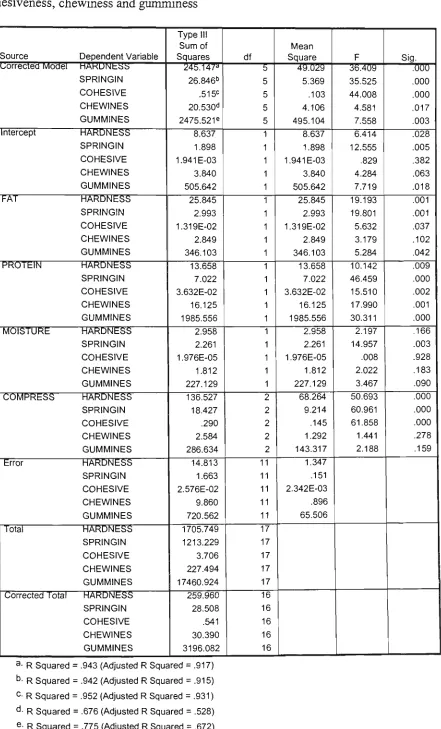
Table 3.3.2 The effects of fat, protein, moisture and compression 43 on hardness, springiness, cohesiveness, chewiness and
gumminess.
Table 6.3.1 Selected composition of mozzarella cheeses. 94
Figure 6.3.2 Effect of age, compression, age x compression, 95 culture, age x culture on the hardness, cohesiveness,
adhesiveness, springiness, gumminess and chewiness of the EPS and non-EPS cheeses.
Table 7.3.1 Selected composition of mozzarella cheeses. 121
Table 7.3.2 Effect of moisture content, compression, age and type 122 of fat replacer on the hardness, cohesiveness,
LIST OF FIGURES
Serial No. Figure No. Title Page No.
T Figure 1.1.1 Production statistics of mozzarella cheeses in Ausfraha. 2
2. Figure 2.1.1 Model proposed for physico-chemical and microstmctural 8 changes in mozzarella cheese.
3. Figure 3.2.1 A mozzarella cheese specimen being compressed under a 44 flat plunger using Insfron Universal Testing Machine.
4. Figure 3.3.1 A typical texture profile curve obtained by double 45 compression of mozzarella cheese specimen and plotting
force (Y-axis) and distance (X-axis). Al and A2 are the areas of curves obtained by the first and second compression, respectively, while A3 is the area of curve obtained during relaxation of the specimen after the first compression.
5. Figure 3.3.2 A typical texture profile curve obtained by double 46 compression of cheddar cheese specimen and plotting
force (Y-axis) and distance (X-axis). Al and A2 are the areas of curves obtained by the first and second compression, respectively.
6. Figure 3.3.3 Effect of level of compression of the commercial 47 mozzarella and cheddar cheeses on hardness.
7. Figure 3.3.4 Effect of level of compression of the commercial 48 mozzarella and cheddar cheeses on springiness.
8. Figure 3.3.5 Effect of level of compression of the commercial 49 mozzarella and cheddar cheeses on cohesiveness.
9. Figure 3.3.6 Effect of level of compression of the commercial 50 mozzarella and cheddar cheeses on chewiness.
10. Figure 3.3.7 Effect of level of compression of the commercial 51 mozzarella and cheddar cheeses on gumminess.
11. Figure 4.3.1 Microstmcture of 28 d old fiill fat mozzarella cheese 61 fixed using glutaraldehyde and osmium tefroxide. The
compact protein matrix is seen interspersed with large semm voids (4.3.1a) and the smooth surfaced cavities (4.3.1b) formed due to removal of fat.
12. Figure 4.3.2 Microstmcture of 28 d old fiill fat mozzarella cheese 62 fixed using glutaraldehyde and osmium tefroxide. Large
13. Figure 4.3.3 Microstmcture of mozzarella cheese made using 63 exopolysaccharide producing starter cultures. The
filamentous exopolysaccharide (4.3.3 a) and the sfreptococci (4.3.3b) are seen.
14. Figure 4.3.4 High magnification scanning elecfron microscope image 64 of mozzarella cheese made using exopolysaccharide
producing starter cultures showing exopolysaccharide (4.3.4a) produced by S. thermophilus (4.3.4b).
15. Figure 4.3.5 SEM image at high magnification of mozzarella cheese 65 made using exopolysaccharide producing starter cultures
showing Lactobacillus delbrueckii ssp. bulgaricus (4.3.5a), Streptococcus thermophilus (4.3.5b) and large void (4.3.5c) formed due to removal of serum from the cheese.
16. Figure 4.3.6 Microstmcture of mozzarella cheese made using non- 66 exopolysaccharide producing starter cultures showing
Streptococcus thermophilus (4.3.6a), semm channels
(4.3.6b), smooth surfaced small voids (4.3.6c) and
Lactobacillus delbrueckii ssp. bulgaricus (4.3.6d).
17. Figure 5.3.1 Microstmcture of 28 d old fiill fat mozzarella cheese 73 fixed using glutaraldehyde and osmium tettoxide and
cryoprotected with sucrose. The protein sfrands are seen covered with numerous small smooth surfaced voids due to removal of fat (5.3.1a). Large semm voids (5.3.1b) are also seen.
18. Figure 5.3.2 Microstmcture of 28 d old fiill fat mozzarella cheese 74 fixed using glutaraldehyde and osmium tefroxide and
cryoprotected with sucrose. The protein sfrands (5.3.2a) are seen surrounded by large semm voids (5.3.2b).
Streptococcus thermophilus (5.3.2c) are seen attached to
protein sfrands.
19. Figure 5.3.3 Microstmcmre of mozzarella cheeses made using 75 exopolysaccharide producing starter cultures. The
exopolysaccharide (5.3.3a) produced by sfreptococci (5.3.3b) is seen. The protein strand (5.3.3c) seems to be covered with loose particles (5.3.3d).
20. Figure 6.3.1 Hardness values of EPS and non-EPS cheese samples 96 over a 26 d storage period measured at 50 (EPS = • ;
non-EPS = • ) and 70% compression (non-EPS = • ; non-non-EPS =
" ) •
21. Figure 6.3.2 Cohesiveness values of EPS and non-EPS cheese samples 97 over a 26 d storage period measured at 50 (EPS = • ;
non-EPS = • ) and 70% compression (non-EPS = • ; non-non-EPS =
22. Figure 6.3.3 Adhesiveness values of EPS and non-EPS cheese samples 98 over a 26 d storage period measured at 50 (EPS = • ;
non-EPS = • ) and 70% compression (non-EPS = • ; non-non-EPS =
^ ) .
23. Figure 6.3.4 Springiness values of EPS and non-EPS cheese samples 99 over a 26 d storage period measured at 50 (EPS = • ;
non-EPS = • ) and 70% compression (non-EPS = • ; non-non-EPS =
" ) •
24. Figure 6.3.5 Gumminess values of EPS and non-EPS cheese samples 100 over a 26 d storage period measured at 50 (EPS = • ;
non-EPS = • ) and 70% compression (non-EPS = • ; non-non-EPS =
" ) •
25. Figure 6.3.6 Chewiness values of EPS and non-EPS cheese samples 101 over a 26 d storage period measured at 50 (EPS = • ;
non-EPS = • ) and 70% compression (non-EPS = • ; non-non-EPS =
^ )
-26. Figure 6.3.7 A scanning elecfron micrograph of 28 d old skim milk 102 mozzarella cheese made using non-EPS producing starter
cultures. The protein matrix (a) is seen having semm voids (b) and Streptococcus thermophilus (c) and
Lactobacillus delbrueckii ssp. bulgaricus (d) are foimd
located in these voids.
27. Figure 6.3.8 A scanning electron micrograph of 28 d old skim milk 103 mozzarella cheese made using EPS producing starter
cultures. The elongated protein strands (a) and large semm voids (b) are seen.
28. Figure 6.3.9 A scanning electron micrograph of 28 d old skim milk 104 mozzarella cheese made using EPS producing starter
cultures. Streptococcus thermophilus (a) and
Lactobacillus delbrueckii ssp. bulgaricus (b) are seen
covered with EPS. Minute particles (c) of proteins are visible on the surface of the cheese matrix.
29. Figure 6.3.10 A scanning electron micrograph of 28 d old skim milk 105 mozzarella cheese made using EPS producing starter
cultures. The cheese specimen shows numerous small voids (a), and Streptococcus thermophilus (b) are visible on the surface.
30. Figure 6.3.11 A scanning electron micrograph of 28 d old skim milk 106 mozzarella cheese made using EPS producing starter
31. Figure 7.3.1 Hardness values of confrol cheese without any fat 123 replacers and StaSlim® 143, Maltrin® M040 and MlOO
based cheeses over 18 d storage period measured at 50% compression.
32. Figure 7.3.2 Hardness values of confrol cheese without any fat 124 replacers and StaSlim® 143, Maltrin® M040 and MlOO
based cheeses over 18 d storage period measured at 70% compression.
33. Figure 7.3.3 Cohesiveness values of confrol cheese without any fat 125 replacers and StaSlim® 143, Maltrin® M040 and MlOO
based cheeses over 18 d storage period measured at 50% compression.
34. Figure 7.3.4 Cohesiveness values of control cheese without any fat 126 replacers and StaSlim® 143, Maltrin® M040 and MlOO
based cheeses over 18 d storage period measured at 70% compression.
35. Figure 7.3.5 Adhesiveness values of confrol cheese without any fat 127 replacers and StaSlim® 143, Maltrin® M040 and MlOO
based cheeses over 18 d storage period measured at 50% compression.
36. Figure 7.3.6 Adhesiveness values of confrol cheese without any fat 128 replacers and StaSlim® 143, Maltrin® M040 and MlOO
based cheeses over 18 d storage period measured at 70% compression.
37. Figure 7.3.7 Springiness values of control cheese without any fat 129 replacers and StaSlim® 143, Maltrin® M040 and MlOO
based cheeses over 18 d storage period measured at 50% compression.
38. Figure 7.3.8 Springiness values of confrol cheese without any fat 130 replacers and StaSlim® 143, Maltrin® M040 and MlOO
based cheeses over 18 d storage period measured at 70%) compression.
39. Figure 7.3.9 Gumminess values of control cheese without any fat 131 replacers and StaSlim® 143, Maltrin® M040 and MlOO
based cheeses over 18 d storage period measured at 50% compression.
40. Figure 7.3.10 Gumminess values of confrol cheese without any fat 132 replacers and StaSlim® 143, Maltrin® M040 and MlOO
based cheeses over 18 d storage period measured at 70% compression.
based cheeses over 18 d storage period measured at 50%i compression.
42. Figure 7.3.12 Chewiness values of confrol cheese without any fat 134 replacers and StaSlim® 143, Maltrin® M040 and MlOO
based cheeses over 18 d storage period measured at 70%) compression.
43. Figure 7.3.13 A scanning elecfron micrograph of 28 d old skim milk 135 mozzarella cheese made without addition of fat replacers.
44. Figure 7.3.14 A scanning elecfron micrograph of 28 d old skim milk 136 mozzarella cheese made without addition of fat replacers.
45. Figure 7.3.15 A scanning electron micrograph of 28 d old skim milk 137 mozzarella cheese specimen made using Maltrin® M040
a carbohydrate based fat replacers, showing the cross section of cheese cut parallel to the protein sfrands.
46. Figure 7.3.16 A scanning electron micrograph of 28 d old skim milk 138 mozzarella cheese specimen made using Maltrin® M040
a carbohydrate based fat replacers, showing the gel like behaviour of the fat replacer. Note the cheese shows protein strands elongated in various directions due to manual sfretching.
47. Figure 7.3.17 A scanning elecfron micrograph of 28 d old skim milk 139 mozzarella cheese specimen made using Maltrin® M040
a carbohydrate based fat replacers, showing the gel like behaviour of the fat replacer. Note the cheese shows protein sfrands elongated in various directions due to manual sfretching.
48. Figure 7.3.18 A scanning electron micrograph of air dried, aqueous 140 dispersion of Maltrin® M040 a carbohydrate based fat
replacer, showing the gel like behaviour of the fat replacer.
49. Figure 7.3.19 A scanning electron micrograph of freeze dried, aqueous 141 dispersion of Maltrin® M040 a carbohydrate based fat
replacer, showing the coalescing of fat replacer particles.
50. Figure 7.3.20 A scanning elecfron micrograph of 28 d old skim milk 142 mozzarella cheese specimen made using Maltrin® MlOO
a carbohydrate based fat replacers, showing the gel like behaviour of the fat replacer.
51. Figure 7.3.21 A scanning elecfron micrograph of 28 d old skim milk 143 mozzarella cheese specimen made using Maltrin® MlOO
the protein fibres.
52. Figure 7.3.22 A scanning elecfron micrograph of 28 d old skim miUc 144 mozzarella cheese specimen made using Maltrin® MlOO
a carbohydrate based fat replacer. The cheese shows indentations made by the fat replacer on the protein matrix. The specimen shows the cross section of the cheese parallel to the protein sfrands.
53. Figure 7.3.23 A scanning elecfron micrograph of air dried, aqueous 145 dispersion of Maltrin® MlOO a carbohydrate based fat
replacer, showing the gel like behaviour of the fat replacer.
54. Figure 7.3.24 A scanning elecfron micrograph of freeze dried, aqueous 146 dispersion of Maltrin® MlOO a carbohydrate based fat
replacer, showing the coalescing of fat replacer particles.
55. Figure 7.3.25 A scanning elecfron micrograph of 28 d old skim milk 147 mozzarella cheese specimen made using StaSlim® 143 a
carbohydrate based fat replacer. The cheese shows indentations made by the fat replacer on the protein matrix. The specimen also shows the particulate nature of the fat replacer.
56. Figure 7.3.26 A scanning electron micrograph of 28 d old skim milk 148 mozzarella cheese specimen made using StaSlim® 143 a
carbohydrate based fat replacer. The cheese shows the fat replacer located within the semm channels. The specimen also shows the particulate nature of the fat replacer.
57. Figure 7.3.27 A scanning electron micrograph of 28 d old skim milk 149 mozzarella cheese specimen made using StaSlim® 143 a
carbohydrate based fat replacer. The cheese shows indentations made by the fat replacer on the protein matrix. These indentations look similar to the ones made by fat globules. Also the fat replacer shows a smooth surface indicating probably soft hydrated particles of the fat replacer.
58. Figure 7.3.28 A scanning electron micrograph of 28 d old skim milk 150 mozzarella cheese specimen made using StaSlim® 143 a
carbohydrate based fat replacer. The cheese shows the fat replacer located between the protein strands, which could be the reason fro, the softness and pliable texmre of the cheese.
59. Figure 7.3.29 A scanning electron micrograph of air-dried, aqueous 151 dispersion of StaSlim® 143 a carbohydrate based fat
60. Figure 7.3.30 A scanning elecfron micrograph of freeze dried, aqueous 152
dispersion of StaSlim® 143 a carbohydrate based fat
LIST OF ABBREVIATIONS
USDA
FDM
FDW
SNF
TPA
GRAS
SEM
EPS
HTST
CPD
TEM
STEM
MNFS
United States Department of Agrici
Fat in dry matter
Fat by dry weight
Solid not fat
Texture profile analysis
Generally recognised as safe
Scanning elecfron microscope
Exopolysaccharide
High temperature short time
Critical point drying
Transmission elecfron microscope
Scanning fransmission elecfron mi
1.0. INTRODUCTION
1.1. BackgroundMozzarella cheese is a semi hard (semi-soft) variety of cheese. Mozzarella cheeses have
gained popularity as a pizza cheese over the past 20-30 years. The per capita
consumption of fluid milk in Ausfralia has remained relatively static, whereas the
amoimt of manufacturing milk increased from 5.2 billion lifres to 7.1 bilhon hfres in
1997 (Sutherland, 1998). Further it is reported that expansion in manufacmring milk
supply is expected at a similar rate thereby more milk would be available for the
manufacture of cheeses. Among the major milk products, cheese and whey products
accounted for 40% of total manufacturing milk in 1996-97. Presently 60%) of the
manufactured products are exported (Sutherland, 1998).
In the past 10 years the proportion of cheeses manufacmred in Australia has increased
steadily and the amount in 1997 was 290,000 tonnes/year. The production of mozzarella
cheeses increased from 13,708 tonnes in 1992/93 to 27,431 tonnes in 1997/98. The
non-cheddar cheeses being exported have shown an increase from 14% to nearly 40% of
total cheese exports between 1988 and 1997. The domestic cheese market has shown a
shift towards consumption of pizza/shredding types and fresh cheese types within the
non-chetidar sector. The domestic mozzarella and pizza cheese market is estimated to be
31,300 tonnes in 1997/98. The major growth in the cheese market is through the fast
food outiets as an ingredient in pizzas and burgers. The non-retail sector accounts for
80% of mozzarella cheese market while that of cheddar is only 18%. The trend in
12000
1992/93 1993/94 1994/95 1995/96 1996/97 1997/98
Time (yrs)
Figure 1.1.1. Production statistics of mozzarella cheeses in Ausfralia ,^Sutherland, 1998).
Mozzarella and pizza cheeses account for about 16% of the total Australian cheese
market (Australian Dairy Corporation, 1996) while in Italy these cheeses account for
78%) of the total Italian cheese produced (Merrill et al, 1994).
The present frend is to reduce the fat content in cheeses. This has led to manufacture of
cheeses with low fat or reduced fat contents. In recent years demand for cheeses
containing low fat has increased (Shepherd and Stockley, 1987; Anonymous, 1992;
Anonymous, 1995).
Recent surveys have shown that consumers are becoming more aware of consumption
of fat from cheese and other dairy products (USDA, 1991; Tunick et al, 1993a, b;
Ausfralian Dairy Corporation, 1996). In a survey, 23%) of the respondents reported that
they had stopped eating dairy products because of their high fat content (Barr, 1990).
Thus low fat cheeses are becoming increasingly popular among consumers. As a result,
sales of reduced fat cheeses have increased by 9% in 1995/96 (Australian Dairy
diet low in fat and cholesterol. Suggested goals for fat in diets include total fat that
provides 30%) or less of calories, and saturated fat that provides less than 10% of
calories (McGinley, 1994; Anonymous, 1994). Accordmg to Food and Nutrition Service
of the USDA, the school lunch program provided 38% calories from unsaturated fat and
15% from saturated fat and only about 1% of the 92,000 schools in the program met
these guidelines (McGinley, 1994; Tunick et al, 1995 a, b, c). A significant correlation
between dairy fat intake and mortality rates from coronary heart disease has been
reported (Renaud and deLorgeril, 1992). There is apprehension by many consumers
about dietary fat which has led to the development of mozzarella cheeses containing
9-11% fat. This is less than half the fat of normal fiill fat mozzarella, which could be
labelled in the US as 'lite' according to new regulations (Tunick et al, 1991; 1993a, b;
1995a, b, c).
But reduction in fat changes the flavour and texture profiles of mozzarella cheeses. A
few varieties of reduced fat cheddar cheeses are reported to have characteristic cheddar
flavour, but there are no reduced fat mozzarella cheeses that resemble delicately
flavoured whole milk mozzarella. The flavour and texmre characteristics are due to fat
content and reduced fat cheeses have a plastic body (Burros, 1992). The texmre
characteristics of low fat mozzarella cheeses are adversely affected by reduction in fat
level or substitution of vegetable oil for milk fat (Malin et al, 1993). Mozzarella
cheeses with fat content lower than that of partly skim cheeses have potential of finding
an important market among light dairy products (Tunick et al, 1993a, b). In mozzarella
cheeses the flavour is of secondary importance, while stretchability and melting
characteristics are of primary importance. There is a requirement for minimal fat
(FDM), but pizza cheese and mozzarella are now successfully made with substantially
lower fat contents; as low as 19%) FDM (Jameson, 1990). A few workers have studied
manufacture of imitation cheese, low fat high moisture mozzarella cheeses and fat
substituted mozzarella cheeses without much success. Previous studies using protein
based (Simplesse DlOO and Dairy lo), and carbohydrate based (Stellar lOOX and
Novagel RCN-15), fat replacers have been partly successfiil, especially when protein
based fat replacer was used (Lucey and Gorry, 1993, Desai and Noltuig, 1995,
McMahon et al, 1996). In the present investigation, maltodextrins, tapioca dextrins,
com symp sohds and polysaccharide based fat replacers were used for making low fat
mozzarella cheeses. Also exopolysaccharide producing microorganisms were used to
improve springiness characteristic in mozzarella cheeses.
The objectives of this study were to examine texture characteristics of four commercial
cheeses, and to study the microstmcture of low fat cheeses, and location and distribution
of fat replacers in skim milk cheeses. The specific objectives of this project were:
(1) to assess the commercial mozzarella cheeses for their texture characteristics,
(2) to compare the texture characteristics of fiill fat mozzarella cheeses with low fat
cheeses,
(3) to investigate methods of specimen preparation for microstmcture smdy,
(4) to examine the effects of exopolysaccharide producing starter cultures on texture and
microstmcture characteristics of mozzarella cheeses, and
(5) to manufacture skim milk mozzarella cheeses using fat replacers and smdy
Chapters 1 and 2 of this thesis contain infroduction, the review of literature and chapter
3 deals with the evaluation of commercial mozzarella cheeses. Chapter 4 focuses on the
simplified method of specimen preparation of mozzarella cheeses for microstmcture
study while chapter 5 examines the microstmcture of mozzarella cheeses made with or
without exopolysaccharide producing starter cultures using sucrose as a cryoprotectant.
Chapter 6 deals with examining the textiure characteristics of skim milk mozzarella
cheeses made using exopolysaccharide or non-exopolysaccharide producing starter
cultures and chapter 7 includes the texture and microstmcmre smdy carried out on skim
milk mozzarella cheeses made using fat replacers. Chapter 8 gives overall conclusions.
1.2. References
Anonymous. (1992). Soft options. German survey. Dairy Ind. Int 57(6): 29-30.
Anonymous. (1994). School lunches will meet dietary guidelines by 1998 under new USDA proposal. Cheese Reporter \\2,(\Q))\\.
Anonymous. (1995). Cheese manufacturers see market for healthy cheese having most potential. Cheese Reporter 120(15): 16.
Ausfrahan Dairy Corporation (1996). Written communication.
Barr, A. (1990). Consmner motivational forces affecting the sale of light dairy products.
Food Technol. 44:97-8.
Burros, M. (1992). If butter fat is cut, cheese doesn't cut it. Newyork Times June 3, pCl.
Desai, N. and Nolting, J. (1995). Microstmcture smdies of reduced fat cheeses containing fat substitute. In Chemistry of stmcture- fimction relationships in cheese, eds. Malin, E. L. and Tunick, M. H., Plenum press, NY. 295-302.
Lucey, J. A. and Gorry, C. (1993). Effect of Simplesse® 100 on the manufacmre of low fat cheddar cheese, In Cheese yield and factors affecting its control. Int. Dairy Fed.
Sem., Cork, Ireland. 439-447.
Malin, E. L., Banks, J. M., Tunick, M. H., Law, A. J. R., Leaver, J. and Holsinger, V. H. (1993). Texture enhancement of low fat mozzarella cheese by refiigerated storage. Int.
Dairy J. 3(4-6) 548 poster A4.
McMahon, D. J., Alleyne, M. C , Fife, R. L. and Oberg, C. J. (1996). Use of fat replacers in low fat mozzarella cheese. J. Dairy Sci. 79: 1911-1921.
McGinley, L. (1994). Planned new school lunch guidelines prompt food sellers to think nutrition. Wall St J. (Westn.) June 6 pBl.
Merrill, R. K., Oberg, C. J. and McMahon, D. J. (1994). A method for manufacturing reduced fat mozzarella cheese. J. Dairy Sci. 11(1): 1783-9.
Renaud, S. and M. deLorgeril 1992. Wine, alcohol platelets and the french paradox for coronary heart disease. Lancet 339:1523.
Shepherd, R. and Stockley, L. (1987). Nutrition knowledge, attimdes, and fat consumption. J. Amer. Diet. Asso. 87(5): 615-9.
Sutherland, B. J. (1998). Developments in cheese science and technology in Austraha.
Aust J. Dairy Technol. 53(l):63-65.
Tunick, M. H., Mackey, K. L., Shieh, J. J., Smith, P. W., Cooke, P. and Malin, E. L. (1993a). Rheology and microstmcmre of low fat mozzarella cheese. Int. Dairy J. 3: 649-62.
Tunick, M. H., Malin, E. L., Shieh, J. J., Smith, P. W., Sullivan, B. C , Mackey, K. L. and Holsinger, V. H. (1993b). Proteolysis and rheology of low fat and fiill fat mozzarella cheeses prepared from homogenised milk. J. Dairy Sci. 76(12): 3621-8.
Tunick, M. H., Malin, E. L., Smith, P. W. and Holsinger, V. H. (1995a). School lunch pizzas topped with low fat mozzarella cheese. Cult. Dairy Prod. J. 3 0(2): 6-9.
Tunick, M. H., Malin, E. L., Smith, P. W. and Holsinger, V. H. (1995b). Effects of skim milk homogenisation on proteolysis and rheology of mozzarella cheese. Int. Dairy J. 5: 483-91.
Tunick, M. H., Malin, E. L., Smith, P. W., Cooke, P. H. and Holsinger, V. H. (1995c). Influence of reimet source on proteolysis, rheology and microstmcture of low fat mozzarella cheese. J. Dairy Sci. 78(suppl.l): 101.
2.0. LITERATURE REVIEW
2.1. Mozzarella cheeses
Mozzarella cheeses are produced from whole or partly skimmed milk to which small
amounts of starter or organic acids are added, followed by a milk coagulator, rennet
extract. The curd formed is cut, and allowed to matt. Exposure of the drained curd to
warm temperatures permits a mild acid ripening to pH 5.2; at this pH the curd is heated
in hot water, stretched or mixed and moulded. The cheese is then slightly salted.
The physico-chemical and microstmctural changes (Figure 2.1.1) taking place during
refrigerated storage in the first two weeks along with proteolysis have been reported to
be the driving forces behind the functional changes in mozzarella chees^^indstedt and
(Guo, 1
paracasein llbres
microEtfuclura swelling ^
tat globule
hydrated
paracasein ^^ 9^5 globule Figure 1 : Proposed model for physico-chemical and mierostructur^l changes in pizza cheese during Etiort-term refrigerated ageing.
Figure 2.1.1. A model proposed for physico-chemical and microstmctural changes in
mozzarella cheeses (Kindstedt and Guo, 1997).
The aim of cheese making in 'Pasta Filata' is achieving the smooth texture and grain in
cheese tiirough a skilful sfretching of curd in hot water (Jana and Upadhyay, 1991). The
paracaseinate which is converted to monocalcium paracaseinate at pH between 5.2 and
5.4. The latter provides the strings and sheen to the cheese (Kosikowski, 1982). I
2.1.1. Types of mozzarella cheeses
Mozzarella cheeses can be classified as shreddable or non-shreddable varieties. The
shreddable variety usually tends to have lower moisture content than the non-shreddable^
variety. The mozzarella cheeses are also classified on the basis of the method of
acidification of milk ie. direct acidified or through addition of starter cultures. Several
organic acids are used to cause coagulation of the milk including lactic acid, citric acid
and acetic acid. Among these lactic acid is the widely used coagulant. Streptococcus
thermophilus and Lactobacillus delbrueckii ssp. bulgaricus are the commonly used
starter cultures. Lactobacillus helveticus and Lactobacillus casei are also used to
increase proteolysis in the mozzarella cheeses during storage; this enhances ftmctional
characteristics including melt, sfretch and flow of the cheeses.
In the USA there are four categories in which mozzarella cheeses can be classified:
mozzarella cheese, low moisture mozzarella cheese, part skim mozzarella cheese and
low moisture part skim mozzarella cheese. These varieties differ in their fat and
moisture content. Mozzarella cheese must have 45% fat (FDW) and 52 to 60%)
moisture. Most of the mozzarella cheeses produced in the US falls into the pizza cheese
category ie. low moisture part skim mozzarella cheese with a fat content of 30 to 45%)
FDW and a moisture content of 45 to 52%. In compiling statistics all categories are
usually combined and referred to as "mozzarella" cheese which is equivalent to low
moisture part skim mozzarella cheese. The shreddable type mozzarella cheese must
2.1.2. Starter cultures used for the manufacture of mozzarella cheeses
Several manufacturers use Streptococcus thermophilus only for manufacturing
mozzarella cheeses. Details of the different types of cultures and their characteristics are
shown in Table 2.1.1. (Sigsgaard, 1994). Normally the starter cultures consists of a
combination of Streptococcus thermophilus and Lactobacillus delbrueckii ssp.
bulgaricus or Lactobacillus helveticus organisms.
Table 2.1.1. Chr. Hansen's culture programme for pizza cheese production (Sigsgaard, 1994).
Thermophilic cultures
Type DVS defined
TH-3 TH-4 St-36 St-37 St-75 St-B 01 lactic sfrains Acid Galactose production fermentation Streptococcus thermophilus fast negative fast negative fast negative fast negative fast negative slow negative Type DVS defined sfrains Lactobacillus delbrueckii ssp. Lb-9
LB-12
slow positive fast negative Type DVS defined sfrains Lactobacillus helveticus
Lh-B 01 Lh-B 02
Type DVS multiple CH-1
B-3
; sfrain
Type DVS composed
bulgaricus TCC-1 TCC-2 TCC-3 TCC-4 slow positive fast positive Proteolytic
activity
medium Medium High High High Medium bulgaricus Medium Medium Low LowSalt sensitivity (50%/100% inhibition) 2.1/4.0 1.9/3.0 2.5/3.0 2.5/3.0 2.5/3.0 2.0/3.0 2.1/3.0 1.7/3.0 3.1/4.0 2.5/3.0
, yoghurt Streptococcus thermophilus/Lactobacillus delbrueckii ssp. bulgaricus fast negative fast negative Medium Medium 2.1/3.0 1.9/3.0
cheese cultures Streptococcus thermophilus/Lactobacillus delbrueckii ssp.
fast negative fast negative fast negative fast negative Medium Medium Medium Medium 2.7/3.5 3.1/4.0 2.8/3.5 2.8/3.5
Type DVS composed cheese cultures Streptococcus thermophilus/Lactobacillus helveticus TCC-20 fast positive Low 2.8/3.5
Type DVS composed cheese cultures Streptococcus thermophilus/Lactobacillus helveticus /Lactococcu
lactis ssp. lactis or cremoris/Lactococcus lactis ssp. diacetylactis or cremoris
TCC-21 fast positive Low 3.7/>4
Type DVS composed cheese cultures Streptococcus thermophilus/Lactococcus lactis ssp. lactis or
cremoris
The cultures are selected based on their acid production, galactose fermentation,
proteolytic activity and salt sensitivity. Previous studies reported by Jana and Upadhyay
(1991) have indicated the use of Lactococcus lactis. Streptococcus durans and
Streptococcus faecalis for the manufacture of high moisture mozzarella cheese while the
effect of Pseudomonas cerevisiae, Lactobacillus plantarum, Lactobacillus casei.
Streptococcus faecalis and Streptococcus durans along with Streptococcus thermophilus
and Lactobacillus delbrueckii ssp. bulgaricus to avoid blistering or burning of cheese
during baking of pizzas was also reported to have been studied. These adjunct starter
cultures mainly utilise the galactose accumulated in the cheese thereby reducing
Maillard browning. The accumulation of galactose is due to the activity of S.
thermophilus, which utilises lactose and glucose from milk, but does not have galactase
enz3mie (McMahon ef a/. 1993).
Hassan et al. (1995 a, 1995b), measured the size of capsule formed and its effect on acid
production by EPS producing starter bacteria. Further studies were carried out (Hassan
et al, 1996a) on the viscosity characteristics of yogurt manufacmred using EPS
producing starter cultures. Similar smdies (Hassan et al, 1996b) on yogurt made using
exopolysaccharide producing starter cultures including encapsulated non-ropy or
unencapsulated ropy sfrains of lactobacilli showed an increase in moisture retained in
the yogurt gel. Hassan and Frank (1997) also observed a reduction in curd tension and
firmness of rennet curd due to increased open casein network with large pores when
made using EPS producing starter cultures compared to non-EPS producing starter
2.2. Factors affecting quaUty of mozzarella cheese
The major factors affecting the physical properties of mozzarella cheese such as pH,
protein, moisture, calcium, salt, type of enzymes used, culture used, age (storage
conditions) and fat are described below.
2.2.1. Cheese pH
Acid production is the key to the manufacture of good quality cheeses. It affects the
state of milk solids. It has been observed that at pH 5.2 of cheese curd before hot
sfretching gives optimum sfretchability for starter added cheese manufacture whereas
for direct acidification the pH can be 5.3 or 5.4. At this pH the colloidal calcium
phosphate attached to casein micelles is solubilised and a portion of calcium ions is losti
in the whey. The native protein, casein is fransformed chemically to another form of
protein highly sensitive to coagulation in the presence of calcium. This precipitates out
at room temperature as dicalcium paracaseinate, enfrapping fat, insoluble salts, lactose'
and some serum. This precipitate is incapable of producing a smooth plastic mass when
exposed to hot water or steam. By acid development some of the calcium of dicalcium
paracaseinate is dissolved by the acid and monocalcium paracaseinate is formed. This
caseinate has the unique property of forming smooth, pliable and stringy curd when
O
heated to 54 C or higher. Further acid development during ripening causes more
calcium to be lost and paracasein is formed which does not retain fat (Kosikowski,
1982). During sfretching the free casein is available for stabilising newly created fat
The moisture content of cheese is dependent upon the acidity or pH during curd
formation ((Oberg et al, 1993)i Excessive acid production causes more syneresis and the
cheese becomes crumbly, whereas less acid production gives pasty or sticky cheese due
to excess moisture retamed. Also by confrollmg the moisture content the bacterial
growth and enzyme activity are regulated which in turn mfluence the rate and extent of
ripening. The decrease in calcium content enhances the susceptibility of casein during
ripening to proteolysis and thus the textural and rheological properties of cheese
(Holsinger et al, 1995). Also the rennet activity is pH dependent and lowering the pH
(Holsinger et al, 1995) confrols the activity of non-starter bacteria.
2.2.2. Protein
Protein plays a major role in the manufacture of cheeses. It is the major component of
cheese body and gives the desired firmness, stretch and meltability, which are the
essential characteristics of mozzarella cheese. Although cheese firmness is affected by
the relative amounts of water, protein and fat, the dominant factor is the amount and
ratio of water and protein which have the greatest effect ( ^ n t i c e , 1987; Walstta et al,
(1987). The hardness of cheese varieties with diverse composition correlated most
closely with protein content but not related to fat contentuChen et al, 1979)J Also
when the ratio of fat to SNF increased there was a decrease in elasticity more so because
of SNF part (Masi and Addeo, 1986). Similar effect due to moisture changes has been
i2.2.3. Moisture
The moisture content in cheese is affected by the rate and extent of syneresis which m
turn is confrolled by milk composition especially the calcium ion concenfration^ p H ^ f
whey^ temperature of cooking, rate at which curd is. stfrred with the whey and time
MHolsinger et al, 1995)?\Moisture content affects various characteristics of mozzarella
cheese such as hardness, springiness, chewiness, meltabihty and crumbliness. Decrease
in moisture content of mozzarella cheese caused decrease in meltability, cohesiveness
and an increase in hardness, springiness, chewiness and crumbliness UTunick et al,
(1991)\ It has also been reported that reduction in moisture levels in mozzarella cheese
resulted in higher values for hardness and springiness (because of increase in elastic
modulus and viscous modulus) and lower values for cohesiveness, complex viscosity
and meltability (Tunick et al, 1993a).
'2.2.4. Calcium
Calcium exists in milk in the form of bound calcium phosphate with casein and keeps
the casein in a colloidal phase. The removal of calcium causes dissociation of casein
which becomes available for emulsification of fat and there will be less oiling off upon
melting. Excess of calcium has been linked with excessive curd firmness. So part of
calcium is destabilised and expelled along with whey due to acid production by starter
culture in milk or direct acidification during manufacture. It has also been reported that
a pH of 5.6 obtained by acidification using citric acid gives similar curd as with
lowering of pH to 5.2 by otiier acids because calcium gets removed because of chelating
** 2.2.5. Salt
Salt is incorporated into mozzarella cheese by either brining alone or along with dry
saltmg. This step is also necessary to cool the hot sfretched cheese. Moisture loss during
salting depends on brine temperature, with greater loss as brine temperamre mcreases.
But the salt uptake is affected by the brine temperature and brine sfrength (Kindstedt,
1993). This step also has positive effects on the product.
Salting also improves emulsification of fat because of calcium exchange in protein and
is independent of the moisture content of the product. So there are less chances of
oiling off. This effect has been proven to be better in case of dry salting of cheese curd
before it goes to the sfretcher (Oberg et al, 1993, Tunick, 1994).
Sahing inhibits non-starter organisms from growing and causing spoilage during
storage. Excessive salting may also inhibit the activity of bacteria which come as post
manufacture contaminants and grow during storage. So there would be more
unfermented sugars leading to browning of mozzarella cheese during pizza making
(Tunick et al, 1991). Also a study by Tunick et al (1995c) has shown that it can cause
decrease in melt.
2.2.6. Enzymes
The coagulants used in cheese making are enzyme preparations belonging to the family
of aspartic proteinases (Harboe, 1998). Generally, rennet (an enzyme extracted from the
stomachs of young ruminants) is used as the coagulant in cheese making. The enzyme
used in manufacture of mozzarella cheese is of vital importance because each enzyme
gives different characteristics to the final product. The main desfred characteristics
(Harboe, 1998) of coagulants are:
(i) high milk clotting and low general proteolytic activity, thereby reducing
casein fragment losses,
(ii) good curd forming properties, which will retain most of the fat globules and
large peptides within the curd,
(iii) low pH dependency during milk clotting for better confrol and consistency,
(iv) complete inactivation of enzymatic activity with normal pasteurisation to
get whey free of active enzymes that can be used for manufacture of
products such as ricotta cheese,
(v) high purity especially free from starch degrading enzymes,
(vi) good stability during handling and storage.
Tunick et al (1995c) studied characteristics of microbial rennet, using Mucor meihei
and Clostridium parasitica. With calf rennet, the curd showed 25- 39 % decrease in
hardness and 23- 26 % decrease in springiness in 6 week period. During the same time
with cloned calf chymosin, the moisture retention in mozzarella cheese decreased and
mehability increased. Confrol of moisture in non-fat substance is more important than
tiie rennet source in manufacturing mozzarella cheese (Tunick et al, 1995c). In another
study by Oberg et al (1993) pepsin produced more open texture curd, while chymosin
gave better mehability to the mozzarella cheese. There was 19- 27 % increase in
mehability in 6 week period when Mucor meihei enzyme was used (Tunick et al,
It has been reported that rennet retains some activity during manufacture of mozzarella
cheese (DiMatteo et al, 1982; Tunick et al, 1991, 1993b). Table 2.2.1. shows tiie heat
stability of some of the coagulants studied during pasteurisation of whey.
Rennet cleaves ^sl-casein to form ^sl-I- casein and a smaller peptide (McSweeney et
al, 1993a). The '^s2-casein and f^-casein were also found to be degraded which could be
due to plasmin, a native milk enzyme, which is heat stable (Farkye et al, 1991; Farkye
and Fox, 1992 ). Yun et al. (1993) showed that ^sl-casein only degrades due to action
of rennet and not ^s2-casein or "-casein.
Table 2.2.1. Heat stability of some of the coagulants at pasteurisation temperatures for
whey (Harboe, 1998).
Type of Coagulant Percent of residual activity after 5 min at
O O
60 C (corresponds to 72 C for 15 sec.)
pH 5.0 pH 5.5 pH 6.0
Rennet containing chymosin and pepsin
Microbial coagulant native type
Microbial coagulant destabilised
Microbial coagulant exfra destabilised
6 1 14 17
40 2 41 68
Visser et al. (1989) in their studies on hydrolysis of as2-casein by plasmin, showed that
the largest peptide formed could have mobility similar to that of aslIcasein, a s l
-casein or P--casein and therefore would not be detected. Rennet enzyme is most
commonly used for the manufacture of cheeses.
2.2.7. Starter culture
The selection of a particular culture is very important to obtain the desired
characteristics of the product. The parameters to be considered while selecting culture
are acidification rate, proteolytic activity, lactose fermentation and sah sensitivity.
Normally for pizza cheese Streptococcus thermophilus, Lactobacillus delbrueckii ssp.
bulgaricus and/or Lactobacillus helveticus are used. Streptococcus thermophilus are
mainly used for acid production whereas Lactobacillus delbrueckii ssp. bulgaricus and
Lactobacillus helveticus are used for their proteolytic activity. Lactobacillus helveticus
has a wider spectrum of proteolysis compared to Lactobacillus delbrueckii ssp.
bulgaricus and almost all strains of Lactobacillus helveticus are galactose fermenting
unlike Lactobacillus delbrueckii ssp. bulgaricus (Per Sigsgaard, 1994). Galactose
fermentation is important because most sfrains of Streptococcus thermophilus cannot
hydrolyse galactose and this may cause Maillard browning in the final cheese when
baked on the pizza. To avoid this Lactobacillus delbrueckii ssp. bulgaricus or
Lactobacillus helveticus are used.
Thus a proper starter culture must be used which may be a single sfrain of Streptococcus
thermophilus or mixed sfrains of Streptococcus thermophilus and Lactobacillus
2.2.8. Storage
A specific ripening pathway during storage of mozzarella cheese has been indicated m
the study by Malin et al. (1993). During storage various biochemical changes occur in
cheese including glycolysis, lipolysis and proteolysis and secondary catabolic changes
such as deamination, decarboxylation, P-oxidation and ester formation in cheddar
cheese^(Holsinger ef al, 1995}^In case of mozzarella cheese, the principal biochemical
change is due to proteolysis. Although there is very limited proteolysis in mozzarella
cheese when compared to ripened cheese varieties, it affects the ftmctional and
rheological characteristics of mozzarella cheeses. Various methods of assessing
proteolysis in cheeses have been reported (Fox et al, 1995). Kindstedt et al (1997) have
suggested a model for physico-chemical and microstmctural changes in pizza cheese
during short time refiigerated ageing.
Tunick et al (1991, 1993a, 1993b, 1995c) \eported that during refiigerated storage
meltability increases with proteolysis, whereas hardness, springiness, gumminess,
chewiness decreased. Oberg et al (1993) observed an increase in free oil formation after
first two weeks of storage, ^iefes et al. (1993))showed that refrigerated samples were
less elastic and less viscous than frozen and thawed samples of same age. They also
observed that during freezing local dehydration takes place causing stmctural changes in
proteins and upon thawing these proteins are unable to rebind water and thus lose
elasticity. Further, the fat granules were formed at freezing temperamres causing
hardness. However, Tunick et al. (1995c) did not observe any texmral defects in 1-week
storage proteolysis by plasmin and residual coagulant caused cheese softening (Diefes et
al, 1993).
Reports (Tunick et al, 1991; 1995b; Anonymous, 1995; Dryer, 1994) suggest tiiat 6
weeks old low fat high moisture mozzarella cheese had similar textural properties as
fresh 1 week old high fat low moisture mozzarella cheese. Tunick et al. (1991) observed
frozen mozzarella cheese samples of 48 days to show poor cohesiveness and meltability
when evaluated after thawing. Thawing at 4.4°C for 21 days produced optimum values
of cohesiveness and meltability.
2.2.9. Fat
A linear decrease in elasticity of mozzarella cheeses was observed as the ratio of fat to
solids-not-fat increased (Masi and Addeo, 1986). The effect of milk fat on cheese
elasticity may be related to the interaction between the fat globule surface membrane
and the cheese protein matrix. Globules that were washed to remove the surface
membrane did not contribute to the elasticity of the acid milk gels. They did not react
with the protein matrix, and the gels behaved as if the voids were filled with particles
possessing the rheological properties of water. Fat globules coated with protein during
homogenisation contributed substantially to the gel elasticity (Olson and Johnson,
1990).
Chen et al. (1979) observed that protein levels play dominant role affecting elasticity of
cheese varieties of varying composition. However, fat plays a more dominant role in
stickiness but effect of fat without change in protein level is unknown (Olson and
Johnson, 1990).
The firmness of cheese is affected by the melting point of milk fat (Prentice, 1987). An
indirect linear relationship was observed between penefrometer readings of cheese and
iodine number of milk fat; the latter is a measurement of saturation and an indication of
meltability. The proportion of solid to hquid fat at different temperatures might affect
rheological properties of cheese. The impact of fat on temperature induced softening
may be questionable because changes in relative firmness were linear and similar
between 5°C and 30°C for cheese of varying composition (Prentice, 1987) including
low fat (30% fat reduction) cheeses. In Scandinavia vegetable oils including soybean
oil, sunflower oil and cotton-seed oil are used to replace milk fat. The typical fat
contents of these products are about 50% FDM and the products are being marketed as
"Lochol" and "Minichol" (Tunick et al, 1991).
The effect of polyunsaturated: saturated fat ratio was not studied in much detail but
cheddar cheese has been made successfiilly using Aha milk (milk produced from cows
fed with protected polyunsaturated fat supplements) but in this process the starter
cultures had to be changed (Tunick et al, 1991).
"^ It has been reported that when the fat content of the mozzarella cheese is decreased, the
moisture retention also decreases giving the cheese a poor meft and sfretch
characteristic. The cheese is said to have a mbbery texture (Fecera et al, 1995) and
there is an increase in hardness, springiness and chewiness (Tunick etal, 1991). Xunick
[et al. (1995b)^concluded from then study that proteolysis and rheology of cheese are
affected more by fat content and storage rather than by fat globule size or
homogenisation of fat. A study by Merrill et al. (1994) showed that different casein: fat
ratios (1.2 ; 1.6 ; 2.0 & 2.4) to make low fat mozzarella cheese had no effect on the melt
and sfretch characteristics. It is also well known that low fat high moisture cheeses
exhibit stickiness when masticated, especially when their fat content is 15 % or less
(Olson and Johnson, 1990).
2.2.9.1. Free oil formation
A detailed study by Tunick et al. (1994) of the effect of different manufacturing
conditions on the free oil formation has shown that:
(i) free oil formation is dependent on FDM. Above 37 % FDM there is more
significant amount of free oil formed which increases with increase in fat.
J^) free oil increases during refiigerated storage of mozzarella cheese due to
more breakdown of casein which destabilises fat from its emulsified state,
(iii) free oil is greatly decreased if homogenisation is done to cheese milk prior
to cheese manufacture,
(iv) addition of emulsifying salts or increase in pH tends to decrease free oil
formation. However, increase in pH adversely affects the stretchability of
mozzarella cheese,
(v) decrease in cooking temperamre causes increase in free oil due to increase
in proteolysis.
Studies carried out by Tunick et al, 1991; 1995b; 1995c and Tunick (1994) showed that
increase in FDM does not affect melting point of fat in homogenised cheese free oil.