Morphological Reinflection in Context: CU Boulder’s Submission to
CoNLL-SIGMORPHON 2018 Shared Task
Ling Liu and Ilamvazhuthy Subbiah and Adam Wiemerslage and
Jonathan Lilley and Sarah R. Moeller
University of Colorado
Abstract
This paper describes two systems for the sec-ond subtask of CoNLL-SIGMORPHON 2018 shared task on universal morphological re-inflection submitted by the University of Col-orado Boulder team. Both systems are imple-mentations of RNN encoder-decoder models with soft attention. The first system is simi-lar to the baseline system with minor differ-ences in architecture and parameters, and is implemented using PyTorch. It works for both track 1 and track 2 of the subtask and generally outperforms the baseline at low data settings in both tracks. The second system predicts the morphosyntactic description (MSD) of the lemma to be inflected using an MSD predic-tion model. The data for subtask 2 is processed and reformatted to subtask 1 data format to train an inflection model. Then the inflection model predicts the inflected form for the tar-get lemma given the predicted MSD. This sys-tem achieves higher accuracies than the first system when the training data is the most lim-ited, though it does not perform better when the training data is abundant.
1 Introduction
Several natural language processing tasks can ben-efit from representational power in a computa-tional model at the level of morphology. The task of morphological inflection has been explored re-cently in great depth (Cotterell et al.,2016,2017), resulting in several effective models for that task. Of particular note is an architecture proposed by
Kann and Sch¨utze(2016), which is modeled after
an encoder-decoder model that found success in machine translation (Cho et al.,2014).
A related, but relatively unexplored task is that of morphological inflection in context. This paper documents the University of Colorado Boulder’s system for that task (subtask2) in the CoNLL-SIGMORPHON 2018 shared task. We
experi-mented with a model very similar to the provided baseline, which computes the context for a given inflection as the concatenation of word and MSD embeddings to the left and right of the word that is to be inflected. During encoding of an input se-quence, the context vector is concatenated with the character embedding at each time step.
We also experimented with an encoder compris-ing of three separate LSTMs whose output states are concatenated and used to predict the MSD for the lemma to be inflected. We then use a sec-ond encoder-decoder network to perform inflec-tion over the given lemma according to that MSD, thus formulating the second portion into the prob-lem in task1 where the training data are pairs of lemma, inflected word form, and the MSD for the inflection and the task is to predict the inflected word form given the lemma and MSD.
We find that the first system described here outperforms the second one when there is ample training data, whereas the latter performs better when the training data is scarce.
2 Task and data description
The shared task is broken into 2 subtasks. This paper presents systems that participated only in subtask2. There are seven languages for this task: German, English, Spanish, Finnish, French, Rus-sian, and Swedish; and 3 data settings: low (<100
sentence examples), medium (<900sentence ex-amples), and high (< 8000 sentence examples).
Each data setting varies across languages with re-gard to the number of training sentence examples. Within subtask 2 there are two tracks. Both tracks present each problem in context, that is, given some lemma and the word forms surround-ing it in a sentence, the goal is to generate the cor-rectly inflected form of that lemma. In track one, the MSD and lemma for each word in the sentence
is available, whereas in track 2 only the inflected word form is available. For testing in both tracks, only the lemma of the form that should be inflected is provided. More details about the tasks and data can be found inCotterell et al.(2018).
3 System description
3.1 System 1
Our first system is similar to the subtask 2 base-line system provided by the shared task orga-nizers (Cotterell et al., 2018) but with a few changes in the architecture and parameters. It is an encoder-decoder model with soft attention (
Bah-danau et al., 2015) implemented with PyTorch
based on the PyTorch tutorial of translation with a sequence to sequence network and attention,1and
it works for both track 1 and track 2.
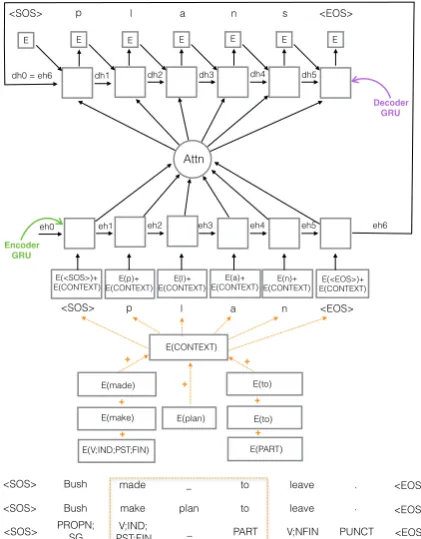
ArchitectureThe encoder is a single layer Gated Recurrent Unit (GRU) (Cho et al.,2014). It takes as input the concatenation of the context embed-ding and the embedded characters in the lemma, and outputs a sequence of state vectors, which are then translated into a sequence of embeddings by a one-layer GRU decoder using an attention mech-anism. The embeddings are then transformed into output characters by a log softmax layer. For track 1, the context embedding is the concatena-tion of word embeddings for the previous inflected word form, previous lemma, previous MSD, cur-rent lemma, next inflected word form, next lemma, and next MSD. If a word is at the beginning of the sentence, we add a special symbolhSOSias its
history context, and if a word is at the end of the sentence, we add another special symbol hEOSi
as its future context. The context embedding for track 1 is illustrated in the bottom part of Figure
1. For track 2, the context embedding is the con-catenation of word embeddings for the previous inflected word form, current lemma, and next in-flected word form as is shown in Figure2. Special symbols indicating the beginning and end of sen-tences are also used. For the character embedding of lemmas, we also usedhSOSiandhEOSito
indi-cate the beginning and end of the lemma.
The decoder starts decoding with input ashSOSi
and hidden state as the last hidden state of the en-coder. An attention mechanism is implemented to
1https://pytorch.org/tutorials/ intermediate/seq2seq_translation_ tutorial.html
Attn
E E E E E E
E(p)+ E(CONTEXT)
E(l)+ E(CONTEXT)
E(a)+ E(CONTEXT)
E(n)+
E(CONTEXT) E(CONTEXT)E(<EOS>)+
p l a n <EOS>
p l a n s <EOS>
E(<SOS>)+ E(CONTEXT)
<SOS>
dh1 dh2 dh3 dh4 dh5
Encoder GRU
Decoder GRU
E <SOS>
dh0 = eh6
eh0 eh1 eh2 eh3 eh4 eh5 eh6
Bush made _ to leave .
<SOS> <EOS>
Bush make plan to leave .
<SOS> <EOS>
PROPN; SG
V;IND;
PST;FIN _ PART V;NFIN PUNCT
<SOS> <EOS>
E(CONTEXT)
E(make)
E(V;IND;PST;FIN) E(plan)
E(to)
E(to)
E(PART) E(made)
+
+
+
+ +
[image:2.595.309.520.65.335.2]+ +
Figure 1: Architecture of system 1 with track 1 context embedding
allow the decoder network to focus on different parts of the encoder’s outputs at each step of gen-eration. It is implemented as another feed-forward layer which takes as its input the decoder’s input and hidden states and calculates a set of attention weights. We multiply the attention weights with the encoder output vectors to create a weighted combination. This weighted combination will go through a non-linear ReLU layer before going to the GRU process. In addition, a dropout layer is added to the decoder input to deal with overfitting. The dropout rate is 0.1. The decoding process stops when the end symbolhEOSiis generated. It
may also stop early when a maximum prediction length has been reached. The maximum predic-tion length is set at 50. The overall architecture of this system as to track 1 is shown in Figure1. For track 2, only the context embedding is different, i.e. the context is the concatenation of the previ-ous inflected word form, the target lemma and next inflected word form embeddings.
Bush made _ to leave .
<SOS> <EOS>
_ make plan _ leave _
_ _
_ _ _ _ _ _
_ _
E(CONTEXT)
E(plan) E(to) E(made)
+ +
[image:3.595.72.290.62.149.2]+
Figure 2: Context embedding for system 1 at track 2
predictions for entries where the lemma form is provided.
Settings and Hyper-parameters The model is trained to minimize the negative log likelihood loss (NLLLoss) on the training data. The opti-mization method is the Adam algorithm (Kingma
and Ba,2015) with a learning rate of 0.00005. As
to other hyper-parameters, we use an embedding size of 100 for the character, lemma, word-form and MSD embeddings. The hidden size is 800 for track 1 and 400 for track 2.
3.2 System 2: MSD prediction and inflection
In our second approach we reformulate the task 2 problem as a task 1 problem. This approach involves predicting the morphosyntactic descrip-tions of the lemma in question, given the inflected word forms, the lemmas and the MSDs for the rest of the sentence. Once we have the predicted MSDs, we use a task 1 inflection model to get the inflected form. This section describes the archi-tecture for the MSD prediction model followed by the inflection model. This system is only for track 1 as it relies on the morphosyntactic descriptions.
3.2.1 MSD prediction model
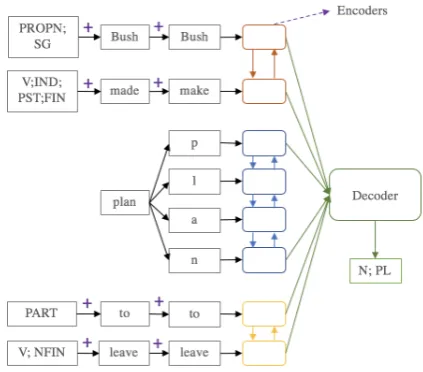
The MSD prediction model uses a many-to-one encoder-decoder neural network to predict the MSDs of the lemma to be inflected.
Architecture The encoder uses three separate single-layer bidirectional LSTMs (LST Mlef t,
LST Mbase andLST Mright) to encode the input
into a fixed length vectorc. It is based on
Vylo-mova et al. (2017). LST Mlef t takes as input the
sequence that is to the left of the current lemma in the sentence and computes the hidden states h(lt)∈RH.
h(lt) =fl(x(t), h(lt−1))
Figure 3: Architecture of the MSD prediction model
where x(t) ∈ R3E is a concatenation of
the inflected word form embedding e(wt), the
lemma embedding e(lt) and the MSD
embed-ding e(msdt) for some word t in the sentence;
e(wt), e(lt), e(msdt) ∈ RE, where E is the
di-mension of the embedding layer.
In a similar fashion, LST Mright takes as
in-put the sequence that is to the right of the current lemma in the sentence.
h(rt)=fr(x(t), h(rt−1))
LST Mbasetakes as input the sequence of
char-acter embeddings, e(ct), concatenated with the
lemma embedding, e(l), for every character c in the lemma.
hb(t)=fb(xb(t), h(bt−1))
The input to the decoder is the vectorc ∈R3H
which is the concatenation of the final states from the three encoder LSTMs.
c= [h(lTl);hr(Tr);h(bTb)]
The decoder acts as a classifier that classifies the input into one of the possible MSD combinations.
hd=fd(c, h(0)d )
Pmsd=sof tmax(W.hd+b)
The high level architecture of the model is shown in Figure3.
[image:3.595.311.523.69.255.2]we used only lemmas whose POS are verbs, nouns or adjectives.
Settings and Hyper-parameters We used a hidden size of 100 and an embedding size of 100 for the character, lemma, word and MSD embeddings. We used Adam as the optimizer with a learning rate of 0.0005.
3.2.2 Inflection model
The Inflection model outputs the inflected word-form given a lemma and its associated morphosyntactic features (for example, touch +
V;V.PTCP;PRS ⇒ touching). It is an
encoder-decoder soft-attention based neural network that takes as input the sequence of lemma charac-ters and the morphosyntactic descriptions, and produces a sequence of characters as output. The Inflection model is based on University of Colorado Boulder’s submission to CoNLL-SIGMORPHON 2017 Shared Task (Silfverberg
et al.,2017).
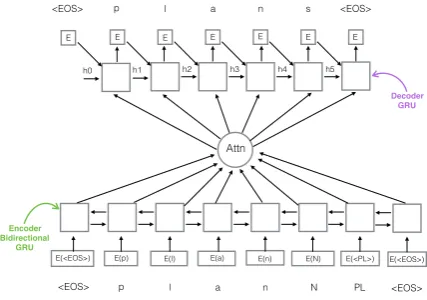
Architecture The encoder is a single layer bi-directional GRU that takes as input the embeddings e(.) of lemma characters and the
morphosyntactic descriptions, and produces a sequence of state vectors. The decoder then uses this sequence of state vectors to generate the sequence of output embeddings. At each stage in the decoding process, the decoder uses the following to compute the current state vector:
• the previous decoder hidden state.
• the previous output embedding.
• A weighted sum of all the encoder states.
The decoding process starts with the embedding for the word boundary symbol hEOSi and a
ran-domly initialized hidden stateh0. The weights for the encoder states is computed using an Attention mechanism which uses the previous decoder state as input. The weights are normalized using a soft-max function. The overall architecture of the in-flection model is shown in Figure4.
Data The data to train the inflection model was generated from the task2 training data by taking out entries of verbs, nouns or adjectives and putting them into task 1 data format. The amount of training data we get in this way is comparable
Attn
E E E E E E
E(p) E(l) E(a) E(n) E(N)
p l a n N p l a n s <EOS>
E(<PL>)
PL
E(<EOS>)
<EOS>
h1 h2 h3 h4 h5
Encoder Bidirectional
GRU
Decoder GRU
E(<EOS>)
<EOS> E
<EOS>
[image:4.595.309.523.65.215.2]h0
Figure 4: Architecture of the inflection model
to the data size of task 1 at different data settings for all the 7 languages; more than 10000 examples for the high data setting, more than 2000 examples for the medium data setting, and more than 250 examples for the low data setting.
Settings and Hyper-parameters The inflec-tion model uses an embedding size of 100 and a hidden state of size 100 for the encoder and the decoder. The data is processed in batches of 20. Masking is used to mask part of the input sequences which are shorter than the maximum length in the batch. Stochastic Gradient De-scent (SGD) with gradient clipping is used for optimization and the loss function is NLLLoss.
4 Experiments
4.1 Exploratory experiment: lemma copying
As the first exploration of the task and an evalua-tion of task complexity, we experimented by copy-ing the lemma directly. In other words, we sim-ply guess that the inflected form of a lemma in the context is the lemma itself. This experiment will be referred to as the copy system going further.
4.2 System 1
HIGH MEDIUM LOW
LANGUAGE COPY SYS 1 SYS 2 BASELINE COPY SYS 1 SYS 2 BASELINE COPY SYS 1 SYS 2 BASELINE
DE 58.95 63.3 62.49 64.51 58.95 55.11 55.11 54.4 58.95 10.41 32.15 0.2 EN 62.64 76.23 68.58 72.91 62.64 65.16 66.57 60.02 62.64 57.6 59.62 1.81 ES 25.53 51.75 36.75 53.44 25.53 41.8 32.68 23.14 25.53 25.53 27.77 8.98 FI 22.36 43.07 30.24 49.05 22.36 23.38 23 28.21 22.36 7.12 11.44 0.76 FR 23.63 58.04 60.9 63.54 23.63 44.2 42.16 45.01 23.63 25.66 26.88 0 RU 18.37 65.16 55.52 71.18 18.37 44.58 40.46 50.3 18.37 15.06 22.09 0 SV 32.45 60.53 37.77 62.23 32.45 49.68 34.57 47.55 32.45 20.74 29.04 1.17
[image:5.595.71.529.203.314.2]AVERAGE 34.85 59.73 50.32 62.41 34.85 46.27 42.08 44.09 34.85 23.16 29.86 1.85
Table 1: Track 1 accuracies for original form of the copy system, system 1, system2, and baseline
HIGH MEDIUM LOW
LANGUAGE COPY SYS 1 SYS 2 BASELINE COPY SYS 1 SYS 2 BASELINE COPY SYS 1 SYS 2 BASELINE
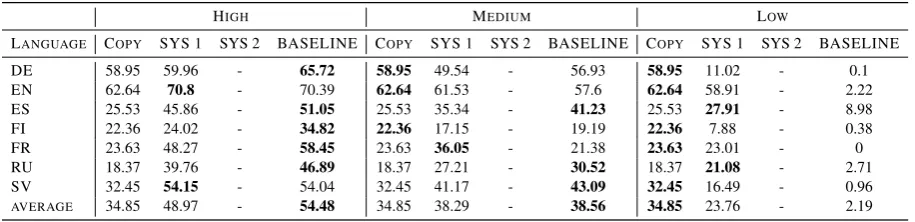
DE 58.95 59.96 - 65.72 58.95 49.54 - 56.93 58.95 11.02 - 0.1 EN 62.64 70.8 - 70.39 62.64 61.53 - 57.6 62.64 58.91 - 2.22 ES 25.53 45.86 - 51.05 25.53 35.34 - 41.23 25.53 27.91 - 8.98 FI 22.36 24.02 - 34.82 22.36 17.15 - 19.19 22.36 7.88 - 0.38 FR 23.63 48.27 - 58.45 23.63 36.05 - 21.38 23.63 23.01 - 0 RU 18.37 39.76 - 46.89 18.37 27.21 - 30.52 18.37 21.08 - 2.71 SV 32.45 54.15 - 54.04 32.45 41.17 - 43.09 32.45 16.49 - 0.96
AVERAGE 34.85 48.97 - 54.48 34.85 38.29 - 38.56 34.85 23.76 - 2.19
Table 2: Track 2 accuracies for original form of the copy system, system 1, system2, and baseline
4.3 System 2
In our experiments for System 2, we train the MSD prediction model for 10 epochs on all data settings. To train the inflection model we used 200 epochs for the low data setting and 100 epochs for the medium and high data settings. We also experimented with higher embedding and hidden sizes of 200 for the MSD prediction model and we found no significant improvements.
5 Results and discussion
The evaluation result as to original forms for track 1 is shown in Table1. In general, our first system (SYS 1) outperforms the second system (SYS 2) in both high and medium data settings, though nei-ther of them get a higher averaged accuracy than the baseline system when the training data size is high and the first system is only marginally bet-ter than the baseline when the training data is of medium size. For the four systems summarized in the table, our first system performs the best only with English at high data setting, and it achieves the highest accuracies with Spanish and Swedish at medium data setting. The second system out-performs the other three systems with English at medium data setting. However, when the train-ing data is the most limited, i.e. at the low data setting, the second system outperforms both the first system and the baseline as to average
accu-racy over the seven languages, though it is still worse than the copy system. To be specific, direct lemma copy produces the best results for German, English, Finnish and Swedish among the four sys-tems at the low data setting. The second system outperforms the other three systems with Spanish, French, and Russian.
Table 2 provides the evaluation results for the baseline system, our first system and the copy sys-tem, as to original forms for track 2. Our second system relies on the prediction of MSDs and does not work for track 2. For this track, we see the pat-tern of the system performance is similar to that of track 1. That is, the baseline system generally outperforms our first system and the copy system at the high data setting and gets very close to the first system in terms of averaged accuracies at the medium data setting, and our first system outper-forms the baseline by a large margin at the low data setting though it is still worse than the copy system.
higher than the results of SYS 1 on track 2 on most languages (except Spanish, for which SYS 2 track 1 is a mere 0.14% lower). This suggests that, when training data is very limited, the MSDs introduce a lot of ambiguity if only used as contextual in-formation. On the other hand, if we first predict the MSD as our second system does, the ambigu-ity is reduced and thus the system generates bet-ter predictions. German is the language where the second system is most significantly better than the first system on the track 1 low data setting. Ger-man is a language with much ambiguity in its in-flected forms. For a German word form, there can be as many as 40 different readings (M¨uller and
Sch¨utze,2015). This fact also supports the
ambi-guity explanation for the difference in the perfor-mance of our first and second systems.
In the low setting, Finnish, German and Russian have the lowest scores for our first model. Finnish and Russian are the two languages with the most complex inflection systems in the sense that they have the highest number of distinct MSDs. In the high data setting, counting only the parts-of-speech the model is supposed to predict, i.e. nouns, verbs and adjectives, there are 346 distinct MSDs in Finnish training data and 345 in Rus-sian training data. The rich inflection requires more data for the model to learn. Though Ger-man has less distinct MSDs than Finnish and Rus-sian, its inflection is also complex in the sense that it’s less predictable: Unlike Russian and Finnish which use almost exclusively suffixes, German is not primarily suffixing but employs prefixing, cir-cumfixing, and umlauting. Its inflectional rules are less regular than Finnish or Russian. A qualitative analysis of the predictions in the low data setting, finds that our first model tends to make changes in the stem for German though not for Finnish and Russian, and the wrong changes in the stem cause wrong predictions for German words while for Finnish and Russian the errors are mainly wrong suffixation. This agrees with the distinct features of their inflection systems.
The intuition behind just copying the lemma when the training data is limited, is the linguis-tic observation that the lemma form is usually the most frequently used form and thus any uninfor-mative inflection tends to be less likely than the lemma.
6 Conclusion
For this task, we explored the performance of RNN encoder-decoder models with soft attention as to predicting the inflected forms of a lemma in context. We developed two systems by imple-menting the encoder-decoder model in different ways. We found that when the training data is very limited, morpho-syntactic descriptions con-tribute to better prediction results. Though both of our systems outperform the baseline at the low data setting, none of the systems are better than the blind guess of the inflected form being the lemma itself. However, when the training data is abundant, neural network systems outperform the lemma copying approach.
References
Dzmitry Bahdanau, Kyunghyun Cho, and Yoshua Ben-gio. 2015. Neural machine translation by jointly learning to align and translate. InInternational Con-ference on Learning Representations.
Kyunghyun Cho, Bart Van Merri¨enboer, Caglar Gul-cehre, Dzmitry Bahdanau, Fethi Bougares, Holger Schwenk, and Yoshua Bengio. 2014. Learning phrase representations using RNN encoder-decoder for statistical machine translation. arXiv preprint arXiv:1406.1078.
Ryan Cotterell, Christo Kirov, John Sylak-Glassman, G´eraldine Walther, Ekaterina Vylomova, Arya D. McCarthy, Katharina Kann, Sebastian Mielke, Gar-rett Nicolai, Miikka Silfverberg, David Yarowsky, Jason Eisner, and Mans Hulden. 2018. The CoNLL– SIGMORPHON 2018 shared task: Universal mor-phological reinflection. In Proceedings of the CoNLL–SIGMORPHON 2018 Shared Task: Univer-sal Morphological Reinflection, Brussels, Belgium. Association for Computational Linguistics.
Ryan Cotterell, Christo Kirov, John Sylak-Glassman, G´eraldine Walther, Ekaterina Vylomova, Patrick Xia, Manaal Faruqui, Sandra K¨ubler, David Yarowsky, Jason Eisner, and Mans Hulden. 2017. The CoNLL-SIGMORPHON 2017 shared task: Universal morphological reinflection in 52 languages. In Proceedings of the CoNLL-SIGMORPHON 2017 Shared Task: Universal
Mor-phological Reinflection, Vancouver, Canada.
Asso-ciation for Computational Linguistics.
Ryan Cotterell, Christo Kirov, John Sylak-Glassman, David Yarowsky, Jason Eisner, and Mans Hulden. 2016. The SIGMORPHON 2016 shared task: Mor-phological reinflection. InProceedings of the 14th SIGMORPHON Workshop on Computational
Re-search in Phonetics, Phonology, and Morphology,
Katharina Kann and Hinrich Sch¨utze. 2016. MED: The LMU system for the SIGMORPHON 2016 shared task on morphological reinflection. InProceedings of the 14th SIGMORPHON Workshop on Computa-tional Research in Phonetics, Phonology, and
Mor-phology, Berlin, Germany. Association for
Compu-tational Linguistics.
Diederik P. Kingma and Jimmy Lei Ba. 2015. Adam: a method for stochastic optimization. InInternational
Conference on Learning Representations.
Thomas M¨uller and Hinrich Sch¨utze. 2015. Robust morphological tagging with word representations.
InProceedings of the 2015 Conference of the North
American Chapter of the Association for
Computa-tional Linguistics: Human Language Technologies,
pages 526–536.
Miikka Silfverberg, Adam Wiemerslage, Ling Liu, and Lingshuang Jack Mao. 2017. Data augmentation for morphological reinflection. Proceedings of the CoNLL SIGMORPHON 2017 Shared Task: Univer-sal Morphological Reinflection, pages 90–99.