Related Randomness Attacks for Public Key Encryption
?Kenneth G. Paterson, Jacob C. N. Schuldt, Dale L. Sibborn Information Security Group, Royal Holloway, University of London {kenny.paterson,jacob.schuldt,dale.sibborn.2011}@rhul.ac.uk
Abstract. Several recent and high-profile incidents give cause to believe that randomness failures of var-ious kinds are endemic in deployed cryptographic systems. In the face of this, it behoves cryptographic researchers to develop methods to immunise – to the extent that it is possible – cryptographic schemes against such failures. This paper considers the practically-motivated situation where an adversary is able to force a public key encryption scheme to reuse random values, and functions of those values, in encryp-tion computaencryp-tions involving adversarially chosen public keys and messages. It presents a security model appropriate to this situation, along with variants of this model. It also provides necessary conditions on the set of functions used in order to attain this security notation, and demonstrates that these conditions are also sufficient in the Random Oracle Model. Further standard model constructions achieving weaker security notions are also given, with these constructions having interesting connections to other primitives including: pseudo-random functions that are secure in the related key attack setting; Correlated Input Secure hash functions; and public key encryption schemes that are secure in the auxiliary input setting (this being a special type of leakage resilience).
1
Introduction
Modern cryptographic primitives are heavy consumers of randomness. Unfortunately, random number generators (RNGs) used to provide this randomness often fail in practice [17, 19, 21, 22, 13, 1, 16, 27]. This is due to issues including poor algorithmic design, software bugs, insufficient or poor estimation of system entropy, and the handling of randomness across virtual machine resets [29]. The results of randomness failures can be catastrophic and newsworthy in practice – DSA, ECDSA and Schnorr private signing keys can be exposed [9, 29]; plaintext recovery for low entropy plaintext becomes possible in the the public key encryption setting; key generation processes can be severely weakened [13, 25, 23, 10]; ephemeral Diffie-Hellman keys can become predictable leading to compromise of session keys [19]; and electronic wallet security can be compromised [11].
Evidently, randomness failures are a major problem in practice. The cryptography research community has begun to address this problem only relatively recently [30, 31, 24, 2, 35, 29]. Accepting that randomness failures are endemic and unlikely to be eliminated in totality, a basic approach is to try tohedge against randomness failures, that is, to design cryptographic primitives that still offer a degree of security in the face of randomness failures. Work in this direction can be summarised as follows:
– For signatures, there is a folklore de-randomisation technique which neatly sidesteps security issues arising from randomness failures: simply augment the signature scheme’s private key with a key for a pseudo-random function (PRF), and derive any pseudo-randomness needed during signing by applying this PRF to the message to be signed; meanwhile verification proceeds as normal. This renders trivial the problem of dealing with bad randomness for signatures.
– In the private key (symmetric) encryption setting, Rogaway [30] argued for the use of nonce-based encryp-tion, thus reducing reliance on randomness. Rogaway and Shrimpton [31] initiated the study of misuse-resistant authenticated encryption (AE), considering the residual security of AE schemes when nonces are repeated. Katz and Kamara [24] considered the security of symmetric encryption in a chosen-randomness setting, wherein the adversary has complete control over the randomness used for encryption (except for the challenge encryption which uses fresh randomness).
– In the public key encryption (PKE) setting, Bellare et al.[2] considered security underchosen distribution attack, wherein the joint distribution of message and randomness is specified by the adversary, subject to containing a reasonable amount of min entropy. The PKE scheme designer’s challenge is to find a way of “extracting” this entropy in a secure way. Bellare et al. gave several designs for PKE schemes achieving this notion in the Random Oracle Model (ROM) and in the standard model. This is a powerful and general approach, but does have its limitations: under extreme failure conditions, the joint message-randomness distribution may simply fail to contain sufficient entropy, at which point all security guarantees may be lost; moreover, for technical reasons, the model in [2] requires the target public key to be hidden from the adversary until all encryption queries have been made. This is impractical in real world applications. ?
– Also in the PKE setting, Yilek [35], inspired by virtual machine reset attacks in [29], considered the scenario where the adversary does not know the randomness (in contrast to the chosen-randomness setting of [24]), but can instead force the reuse of random values that are otherwise well-distributed and unknown to the adversary. This is referred to in [35] as the Reset Attack (RA) setting. To fully reflect the reality of ran-domness failures in this setting, Yilek provides the adversary with the ability to encrypt chosen messages under adversarially generated public keys using the unknown but repeated random values. This makes his model very powerful, to the extent that certain trivial attacks must be excluded by assuming the adversary is equality-pattern respecting. In [35], Yilek also gave a general construction in which the random coins of the encryption algorithm are used as a key to a PRF, the input to the PRF is the public key concatenated with the message to be encrypted, and the output of the PRF is then used as the ‘randomness’ for the encryption algorithm. This is sufficient to achieve security in his RA setting. Note that the RA security model is incomparable with the CDA model of [2].
– Ristenpart and Yilek [29] studied the use of “hedging” as a general technique for protecting against broad classes of randomness failures in already-deployed systems, and implemented and benchmarked this tech-nique in OpenSSL. Hedging in the sense of [29] involves replacing the random value r required in some cryptographic scheme with a hash ofrtogether with other contextual information, such as a message, algo-rithm or unique operation identifier, etc. Their results, while applying to a variety of different randomness failure types (see in particular [29, Figure 3]), all have their security analyses restricted to the ROM.
1.1 Motivation
Inspired by the challenge of preserving security under randomness failures, we initiate the study of security for PKE in what we call theRelated Randomness Attack(RRA) setting. Our RRA setting builds on the RA setting from [35] and brings the theory of hedging PKE against randomness failures closer to practice. As we shall see, it also has interesting connections with related key attacks for PRFs and PKE, as developed in [5, 3, 4, 6, 34], and leakage resilient cryptography (and in particular, the techniques developed in [14] to provide security for PKE in the auxiliary input setting).
In our RRA setting, the adversary can now not only force the reuse of existing random values as in the RA setting, but can also force the use offunctions of those random values. This power is analogous to the power granted to the adversary in the Related Key Attack (RKA) setting, wherein an adversary is able to tamper with private (or secret) keys used during cryptographic operations. The RA setting arises as the special case of our RRA setting where only the identity function is allowed. The extra adversarial power in the RRA setting allows the modelling of reset attacks in which the adversary does not have an exact reset capability, but where the randomness used after a reset is in some way related to that used on previous resets. Such behaviours were observed in the experimental work in [29]. Furthermore, our RRA setting allows modelling of situations where the randomness used in a scheme comes from a PRNG which is not regularly refreshed with new entropy, but which steps forward under some deterministic state evolution functionNext and output functionOut; here the appropriate functions in our RRA setting would be the compositionsOut(Nexti(·)).
More generally, RRA security has a strong theoretical motivation as being a stepping stone towards giving the adversary enhanced control over the inputs to cryptographic algorithms – messages (in the standard PKE setting), keys (in the RKA setting), and now randomness (in our new RRA setting). It is an interesting direction for future research to develop this theme further, by examining security in a combined RKA/RRA setting, where the adversary would be able to simultaneously tamper withall the inputs to a PKE scheme.
1.2 Our contributions
RRA security model In this paper, we provide a strong model and security definition for PKE in the RRA setting, which we name RRA-ATK security (where ATK = CPA or CCA) . Our model is inspired by that of Yilek for the RA setting: via access to anEncoracle, we allow the adversary to get arbitrary messages encrypted under arbitrary public keys, using functionsφof an initial set of well-distributed but unknown random values. The public keys can even be maliciously generated, and the adversary can of course know all the corresponding private keys. The adversary is tasked with winning an indistinguishability-style game, via anLR oracle which gives access to encryptions of left or right messages with respect to an honestly generated target public keypk∗, but again where the adversary can force the use of functionsφof the initial random values. When the functions φare limited to coming from some setΦ, we speak of a Φ-restricted adversary.
when simulatingdecryption queries. By contrast, it isencryption queries that require special treatment in our RRA setting.
Given the power of the adversary in the RRA setting, we cannot hope to achieve security against all sets of adversarial queries. So we must restrict the adversary from achieving “trivial wins”. In particular, no matter what set of functionsΦthe adversary uses to modify the random values, it can win simply by making the same combination of messages and functions in its LR quires as in its encryption queries under target public key pk∗. These must then be ruled out by identifying forbidden combinations of queries. Thus we must assume the adversary is equality-pattern respecting, for a suitable definition that extends that of [35]. However, this alone is not enough: from the RKA setting and the results of [15], we already know that certain set of functionsΦare too powerful, in allowing trivial wins for the adversary in that setting. We should not be surprised that the same is true in our RRA setting. For example, if constant functions are allowed in the RRA setting, an adversary would trivially be able to determine which of two challenge message is encrypted in a ciphertext from the LR oracle. Analogously to [5], we identify collision-resistance and output-unpredictability as necessary conditions on the set of functionsΦwhich the adversary uses to transform random values in its attack.
ROM construction We are able to show that, in the ROM, these necessary conditions on the function setΦare actually also sufficient. More specifically, we show how to transform any IND-ATK secure PKE schemePKEinto a new PKE schemeHash-PKEthat is RRA-ATK secure for equality-pattern respecting,Φ-restricted adversaries, simply by hashing the random input together with the public key and message during encryption. In fact, this is just an application of the hedging approach from [29], and an instance of the randomized-encrypt-with-hash (REwH) scheme from [2]. Our result then shows that this approach also provides security in our new RRA setting.
Standard model constructions Having dealt with the ROM, we then turn our attention to constructions in the standard model. Reinforcing the connections to RKA security, we are able to show that any Φ-restricted RKA-PRF can be used to build a RRA-ATK secure PKE scheme forΦ-restricted adversaries, thus transferring security from the RKA setting for PRFs to the RRA setting for PKE. But the limited range of RKA-PRFs currently available in the literature [26, 3] essentially restricts the obtained RRA-ATK secure PKE scheme to a class of functions Φ consisting of linear or group-induced functions. To achieve an RRA-ATK secure PKE scheme for richer classes of functions, we must seek alternative methods of construction.
Unfortunately, we have not been able to achieve our full RRA-ATK security notion for more interesting function classes using other constructions. So we must resort to exploring alternative versions of this notion in order to make progress. We relax RRA-ATK security along two independent dimensions: the degree of control that the adversary enjoys over the public keys under which it can force encryptions for related random values, and the degree of adaptivity it has in the selection of functionsφ∈Φ:
– We first consider the situation where the public keys are all honestly generated at the start of the security game, and the public keys and all but one of the private keys are then given to the adversary — the honest-key, related randomness attack (HK-RRA) setting. This is a reasonable relaxation in that, in practice, all the public keys that the adversary might be able to induce a user to encrypt under would be properly generated by users and then certified by a CA ahead of time. In this setting, we provide a generic construction for a scheme achieving HK-RRA-ATK security based on combining any IND-ATK secure PKE scheme with a Correlated-Input Secure (CIS) hash function [20]. Currently known instantiations of CIS hash functions allow us to obtain selective, HK-RRA-ATK security for Φ-restricted adversaries where Φ is a large class of polynomial functions (as opposed to the linear functions we can achieve using our RKA-PRF-based construction). Here, selectivity refers to the adversary committing at the start of the game to the set of functions it will use.
– We then consider the situation where there is no restriction on public keys, but the adversary is committed up-front to a vector of functions φ= (φ1, . . . , φq) that it will use in its attack, and where security is in the
end quantified over all choices of φfrom some set Φ. This quantification is subtly different from allowing the adversary a fully adaptive choice of functions φ∈ Φ(for a detailed discussion, see Section 3). In this situation, we refer to the function-vector, related randomness attack (FV-RRA) model. Here, we are able to give a direct construction for a PKE scheme that is FV-RRA-ATK secure solely under the DDH assumption, assuming the component functionsφiofφare simultaneously hard to invert on a random input. Our scheme
proc. Initialise(λ):
b←${0,1};
(pk, sk)←$PKE.K(1λ);
S ← ∅; Returnpk
proc. LR(m0, m1):
c←$PKE.E(pk, mb)
S ← S ∪ {c} returnc
proc. Dec(c): Ifc∈ S, return⊥ Else returnPKE.D(sk, c)
proc. Finalise(b0): Ifb=b0, return 1
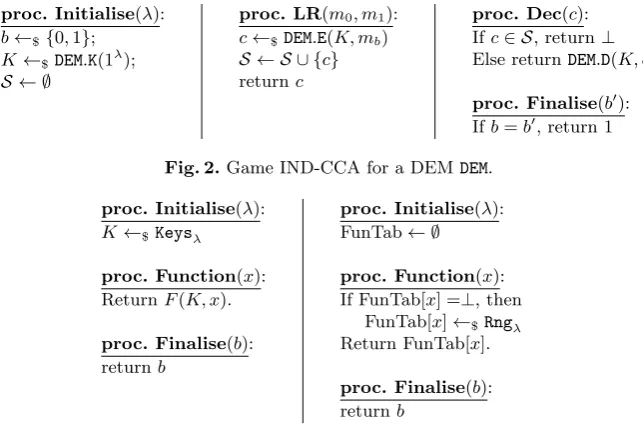
Fig. 1.Game IND-CCA for PKE.
To summarise, in the standard model, we can achieve our full security notion, RRA-ATK security, but only for a limited class of functionsΦ(inherited from known results on RKA-PRFs), while we can achieve alternative security notions for richer classesΦ.
1.3 Future Directions
In this paper, we concentrate on PKE, but RRA security notions can be developed for other primitives. As previously noted, the case of signatures is quite simple, provided one is prepared to extend a scheme’s private key. We would expect symmetric key encryption and key exchange primitives to be more complex. Also as noted above, our RRA setting is related to the RKA setting, and it is an open problem to develop these connections further, possibly by considering a combined RKA/RRA setting.
2
Preliminaries
Throughout the paper we will use λ∈ N to denote the security parameter, which will sometimes be written
in its unary representation, 1λ. We denote by y ←xthe assignment ofy to x, and bys ←
$ S we denote the selection of an elementsuniformly at random from the setS. The notation [n] represents the set{1,2, . . . , n}. We let FF(K,D,R) denote the set of all families of functionsF :K × D → R.
All our security games and proofs will utilise code-based games and the associated language. Here we briefly recall the basic definitions from [8]. A game consists of at least two procedures. We begin withInitialise, which assigns starting values to all variables and then gives outputs, if there are any, to the adversary. The adversary A may then submit queries to the oracle procedures, and when A halts (and possibly outputs a value) the Finaliseprocedure begins.Finalisewill take the output from A(if there is one) as its input and will output its own value. The value output by Finaliseis defined to be the output of the game. We writeP[GA⇒b] to
denote the probability that game Goutputs bit b when run withA. However, in some proofs we will use the notationAG ⇒b. This means that the adversary outputs b when run with the gameG. We will occasionally
use the notation A(x) ⇒b, which denotes adversary A outputting b when given the input x. For brevity, in what follows ATK will denote either CPA or CCA, where theorems or statements apply to both games. Any proofs or figures will refer to the CCA setting, but may be easily modified to the CPA case.
2.1 Public Key Encryption
We denote a specific PKE scheme by PKE = (PKE.K,PKE.E,PKE.D). All three algorithms are polynomial-time. The randomised key generation algorithm PKE.K takes the security parameter as its input and outputs a key pair (pk, sk). The encryption algorithm, on input a messagem∈ Mand a public keypk chooses random coins from Rndand uses these coins to output a ciphertext c. The decryption algorithm is deterministic. Its inputs are a private keysk and a ciphertextc. The algorithm either outputs a messagem or an error symbol⊥. We require the scheme PKEto satisfy the correctness property. That is, for all λ∈N, all all pairs (pk, sk) output
by the key generation algorithm, and all messagesm∈ M, we require thatPKE.D(sk,PKE.E(pk, m)) =m. Definition 1. The advantage of an IND-ATKadversaryA against a schemePKEis
AdvindPKE-,Aatk(λ) := 2·P[IND-ATKAPKE(λ)⇒1]−1
where game IND-ATK is shown in Figure 1. A scheme PKE is IND-ATK secure if the advantage of any polynomial-time adversary is negligible in the security parameterλ.
2.2 Data Encapsulation Mechanisms
We define a DEM DEM= (DEM.K,DEM.E,DEM.D) in the natural way. The three algorithms are polynomial-time. Key generation takes the security parameter as an input and outputs a keyK. The encryption algorithm takes a messagem∈ MDEM
λ and a keyKas its inputs, chooses random coins fromRndDEMλ , and outputs a ciphertextc.
proc. Initialise(λ):
b←${0,1};
K←$DEM.K(1λ);
S ← ∅
proc. LR(m0, m1):
c←$DEM.E(K, mb)
S ← S ∪ {c} returnc
proc. Dec(c): Ifc∈ S, return⊥ Else returnDEM.D(K, c)
proc. Finalise(b0): Ifb=b0, return 1
Fig. 2.Game IND-CCA for a DEMDEM.
proc. Initialise(λ):
K←$Keysλ
proc. Function(x): ReturnF(K, x).
proc. Finalise(b): returnb
proc. Initialise(λ): FunTab← ∅
proc. Function(x): If FunTab[x] =⊥, then
FunTab[x]←$Rngλ Return FunTab[x].
proc. Finalise(b): returnb
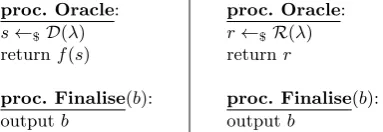
Fig. 3.Games for PRF security. Game PRFReal is on the left, PRFRand on the right.
Definition 2. The advantage of an IND-ATKadversaryA against a schemeDEMis
AdvindDEM-,Aatk(λ) := 2·P[IND-ATKADEM(λ)⇒1]−1
where game IND-ATK is shown in Figure 2. A scheme DEM is IND-ATK secure if the advantage of any polynomial-time adversary is negligible in the security parameterλ.
2.3 Pseudorandom Functions
Definition 3. Let F :Keysλ×Domλ →Rngλ be a family of functions. The advantage of a PRFadversary A against F is
AdvprfF,A(λ) :=P[PRFRealAF(λ)⇒1]−P[PRFRand
A
$(λ)⇒1]
where the games PRFReal and PRFRand are defined in Figure 3. We say F is a secure PRF family if the advantage of any polynomial-time adversary is negligible in the security parameter λ.
Related Key Attack Pseudorandom Function
Definition 4. LetF :Keysλ×Domλ→Rngλbe a family of functions. The advantage of anRKA-PRFadversary
Aagainst F is
AdvrkaF,A-prf(λ) :=P[RKA-PRFRealAF(λ)⇒1]−P[RKA-PRFRand
A
$(λ)⇒1]
where the games PRFReal and PRFRand are defined in Figure 4. We say F is Φ-RKA-PRF secure if the advantage of anyΦ-restricted, polynomial-time adversary is negligible in the security parameter λ.
2.4 Key Derivation Functions
Definition 5. Let λ be a security parameter. Consider a polynomial-time computable function f that maps fromD(λ)toR(λ). The advantage of a KDFadversaryAagainst f is
Advkdff,A(λ) :=P[KDFRealAf(λ)⇒1]−P[KDFRand
A
$(λ)⇒1]
proc. Initialise(λ):
K←$Keysλ
proc. Function(φ, x): returnF(φ(K), x).
proc. Finalise(b): returnb
proc. Initialise(λ):
G←FF(Keysλ,Domλ,Rngλ)
K←$Keysλ
proc. Function(φ, x): returnG(φ(K), x).
proc. Finalise(b): returnb
proc. Oracle:
s←$ D(λ)
returnf(s)
proc. Finalise(b): outputb
proc. Oracle:
r←$R(λ)
returnr
proc. Finalise(b): outputb
Fig. 5.Games for KDF security. Game KDFReal is on the left, KDFRand is on the right.
where games KDFRealandKDFRand are defined in Figure 5. We sayf is a secure Key Derivation Function (KDF) if the advantage of any polynomial-time adversary is negligible in the security parameterλ.
This definition can be extended to allow the adversary to make multiple oracle queries. In the real game, for queryi, a random value si←$ D(λ) is chosen for each query and the adversary is given f(si). In the random
game, ri ←$ R(λ) is chosen for each query and the adversary is given ri. Then, using a hybrid argument, we
can show that, for anyt-query adversary A, there is a (single-query) KDF adversaryBsuch that: Advtf,-kdfA (λ)≤t·Advkdff,B(λ)
whereAdvtf,-kdfA (λ) denotes the advantage of t-query KDF adversaryAagainstf.
2.5 Computational Assumption
Definition 6 (Decisional q-Diffie-Hellman Inversion (q-DDHI) Problem). The advantage of an algo-rithm A in solving the decisional q-Diffie-Hellman inversion problem in a cyclic group G of order p =p(λ), is
Advq-ddhi
G,A (λ) :=|P[A(g, g
x, gx2
, . . . , gxq, g1/x) = 1]−P[A(g, gx, gx2, . . . , gxq, R) = 1]|
wheregis a random generator ofG,x←$Zp,R←$G, and the probability is taken over the choice ofg, R∈G,
choice of x∈Zp, and the random coins consumed by A.
3
Related Randomness Security for Public Key Encryption
We now formalise our notions of related randomness security for PKE. We give a detailed treatment of our strongest notion, before sketching restricted versions. The description of our security notions will utilise code-based games and the associated language (see [8]).
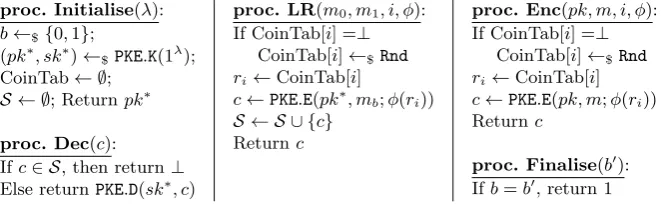
Our strongest security notion, RRA-CCA security, is defined via the game in Figure 6. Here, a challenge key pair (pk∗, sk∗) for a PKE scheme PKE = (PKE.K,PKE.E,PKE.D) with randomness space Rnd is honestly generated, and the adversary is considered successful if it wins an indistinguishability game with respect to messages encrypted under pk∗. Extending the standard PKE setting, the adversary is able to control which one of polynomially many random values ri ∈ Rnd is used in responding to each encryption query for pk∗;
furthermore, the adversary is able to obtain the encryption of messages of its choice under (possibly maliciously generated) arbitrary public keys. Extending the model of Yilek [35], our adversary not only specifies which one of the random valuesriis to be used in each query, but also specifies, for each query he makes, a functionφon
Rnd; the valueφ(ri) is used for encryption in place ofri. In the CCA setting, the adversary also has access to
a regular decryption oracle for private keysk∗. Note that if the adversary usesonly the identity function, then we recover the Resettability Attack (RA) model of Yilek [35].
It is not difficult to see that, as in the RA setting, an adversary may trivially win this game if no restrictions are placed on oracle queries.1 We will shortly introduce anequality-pattern respecting definition for adversaries, designed to prevent trivial wins of this kind. This extends the related RA definition from [35]. However, restric-tions on the funcrestric-tionsφwill also be required. To illustrate the issue, consider as an extreme case the constant functionφC (withφC(r) =Cfor allr∈Rnd). Suppose the adversary submitsLRquery (m0, m1, j, φC) for any
m06=m1and any j∈N; the adversary receives a ciphertextc∗ and then computesc0=PKE.E(pk∗, m0;C); the adversary outputs guess b0 = 0 if and only ifc∗=c0. It is easy to see that this adversary wins the RRA-ATK game with probability 1. This example is analogous to one in the related key attack setting for PRFs in [5]. Hence, we will need to restrict the class of functions which the adversary is allowed to access in its queries to come from some setΦ, in which case we speak ofΦ-restricted adversaries. We have already seen that constant
1 For example, if an adversary requests the encryption of m under the target public key using coins φ(ri),
proc. Initialise(λ):
b←${0,1};
(pk∗, sk∗)←$ PKE.K(1λ);
CoinTab← ∅; S ← ∅; Returnpk∗
proc. Dec(c):
Ifc∈ S, then return⊥ Else returnPKE.D(sk∗, c)
proc. LR(m0, m1, i, φ):
If CoinTab[i] =⊥ CoinTab[i]←$Rnd
ri←CoinTab[i]
c←PKE.E(pk∗, mb;φ(ri)) S ← S ∪ {c}
Returnc
proc. Enc(pk, m, i, φ): If CoinTab[i] =⊥
CoinTab[i]←$Rnd
ri←CoinTab[i]
c←PKE.E(pk, m;φ(ri)) Returnc
proc. Finalise(b0): Ifb=b0, return 1
Fig. 6.Game RRA-ATK. (Note that if ATK = CPA, then the adversary’s access toproc. Decis removed.)
functions must be excluded from Φ if we are to have any hope of achieving our related randomness security notion.
Thus we have two sets of constraints that we need to consider to prevent trivial wins: those on messages and randomness indices (analogous to the RA setting from [35]) and those on functionsφ (analogous to the RKA setting for PRFs from [5]). Let us deal with the first set of constraints first and define what it means for an adversary to be equality-pattern respecting. The following definition is adapted from [35] for our purposes. Definition 7. LetAbe aΦ-restricted adversary in GameRRA-ATKthat queriesrdifferent randomness indices to itsLRandEncoracles and makesqi,φqueries to itsLRoracle with indexiand functionφ∈Φ. LetEi,φ be the set of all messagesmsuch thatAmakesEncquery(pk∗, m, i, φ). Let(mi,φ,0 1, mi,φ,1 1), . . . ,(mi,φ,qi,φ
0 , m
i,φ,qi,φ 1 )
beA’sLRqueries for indexi∈[r]andφ∈Φ. Suppose that for all pairs(i, φ)∈[r]×Φand for allj6=k∈[qi,φ], we have:
mi,φ,j0 =mi,φ,k0 iffmi,φ,j1 =mi,φ,k1
and that, for all pairs(i, φ)∈[r]×Φ, and for allj∈[qi,φ], we have:
mi,φ,j0 ∈/Ei,φ∧m i,φ,j
1 ∈/ Ei,φ.
Then we say thatAis equality-pattern respecting.
Notice that if the adversary is restricted to using only the identity function, then this definition reduces to the equality-pattern respecting definition for the RA setting, cf. [35, Appendix A].
Definition 8. We define the advantage of an equality-pattern respecting, RRA-ATK adversary A against a PKE schemePKEto be:
AdvrraPKE-,atkA (λ) := 2·P[RRA-ATKAPKE(λ)⇒1]−1.
A PKE scheme PKE is said to be Φ-RRA-ATK secure if the advantage of any Φ-restricted, equality-pattern respecting,RRA-ATKadversary againstPKEthat runs in polynomial time is negligible in the security parameter
λ.
3.1 Alternative security notions
The above definition forΦ-RRA-ATK security is very powerful: it allows an adversary to submitany public key to its encryption oracle and allows the adversary toadaptively choose the functionsφ, the only restriction being that they lie inΦ. In Theorem 3 we will exhibit conditions that are both necessary and sufficient for achieving security in this sense in the ROM (given a starting PKE scheme that satisfies the usual definition of IND-ATK security). In the standard model, we will give a construction that relies on RKA-PRFs. Since constructions for these are currently very limited in terms of the function classes they can handle, we will now consider alternative versions of theΦ-RRA-ATK notion.
The first alternative notion we consider is calledHonest Key Related Randomness (HK-RRA) security. The security game is given in Figure 7 and has two parameters, λ and `. Informally, the game itself generates a polynomial number`of key pairs and returns the public keys to the adversary. The adversary then chooses which public key he wishes to be the target key, and is given the private keys corresponding to all the non-target public keys. Meanwhile, the adversary’s queries to itsEnc oracle are restricted to using the public keys generated by the game. SuitableΦ-HK-RRA-ATK security notions follow by analogy with our earlier definitions.
proc. Initialise(λ, `):
b←${0,1};
funchoice←false; Keys← ∅; Functions← ∅; target←false;
CoinTab← ∅; S ← ∅; (pk∗, sk∗)← ∅ Fori= 1 to`
(pki, ski)←$ PKE.K(1λ)
Keys←Keys∪pki Return Keys
proc. Target(j):
Iftarget=true, return⊥ Else (pk∗, sk∗)←(pkj, skj) target←true
Return{ski}i6=j
proc. Enc(pk, m, i, φ): Iftarget=false, return⊥ Ifpk /∈Keys, return⊥ If CoinTab[i] =⊥,
CoinTab[i]←$Rnd
ri←CoinTab[i]
c←PKE.E(pk, m;φ(ri)) Returnc
proc. Dec(c):
Iftarget=false, return⊥ Ifc∈ S, then return⊥ Else returnPKE.D(sk∗, c)
proc. LR(m0, m1, i, φ):
Iftarget=false, return⊥ If CoinTab[i] =⊥,
CoinTab[i]←$Rnd
ri←CoinTab[i]
c←PKE.E(pk∗, mb;φ(ri)) S ← S ∪ {c}
Returnc
proc. Finalise(b0): Ifb=b0, return 1
Fig. 7.Game`-HK-RRA-ATK. (Note that if ATK = CPA, then the adversary’s access toproc. Decis removed.)
proc. Initialise(λ):
b←${0,1};
(pk∗, sk∗)←$PKE.K(1λ);
CoinTab← ∅;S ← ∅; returnpk∗
proc. Dec(c):
Ifc∈ S, then return⊥ Else returnPKE.D(sk∗, c)
proc. LR(m0, m1, i):
If CoinTab[i] =⊥, CoinTab[i]←$Rnd
ri←CoinTab[i]
c←PKE.E(pk∗, mb;ri) S ← S ∪ {c}
returnc
proc. Enc(pk, m, i, j): If CoinTab[i] =⊥,
CoinTab[i]←$Rnd
ri←CoinTab[i]
c←PKE.E(pk, m;φj(ri)) returnc
proc. Finalise(b0): Ifb=b0, return 1
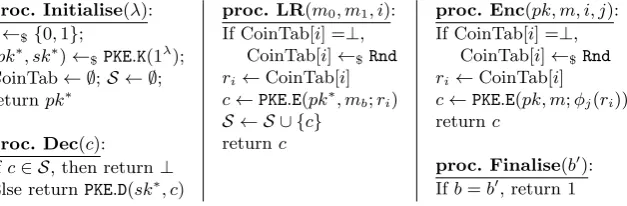
Fig. 8.Gameφ-FV-RRA-ATK, whereφ= (φ1, . . . , φq). (As usual, if ATK = CPA, then the adversary’s access toproc.
Decis removed.)
to the game before he is allowed to see the target public key (or set of public keys, if playing in the Honest Key setting). In this setting, we refer toΦ-sHK-RRA-ATK security.
The final alternative notion we consider is calledFunction-Vector Related Randomness (FV-RRA) security, and is based on the game in Figure 8. Here, the adversary is parameterised by a vector of functions φ = (φ1, . . . , φq), and is limited to using only these functions in its oracle queries. Additionally, we restrict the
adversary by demanding that theLRqueries use only the identity function. However, once again, the adversary has complete freedom over public keys submitted to its encryption oracle. Furthermore, security will be quantified overall choices of vector from a particular class. (Specifically, in our construction in Section 7, we will demand that security holds over all vectors φ that are simultaneously hard to invert on a common random input r.) This quantification actually makes our notion rather strong.
Definition 9. Let φ= (φ1, . . . , φq)be a vector ofq:=q(λ)functions. We define the advantage of an equality-pattern respecting, φ-FV-RRA-ATKadversaryA against a PKE schemePKEto be:
AdvφPKE-fv,A-rra-atk(λ) := 2·P[φ-FV-RRA-ATKAPKE(λ)⇒1]−1.
If Φ is a set of vectors of functions, then a PKE schemePKEis said to be Φ-FV-RRA-ATK secure if, for all
φ∈Φ, the advantage of any equality-pattern respecting, φ-FV-RRA-ATK adversary against PKEthat runs in polynomial time is negligible in the security parameterλ.
Comparison of security notions The first alternative security notion, HK-RRA-ATK security, is easily seen to be a strictly weaker notion than full RRA-ATK security2. Likewise, the selective models are easily seen to be weaker then their adaptive counterparts. However, the relation between full RRA-ATK security and FV-RRA-ATK security is not immediately obvious. Aside from the restriction onLR-queries in FV-RRA-ATK security, there is a subtle distinction between requiring security for all vectorsφof functions from a particular set Φ and requiring security for a fully adaptive choice of functions φ ∈ Φ. In particular, the former notion will allow a security reduction to consider multiple runs of an adversary with different random coins for a fixed
2
proc. Initialise(λ): (pk∗, sk∗)←$PKE.K(1λ);
CoinTab← ∅; S ← ∅; Returnpk∗
proc. Enc(pk, m, i, φ): If CoinTab[i] =⊥,
CoinTab[i]←$Rnd
ri←CoinTab[i]
c←PKE.E(pk, m;φ(ri)) Return c
proc. LR(m0, m1, i, φ):
If CoinTab[i] =⊥, CoinTab[i]←$ Rnd
ri←CoinTab[i] Ifi≤qr−j,
returnc←PKE.E(pk∗, m0;φ(ri))
Ifi > qr−j,
returnc←PKE.E(pk∗, m1;φ(ri))
S ← S ∪ {c} returnc
proc. Dec(c):
Ifc∈ S, then return⊥ Else returnPKE.D(sk∗, c).
proc. Finalise(b0): Ifb=b0, return 1.
Fig. 9.The gameGj used in the proof of Lemma 1.
choice of function vectorφ, whereas the latter notion will leave open the possibility that an adversary will chose a different sequence of functionsφin each run. Also note that FV-RRA-ATK security guarantees that there is no choice ofφfor which the considered scheme is weak, even if this choice might be computationally hard for an adaptive adversary to find. Furthermore, the relation between the notions might also be influenced by the considered class of functions Φ. It remains future work to fully explore and categorise the possible notions of RRA security.
It is not hard to see that our RRA security notions are incomparable with the CDA security notions of [2]. In the RA setting, Yilek defines only an equivalent of our full RRA-ATK notion; it is clear that RRA-ATK security is stronger than his RA-ATK security whenever the function setΦcontains the identity function. The same would carry over to relaxed versions of RA-ATK security.
3.2 A Simplifying Lemma
Lemma 1. Consider an equality-pattern respecting, RRA-ATK adversaryA that queries qr distinct random-ness indices and makes at most qLR LR queries. Then there exists an equality-pattern respecting, RRA-ATK adversaryB that queries at most1 randomness index and makes at mostqLR LR queries such that
AdvrraPKE-,atkA (λ)≤qr·AdvrraPKE-,atkB (λ),
whereBruns in approximately the same time asA. In the CCA setting,Bmakes the same number of decryption queries asA.
Proof. To keep the notation from becoming too cluttered, we denote byAG(qLR,qr)an adversaryAplaying the RRA-ATK game that makesqLR LR queries and queriesqr distinct randomness indices. To prove the lemma
we will use an alternative, but equivalent, notion of adversarial advantage, namely: Advrra-atkPKE,A (λ) =|P[AG(qLR,qr)⇒1|b= 0]−
P[AG(qLR,qr)⇒1|b= 1]|.
Notice that we are now interested in the output of the adversary, rather than the output of the game. LetG0 denote the RRA-ATK security game in Figure 6 whereb = 0. LetGqr denote the same game where b= 1. If gamesGj are as defined in Figure 9, then
Advrra-atkPKE,A (λ) =|P[AG0⇒1]−
P[AGqr ⇒1]|
=
qr−1 X
j=0
P[AGj ⇒1]−P[AGj+1⇒1]
≤
qr−1 X
j=0
|P[AGj ⇒1]−
P[AGj+1 ⇒1]|,
Without loss of generality, we will assume that gamesj∗ andj∗+ 1 have the largest difference. Then, Advrra-atkPKE,A (λ)≤qr· |P[AGj∗ ⇒1]−
P[AGj∗+1 ⇒1]|.
The only difference between gamesj∗ andj∗+ 1 is in how theLRoracle responds to a query with randomness index qr−j∗. If Acan distinguish between games j∗ andj∗+ 1, then we can use this adversary to build an
Setup
CoinTab← ∅; S ← ∅
ThenBforwards the keypk∗ toA. AdversaryBwill simulate either gameGj∗ orGj∗+1 forAby answering
A’s oracle queries as follows: Enc query (pk, m, l, φ)
Ifl=qr−j∗, Bsubmits (pk, m, φ) to itsEnc oracle. It returns the result toA.
Otherwise, if CoinTab[l] =⊥, Bchooses CoinTab[l]←$Rnd rl←CoinTab[l], andBreturnsPKE.E(pk, m;φ(rl)).
LR query(m0, m1, l, φ)
Ifl=qr−j∗, Bsubmits (φ, m0, m1) to itsLRoracle and returns the result toA. Otherwise, if CoinTab[l] =⊥, Bchooses CoinTab[l]←$Rnd
rl←CoinTab[l]
ifl < qr−j∗,B returnsPKE.E(pk∗, m0;φ(rl))
else ifl > qr−j∗, BreturnsPKE.E(pk∗, m1;φ(rl))
B updatesS to include the ciphertext returned toA Dec query c
Ifc∈ S, thenB returns⊥.
OtherwiseBsubmitsc to itsDecoracle and the output is returned toA. WhenAhalts with output bitb0,Bhalts and outputs the same bitb0.
Whenb= 0 (andB receives an encryption ofm0), it perfectly simulatesGj∗ forA. Whenb= 1,Bprovides a
perfect simulation ofGj∗+1. It follows that
Advrra-atkPKE,A (λ)≤qr· |P[AGj∗ ⇒1]−
P[AGj∗+1 ⇒1]|
=qr· |P[B ⇒1|b= 1]−P[B ⇒1|b= 0]|
=qr·Advrra-atkPKE,B (λ).
This completes the proof.
The above lemma shows that we need only consider adversaries that use one randomness index. The lemma actually applies for all variations of related randomness security considered above, not just our strongest RRA-ATK notion. This enables us to make a simplifying step at the beginning of all our proofs (at the cost of aqr factor in all advantages), and to use the following simplified equality-pattern definition in all our proofs:
Definition 10. Let A be a Φ-restricted adversary in Game RRA-ATK that queries 1 randomness index (as-sumed to bej = 1) to its LR andEncoracles and makesqφ queries to itsLR oracle with functionφ. LetEφ be the set of all messages m such that A makesEnc query (pk∗, m,1, φ). Let (mφ,01, mφ,11), . . . ,(mφ,qφ
0 , m
φ,qφ 1 )
beA’sLRqueries with functionφand randomness index1. Suppose that for allφ∈Φand for allj6=k∈[qφ], we have:
mφ,j0 =mφ,k0 iffmφ,j1 =mφ,k1
and that, for allφ∈Φand for allj∈[qφ], we have:
mφ,j0 ∈/Eφ∧m φ,j
1 ∈/Eφ.
Then we say thatAis equality-pattern respecting.
Yilek claimed in [35] that a further simplification is possible in his Reset Attack (RA) setting, namely that there is a reduction from any adversary makingq LRqueries to an adversary making just oneLRquery. One might hope that a corresponding result would be possible in our Related Randomness setting. Only a sketch proof is given for the RA setting claim in [35], but it appears to be flawed.3While we do not have a separation between models with 1 andq >1 LRqueries for either Yilek’s RA or our RRA setting, neither have we been able to prove the desired simplification fromqto 1LRquery.
3 The adversary with oneLRquery, which we will callA
1, is supposed to simulate the game forAq, the adversary with
q LR queries. AdversaryA1 first guesses an indexi∈ {1, . . . , q}. When adversaryAq makes itsith LR query,A1
passes the query to its ownLRoracle. For all other queries,A1is supposed to pass eitherm0orm1to itsEncoracle.
However, this simulation is not always possible because of the necessary equality-pattern restrictions in the RA setting. For example, an adversary making twoLR queries may submit the pairs (m0, m1) and (m1, m0) to its LR oracle,
as these are equality-pattern respecting in the model of [35]. Without loss of generality, the simulating adversaryA1
passes the pair (m0, m1) to itsLRoracle, and then, forLRquery (m1, m0), submits eitherm0orm1to itsEncoracle.
However,A1 would no longer be equality-pattern respecting, even though the original adversary is. Fortunately, the
3.3 Function Restrictions
Above, we briefly alluded to the fact that the class of functions Φ used by our RRA adversaries must be restricted in various ways. The example given showed that constant functions must always be excluded. Here, we exhibit much stronger necessary conditions onΦthat must be satisfied, namely output-unpredictability and collision-resistance. These notions are closely related to notions with the same names arising in the setting of related key security for PRFs that was considered in [5]. Here, however, we are concerned with functions acting on the randomness used in PKE schemes rather than on PRF keys.
Definition 11 (Output-unpredictability forΦ). Let Φbe a set of functions fromRndtoRnd. Let αandβ
be positive integers. Then the(α, β)-output-unpredictability of Φis defined to be:
InSecupΦ (α, β) = max
P⊆Φ,X⊆R,|P|≤α,|X|≤β{P[r←$Rnd:{φ(r) :φ∈P} ∩X 6=∅]}.
Definition 12 (Collision-resistance forΦ). LetΦbe a set of functions from RndtoRnd. Letαbe a positive integer. Then the α-collision-resistance of Φis defined to be:
InSeccrΦ(α) = max
P⊆Φ,|P|≤α{P
[r←$Rnd:|{φ(r) :φ∈P}|<|P|]}.
Regarding these two definitions, we have the two following results.
Theorem 1 (Necessity of output-unpredictability).LetΦbe a class of functions fromRndtoRnd. Suppose there are natural numbersα= poly1(λ)andβ = poly2(λ)such that InSecupΦ (α, β) =p, wherep:=p(λ)is non-negligible. Then no PKEscheme can be RRA-ATKsecure with respect to the class of functions Φ.
Proof. By definition, there exists a setP ⊆Φand a setX⊆Rnd, both of polynomial size, such that
P[r←$Rnd:{φ(r) :φ∈P} ∩X 6=∅] =p.
We will construct a polynomial-time adversaryAthat has advantagepagainst any schemePKE. Letpk∗ denote the target public key in the RRA-ATK security game. The adversary,A, chooses two distinct messagesm0and m1 and computes E0 ={PKE.E(pk∗, m0;r) : r∈ X} andE1 ={PKE.E(pk∗, m1;r) : r ∈X}. Then A requests LR oracle outputs for (m0, m1,1, φ) for allφ∈P. Let Eφ={PKE.E(pk∗, mb;φ(r1)) :φ∈P} denote the set of
responses toA’sLRqueries. IfEb∩Eφ6=∅, thenAoutputsb, otherwiseAchoosesb←${0,1}and outputsb. Letpreddenote the event thatEb∩Eφ6=∅, then
Advrra-atkPKE,A (λ) = 2·P[RRA-ATKAPKE(λ)⇒1]−1
= 2·P[RRA-ATKAPKE(λ)⇒1|pred]·P[pred] +2·P[RRA-ATKAPKE(λ)⇒1|pred]·P[pred]−1 = 2
p+1
2(1−p)
−1 =p.
The third line follows because if pred occurs then Awins with probability 1, whilst if pred does not occur thenAguesses and hence wins with probability 1/2. NoDecqueries are required for this attack, so it applies to both the CPA and CCA settings.
Theorem 2 (Necessity of collision-resistance). Let Φ be a class of functions from Rnd to Rnd. Suppose there is a natural number α= poly1(λ)such that InSeccrΦ(α) =p, where p:= p(λ)is non-negligible. Then no
PKEscheme can be RRA-ATKsecure with respect to the class of functions Φ. Proof. By definition, there exists a subsetP⊆Φof polynomial size such that
P[r←$Rnd:|{φ(r) :φ∈P}|<|P|] =p.
We construct a polynomial-time adversaryAthat has advantage p/2. Let the target public key be pk∗. Then Achooses|P|+ 1 distinct messagesm0, m1, . . . , m|P| and assigns an index to eachφ∈P. Forifrom 1 to |P|,
ArequestsLRoracle output for query (m0, mi,1, φi). Let the output of theLRoracle for theith query beci.
Alg.Hash-PKE.K(1λ): (pk, sk)←$PKE.K(1λ)
Alg.Hash-PKE.E(pk, m):
r←$Rnd
c←PKE.E(pk, m;H(pk||m||r)) returnc
Alg.Hash-PKE.D(sk, c):
m←PKE.D(sk, m) returnm
Fig. 10.SchemeHash-PKEbuilt from a PKE schemePKEand a hash functionH.
Advrra-atkPKE,A (λ) = 2·P[RRA-ATKAPKE(λ)⇒1]−1
= 2·P[RRA-ATKAPKE(λ)⇒1|b= 0∧coll]·P[b= 0∧coll] +2·P[RRA-ATKAPKE(λ)⇒1|b= 0∧coll]·P[b= 0∧coll]−1 = 2
1 2p+
1 2(1−
1 2p)
−1
=1 2p.
This follows because ifb= 0 andcolloccurs (which happens with probabilityp/2) thenAwins with probability 1, whilst if coll does not occur orb= 1 thenAguesses and hence wins with probability 1/2. NoDecqueries are required for this attack, so this argument applies equally well to both the CPA and CCA settings.
We note that many classes of functions that arise from practical attacks satisfy the output-unprecdictability and collision-resistance conditions. For example, the class of functions that flip bits at certain positions, or the class of functions that fix the value of certain bits, are both output-unpredictable and collision-resistant (provided at least a polynomial number of bits are not fixed, in the latter case).
4
Construction in the Random Oracle Model
We have seen that the class of functionsΦmust be collision-resistant and output-unpredictable in order to be secure against related randomness attacks. In the ROM, these two conditions are in fact alsosufficient to ensure security in ourstrongest RRA-ATK models, in the following sense: given a hash function H, any PKE scheme PKEthat is IND-ATK secure, and a set of functionsΦthat is both collision-resistant and output-unpredictable, the schemeHash-PKEconstructed fromPKEas in Figure 10 isΦ-RRA-ATK secure in the ROM. The next result formalises this claim.
Theorem 3. SupposeAis aΦ-restricted, equality-pattern respecting adversary in theRRA-ATKgame against the scheme Hash-PKEdefined in Figure 10. SupposeArequests encryptions forqφ distinct functions, queries qr randomness indices, and makesqRO random oracle queries. Then there exists an IND-ATK adversaryC against
PKEsuch that:
AdvrraHash-atk-PKE,A(λ)≤qr·qLR·AdvindPKE-,atkC (λ) + 2qr·InSecΦcr(qφ) + 2qr·InSecΦup(qφ, qRO).
Adversary C’s running time is approximately the same as that of A. In the CCA game, C makes the same number of decryption queries as A.
Proof. First, we invoke Lemma 1, so that we now only have to prove the theorem for an adversary using just one randomness value, which we assume to be r∗. Without loss of generality, we assume that queries to the random oracle take the formpk||m||r, wherepkis a public key,mis a message andris a randomness value. Let preddenote the event that Amakes a queryX =pk||m||r to the random oracle and this valueX is used by theEncorLR oracle as an input to the random oracle to encrypt a messagemwith randomnessφ(r∗) under public keypk. Letcolldenote the event thatAqueries distinct functionsφ1 andφ2 such thatφ1(r∗) =φ2(r∗). Then
Advrra-atkHash-PKE,A(λ) = 2·P[RRA-RO-ATKAHash-PKE⇒ 1]−1
≤2· P[RRA-RO-ATKAHash-PKE⇒1|coll∨pred] +P[coll∨pred]
−1 ≤2·P[IND-ATKBPKE⇒1]−1 + 2·P[coll] + 2·P[pred]
≤Advind-atkPKE,B (λ) + 2·InSecΦcr(qφ) + 2·InSecΦup(qφ, qRO)
Alg.PRF-PKE.K(1λ): (pk, sk)←$PKE.K(1λ)
Alg.PRF-PKE.E(pk, m):
r←$Rnd
r0←Fr(pk||m)
c←PKE.E(pk, m;r0) returnc
Alg.PRF-PKE.D(sk, c):
m←PKE.D(sk, c) returnm
Fig. 11.SchemePRF-PKEbuilt from a standard PKE scheme,PKEand a PRF,F.
The third line follows because if neither coll norpred occurs, then the inputs to the random oracle are distinct and unknown, so the outputs may be replaced with random values chosen independently and uniformly at random. Hence, a standard IND-ATK adversary B can simulate this game for A. For A’s Enc queries, B chooses a fresh random value and uses this to encrypt. For LR queries, B forwards the message pair to his ownLRoracle. Decqueries are forwarded toB’sDecoracle andB returns a random value for random oracle queries. FromA’s perspective,Bprovides a perfect simulation. WhenAoutputs a bit,Boutputs the same bit. The final line comes from a straightforward hybrid argument.B is allowed multiple LRqueries, but this may be simulated by a standard IND adversary that is allowed only 1LRquery, with a security loss. The simulator C guesses an indexj ∈ {1. . . , qLR} and forwards the target public key. ForB’si-th query, ifi < j (resp.i > j)
C encryptsm0(resp.m1) with fresh randomness and returns the ciphertext toB. Ifi=j,Cforwards (m0, m1) to his ownLR oracle and forwards the output toB. At the end of the simulationCoutputs the same bit asB. This completes the proof.
Bellare et al.[2] introduced therandomized-encrypt-with-hash (REwH) method to protect against random-ness failures in public key encryption. This method amounts to incorporating as much context as possible via hashing when setting up randomness. It was further developed in [29] as a general purpose technique applicable to multiple cryptographic primitives. The construction in Figure 10 can be seen as an instance of this method, in that the “random value” used during encryption is replaced with a hash of the public key, the message to be encrypted, and the actual random value. Theorem 3 then shows that hedging in this way not only protects against the various forms of randomness failure considered in [2, 29], but also protects against failures in our related randomness setting, to the maximum extent possible.
Now that we have shown a necessary and sufficient condition for RRA security in the ROM, the challenge is to extend our results to the standard model. The remainder of this paper is concerned with achieving this goal.
5
Related Randomness Security for PKE from RKA-PRFs
Since the RA setting of [35] is a special case of our RRA setting, an obvious way to try to achieve RRA security is to extend the main construction from [35]. That construction combines a PRF with an IND-ATK secure PKE scheme. Specifically, the randomnessris used as a key to the PRF, and the input to the PRF is the “context” pk||m; the output from the PRF is then used as the actual randomness for encryption. This construction extends directly to our setting, and security is guaranteed againstΦ-restricted adversaries in our strongest RRA-ATK models, under the assumption that the PRF is Φ-RKA-secure (i.e. secure against related key attacks for the
same class of functions Φ). Thus the construction transfers RKA security for PRFs to RRA-ATK security for PKE. Figure 11 formalises the construction, and Theorem 4 our security result. Notice that our RO scheme in Section 4 may be interpreted as an instantiation of the scheme in Figure 11, since a random oracle can be viewed as an (unkeyed) RKA-PRF.
Theorem 4. SupposeAis aΦ-restricted, equality-pattern respecting adversary in theRRA-ATKgame against the scheme PRF-PKE defined in Figure 11. Suppose A makes qLR LR queries, qs Enc queries, and uses qr randomness indices. Then there exists a Φ-restricted RKA-PRF adversary B and an IND-ATK adversary C
such that
AdvrraPRF--atkPKE,A(λ)≤qLR·qr·AdvindPKE,-Catk(λ) + 2qr·AdvF,rkaB-prf(λ).
AdversariesB andC run in approximately the same time asA. Adversary C makes1 LR query and the same number ofDecqueries asA. Adversary B makes at mostqLR+squeries to its oracle.
Proof. We first apply Lemma 1, so that we may concentrate on an adversary using just one randomness value. LetG0be the real RRA-ATK security game played by an adversary Aagainst the scheme PRF-PKEand letG1 be the game where outputs of the PRF F are replaced with values chosen uniformly at random. That is, in G1, each encryption uses fresh random coins rather than using outputs fromF. We first claim that there is an adversaryBagainst theΦ-RKA-PRF security of F such that:
P[GA0 ⇒1]−P[G
A
1 ⇒1]≤Adv rka-prf
F,B (λ)
oracle, uses the output, r0 to encrypt, so that c ← PKE.E(pk, m;r0), and returns c to A. When A submits an LR query (m0, m1,1, φ), B sends (φ, pk∗||mb) to its oracle and uses the output, r0, to encrypt, setting
c←PKE.E(pk∗, mb;r0) and returning ctoA. In the CCA game,Bgeneratedsk∗so he may use this to respond
to any decryption queries. At the end of the simulation, when A outputs a bit b0, B outputs 1 if and only if b=b0. IfBis in the real world, he simulatesG0, otherwise he simulatesG1.
Now adversaryA’s queries in gameG1can be simulated by an IND-ATK adversaryCagainstPKEas follows. The adversary C must guess an indexj ∈ {1, . . . , qLR}. For the i-thLR query made by A, wheni < j (resp.
i > j) C responds with an encryption of m0 (resp.m1). For the j-th LR query made by A, C forwards the query to his own LRoracle and returns the output. At the end of the simulationC outputs the same bit asA playingG1. A standard hybrid argument shows that:
2·P[GA1 ⇒1]−1≤qLR·Advind-atkF,C (λ).
Hence,
Advrra-atkPRF-PKE,A(λ) = 2·P[GA0 ⇒1]−1
= 2(P[GA0 ⇒1]−P[G1A⇒1]) + 2·P[GA1 ⇒1]−1 ≤2·Advrka-prfF,B (λ) +qLR·Advind-atkF,C (λ).
Combining with the randomness reduction lemma gives the desired result.
The previous theorem is seductively simple, but currently of limited application because the set of known RKA-secure PRFs is rather sparse. RKA-PRFs were first formalised in 2003 by Bellare and Kohno [5], and some initial (though not fully satisfactory) constructions were given in [5] and [26]. Setting these aside, the only known constructions are due to Bellare and Cash [3]. They gave a first construction for an RKA-PRF (based on the Naor-Reingold PRF) which is provably secure under the DDH assumption for related key functions Φ corresponding to component-wise multiplication on the key-space (Z∗
p)n+1. They also provided a second
construction achieving a similar result under the DLIN assumption. A third construction for related key functions Φcorresponding to component-wiseaddition on the key-space (Zp)n was recently withdrawn by the authors of
[3].
The limited nature of existing RKA-PRF families forces us to find alternative approaches to achieving security in the RRA setting. The application for RKA-PRFs implied by Theorem 4 also provides yet more motivation for the fundamental problem of constructing RKA-PRFs for richer classes of related key function.
6
Related Randomness PKE from CIS Hash Functions
To address some of the limitations encountered in the previous approach, we show how a PKE scheme secure in the RRA setting can be constructed using correlated-input secure (CIS) hash functions as introduced in [20]. While the currently known instantiations of CIS hash functions only allow us to obtain selective HK-RRA-ATK security, we are able to obtain security for a large class of polynomial functions, as opposed to linear functions to which the previous construction is currently restricted.
In its strongest form, a CIS hash functionh(with keyk) will yield outputhk(x) which is pseudorandom, even
when given the hash value of multiple correlated input values (hk(φ1(x)), . . . , hk(φq(x))), where the correlation
functions φ1, . . . , φq are maliciously chosen. This type of CIS hash function is closely related to RKA-secure
PRFs. In fact, the authors of [20] show that given a CIS hash functionh, an RKA-secureweak PRFF can be obtained simply by exchanging the role of the key and the input of h:
FK(x) :=hx(K).
Recall that weak PRF security does not allow an adversary to choose the function inputs, but instead, the inputs are chosen uniformly at random in the security game.
The authors of [20] furthermore give a concrete construction of a CIS hash function secure for a class of correlation functions consisting of uniform-output4polynomials of bounded degree, albeit in a restricted security model where the adversary’s function queries are non-adaptive. This then yields a non-adaptive, RKA-secure weak PRF.
Unfortunately, such a PRF this is not sufficient for our purposes. Surprisingly, however, by making a relatively simple modification to the above construction of PRFs from CIS hash functions, it is possible to obtain a primitive similar to an RKA-secure (standard) PRF. More specifically, consider a CIS hash function h and a
4
proc. Initialise(λ, `): (K,D,R, h)←GenFun(1λ) Fori= 1 to`
ki←$K
x←$D
b←${0,1}
S ← ∅ func←false chal←false return (K,D,R, h)
proc. Functions(φ1, . . . , φq): Iffunc=true, return⊥ func←true
returnk1, . . . , k`
proc. Hash(i, j): Iffunc=false orchal=true,
return⊥ S ← S ∪ {(i, j)} returnhki(φj(x))
proc. Chal(i∗, j∗): Iffunc=false orchal=true,
return⊥ If (i∗, j∗)∈ S,
return⊥
y0←$R
y1←hki∗(φj∗(x))
chal←true returnyb
proc. Finalise(b0): Ifb=b0, return 1
Fig. 12.Game`-MK-SCI-PR for a familyHof keyed hash functions defined byGenFun.
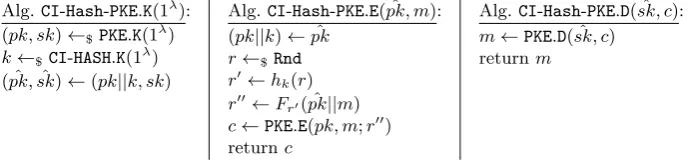
Alg.CI-Hash-PKE.K(1λ): (pk, sk)←$PKE.K(1λ)
k←$CI-HASH.K(1λ)
( ˆpk,skˆ)←(pk||k, sk)
Alg.CI-Hash-PKE.E( ˆpk, m): (pk||k)←pkˆ
r←$ Rnd
r0←hk(r)
r00←Fr0( ˆpk||m) c←PKE.E(pk, m;r00) returnc
Alg.CI-Hash-PKE.D( ˆsk, c):
m←PKE.D( ˆsk, c) returnm
Fig. 13.SchemeCI-Hash-PKEbuilt from PKE schemePKE, PRFF, and hash function familyH.
standard PRF f. We introduce a public parameter c of F which will correspond to the key for h, and then, instead of using the output ofhdirectly, we usehto derive a key forf. More specifically, we define
Fc,K(x) :=fhc(K)(x).
Whilst not strictly an RKA-secure PRF due to the presence of the public parameter c, this primitive allows adaptively chosen inputsx, while remaining secure under related key attacks. This ‘partial’ RKA-secure PRF will allow us to obtain HK-RRA-ATK secure encryption schemes for the function families of the underlying CIS hash functionh. However, to achieve this, we need to extend the definitions and theorems of [20] to the multi-key setting (reflecting the fact that in the HK-RRA setting, our adversary can interact with multiple public keys).
We formally define multi-key selective correlated-input pseudorandomness (MK-SCI-PR) for a family of keyed hash functions via the security game shown in Figure 12. The definition is selective in the sense that the adversary is required to submit the correlation functions before seeing the hash function keys used in the game. As in the definition of related randomness security, we considerΦ-restricted adversaries i.e. adversaries who are restricted to submit correlation functions belonging to a given class of functionsΦ.
Definition 13. A familyHof keyed hash functions is said to be(Φ, `)-MK-SCI-PRsecure if for allΦ-restricted adversariesA, the advantage ofA againstH, defined as
Adv`H-mk,A-sci-pr(λ) := 2·P[`-MK-SCI-PRAH(λ)⇒1]−1,
is negligible in the security parameterλ.
Based on an ordinary PKE schemePKE, a PRFF, and a family of hash functionsH, we construct a PKE scheme CI-Hash-PKE as shown in Figure 13. The following theorem establishes the selective `-HK-RRA-ATK security of this scheme based on the IND-ATK security ofPKE, the multi-key selective CIS security of H, and the (regular) pseudorandomness ofF.
Theorem 5. SupposeAis aΦ-restricted, equality pattern respecting adversary in the selective`-HK-RRA-ATK
game against the schemeCI-Hash-PKEin Figure 13. SupposeAmakesqLR LRqueries, uses qr randomness in-dices, and usesqφfunctions in its oracle queries. Then there exists aΦ-restricted, multi-key, selective correlated-input hash adversaryB, a PRFadversaryC and an IND-ATKadversaryD such that
Adv`CI-shk-Hash-rra-PKE-atk,A(λ)≤2qφ·qr·Adv
`-mk-sci-pr
H,B (λ) + 2qφ·qr·Adv
prf
F,C(λ)
+`·qLR·qr·AdvindPKE-,Datk(λ) +
`2·q
r
|HashKeySpace|.
AdversariesB,CandDrun in approximately the same time asA. AdversaryCmakes at mostqLR queries, and
Proof. First, we invoke Lemma 1, so that we now only have to prove the theorem for an adversary using just one randomness value. We prove the theorem via a sequence of game hops and hybrid arguments. LetG0 be the real correlated-input hash PKE game, which is the non-adaptive version of the game in Figure 7. The game G1 is the same except for queries on the target key. Rather than using the hash function, the game picks a uniformly random output for each function and uses this value as a key for the PRF.
Adv`CI-Hash-PKE-hk-rra-atk,A(λ) = 2·P[GA0]−1
≤2·(P[GA0 |coll] +P[coll])−1
= 2·(P[GA0 |coll]−P[GA1 |coll]) + 2·P[coll]−1 +2·P[GA1 |coll].
If there are no collisions in the hash function keys, then the difference betweenG0andG1is negligible. This can be stated formally as:
Lemma 2. The difference between the success probability ofAin gamesG0andG1is bounded by the advnatage
of a multi-key, CI hash adersary B. That is:
P[GA0 |coll]−P[GA1 |coll]≤Adv
`-mk-sci-pr
H,B (λ).
Proof. We will prove this via a hybrid argument. LetG0,idenote the game in which, for the target public key,
for function k≤qφ−i the output of the hash function is real, whereas for functionk > qφ−i the output is
random, rather than using the hash function. Notice thatG0=G0,0 andG1=G0,qφ, so
P[GA0 |coll]−P[GA1 |coll] =
qφ−1 X
n=0
P[GA0,i|coll]−P[GA0,i+1 |coll] ≤qφ· |P[GA0,j∗|coll]−P[GA0,j∗+1|coll]|.
If an adversary can distinguish gamesj∗ andj∗+ 1 when there are no collisions of hash keys, then we may use this adversary to construct a multi-key CI hash adversary that distinguishes with the same probability. The CI-hash adversaryBwill simulate either the gameG0,j∗ orG0,j∗+1 forA.
AdversaryBinitiates the CI hash game and is given the description of a hash function. Then,Bsets up the game forA.
Setup
b←${0,1}
guess an index j∗∈ {0, . . . , qφ−1}
funchoice←false;target←false
Keys← ∅; Functions← ∅, S ← ∅; ( ˆpk∗,skˆ∗)← ∅
WhenBhas finished this setup procedure, he forwards the description of the hash function toA. AdversaryB will then answerA’sFuncandTargetqueries as follows:
Func query (φ1, . . . , φqφ)
Iffunctions=true,B returns⊥
OtherwiseBforwards the query to his CI challenger and receivesk1, . . . , k`
Fori= 1 to`,B generates (pki, ski)←$PKE.K(1λ) B sets ˆpki=pki||ki, and ˆski=ski
functions←true B returns{pkˆi} toA
Target query (j)
Iftarget=true,Breturns⊥ otherwiseBsets ( ˆpk∗,skˆ∗)←( ˆpk
j,skˆj)
target←true
Fori6=j,B returns{skˆi}
be stored alongside (kj, qφ−j∗) in the table. For input pairs (kj, κ), where κ > qφ−j∗,B replaces the oracle
outputs in the table with uniformly random values. (N.B. AdversaryB could (and would in practice) generate this table ‘on-the-fly’ in response toA’sEnc andLRqueries. However, to keep our presentation clear and un-cluttered, we adopt the current approach of generating the whole table before answeringA’sEncorLRqueries.)
Enc query ( ˆpk, m,1, κ)
Iftarget=false orfunctions=false, return⊥ B parses ˆpk=pki||ki
B finds (ki, κ, ri,κ) in the look up table and returnsPKE.E(pk, m;Fri,κ( ˆpk||m)) LR query(m0, m1,1, κ)
Iftarget=false orfunctions=false, return⊥
B finds (kj, κ) in the table and gets corresponding valuerj,κ
B returnsPKE.E(pk∗, mb;Frj,κ( ˆpk
∗
||mb))
B adds the ciphertext to the setS Dec query (c)
Iftarget=false orfunctions=false, return⊥ Ifc is not inS,BreturnsPKE.D(skj, c)
ElseB returns⊥
At the end of the simulation, Boutputs 1 if Aoutputsb=b0. If B is in the real world, he simulatesG
0,j∗
perfectly. In the random world, he simulatesG0,j∗+1 perfectly. Hence, we may conclude that
|P[GA0,j∗|coll]−P[GjA∗+1|coll]| ≤AdvH`-mk-sci-pr,B (λ).
Game 2 is the same asG1, except that, for the target public key, a fresh output is chosen for each encryption rather than using the PRF. If an adversary can distinguish games 1 and 2 when there are no collisions in the hash keys, then we may use this adversary to win the PRF game.
Lemma 3. The difference between the success probabilities of any adversaryAis bounded by a PRF adversary
B as follows:
P[GA1 |coll]−P[G
A
2 |coll]≤qφ·AdvprfF,C(λ).
Proof. LetG1,idenote the game in which, for function k≤i, a uniformly random value is chosen rather than
using the PRF, whereas fork > ithe PRF is used. Observe thatG1=G1,0andG2=G1,qφ, from which we see that
P[GA1 |coll]−P[G
A
2 |coll] =
qφ−1 X
n=0
P[GA1,i|coll]−P[G
A
1,i+1 |coll] ≤qφ· |P[GA1,j∗|coll]−P[GA1,j∗+1|coll]|.
If an adversary can distinguish gamesG1,j∗andG1,j∗+1, then we may use this adversary to construct a PRF
adversary with the same advantage in the PRF game. The PRF adversaryC will simulate either gameG1,j∗ or
G1,j∗+1. AdversaryC’s setup procedure for the simulation is as follows:
Setup
b←${0,1}
choose an index j∗∈ {0, . . . , qφ−1}
r←$Rnd
choose qφ−j∗−1 uniformly random PRF keysρj∗+2, . . . , ρq
φ funchoice←false;target←false
Keys← ∅; Functions← ∅; S ← ∅; ( ˆpk∗,skˆ∗)← ∅
WhenCfinishes this setup procedure, he forwards the description of the hash function toA. ThenCresponds toA’s queries as follows:
Func query (φ1, . . . , φqφ)
Iffunctions=true,C returns⊥
otherwiseC chooses hash keysk1, . . . , k` uniformly at random, making sure they are all distinct
Fori= 1 to`,C generates (pki, ski)←$PKE.K(1λ) C sets ˆpki=pki||ki and ˆski=ski
Target query (j)
Iftarget←true,C returns⊥ otherwiseC sets ( ˆpk∗,skˆ∗)←( ˆpk
j,skˆj)
target←true
Fori6=j,C returns{skˆi}
Enc query ( ˆpk, m,1, κ) C parses ˆpk=pki||ki
ifi=j,
ifκ < j∗+ 1,C choosesr0←$Rnd
else ifκ=j∗+ 1,Csubmits ˆpki||mto his oracle and recieves outputr0
else ifκ > j∗+ 1,Ccomputesr0←Fρκ( ˆpk||m) else Ccomputesr0←Fhki(φκ(r))(m)
C returnsc←PKE.E(pki, m;r0)
LR query(m0, m1,1, κ)
ifκ < j∗+ 1,C choosesr0←$Rnd
else ifκ=j∗+ 1,Csubmits ˆpkj||mto his oracle and recieves outputr0
else ifκ > j∗+ 1,Ccomputesr0←Fρκ( ˆpkj||mb)
C returnsPKE.E(pk∗, mb;r0)C adds the ciphertextctoS
Dec query (c)
Ifc is not inS,C returnsPKE.D(skj, c).
ElseC returns⊥
At the end of the simulation,Coutputs 1 if and only ifAoutputsb=b0. IfCis in the real world, he simulates G1,j∗ perfectly. In the random world, he simulatesG1,j∗+1 perfectly. Hence, we may conclude that
|P[GA1,j∗|coll]−P[GA1,j∗+1|coll]| ≤Adv
prf
F,C(λ).
Finally, the gameG2may be simulated by a standard IND-ATK adversary. That is:
Lemma 4. For any adversary A, we may bound A’s advantage by an IND-ATK adversary’s advantage as follows:
2·P(GA2 |coll)−1≤`·qLR·AdvindPKE-,Datk(λ).
Proof. Again, we use a hybrid argument. LetG2,idenote the game in which, for thekthLRquery, ifk≤qLR−i,
LR queries are answered with an encryption of m0, whilst if k > qLR−i LR queries are answered with an
encryption ofm1.
2·P(GA2 |coll)−1 =|P(A
G2,0 ⇒1|coll)−
P(AG2,qLR ⇒1|coll)|
≤qLR· |P(AG2,j∗ ⇒1|coll)−P(AG2,j∗+1 ⇒1|coll)|.
If an adversaryAcan distinguish the gamesG2,j∗andG2,j∗+1, then we may construct a standard IND-ATK
adversary that distinguishes with the same advantage.
The IND-ATK adversaryDfirst runs hisInitialiseprocedure and is given a public keypk∗. ThenDsets-up the simulation forAas follows:
Setup
guesses an indexj∗∈ {0, . . . , qLR−1}
choose a uniformly randomt∈ {1, . . . , `} choose r←$Rnd
ctr←1
funchoice←false;target←false
Keys← ∅; Functions← ∅; S ← ∅; ( ˆpk∗,skˆ∗)← ∅
When completed, the IND-ATK adversary Dforwards the description of the hash function to A and answers A’s oracle queries as follows:
Func query (φ1, . . . , φqφ)
Iffunctions=true,Dreturns⊥
otherwiseDchooses hash keysk1, . . . , k`uniformly at random, making sure they are all distinct
Fori∈ {1, . . . , t−1, t+ 1, . . . , `} D generates (pki, ski)←$PKE.K(1λ) Dsets pkt=pk∗
Fori= 1 to`,Dsets ˆpki=pki||ki and ˆski=ski