TOWARDS EFFICIENT COLLABORATION FOR
E-SERVICE TRANSACTION MANAGEMENT:
Semantics, Security and Reliability
By Jiangang Ma
A Thesis Submitted to School of Engineering and Science in Fulfillment of the Requirements for the degree of
DOCTOR OF PHILOSOPHY
Supervisor: Professor Yanchun Zhang
Australia
© Copyright 2010 By
DECLARATION
I, Jiangang Ma, declare that the PhD thesis entitled Towards Efficient Collaboration for e-Service Transaction Management: Semantics, Security and Reliability is no more than 100,000 words in length including quotes and exclusive of tables, figures, appendices, bibliography, references and footnotes. This thesis contains no material that has been submitted previously, in whole or in part, for the award of any other academic degree or diploma. Except where otherwise indicated, this thesis is my own work.
CONTENTS
DECLARATION ... iii
CONTENTS ... iv
LIST OF TABLES... ix
LIST OF FIGURES ... x
ACKNOWLEDGMENT ... xii
ABSTRACT ... xiii
1. Chapter 1 Introduction...1
1.1 Motivation and Research Problems ... 3
1.1.1 Discovering Web Services Based on Semantics ... 5
1.1.2 Securely Accessing Web Services ... 7
1.1.3 Reliable Collaboration in Distributed Transaction Management... 8
1.2 Proposed Solutions... 9
1.2.1 Collaboration through Web Services Discovery Based on Latent Semantics Analysis ... 9
1.2.2 A Layered Access Control Architecture Based on Process View... 10
1.2.3 Reliable Collaboration Based on Relaxed Atomicity Sphere Model... 11
1.3 Thesis Outline ... 12
2. Chapter 2 State of the Art...15
2.1 Background ... 16
2.1.1 Collaboration in Distributed Environment... 16
2.1.2 Business Collaboration Approaches ... 20
2.1.3 Business Process ... 25
2.1.4 Workflows... 27
2.2 Services-Oriented Architecture (SOA) ... 31
2.2.1 Simple Object Access Protocol (SOAP ) ... 31
2.2.2 Web Service Description Language (WSDL)... 32
2.2.3 Universal Description, Discovery and Integration (UDDI ) ... 34
2.2.4 Business Process Execution Language for Web Services (BPEL4WS) ……….35
2.2.5 Ontology... 35
2.3 e-Service Transaction Management Through Workflows ... 36
2.3.1 eFlow 36 2.4 e-Service Collaboration Transaction Management Through Web Services Composition ... 37
2.4.1 Quality-Driven Web Services Composition Transaction... 37
2.4.2 Ontology-Driven Web Services Composition Transaction... 38
2.4.3 Rule-based Web Service Composition Transaction... 39
2.5 Research Problems and Challenges ... 40
2.6 Summary ... 41
3. Chapter 3 Basic Models for e-Service Transaction Management...43
3.1 Introduction ... 43
3.2 Introduction to Modeling for Distributed Collaboration... 44
3.3 Basic Requirements for Distributed Collaboration ... 45
3.3.1 Security Requirements ... 46
3.3.2 Reliability Requirements... 47
3.3.3 Transactional Requirements... 50
3.4 Role Based Access Control... 51
3.5 A Distributed Workflow Model ... 52
3.5.3 Control Flow Model... 58
3.5.4 Transactional Web Services Model ... 59
3.5.5 A Workflow Model ... 60
3.6 Summary ... 61
4. Chapter 4 Collaboration Through Web services Discovery and Composition Based on Semantics...63
4.1 Introduction ... 65
4.2 Web Service Discovery Approaches... 67
4.2.1 Keyword-Based Web services Discovery... 71
4.3 DC-SVD: Divide and Conquer Semantic Discovery Approach ... 75
4.3.1 Overview of DC-SVD Approach ... 77
4.3.2 Decomposing Search Result Collection... 78
4.3.3 Matching Web services in Latent Semantic Space ... 84
4.3.4 Experiments Evaluation ... 89
4.3.5 Related Work ... 94
4.4 Efficiently Selecting Web services Using A Clustering Semantic Approach.. 96
4.4.1 Probabilistic Latent Semantic Analysis (PLSA) ... 97
4.4.2 Eliminating Irrelevant Services from Service Collection ... 100
4.4.3 Web services Discovering based on PLSA... 105
4.4.4 PSMA -- Probabilistic Semantic Matching Algorithm ... 109
4.4.5 Experimental Evaluation... 113
4.4.6 Related work ... 120
4.5 Web service Composition Based On Ontology ... 121
4.5.1 Web service Representation... 124
4.5.2 Ontology Design ... 126
4.5.5 Related Work ... 134
4.6 Summary ... 135
5. Chapter 5 Secure Collaboration in Scientific Workflows...137
5.1 Introduction ... 138
5.2 Security Requirements of Cross-Organizational Collaboration... 142
5.3 Deriving Consistency View Based On Workflow Model... 144
5.3.1 Consistency Views ... 145
5.4 A Layered Access Control Model For Secure Collaboration ... 148
5.4.1 Secure Collaborative System ... 148
5.4.2 A Two Layer Security Architecture... 150
5.4.3 Security Policy ... 154
5.5 Related Work ... 155
5.6 Summary ... 156
6. Chapter 6 Ensuring the Reliable Collaboration in Distributed Environment...157
6.1 Introduction ... 158
6.2 Transaction Models ... 161
6.2.1 Transaction and Transaction Properties ... 161
6.2.2 Advantages of Transaction... 162
6.2.3 Transaction for Collaboration ... 163
6.2.4 Atomicity Sphere ... 164
6.3 Extended Atomicity Sphere ... 165
6.3.1 Maintaining Data Consistency ... 166
6.3.2 Maintaining Process Consistency ... 170
6.6 Summary ... 174
7. Chapter 7 A Framework for Supporting e-Services Transaction and Case Study...175
7.1 System Architecture ... 175
7.2 User Application Layer (UAL) ... 176
7.3 Collaborative Process Model Layer ... 177
7.4 Evaluation and Case Study... 179
7.5 Summary ... 181
8. Chapter 8 Conclusion and Future Work...183
8.1 Contributions and Summary of This Thesis ... 183
8.2 Possible Future Research Work ... 185
LIST OF TABLES
Table 4.1: Experiment datasets... 90
Table 4.2: An example of service transaction matrix ... 104
Table 4.3: Aspects and their service ... 117
Table 4.4: Examples of the most likely words for 4 hidden concept ... 119
LIST OF FIGURES
2.1 Traditional business approach ... 17
2.2 Business collaboration ... 19
2.3 Business collaborative strategy... 20
2.4 Collaborative patterns ... 22
2.5 Form virtual organization ... 24
2.6 A scenario of distributed collaboration... 25
2.7 The specification of web service ... 33
2.8 An example of WSDL file for cargoshipping web service... 34
3.1 Control dependency ... 59
4.1 Service discovery and composition ... 65
4.2 Web service discovery... 66
4.3 Approaches of Web service discovery ... 69
4.4 Decomposing search results ... 78
4.5 An example of matrix ... 83
4.6 Precision and recall... 92
4.7 Comparisons of DC-SVD with keyword ... 93
4.8 Performance in different size of SVD ... 94
4.9 Outline of the matching ... 99
4.10 An example of data processing... 116
4.11 Accuracy of CPLSA and keyword for four categories ... 118
4.12 Precision and recall of PLSA and keyword ... 119
4.13 Ontology0based system architecture ... 123
4.14 Ontology for Web services ... 125
4.15 Cargoshipping ontology... 128
5.1 Scenario of lymphoma DNA classification ... 140
5.2 An example of deriving views ... 147
5.3 Model of a layered access control ... 152
6.1 Run model and composite entity ... 168
6.2 Example of process consistency ... 171
ACKNOWLEDGMENT
I would like to thank many people who have contributed to the successful completion of this thesis.
First, I would like to express my sincere gratitude and thanks to my principal supervisor, Professor Yanchun Zhang, both in my academic research and in other aspects of life during my PhD research. I have learned much how to do research from him. Our regular discussions and meetings have immensely contributed my research. This research work would have not been completed without his valuable guidance, encouragement and suggestions. My thanks also go to my co-supervisor, Dr. Fuchun Huang, for his valuable comment, discussion, and assistance throughout my research.
Second, I wish to thank postgraduate officers, Ms. Natalie Gloster, Ms. Lesley Birch and Ms. Elizabeth Smith for their organizing all academic research activities for my PhD research. I highly appreciate their excellent work for assisting PhD students. My thanks also go to the School of Engineering and Science at Victoria University for providing me with an excellent research environment.
Furthermore, I would like to thank all the staff members and my classmates at the School of Engineering and Science. In particular, my thanks go to A/Prof. Xu Yi, A/Prof. Hao Shi, A/Prof. Yuan Miao, Ms. Anne Venables, Dr Alasdair McAndrew, Dr Gitesh Raikundalia and Prof. Pietro Cerone, for their encouragement, suggestions and assistance.
ABSTRACT
With advances in Web technologies, business and scientific communities are increasingly depending on collaboration to support a variety of business domains, such as enterprise production management and e-business integration, and to assist scientists in their researches. These business and scientific explorative activities are typically carried out in multi-organizations, run over long periods of time and involved in different business processes and huge amounts of data. In these situations, data resources (e.g. business databases and medical testing data), individual computational tasks (e.g. gene comparison) and user-created workflows (e.g. experimental steps) are likely to be distributed over various locations, connected over the Internet. In addition, these distributed resources can be further wrapped as Web services, which are published and deployed on the Web, so that other business partners are able to share these valuable computational resources for facilitating their business and scientific activities. These collaborations in distributed environment allow business partners to transform a complicated business or scientific problem into a series of simpler, and more easily handled ones.
The second challenge is security, which is currently ignored in most of Web services-based transaction systems. This is particularly important in a Web services context because the messages transmitted over the Web could be accessed and altered by impostors. For security reasons, it is important that confidential information like private business processes and sensitive data (e.g. patients’ private data in medical research) should not be visible or released to unauthorized users.
Another challenge to overcome in this collaborative environment is that efficient fault tolerant mechanisms are needed for ensuring reliable execution of collaborative systems. A basic requirement for reliable collaboration in distributed experiments is that the business processes or experiments should be allowed to proceed without violating business process specifications and data consistencies even when the failures occur for some reasons. This requirement is particularly applicable to distributed transactions because the collaboration may consist of hundreds of separate processes or computing steps and may involve lots of data objects whilst the computing steps may fail. In such cases, giving up the overall collaboration would be too expensive.
approach is to indirectly associate the intention of users to the advertisements in Web services by applying Probabilistic Latent Semantics Analysis (PLSA). Then, we model the internal activities within an institution by employing workflow technology whilst the individual workflow models of participating institutions can be mapped to process views, which are further described by Web services. Based on the process view model, a two layered access control architecture is proposed to protect computing resources. Finally, the atomicity concept is relaxed by integrating transactions and exception handling models in order to ensure the reliable collaborations on the Web.
PUBLICATIONS BASED ON THIS THESIS
Refereed Journal Papers
[1] Jiangang Ma, Jinli Cao and Yanchun Zhang. Efficiently Supporting Secure and Reliable Collaboration in Scientific Workflows. In Journal of Computer and System Sciences (JCSS), Volume 76, Issue 6, September 2010, Pages 475-489, 2010.
Refereed International Conference Papers
[2] Jiangang Ma, Yanchun Zhang and Jing He. Web Services Discovery based on Latent Semantic Approach. In the proceedings of The IEEE International conference on web services (ICWS2008), September 23-26, China, 2008.
[3] Jiangang Ma and Yanchun Zhang. Efficiently Finding Web Services Using a Clustering Semantic Approach. In the proceedings of the 2008 International Workshop on Context Enabled Source and Service Selection Integration and Adaptation: organized with the 17th International World Wide Web Conference (WWW 2008), CSSSIA 2008, Beijing, China, April 22, 2008.
[4] Yanchun Zhang and Jiangang Ma. Discovering Web Services based on Probabilistic Latent Factor Model. In the proceedings of the 9th Asia-Pacific Web Conference and the 8th International Conference on Web-Age Information Management, China, June16-18, 2007.
[6] Jiangang Ma, Yanchun Zhang and Minglu Li. OMWSC-An Ontology-Based Model for Web Services Composition. In the Proceedings of Fifth International Conference on Quality Software (QSIC 2005). Australia, 2005.
1.
Chapter 1
Introduction
Fierce competition and quickly changing markets in today’s global economy demand business enterprises to provide high-quality products or services, with short life cycles in order to meet increasing expectations of customers. This implies that enterprises need to possess a broad range of knowledge, techniques and skills, ranging from developing capabilities at the logistics layer and the transaction layer [46, 121] to provide competitive products and services. However, it is difficult for a single enterprise, in particular, for small and medium-sized enterprises (SME), to have such comprehensive skills and capabilities either for suffering high cost or for infeasibility. This, together with the advances in Information and Communication Technologies (ICT), particularly with Service-Oriented Architecture (SOA), has motivated the evolution of collaborative techniques to manage it.
e-business integration and scientific research experiments. In particular, small and medium-sized enterprises (SMEs) represent the major parts of the collaborations. For example, SMEs comprise 99% of all companies in the European Union [110]. As demonstrated by a recent survey [131] from AT&T, about 75% of firms in a worldwide expect the number of collaborative relationships with third parties overseas to grow. Effectively collaborating with business partners in a distributed environment poses a number of significant challenges. First, the collaboration needs to take into consideration semantics that has an impact on finding proper business partners. These business partners often integrate existing applications, including data, business logic and other resources in terms of Web services, which are published and deployed on the Web, so that other trading partners are able to discover and share these valuable computational resources for facilitating their collaborations. As Web services are usually created by different providers that employ different phrases and terms for presenting and describing services’ characteristics and capabilities, it is difficult for trading partners to correctly understand the relevant semantic information hidden in the service descriptions for effective discovery and composition of Web services [76, 123].
that the business processes or scientific research experiments should be allowed to proceed without violating business process specifications and data consistencies even when the failures occur for some reasons. This requirement is particularly applicable to distributed transactions because the collaboration may consist of hundreds of separate processes or computing steps and may involve lots of data objects whilst the computing steps may fail. In such cases, giving up the overall collaboration would be too expensive. At the same time, Service-Oriented Architecture (SOA) has emerged as an effective means to support cooperating applications that seamlessly join together heterogeneous software modules from diverse organizations in the form of Web services. Our research is motivated by the need to facilitate the effective collaboration in a semantic, reliable and secure manner.
This chapter is organized as follows. In Section 1.1, we outline the research problems that will be tackled in this thesis. In Section 1.2, we summarize proposed solutions and we present the structure of this thesis in Section 1.3.
1.1
Motivation and Research Problems
are able to collaborate with other counterparts for a given goal, by assembling these application components with little effort to create business processes. These business processes can be further improved via automated techniques such as Workflows in order to enhance overall efficiency and effectiveness of business collaboration.
Typical examples in a distributed collaboration where semantics, reliability and security can be of great importance are in the fields of e-business and e-research. Consider the first case related to supply chain management and manufacturing processes that involve a high level of complexity and many business trading partners with complex interrelationships. For example, the completion of whole business transaction involves selecting goods remotely, managing orders with an electronic cart, paying electronically and tracking the shipment, and so on. Consequently, any failure during the collaboration among trading partners may result in unreliability in the distributed software systems, and may have a significant commercial impact. For example, a customer may have paid the bill whereas the supplier fails to deliver the ordered products.
scientific researches. As a result, these collaborations in a distributed environment allow scientists to transform a complicated scientific research problem into a series of simpler, and more easily handled steps.
Although current Web technologies have achieved a certain level in facilitating applications mentioned above, there are a number of unique challenges that remain unaddressed in distributed collaborations. These challenges include: (i) how to effectively discover Web services based on semantics, (ii) how to securely access Web services in a distributed context, and (iii) how to reliably collaborate trading partners in the presence of failures in a distributed transaction context.
1.1.1 Discovering Web Services Based on Semantics
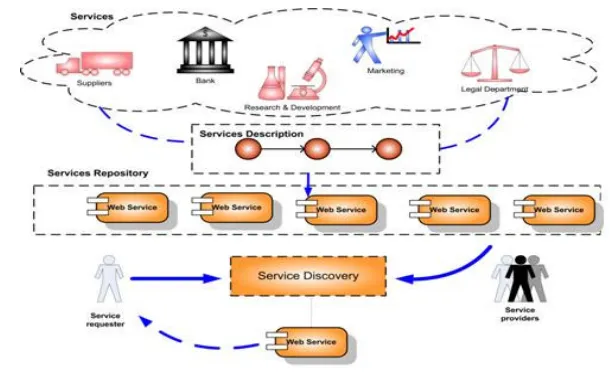
Web services discovery process mainly involves locating desired Web services either published in a registry like UDDI or scattered in P2P systems, matching users’ requirements to a set of Web services and returning relevant ones to the consumers. One of the current discovery approaches is based on keyword strategy. The keyword-based discovery approach consists of two main steps. A service user first types keywords into a Web service search engine to look for the corresponding services. The user then selects the desired Web services returned.
Here Web service discovery refers to a process of locating the appropriate collaborative participators (Web services and Web service providers). In Service-Oriented Architecture, a set of Web services might be found for individual tasks in a local repository or located across different organizations over the Internet. During the run-time phase, the Web services discovered are invoked through enabling data flows and control flows among tasks. When individual Web service completes its application invocation on behalf of the tasks, the collaborative process proceeds to the next tasks until the whole collaborative objective is realized. In this collaborative application, service consumers and service providers need to agree on the descriptions on Web services in terms of functional and non-functional properties. The functional properties specify what Web services can do whilst non-functional properties mean the quality of services, such as reliability, security and transaction.
Efficient discovering Web services is a challenging issue for several reasons. Firstly, with the ever-increasing number of services published on the Internet, it is difficult for service consumers to select the best ones to complete their tasks because a large number of Web services offer similar functionalities. Secondly, keywords are insufficient in expressing semantic concepts, which is partially due to the fact that keywords are often described by natural language, being much richer in terms of diversity. As a result, finding desired Web services is akin to looking for a needle in a haystack [43].
time-consuming. Therefore, there is a need to have effective approaches to semantically discovering Web services for fascinating distributed collaborative applications.
1.1.2 Securely Accessing Web Services
The second challenge is security, which is currently ignored in most current collaboration applications. The existing collaborative applications like workflow systems are based on the assumptions that the collaboration among trading partners is conducted within a dedicated infrastructure whilst the integration of different information and securely accessing Web services are under control of a trusted centralized coordination mechanism. On such an assumption, participants involving in a collaborative process have a prior expectation of what applications will be accessed and how clients will invoke Web services.
1.1.3 Reliable Collaboration in Distributed Transaction Management
A robust business application should be reliable. In other words, it should be able to continue to complete its work, and capable of adapting itself to some failures. There are a variety of sources that are responsible for failures. A failure may be due to hardware reasons, such as computers crash or Internet communication interruption, or it may come from software reasons, for instance, an incorrect commuting outcome caused by executing a task in a workflow.
Reliable business collaboration in a Web service context is even more complex. First, it requires loosely coupled connections between different distributed systems so that business partners involving a collaboration can cooperate more freely across the Internet. Second, the collaboration is established in a highly dynamic fashion and on-demand basis. For example, new participants (e.g., new services) may join the collaboration whilst existing services may be removed at any time. This requires efficient adaptive collaboration techniques in order to ensure reliable execution of business processes. Here, a reliable distributed collaboration system refers to one that can continue to process users’ requests even when some errors occur. In other words, even if components of distributed transaction management system fail, a reliable distribute transaction system should be able to continue executing users’ requests without violating process consistency and data consistency.
1.2
Proposed Solutions
In this thesis, we address the challenges mentioned earlier by presenting a transaction framework and models for supporting semantic discovery of Web services and maintaining secure and reliable collaborations. The proposed process-oriented infrastructure of collaboration for e-service transaction management will be referred to as acronym CSTM (towards efficient collaboration for e-service transaction management: semantics, security and reliability) in the remainder of this thesis. The proposed approaches depend on workflow technologies by integrating control flows and data flows models, and they employ a relaxed transaction concept for fault tolerance, in order to maintain the process consistencies, as well as, data consistencies even in presence of failures.
1.2.1 Collaboration through Web Services Discovery Based on Latent Semantics Analysis
advertisements in Web services by applying latent semantics analysis. As a result, Web services can be matched against a query at the concept level. The salient features of our approach are:
• Complying with currently dominating industrial techniques for Web services discovery. At present, the dominating industrial techniques for Web services discovery and description are to use UDDI registry and WSDL description. Our method is compatible with the existing standards through combining the keyword technique and the semantics extracted from the service WSDL descriptions, which is different from traditional keyword-based technique for Web service discovery.
• Supporting scalability for Web service discovery. We propose a divide and conquer semantic discovery approach in order to transform a complex problem into a series of simpler ones, which can be handled more easily. The objective is to handle the poor scalability for Web service discovery in the Web environment.
1.2.2 A Layered Access Control Architecture Based on Process View
resources such as data and file should not be modified by unauthorized executing entities. The basic features of our approach are:
• Balancing security and information choice for users. We use process views as the abstraction of the specifications for original business processes, which can be achieved by defining parts of the specifications. These parts of specifications are only visible and accessible to authorized users. The objective of our approach is to minimize what collaborative partners need to know during their collaboration with each other.
• Associating various roles with process views. We extend the Role-Based Access Control (RBAC) [102] model to securely access Web services. Based on the process view model, various roles can be associated with views, so that users can only see necessary parts of processes they are entitled to see.
1.2.3 Reliable Collaboration Based on Relaxed Atomicity Sphere Model
We propose a transaction approach [75] in order to support reliable collaboration in a distributed context. The main objective of the approach is to reduce the cost of recovering processes in case of failures, and ensure data consistency at various levels of granularity. For that purpose, the atomicity sphere concept is relaxed by integrating transactions and exception handling models so that data consistency as well as process consistency will be maintained. The features of the proposed approach are:
execution of a task as a run. Based on the run model, data flows are manipulated in the right way in the execution of a business process to ensure data consistency.
• Maintaining process consistency. We extend the notion of atomicity sphere by combining atomicity sphere with exception handling approach, aiming to maintain the consistency of computing processes. During the design phase, a collaborative application system is constructed by creating spheres properly. For example, a set of spheres may form a hierarchy structure where the outermost sphere represents a transaction whilst other spheres below the root indicate sub-transactions. Furthermore, we combine a backward error recovery and forward error recovery methods in order to ensure reliable collaboration.
1.3
Thesis Outline
This dissertation is organized in three parts. In the first part, we deal with semantics introduced in Web services discovery for collaborative processes. In the second part, we discuss security issues by introducing an access control framework and process view model. Finally, we focus on reliability by presenting a relaxed transaction model.
The underlying research issues constitute grand challenges in service-oriented computing, and need the integration of concepts and techniques from various disciplines, including SOA, business process management, workflows, database transaction and security.
Furthermore, e-service transaction management of collaboration through Web services composition is reviewed and related frameworks are also discussed in this chapter. Chapter 3 describes basic security and reliability requirements for distributed collaborations. In this chapter, we define basic models used for distributed collaborations. The basic models include task models, a Web service model and a workflow model.
Chapter 4 deals with semantic Web services discovery. The proposed novel discovery approach combines keywords techniques with the semantics extracted from the services’ descriptions by employing a divide and conquer semantic discovery approach, in order to handle poor scalability and lack of semantics. The key idea of our approach is to indirectly associate the intention of users to the advertisements in Web services by applying Probabilistic Latent Semantics Analysis (PLSA). The chapter also provides the experimental results.
Chapter 5 discusses the security issue. In this chapter, we present an approach to support securely access Web services. Our approach is based on the process views, which place emphasis on information hiding, minimizing what trading partners need to know during their collaboration with each other.
Chapter 6 presents the design of enabling transactional support for failures handling. To this end, the atomicity sphere concept is extended by considering two levels of atomicity abstraction for supporting reliable collaboration.
Chapter 7 reports a framework to exemplify the usage of the approaches presented in this thesis for supporting semantic, reliable and secure collaborations.
2.
Chapter 2
State of the Art
The need for the coordination of trading partners and the importance of transaction management in a distributed environment has been evident for long time. As traditional business approaches are mainly based on central control mechanisms by which trading partners are working together with closely coupled, it is quite difficult to facilitate the interoperability among trading partners and may have a significant impact on providing competitive products and services. As we discussed in the previous Chapter, effective collaborative approaches can cope with those issues, but they also pose a number of significant challenges such as semantics, security and reliability. Fortunately, service-oriented technologies are deemed as an effective means to support cooperating applications and have significant impact on expanding service-based economy [96, 123]. As demonstrated by a recent survey [108], about 75% of economic output in industrialized countries comes from the service-based economy.
and practice of collaborations in distributed contexts. It does this by first presenting background knowledge on business collaborations and describing basic terminologies, concepts and techniques, such as web services, business process and workflows, and so on. We then give brief overview of some research work relevant to web service transaction management frameworks and address their limitations.
This chapter is organized as follows: Section 2.1 introduces some background knowledge, concepts and terminologies used in this thesis. Section 2.2 provides a survey on Services-Oriented Architecture (SOA). Section 2.3 reviews some e-service transaction management prototypes. In Section 2.4, we discuss e-service collaborative transaction management through Web services compositions. Research problems in this thesis are provided in Section 2.5. Finally, a summary is reported in Section 2.6.
2.1
Background
This section introduces some background knowledge, concept and terminologies relevant to the research field in a semantic, reliable and secure collaboration.
2.1.1 Collaboration in Distributed Environment
In this section, we first introduce a simple car manufacturing scenario that will be used to illustrate the traditional approach to do business and its limitation, and then discuss business collaboration and its characteristics.
Doing Business via Traditional Approaches
to an automobile dealer who further sends the order to an auto manufacturer through some kinds of methods. After receiving the order for car, the vehicle manufacturer commences in ordering the parts by contacting the parts suppliers, who in turn order raw materials in order to create the parts. Meanwhile, the suppliers may calculate the price of the ordered parts and the fee for shipping the parts to the manufacturer, and send an invoice to request payment. Once receiving the all the parts from the suppliers, the manufacturer begins to produce the car and send it the dealer. Normally, this business activity is a long transaction process that may last for weeks or months.
Figure 2.1: Traditional business approach
services like road transport, distribution and shipping, etc. Finally, the objective of a business is to be cost-effective from transaction layer to logistics layer.
We can further summarize the basic characteristics of traditional business approaches based on the car manufacturing scenario:
• Tightly coupling. Traditional business approaches emphases on intimated relationships among business partners. For example, actors in the scenario above mainly focus on direct relationship with their partners rather than have the end-to-end management of processes running across many different organizations. Furthermore, business information is shared with direct business partners by using traditional business approaches [46].
• Centrally controlling. Traditional business approaches are mainly based on a central decision making control mechanism. As mentioned above, in a traditional business activity, a business is viewed as a sequential chain of events (a value chain) by which business actors are working together with closely coupled. In such an architecture, the coordination among partners is adopted by a hierarchical mechanism by which a single top level activity defines the overall business goal and regulates the detailed transaction steps [95, 64].
Doing Business via Collaborative Approaches
In this scenario, seller company (SC) is deemed as a product or service provider whilst buyer company (BC) as a product requestor. To begin with, SC looks for collaborative specification and using scenarios in a registry (step 1). After familiarizing with the use-cases and related regulations, SC will build its own business applications that comply with the specification by using different software solutions such as using Web services to wrap existing applications (step 2). After that, SC will describe the functionality of its applications in terms of business profile, and then publish it to a registry (step 3). If BC intends to do business with SC, it will look for the functionality specification supported by SC in the registry (step 4). Next, the two companies will negotiate each other to reach a collaborative agreement on different aspects of a business like documents changing and security requirement, etc (step 5). At this point, BC sends a request to SC (step 6). Finally, the two companies are already to do business according to the reached collaboration agreement.
Figure 2.2: Business collaboration [35]
2.1.2 Business Collaboration Approaches
In the previous section, we have described the interaction of two business companies doing a business by using ebXML. In this section, we introduce some of basic collaborative approaches and patterns in a distributed context whilst some detailed mathematics models related to collaborations will be discussed throughout the remaining chapters.
.
Figure 2.3: Business collaborative strategy
Collaborative Strategy
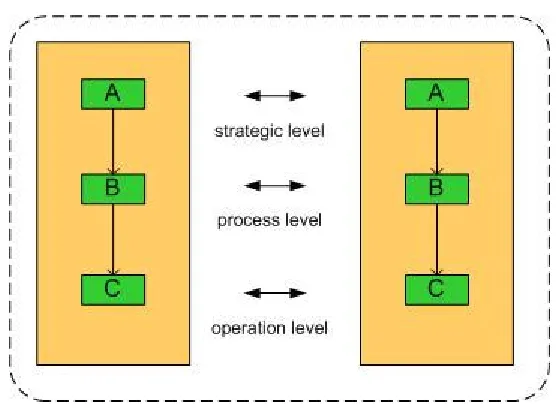
the concrete operational level [123]. Figure 2.3 shows the general idea of doing business by using a collaborative approach.
• The strategic level deals with high-level decisions that involve different trading partners. This often includes general decisions regarding achieving a particular, potential common business objective, such as if two trading partners agree to design a software application together. As a result, a virtual organization will be formed according to the strategic decision made. Also at this level, each partner within the virtual organization expects to complete a task, for instance, one partner providing loans service and the other for insurance, and so on.
• The concept level describes business processes according to a value chain model. These concepts are generally well-defined coarse processes so that multiple scenarios are enabled to reflect the flexibility of a collaboration.
• The operational level focuses on the technical aspects of a collaboration to realize the scenario of a collaboration. At this level, each partner may develop its own applications, integrate existing applications as services and further wrap them as Web services. Furthermore, with Web services, the well-defined coarse processes can be realized through discovering and composing Web services to enable control flows and data flows among the partners.
Collaborative Patterns
collaboration can be categorized into three patterns: chained pattern, nested pattern and synchronized pattern [56], shown in Figure 2.4.
In a chained collaborative pattern (Figure 2.4 (a)), a business process triggers a collaboration by invoking a task in another business process. During the collaboration after the process triggering, the two collaborative processes have an independent relationship, that is, triggering process can independently continue to proceed or terminate without being subject to the triggered process. In a nested collaborative pattern (Figure 2.4 (b)), on the other hand, a task in business process triggers a collaboration by invoking a task in another business process. However, the triggering process has to wait until the completion of the triggered process. Finally, in a synchronized collaborative pattern (Figure 2.4 (c)), the two collaborative processes have a dependent relationship. At a collaborative point, two processes execute in parallel through exchanging synchronizing information and they can proceed to work after the completion of both processes.
Forming Virtual Organization
Due to the increasing pressure of competition and market changing, business enterprises employ collaborative approaches to seek new business opportunities. This means that it may not effective for a single business enterprise to perform all of business activities alone. For example, it may be cheaper for an enterprise to select new business partners to do parts of its work because these partners may have highly specific expertise related to the work, so that acquiring another partner to do the job could lower business costs. What is more, business enterprises may change their business processes to further improve work efficiency by merging their processes with a partner’s ones to run in a competitive manner. As a result, this outsourced running manner and the process changing results in forming a virtual organization. We summarize the above process of forming a virtual organization as follow [95], shown in Figure 2.5:
• Starting from an agreement on collaborations
• Reducing some repeating work units
• Developing independent work unit based on common objective
• Integrating relationship between suppliers and customers
Figure 2.5: Form virtual organization [95]
Based on the description above, we can further summarize the basic characteristics of do business via a collaborative business approaches. The main objectives of such collaboration are to share resources, improve a business enterprise’s working efficiency and provide better products or services. Furthermore, effective process collaboration provides business companies with more flexible means for the choice of the services offered by other independent service providers. For example, a business company is able to focus on its own important work, outsourcing some routine work to other partners in order to reduce the costs of production.
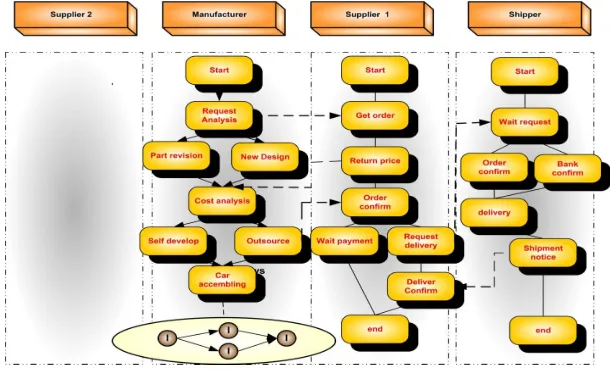
by selecting more appropriate business partners. For example, if the quotes offered from supplier 1 are over the expected budget, the manufacturer may select supplier 2.
Figure 2.1: A scenario of distributed collaboration
In the following section, we will present some terminologies relevant to the business collaborations introduced in the above scenario.
2.1.3 Business Process
by a CPU supplier at place B; and the claiming management process may be implemented by an insurance company at place C. Finally, these tasks in a business process could also be sub-processes that may be realized by combing various Web services, which correspond to a business transaction.
Business Process Design Approaches
Two basic strategies have been used to design business processes: the top-down approach and the bottom-up approach. The top-down process design approach refers to the procedure of analyzing requirements, and decomposing a business process into sub-processes or tasks, which can be easily handled and realized with individual Web services. More specifically, the top-down approach starts with a requirements analysis, which specifies what a business company expects to achieve with respect to the objectives of the company, such as whole performance of business process, reliability of business activities and security, and so on. After the decomposition of a business process, the dependency among tasks needs to be examined and determined. This includes the description of each task in the business process, such as functional features (e.g., input and output) and non-functional features (e.g., reliability, transaction), and the relationships between tasks in the process, including control flows and data flow among the tasks. Top-down design is a suitable approach when a business process is being designed from scratch.
bottom-up design is the individual services, and final result of this approach would be a global process model. The advantage of this approach is to reduce the cost of developing business processes because of the reuse of existing resources. The downside is the lack of an integrated view of the entire system. Therefore, in real application in developing business processes, the two approaches may need to be applied to complement one another.
Web Service Discovery and Business Process
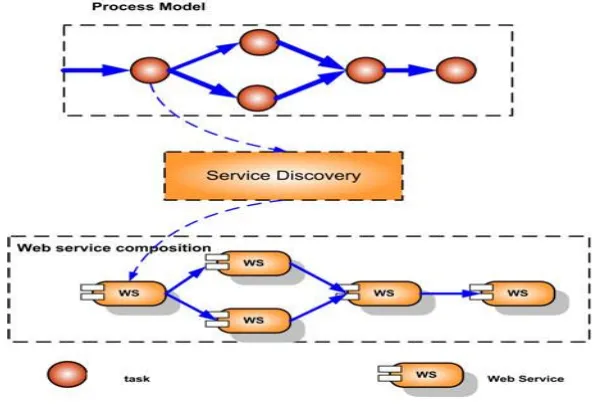
Before the execution of a business process, a set of Web services needs to be located to fulfill the tasks included in the business process. In this case, the assignment of tasks to appropriate services is referred to Web service discovery. In this situation, how to effectively select appropriate Web services for tasks is considerably challenging issue in distributed context because there may exist a number of solutions.
2.1.4 Workflows
Workflows refer to the automation of business processes, in whole or part. The Workflow Management Coalition(WfMC) [136] defines workflow as “the automation of a business process, in whole or part, during which documents, information or tasks are passed from one participant to another for action, according to a set of procedural rules” [136]. In the following, we introduce some basic concepts about workflow.
Tasks and Collaboration
into simpler tasks whilst, a complex task include a subset of tasks and the ordering relationships of their execution. The execution of a task in workflows is performed by an agent. Depending on the specific processes and applications, an agent can be a human, a program, a physical device or a Web service. If a task is assigned to people, the assignment of people to tasks in a business process is often performed via roles.
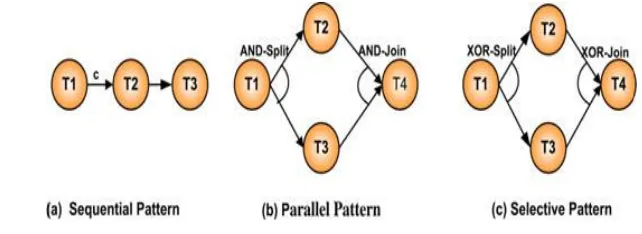
The tasks in a workflow need to coordinate each other for achieving a business objective. More precisely, the coordination of tasks involves how to schedule tasks available, that is, which tasks to select, what order of task to follow and what data dependency among task to regulate. This relationship among the tasks in the course of coordination is called workflow patterns, and can be further described via control flows and data flows. For example, in a sequence invocation of tasks, some tasks have to be scheduled one after the completion of the other. In service-oriented environment, a complex and long-running business process is generally performed in a highly distributed and heterogeneous environment. With workflow technology, the enterprise business activities can be structured as a set of tasks that are executed in a specified partial order.
Workflow Description and Workflow Enactment
tasks reflect their dependency. A task could be corresponding different business activities such as transaction and sub-process. Control flows denote the potential execution sequence of various tasks. For example, a directed edge pointing from A to B, called control connectors, regulates the flow of control from task A to task B, which means that task B can only start after task A has completed. On the other hand, data flows reflect real execution sequence of various tasks. Based on specific business rules, real data determines which path (consisting of real execution sequence of tasks) should take. These control and data flows are normally called business logic, which is necessary to realize the desired processes.
Workflow Management System
A workflow management system (WfMS) provides an effective environment to support for both defining workflow and run, schedule and monitor its execution. Formally, a WfMS is a software system that completely defines, manages and executes workflow through the execution of workflow whose order of execution is driven by a computer representation of the workflow logic [136].
assist designers to model workflow processes. Second, for running and scheduling workflows, a workflow engine (a software service) will take as input the description of the workflow description, interpret the process definition, and control and manage the process instances.
2.1.5 Transaction Management
service transaction management is a comprehensive logical architecture that uses e-services to develop, deploy, discover, compose, and manage computing resources. Normally, the transaction management involves complex business processes that may include several transactions. The transactions often involve various activities that may invoke and span in multiple e-services such as payment processing, shipping, coordinating and managing marketing strategies, and so on. Over the years, organizations have been seeking closer collaboration, application reusability and cost cutting in the face of tougher competition. Therefore, an effective and efficient e-service transaction management has become a critical factor for the organizations’’ business success.
with the weaker specifications of the ACID properties. However, to e-services transaction management, the strict ACID properties may not be desirable.
Then, traditional transactions are effective in a homogenous and centralized database. In this case, the data in traditional transactions is raw (no meaning) and known (with fixed value). Nevertheless, in a distributed transaction management of service-oriented structure, Web services have long running behaviors [73], which may not be precisely known when they are invoked. In addition, traditional transaction models and analyses fail to include the performance aspects of e-services transactions (e.g. QoS, scalability, etc.)[5, 23, 74], nor do they consider composite business transactions. Imagining ordering goods on the Internet as an example, it needs long running business activities such as checking price, sending order and shipping package, and so on.
Therefore, to achieve the objectives of these complex business transactions, an efficient transaction management should understand the different services’ syntactic and semantic descriptions, have efficient approaches and models for coordinating business interactions, and have proper frameworks for managing computing resources that may span different administrative domains.
2.2
Services-Oriented Architecture (SOA)
In this section, we will introduce the essential protocols and components that are related to constructing the CSTM framework.
Simple Object Access Protocol (SOAP) is a XML based protocol that can be used to exchange structured information in a decentralized, distributed environment [133]. SOAP provides an XML format for sending messages, which is independent of programming language and computer platforms. In particular, SOAP works on existing network transport protocols, such as HTTP, SMTP, FTP, etc, rather than defining a new transport protocol. The transporting elements in SOAP are a SOAP message, which is an XML document with the body element and header element. The body element includes the transmitted documents whilst a header element can contain optional routing and security information. Both the header and body elements are themselves XML nodes. In addition to the basic message structure, the SOAP specification also defines a model that dictates who should process messages and how recipients should process SOAP messages. For business collaborative applications in distributed environment, SOAP can be used as the common communication protocol for constructing the CSTM framework.
2.2.2 Web Service Description Language (WSDL)
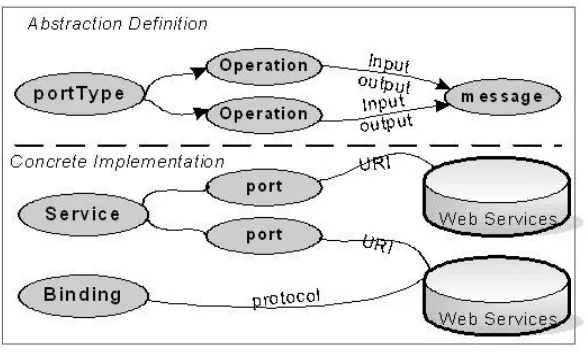
Figure 2.7: The specification of web service
On the other hand, the concrete implementations specify how the abstract interfaces are mapped to the specific bindings, which may include particular binding protocols like SOAP and network address. Similarly, a set of elements such as service, port and binding are used to define these deployment details. For business collaborative applications in distributed environment, WSDL can be considered as the common language that defines service interfaces.
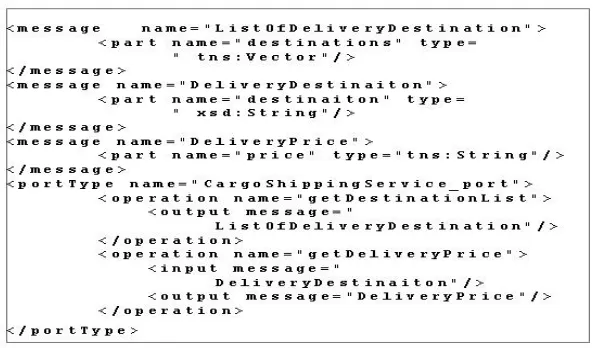
Figure 2.8: An example of WSDL file for cargoshipping web service
2.2.3 Universal Description, Discovery and Integration (UDDI)
collaborative applications in distributed environment, UDDI can be considered as a service broker.
2.2.4 Business Process Execution Language for Web Services (BPEL4WS)
At present, BPEL4WS [135] is an industrial standard for describing Web services. In particular, it can serve not only as a platform for modeling an abstract process but as the implementation language for executable processes. In an abstract process, BPEL4WS describes a business protocol, specifying roles between different parties and their relationship without considering internal behaviors for parties. On the other hand, in an executable process, BPEL4WS specifies an execution order among a set of activities constituting the process. Currently, BPEL4WS engine is one of the main execution environments, which provides a full package of Web service processes, including development, deployment and execution.
2.2.5 Ontology
Ontology refers to a formal specification of a conceptualization. Based on a theory on existence, such a technique organizes a domain knowledge into the categories by virtue of objects’ components and their semantic connectives, aiming at capturing the information on the structure and semantics of a domain. In other words, an ontology describes concepts and relations between domain concepts.
an ontology also describes service classes, which are used to define the property of the services. Because of its properties, ontology is used to discover Web services.
2.3
e-Service Transaction Management through Workflows
The approach of workflow-based composition is first achieved by definition of an abstract process of service model that includes a set of tasks and their data dependency, and then in runtime, each task is used to search the real atomic Web service to fulfill the task. Normally, a business process is a set of one or more interconnected activities to realize a business objective while a workflow is an automation of business process during which information or tasks are passed from one participant to another, according to a set of predefined rules. Thus, we can model workflow using a graph in which its nodes represent activities or tasks and its edges represent control and data flows.
2.3.1 eFlow
form, a new instance of the process is started. When a service node is invoked, a search recipe is executed to select a reference to a specific service.
However, most approaches of these process-based workflows are static and predefined. In other words, an abstract process model should be created before the composition planning starts. Obviously, this feature reflects that this kind of workflow method lacks flexibility and is not user-friendly. The main problems include:
• these kinds of workflow-based approaches have been mainly defined by users manually
• the degree of automation of producing composite service is low
• there is shortage of semantics
2.4
e-Service Collaboration Transaction Management through Web
Services Composition
To tackle the problems mentioned above, semantic Web and AI technologies point the way to the future. Recently, academic researchers of the Web have been making unrelenting efforts towards automatic, semantic Web enabled e-services transaction management. The basic ideas and methods are to annotate Web services with semantic information, develop different mathematical models and apply various automatic algorithms. Some examples are summarized as following.
2.4.1 Quality-Driven Web Services Composition Transaction
Duration, Reliability, Availability and Reputation. As multiple Web Services may provide similar functionalities with different properties (e.g. different price), the QoS is used to be a standard for selecting proper candidate services and producing an optimizing plan for a composite service. An interesting approach that describes the composition process of e-workflows is put forward in [23]. The approach relies on the use of ontology to describe workflow tasks and Web services interfaces. In [23], service composition consists of two steps. First, a client creates a service template (ST) to indicate his/her intention, and then the ST will be employed later to find appropriate Web services. Second, the ST is sent to a discovery module that returns a set of service objects (SO). Consequently, the task of service composition can be completed by matching ST with SO in terms of syntactic similarity, operational similarity, and semantic similarity.
2.4.2 Ontology-Driven Web Services Composition Transaction
interfaces of individual services. After that, these compositions are ranked and an optimum composition is selected.
Another example of composing e-services is to combine states with atomic process of Ontology Web Language for Services (OWL-S) [137]. In OWL-S, a state is viewed as a database instance, and an atomic process is similar to one of OWL-S. In fact, this approach regards service composition problem as mediator synthesis problem, that is, the approach results in building a mediator service that simulates the behavior of an objective Web service. Finally, other related works on automatic compositor of OWL-S services can be found in [39].
2.4.3 Rule-based Web Service Composition Transaction
While being promising in their theories and applications, no single approach can provide a solution that efficiently and successfully supports all business transaction process. For example, an expert system is needed in [94] to realize e-services transaction management, but such an expert system is not always available and not always practical in service-oriented computing.
2.5
Research Problems and Challenges
Due to its complexity, the problems of the semantics and the reliable collaboration in Web-based context have attracted much attention in service-oriented computing. The complexity can be mainly summarized as following:
• As Web services are usually created by different providers that employ different phrases and models for presenting and describing services’ characteristics and capabilities, it is difficult for service consumers to correctly understand the relevant semantic information hidden behind the Web service descriptions.
• As the number of available Web services on the Web is ever increased, it is very difficult or beyond the human capability to discover and compose Web services manually.
• As the Web services can be created and updated dynamically, it is very difficult for the e-service transaction systems to handle the exception raised at the execution of business processes and make a correct decision on the fly.
atomicity and isolation policy is inappropriate for enabled e-service transactions management in a service-oriented application.
In this thesis, we address the challenges mentioned earlier by presenting an access control framework and models for supporting semantic, reliable and secure collaboration. The proposed approaches depend on workflow technologies by integrating control flows and data flows models, and they employ a relaxed transaction concept for fault tolerance, in order to maintain the process consistencies, as well as, data consistencies even in presence of failures.
To achieve these objectives, we first locate relevant Web services by semantic approach. The key idea of our approach is to indirectly associate the intention of users to the advertisements in Web services by applying Probabilistic Latent Semantics Analysis (PLSA). Then, we model the internal activities within an institution by employing workflow technology whilst the individual workflow models of participating institutions can be mapped to views, which are further described by Web services. Based on the view model, a two layered access control architecture is proposed to protect computing resources. Finally, the atomicity concept is relaxed by integrating transactions and exception handling models in order to ensure the reliable collaboration on the Web.
2.6
Summary
result, these enterprises lack the flexible ability to meet a specific business objective and respond the market change rapidly because it is difficult for them to provide relatively complex, add-value and quickly delivered products and services to markets. The new approaches are based on process-oriented collaborative strategy [121, 95, 64]. The key idea is that the collaboration among trading partners is based on sharing business logic of whole collaborative process. Under this strategy, each partner can focus on its core businesses, flexibly select trading partners and join the collaborative process according to the common objective.
Some questions often raised are the semantics, security and reliability in a distributed collaboration. These issues require the use of analysis and model, a hybrid semantics extracting approach and transaction-based approach, which can solve effective collaboration among trading partners in a distributed environment. For a detailed discuss, see the following chapters. In the next chapter we will first present basic models for semantic, secure and reliable transaction management applied to this thesis.
3.
Chapter 3
Basic Models for e-Service Transaction
Management
3.1
Introduction
In the previous Chapter, we introduce a scenario of doing business by using new collaborative approaches, which involves different actors, such as manufacturers, suppliers, banks, transportation, warehouses and customers, and so on. In a distributed environment, the collaboration among these trading actors may show the complex behaviors in the setting of the structure for doing actual business transaction and the exchange of goods, services or money. Once this initial observation is done, how do we derive some essential features from these complex collaborative phenomena, so that various aspects of effective collaboration like semantics, security and reliability can be examined?
distributed environment, including security requirements, reliability requirements and semantics requirements. We then present some basic terminologies used in security model and transaction model. Finally, we describe a workflow model
This chapter is organized as follows. In Section 3.2 we first present basic modelling concept. In Section 3.3, we identify the basic requirements about security, reliability and transaction in a distributed application. Section 3.4 gives a role based access control model and a distributed workflow model is discussed in Section 3.5. Finally, Section 3.5 reports the summary of this chapter.
3.2
Introduction to Modeling for Distributed
Collaboration
Business collaborative applications often involve long-running computations, loosely coupled systems and components, which are linked together to form a cohesive whole. In particular, the process-based collaboration with Web services is emerging as a promising approach to automate business process across organizational boundaries. With this approach, individual Web services are federated into a cohesive whole whose business logic is expressed as a process model. Furthermore, workflow management systems (WFMSs) can be employed to automate business process by choreographing its component services.
or seeking new business opportunities, in order to survive in the increasing competitive pressure of the globalization of economies.
Thus, there is a need for requirement analysis, models and abstraction in order to help us understand what attributes of the key components involved in a distributed collaboration system. In this chapter, we describe basic security, reliability and transaction requirements and models that are used in this thesis.
The aim of developing models is to provide a basic framework in which the various aspects of a distributed collaboration such as structure, reliability and fault tolerance can be examined. A model is an abstract description of the important features of a system under study. The feature description often includes the attributes of the system under study and a set of rules, which are used to demonstrate how these attributes interact with one another. Instead of listing all characteristics related to a system in a model, an effective model should consider only the essential attributes in order to help designers to understand the systems’ behaviors, ignoring some minor aspect of the system.
3.3
Basic Requirements for Distributed
Collaboration
Normally, requirements are an informal description of what a collaborative system is supposed to achieve. The description is really indicating what a system can do with it, rather than how the system exactly do with it.
3.3.1 Security Requirements
Compared to traditional collaborative applications, modern distributed collaboration applications put forward new security requirements. These requirements include: decentralized security management,capability-based access control and multiple domain access control interaction.
Capability-Based Access Control. As business integrations in distributed context take place in a loosely coupling manner, they can interoperate more freely across the Internet. In addition, the collaboration in distributed context is established in a highly dynamic fashion and on-demand basis, and interacting users and Web service providers may even know little about each other. In this situation, access control methods based on the identity of each user is unsuitable for dynamic distributed collaboration. For example, accessing scalability based on the identity control will be decreased when the number of users and services increase, especially when the population of users and services is highly dynamic. Therefore, capability-based access control, rather than a partner’s identity, is of importance [60].
3.3.2 Reliability Requirements
The importance of service-oriented computing for collaboration in business applications and software engineering continues to grow. The growth however, is impeded by the increasing complexity of distributed applications and the lack of reliability and flexibility of applications that use Web services. Here, reliability refers to the continuity of the service delivered by a system. In other words, a system could successfully complete its tasks in the face of failures.

![Figure 2.4: Collaborative patterns [56]](https://thumb-us.123doks.com/thumbv2/123dok_us/7923755.1315685/39.612.171.481.458.629/figure-collaborative-patterns.webp)
![Figure 2.5: Form virtual organization [95]](https://thumb-us.123doks.com/thumbv2/123dok_us/7923755.1315685/41.612.175.479.69.255/figure-form-virtual-organization.webp)