Solving Task Allocation to the Worker Using
Genetic Algorithm
Jameer. G. Kotwal Computer department
GHRCEM, Pune
Dr. Tanuja S. Dhope Computer department
GHRCEM, Pune
Abstract-This paper deals with the task-scheduling and worker-allocation problem, in which each skillful worker is capable to perform multiple tasks and has various regular and worker capacity to perform tasks, and the task allocation is operated with daily overhead. We propose a worker assignment model and develop a heuristic algorithm that is genetic algorithm whose performance is to be evaluated against the optimal seeking methods in terms of small sized problems. The genetic algorithm is applied in a way that reduces the amount of involvement required to understand the existing solution. Genetic algorithm is basically used to minimize the total make-spam for scheduling jobs and assigning task to the worker. An attempt is made with an analytic review of the literature on the Genetic Algorithmic approach to GAP (generalized assignment problem), which is proved to be convenient and efficient in deriving the required solutions. Here a crossover and mutation operator respectively has been defined by focusing to solve the assignment problems. Here we have taken the simulation result of different tasks and different workers and it is solved through various algorithms. And the result in the graph, the same data set task-worker set is being provided to GA, ACO (Ant colony optimization), simulated annealing and also tabu search and the time is calculated for the comparison purpose as shown with different task and different worker. Each column represents the task performed by worker.
Keywords- Genetic algorithm, assignment problem, make-spam, Ant colony algorithm, simulated annealing, tabu search.
1. INTRODUCTION
A task assignment problem is a most common problem in the case of transportation problem, assembly line etc. The main objective is to assign a number of resources to an equal number of activities so as to minimize the total cost and also to maximize total profit while allocating jobs/task to worker. The problem of assignment arises because available resources such as men, machines, etc. have varying degrees of efficiency for performing different activities. Therefore, cost, profit or time of performing the different activities is different. Thus, the problem is how the assignments should be made so as to optimize the given objective [1]. The assignment problem is one of the fundamental combinatorial optimization problems in the branch of optimization or operations research in Mathematics. There are a number of agents and a number of tasks. Any agent can be assigned to perform any task, incurring some cost that may vary depending on the agent-task assignment. In such problem, it is required to perform all tasks by assigning exactly one agent to each task in
such a way that the total cost of the assignment is minimized. If the numbers of agents and tasks are equal and the total cost of the assignment for all tasks is equal to the sum of the costs for each agent (or the sum of the costs for each task, which is the same thing in this case), then the problem is called the linear assignment problem [2]. Commonly, when speaking of the assignment problem without any additional qualification, then the linear assignment problem is meant.
2. LITERATURE REVIEW
2.1 Multi-objective GA for assembly line balancing problem with worker allocation
WENGIANG ZHANG, MITSUO GEN and LIN LIN [3] has solved an assembly line balancing problem is a problem regarding the optimization of manufacturing, which is use to assign the various tasks to a station [3]. Genetic Algorithm proves the best optimization technique for solving the problem. In this paper ZHANG, GEN and LIN they have use a pareto-based scale independent fitness function for solving the assembly line problem with considering the minimize cycle time to process. Without using the relative preferences of multiple objectives they have used a pareto dominance relationship for solving the problem. Random key based representation is used with genetic algorithm [3]. The total cost, worker load are considered into account for solving problem.
2.2 Modified genetic algorithm for the generalized assignment problems
MUSTAFA.B.AKBULUT and A.EGMEN YILMAZ had solved a task assignment problem by using modified genetic algorithm [4]. Here they have made some changes while solving the problem GA operator like population selection, crossover and mutation. Individual in the population are represented as decimal due to the problem of binary representation. Here cycle crossover is used for efficiently preserving position of the elements for each and every individual from population .the elements which are common in both parent individuals are recorded and there index also. Maintain the common elements as it is and crossover the other elements to generate new individual [4]. And randomly selected elements are mutated to any element from the gene pool.
2.3 A Strategy to Improve Performance of genetic Algorithm for Nurse Scheduling problem
cost bit matrix of which each cell indicates any violation of constraints [5]. NSP is to create weekly or monthly schedules for n nurses by assigning one out of a number of
possible shift patterns to each nurse [5]. These schedules have to satisfy working contacts and meet the requirements for the number of nurses of different grades for each shift, while being seen to be fair by the staff concerned.
3. PROBLEM DESCRIPTION
When a worker performs a task repetitively, she/he requires less time to produce the succeeding units of a task due to his/her learning ability. While assigning task to the worker, a fixed flow of assignment is always accept as true without proof in developing a task-worker assignment. Since the learning period is a small part compared to the overall produce material. However, now in the current industry, products are introduce faster in the market and the size of product is small. Because of this tiny size, tasks-worker assignments based on a constant production rate assumption may not be applicable [6]. As a result, learning skill must be considered in the assignments in the current period. So here while assign task to the worker, we are considering the skill levels of the worker and learning ability of the worker. If the worker is caliber to perform the task then and then only we are assigning task to that worker. The processing time of each worker varies in the production period depending on worker learning ability. We focused on task-worker assignments where tasks are ordered in a series and the number of tasks is greater than the number of workers [6]. Workers can perform multiple tasks with the limited restriction. An optimizing technique was proposed to find the best assignment.
4. EXISTING MODEL 4.1 Hungarian Method
The Hungarian method is a combinatorial optimization algorithm that solves the assignment problem in polynomial time. This method was developed by Harold Kuhn in 1955, who gave the name”Hungarian method” because the algorithm was implemented earlier and works of two Hungarian mathematicians: Dnes Konig and Jeno Egervry [7].
4.2 Basics Steps of Hungarian Method
1) From each row, we find the row minimum and subtract it from all entries on that row.
2) From each column, we find the column minimum and subtract it from all entries on that column.
3) We draw lines across rows and columns in such a way that all zeros are covered and that the minimum number of lines has been used.
4) A test for optimality. If the number of line is just drawn in n, we are done. If the number of line is ≥n, we go to step 5.
5) We find the smallest entry which is not covered by the lines and subtract it from vertical and also from a horizontal line. Now we can go back to step 3.
4.3 Mathematical Model Hungarian:
Let ci,j be the cost of assigning the ith resource to the jth
task. We define the cost matrix to be the n × n matrix.
C= C1,1 C1,2……C1,n C2,1,C2,2…….C2,n . . . . Cn,1 Cn,2 …...Cn,n
An assignment is a set of n entry positions in the cost matrix ,no two of which lie in the same row or column. The sum of the n entries of an assignment is its cost. An assignment with the smallest possible cost is called an optimal assignment.
5. PROBLEM FORMULATION 5.1 Hypothesis/Proposed explanation
In literature of parallel machine model[4], the workers are mostly neglected and they are not considering into the account. But however in practical situation, the number of worker are allotted to the task but to complete the task within less time we have to add more worker to that task [8]. While assigning worker to the task these can be a mathematical relationship. In scheduling problem for task assignment there can be efforts to tackle with two main issues:
1) Assigning jobs/task to the worker.
2) And processing that jobs/task at the machine.
5.2 Symbol representation of the problem
The assignment problem concerns with the assignment of task to the worker and also the allocation of the available worker assigning to the each station to minimize the time and also the total cost and consider the variation of work load on the worker while solving the assignment problem and additional variables of worker for solving assignment problem is also taken into account [8].
Notation or indices is given below:- j, k: index of task(1...n).
w: index of worker(1...m). n: number of tasks.
m: number of workers. Ct: cycle time.
dj,w: worker cost of worker w process task j. tj,w: processing time of jth task for wth worker. 5.3 Decision Variable
Xi,j ={0 otherwise1 task j assign to station i.
Yi,j={0 otherwise1 worker is assign 5.4 Mathematical Model
Minimize the total worker cost.
Min dt=∑m
i=1∑mj=s,I ∑mw=1 dj,w yt,w………equ (1). ∑m
i=1 xi,j=1 for all i task j must be assigned to only one
station...equ(2).
∑m
i=1 yt,,w=1 for all i only one worker can be allocated
to station ...equ(3).
6. RELATED WORK 6.1. Genetic Algorithm
population solution from one population are taken to form a new population and this will give a new population which is good than old one. Here in population each chromosome is represent as genes. In each generation, three main operator of genetic algorithm that is selection, crossover and mutation are performed.
N Yes
\
Fig 1: Genetic Algorithm.
6.2 Algorithm
1. Input: : Set the parameters: pop_size, maxgen, Pm, Pc ,gen = 0, GN.
2. Steps:
3. Generate the initial population 4. gen←1.
5. While (gen <= maxgen) do 6. P ← 1
7. While (p <= pop_size) do 8. Genetic operations
i) Select two chromosomes from the parent population randomly
ii) Apply crossover according to pc (pc >=0.5). iii) Mutate the new child according to Pm parameter
(pm>=0.015).
9. Compute the total cost of the new child C(x) according to Eq. 3.
10. Save this child as a candidate solution. 11. P ← p+1.
12. End do
13. Set gen =gen + 1 14. End do
15. Compare among all solutions to obtain the best solution
7. RULES OF ASSIGNING TASK
1) The number of task is not equal to the number of worker, where n≠m.
2) There might be task which is not assigned to any worker.
3) There might be worker which is not assigned to any task.
4) There might be additional rules that for some worker-task pair the assignment is unavailable.
7.1 Assumption
1) A worker is assigned to one station and only process the task assigned to that station.
2) A task cannot be split amongst two or more worker. 3) The processing time of worker for each task is known. 4) Task processing time differs among worker because of
workers differs in their work experience.
5) Worker should have different worker cost according to the different work experience.
7.2 Population selection
As stated earlier, GA fined a near optimal solution by analyzing the behavior how the population is generated. Here the new population is generated or produce based on the fitness of the old population. By using the fitness function each fit individual are selected from the old population to produce new population [10]. In GA we can represent the binary individuals in a population, due to the difficulty of applying crossover and mutation operator. In task assignment problem, however individuals from a population are slightest different permutations of a restricted set, encoding the binary representation is a difficult task. The binary representation needs more different restore algorithm to a good condition. Due to the lack of difficulties and accuracy. Here we choose to represent the individual in population as decimal number. Permutation encoding is used for encoding the population such as in travelling salesman problem or task ordering problem [11]. Every chromosome is a string of number that represents a position in a sequence.
Chromosome A (4 3 2 1). Chromosome B (5 6 7 8).
7.3 Crossover
Crossover is a operator of genetic which combines two chromosome from parents to produce a new chromosome(offspring).Here the idea behind crossover is that the new chromosomes may be good than both of parents. Crossover operators are of many types: one point crossover, two point, uniform, arithmetic etc. According to the user defined probability of crossover evolution occurs [12]. Weight Mapped crossover can be viewed as an extension of one-point crossover for permutation representation.
As one-point crossover 1) Two chromosome would be to choose a random cut point.2) generate the offspring by using segment of own parent to the left of the one-cut point.3) and then, remapping the right segment that base on the weight of other parent of right segment. The WMX for worker allocation is.
Generate initial population of solution
Evalute fitness of each solution
Selection of individual solution
Mating(reproduction)
Mutation
New Population generated & fitness evaluate
Sufficient solution & quality of max. search terms reached.
Step 1: Set a cut-point. Parent 1: Parent 2:
Step 2 : mapping the weight of the right segment. 4 2 2 4
2 3 2 3
Step 3: generate offspring with mapping relationship. Offspring 1: 3 1 2 4
Offspring 2: 1 4 3 2
7.4 Mutation
Mutation is a genetic algorithm operator used to maintain genetic different from one population of chromosome to the next. According to the user defined probability of mutation evolution occurs. Mutation becomes different from one another. Mutation makes different one or more genes values in a chromosome from its beginning state. This can output entirely new gene values added to the gene pool [12]. To mutate a binary population it is easy but it is very difficult to do in decimal individual with unique element. Here in this technique the randomly selected element of any individual is mutated with any element from a available gene pool. Here we are setting the threshold and any values that are over the threshold are set as invalid solution probability of mutation is kept low [12]. Swap mutation selects two positions at random and then swap the gene on these positions.
The example of swap mutation is shown in fig. Step 1:select two position at random.
Parent
Locus 1 2 3 4 5 6 7 8 9
Task 0.25 0.66 1.5 0.44 0.5 0.46 3.5 8 1.5
Step 2: produce offspring by swapping selected position Offspring
Locus 1 2 3 4 5 6 7 8 9 Task 0.25 0.66 3.5 0.44 0.5 0.46 1.5 8 1.5
Fig 2. Illustration of Swap mutation.
8. RESULTS
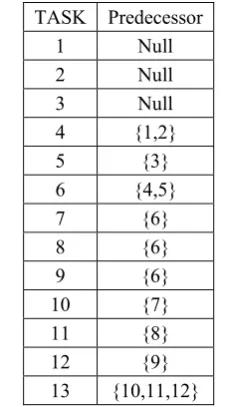
As an illustrative example, one of the problem from the dataset is taken to solve the problem. The task assignment problem having 13 tasks with their skills and 9 worker is used. The precedence graph is shown in fig. The processing time of worker are shown in table. Information is the processed form of data.
Fig 3.A precedence graph for the example
TASK Predecessor 1 Null 2 Null 3 Null 4 {1,2} 5 {3} 6 {4,5} 7 {6} 8 {6} 9 {6} 10 {7} 11 {8} 12 {9} 13 {10,11,12} TABLE 1:- Data set for the example
The chromosome is composed of two parts, the first part is the task priority vector and the second part is worker allocation vector shown in fig.4.
TASK 1 2 3 4 5 6 7 8 9 10 11 12 13
Worker 1 2 3 4 5 6 7 8 9
Fig 4. Chromosome Representation.
The Fig 5 :show the final assignment of the task to the worker by using simulated annealing and tabu search. The right side figure shows result of simulated annealing and the colorful bar show the task assign to worker. The left side figure shows the result of tabu search.
Fig.5:Result of Simulated annealing and Tabu Search.
Locus id 1 2 3 4
Worker 3 1 4 2
Locus id 1 2 3 4
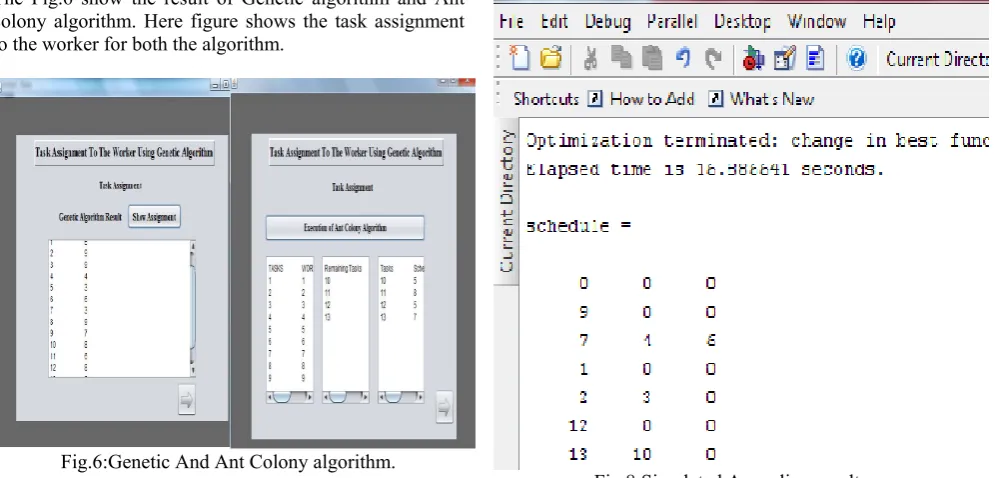
The Fig.6 show the result of Genetic algorithm and Ant colony algorithm. Here figure shows the task assignment to the worker for both the algorithm.
Fig.6:Genetic And Ant Colony algorithm.
Graph:
In this graph fig 6 , the comparison result is shown of genetic algorithm with the ant colony algorithm in form of time require to process the assignment problem.
Fig 7: Execution Time.
The result of task assignment to the worker by using simulated annealing is executed in MATLAB, the scheduling problem consist’s of finding an optimal assignment of task on a set of ach worker.Each worker perform their job independently,but ach can only perform one job at a time.The goal is to determine the shortest schedule for the given set of task’s.
Here in the fig:8 in simulated annealing the current schedule is not necessarily the best schedule found so far.We create a second custom plot function that will display to us the best schedule that has been discovered so
far.We can add a custom plot function to plot the length
of time that the tasks are taking on each worker. Each bar represents a worker, and the different colored piece of each bar is the different tasks.
Fig 8:Simulated Annealing result.
Tabu Search result:-
Local (neighborhood) searches take a potential solution to a problem and check its immediate neighbors (that is, solutions that are similar except for one or two minor details) in the hope of finding an improved solution. Local search methods have a tendency to become stuck in suboptimal regions or on plateaus where many solutions are equally fit. Here in the below figure it showing the result of task assigning to the worker as well as time require for assigning task to worker. The result is shown in Matlab.
Table.2:-Execution time for various algo.for assigning task.
9. CONCLUSION
The worker assignment problems are extended into more complicated if the number of task is more with compare to the worker. In order to solve the problem, a heuristic-mixed genetic algorithm is proposed. The algorithm creatively integrates a heuristic method during decoding procedure so that solving the worker assignment problems by GA becomes possible. By using the GA operator like: Selection mechanism, fitness function, crossover and mutation operator. In future, we can extend by assigning more than one worker to the task and the processing time is also varied. We can solve the problem by combining more evolutionary algorithmic technique. The simulated annealing and tabu search algo. Is also an evolutionary algo. The same problem is given to every algo. and the table.1 show the execution time for various algorithm.
REFERENCES
[1] E. Mokotoff, parallel machine scheduling problem:A survey, Asia-pacific journal of operational research, vol. 18, 2011, pp.193-242. [2] Ahmad Rabbani Motlagh,” An efficient Ant colony optimization
algorithm for multiobjective flow shop scheduling problem”, world academy of science, Engineering and Technology 75 2011. [3] Wenqiang Zhang, Mitsuo Gen and Lin Lin A multiobjetive genetic
algorithm for assembly line balancing problem with worker allocation, 2008 IEEE, 1-4244-2384-2.
[4] Mian Tahir Aftab, Muhammad umer and Riaz Ahmad jobs
scheduling and worker assignment problem to minimize make-spam using ant colony optimization metaheuristics, world Academy of science, Enginnering and Technology.
[5] Uwe Aickelin and Kathryn A. Dowsland “An Indirect Genetic Algorithm for a Nurse Scheduling problem” computers and operational research, 31(5), pp 761-778 ,2004
[6] Mustafa B. Akbukut, A. Egemen Yilmaz A modified genetic algorithm for the generalized assignment problems, journal of
electrical and electronic engineering vol.9 number 2 and year 2009(951-958).
[7] Praveena Akki and Poonguzhali.E "Resource Allocation and storage using Hungarian method in Mobile Cloud computing” in IJARSCCE volume 3,Issue 8,Aug 2013.
[8] Caijun Yang, jie Gao A multiobjective genetic algorithm for mixed model assembly line rebalancing problems..
[9] Na-Na Li, jian-Nan Zhang, Jun Hua gu solving expert assignment problem using improved genetic algorithm, sixth international conference on machine leaning and cybernetics,hong kong,19-22 august 2007.
[10] Xiongwen Qian and Qifu Fan solving multi manned assembly line balancing problem by a heuristic mixed genetic algorithm 2011 international conference on information technology, innovation management and industrial engineering.
[11] A.Ammar, S.Elkosantini, H.pierreval Resolution of multi-skilled worker assignment problem using simulation optimization: a case study.
[12] Yinping Zh, Hua Lin and Maotao lang Research on the problem for knowledge staff and task assignment.
[13] Dataset from Armin Scholl Data of assembly line balancing problem.
[14] P-C Hu “Minimizing total flow time for the worker assignment scheduling problem in the identified parallel machine technology, vol-25(9-10),2005,pp.1046-1052.
[15] L.A.Chaudary,”minimizing flow time for the worker assignment problem in identical parallel machine models using GA”,International journal of Advanced Manufacturing Technology,2009,DOI 10.1007/s00170-009-2323-1.
[16] Marco Dorigo and Krzysztof Socha,”An introduction to Ant colony optimization”,Technical report No.TR/IRIDIA/2006-010,April 2006,Last revision:April 2007.
[17] Ahmad Rabbani Motlagh,” An efficient Ant colony optimization algorithm for multiobjective flow shop scheduling problem”, world academy of science, Engineering and Technology 75 2011.
Task
Worker
Genetic Algo. Ant Colony Algo. Simulated Annealing Tabu Search
2 4 6 9 11 2 4 6 9 11 2 4 6 9 11 2 4 6 9 11
5 7.0 6.1 4.6 7.2 6.3 6.9 5.2 5.4 6.7 4.9 14.3 4.11 4.14 5.43 6.67 0.52 0.64 0.63 0.62 0.61
6 6.5 4.9 4.5 5.8 5.6 5.0 4.7 4.6 4.4 5.9 4.11 4.29 5.19 5.19 7.70 0.60 0.62 0.73 0.72 0.73
10 5.5 3.9 5.2 5.6 4.4 7.1 6.9 4.5 4.7 4.1 4.74 5.55 6.98 6.61 11.2 1.31 1.03 1.06 1.29 1.23
13 4.6 4.2 4.8 8.1 6.1 4.5 4.0 4.1 5.9 4.3 4.43 6.32 4.36 16.6 8.35 0.66 1.44 1.87 2.69 1.76
15 7.3 4.4 5.1 5.1 6.7 3.8 4.1 4.6 4.8 4.4 5.15 6.44 5.55 10.2 12.5 2.20 1.80 2.29 2.10 2.09
18 5.0 4.3 5.5 3.9 4.2 4.4 4.8 6.6 4.2 5.8 5.98 6.30 13.4 14.8 9.34 2.61 2.54 2.63 1.96 2.59
21 4.4 5.2 4.6 4.0 5.0 4.7 4.9 4.3 5.1 4.7 5.06 7.03 13.9 13.7 9.47 3.52 3.46 3.29 3.43 3.84
23 5.2 5.2 5.7 6.1 4.6 4.9 6.2 6.0 7.0 4.3 6.04 9.20 14.3 20.9 12.4 4.05 4.45 3.33 3.92 3.77