Encryption Scheme
?Avik Chakraborti1, Anupam Chattopadhyay2, Muhammad Hassan3, and Mridul Nandi1
1
Indian Statistical Institute, Kolkata, India [email protected],[email protected] 2
School of Computer Engineering, NTU, Singapore [email protected]
3
RWTH Aachen University, Germany [email protected]
Abstract. In this paper, we propose a new hardware friendly authen-ticated encryption (AE) schemeTriviAbased on (i) a stream cipher for generating keys for the ciphertext and the tag, and (ii) a pairwise in-dependent hash to compute the tag.We have adopted one of the ISO-standardized stream ciphers for lightweight cryptography, namely Triv-ium, to obtain our underlying stream cipher. This new stream cipher has a state that is a little larger than the state ofTriviumto accommodate a 128-bit secret key and IV.Our pairwise independent hash is also an adaptation of theEHC or “Encode-Hash-Combine” hash, that requires the optimum number of field multiplications and hence requires small hardware footprint. We have implemented the design in synthesizable RTL. Pre-layout synthesis, using 65 nm standard cell technology under typical operating conditions, reveals thatTriviAis able to achieve a high throughput of 91.2 Gbps for an area of 24.4 KGE. We prove that our construction has at least 128-bit security for privacy and 124-bit security of authenticity under the assumption that the underlying stream cipher produces a pseudorandom bit stream.
Keywords:Trivium, stream cipher, authenticated encryption, pairwise independent,EHC,TriviA.
1
Introduction
The emergence of Internet-of-Things (IoT) has made security an extremely im-portant design goal. A huge number of embedded devices are online and this online presence opens myriads of possibilities to a third party intruder to alter the communication between two devices. Hence, a critical information trans-fer requires a secure channel. Symmetric-key encryption provides privacy by securing the channel, whereas message authentication codes (MACs) are used to provide integrity and authenticity assurances. Using an appropriate, efficient
?This is the full version of the paper. The original version of the paper will appear in
combination of symmetric key encryption and MAC, also called authenticated encryption [10,25], one can achieve both privacy and authenticity. An interest in new efficient and secure solutions of authenticated encryption is manifested in the recently launched competition called CAESAR [3].
Authenticated encryption can be achieved using either a stream cipher or a block cipher or both. The general opinion seems to be that stream ciphers can be designed to offer high throughput/ area ratios, a desired performance metric for embedded devices.Trivium[16],Grain[23],Mickey[9] etc. are prominent exam-ples of implementation-friendly stream ciphers from the eSTREAM project [4]. Triviumhas been specified as an International Standard under ISO/IEC 29192-3 for the lightweight cryptography category [5].
Authenticated Encryption based on Stream Cipher. A method of
us-ing stream cipher for the construction of authenticated encryption scheme is de-scribed by Bernstein in [12]. The authenticated encryption schemeHELIX[19] and laterPHELIX [35] are designed based on a stream cipher. Both were later attacked [31, 36]. Grainhas been modified to Grain-128 [24] to support an in-tegrated authentication mechanism. To the best of our knowledge, in the ETSI specification [1], combining the stream cipher SNOW-3G [2] with polynomial hash, and later in [33] by Sarkar, a definitive study on constructions of authen-ticated encryptions using stream cipher and∆U hash have been made. Integrat-ing universal hash with other cryptographic primitives has also been studied by Bernstein [11].
Our Contribution. In this paper, we propose a new stream cipherTriviA-SC which is a modification of Trivium [16], a well-studied and efficient (both in terms of software and hardware) stream cipher. Moreover, our new stream cipher has a key and a initial value of 128 bits. We introduce non-linearity in the output stream which helps to resist some known approaches of finding the key for Trivium. We also study a ∆-Universal hash EHC [32], parametrized by a parameterd, which requires a minimum number of field multiplications and can be implemented with small hardware footprint. In the paper by Nandi [32], the
We also report the hardware performance ofTriviAon both FPGA and ASIC platforms and make a comparative study with other authenticated encryption schemes implemented in a similar platform. We have observed that, TriviA is very efficient in terms of throughput, cycles per byte and area-efficiency. For area-efficiency metricTriviAis at least 3.8 times better than the closest candidate Asconfrom our list.
2
Preliminaries
Notation. We represent a tuple (Xa,· · · , Xb) byX[a· · ·b], when theXi’s are bit strings, we also identify the tuple as the concatenationXak · · · kXb. For a set
S, letS+ =∪∞
i=1Si, S≤n =∪ni=1Si and S∗ =S+∪ {λ} where λ is the empty string. The usual choice ofS is{0,1}. For∀x=x1. . . xn ∈ {0,1}∗, denotenby |x|. The string with one followed bynzeroes is denoted by 10n. Let the number ofn-bit blocks in a Boolean string xbe denoted by`n
x=|x|/n.
Finite Field. LetF2n denote the finite field over{0,1}n, for a positive integer
n. In this paper, we consider the primitive polynomials [18,29]p32(x) =x32+
x22+x2+x+ 1 and p
64(x) = x64+x4+x3+x+ 1 to represent the fields
F232 and F264 respectively. We denote the corresponding primitive elements by
α and β which are binary representations of 2. The field addition or bit-wise addition is denoted as “xor”⊕. We note that multiplication by powers ofα,βare much simpler than multiplication between two arbitrary elements. For example, multiplication between an arbitrary elementa:= (a0, . . . , a31)∈ {0,1}32 andα isa·α= (b0, . . . , b31) whereb0=a31,b1=a0⊕a31,b2=a1⊕a31,b22=a21⊕a31 and for all other i, bi = ai−1. Similarly, one can express the multiplication of other powers of primitive elements by some simple linear combinations of the bits ai’s. This representation is useful when we implement power of α and β
multipliers in hardware.
2.1 Authenticated Encryption and Its Security Definitions
An authenticated encryption FK is an integrated scheme that provides both privacy of a plaintext M ∈ {0,1}∗ and authenticity or data integrity of the plaintext M as well as the associate data D ∈ {0,1}∗. Thus, on the input of a public variable nonce N (it can be considered as an arbitrary number distinct for every encryption), associate data D ∈ {0,1}∗ and a plaintextM ∈ {0,1}∗,
FK produces a tagged-ciphertext (C, T) where |C| = |M| and |T| = t (tag-size, usually 128). Its inverse or decryption algorithm FK−1 returns ⊥ for all those (N, D, C, T) for which no suchM exists, otherwise it returnsM for which (C, T) is the tagged-ciphertext.
Privacy. A distinguishing advantage of A against two oracles O1 and O2 is defined as∆A(O1;O2) =|Pr[AO1 = 1]−Pr[AO2= 1]|. Given a nonce-respecting
PRF-advantage ofA againstF asAdvprfF (A) :=∆A(FK; $) where $ returns a random string of appropriate size. The PRF-advantage ofF is defined as
AdvprfF (q, σ, t) = max
A Adv
prf F (A),
where the maximum is taken over all adversaries running in time tand making
qencryption queries with total bit-size of all responses at mostσ.
Authenticity. We say that an adversaryAforgesan authenticated encryption
F ifA outputs a fresh (not obtained before through an F-query) (N, D, C, T) whereFK−1(N, D, C, T)6=⊥. Note that in the forging attemptN can repeat. In general, a forger can make qf attempts to forge. We denote the forging advan-tages as
AdvauthF (A) :=Pr[AF forges], Advauth
F (q, qf, σ, t) = max
A Adv
auth F (A),
where the maximum is taken over all adversaries running in time t making q
encryption queries andqf forging attempts with total bit-size of all responses at mostσ.
2.2 Examples of Universal Hash Functions
A keyed hash function h(K;·) over D is called an -∆U (universal) hash functionif for allδ, theδ-differential probability
Pr[h(K;x)−h(K;x0) =δ]≤for allx6=x0∈D .
In this paper, we conventionally assume the hash keys are uniformly chosen from the key-space. A hash function h is called -universal (or -U) if the 0-differential probability (or collision probability) is at most for all x6= x0. We call h -balanced if for alla, b,Pr[h(K;a) =b]≤.
Examples. The Multi-linear hashML(k1;x1) :=k1·x1and Pseudo-dot-product (or PDP) hash PDP(k;x) := (x1⊕k1)·(x2⊕k2), with k = k1||k2 and x =
x1||x2are two popular examples of 2−32-∆U hash wherex1, x2, k1, k2∈F232 and
k, x ∈F264. One can check that the ∆U property of a hash using independent
keys is closed under summation. This is a useful technique to define a hash for larger domain, e.g. we can add the invidual PDP values corresponding to the message and key blocks to obtain a ∆U hashLmi=1(k2i−1⊕x2i−1)·(k2i⊕x2i) forx= (x1,· · · , x2m) andk= (k1,· · ·k2m).
3
EHC
Hash
element ofF2n is defined below. Forn= 32 and 64 the matrices are denoted by
Vα(d)and V( d)
β respectively.
Vγ(d)=
1 · · · 1 1 1
γ`−1 · · · γ2 γ 1
γ2(`−1) · · · γ4 γ2 1 ..
. · · · ... ... ...
γ(`−1)(d−1)· · ·γ2(d−1)γd−11
.
We have observed that, whenever 1, γ, . . . , γ`−1 are distinct, any s ≤ d columns of V are linearly independent. We next describe theVMult algorithm for multiplying Vα(d) to a vector h = (h1, . . . , h`) ∈ F`32 in an online manner
using Horner’s rulewithout requiringany additional memory.
AlgorithmVMultα,d
Input:x:= (x1, x2, ..., x`)∈F`232
Output:y:= (y1, y2, . . . , yd)∈Fd232 such thaty=V
(d)
α ·x
1 y1=· · ·=yd= 032
2 fori= 1 to`
3 forj= 1 tod: yj←αj−1·yj⊕xi ; \∗VHornermodule∗\
4 return(y1, . . . yd);
Algorithm 1:VMultα,dmultiplies an`-dimensional column vectorx= (x1, . . . , x`) by
a Vandermonde matrixVα(d)to output ad-dimensional vectory:=Vα(d)·x. Similarly we
defineVMultβ,dfor 64-bit field elements. Note that,αandβare the primitive elements ofF232 andF264, respectively described in Sect. 2. When we implement this algorithm
in hardware we only need to implementVHorner.
3.1 ECCode
We next describe the efficient instantiation of an error correcting codeECCoded with systematic form over{0,1}64.
ECCoded(x1, . . . , x`) = (x1, . . . , x`, x`+1, . . . , x`+d−1), (1)
where (x`+1, . . . , x`+d−1) =VMultβ,(d−1)(x1, . . . , x`).
Example 1. Let (x1, x2, x3) ∈ ({0,1}64)3 be the input toECCode4. The out-put is ECCode4(x1, x2, x3) = (x1, x2, x3, x4, x5, x6) where, x4 = x1+x2+x3,
In [32], it has been shown that for d = 4, the above code has minimum distance 4. We next extend their result ford= 5 and show that it has minimum distance 5 for all`≤230. The result is described in Proposition 1 below.
Proposition 1. ECCode5 has minimum distance 5 over {0,1}64` for any fixed
`≤230.
Proof. ECCode5 is a linear code with systematic form in which the expansion is determined by the matrixV :=Vβ. So it suffices to show thatVβ is an MDS matrix, i.e., all square submatrices are non-singular. Clearly, any square subma-trix of size 1 or 4 is a Vandermonde masubma-trix and hence non-singular. Each of the submatrices of size 2 can be converted to a Vandermonde matrix by elementary column operations (multiplying the columns with non-zero constants).
We now consider the submatrices of size 3. If we consider the submatrices corresponding to the 1st,2ndand the 3rdrow or the 2nd,3rdand the 4throw, then these submatrices can be transformed to a Vandermonde matrix by elementary column operations (by non-zero constant multiplications). If we consider the submatrices corresponding to the 1st,2ndand the 4throw or the 1st,3rd and the 4throw then the matrices have the form
β1i β1j β1k
β3iβ3j β3k
or
β12iβ12j β12k
β3iβ3j β3k
.
One can check that the submatrix corresponding to the 1st,2nd and the 4th row is non-singular if and only if 1 +β(i−j)+β(k−j) 6= 0, by computing the determinant. We have experimentally verified that the above condition holds for alli < j < k≤230. This completes the proof. ut
3.2 EHC Hash
EHChash [32] is a 2−128-∆U hash which requires fewer multiplications than the Toeplitz hash [26] to process a message block. For a fixed length ` ≤230, the definition of EHC(d,`) is given in the Algorithm 2 for all d≤5.PDPhash used in this construction is described in Sect. 2.
The variable length hashEHC(d) defined over all messages of sizes 64`, 1≤
`≤230, is computed as follows:
EHC(d)((K,(V1, V2));x) =EHC(d,`)(K;x)⊕b1·V1⊕b2·V2,
where x∈ s64`,K ∈ {0,1}64(`+d−1), V
1, V2 ∈ {0,1}32d and (b1, b2)∈ {0,1}2 is the binary representation of ` mod 4.
Example 1 (continued). We have already seen how ECCode4(x1, x2, x3) = (x1, x2, x3, x4, x5, x6) has been defined. Let k = (k1, . . . , k6) ∈ ({0,1}64)6 be the corresponding key. For 1 ≤ i ≤ 6, denote, xi = xi1||xi2 and ki = ki1||ki2 with xi1, xi2, ki1, ki2 ∈ {0,1}32. For 1 ≤ i ≤ 6, denote gi = PDP(xi, ki) = (xi1+ki1)(xi2+ki2). Thus,EHC(4,3)(k;x1, x2, x3) = (o1, o2, o3, o4) where,
AlgorithmEHC(d,`)
Input: (k1, . . . , k`+d−1)∈ {0,1}64(`+d−1), x∈ {0,1}64`
1 (x1, . . . , x`+d−1)←ECCoded(x);
2 fori= 1to`+d−1 : gi=PDP(ki, xi);
3 returnVMultα,d(g1, g2, . . . , g`+d−1);
Algorithm 2:EHC(d,`) [32] hash for a fixed length message.
3.3 Discussions
ECCode4 and ECCode5 are MDS codes for ` ≤ 232 and ` ≤ 230 respectively (see [32] and Proposition 1). To incorporate arbitrary length messages, we define ECCode∗d as follows. It first parses x∈F+264 as (X1, . . . , Xm) such that allXi’s,
possibly excluding the last one, are 230-block elements. We call theseXi’schunk. The last one is possibly an incomplete chunk. Next, applyECCodedto all of these chunks individually. More formally,
ECCode∗d(x) = (ECCoded(X1), . . . ,ECCoded(Xm−1), ECCoded(Xm)). (2)
We next extend the definition of EHC(d,`), denoted as xEHC(d,`), which works the same as EHC(d,`) except it runs ECCode∗d instead of ECCoded (line 1 of Algorithm 2), i.e., the first step is executed as (x1, . . . , x`+d−1)←ECCode∗d(x).
Table 1.# 32-bit field multiplications needed forEHC-Hash,Toeplitz-Hashand Poly-Hash(withd= 4) to process a 64`-bit message,`≤230. In case of Poly-Hashwe need to apply 40-bit field multiplications for a 160-bit hash.
Tag Size d # Multiplications EHCHash
# Multiplications
Toeplitz-PDPHash
# Multiplications
Poly-Hash
128 4 `+ 3 4` 4.5`
160 5 `+ 4 5` 4.5`[40]
a pairwise independent hash can be achieved by masking one more independent key to the output of a∆-Universal hash. However, as we generate keys on the fly, our hash becomes pairwise independent and this further saves more storage. We provide a detailed discussion of hardware implementation along with the block diagram in Sect. 6.
4
TriviA
Authenticated Encryption
We first propose a stream cipher TriviA-SC4 which has a similar design as the popular stream cipherTrivium[16]. Triviumis well studied and efficient both in terms of hardware and software. It uses an 80-bit secret key, an 80-bit nonce and a 288-bit internal state and provides 80-bit security. We aim to provide higher security while maintaining the simplicity and without increasing the state size much. In particular, we have made the following modifications:
1. We keep the size of stateS to be 384 bits and increase the size of keyKand nonceN to 128 bits.
2. We introduce a non-linear effect in the key stream computation.
z
A66
A1
A75
A102
B1
B
69
B96
B
66
C1
C66
C120
L
L
L
J
J L L
L
J L
L
L
L
J
1
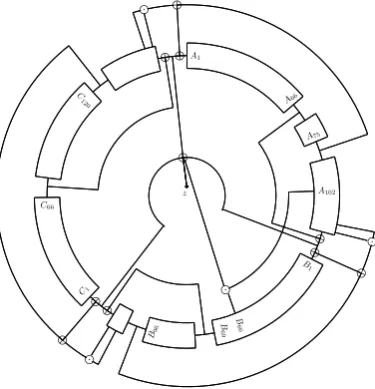
Fig. 4.1.TriviA-SCStream Cipher
ModulesofTriviA-SC: The stateS:= (S1, S2, . . . , S384)∈ {0,1}384 is represented byA= (S1, . . . , S132),B= (S133, . . . , S237) andC= (S238, . . . , S384).
Load(K, N)/∗Key and IV Loading∗/
1 A=Kk14
, B= 1105, C=Nk119 ;
Update(S)/∗Update a Single Round∗/
2 t1←A66⊕A132⊕(A130∧A131)⊕B96; 3 t2←B69⊕B105⊕(B103∧B104)⊕C120; 4 t3←C66⊕C147⊕(C145∧C146)⊕A75; 5 (A1, A2, A3, ..., A132)←(t3, A1, A2, ..., A131); 6 (B1, B2, B3, ..., B105)←(t1, B1, B2, ..., B104); 7 (C1, C2, C3, ..., C147)←(t2, C1, C2, ..., C146);
Algorithm 3:Modules ofTriviA-SC: Note that, the update and key-extract module has parallelism and so we can runKeyExtandUpdate64 times in one clock-cycle which would be denoted asKeyExt64andUpdate64described in Algorithm 4.
Algorithm 3 describes all the basic modules used for the stream cipher TriviA-SC (see Fig. 4.1). A proper integration of these modules need to be defined to obtain a stream cipher or an authenticated encryption. For example, when we want to use it in stream cipher mode, we first run Load(K, IV) for an initial value IV, then Update for some reasonable rounds (to make the state random) and finally, bothKeyExtandUpdateto obtain the key stream. However, in case of authenticated encryption we additionally need to process the associate data and need to produce a tag.
Trivia-SCis also parallelizable up to 64 bits, i.e., the stream cipher can pro-duce upto 64 output bits at a single clock cycle (described inKeyExt64). Simi-larly, the 64 round updates of Trivia-SCcan also be computed in a single clock cycle (described inUpdate64) due to the parallelism.KeyExt64andUpdate64are described in Algorithm 4.
4.1 Specification of TriviA
Algorithm 5 describes our authenticated encryption algorithmTriviA.
Sarkar in [33] has proposed several generic methods of combining∆U hash and a stream cipherSCK. Formally, a stream cipher supporting ann-bit initial value IV is a keyed functionSCK:{0,1}n×N→ {0,1}+such thatSCK(N;`)∈ {0,1}`. Whenever understood, we simply skip ` as an input for the sake of notational simplicity. We mention a scheme which is close to our design paradigm and state its security guarantee (in a revised and simplified form appropriate to our notation).
Theorem[33]SupposeHτ is an-∆Un-bit hash function andSCK is a stream
cipher. Let AEbe an authenticated encryption scheme defined as
KeyExt64/∗Extract 64 Bit Key Stream∗/
1 t=A[3···66]⊕A[69···132]⊕B[6···69]⊕B[42···105]⊕C[3···66]⊕C[84···147]⊕
A[39···102]∧B[3···66] ; 2 Outputt;
Update64/∗Update 64 Rounds∗/
3 t1←A[3···66]⊕A[69···132]⊕(A[67···130]∧A[68···131])⊕B[33···96] ; 4 t2←B[6···69]⊕B[42···105]⊕(B[40···103]∧B[41···104])⊕C[57···120]; 5 t3←C[3···66]⊕C[84···147]⊕(C[82···145]∧C[83···146])⊕A[12···75] ; 6 (A1, A2, A3, ..., A132)←(t3, A1, A2, ..., A68) ;
7 (B1, B2, B3, ..., B105)←(t1, B1, B2, ..., B41) ; 8 (C1, C2, C3, ..., C147)←(t2, C1, C2, ..., A83) ;
Algorithm 4: 64-bit modules ofTrivia-SC. Here∧denotes “bitwise-and” of two 64-bit variables.
AlgorithmTriviA
Input: (K,(N, D, M))∈ {0,1}128×({0
,1}128× {0
,1}∗× {0
,1}∗
),`M, `D≤230.
1 Processing N:Load(K, N), Update6418 times; 2 Processing D: (z, SK)←KeyGen(`D+ 4) ;
3 T0=EHC(5,`D)(SK ;D)⊕(z
`D+2kz`D+3kz`D+4[1..32]) ;
4 S[1..160] =S[1..160]⊕T0,Update6418 times; 5 Processing M: (z, SK)←KeyGen(`M+ 3);
6 if64divides|M|thenV =z`Mkz`M+2;
7 elseV =z`M+1kz`M+3;
8 C=M⊕z,T =EHC(4,`M)(SK;M)⊕V ;
9 return(C, T) ;
ModuleKeyGen(`):
10 fori= 1to`: zi=KeyExt64,SKi=A[1..64],Update64;
11 return(z1k · · ·z`, SK1k · · ·SK`) ;
Algorithm 5:TriviAAuthenticated Encryption Scheme: Given a binary stringx, we define x:=xk10d where dis the smallest non-negative number such that|x|+d+ 1
is a multiple of 64 and we write`x =|x|/64. The nonceN is chosen unique for each
where(R, Z) =SCK(Hτ(N, A), |M|+n). Then, we have
1. AdvprfAE(q, σ, t) ≤ AdvprfSC(q, σ, t0) +q2and
2. AdvauthAE (q, qf, σ, t) ≤ AdvSCprf(q+ 1, σ, t0) + (1 +q2).
Wheret0≈t+t
H andtH is the total time required for hashing all queries.
How Our Construction Differs from AEK,τ.The above construction re-quires two keys K and τ. In our construction, we generate the key τ from the stream cipher and hence we require only one keyK. As the stream cipher gen-erates run time output bit stream, we can apply those universal hash functions requiring variable length keys, which are more efficient than those hash func-tions based on a single small key. For example,Poly-Hash [14,15,34] is not as hardware efficient asEHCand provides a weaker security bound.
4.2 Discussions
Authenticated Encryption for larger message/associate data. We can further extendTriviAfor computing the intermediate data and the tag for arbi-trary length message and associated data. A brief description of the extended version of TriviA is given as follows. The extended algorithm of TriviAfor han-dling larger messages is functionally almost the same as TriviA, except that it usesxEHC(d,`)to compute the intermediate data (line 3 of Algorithm 5) and the tag, and theKeyGen algorithm will generate keystream according to the length of the codeword computed byECCode∗d. The algorithm also selects the part of the keyz that appears in the same clock cycles with the message blocks so that we do not need to hold the key. This part of z is xored with the message to produce the ciphertext as before.
Nonce Misuse Scenario. We generalize theEHChash to incorporate 160 bits hash for processing associate data. This would allow some room for repetition of the nonce (but no repetition of nonce, associated data pair) without degrading the security (see the privacy and authenticity bound forTriviAin Sect. 5).
5
Security Analysis
5.1 Security Against Known Attacks
Cube-Attack and Polynomial Density: The Cube Attack [17] is the best known algebraic attack on reduced round versions of Trivium [16]. Note that the output bits from the stream cipher can be described by a polynomial over the key and the nonce bits. The cube attack tries to analyze the polynomial
P(k1,· · ·, kn;iv1,· · ·, ivp) corresponding to the first output bit, wherek1,· · · , kn are the secret key bits andiv1,· · · , ivpare the public nonce bits. Given a subset
S = {ivv1,· · ·, ivvk} of the set of all public nonce bits, P can be written as
P =ivv1· · ·ivvkPS+PR, where no monomial ofPR is divisible byivv1· · ·ivvk.
Table 2.The estimation of monomial densities of TriviA-SCwith 1152, 960, 896 and 832 Rounds.
Monomial Size 25 26 27 28 29 1152 0.49 0.49 0.5 0.52 0.4 960 0.5 0.5 0.5 0.51 0.36 896 0.5 0.49 0.5 0.47 0.5 832 0.43 0.36 0.29 0.14 0.03
PSis linear. TheTriviA-SCwith the recommended 1152-rounds initialization has no maxterm of size less than or equal to 29. Moreover, for the 896 and 832-round initialization version we have not found any maxterm of size 29 or less. But for the 768-round initialization version we have found some linear superpoly with cube size 20. This justifies our recommendation of the 1152-round initialization forTriviA-SC. We have also applied the Moebious Transformtechnique described by Fouque et al. [20] to estimate the polynomial density of the output boolean function. We restrict polynomial to 30IV variables and the density of the mono-mials of degree less than 30 in the restricted polynomial has been calculated. The result is given in Table 2. For a random Boolean function, we expect 50% den-sity. The statistical tests on TriviA-SC have been performed by observing the output bit stream using the NIST Test Suite [6] and no weeknesses were found. We have also performed the same tests on a version ofTriviA-SCwhere the key is a random 384-bit string and no weaknesses were found.
Resistance against guess-then-find attack [27]: The attack presented by Maximov et al. [27] works in two phases. The first phase guesses some internal state and makes linear approximations of some of the nonlinear state updation. This would help to produce a set of linear equations (and also several second degree equations) on the unguessed state bit using the observed output stream. In the second phase we simply solve all state bits provided we have sufficient number of equations. This idea is applicable for both reduced round versions of TriviumandTrivia-SC.
One possible approach of the first phase for the Trivium is an exhaustive guess on one-third of the state (96 bits with the indices that are a multiple of 3 stored in a set τ0(t) out of 288 bits). As the output bits are linear in the state bits, it is sufficient to guess 72 state bits and the remaining 32 state bits can be recovered easily. This actually happens, as indices of the bits in the output polynomial are multiple of 3 as well as the lifetime of a state bit in the internal state is at least 66 rounds before it is mixed with other bits. Using this guesses, we can obtainn1= 100 linear equations andn2= 61, 2-degree equations on the remaining internal state bits by observing the output stream. So the complexity for the second phase, denoted c, would be costly as we do not have sufficient linear equations.
several other linear equations on the state bits in τ0(t). The complexity of the first phase for this version of the attack is 283.5 and it forms n
1 = 192 linear equations. Thus, the complexity in the second phase would be small.
UnlikeTrivium, TriviA-SC has a nonlinear function in the output stream so to obtainn1=rlinear equations one has to approximaternonlinear equations (“AND” gate). In fact, as long as r ≤96, the indices involved in these linear approximations are completely disjoint. Thus, the probability that all of these linear approximations hold is (3/4)r. Now if we follow a similar approach men-tioned above, we first make a guess of one-third of the internal state (128 bits out of 384). However, one can simply guess 106 state bits and the remaining 22 bits can be recovered from the output stream. As the output is nonlinear, we have to make a linear approximation for 22 round outputs. So the complexity of the first phase would be about 2128−22×(4/3)22. Now if we want to obtainn
1= 32 linear equations for the second phase (which is in fact much less than sufficient linear equations to recover all unguessed state bits), the total complexity for the first phase becomes 2106×(4/3)22×(4/3)32>2128. So we can not perform the above guess-then-find attack strategy in our stream cipher.
5.2 Privacy of TriviA
An adversary is called nonce-respecting if it makes encryption queries with all distinct nonce. A relaxed nonce-respecting adversary makes queries such that the pairs (N, D) are distinct over allq encryption queries. In the following two theorems we assume that the stream cipherTrivia-SCgenerates a pseudorandom bit stream.
Theorem 1. LetAbe a relaxed nonce-respecting adversary which makes at most
qencryption queries. Moreover we assume that Acan make at most232 queries
with a same nonce. Then, AdvprivTriviA(A) ≤ 2129q .
Proof. Suppose A makes q queries (N1, D1, M1), . . . ,(Nq, Dq, Mq) such that (Ni, Di)’s are distinct and letZi and (Ci, Ti) be the respective key stream (in-cluding the state bit extraction) and final responses. Moreover let T0
i denote the intermediate tag obtained from the associated data which are inserted in the state after processing associated data. Let N ={N : ∃i N =Ni} denote the set of all distinct nonces. We denote m=|N |. For each N ∈ N, we write IN ={j :Nj =N} and|IN|=qN. Note that,qN ≤232 for all nonces N and
P
N∈NqN =q. By our assumption on the stream cipher output, the key stream
Zi’s would be independently distributed whenever we have distinct nonces. Thus, we define an event coll: there existsi 6=j such that Ni =Nj and Ti0 = Tj0. If thecoll event does not hold, then by using the ideal assumption of the stream cipher, all key streams Zi’s (even with same nonce) are independent and uni-formly distributed. As (Ci, Ti)’s are injective functions of the key-streamZi, the distribution of (Ci, Ti)’s are independent and uniform. So the privacy advantage is bounded by the probability of the eventcoll. In Proposition 2 below, we show that the collision probability is bounded above by q
2129 and hence the result
Proposition 2. Pr[coll]≤ 2129q .
Proof. Fix a nonce N ∈ N. The probability that there exists i 6= j with
Ni = Nj = N such that Ti0 = Tj0 is bounded by qN
2
×2−160. This actually holds as this collision implies thatEHC5(Di) =EHC5(Dj) andEHC5is a 2−160
-∆U hash (the underlying code ECCode5 is MDS as shown in Proposition 1). Summing up the probability for all choices of nonce N, we have
P r[coll] = X N∈N
q2
N/2161≤232
X
N∈N
qN/2160=q/2129.
5.3 Authenticity of TriviA
Now we show the authenticity of TriviA.
Theorem 2. LetAbe a relaxed nonce-respecting adversary which makes at most
q queries such that nonce can repeat up to 232 times. In addition, A is making
at mostqf forging attempt. If the stream cipherTrivia-SCis perfectly secure then
AdvauthTriviA(A) ≤ q 2129 +
qf 2124.
Proof. As before, let theq queries be (Di, Ni, Mi) and the corresponding re-sponses be (Ci, Ti) with intermediate tagsTi0, 1≤i≤q. We also denote the key stream for theith query beZi. By applying the privacy bound, which isq/2129, we may assume that the all q key streams Z1, . . . , Zq are uniformly and ran-domly distributed. Now we consider two cases depending on a forging attempt (N∗, D∗, C∗, T∗).
Case A. The adversary makes a forging attempt (N∗, D∗, C∗, T∗) with a fresh (N∗, D∗). In this case, letI ={i:N
i=N∗}. By the restriction,|I| ≤232. Note that for allj 6∈ I, theZj’s are independent fromZ∗the key-stream for the forging attempt. For alli∈ I, theZi’s also would be independent fromZ∗ provide that the intermediate tag T0
i’s do not collide with the intermediate tag T∗ for the forging attempt. This can happen with probability at most 232/2160 = 2−128. WheneverZ∗behaves like a random string, the forging probability will be 2−128 (as the tag size is 128). So the total forging probability, in this case, will be at most 2−128+ 2−128= 2−127.
Case B. Suppose the adversary makes a forging attempt with (N∗, D∗) = (Ni, Di) for some i. Note that one of the key-streams Zi and Z∗ would be a prefix of the other (depending on the length of the ciphertext). Note that for all otherZj’s,j 6=iwould be independent ofZ∗and so we can ignore the responses of the other queries. So the forging probability is the same as
p:=Pr[(Ni, Di, C∗, T∗) is valid |(Ci, Ti) is response of (Ni, Di, Mi)]. (3)
We postpone the proof of the claim. Assuming this claim, any forging at-tempt is successful with probability at most 2−124 (as the Case-A has lower success probability). Since A makes at most qf attempts and adding the pri-vacy advantage the forging probability would be bounded by 2129q +
qf
2124. This
completes the proof.
Proof of the Claim. LetM∗be the message corresponding toC∗. We prove it by considering different cases based on `:=`Mi and`
∗ :=`
M∗. For simplicity, we assume that both Mi and M∗ are complete block messages. The proof for incomplete message blocks is similar. We also writeZ into a pair (SK, z) where
SK denotes the state key andz denotes the output stream. Note that, thez -values can be leaked through the ciphertext and some of thez-values may be also used to compute the tag. We mainly need to handle different cases depending on how thez-values are leaked.
Case 1: `∗ = ` In this case, the conditional forging event can simply be written asEHC4,`(SK;Mi)⊕EHC4,`(SK∗;M∗) =δ:=T
i⊕T∗. As,`∗=`, thus
SK=SK∗. By using the known fact thatEHCis a 2−128-∆U hash [32] we have
p≤2−128.
For the case 2 and 3, we denote, EHC4,`(z;Mi) = (H1, H2) and similarly EHC4,`∗(z∗;M∗) = (H∗
1, H2∗) whereHi andHi∗s are 64-bit strings. We similarly parseT andT∗ as (T
1, T2) and (T1∗, T2∗).
Case 2:`∗ =`+ 1 In this case, all of the variable keysz are distinct and are not leaked through the ciphertext Ci. So the forging probability is equivalently written as
p=Pr[H1∗⊕z`+1=T1∗, H2∗⊕z`+3=T2∗ |H1⊕z`=T1, H2⊕z`+2=T2].
Thus, by using the entropy ofz`, z`+1, z`+2 andz`+3, we get the bound.
Case 3: `∗ > `+ 1 Except the case `∗ = `+ 2, this case is same as before as all variable keysz are distinct and are not leaked through the ciphertextCi. When`∗=`+ 2 we have three variable keysz
`, z`+2andz`+4which are masked to define the tags. So the forging probability is equivalently written as
p=Pr[H1∗⊕z`+2=T1∗, H2∗⊕z`+4=T2∗ |H1⊕z`=T1, H2⊕z`+2=T2].
The independence of thez values implies,
p=Pr[H2∗⊕z`+4=T2∗]×Pr[H1∗⊕H2=T1∗⊕T2:=δ]
= 2−64×Pr[H1∗⊕H2=T1∗⊕T2:=δ].
Now the effect of the state keys SK`+4, SK`+5 is not present in H1∗ but they influence H2. By using 2−31-balancedness of the pseudo-dot-product hash, we conclude thatPr[H∗
Case 4: `∗ < `− 2 In this case, the variable keys are different for both computations. Since one set of variable keys are leaked through the ciphertext and the other has full entropy we use the fact thatEHCis 2−124-balanced. Using this one can show thatp≤2−124.
Case 5: `∗ = `− 1 Again, all four variable keys are distinct and one of them is leaked. So we can apply the argument (using balancedness of one 64-bit equation) to show thatp≤2−126.
Case 6: `∗= `−2 Again, by simplifying the forging event with the notation described in case 3 we have
p=Pr[H1∗=z`−2⊕T1∗, H2∗⊕z`=T2∗ |H1⊕z`=T1, H2⊕z`+2=T2].
Here note that, unlike in case 2, the value of z`−2 is leaked in the ciphertext. The above probability is the same asPr[H∗
1 =c1, H2∗⊕H1=c2] for some 64-bit constantsc1 andc2. Based on the balanced property of H1∗ (based on the state keySK1, . . . , SK`+1) and the balanced property ofH1 (based on the state key
SK`+2, SK`+3) we can conclude thatp≤2−124.
By considering all the above cases, we prove thatp≤2−124which concludes
the proof of the claim. ut
6
Hardware Implementation of
TriviA-ck
6.1 Cycles Per Byte (cpb) Analysis
TheTriviAdesign targets high speed implementation and requires 47 clock cycles to authenticate and encrypt one message block of 64 bits. 18 cycles are required for the initialization phase where the state register is updated in every cycle along with Z, the associated data AD is loaded and processed in 1 cycle, and during the checksum phase instead of loading the block, the checksum computed in an earlier stage is used as the input. The overall computation requires 4 cycles and an additional cycle is required to update the tag and the state register during the processing ofAD. For message (msg) encryption, again, the same number of cycles are required butADis replaced bymsg. The rest of the process is the same with one minor difference, now the checksum is calculated only 3 times instead of 4 before the tag update. Analytically, the cycle count can be represented in the following manner
cycle count= (init count∗2) +adlen
8 +
msglen
8 + 4 + 1 + 3 + 1, (4) where init count is 18 in TriviA, adlen and msglen are in bytes instead of bits. The correspondingcpb can be calculated using the following formula
cpb=cycle count
Pipelining: So far, our analysis is done based on a design without any pipeline. Pipelining is a well-known technique to improve the throughput for a digital design. A three-stage pipelined design is employed forTriviA, which is explained later in this section. Pipelining affects latency adversely. In our case, the cycle count to authenticate and encrypt one message block of 64 bits increases to 49. Two additional clock cycles are required to flush the pipeline registers. The rest of the data processing flow remains the same. Similarly the cycle count for a pipelined design can be represented in the following manner.
cycle count= (init count∗2) +adlen
8 +
msglen
8 + 9 + (pipe stages−1), (6)
where pipe stages is equal to 3 in our case. As the number of pipe stages in-creases, the corresponding cycle count will increase accordingly. Thecpb can be calculated using Eq. (5).
6.2 Hardware Architectures
We have implemented two different architectures ofTriviA: a base implementa-tion without any pipelining, and a three-stage pipelined implementaimplementa-tion. The implementation is performed in a modular manner, which offers excellent scal-ability. Due to the similarity in the operations for processing AD, and msg, the same hardware modules are used to process both kinds of data. A single bit switch is used to distinguish between the type of input data. Following the different operations in TriviA algorithm, the TriviA architecture consists of the following modules:
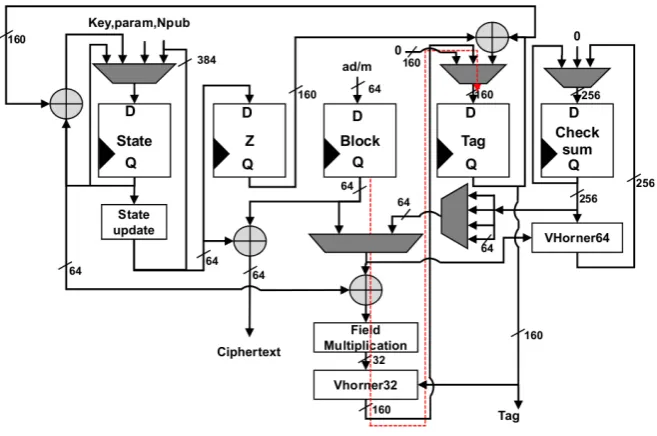
1. State Registers: The state registers are used to store the intermediate states after each iteration. The state registers are used for 384-bit State Update, 256-bitZ register, 64-bitblock, 160-bittag, and 256-bitchecksum.
2. State Update: TheState Updatemodule is nothing but a combination of Up-dated64,KeyExt64which are used to update the current state of the stream cipher and generate key-stream. This module is used in each iteration during initialization, encryption, and finalization. It takes 128-bitkey, 128-bit nonce (which is further divided into two 64-bit parts, namelypubandparam) and 384-bit stream cipher state register as inputs and updates the stream cipher state.
5. VHorner64: This module is used for Horner’s multiplication for the 64-bit Vandermonde Matrix Multiplication while computing the checksum for the error correcting code. It takes an input block of 64-bits, and the current checksum value of 256 bits as input. It generates a 256-bit checksum value as output. This modules executes its operations on 256 bits of the checksum when working onAD, otherwise it uses only 192 bits.
Fig. 6.1.TriviAbasic hardware implementation
Base Implementation: We start with a base implementation of TriviA that exploits the parallelism inherent in the algorithm and processes 64 bits in each cycle, as shown in Fig. 6.1. The critical path is shown using a dotted line. Prior to initialization, the state register is loaded with Key,param, puband 1 in the remaining bits on reset. Once the state registers are initialized, the initialization process starts where state register is updated in each cycle with State Update operation. After the initialization process, 8 bytes of AD are fetched to the
block register, which feeds the Field Multiplication module after performing an
exclusive OR between the 64-bit block and the 64-bitstate register. In parallel, an exclusive OR is also performed between the 64-bit block and the 64-bit Z
The checksum is updated in theVHorner64module which is also executed in parallel. When theAD is finished, the checksum is calculated hence we require a 4×1 64-bit MUX which fetches 64 bits of the checksum at a time to update the tag. Since the checksum is calculated at the end, we can share resources using a 2×1 64-bit MUX. The first input of the MUX comes from theblock register, while the second input comes in chunks of 64 bits from the checksum. All these operations are parallel, hence one round can be executed in a single cycle. At the end, after processing the checksum, thetag and the state register are updated in single cycle. We require a 4×1 MUX at the input ofstate register and a 3×1 MUX at the input of thetag register. Thestate register takes input from four sources, initialization values on reset, State Update after each cycle, the result of an exclusive OR between thestate register and thetag, and a feedback path. Similarly, tag takes values from three sources, initialization on reset, output of VHorner32, andZ exclusive ORed withtag.
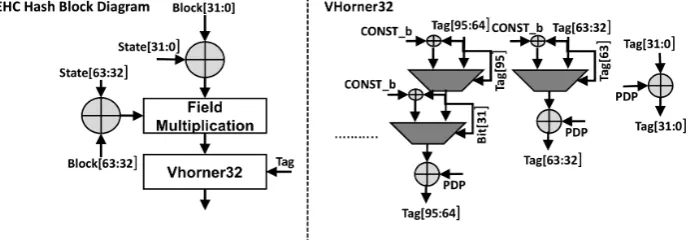
Fig. 6.2.EHC Block Diagram
The control of the complete design is implemented using a finite state machine (FSM), not shown in the schematic for the sake of simplicity. The FSM consists of 6 states, starting with an idle state followed by initialization. After initialization, FSM enters the processing state and stays there until all the data has been processed. Then it jumps to checksum processing, followed by tag update, and pipeline flush. A 3-bit register is required to store the state of the FSM.
The combinational logic can be easily reduced for lowering the area further by first, sharing computing resources and second, performing computation on smaller bit-widths. Consequently, the throughput will decrease leading to an area-delay trade-off. In the following, we implement a pipelined architecture to boost the throughput.
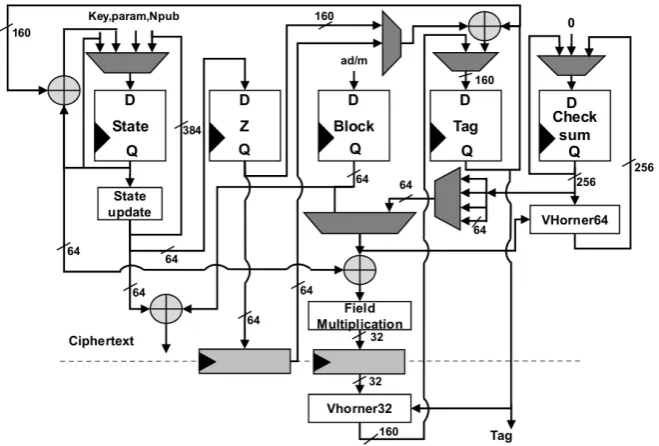
series. This long chain of MUXes reduces the clock speed of the whole de-sign, hence other modules which can operate at higher frequencies are also lim-ited by this. We break the critical path and insert a pipeline register after the Field Multiplicationmodule. To balance the design, we also insert a pipeline reg-ister after theZ register. Using the pipelined architecture, as shown in Fig. 6.3, we could achieve higher throughput forTriviA.
Fig. 6.3.TriviApipelined hardware implementation
Enc/Dec Implementation: Due to the similar structure of encryption and decryption algorithms, a combined hardware can also be designed with a small increase in area, while getting the same throughput. The encryption or decryp-tion mode is selected using amode select signal. When themode select is set to
0, the hardware operates in encryption mode, whereas whenmode select is set to1, the hardware operates in decryption mode.
6.3 Performance Results and Comparison
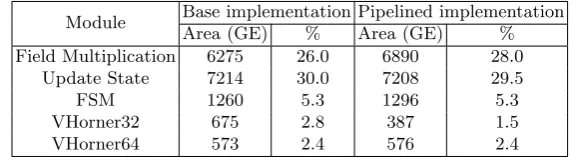
implementation of TriviA was 23.6 KGE at a frequency of 1150 MHz, with 7.2 KGE required for sequential logic and 16.4 KGE required for combinational logic. The corresponding throughput turns out to be 73.9 Gbps, and the area-efficiency (throughput/area) is 3.13 Mbps/GE. The area utilization is shown in Table 3 where each module and its respective area is shown. The registers forTag,block, andchecksumare instantiated in the top-module, hence their distribution is not listed in the table.
The synthesis for pipelined implementation was performed under similar op-erating conditions, tools, and libraries. The design was successfully synthesized at 1425 MHz for an area of 24.4 KGE, with 7.7 KGE in sequential and 16.7 KGE in combinational logic. The design successfully achieved a throughput of 91.2 Gbps with an area-efficiency of 3.73 Mbps/GE. The module-wise break-down of area is shown in Table 3. The registers for Tag, block, checksum, and pipeline registers are instantiated in the top-module, hence their distribution is also not listed in the table. For performance measures, different message lengths
Table 3.Area utilization without pipeline stage,TriviA
Module Base implementation Pipelined implementation Area (GE) % Area (GE) % Field Multiplication 6275 26.0 6890 28.0
Update State 7214 30.0 7208 29.5
FSM 1260 5.3 1296 5.3
VHorner32 675 2.8 387 1.5
VHorner64 573 2.4 576 2.4
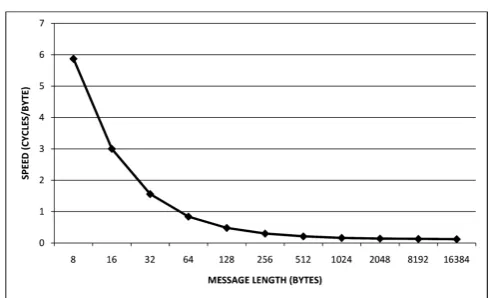
were considered to calculate cycles per byte, taking associated data length as a small value of 8 bytes. When the message length is 8 bytes, the overhead of initialization is very large in both the cases, base implementation and pipelined implementation, giving a high cycles per byte count. As we increase the message length, the overhead becomes smaller resulting in 0.12 cycle per byte for a very long message. This is shown in the Table 4 and graphically in Fig. 6.4. Hence, as we increase the message length the cycles per byte of both designs converge. Note that, if we assume that the associated data is of the same length as the message, then the cycle per byte doubles.
Example. If both themessage andAD are of 8192 bytes then 0.25 cycles per byte are required.
Table 4.TriviAperformance (in clocks per byte or cpb)
Algorithm Message length (Bytes)
8 16 32 64 128 256 512 1024 2048 8192 16384
TriviA-pipelined 6.12 3.12 1.62 0.87 0.50 0.31 0.21 0.17 0.14 0.13 0.12
Fig. 6.4. Hardware performance of pipelined design of TriviA for different message lengths
effects of physical synthesis, diversity of cells in different technology libraries and synthesis constraints. The unavailability of the RTL code and the synthesis details in the presented papers makes the task even harder. Nevertheless, the performance gap is at least an order of magnitude in the area-efficiency, hence unlikely to close.
To the best of our knowledge, not all CAESAR candidates have hardware implementations in ASIC so far, and there is no other hardware implementa-tion of TriviA as well, so, the comparison done with the known results listed in Table 5 shows that, theTriviA has a better throughput, cycles per byte and area-efficiency. Particularly, for the area-efficiency, theTriviAis at least 3.8 times better compared to the closest entry Ascon. We will offer the hardware imple-mentation to the CAESAR candidates and also request corresponding RTL for a fair evaluation in similar technology settings.
Besides CAESAR candidates, it is also interesting to benchmarkTriviAagainst state-of-the-art authenticated encryption engines that are commercially avail-able. We take one particular example from [7], which provides high-speed au-thenticated encryption hardware based on AES-CCM mode. Based on the data provided at [7], for 130 nm CMOS technology, AES-CCM achieves>800 Mbps at<19Kgates. Even with an optimistic technology scaling, this is still one order of magnitude inferior compared to the performance achieved with theTriviA.
Table 5.BenchmarkingTriviAin ASIC
AE Schemes
ASIC Implementation
Cycles/ Byte (cpb) Area
(KGE)
Throughput (Gbps)
Efficiency (Mbps/ GE)
TriviABase 23.6 73.9 3.13 0.12
TriviAPipelined 24.4 91.2 3.73 0.12
Scream, iScream[22] 17.29 5.19 0.30
-NORX* [8] 62 28.2 0.45
-Ascon* [21] 7.95 7.77 0.98 0.75
AEGIS[13,37]
AO1 20.55 1.35 0.07 6.67 AO2 60.88 37.44 0.61 0.33 TO1 88.91 53.55 0.60 0.20 TO2 172.72 121.07 0.70 0.07
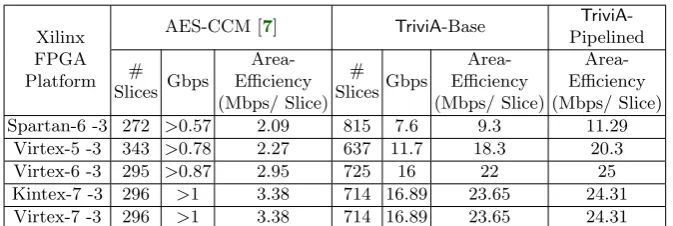
key, and 48 cycles to generate output cipher text. In order to benchmark, we performed pre-layout logic synthesis done for TriviA under typical conditions using Xilinx ISE 14.7. The results are collectively reported in Table 6. It can be noted that the area occupied forTriviAis generally larger compared to [7], since the computation in TriviA is done in parallel, processing 64 bits in 1 cycle. In comparison, [7] requires 48 cycles. When comparing the area-efficiency figures, it is clear thatTriviAis much superior by showing at least 5.4×improvement for TriviApipelined implementation compared to AES-CCM implementation of [7].
Table 6.BenchmarkingTriviAin FPGA
Xilinx FPGA Platform
AES-CCM [7] TriviA-Base TriviA -Pipelined #
Slices Gbps
Area-Efficiency (Mbps/ Slice)
# SlicesGbps
Area-Efficiency (Mbps/ Slice)
Area-Efficiency (Mbps/ Slice) Spartan-6 -3 272 >0.57 2.09 815 7.6 9.3 11.29
Virtex-5 -3 343 >0.78 2.27 637 11.7 18.3 20.3 Virtex-6 -3 295 >0.87 2.95 725 16 22 25 Kintex-7 -3 296 >1 3.38 714 16.89 23.65 24.31 Virtex-7 -3 296 >1 3.38 714 16.89 23.65 24.31
7
Conclusion
proposal uses a stream cipher and a pairwise independent hash function. We have constructed a stream cipherTriviA-SC, which is a variant of a well known stream cipher Trivium[16]. Triviumis well studied and very efficient in both hardware and software. We have also used a hardware efficient∆-Universal hash function EHC, which requires minimum number of field multiplications to process a mes-sage. We have integrated these two primitives in an efficient way, such that the resultant construction is highly efficient in both hardware and software as well as it provides high security of 128-bits for privacy and 124-bits for authenticity. This work provides the details of the hardware implementation of TriviA and hardware comparison betweenTriviAand some of the CAESAR candidates. We have observed that,TriviAis very hardware efficient in terms of throughput, cy-cles per byte and area-efficiency. More specifically the area-efficiency ofTriviAis at least 3.8 times better than the closest CAESAR candidateAscon.
Acknowledgement
Avik Chakraborti and Mridul Nandi are supported by the Centre of Excellence in Cryptology and R. C. Bose Centre for Cryptology and Security, Indian Sta-tistical Institute, Kolkata. We would like to thank Bart Preneel for his detailed comments and suggestions on our paper. We would also like to thank the anony-mous reviewers for their useful comments on our paper.
References
[1] ETSI/SAGE Specification, Specification of the 3GPP Confidentiality and In-tegrity ALgorithms UEA2 and UIA2.(2006),Document 5: Design and Evaluation Report, Version 1.1., 2006. Citations in this document:§1.
[2] ETSI/SAGE Specification, Specification of the 3GPP Confidentiality and In-tegrity ALgorithms UEA2 and UIA2. (2006), Document 2: SNOW 3G Specifi-cation, 2006. Citations in this document:§1.
[3] CAESAR,Competition for Authenticated Encryption: Security, Applicability, and Robustness. (2014). URL: http://competitions.cr.yp.to/caesar.html. Cita-tions in this document:§1.
[4] eSTREAM,The ECRYPT Stream Cipher Project. URL:http://www.ecrypt.eu. org/stream. Citations in this document:§1.
[5] International Organization for Standardization,ISO/IEC 29192-3:2012, Informa-tion technology – Security techniques – Lightweight cryptography – Part 3: Stream ciphers(2102). URL:http://www.iso.org/iso/iso_catalogue/catalogue_tc/ catalogue_detail.htm?csnumber=56426. Citations in this document:§1. [6] National Institute of Standards and Technology, A Statistical Test Suite for
Random and Pseudorandom Number Generators for Cryptographic Applications. (2010). URL:http://csrc.nist.gov/groups/ST/toolkit/rng/documentation_ software.html. Citations in this document:§5.1.
[8] J. P. Aumasson, P. Jovanovic, S. Neves, NORX: Parallel and Scalable AEAD. (2014), 19 – 36, Computer Security-ESORICS, Springer International Publish-ing, 2014, 2014. URL: https://eprint.iacr.org/2015/034.pdf. Citations in this document:§5.
[9] S. Babbage, M. Dodd,The eSTREAM Finalists.(2008), 191 – 209. Citations in this document:§1.
[10] M. Bellare, C. Namprempre,Authenticated encryption: Relations among notions and analysis of the generic composition paradigm.(2000), 531–545,ASIACRYPT, Lecture Notes in Computer Science, 2501, 2000.
[11] D. J. Bernstein,The Poly1305-AES Message-Authentication Code.(2005), 32–49, FSE, Lecture Notes in Computer Science, 3557, 2005. Citations in this document: §1.
[12] D. J. Bernstein, Cycle counts for authenticated encryption. (2007), Workshop Record of SASC 2007: The State of the Art of Stream Ciphers, 2007. Citations in this document:§1.
[13] D. Bhattacharjee, A. Chattopadhyay,Efficient Hardware Accelerator for AEGIS-128 Authenticated Encryption.(2014), 385–402,Inscrypt, Lecture Notes in Com-puter Science, 8957, 2014.
[14] J. Bierbrauer, T. Johansson, G. Kabatianskii, B. Smeet, On Families of Hash Functions via Geometric Codes and Concatenation.(1993), 331–342,CRYPTO, Lecture Notes in Computer Science, 773, 1993.
[15] B. den Boer,A simple and key-economical unconditional authentication scheme. (1993), 65 – 72,Journal of Computer Security 2, 1993.
[16] C. D. Canni`ere, B. Preneel,“Trivium,” New Stream Cipher Designs.(2005), 244– 266,The eSTREAM Finalists, Lecture Notes in Computer Science, 4986, 2005. Citations in this document:§1,§1,§4,§5.1,§7.
[17] I. Dinur, A. Shamir,Cube Attacks on Tweakable Black Box Polynomials.(2009), 278–299, EUROCRYPT, Lecture Notes in Computer Science, 5479, 2009. Cita-tions in this document:§5.1.
[18] X. Fan, G. Gong, Specification of the Stream Cipher WG-16 Based Confi-dentiality and Integrity Algorithms. (2013). URL:http://cacr.uwaterloo.ca/ techreports/2013/cacr2013-06.pdf.
[19] N. Ferguson, D. Whiting, B. Schneier, J. Kelsey, S. Lucks, T. Kohno,Fast En-cryption and Authentication in a Single Cryptographic Primitive.(2003), 330–346, FSE, Lecture Notes in Computer Science, 2887, 2003. Citations in this document: §1.
[20] P. A. Fouque, T. Vannet, Improving Key Recovery to 784 and 799 rounds of Trivium using Optimized Cube Attacks.(2013),FSE, Lecture Notes in Computer Science, 8424, 2013. Citations in this document:§5.1.
[21] H. Groβ, E. Wenger, C. Dobraunig and, C. Ehrenhofer,Suit up! Made-to-Measure Hardware Implementations of ASCON.(2014). URL:https://eprint.iacr.org/ 2015/034.pdf. Citations in this document:§5.
[22] V. Grosso, G. Leurent, F. Standaert, K. Varici, F. Durvaux, L. Gaspar, S. Kerck-hof,SCREAM and iSCREAM Side-Channel Resistant Authenticated Encryption with Masking.(2014). URL:http://competitions.cr.yp.to/round1/screamv1. pdf.. Citations in this document:§5.
[24] M. Hell, T. Johansson, A. Maximov, W. Meier,A Stream Cipher Proposal: Grain-128.(2006),International Symposium on Information Theory-ISIT, IEEE, 2006. Citations in this document:§1.
[25] C. Jutla,Encryption Modes with Almost Free Message Integrity.(2008), 547–578, J. Cryptology, 21, 2008.
[26] Y. Mansour, N. Nissan, P Tiwari, The Computational Complexity of Universal Hashing.(1990), 235–243,Twenty Second Annual ACM Symposium on Theory of Computing, 1990. Citations in this document:§3.2.
[27] A. Maximov, A. Biryukov, Two Trivial Attacks on Trivium.(2007), 36–55, Se-lected Areas in Cryptography, Lecture Notes in Computer Science, 4876, 2007. Citations in this document:§5.1,§5.1.
[28] D. A. McGrew, J. Viega, The Galois/Counter Mode of Operation (GCM). (2005). URL: http://csrc.nist.gov/groups/ST/toolkit/BCM/documents/ proposedmodes/gcm/gcm-spec.pdf.
[29] T. K. Moon, Error Control Coding: Mathematical Methods and Algorithms. (2005),Wiley, 2005.
[30] G. E. Moore,Cramming more components onto integrated circuits.(1965), Re-trieved 2015-06-07, 1965. URL: http://download.intel.com/museum/Moores_ Law/Articles-Press_Releases/Gordon_Moore_1965_Article.pdf. Citations in this document:§6.3.
[31] F. Muller,Differential Attacks against the Helix Stream Cipher.(2004), 94 – 108, FSE, Lecture Notes in Computer Science, 3017, 2004.
[32] M. Nandi,On the Minimum Number of Multiplications Necessary for Universal Hash Constructions.(2014), 489 – 508,FSE, Lecture Notes in Computer Science, 8540, 2014. Citations in this document:§1,§1,§3.1,§3.2,§2,§3.3,§5.3.
[33] P. Sarkar,Modes of Operations for Encryption and Authentication Using Stream Ciphers Supporting an Initialisation Vector.(2014), 189–231, Cryptography and Communications, 6(3), 2014. Citations in this document:§1,§1,§4.1,§4.1. [34] R. Taylor,Near optimal unconditionally secure authentication.(1995), 244–253,
EUROCRYPT, 950, 1995.
[35] D. Whiting, B. Schneier, S. Lucks and, F. Muller, Phelix: Fast Encryption and Authentication in a Single Cryptographic Primitive (2004). URL: http://www. ecrypt.eu.org/stream/. Citations in this document:§1.
[36] H. Wu, B. Preneel,Differential-Linear Attacks Against the Stream Cipher Phelix. (2007), 87–100,FSE, Lecture Notes in Computer Science, 4593, 2007.