International Journal of Research (IJR)
e-ISSN: 2348-6848, p- ISSN: 2348-795X Volume 2, Issue 06, June 2015Available at http://internationaljournalofresearch.org
Implementing Finite State Machine Simulation – A Review
Kalpna1& Mr. Amit varma2
1M. Tech scholar, SGI, Samalkha, Haryana
2Assistant Professor, Computer Science deptt, SGI Samlkha
ABSTRACT –
Objective - we have been using sine wave functions from our high school calculus. Simulation is a integral part of anyone’s life now. We will program in simulink to see how can we simulate a sine wave and obtain a optimized wave. Also we will see how can
we change the initial conditions of our parameters in simulation on the run. Secondly we will build a finite state machine that will show a tradeoff between position and velocity using sine wave. It is encountered with many usual problems. We will fix those problems using simulation in simulink at small intervals of time.
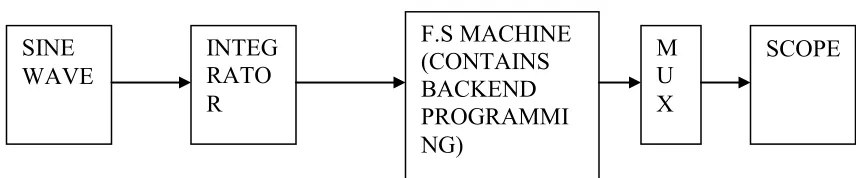
Fig 1 - FINITE STATE MACHINE WITH SINE WAVE SIMULATOR
INTODUCTION
1.Finite state machines
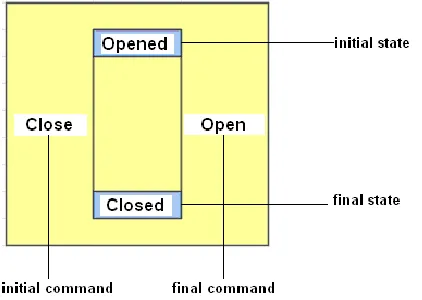
Finite state machines are autonomous systems, which are evolving at a time, automatically, depending on the signals applied at that moment and the state in which the system is. The finite state machines are inspired from reality, where everything has a limited life cycle. This life cycle means an initial state, an intermediary state and a final one. Also it is considered that a finite state machine is a system with a finite number of
states, having a model of behavior composed by states, transitions and actions. A state stores information about the past, meaning that reflect the changes from the system initialization to the present. A transition involves a change of state and is described by a condition that must be satisfied in order to start the transition. An action is a description of an activity, which must be performed at a given time. A finite state machine is represented with the state diagram, given by the transition table from one state to another.
(Ivan et. al. 2011).
SINE WAVE
INTEG RATO R
M U X
SCOPE F.S MACHINE
International Journal of Research (IJR)
e-ISSN: 2348-6848, p- ISSN: 2348-795X Volume 2, Issue 06, June 2015Available at http://internationaljournalofresearch.org
Fig. 1. Finite state machine
In a Finite State Machine the circuit’s output is defined in a different set of states i.e. each output is a state. A State Register to hold the state of the machine and a next state logic to decode the next state. An
output register defines the output of the machine. .(Monga et. al., 2012. The FSM is used to model the communication channel of proposed protocol between the Client Ci and the Server Si.( Aljeaid et. al., 2014) Finite State Machine (FSM) with different encoding algorithm constraints like gray, one-hot, sequential, Johnson, speed1 and auto. Finite state machine is a restricted class of sequential circuits called synchronous circuits which assumes the existence of a common global clock. An FSM is a discrete dynamic system that translates the sequence of input vectors into sequence of output vectors. (Uma et.al., 2012)
LITERATURE REVIEW –
AUTHERS OBJECTIVE METHODOLOGY RESULT
Malik et al.,
(1995) Studies the concept of the Cartesian composition of fuzzy finite state machines. Shows that fuzzy finite state machines and their
Cartesian composition
share many structural
properties.
Case study uzzy finite state machines which is a Cartesian
composition of
submachines can be studied in terms of smaller machines.
Erich Schmidt, (2011)
to discuss the state of the
art of finite element
analysis of electrical
machines and transformers. Electrical machines and transformers are prime examples of multi‐physical
systems involving
electromagnetics, thermal issues, fluid dynamics, structural mechanics as
well as acoustic
phenomena.
numerical analysis Various methods of
coupling the
different physical
domains of
multi‐field finite
element analyses
are described.
Thereby, weakly
coupled cascade
algorithms can be used with most problems in the field of electrical
machines and
transformers
König et al.,
International Journal of Research (IJR)
e-ISSN: 2348-6848, p- ISSN: 2348-795X Volume 2, Issue 06, June 2015Available at http://internationaljournalofresearch.org
finite state machines
(FSMs) to build a
decentralized online‐evolutionary
framework for swarms of mobile robots.
multi‐parental
generation of
offspring is presented and a known mutation operator is extended to
harden parts of
genotypes involved in good behavior, thus narrowing down the dimensions of the search space.
evolving the
benchmark
behaviors. The
memory genome
and the number of
parents for
reproduction highly
influence the
quality of the
results; the
recombination operator leads to an
improvement in
certain parameter
combinations only.
Rajagopal et al., (1999)
Accurate prediction of
temperature distribution in an electrical machine at the design stage is becoming increasingly important. It is essential to know the locations and magnitudes of hot spot temperatures for
optimum design of
electrical machine.
A methodology based
on axi‐symmetric
finite element
formulation has been developed to solve the conduction‐convection
problem in radial
cooled machine using a new eight noded solid‐fluid coupled element.
Steady state
temperatures have been determined for
102 kW radial
cooled motor at 100 percent and 75 percent loads and are validated with experimental results obtained from heat
run tests.
Parametric studies have been carried out to study the effect of critical
parameters on
temperature
distribution and for
optimising the
design.
Tadeusz Sobczyk, (2010)
to reduce issues arising when computing steady
state solutions for AC machine models using the harmonic balance method.
LU decomposition of an infinite matrix
An algorithm for
the LU
decomposition of
an infinite matrix
representing the
inductance matrix
of an AC
machine and an
International Journal of Research (IJR)
e-ISSN: 2348-6848, p- ISSN: 2348-795X Volume 2, Issue 06, June 2015Available at http://internationaljournalofresearch.org
state currents in a recursive manner.
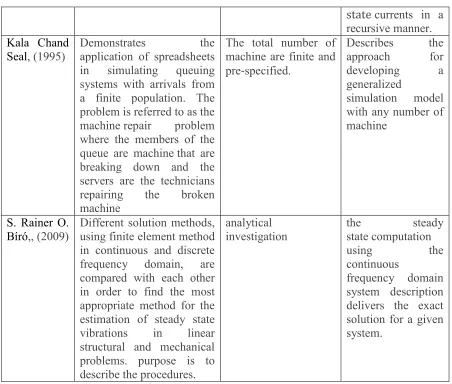
Kala Chand
Seal, (1995) Demonstrates application of spreadsheets the
in simulating queuing
systems with arrivals from a finite population. The problem is referred to as the
machine repair problem
where the members of the queue are machine that are breaking down and the servers are the technicians
repairing the broken
machine
The total number of machine are finite and pre‐specified.
Describes the
approach for
developing a
generalized
simulation model
with any number of machine
S. Rainer O.
Bíró,, (2009) Different solution methods, using finite element method in continuous and discrete
frequency domain, are
compared with each other in order to find the most appropriate method for the estimation of steady state
vibrations in linear
structural and mechanical problems. purpose is to describe the procedures.
analytical
investigation the state computation steady
using the
continuous
frequency domain system description delivers the exact solution for a given system.
TABLE 2 – WORK DONE BY DIFFERENT RESEARCHERS ON FINITE STATE MACHINE AND SIMULATION IN PREVIOUS YEARS
SIMULATION - It is well known that stochasticity populations can generate dynamics profoundly different from the predictions of the corresponding deterministic model. For example, demographic stochasticity can give rise to regular and persistent population cycles in models that are deterministically stable and can give rise to molecular noise and noisy gene expression in genetic and chemical systems where key molecules are present in small numbers or where key reactions occur at a low rate. Because analytical solutions to stochastic time-evolution equations for all but the simplest systems are intractable,
International Journal of Research (IJR)
e-ISSN: 2348-6848, p- ISSN: 2348-795X Volume 2, Issue 06, June 2015Available at http://internationaljournalofresearch.org
beyond what is possible using the basic algorithm by Gillespie. Although the SSA and its various exact and accelerated Monte Carlo implementations have largely been developed for models of chemical kinetics and molecular dynamics, the procedures are applicable to any continuous time system that can be described using coupled _rst-order ordinary di_erential equations. The examples used in this paper are selected to illustrate how to implement the SSA for di_erent types of ecological models. Automotive air-conditioning (AAC) is a necessity for thermal comfort in the cabin of a passenger vehicle especially for people who are living in countries with hot and humid climate [2]. Simulations have been performed to investigate the impact of radial variation of neutral atoms (neutral puff) on the edge plasma of small size divertor tokamak. It was demonstrated that, the variation of neutral atoms (neutral puff) in edge plasma of small size divertor tokamak generates additional large radial electric field and large radial electric field shear near separatrix which can significantly influence global confinement by affecting the transition from low (L) to high (H) confinement. This simulation was performed by using B2SOLPS0.5.2D fluid transport code based on a reduced form of the transport form of transport equations.
SCOPE OF THE PAPER–
Implementation of finite state machine with sine wave and simulating the working by using step wise simulation using Simulink and Matlab.
Problems are encountered during finite state machine simulation. These problems are also overcome by use of step wise simulation and Simulink.
METHODOLOGY USED IN THE PAPER –
1. Designing a sine wave simulator using appropriate multiplexer and integrator in simulink.
2. Plotting the curve for sine wave corresponding to random values. 3. Changing the initial values of the
simulation parameters on the run. 4. Adding a chart as output of the
integrator
5. Designing a velocity - position state flow structure in the chart using 3 different states.
6. Setting the tradeoff between values and position.
7. Observing the output of finite state machine
8. Output showed when position symbol becomes positive output does not go to 1.
9. This is called simulation overstepping the critical time instant. 10.Fixing this problem using simulink 11.Plotting the output curve again at
different small intervals of time. Problem is fixed, Output goes to 1 as soon as position becomes positive
TOOLS USED – 1. MATLAB
2. SIMULINK
REFERENCES
[1.] Gillespie, Implementing the Stochastic Simulation Algorithm, Journal of Statistical Software, April 2008, Volume 25, Issue 12
International Journal of Research (IJR)
e-ISSN: 2348-6848, p- ISSN: 2348-795X Volume 2, Issue 06, June 2015Available at http://internationaljournalofresearch.org
Computer Science Issues, Vol. 10, Issue 1, No 1, January 2013
[3.] Amr Hasheim , Simulation of Radial Variation of Neutral Atoms on Edge Plasma of Small Size Divertor Tokamak, Bekheit, Journal of Modern Physics, 2012, 3, 145-150 February 2012
[4.] Ivan et. Al., 2011, Collaborative Systems – Finite State Machines, Informatica Economică, vol. 15, no. 2.
[5.] Monga et. al., 2012, Finite State Machine based Vending Machine Controller with Auto-Billing Features, International Journal of VLSI design & Communication Systems (VLSICS) Vol.3, No.2.
[6.] Aljeaid et al., 2014, Modelling and Simulation of a Biometric Identity-Based Cryptography, International Journal of Advanced Research in Artificial Intelligence, Vol. 3, No.10.
[7.] Zhui et al., 2009, Comparison of Petri Net and Finite State Machine Discrete Event Control of Distributed Surveillance Networks, International Journal of Distributed Sensor Networks, 5: 480–501
[8.] Uma et al., 2012, synthesis optimization of finite state machine design in FPGAS, International Journal of VLSI design & Communication Systems, Vol.3, No.6.
[9.] Singh et. al.,2012, Finite State Testing and Syntax Testing, International
Journal of Computers & Technology, Volume 3. No. 1
[10.] D.S. Malik, J.N. Mordeson, M.K. Sen, (1995) "The Cartesian composition of fuzzy finite state machines",Kybernetes, Vol. 24 Iss: 4, pp.98 – 110
[11.] Erich Schmidt, (2011) "Finite element analysis of electrical machines and transformers: State of the art and future trends", COMPEL - The international journal for computation and mathematics in electrical and electronic engineering, Vol. 30 Iss: 6, pp.1899 – 1913
[12.] Lukas König, , Hartmut Schmeck, (2009) "Decentralized evolution of robotic behavior using finite state machines", International Journal of Intelligent Computing and Cybernetics, Vol. 2 Iss: 4, pp.695 – 723
[13.] M.S. Rajagopal, K.N. Seetharamu, P.A. Aswatha Narayana, (1999) "Finite element analysis of radial cooled rotating electrical machines", International Journal of Numerical Methods for Heat & Fluid Flow, Vol. 9 Iss: 1, pp.18 - 38