Improvements for Finding Impossible Differentials of Block
Cipher Structures
Yiyuan Luo1? and Xuejia Lai2,3??
1 School of Electronics and Information, Shanghai Dianji University
2
Department of Computer Science and Engineering, Shanghai Jiao Tong University
3
Westone Cryptologic Research Center, Beijing 100070, China
Abstract. In this paper we improve Wu and Wang’s method for finding impossible diffe-rentials of block cipher structures. This improvement is more general than Wu and Wang’s method that it can find more impossible differentials with less time. We apply it on Gen-CAST256, Misty, Gen-Skipjack, Four-Cell, Gen-MARS, SMS4, MIBS, Camellia*, LBlock, E2 and SNAKE block ciphers. All impossible differentials discovered by the algorithm are the same as Wu’s method. Besides, for the 8-round MIBS block cipher, we find 4 new impossible differentials, which are not listed in Wu and Wang’s results. The experiment results show that the improved algorithm can not only find more impossible differentials, but also largely reduce the search time.
Keywords: Cryptanalysis; Impossible differential; Block ciphers;
Mathematical Subject Classification: 94A60
1
Introduction
Impossible differential cryptanalysis, introduced by Biham et al. [4] and Knudsen [18] independently, is a special case of differential cryptanalysis that uses differentials with probability zero to sieve the right keys from the wrong keys. It is one of the most powerful attacks for block ciphers and is considered in many block cipher designs [41,9,12,39,21,20,13,36]. The best cryptanalytic results for some block ciphers are obtained by impossible differential cryptanalysis [8,4]. For example, the currently best attack on the 31-round Skipjack is still the impossible differential cryptanalysis by Bihamet al.[4]
The key step in impossible differential cryptanalysis of a block cipher is to find the longest impossible differential. Given two variables x1, x2 ∈ Fn2, the difference of x1 and x2 is usually denoted as ∆x=x1⊕x2. An impossible differential for ann-subblock block cipher is in the form (∆in9r∆out) where ∆in= (∆x1, . . . , ∆xn) and ∆out= (∆y1, . . . , ∆yn). (∆in9r∆out) means the probability of the output difference is∆outafterrrounds of a block cipher for an input difference
∆inis zero. At the first glance, impossible differentials are obtained manually by observing the block cipher structure. However, since the emergence of impossible differential cryptanalysis, automated techniques for finding impossible differentials have been introduced.
The first automated technique is called the Shrinking method introduced by Biham et al [4]. This method is simple but very useful. It only considers truncated differentials whose differences distinguish only between zero and arbitrary nonzero difference. Given a block cipher, the adversary first designs a mini version of this block cipher, which is, scales down the block cipher but preserves
?
Yiyuan Luo was supported by NSFC (61402280) and Academic Discipline Project of Shanghai Dianji University (16YSXK04)
??
the global structure. Then the adversary exhaustively searches for this mini cipher and obtains some truncated impossible differentials. Usually these truncated impossible differentials of the mini cipher remain impossible differentials in the normal version. This method can deal with most block ciphers in the real world. However, it becomes very slow if the number of subblocks of a block cipher is as large as 16, since exhaustive search on the mini version of this type of cipher is still a heavy load for most computers.
The second automated technique is based on the miss in the middle approach. This method combines two differentials, one from the input and the other from the output, both with probability 1. However, these two differentials cannot meet in the middle since they can never be equal in the middle. TheUmethod [17,16] and the UID method [24] both belong to this category. In theU method and the UID method, the adversary first represents the block cipher structure as a matrix, then given a differential pair (∆in, ∆out), he calculates them-round intermediate difference from∆inforwardly and the (r−m)-round intermediate difference from∆outbackwardly by the matrix method. If there is a contradiction for these two intermediate differences, then an impossible differential (∆in9r∆out) is verified. Representing a block cipher by the matrix has been a popular method in impossible differential, integral and zero correlation linear cryptanalysis [37,22,40,3,36,2,6,20].
In [34], Wu and Wang extend the U-method and UID method to a more generalized method which does not use the miss in the middle approach. They treat ther-round block cipher structure as a system of equations, which describe the propagation behavior of differences in the inner primi-tives, especially sbox permutations or branch swapping of the block cipher structure. To judge if a truncated differential (∆in, ∆out) is impossible, they predict information about unknown variables from the known ones iteratively. Finally a truncated differential is verified by checking the constrai-ned conditions in the system. This method is similar as a linear programming method for solving optimization problems.
In [30], Sun et al.show that Wu and Wang’s automatic search method can find all impossible differentials of a cipher that are independent of the choices of the inner primitives. However, Wu and Wang’s method can only find all truncated impossible differentials since the choice of truncated difference may result in missing some impossible differentials. Wu and Wang’s method only considers differences∆in= (x1, . . . , xn) and∆out= (y1, . . . , yn) wherexi andyi are zero or nonzero values. They assign an indicator to indicate the choice of xi andyi, representing by 0 a subblock without difference and by 1 a subblock with a difference. The relationships between nonzero differences have been omitted. For example,yimay be equal to somexj, where 1≤i, j≤n. If some linear constraints between nonzero variables in∆inand∆outare needed, Wu and Wang claimed their method could still work by translating all linear constraints into the system of equations. However, this method increases the run complexity and implement of the search method. Since it changes the equation system for every value of (∆in, ∆out) and if the relationship between∆inand∆outis complicated, the matrix will be very large.
The idea of the UID method is it represents the differential with symbols and utilizes the propa-gation property of the linear accumulated symbols. The idea of the Wu-Wang method is to utilize solving linear equations to determine an impossible differential. We show that the Wu-Wang method can be improved by combining the idea of the UID method and Wu-Wang method. Instead of using 1 to represent the nonzero difference, we use a letter symbol to represent a difference and different symbols represent different nonzero values. This method can represent more relationships between these subblocks. For example, if∆in= (a,0,0, a) and∆out= (a,0,0, b) for a 4-subblock structure whereaandbare different nonzero values, then we havex1=x4=y1andy46=x1. In our method, the matrix of the system does not need to be changed with (∆in, ∆out). We also improve the Wu-Wang method by simplifying the test of whether there are solutions for linear systems. Since the most time consuming part is the matrix operation, our improved method can find more impossible differentials in less time.
improvement largely reduced the run time for finding impossible differentials. In [33], the results for MIBS, LBlock and E2 are obtained in a few hours on a 2.66 GHz processor with MAGMA package. However, our results for MIBS, LBlock and E2 are obtained within 10 seconds on a 2.20 GHz processor.
In [27], Mouhaet al. used mixed integer linear programming for finding differential characteris-tics. Recently, this method has been widely applied in automatic searching of (impossible) differential characteristics [31,11,38]. In [38], Sasaki and Todo also proposed a tool for finding impossible dif-ferentials of block ciphers. This new tool can take into account the property of S-box. Thus, they can find more impossible differentials. However, for the MIBS cipher, the four new found impossible differentials by our method are not listed in their results. This is because we consider the relationship between subblocks in the differentials.
2
Preliminaries
In this section we introduce some basic concepts and notions used in this paper. We first introduce the block cipher structures. Next we review the solvability of a system of linear equations.
2.1 Block Cipher structures
There are two mainly block cipher structures, which are the Feistel structure and its generalizations and the substitute permutation network (SPN). The round function of most of those structures consists of three basic operations: the sbox look-up, the exclusive-or addition (Xor) and the branch swapping, where the only nonlinear component is the sbox look-up operation. In differential cryp-tanalysis, the Xor differences of plaintext/ciphertext pairs are considered, we omit the key and constant addition since they have no relevance to our analysis. We assume a block cipher structure hasn sub-blocks (branches), and the input and output differences are denoted by (∆x1, . . . , ∆xn) and (∆y1, . . . , ∆yn) respectively.
2.2 The solvability of a linear system
Now we review the basics in linear algebra of determining the solvability of a system of linear equations. Let m, nbe two positive integers,m < n, letAx=b be a system ofmlinear equations withnvariables, whereA is am×nmatrix overF2and x= (x1, . . . , xn) andb= (b1, . . . , bm) are two bit vectors, then the augmentedm×(n+ 1) matrixB = [A|b] can determine the solvability of the linear system.
A regular method is to deduce the reduced row echelon form (a.k.a. row canonical form) of matrix
B by Gauss-Jordan Elimination algorithm. The reduced row echelon form of a matrix is unique and denoted byB0. One start to checkB0 from the last row to the first, to see if there exist a row which the first n entries are zeros and the last entry is nonzero. If there are such rows, then the linear system has no solution. For example, if the augmented matrix B of a linear system in reduced row echelon form is
B0=
1 0 0b1 0 1 0b2 0 0 0b3
whereb3is nonzero, then the linear system has no solution.
3
Mathematical Models for Finding IDs of Block Cipher Structures
Our improvement is based on Wu and Wang’s method. If the nonlinear sboxSi in a block cipher structure is a permutation, then there is a constraint on the input differencexiand output difference
structure. In order to find impossible differential for anr-round block cipher structure, we first set differential variables for the states, then transform ther-round block cipher structure into a system of linear equations and constraints, denoted byS. Then for a given differential (∆in, ∆out) where
∆in= (a1, . . . , an) and∆out= (b1, . . . , bn), we can check if it is impossible by solvingSwith initial values (a1, . . . , an, b1, . . . , bn), ifS has no solution, then ∆in9r∆out.
F1
X0 X1
Y1
F2
X1 Y2 X2
F3
X2 Y3 X3
F4
X3 Y4 X4
F5
X6 X5
X4 Y5
1
Fig. 1.State variables for 5-round Feistel Structure
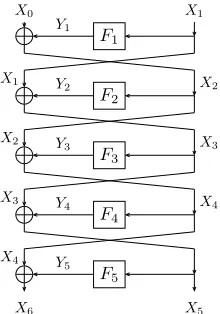
Here we take the 5-round Feistel structure as an example. We first assign differential variables for 5-round Feistel structure. In Fig 1, Fi,1≤i ≤5 are permutations, the output difference of Fi for input differenceXi isYi, thusXi ∼Yi . According to the computation graph of 5 round Feistel structure, we obtain the following systemS of equations and constraints:
X0⊕X2⊕Y1= 0 X1∼Y1
X1⊕X3⊕Y2= 0 X2∼Y2
X2⊕X4⊕Y3= 0 X3∼Y3
X3⊕X5⊕Y4= 0 X4∼Y4
X4⊕X6⊕Y5= 0 X5∼Y5
In order to check if (a,0)→(a,0) is an impossible differential whereais a nonzero value, we solve the above system withX0=a, X1= 0, X5= 0, X6=a. SinceX1∼Y1andX5∼Y5we haveY1= 0 andY5= 0. From linear equations ofS, we getY3= 0, thusX3= 0 sinceX3∼Y3, next from linear equationsS we obtainY2= 0, howeverX2=aandX2∼Y2, thus the systemShas no solution and (a,0)→(a,0) is an impossible differential for 5-round Feistel structure.
Now we want to find all impossible differentials for 5-round Feistel structure, we enumerate all the possible differential pairs (∆in, ∆out)∈ {(0, a),(a,0),(a, a),(0, b),(b,0),(b, b),(b, a),(a, b)} where a
andbare two different nonzero values. For each value of (∆in, ∆out), we judge if it is an impossible differential, after all cases are tested, we will find all impossible differentials.
Thus the general algorithm for finding all r-round impossible differentials for a block cipher structure is outlined as:
1. Generate all the possible differential pairs (∆in, ∆out) in a setD.
2. Assign differential variables according to the computation figure of the r-round block cipher structure. Generate the systemS of linear equations and constraints with the differential varia-bles.
4
The Detailed Algorithm
In this section we describe the detailed algorithm and implementation details.
4.1 Generate all possible differential pairs
We use symbolsai, bi,1≤i≤nto denote 2ndifferent the nonzero values. For a block cipher struc-ture, the input difference is (∆I1, . . . , ∆In) where∆Ii∈ {0, a1, . . . , an}and the output difference is (∆O1, . . . , ∆On) where∆Oi ∈ {0, a1, . . . , an, b1, . . . bn}. Note that the input difference and output difference will not be zero since it will be trivial in differential cryptanalysis. Thus there are total ((n+ 1)n−1)·((2n+ 1)n−1) differential pairs. This value is large for many block cipher structures. However, an impossible differential (∆I1, . . . , ∆In)9(∆O1, . . . , ∆On) for a block cipher struc-ture is usually simple, that is, there are very few nonzero values in (∆I1, . . . , ∆In) and (∆O1, . . . , ∆On). Since if the input or output differential are complicate, it will propagate fast due to the round structure of the cipher. Thus it is reasonable to consider simple differential pairs. Actually all the impossible differentials found for block cipher structures in the literature are simple.
In this paper we only consider the input difference (∆I1, . . . , ∆In) where ∆Ii ∈ {0, a} and the output difference (∆O1, . . . , ∆On) where ∆Oi ∈ {0, a, b}. Thus there are total (2n −1)(3n −1) differential pairs need to be checked.
4.2 Generate the systemS
Given a block cipher structure, we first need to draw the computational figure and assign differential variables, as introduced in the analysis of 5-round Feistel structure. This step is varying according to different block cipher structures. However, since most block cipher structures iterate the same round structure for several times, these variables are regular and easy to implement in a computer program. As in the analysis of 5-round Feistel structure, the input difference of a nonlinear permutation is denoted by variableXiand the output difference is denoted by variableYi. Thus if we see a variable
Yi, it must be some output difference of a nonlinear permutation.
For a block cipher structure with r rounds, there arepvariablesXi,0≤i≤pand qnumbers of variablesYi,1≤i≤q. The numberpand qare determined by the round structure and the round number r. For ther-round Feistel structure,p=r+ 2 andq=r. We first denote all variables in a variable vector as
X= (X0, . . . , Xp−1, Y1, . . . , Yq),
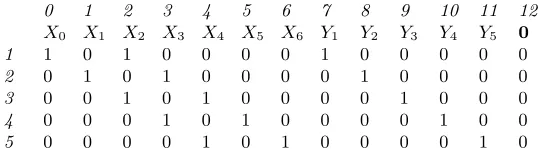
then linear equations in systemS can be write asM X=0whereM is akr×(p+q) matrix overF2 and0is a (p+q)-dimensional zero vector, wherek is the number of linear equations in one round of the block cipher structure. The augmented matrix of these linear equations isB= [M|0]. For the 5-round Feistel structure, the augmented matrixB is denoted in Table 1 .
0 1 2 3 4 5 6 7 8 9 10 11 12
X0 X1 X2 X3 X4 X5 X6 Y1 Y2 Y3 Y4 Y5 0
1 1 0 1 0 0 0 0 1 0 0 0 0 0 2 0 1 0 1 0 0 0 0 1 0 0 0 0 3 0 0 1 0 1 0 0 0 0 1 0 0 0 4 0 0 0 1 0 1 0 0 0 0 1 0 0 5 0 0 0 0 1 0 1 0 0 0 0 1 0
Table 1.The 5×13 augmented matrix of 5-round Feistel structure
For the 5-round Feistel structure, N = {< 1,7 >, < 2,8 >, < 3,9 >, < 4,10 >, < 5,11 >}. In the real implementation, it is noted that for most block cipher structures, the distance between a constraint Xi and Yi is fixed and determined by the round structure and the round number, that is, id(Yi)−id(Xi) is a constant. For example, the distance of constraint Xi and Yi for a r-round Feistel structure isr+ 1. Thus the mapN is not needed to be implemented but only the fixed index distance is needed. This observation facilitates the real implementation of the algorithm.
4.3 Determine the solvability of S
In the beginning, we assign a symbol ’ ?’ to each variable in the variable vector X, which means every variable is undetermined. Given a differential pair (∆in, ∆out), we need to check if there exist solutions of the system S with the initial value (∆in, ∆out). We first need to initialize the variable vector X according to (∆in, ∆out). As in the 5-round Feistel structure, for a differential pair∆in= (a,0), ∆out= (a,0), the variable vector X is initialized as:
X0 X1 X2 X3 X4 X5 X6 Y1 Y2 Y3 Y4 Y5
a 0 ? ? ? 0 a ? ? ? ? ?
For a constraintXi∼Yi, the algorithm updates (Xi, Yi) and detects contradictions as follows.
– If the value Xi is updated,
• IfXi= 0 and Yi=?, thenYi is set to 0;
• IfXi is a nonzero symbol andYi=?, thenYi is set to the nonzero symbol ’*’; • IfXi= 0 and Yi is an nonzero symbol, then we obtain a contradiction;
– If the value Yi is updated,
• IfYi = 0 andXi=?, thenXi is set to 0;
• IfYi = 0 andXi is an nonzero symbol, then we obtain a contradiction;
We use⊕to denote the symmetrical difference (Xor) of X1 andX2. For example, ifX1={a1} and X2 ={b1}, then X1⊕X2 = {a1, b1}; if X1 ={a1} and X2 ={0}, then X1⊕X2 = {a1}; if
X1={a1} andX2={a1, b1}, thenX1⊕X2={b1}.
The function UpdateMatrix(B, X) updates the augmented matrix B according to the variable vector X. If the i-th variable in X is 0, then the corresponding i-th column of B is set to a zero vector. As in [34], this method keeps solutions of the augmented matrixB unchanged. IfXi is not in the set{0,?,∗}, we check each row ofB, if the value of thei-th column at ther-th rowBr,i is 1, then we XorXi to the last element of ther-th row ofB and set Br,i to 0.
The function UpdateVector(X,N, j, J) updates the j-th variable Xj with the value J, at the same time all constraints inN are maintained. As described in the beginning of this subsection, the function updatesXj with the valueJ by checking each constrint inN and returns true if succeeds or false if there is a contradiction. There are many subcases, ad described in the detailed algorithm. During the updating process, there may be contradictions. For example, ifXj ={a}andJ ={a, b} which means J = a⊕b, there is a contradiction since a⊕b can never be a. If J is {0} but the corresponding variable which is the sbox output ofXj is nonzero, orJ is{0}but the corresponding variable which is the sbox input ofXj is nonzero, there will be contradictions.
The function ReducedRowEchelon(B) transforming the ι×κ matrix B into the reduced row echelon form by Gauss-Elimination algorithm. Note that every element in the firstκ−1 columns of
B is inF2, while elements in the last column ofB are represented by a set of symbols. Thus the Xor operation in the last column ofB is the symmetrical difference operation. The readers can refer to [28] for the detailed algorithm of transforming a matrix into the reduced row echelon form.
The detailed algorithm for checking if a differential is impossible is described in Algorithm 1. In Algorithm 1, the variable vector X is first initialized according to the differential pair (∆in, ∆out) and the constraint array N. Then the algorithm continue checks if there is a contradiction with a loop test until B and X is not updated any more. During the loop the algorithm first updatesB
FunctionUpdateMatrix(B,X)
// Update the augmented matrix B according to the variable vector X
1 K ←the size ofX;
2 fori←0toK−1do 3 t←X[i] ;
4 if tis0then
5 Every element of thei-th column ofB is set to 0.
6 else if tis not ’ ?’ andtis not ’*’ then 7 L←the number of rows ofB;
8 forr←0toL−1do 9 if B[r, i]is1then 10 B[r, i]←0;
11 B[r, K−1]←B[r, K−1]⊕t;
12 end
13 end
14 end 15 end
the algorithm obtains a contradiction and stops. Otherwise if there exists a solution for a variable from the reduced row echelon form, the index and the value of the variable is denoted as (j, J). The algorithm update the variable vectorX with (j, J) by theUpdateVector(X,N, j, J) function , if the updating process return false, a contradiction is obtained and the algorithm stops, otherwise, the algorithm continues to run.
4.4 Complexity
For the ι×κ matrix B and the κ−1 dimension vector X, the time complexity of the function UpdateMatrix is ι·κ, the time complexity of the function ReducedRowEchelon is ι2·κ, the time complexity of the functionUpdateVectoris a constantc. The while loop continues runningκ/2 times since there at mostκ−1 values inX and in each loop either 2 variables are updated or there is a contradiction. Thus the total complexity of the algorithm is c
2 ·ι
2κ2, where c is a small constant. The space complexity is dominated by storing the matrixB and is aboutι·κ.The time complexity of the Wu-Wang method is T·ι2κ2 and this T is much larger than ourc. The Wu-Wang method stores 3 matrices, thus its space complexity is at least triple of our method.
4.5 Comparison with Previous method
In [33], Wu and Wang proved that theU-method and the UID-method are specific cases of the Wu-Wang method. They found that their method can find longer impossible differential for the MIBS cipher than by U-method and the UID-method. However, in the UID-method, for an impossible differential pair ((∆I1, . . . , ∆In),(∆O1, . . . , ∆On)), the relationship between input variables and output variables are considered since UID-method uses symbols to denote values. For example, the UID-method considers the relation between∆Ii and∆Oj and checks if they are equal, however the U-method and Wu-Wang method only use 0 and 1 to denote zero and non-zero values, which omit the relationship between input and output differentials.
FunctionUpdateVector(X,N, j,J)
// Update the variable vector X according to the variable (j, J) where J is the value
of the j-th variable in X. N is the array of constraints.
input :the variable vectorX, the constraint arrayN, (j, J).
output:A boolean flag indicates if the update procedure success.
1 flag←true; 2 foreacha∈ N do 3 k0←a[0];k1←a[1];
4 if jis equal to k0 then 5 if J⊕Xk0 is not 0 then
6 flag←false;// Ex. J=a⊕b but Xk0=a, a contradiction.
7 returnflag;
8 else if J is0andXk0 is ? then
9 if X[k1]is not 0 thenflag←false;
10 returnflag;
11 end
12 Xk0←0 ;Xk1 ←0 ;
13 else if J is a nonzero value then 14 Xk0←J;Xk1 ← ∗;
15 end
16 else if j is equal tok1 then
17 if J⊕Xk1 is not 0 thenflag←false
18 returnflag;
19 else if Xk1 is ?andJ is 0 then
20 Xk1←0;Xk0←0;
21 end
Algorithm 1: The algorithm for checking an impossible differential input :A differential pair (∆in, ∆out) and the systemS
output:A boolean flag indicates if (∆in, ∆out) is an impossible differential
1 B is theι×κaugmented matrix ofS;
2 X is theκ−1 dimension variable vector ;
3 N is the map of constraints ofS; 4 flag←false;
5 index←true;
6 Initialize every variable inX according to (∆in, ∆out) and the constraints inN;
7 while index do
8 UpdateMatrix(B,X)// Update B according to X ;
/* Transform B into the reduced-row-echelon form by Gauss-Jordan Elimination */
9 ReducedRowEchelon(B);
10 if B has no solutionthen 11 flag←true;
12 break;
13 else
14 index←false;
15 count←0 ;
16 fori←ιto1do 17 −→v ←RowiofB;
18 if the sum of the firstκ−1elements of−→v is1then 19 j←the index of the element 1 in−→v;
20 J←the last element of−→v;// the solution of the j-th variable in X
21 /* update the variable vector X with (j, J) and return true if there is
no contradiction and return false otherwise. */
22 b←UpdateVector(X,N,j,J);
23 if bis falsethen
24 flag←true;
25 returnflag;
26 else
27 index←true;
28 end
29 end
30 end
31 end 32 end 33 returnflag;
of the algorithm. While in the Wu-Wang method, to add linear relationships between nonzero values in (∆in, ∆out), the matrix B must change with different values of (∆in, ∆out). This will consume more time during the run of the algorithm.
The most time consuming part in the algorithm is the matrix operation. To check if the augmented matrix has any solutions, the Wu-Wang method needs to compute the rank of the matrixM andB. We show this step is not required since we can check the solvability of the system from the reduced row echelon form of the matrixB, as introduced in the preliminaries section. Thus our improvement largely reduces the search time of finding impossible differentials of a block cipher structure.
5
Applications and Experiment results
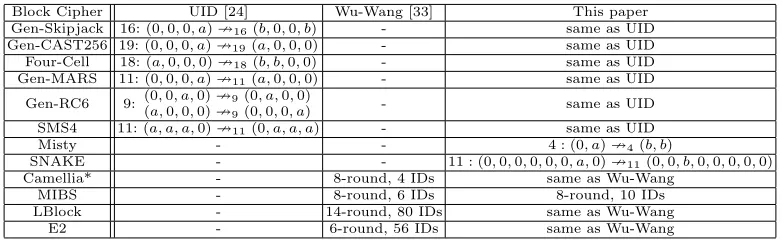
java code of this algorithm and complete impossible differential results in GitHub [23]. To reduce the space of this paper, we present some of the impossible differential results in Table 5. The file Impossible Differential.txt in [23] lists the complete impossible differential results for these block cipher structures. Most impossible differentials discovered by our algorithm are the same as the Wu-Wang method.
Block Cipher UID [24] Wu-Wang [33] This paper Gen-Skipjack 16: (0,0,0, a)916(b,0,0, b) - same as UID
Gen-CAST256 19: (0,0,0, a)919(a,0,0,0) - same as UID
Four-Cell 18: (a,0,0,0)918(b, b,0,0) - same as UID
Gen-MARS 11: (0,0,0, a)911(a,0,0,0) - same as UID
Gen-RC6 9: (0,0, a,0)99(0, a,0,0)
(a,0,0,0)99(0,0,0, a) - same as UID
SMS4 11: (a, a, a,0)911(0, a, a, a) - same as UID
Misty - - 4 : (0, a)94(b, b)
SNAKE - - 11 : (0,0,0,0,0,0, a,0)911(0,0, b,0,0,0,0,0)
Camellia* - 8-round, 4 IDs same as Wu-Wang
MIBS - 8-round, 6 IDs 8-round, 10 IDs
LBlock - 14-round, 80 IDs same as Wu-Wang
E2 - 6-round, 56 IDs same as Wu-Wang
Table 2. Summary of Impossible differentials (IDs) of some well-known block ciphers structures found by different methods
Moreover, for the 8-round MIBS, we find new 4 impossible differentials, which are not found by the Wu-Wang method since these new 4 impossible differentials are not simple truncated impossible differentials. MIBS is a 16-subblock Feistel structure with substitution and permutation (SP) round function. In the SP round function, the 8 subblock is first substituted by 8 sboxes, then a 8×8 matrix is applied as the permutation. The permutation matrixP is
1 1 0 1 1 0 1 1 0 1 1 1 1 1 1 0 1 1 1 0 1 1 0 1 0 1 1 1 0 0 1 1 1 0 1 1 1 0 0 1 1 1 0 1 1 1 0 0 1 1 1 0 0 1 1 0 1 0 1 1 0 1 1 1
.
There are total 10 impossible differentials are found for 8-round MIBS by our improved algorithm. The new four 8-round impossible differential found are listed in Table 3.
No. ∆in ∆out Reference
1 (0,0,0,0,0,0,0,0; 0,0,0,0,0, a,0,0) (b,0,0,0,0,0,0, b; 0,0,0,0,0,0,0,0)
This paper 2 (0,0,0,0,0,0,0,0; 0,0,0,0,0, a,0,0) (0,0,0,0, b,0,0, b; 0,0,0,0,0,0,0,0)
3 (0,0,0,0,0,0,0,0;a,0,0,0,0,0,0, a) (0,0,0,0,0, b,0,0; 0,0,0,0,0,0,0,0) 4 (0,0,0,0,0,0,0,0; 0,0,0,0, a,0,0, a) (0,0,0,0,0, b,0,0; 0,0,0,0,0,0,0,0) 5 (0,0,0,0,0,0,0,0; 0,0, a,0,0,0,0,0) (0,0,0,0, b,0,0,0; 0,0,0,0,0,0,0,0)
[33] 6 (0,0,0,0,0,0,0,0; 0,0, a,0,0,0,0,0) (0,0,0,0,0,0,0, b; 0,0,0,0,0,0,0,0) 7 (0,0,0,0,0,0,0,0; 0,0,0,0, a,0,0,0) (0,0, b,0,0,0,0,0; 0,0,0,0,0,0,0,0) 8 (0,0,0,0,0,0,0,0; 0,0,0,0, a,0,0,0) (0,0,0,0,0,0, b,0; 0,0,0,0,0,0,0,0) 9 (0,0,0,0,0,0,0,0; 0,0,0,0,0,0, a,0) (0,0,0,0, b,0,0,0; 0,0,0,0,0,0,0,0) 10 (0,0,0,0,0,0,0,0; 0,0,0,0,0,0,0, a) (0,0, b,0,0,0,0,0; 0,0,0,0,0,0,0,0)
Table 3.Impossible differentials for 8-round MIBS. There are 4 new found impossible differentials.
Compare with Wu and Wang’s algorithm, this improvement is more general since it not only finds more impossible differentials for a block cipher structures, but also has better efficiency. The results for MIBS are obtained on a 2.66 GHz processor with MAGMA package in a few hours by Wu and Wang’s algorithm [33]. However, our results for MIBS are obtained on a 2.20 GHz processor in Java language in less than 10 seconds. Thus, the algorithm presented in this paper is more efficient than Wu and Wang’s algorithm.
6
Conclusion
In this paper we improve Wu and Wang’s algorithm for finding impossible differentials of block cipher structures. The improved method is more general than Wu and Wang’s method that it can find more impossible differentials with less time. We apply this method to many block cipher structures. The experiment results show that this improvement can largely reduce the search time for the impossible differentials of a block cipher. Since there are known relationships between impossible differential, integral and zero correlation linear cryptanalysis [7,5,30]. This method can be used as a cryptanalytic tool to evaluate the security of a block cipher against these kinds of cryptanalysis.
References
1. Aoki, K., Ichikawa, T., Kanda, M., Matsui, M., Moriai, S., Nakajima, J., and Tokita, T.
Camellia: A 128-bit block cipher suitable for multiple platforms - design and analysis. In SAC 2000 (2011), vol. LNCS 2012, Springer-Verlag, pp. 39–56.
2. Berger, T., and Minier, M. Some results using the matrix methods on impossible, integral and zero-correlation distinguishers for Feistel-Like ciphers. InProgress in Cryptology – INDOCRYPT 2015 (2015), vol. LNCS 9462, pp. 180–197.
3. Berger, T., Minier, M., and Thomas, G. Extended generalized Feistel networks using matrix repre-sentation. InSelected Areas in Cryptography – SAC 2013 (2014), vol. LNCS 8282, pp. 289–305. 4. Biham, E., Biryukov, A., and Shamir, A. Cryptanalysis of Skipjack reduced to 31 rounds using
impossible diffrentials. InAdvances in Cryptology - EUROCRYPT’99 (1999), vol. LNCS 2595, Springer-Verlag, pp. 12–23.
5. Blondeau, C., Bogdanov, A., and Wang, M. On the (in)equivalence of impossible differential and zero correlation distinguishers for Feistel and Skipjack-type ciphers. InACNS 2014 (2014), vol. LNCS 8479, Springer-Verlag, pp. 271–288.
6. Blondeau, C., and Minier, M. Analysis of Impossible, Integral and Zero-Correlation Attacks on Type-II Generalized Feistel Networks Using the Matrix Method. InFSE 2015 (2015), vol. LNCS 9054, Springer-Verlag, pp. 92–113.
7. Bogdanov, A., Knudsen, L., Leander, G., Standaert, F., Steinberger, J., and Tischhauser, E. Key-Alternating Ciphers in a Provable Setting: Encryption Using a Small Number of Public
Permu-tations. InASIACRYPT 2012 (2012), vol. LNCS 7237, Springer Verlag, pp. 45–62.
8. Boura, C., Naya-Plasencia, M., and Suder, V.Scrutinizing and Improving Impossible Differential Attacks: Applications to CLEFIA,Camellia, LBlock and Simon. InASIACRYPT 2014, PART I (2014), vol. LNCS 8873, Springer-Verlag, pp. 179–199.
9. Cheng, L., Sun, B., and Li, C. Revised cryptanalysis for sms4. Science China Information Sciences 60, 12 (2017), 122101.
10. Choy, J., Chew, G., Khoo, K., and Yap, H.Cryptographic properties and application of a generalized unbalanced Feistel network structure. InProc of ACISP’2009 (2009), vol. LNCS 5594, Spring-Verlag, pp. 73–89.
11. Cui, T., Jia, K., Fu, K., Chen, S., and Wang, M. New Automatic Search Tool for Impossible Differentials and Zero-Correlation Linear Approximations. Cryptology ePrint Archive, Report 2016/689, 2016. https://eprint.iacr.org/2016/689.
12. Dai, Y., and Chen, S. Cryptanalysis of full PRIDE block cipher.Science China Information Sciences 60, 5 (2017), 052108.
13. Ding, Y., Zhao, J., Li, L., and Yu, H. Impossible differential analysis on round-reduced PRINCE. J. Inf. Sci. Eng. 33, 4 (2017), 1041–1053.
15. Kanda, M., Moriai, S., Aoki, K., Ueda, H., Takashima, Y., Ohta, K., and Matsumoto, T.
E2-A new 128 bit block cipher. IEICE Transactions Fundamentals - Special Section on Cryptography and Information Security E83-A, 1 (2000), 48–59.
16. Kim, J., Hong, S., and Lim, J. Impossible differential cryptanalysis using matrix method. Discrete Mathematics 310 (2010), 988–1002.
17. Kim, J., Hong, S., Sung, J., Lee, S., and Lim, J. Impossible differential cryptanalysis for block cipher structures. InINDOCRYPT 2003 (2003), vol. LNCS 2904, Springer-Verlag, pp. 82–96.
18. Knudsen, L. R. DEAL-A 128-bit block cipher. Technical Report 151. Tech. rep., Department of Informatics, University of Bergen, 1998.
19. Lee, C., and Cha, Y. The block cipher: SNAKE with provable resistance against DC and LC attacks. InJW-ISC 1997 (1997), pp. 3–17.
20. Lin, T., Lai, X., Xue, W., and Huang, G.Discussion on the theoretical results of white-box crypto-graphy. Science China Information Sciences 59, 11 (2016), 1–11.
21. Liu, G., and Jin, C. Algebraic techniques in slender-set differential cryptanalysis of PRESENT-like cipher. Science China Information Sciences 59, 9 (2016), 099104.
22. Liu, G., Jin, C., and Kong, Z. Key recovery attack for PRESENT using slender-set linear cryptana-lysis. Science China 59, 3 (2016), 1–14.
23. Luo, Y. Source codes and results for finding impossible differentials for block cipher structures. https://github.com/ianroo/impossibledifferential.
24. Luo, Y., Lai, X., Wu, Z., and Gong, G.A unified method for finding impossible differentials of block cipher structures. Information Sciences 263 (2014), 211–220.
25. M.Matsui. New block encryption algorithm MISTY. InFSE 1997 (1997), vol. LNCS 1267, Springer-Verlag, pp. 54–68.
26. Moriai, S., and Vaudenay, S. On the pseudorandomness of top-level schemes of block ciphers. In Advances in Cryptology - ASIACRYPT’00 (2000), vol. LNCS 1976, Springer-Verlag, pp. 289–302. 27. Mouha, N., Wang, Q., Gu, D., and Preneel, B.Differential and Linear Cryptanalysis Using
Mixed-Integer Linear Programming. Springer Berlin Heidelberg, 2011.
28. RosettacodeOrg. How to compute the reduced row echelon form of a matrix http://rosettacode.org/wiki/Reduced row echelon form.
29. SMS4. Specication of SMS4, block cipher for WLAN products SMS4 (in Chinese). Avaiable at: http://www.oscca.gov.cn/UpFile/200621016423197990.pdf.
30. Sun, B., Liu, Z., Rijmen, V., Li, R., Cheng, L., Wang, Q., Alkhzaimi, H., and Li, C.Links among impossible differential, integral and zero correlation linear cryptanalysis. InEUROCRYPT 2015, Part I (2015), vol. LNCS 9215, Springer-Verlag, pp. 95–115.
31. Sun, S., Hu, L., Wang, P., Qiao, K., Ma, X., and Song, L. Automatic Security Evaluation and (Related-key) Differential Characteristic Search: Application to SIMON, PRESENT, LBlock, DES(L) and Other Bit-Oriented Block Ciphers. InASIACRYPT (2014).
32. Sung, J., Lee, S., Lim, J., Hong, S., and Park, S. Provable security for the Skipjack-like structure against differential cryptanalysis and linear cryptanalysis. InAdvances in Cryptology-ASIACRYPT’00 (2000), vol. LNCS 1976, Springer-Verlag, pp. 274–288.
33. Wu, S., and Wang, M. Automatic search of truncated impossible differentials for word-oriented block ciphers. Inhttp://eprint.iacr.org/2012/214.pdf.
34. Wu, S., and Wang, M. Automatic search of truncated impossible differentials for word-oriented block ciphers. InINDOCRYPT 2012 (2012), vol. LNCS 7668, pp. 283–302.
35. Wu, W., and Zhang, L. LBlock: A lightweight block cipher. InACNS 2011 (2011), vol. LNCS 6715, Springer-Verlag, pp. 227–344.
36. Wu, W. L., Zhang, L., and Yu, X. L.The DBlock family of block ciphers.Science China Information Sciences 58, 3 (2015), 1–14.
37. Yap, H. Impossible differential characteristics of extended Feistel networks with provable security against differential cryptanalysis. InProc of SecTech 2008 (2009), vol. CCIS 29, pp. 103–121.
38. Yu, S., and Todo, Y. New Impossible Differential Search Tool from Design and Cryptanalysis As-pects. InInternational Conference on the Theory and Applications of Cryptographic Techniques (2017), pp. 185–215.
39. Zhang, W. T., Bao, Z. Z., Lin, D. D., Rijmen, V., Yang, B. H., and Verbauwhede, I. REC-TANGLE: a bit-slice lightweight block cipher suitable for multiple platforms.Science China Information Sciences 58, 12 (2015), 1–15.
40. Zhao, R., Zhang, R., Li, Y., and Wu, B. Construction of MDS block diffusion matrices for block ciphers and hash functions. Science China Information Sciences 59, 9 (2016), 1–3.