Status of the parallelized JUNO simulation software
TaoLin1,∗,JiahengZou1,∗∗,WeidongLi1,2,ZiyanDeng1,2,GuofuCao1,2,XingtaoHuang3,
andZhengyunYou4(on behalf of JUNO collaboration) 1Institute of High Energy Physics, Beijing, China
2University of Chinese Academy of Sciences, Beijing, China 3Shandong University, Jinan, China
4Sun Yat-Sen University, Guangzhou, China
Abstract. The Jiangmen Underground Neutrino Observatory (JUNO) is a multi-purpose neutrino experiment. It consists of a central detector, a water pool and a tracker placed on top. The central detector, which is used for neu-trino detection, consists of a 20 kt liquid scintillator target and about 18,000 20-inch photomultiplier tubes (PMTs) to detect scintillation photons.
Simulation software is an important part of the JUNO offline software. To speed up the simulation, a parallelized simulation framework has been devel-oped based on the SNiPER framework and Geant4 version 10. The SNiPER task components are in charge of the event loop, which can run in sequential mode, Intel TBB mode and other modes. Based on SNiPER, the simulation framework and its underlying parallel libraries have been decoupled. However, parallelized simulation of correlated events is a challenge. In order to keep the correct event order, a component called global buffer is developed in SNiPER. In this paper, an overview of the parallelized JUNO simulation framework is presented. The global buffer is used in the parallelized event correlation simu-lation. An event generator produces events with timestamps in sequential mode. These events are put into the global buffer and processed by the detector simu-lation algorithms in different tasks. After simulation, the events are saved into ROOT files with a ROOT I/O service running in a dedicated thread. Finally, the software performance is presented.
1 Introduction
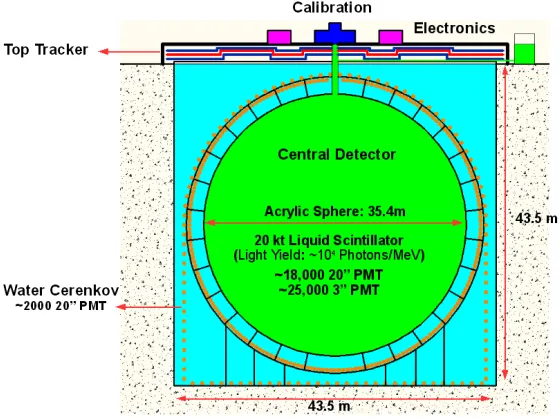
The JUNO [1, 2] experiment, located in southern China, aims to determine the neutrino mass hierarchy. It is about 53 km away from the Yangjiang and Taishan nuclear power plants. To detect neutrinos, a central detector is filled with 20 kt liquid scintillator (LS) target. When a neutrino interacts with LS, it is captured by a proton and then a positron (e+) and a neutron (n) are produced, which is called inverse-beta decay (IBD). Then the positron and the neutron deposit energy in the LS and scintillation photons are produced. These photons propagate in the LS and are collected by the surrounding photomultiplier tubes (PMTs) in the water. Figure 1 shows the schematic view of the JUNO detector, where the innermost part is the central detector which is surrounded by a water Cerenkov detector. The water is used to
suppress radioactivity backgrounds from PMTs, rocks and so on. Equipped with PMTs, the water Cerenkov detector can also measure cosmic ray muons. On the top of the water Cerenkov detector, there is a detector called the top tracker, which can also detect muons.
Figure 1.Schematic view of the JUNO detector.
As part of the offline JUNO software [3], the detector simulation software is important
for detector design, reconstruction algorithm development and physics studies. To fulfill the requirements of Monte Carlo (MC) production, a detector simulation framework [4] is developed based on SNiPER [5] and Geant4 [6, 7]. The framework can support different types
of physics generators by converting the output into a HepMC [8] based event data model. Then the framework loads the HepMC event object and converts it to a Geant4 object, so that Geant4 can start the simulation. A ROOT [9] based event data model, calledSimEvent, is created and filled with hit objects and then put into an event data buffer. The framework saves
the event objects into a ROOT file automatically [10].
In recent years, a multi-threading model has been adopted by several data processing frameworks and libraries, such as Gaudi [11], Geant4 [12] and ROOT. The LHC experi-ments such as ATLAS and CMS experiexperi-ments adopt this model [13–17]. One benefit of a multi-threading model compared with a multi-processing model is the shared memory. For example, the full geometry of JUNO detector is complicated, requiring several hundred MB of physical memory. If the geometry object is shared by multiple threads, the memory usage is reduced significantly. Hence a parallelized detector simulation framework for JUNO was designed and a prototype was implemented based on SNiPER-MT [18].
One challenge for the framework is handling events with time correlation. The order should be preserved for these physics events. For example, a physics generator simulating a supernova burst will generate a series of events with time correlation. When simulating these events using the multi-threading model, the order of events should be kept the same. The supernova burst can be simulated in a dedicated thread, however, the number of events for each supernova burst may differ. The multi-threaded job will finish only when the last event
lock-suppress radioactivity backgrounds from PMTs, rocks and so on. Equipped with PMTs, the water Cerenkov detector can also measure cosmic ray muons. On the top of the water Cerenkov detector, there is a detector called the top tracker, which can also detect muons.
Figure 1.Schematic view of the JUNO detector.
As part of the offline JUNO software [3], the detector simulation software is important
for detector design, reconstruction algorithm development and physics studies. To fulfill the requirements of Monte Carlo (MC) production, a detector simulation framework [4] is developed based on SNiPER [5] and Geant4 [6, 7]. The framework can support different types
of physics generators by converting the output into a HepMC [8] based event data model. Then the framework loads the HepMC event object and converts it to a Geant4 object, so that Geant4 can start the simulation. A ROOT [9] based event data model, calledSimEvent, is created and filled with hit objects and then put into an event data buffer. The framework saves
the event objects into a ROOT file automatically [10].
In recent years, a multi-threading model has been adopted by several data processing frameworks and libraries, such as Gaudi [11], Geant4 [12] and ROOT. The LHC experi-ments such as ATLAS and CMS experiexperi-ments adopt this model [13–17]. One benefit of a multi-threading model compared with a multi-processing model is the shared memory. For example, the full geometry of JUNO detector is complicated, requiring several hundred MB of physical memory. If the geometry object is shared by multiple threads, the memory usage is reduced significantly. Hence a parallelized detector simulation framework for JUNO was designed and a prototype was implemented based on SNiPER-MT [18].
One challenge for the framework is handling events with time correlation. The order should be preserved for these physics events. For example, a physics generator simulating a supernova burst will generate a series of events with time correlation. When simulating these events using the multi-threading model, the order of events should be kept the same. The supernova burst can be simulated in a dedicated thread, however, the number of events for each supernova burst may differ. The multi-threaded job will finish only when the last event