F
OR a number of years ranchers in range arcas of the Provirrrc of Iiritish Columbia and t,hr States of Washington, Idaho and Oregon have claimed that pint needles and pine buds wverc causing nu- tritional or mechanical abortion in range beef cattlc. In British Columbia most claims cent,ered in savannah-like range areas (Fig. 1) where the dominant pine is western yellow pine (Einus ponrlerosa Laws). Such claims of pine needle abor-Virtually no experimwA-d work with pine nredle abortion of beef cat,tle has been reported. Gun, (1928) in writing on t,his problem in range herds stated, “Ken-infectious aborlion is not new to these areas and its possible rawe is yet unknown. The best lead at present indi- cates that it rotates around errors in nutrition.-We are not pwpared t,o admit that pine needles may play a part.”
tion hare been g~nrrally discounted since instances of brucellosis, phosphorous de- ficicncy and vitamin A deficiency, vach a rnusr of abortion are not unknown in these areas. In 1950 the R. C. Beef Gro~rrs Association requested that the Canada Range Experiment Station, IZam- loops, B. C. undertake a study or series of studies to drtermine vhcthcr pine nerdles do or do not cause abort,ion in range berf cattle.
ing on needles of freshly abort.
DESCRIPTION OF
Western yellow pine,
fallen pine will from the Cascade mountains (Henry,
1915).
PLANT EXPERIMENTAL PROCEDURE
locally called During the 1950 fall round-up 18
bull pine, yellow pine, British Columbia Bang’s disease free pregnant range cows pine or jack pine, grows to heights of 160 of Hereford breeding were selected, to 170 feet or more under favourable weighed and divided into three compa- conditions. Ordinarily under range con- rable groups. The animals were housed in ditions it attains a height of 70 to 80 groups in an open faced stock shed. Shav- feet, branches are usually fairly short, ings were used for bedding and provided
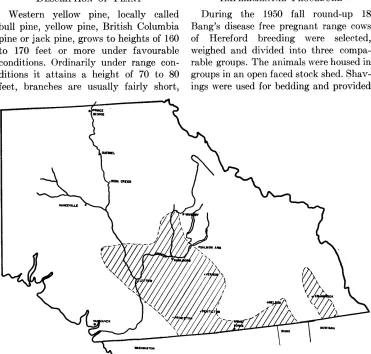
FIGURE 2. DISTRIBUTION OF WE:.;TI~RN ~rsr.mn PINE: IN BRITISII COL.CMRIA
stiff, and upturned. Western yellow pine is peculiar in having its needle-like leaves in bundles of 2 to 5, 3 being the more common. These needles are from 7 to 11 inches long and dark yellow-green in col- our (Henry, 1915).
In Canada this tree is confined to. the drier portions of the southern interior of British Columbia (Fig. 2), extending as far north as Vavenby on the North Thompson River (Canada 1950)) Clinton and the Caribou Road, and eastward
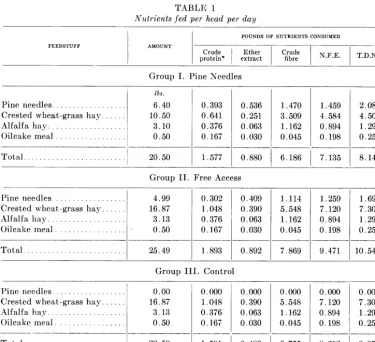
In group I pine needles and buds were fed at a rate of 5 pounds per head per day and gradually increased until at the completion of the trial animals were receiving 8 pounds. The proportion of crested wheatgrass hay was reduced from 15 pounds per head per day according to the weight increase in pine needles fed over 5 pounds. In group II animals were allowed free access to pine needles with no compensatory reduction in cultivated roughage. These fresh needles were placed in the trough daily. Group III animals were refused pine needles. After: the 42nd day 5 pounds of alfalfa hay was fed in replacement for an equal weight of crested wheatgrass hay in all groups. A mineral mixture was available to each group at all times. It was made up of ingredients in the following proportions: bonemeal, 50 pounds; salt, 50 pounds; iron sulphate, 4 ounces; cobalt sulphate, 0.8 ounce; manganese sulphate, 0.5 ounce; copper sulphate 0.3 ounce; potassium iodide 0.3 ounce.
A vitamin A supplement .in the form of pitchardine oil, was provided daily to all animals at the rate of 3000 I.U. per 100 pounds live weight. This was mixed with the oilcake meal and fed immedi- ately.
Hay and concentrate samples were taken for chemical analysis immediately prior to the commencement of the trial and at the approximate mid point of the wintering period. Pine needles and bud samples were analyzed immediately prior t,o the commencement of the trial and at six week intervals throughout the experi- mental period. The samples were analyzed at the Nutrition Laboratory, Canada Experimental Station, Lethbridge, Al- berta for the following constituents : Crude protein, Ether extract; Crude fibre, Ash, Moisture, Nitrogen-free ex- tract, and Carotene.
Each animal was weighed individually
after being on trial 28 days. Being range cows, it was very difficult to weigh with- out exciting them. Weighings were dis- continued at this point to eliminate the possibility of mechanical abortions in- duced during weighing operations.
Daily feed records were kept and the conditions of the animals noted. Mineral consumption was computed every 14 days. The conditions, number and weight of calves born normally or aborted was carefully noted.
RESULTS AND DISCUSSION In weighing the experimental cows after the first 28 day wintering period it was noted t,hat each group recorded gains in weight as did each animal within the groups. Cows in group I started the trial with an initial average weight of 947 pounds and recorded a gain of 65 pounds per head at the completion of the first 28 day feeding period. Cows in group II started at 937 pounds and gained on the average 133 pounds while during the same 28 day period. Group III cows averaged 46 pounds gain from an initial weight of 937 pounds. While no further weights were recorded because of the tempera- ment of the range cows, ocular appraisals indicated that the cows continued to rise in conditions and general appearance until parturition. A summary of the rations fed by groups is given in Table 1. In comparing this ration (assuming 50 percent digestibility) with allowances recommended by Morrison (1945, Table III, p. 1006), and the National Research Council (Guilbert, et al, 1945)) we find
listless and a poor feeder: After one month tinued on May 7 in order that the experi- on trial she was culled from the experi- mental animals could be returned to the ment and returned to the general herd. main herd. The results by groups are Within the herd she calved normally at given in Table 2.
the proper time. In summary, group I cows produced
All cows were bred to commence calving 3 calves born dead, 1 calf born alive and
TABLE 1
N&rients fed per h,gad per day
POUNDS OF NUTRIENTS CONSUMED
FEEDSTUFF
Crude
protein* extract Ether N.F.E. T.D.N.t
Pine needles. ... Crested wheat-grass hay. ... Alfalfa hay ... Oilcake meal. ...
Total...
Group I. Pine Needles
lbs.
6.40 0.393 10.50 0.641 3.10 0.376 0.50 0.167 ----~ __-
20.50 1.577
0.536 1.470 0.251 3.509 0.063 1.162 0.030 0.045 -_- _____
0.880 6.186 .‘_
i
1.459 2.08X 4.584 4.504 0.894 1.296 0.198 0.254 ~ ____-
7.135 8.142
Group II. Free Access
Pine needles . 4.99
Crested wheat-grass hay. 16.87
Alfalfa hay. . 3.13
Oilcake meal . . 0.50 --- ---__ ---- ---
Total . 25.49
0.302 0.409 1.114 1.259 1.690 1.048 0.390 5.548 7.120 7.301 0.376 0.063 1.162 0.894 1.296 0.167 0.030 0.045 0.198 0.254
~- --- --
1.S93 0.892 7.869 9.471 10.541
Group III. Control
Pine needles . . 0.00 Crested wheat -grass hay. . 16.87 Alfalfa hay., . . . 3.13 Oilcake meal . . . 0.50
0.000 0.000 0.000 0.000 0.000
1.048 0.390 5.548 7.120 7.301 0.376 0.063 1.162 0.894 1.296 0.167 0.030 0.045 0.198 0.254
Total _... 20.50 1.591 / 0.483 1 6.755 8.212 8.851
* Crude I’rotein = Nitrogen X 6.25 (Jones, 1931).
t T.D.X.-computed assuming 50?& digestibility.
While the experimental numbers are presence of bred cows since cows will small an analysis of these data indicate nibble on the slash even though ade- statistically significant increase in fre- quately fed.
quency of abortions and stillbirths due to
the effect of eating pine needles and buds CONCLUSION
and it is concluded that they are agents 1. Pine needles and buds are a causa- causing abortion in range beef cattle. tive agent of abortion and the birth of This finding is confirmation of the opin- weak calves.
TARLE 2
Calving record of experimental animals
DATES
February 6 8 March
1
2 6
12 17 21 27 27 28
April 7 24 25 27 28 May
7 17
I Pine needles
Bull
Twins, Bull & Heifer
Bull
Heifer
Heifer
Heifer
GROUP
II Free access
Heifer
I
Bull Heifer
Heifer
Heifer
Bull
III Contro 1
Heifer Heifer
Bull
Bull Bull
ions and beliefs of many stockmen throughout the range areas of British Columbia and adjoining states to the south.
In view of this information it is sug- gested that the bred cow herd be win- tered on areas free of western yellow pine. If this is impossible the lower branches of these trees should be pruned. Logging operations should be discontinued in the
COMMENTS
Born premature and dead
Born premature and dead
Born premature and dead
Born premature & alive-died March 4
Born premature & alive-died March 7
Born alive, died shortly after birth Born alive, weak, died in 36 hours Born alive, normal, weight 70 pounds Born alive, normal, weight 70 pounds Born alive, normal, weight 65 pounds Born alive! appeared normal, died in 18
hrs.
Born alive, normal, weight 75 pounds Born alive, weak, weight 45 pounds Born alive, normal, weight 60 pounds Born alive, normal, weight 78 pounds Born alive, normal, weight 70 pounds
Cattle turned out
Born alive, normal-after turn out.
2. Pregnant range cows will consume quantities of needles and buds even though adequately fed.
3. Pine needles and buds are palatable to wintering stock.
4. Bred range cows should be wintered in areas where such feed is inaccessible.
LITERATURE ClTED
BRUCE, I~. A. 1927. Astragalus serotinus and other stock poisoning plants of British Columbia. Dominion of Canada Dept. Agr .
Bul. No. 88. 44 pp.
Canada Dept. of Mines and Resources. 1939. Native trees of Canada. Bul. 61. King’s Printer, Ottawa. 210 pp.
GUILBERT, H. R., PAUL GERI~OUGH, AND L. L. MADSEX. 1945. Recommended nutrient allowances for domestic animals. No. IV. Recommended Nutrient allowances for beef catt,le. Xat’l Res. Council Wash. D. C. 32 pp.
GUNN, W. R. 1948. B. C. Dept. of Agr.
43rd Annual report. Don McDiarmid, King’s Printer, Victoria, B. C. 228 pp. HENRY, J. K. 1915. Flora of Southern Brit-
ish Columbia and Vancouver Island. W. J. Gage and Co. Ltd. Toronto, Ontario. JONES, D. B. 1931. Factors for Converting
per cent of nitrogen in foods and feeds into percentages of proteins. U. S. Dept. Agr. Cir. No. 183. 22 pp.
MORRISON, F. B. 1945. Feeds and Feeding. 20th ed. The Morrison Pub. Co. Ithaca, N. Y. 1050 pp.
MUENSCHER, W. C. 1945. Poisonous plants of the United States. The Macmillan Co., New York. 266 pp.
SUDWORTH, G. B. 1908. Forest trees for the Pacific slope. U. S. Govt. Ptg. Off. 441 pp.
THE PUBLICATION OF RESEARCH-3
A publication is not judged by its length but by the message it carries. . . . Verbosity and diffuseness suggest a possible lack of really important matter to fill out the space, or at least that the writer has not digested what he has to say.-E. W. AZZen.
A good rule is never to use two pages for a subject that can be compressed by a little thinking into one.-E. F. Smith.