Universally Composable Accumulators
Foteini Badimtsi1[0000−0003−3296−5336], Ran Canetti2[0000−0002−5479−7540], and Sophia
Yakoubov2[0000−0001−7958−8537] 1
George Mason University, Fairfax, VA, [email protected]
2
Boston University, Boston, MA, USA
{canetti,sonka}@bu.edu
Abstract. Accumulators, first introduced by Benaloh and de Mare (Eurocrypt 1993), are compact representations of arbitrarily large sets and can be used to prove claims of membership or non-membership about the underlying set. They are almost exclusively used as building blocks in real-world complex systems, including anonymous credentials, group signatures and, more recently, anonymous cryptocurrencies. Having rigorous security analysis for such systems is crucial for their adoption and safe use in the real world, but it can turn out to be extremely challenging given their complexity.
In this work, we provide the first universally composable (UC) treatment of cryptographic accumulators. There are many different types of accumulators: some support additions, some support deletions and some support both; and, orthogonally, some support proofs of membership, some support proofs of non-membership, and some support both. Additionally, some accumulators support public verifiability of set operations, and some do not. Our UC definition covers all of these types of accumulators concisely in a single functionality, and captures the two basic security properties of accumulators: correctness and soundness. We then prove the equivalence of our UC definition to standard accumulator definitions. This implies that existing popular accumulator schemes, such as the RSA accu-mulator, already meet our UC definition, and that the security proofs of existing systems that leverage such accumulators can be significantly simplified.
Finally, we use our UC definition to get simple proofs of security. We build an accumulator in a modular way out of two weaker accumulators (in the style of Baldimtsiet al.(Euro S&P 2017), and we give a simple proof of its UC security. We also show how to simplify the proofs of security of complex systems such as anonymous credentials. Specifically, we show how to extend an anonymous cre-dential system to support revocation by utilizing our results on UC accumulators.
1
Introduction
dynamic[CL02], remove elements from) the set. If the accumulator isstrong[CHKO08], even a corrupt accumulator manager cannot forge a proof of (non-)membership.
Many crucial primitives are actually special cases of accumulators. For instance, dig-ital signatures are accumulator schemes, where the signature verification key is the ac-cumulator representing the set of signed messages, and the signatures are membership witnesses. The owner of the signing key is the accumulator manager, and she can add elements to the set by signing them. Of course, she cannot un-sign elements (without publishing a revocation list, which is not constant in size), and she cannot produce a proof that a given element has not been signed, so this accumulator is neither dynamic nor universal. She can also always prove the membership of arbitrary elements, so this accumulator is not strong.
Another example of an accumulator is a Merkle hash tree. The tree root is the ac-cumulator representing the set of leaf nodes, and the authenticating paths through the tree are membership witnesses. This accumulator supports both element addition and deletion, but when either of those events occur, all existing witnesses must be updated, requiring total work that is linear in the number of member elements. In many situations, this is prohibitively inefficient. The Merkle hash tree accumulator is strong, because all additions and deletions are publicly verifiable (by means of re-execution). Though the intuitive Merkle hash tree accumulator does not support proofs of non-membership, it can be modified to be universal [CHKO08].
One construction of a universal, dynamic (but not strong) accumulator with efficient update algorithms is the RSA accumulator. It is the original accumulator introduced by Benaloh and de Mare [Bd94], augmented with dynamism by Camenisch and Lysyan-skaya [CL02], and with universality by Li, Li and Xue [LLX07]. It is one of the most popular accumulator constructions because of its compactness and efficiency.
Although accumulators are frequently analyzed as stand-alone primitives, they are
almost exclusively used as building blocksin real-world complex systems, including anony-mous credentials [CL02,Ngu05,CKS09,BCD+17], group signatures [CL02] and, more re-cently, anonymous cryptocurrencies [MGGR13]. Having rigorous security analysis for such systems is crucial for their adoption and safe use in the real world, but it can turn out to be extremely challenging given their complexity. When a system consists of multi-ple building blocks, even if each one of them is proven secure independently, the security analysis of the whole needs to be done from scratch.
Universal Composability. Universally Composable (UC) security [Can01], addresses this problem. Any protocol that has been shown to be UC-secure will maintain its security properties even when it is used concurrently with other arbitrary protocols as part of a larger system. This allows one to formally argue about the security of a complex scheme in a much simpler and cleaner way, as long as all the protocols used within it have already been proven to be UC-secure.
adversary, and interacting with the ideal functionality and simulator. This proves that any time it suffices to use our ideal functionality within a larger system, we can replace it with our protocol and the system will remain secure.
The modularity and the strong security guarantees provided by UC suggest that pro-tocols should always be designed and proven secure in the UC framework. However, this is only the case for a small fraction of proposed cryptographic schemes. One roadblock to using the UC framework is that not all commonly used sub-protocols have UC definitions and proofs. Some such sub-protocols have already been defined and analyzed in the UC framework (e.g. digital signatures [Can01,Can04], zero-knowledge proofs [CKS11], etc.), but others have not. Cryptographic accumulators are one example of a very common primitive that has never been considered in the context of UC security.
Our Results. In this work, we make the following contributions:
1. We provide the first UC definition (ideal functionality) for cryptographic accumu-lators. There are many functionality flavors of accumulators: accumulators might support only additions, only deletions or both, and they might support proofs of membership, proofs of non-membership, or both. Our UC definition covers all of these possibilities in a modular way.
2. We then prove the equivalence of our UC definition to standard accumulator security definitions. This implies that existing secure accumulator constructions — such as the RSA accumulator [Bd94,CL02,LLX07] — are UC secure.
3. Finally, we discuss how our UC definition simplifies the proofs of security for schemes that use accumulators as a building block. First, we build an accumulator out of two weaker accumulators (as in [BCD+17], but with stronger privacy properties), and
give a simple UC proof of security for that composite accumulator, which we call Braavos0. Then, we consider how UC simplifies proofs of security in more complex systems such as anonymous credentials.
Note that when defining a new ideal functionality, there are two possible scenarios: either existing constructions can be proven to securely realize the new functionality (as with digital signatures [Can04]), or new constructions must be developed (as with com-mitment schemes [CF01]). Our second contribution shows that our accumulator function-ality is in the first scenario; popular, existing accumulator constructions already satisfy it. This greatly simplifies the security analysis of existing and future systems that use cryptographic accumulators as a building block.
Informally, two classical properties are considered for cryptographic accumulators. The first is correctness: for every element inside (or outside, for negative accumulators) the accumulated set, an honest witness holder can always prove membership (or non-membership, for negative accumulators) in the set. The second is soundness: for every element outside (or inside, for negative accumulators) the accumulated set, it is infeasible to prove membership (or non-membership, for negative accumulators).
Our ideal functionality is different than most ideal functionalities in that it requires as input from the simulator all of the accumulator algorithms (as previously done in the context of digital signatures [Can04]). This is actually a very intuitive way to build an ideal functionality, since it only deviates from the algorithm outputs when necessary for correctness or soundness. We explain this in more detail in Sec. 3.
made separately, as an additional “layer” on top of the basic correctness guarantees cap-tured in this work. Additionally, privacy-aware constructions often use accumulators and privacy-enhancing mechanisms (such as zero-knowledge proofs) as two separate modules, making the formalization here more conducive to modular analysis. We exemplify this point by sketching a modular analysis of the Baldimtsiet al.[BCD+17] construction of
revocable anonymous credentials from zero knowledge proofs and accumulators.
Outline. We start by setting notation and presenting classical accumulator definitions (but with a twist) in Section 2. Then, in Section 3, we give an ideal UC functionality for accumulators that encompasses both of the properties listed above. In Section 4, we argue that any accumulator that has these properties meets our UC definition, and vice versa. Finally, in Section 5 we discuss how our UC definition of accumulators would simplify the security proof of an existing complex system like anonymous credentials.
1.1 Accumulator Applications
To showcase the importance of a UC analysis for cryptographic accumulators we briefly discuss a few of the most interesting systems that use accumulators as a main building block. The security analysis of all the following systems would be much simpler when the underlying accumulator is UC-secure.
Access Control. Authentication of users is vital to most of the electronic systems we use today. It is usually achieved by giving the user a token, orcredential, that the user must present to prove that she has permission to access a service. A naive construction for an access control system is to maintain a whitelist of authorized users (i.e., by storing their credentials). Whenever a user wants to access the system she just needs to present her credential, and as long as it is on the whitelist, the user will be given access. When a user needs to be revoked, her credential is just removed from the whitelist. Despite its simplicity, such a solution is not practical, since the size of the whitelist will have to grow linearly with the number of participating users.
Cryptographic accumulators enable more efficient access control systems. Instead of keeping a whitelist, an accumulator can be used to maintain the set of authorized users. Whenever a user is given access to the resource, she is given a credential that can be seen as an accumulator membership witness. One possible construction uses the digital signature accumulator together with a blacklist of revoked users, which grows linearly with the number of revocations. This construction is the one most commonly used in public key infrastructures (PKIs), where a certificate revocation list (CRL) that contains the revoked certificates is published periodically. This solution is more efficient, since usually the number of revoked users is much smaller than the number of total users in the system. However, it is still not ideal, since the blacklist can grow to significant size. A dynamic accumulator — which supports both element additions and deletions while remaining small — is a much better solution.
to avoid doing work linear in the number of valid or revoked members in a system. To avoid this inefficiency, anonymous credentials schemes (the most prominent solution for anonymous user authentication) make use of dynamic cryptographic accumulators as an essential building block to allow for efficient proofs of membership (and practical user revocation) [CL02,Ngu05,CKS09]. Idemix [CV02], the leading anonymous credential system by IBM, is such an example of an anonymous credential scheme that employs cryptographic accumulators for user membership management [BCD+17].
Cryptocurrencies. As discussed above, when a proof of membership (or non-membership) needs to be done in zero-knowledge, the naive whitelist and blacklist solutions are not realistic. Anonymous cryptocurrencies, like anonymous credentials, require such zero-knowledge proofs. In order to prove that a payment is valid (and is not a double-spend), when a user wishes to spend a coin that she owns, she must first prove that her coin does not belong in a list of previously spent coins. To ensure anonymity, such a proof must be done in zero-knowledge. Universal cryptographic accumulators are used in Zero-coin [MGGR13] to maintain the set of spent Zero-coins while enabling efficient zero-knowledge proofs of non-membership.
Group Signatures.Accumulators have been suggested for building other cryptographic primitives such as group signatures. In a group signature scheme, the group manager maintains a list of valid group members, and periodically grants (or revokes) member-ship. There has been much research on the topic of group signatures, and a number of efficient schemes have been proposed. One of the first practical solutions supporting revocation uses cryptographic accumulators for user revocation (Camenisch and Lysyan-skaya [CL02], building on the ACJT group signature scheme [ACJT00]).
2
Revisiting Classical Accumulator Definitions
We first discuss accumulator terminology and notation and review accumulator algo-rithms. Then, in Section 2.2, we revise the classical accumulator definitions of security to be more modular, and to support a wider range of accumulator functionalities. These changes make the transition to the UC model more clear and natural.
2.1 Notation and Algorithms
An accumulator is a compact representation of a setS={x1, . . . xn}, which can be used
to prove statements about the underlying set. Different accumulator types and properties have been considered in the literature. Here, we use the terminology and definitions of Baldimtsiet al.[BCD+17], who provide a modular view of accumulator functionalities.
Like them, we consider four basic types of accumulators:
– Static accumulator: represents a fixed set.
– Additive accumulator: supports only addition of elements to the set.
– Subtractive accumulator: supports only deletion of elements from the set.
– Dynamic accumulator [CL02]: supports both additions and deletions.
of time in the number of element additions or deletions which have been performed up until that point. For practical applications a dynamic accumulator should support both additions and deletions in time which is either independent of the number of operations performed altogether, or at least sublinear in this number.
In addition to considering the types of modifications we can make to accumulated sets, we also consider the types of proofs (membership proofs, non-membership proofs, or both) accumulators support.
– Positive accumulator: supports membership proofs.
– Negative accumulator: supports non-membership proofs.
– Universal accumulator [LLX07]: supports both types of proofs.
We consider three types of parties in the accumulator setting. Theaccumulator man-ager is a special party who is the “owner” of the accumulated set: she creates the ac-cumulator, adds and deletes elements, and creates membership and non-membership witnesses. Awitness holder, oruser, is responsible for an accumulated element (i.e. she owns a credential in a system for which an accumulator is used). She is interested in being able to prove the (non-)membership of that element to others, so she maintains the witness for that element, by updating it when/if necessary. Finally, averifier is any third party who is only interested in checking the proofs of (non-)membership (e.g. a gatekeeper checking credentials).
We now describe the algorithms performed by each party, and summarize them in Figure 1. In Figure 2 we summarize the notation used to describe the different accumu-lator algorithm input and output parameters.
Accumulator Manager Algorithms. The following are algorithms performed by the accumulator manager who creates the accumulator and maintains it as required. If the accumulator is additive, she can add elements to it by calling the Update algorithm with Op = Add. If the accumulator is subtractive, she can delete elements by calling UpdatewithOp=Del. If it is dynamic, she can do both. If the accumulator is positive, the accumulator manager can create membership witnesses by calling WitCreate with stts=in(where sttsis a variable representing thestatus of an element, which can bein or outof the set); if it is negative she can create non-membership witnesses by calling WitCreatewithstts=out. If it is universal, she can do both.
– Gen(1λ, S
0) → (sk, a0, m0) outputs the accumulator manager’s secret key sk, the
accumulatora0 (representing the initial setS0⊆Dof elements in the accumulator,
whereDis the domain of the accumulator3), and an auxiliary valuem0necessary for
the maintenance of the accumulator (i.e. one could think ofmtbeing the accumulator
manager’s memory or storage at stept).
– Update(Op, sk, at, mt, x) → (at+1, mt+1, wxt+1,upmsgt+1) updates the accumulator
by either adding or deleting an element. If Op=Add it adds the elementx∈D to the accumulator and outputs the updated accumulator valueat+1and auxiliary value
mt+1, as well as the membership witnesswxt+1forxand an update messageupmsgt+1,
which enables witness holders to bring their witnesses up to date. IfOp=Delthen
3
it deletes the elementxfrom the accumulator and outputsat+1,mt+1 andupmsgt+1
as before, as well as anon-membership witnesswx t+1.
– WitCreate(stts, sk, at, mt, x,(upmsg1, . . . ,upmsgt)) → wtx creates a (non-)
member-ship witness. Ifstts=init generates a membership witnesswx
t forx, and ifstts=out
it generates a non-membership witness. (Of course, this algorithm should only suc-ceed in generating a valid membership witness if x is actually in the set, and in generating a non-membership witness ifxis not in the set.)
Remark 1. The parameters sk, m and upmsg are optional for some accumulator con-structions. For instance, in a Merkle hash tree accumulator there is no secret key sk, and in a digital signature accumulator there is no auxiliary valuemor update messages upmsg. Notice that the WitCreate algorithm takes in both the auxiliary value m and the update messages, which seems redundant; after all, the update messages can always be kept as part of m. The reason we provide the algorithm with both arguments is to account for scenarios which do not use any auxiliary storage.
Remark 2. The notion of a public key is absent on the above definition. One can con-sider the accumulator value ato be the “public key” of the scheme, since it is used for verification. In fact, in the digital signature accumulator construction, the public verifi-cation key is equal to the accumulator value. However, unlike a typical public key, the accumulator value can evolve over time.
Witness Holder Algorithms. Witness holders are interested in proving the (non-)membership of certain elements, and thus maintain witnesses for those elements. They use a witness update algorithmWitUpto sync their witnesses with the accumulator when additions or deletions occur.
– WitUp(stts, x, wx
t,upmsgt+1)→wtx+1 updates the membership witness for elementx
(ifstts=in) or the non-membership witness ifstts=out. The updates use the update messagesupmsg, which contain information about changes to the accumulator value (e.g. that a given element was addedv, what the new accumulator value is, etc).
Verifier/Third Party Algorithms. The last category of accumulator users are the
verifiers(or third parties) who are only interested in checking proofs of (non-)membership. They do so by calling theVerStatusalgorithm.
– VerStatus(stts, at, x, wtx)→φ checks whether the membership witness (ifstts =in)
or the non-membership witness (ifstts=out) for elementxis valid; it returnsφ= 1 if it is, andφ= 0 if it is not.
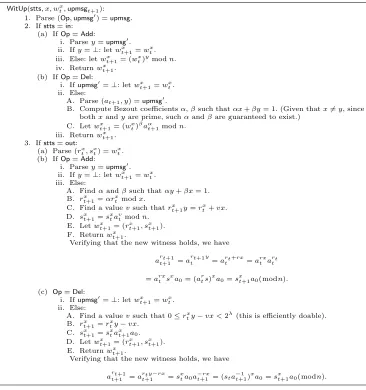
Algorithm Inputs Outputs Accumulator Manager Algorithms
Gen 1λ, S0 sk, a0, m0,v
Update Opt, sk, at, mt, x at+1, mt+1, wxt+1,upmsgt+1,vt+1
WitCreate stts, sk, at, mt,(upmsg1, . . . ,upmsgt), x wxt Witness Holder Algorithms
WitUp stts, x, wx
t,upmsgt+1 wtx+1
Verifier or Third Party Algorithms
VerStatus stts, at, x, wxt φ∈ {0,1}
Additional Third Party Algorithms in Strong Accumulators
VerGen 1λ, S0, a0,v φ∈ {0,1}
VerUpdate Opt, at, at+1, x,vt+1 φ∈ {0,1}
Fig. 1. Accumulator Algorithms. In static accumulators, the Update, WitUp and VerUpdate
algorithms do not exist. In additive accumulators,Opis required to be equal toAddeverywhere. In subtractive accumulators,Op is required to be equal toDel. In dynamic accumulators,Op
can be either. In positive accumulators,sttsis required to be equal toineverywhere. In negative accumulators,sttsis required to be equal toout. In universal accumulators,sttscan be either.
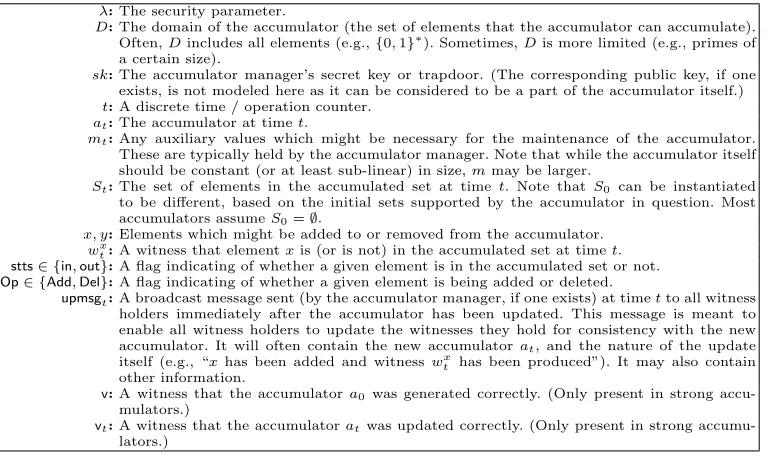
λ:The security parameter.
D:The domain of the accumulator (the set of elements that the accumulator can accumulate). Often,Dincludes all elements (e.g.,{0,1}∗). Sometimes,Dis more limited (e.g., primes of
a certain size).
sk:The accumulator manager’s secret key or trapdoor. (The corresponding public key, if one exists, is not modeled here as it can be considered to be a part of the accumulator itself.)
t:A discrete time / operation counter.
at:The accumulator at timet.
mt:Any auxiliary values which might be necessary for the maintenance of the accumulator. These are typically held by the accumulator manager. Note that while the accumulator itself should be constant (or at least sub-linear) in size,mmay be larger.
St:The set of elements in the accumulated set at timet. Note that S0 can be instantiated
to be different, based on the initial sets supported by the accumulator in question. Most accumulators assumeS0=∅.
x, y:Elements which might be added to or removed from the accumulator.
wx
t:A witness that elementxis (or is not) in the accumulated set at timet. stts∈ {in,out}:A flag indicating of whether a given element is in the accumulated set or not. Op∈ {Add,Del}:A flag indicating of whether a given element is being added or deleted.
upmsgt:A broadcast message sent (by the accumulator manager, if one exists) at timetto all witness holders immediately after the accumulator has been updated. This message is meant to enable all witness holders to update the witnesses they hold for consistency with the new accumulator. It will often contain the new accumulatorat, and the nature of the update itself (e.g., “xhas been added and witnesswxt has been produced”). It may also contain other information.
v:A witness that the accumulatora0 was generated correctly. (Only present in strong
accu-mulators.)
vt:A witness that the accumulatoratwas updated correctly. (Only present in strong accumu-lators.)
Fig. 2.Accumulator Algorithm Input and Output Parameters (from Baldimtsiet al.[BCD+17]).
2.2 Security Definitions
A cryptographic accumulator should satisfy two basic security properties: correctness and soundness. In this section, we review the classical correctness and soundness properties of accumulators (stated, for instance, by Ghoshet al.[GOP+16]). We revise these classical
definitions in several ways.
1. We explicitly consider the correctness of the witness update algorithm, which [GOP+16]
2. We allow the generation of membership witnesses during addition (or non-membership witnesses during deletion) as is commonly done in practice, while [GOP+16] only
con-siders the generation of witnesses from a fixed accumulator state. Because of this, we have two separate notions of correctness —correctness andcreation-correctness.
Correctness Definitions. Definitions 1 and 2 give the correctness requirements for the more general case of a universal dynamic accumulator. Informally, an accumulator is correct or creation-correct if an up-to-date version of a witness produced by Update or WitCreate, respectively, can be used to verify the (non-)membership of the corre-sponding element. It is easy to adapt our definition for cases of additive/subtractive or positive/negative. To get a definition for an additive accumulator, restrict all instances ofOp to be equal toAdd; to get a definition for a subtractive accumulator, restrict all instances ofOpto be equal toDel. Similarly, to get a definition for a positive accumu-lator, restrict all instances of stts to be equal to in; to get a definition for a negative accumulator, restrict all instances ofsttsto be equal toout.
Definition 1 (Correctness).A universal dynamic accumulator is correct for a given domainDof elements if an up-to-date witnesswxcorresponding to valuexcan always be used to verify the (non-)membership ofxin an up-to-date accumulatora. More formally, there exists a negligible functionν in the security parameterλsuch that for all:
– security parametersλ, – initial sets S0⊆D, – values x∈D,
– positive integers tpolynomial in λ, – positive integers tx such that1≤tx≤t,
– operations Op∈ {Add,Del} (with stts=in ifOp=Addandstts=outifOp=Del), – lists of tuples[(y1,Op1), . . . ,(ytx−1,Optx−1)],[(ytx+1,Optx+1), . . . ,(yt,Opt)], where
• yi∈D andOpi∈ {Add,Del} fori∈[1, . . . , tx−1, tx+ 1, . . . , t];
• IfOp=Add, then(x,Del)does not appear in[(ytx+1,Optx+1), . . . ,(yt,Opt)]; and
• IfOp=Del, then(x,Add)does not appear in[(ytx+1,Optx+1), . . . ,(yt,Opt)],
The following holds:
Pr
(a0, sk)←Gen(1λ, S0);
(ai, mi, w yi
i ,upmsgi)←Update(Opi, sk, ai−1, mi−1, yi)fori∈[1, . . . , tx−1];
(atx, mtx, w
x
tx,upmsgtx)←Update(Op, sk, atx−1, mtx−1, x);
(ai, mi, w yi
i ,upmsgi)←Update(Opi, sk, ai−1, mi−1, yi)fori∈[tx+ 1, . . . , t];
wx
i ←WitUp(stts, x, wxi−1,upmsgi)fori∈[tx+ 1, . . . , t]) :
VerStatus(stts, at, x, wxt) = 1
≥1−ν(λ)
Definition 2 (Creation-Correctness).A universal dynamic accumulator is creation-correct for a given domain D of elements if an up-to-date witness wx created by the
WitCreatealgorithm — not by the Update algorithm! — corresponding to value x can always be used to verify the (non-)membership ofxin an up-to-date accumulator a.
– security parametersλ, – initial sets S0⊆D, – values x∈D,
– positive integers tpolynomial in λ, – positive integers tx such that1≤tx≤t,
– statusesstts∈ {in,out}, and
– lists of values[(y1,Op1), . . . ,(yt,Opt)], where
• yi∈D andOpi∈ {Add,Del} fori∈[1, . . . , t];
• Ifstts=in
∗ either (a)x∈S0, or (b)(x,Add)appears in[(y1,Op1), . . . ,(ytx−1,Optx)]and was not followed by(x,Del), and
∗ (x,Del)does not appear in[(ytx+1,Optx+1), . . . ,(yt,Opt)];
• Ifstts=out
∗ either (a)x6∈S0, or (b)(x,Del)appears in[(y1,Op1), . . . ,(ytx−1,Optx)]and was not followed by(x,Add), and
∗ (x,Add) does not appear in[(ytx+1,Optx+1), . . . ,(yt,Opt)];
The following holds:
Pr
(a0, sk)←Gen(1λ, S0);
(ai, mi, wiyi,upmsgi)←Update(Opi, sk, ai−1, mi−1, yi)fori∈[1, . . . , tx];
wxtx←WitCreate(stts, sk, at, mt, x);
(ai, mi, w yi
i ,upmsgi)←Update(Opi, sk, ai−1, mi−1, yi)fori∈[tx+ 1, . . . , t];
wx
i ←WitUp(stts, x, wxi−1,upmsgi)fori∈[tx+ 1, . . . , t]) :
VerStatus(stts, at, x, wxt) = 1
≥1−ν(λ)
Soundness Definitions. Classically,collision-freeness [BP97] is the soundness defini-tion for accumulators. Collision-freeness informally requires that for any element not in the accumulated set it should be hard to find a membership witness. For negative and universal accumulators, collision-freeness can be extended to require that for any element in the accumulated set it should be hard to find a non-membership witness. Another for-malization of accumulator soundness for universal accumulators isundeniability[Lip12], which requires that for any element (regardless of its presence in the accumulated set) it be hard to findboth a membership witness and a non-membership witness.
In this paper, we choose to use collision-freeness, since undeniability is not meaningful for positive or negative accumulators, which only support proofs of membership or proofs of non-membership but not both. Definition 3 gives the collision-freeness definition for a universal dynamic accumulator. This definition can be converted to work for positive, negative, additive or subtractive accumulators in the usual way (by limiting the possible values ofOporstts).
Definition 3 (Collision-Freeness).A universal dynamic accumulator is collision-free
for a given domainD of elements if it is hard to fabricate a (non-)membership witness
Challenger AColFree
S=S0ifS0provided,∅otherwise
S0
←−−−−−−−−−−−−−−−−−−
t= 0
(sk, a0, m0)←Gen(1λ, S0) a 0
−−−−−−−−−−−−−−−−−−→
x∈D,Op∈ {Add,Del} ←−−−−−−−−−−−−−−−−−−
p(λ) times
t=t+ 1 IfOp=Add:S=S∪ {x}
IfOp=Del:S=S\{x}
(at+1, mt+1, wxt+1,upmsgt+1)←Update(Op, sk, at, mt, x)a
t−−−−−−−−−−−−−−−−−−→+1, mt+1, wxt+1,upmsgt+1
x∗∈D, w∗
←−−−−−−−−−−−−−−−−−−
Fig. 3.The Collision-Freeness Game.AColFree wins if (VerStatus(in, at+1, x∗, w∗) = 1 and x∗6∈
S), or (VerStatus(out, at+1, x∗, w∗) = 1 andx∗∈S).
Non-Adaptive Soundness. In the collision-freeness game of Figure 3, the adversary is able to choose elements to add and delete adaptively. However, this notion of collision-freeness (or soundness) is quite strong. In a non-adaptive4 version of the game, the adversary would be required to commit to all elements it intends to add before seeinga0.
Certain accumulators can only be shown to meet non-adaptive soundness. One example of such an accumulator is the CLRSAB accumulator, which was informally introduced as a brief remark by Camenisch and Lysyanskaya [CL02] and formally described by Baldimtsiet al.[BCD+17]. Note that, in particular, a non-adaptively sound accumulator
can always be used to accumulate random values, since it makes no difference whether random values are chosen beforehand or on-the-fly.
Strength. Typically, accumulators are not required to be secure against cheating ac-cumulator managers, since in many scenarios the entity that manages the set (and thus the accumulator) is trusted. When that is not the case (e.g. in many blockchain appli-cations), astrong accumulator can be used. A strong accumulator provides guarantees even against a cheating accumulator manager. Informally, an accumulator isstrongif all of the modifications an accumulator manager makes to the accumulator are verifiable.
Definition 4 (Strength).An accumulator isstrongfor a given domainDof elements if an adversary cannot win the game described in Figure 3 with non-negligible probability even if it is modified as follows: instead of asking the challenger to runGen andUpdate, the adversary runs them locally and sends the challenger the updated accumulator values together with witnessesv. The challenger aborts if VerGenorVerUpdatereturn0.
We must also ensure the correctness of the VerGenandVerUpdatealgorithms.
Definition 5 (Strength Correctness).Informally, an accumulator has strength cor-rectnessif VerGen andVerUpdate run on honestly generated inputs and outputs of Gen
andUpdate always return1.
4 Note that this does not refer to non-adaptive corruptions, as in the context of MPC; it is not
3
Ideal Functionality for Accumulators
Universally Composable (UC) security, proposed by Canetti [Can01] and described briefly in Section 1, requires a different flavor of definitions than those described in Section 2. A UC definition of security for some primitive consists of a set of instructions called anideal functionality which achieves the goals of the primitive when carried out by an incorruptible third party. Informally, to show that a candidate protocolsecurely realizes
the ideal functionality, it must be shown that any adversary in a real execution of the protocol can be simulated by a corresponding ideal world adversary in an interaction with the incorruptible third party running the ideal functionality.
Definition 6 ([Can01, Page 12]).LetexecΠ,A,Z denote the random variable (over the
local random choices of all the involved machines) describing the output of environment Z when interacting with adversaryA and parties running protocol Π. Protocol Π UC-emulates ideal functionality F if for any adversary A there exists a simulator SIM such that, for any environment Z the distributions of execΠ,A,Z and execF,SIM,Z are
indistinguishable. That is, on any input, the probability thatZ outputs1after interacting withAand parties runningΠ differs by at most a negligible amount from the probability thatZ outputs1 after interacting withSIM andF.
In this section we present our ideal functionalityFACC for an accumulator.
Like [Can04], we discuss several candidate ideal functionalities in order to build up the intuition for how we arrived at the ideal functionality described in Fig. 4 and 5.
First Attempt. A naive first attempt at an accumulator functionality might ignore the accumulator and witness objects altogether, instead functioning as a simple set manager. It would allow the accumulator manager to add and remove elements from the set, and answer ‘yes’ or ‘no’ to membership (or non-membership) queries. These queries could optionally be parametrized by timestamps, so as to allow queries about all states of the set, past and present. However, this simple ideal functionality definition fails to support one of the basic modular operations of accumulators. Recall that an accumulator is an object that evolves by time, i.e. at timetit might represent a different set from what it used to represent at timet0. Thus, if we do not consider explicit accumulator objects, then it is impossible to talk about committing to a given set by committing to an accumulator value at a specific time.
with existing off-the-shelf primitives such as secret sharing, encryption, or commitment. In other words, having the functionality give binary answers to membership queries is over-idealization; it is a good way to model accumulators on their own, but it does not lend itself to use by other protocols that need actual accumulator and witness values to operate.
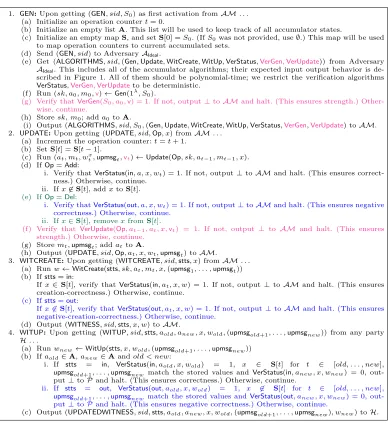
Final Attempt. Our ideal functionality for accumulatorsFACCis described in Figures 4 and 5 and provides interfaces for all of the algorithms in Figure 1. (Note that in the functionality the accumulator manager interfaces ignore all queries for which the querier’s identity is not encoded in the functionality session idsid.)
We loosely base FACC on the ideal functionality for digital signatures described by Canetti [Can04]. Canetti actually gave two different functionalities for digital signatures, which we recall for completeness in Appendix A. The first one (Figure 7) asks the ideal world adversary for a verification key; while the second (Figure 8) asks the ideal world adversary for a verification algorithm. Similarly, Camenisch et al. [CDT19] give func-tionalities for signatures, non-interactive zero knowledge proofs and for commitments that are explicitly parameterized by the protocol algorithms. Using a given deterministic signature verification algorithm, rather than allowing the ideal world adversary to make each verification decision, achieves two goals:
– It forces verification decisions to be consistent.
– It makes combining UC signatures and zero knowledge proofs of signature knowledge in a black box way simpler.
For these reasons, we chose to define ourFACCto receive explicit algorithms from the
ideal world adversary. Thus, instead of asking the ideal world adversary to provide up-dated accumulator states, witnesses and verification decisions, our ideal world adversary providesall accumulator algorithms to the functionality (Step 1e in Figure 4).5 This is
a very intuitive way to define an ideal functionality: it explicitly uses the accumulator algorithms except where it needs to modify their behavior to match what is demanded by correctness or soundness. If an ideal execution (that uses the ideal functionality) is indistinguishable from a real execution, that means that the algorithms’ behavior did not need any modification.
Just like in the context of digital signatures, if the algorithms are modeled explicitly, usage within multi-party computation (MPC) protocols or in larger zero-knowledge-based systems such as Zcash can be done in a modular way, using existing components. In addition to the benefits listed above, this also allows us more flexibility to add privacy features to the ideal functionality, as discussed in Section 3.3.
Remark 3. Note that inputs belonging to anyone but the accumulator manager (AM) can be misinformed (just like parties are frequently misinformed about verification keys in signature schemes, in the absence of a PKI). In order to capture such cases, we require parties to provide all inputs to witness holder and third party algorithms, instead of having some inputs, such as the accumulator value, implicitly stored by the ideal functionality.
5 These algorithms will, among other things, check that elements being added are in the domain
1. GEN:Upon getting (GEN, sid, S0) as first activation fromAM. . .
(a) Initialize an operation countert= 0.
(b) Initialize an empty listA. This list will be used to keep track of all accumulator states.
(c) Initialize an empty mapS, and setS[0] =S0. (IfS0was not provided, use∅.) This map will be used
to map operation counters to current accumulated sets. (d) Send (GEN, sid) to AdversaryAIdeal.
(e) Get (ALGORITHMS, sid,(Gen,Update,WitCreate,WitUp,VerStatus,VerGen,VerUpdate)) from Adversary
AIdeal. This includes all of the accumulator algorithms; their expected input output behavior is de-scribed in Figure 1. All of them should be polynomial-time; we restrict the verification algorithms VerStatus,VerGen,VerUpdateto be deterministic.
(f) Run (sk, a0, m0,v)←Gen(1λ, S0).
(g) Verify thatVerGen(S0, a0,v) = 1. If not, output⊥toAMand halt. (This ensures strength.)
Other-wise, continue.
(h) Storesk,m0; adda0toA.
(i) Output (ALGORITHMS, sid, S0,(Gen,Update,WitCreate,WitUp,VerStatus,VerGen,VerUpdate) toAM.
2. UPDATE:Upon getting (UPDATE, sid,Op, x) fromAM. . . (a) Increment the operation counter:t=t+ 1.
(b) SetS[t] =S[t−1].
(c) Run (at, mt, wxt,upmsgt,vt)←Update(Op, sk, at−1, mt−1, x).
(d) IfOp=Add:
i. Verify thatVerStatus(in, a, x, wt) = 1. If not, output⊥toAMand halt. (This ensures correct-ness.) Otherwise, continue.
ii. Ifx6∈S[t], addxtoS[t]. (e) IfOp=Del:
i. Verify thatVerStatus(out, a, x, wt) = 1. If not, output⊥toAMand halt. (This ensures negative
correctness.) Otherwise, continue. ii. Ifx∈S[t], removexfromS[t].
(f) Verify that VerUpdate(Op, at−1, at, x,vt) = 1. If not, output ⊥ to AMand halt. (This ensures strength.) Otherwise, continue.
(g) Storemt,upmsgt; addattoA.
(h) Output (UPDATE, sid,Op, at, x, wt,upmsgt) toAM. 3. WITCREATE:Upon getting (WITCREATE, sid,stts, x) fromAM. . .
(a) Runw←WitCreate(stts, sk, at, mt, x,(upmsg1, . . . ,upmsgt)) (b) Ifstts=in:
Ifx∈S[t], verify thatVerStatus(in, at, x, w) = 1. If not, output⊥toAMand halt. (This ensures creation-correctness.) Otherwise, continue.
(c) Ifstts=out:
Ifx6∈S[t], verify thatVerStatus(out, at, x, w) = 1. If not, output⊥toAMand halt. (This ensures
negative-creation-correctness.) Otherwise, continue. (d) Output (WITNESS, sid,stts, x, w) toAM.
4. WITUP:Upon getting (WITUP, sid,stts, aold, anew, x, wold,(upmsgold+1, . . . ,upmsgnew)) from any party
H. . .
(a) Runwnew←WitUp(stts, x, wold,(upmsgold+1, . . . ,upmsgnew)) (b) Ifaold∈A,anew∈Aandold < new:
i. If stts = in, VerStatus(in, aold, x, wold) = 1, x ∈ S[t] for t ∈ [old, . . . , new], upmsgold+1, . . . ,upmsgnew match the stored values andVerStatus(in, anew, x, wnew) = 0, out-put⊥toPand halt. (This ensures correctness.) Otherwise, continue.
ii. If stts = out, VerStatus(out, aold, x, wold) = 1, x 6∈ S[t] for t ∈ [old, . . . , new],
upmsgold+1, . . . ,upmsgnew match the stored values andVerStatus(out, anew, x, wnew) = 0,
out-put⊥toPand halt. (This ensures negative correctness.) Otherwise, continue.
(c) Output (UPDATEDWITNESS, sid,stts, aold, anew, x, wold,(upmsgold+1, . . . ,upmsgnew), wnew) toH.
Fig. 4.Ideal FunctionalityFACCfor Accumulators With Explicit Verification Algorithm
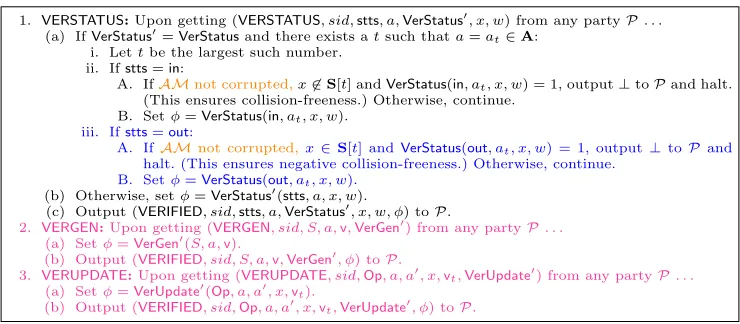
1. VERSTATUS:Upon getting (VERSTATUS, sid,stts, a,VerStatus0, x, w) from any partyP. . . (a) IfVerStatus0=VerStatusand there exists atsuch thata=at∈A:
i. Lettbe the largest such number. ii. Ifstts=in:
A. IfAMnot corrupted,x6∈S[t] andVerStatus(in, at, x, w) = 1, output⊥toPand halt. (This ensures collision-freeness.) Otherwise, continue.
B. Setφ=VerStatus(in, at, x, w). iii. Ifstts=out:
A. IfAMnot corrupted,x∈S[t] andVerStatus(out, at, x, w) = 1, output⊥toP and
halt. (This ensures negative collision-freeness.) Otherwise, continue. B. Setφ=VerStatus(out, at, x, w).
(b) Otherwise, setφ=VerStatus0(stts, a, x, w).
(c) Output (VERIFIED, sid,stts, a,VerStatus0, x, w, φ) toP.
2. VERGEN:Upon getting (VERGEN, sid, S, a,v,VerGen0) from any partyP. . . (a) Setφ=VerGen0(S, a,v).
(b) Output (VERIFIED, sid, S, a,v,VerGen0, φ) toP.
3. VERUPDATE:Upon getting (VERUPDATE, sid,Op, a, a0, x,vt,VerUpdate0) from any partyP. . . (a) Setφ=VerUpdate0(Op, a, a0, x,vt).
(b) Output (VERIFIED, sid,Op, a, a0, x,v
t,VerUpdate0, φ) toP.
Fig. 5.Ideal FunctionalityFACC Interfaces for Third Parties
We use color coding to describe different types of accumulators within the same functionality. If the ideal functionality is limited to the black text, it describes a positive additive accumulator. Actions that are present only in subtractive accumulators are coloredgreen. Actions that are present only in negative accumulators are coloredblue. Finally, actions that are present only in strong accumulators are colored pink; actions
not present in strong accumulators are coloredorange.
We use FACC to refer to the universal dynamic accumulator functionality. We add Add,Del,inandoutto the subscript to denote additive, subtractive, positive and negative accumulators, respectively. We add other parameters to the subscript (e.g. ‘STRONG’) to denote other properties.
3.1 Modeling Decentralized Management
If the accumulator is strong, it may make sense to allow anyone to perform an accumula-tor update, instead of restricting the ability to perform such updates to the accumulaaccumula-tor manager. We model this by making a few changes to the functionality. First, the GEN, UPDATEandWITCREATEinterfaces of the ideal functionality no longer only accept in-vocations byAM. Additionally, instead of having a strict ordering of update operations, we might allow parties to perform an update on any accumulator state, resulting in a tree of states. The functionality will be modified to perform the appropriate checks and record-keeping.
3.2 Modeling Non-Adaptive Soundness
3.3 Adding Privacy Properties
Our ideal functionality as stated in Figures 4 and 5 does not make any attempt to hide anything about the accumulated set from any accumulator user. In this section, we discuss how we add such privacy properties to the ideal functionality.
Add-Delete Unlinkability. In certain scenarios it is desirable that an adversary should not be able to link an addition of an element to a deletion of the same element later on. Such a property is relevant when accumulators are used as an anonymous revocation mechanism where the revocation information should not allow anyone to determine that the user revoked just now was the user who joined two hours ago, and not the user who joined four hours ago [BCD+17]. We do not formally model add-delete unlinkability; instead, we define a stronger property which we callhiding update-message (HUM).
Hiding Update-Message (HUM). Informally, an accumulator ishiding update-message, or HUM, if given all of the update messages produced in the course of an execution, it is impossible to tell whether one specific update message corresponds to the addition / deletion of elementx0 or elementx1forx0, x1∈D.
We can incorporate HUM into our ideal functionality by placing limitations on the algorithm Update provided by the ideal world adversary. We requireUpdate to consist of two sub-algorithms: one sub-algorithm — Update1 — which receives no input at all except for randomness, and produces the update message; and a second sub-algorithm — Update2 — which can receive state from Update1 as well as all of the other inputs typically provided toUpdate, and produces all the other outputs ofUpdate. This forces update messages to reveal nothing about the added / deleted element.
Note that this modification is very strong, since it forces the update messages to sta-tistically hide the elements; constructions where the elements are only computationally hidden would not meet this definition. This modification trivially implies the add-delete unlinkability property described above, since update messages now contain no informa-tion at all about the elements.
Remark 4. We clearly need to withholdxfrom Update1, in order to guarantee that the update message does not revealx. However, we could consider allowing Update1 to see the other inputs to Update. This would not work because if we give Update1 access to the accumulatoraor the auxiliary valuem, then the update message it produces might contain arbitrary information about the set of elements accumulated prior to the current operation. In particular, the update message might reveal which elements were added / deleted previously, breaking the HUM property.
3.4 Discussion: Incorrect Accumulator and Witness Values
If an incorrect accumulator value (or verification algorithm VerStatus0) is provided to the verification interface, we allow the party making the query to control the verification verdict, viaVerStatus0. This models the fact that any party can issue verification queries for accumulator values of their choice — for instance, for accumulator values which they may have generated themselves, and for which they control the accumulated set.
If an incorrect witness for a member element is provided to the verification interface, we allow the ideal world adversary to control the verification verdict (via the algorithm VerStatusit provides during the generation phase). This models the fact that we only re-quire the ideal world adversary to be unable to come up with a witness for anon-member (or a non-membership witness for a member); we do not require that an adversary be unable to come up with a witness for a member (or a non-membership witness for a non-member). For instance, it may be possible to modify valid witnesses to obtain other witnesses for the same element. Note also that multiple witnesses can be generated for the same element by means of theWitCreateinterface.
4
Equivalence Argument
Like Canetti [Can04], we prove that satisfying our UC definition for dynamic universal accumulators is the same as satisfying the classical definition.6
Theorem 1. Let ΠACC = (Gen,Update,WitCreate,WitUp,VerStatus)be a universal dy-namic accumulator scheme, and let VerStatus be deterministic. ThenΠACC securely re-alizesFACC if and only if ΠACC satisfies Definitions 1, 2 and 3.
Proof. Our proof follows the structure of the proof of Canetti [Can04] (pages 12-14).
1. We start by assuming thatΠACCdoes not satisfy Definitions 1, 2 and 3. We then show
thatΠACCalso does not securely realizeFACC. To do this, we build an environmentZ
and an adversaryARealsuch that for any simulatorSIM,Zcan distinguish between
interacting with AReal and ΠACC, and interacting with SIM and FACC. Like the
environment of Canetti [Can04], our environment does not corrupt any parties, and does not send any messages to the adversary. Because all accumulator operations are non-interactive, meaning that they are run locally by individual parties, no messages are exchanged in the real world. So, the adversaryAReal is never activated.
(a) Assume ΠACC is not correct (i.e. does not satisfy Definition 1). That is, there
exists a security parameterλ, an initial setS0⊆D, a valuex∈D, an operation
Op∈ {Add,Del}(withstts=inifOp=Addandstts=outifOp=Del) and a list of values [(y1,Op1), . . . ,(ytx−1,Optx−1)], [(ytx+1,Optx+1), . . . ,(yt,Opt)], where
– yi∈DandOpi∈ {Add,Del}fori∈[1, . . . , tx−1, tx+ 1, . . . , t];
– IfOp=Add, then (x,Del) does not appear in [(ytx+1,Optx+1), . . . ,(yt,Opt)];
and
– IfOp=Del, then (x,Add) does not appear in [(ytx+1,Optx+1), . . . ,(yt,Opt)],
6
such that with non-negligible probability, the honestly-produced witness for x
against accumulatoratwill not verify.
Our environmentZwill send the following commands to some partyAM, where
sidencodes the identity ofAM:
– (GEN, sid, S0),
– (UPDATE, sid,Op1, y1), . . . ,(UPDATE, sid,Optx−1, ytx−1), – (UPDATE, sid,Op, x), and
– (UPDATE, sid,Optx+1, ytx+1), . . . ,(UPDATE, sid,Opt, yt).
As a result of the third step, Z will learn atx and w
x
tx. As a result of the
fourth step,Zwill learnatandt−txupdate messages (upmsgtx+1, . . . ,upmsgt).
It then sends (WITUP,stts, sid, atx, at, x, w
x
tx,(upmsgtx+1, . . . ,upmsgt)) to some
party H (where possibly H = AM), and receives wtx back. Finally, it sends
(VERSTATUS, sid,stts, at,VerStatus0=VerStatus(·,·,·,·), x, wtx) to some partyP
(which may be the same party or not).Z outputs the returned verdictφ. In the real world, φ will be 0 with non-negligible probability according to our assumption.
In the ideal world, if no error messages are returned,φ will always be 1, since inWitUp, we will always hit Item 4(b)i or 4(b)ii of Figure 4, and there the first three listed conditions will be satisfied.
(b) Assume ΠACC is not creation-correct (i.e. does not satisfy Definition 2). Z can
distinguish between the real and ideal worlds in a way very similar to that de-scribed above.
(c) Assume ΠACC is not collision-free (i.e. does not satisfy Definition 3). That is,
there exists an adversary AColFree that can forge a (non-)membership witness for a non-member (or member, respectively) xwith non-negligible probability. OurZ will useAColFreeto generate inputs forAM. Having receivedx∗, w∗ from
AColFree,Zwill computeφinby calling (VERSTATUS, sid,in, at, x∗, w∗), andφout
by calling (VERSTATUS, sid,out, at, x∗, w∗). Z will then output 1 if x∗ was in
the accumulated set andφout = 1 or ifx∗ was not in the accumulated set and
φin= 1, and will output 0 otherwise.
In the real world, if AColFree met the collision-freeness win conditions, Z will output 1 with non-negligible probability according to our assumption.
In the ideal world, bothφinandφoutwill always be 0 or⊥, since we will satisfy the
first two conditions in Item 1(a)iiA (or Item 1(a)iiiA, ifstts=out) ofVERSTATUS in Figure 5. If the third condition is satisfied too,⊥will be returned. If it is not, 0 will be returned, as a result of Item 1(a)iiB (or Item 1(a)iiiB, ifstts=out) in Figure 5.
2. We now prove the other direction. Assume thatΠACCdoes not securely realizeFACC.
That is, there exists an adversary AReal such that for any simulator SIM, there exists an environment Z that can distinguish between interacting with AReal and
ΠACC, and interacting withSIMandFACC. We show that if that is the case,ΠACC
must also violate Definition 1, 2 or 3. We pick a simulator SIM that proceeds as follows, running an internal copy ofAReal:
– Inputs fromZ is forwarded toAReal. Outputs fromAReal is forwarded toZ.
– SIMhandles corruptions according to the standard corruption model [Can01].
This simulator guarantees that the real and ideal worlds will be distributed identically,
unless one of the following causesFACC to return⊥:
– In Update, FACC hits Item 2(d)i or 2(e)i of Figure 4. If this happens, correctness (Definition 1) is violated.
– InWitCreate,FACChits Item 3b or 3c of Figure 4. If this happens, creation-correctness (Definition 2) is violated.
– InVerStatus,FACChits Item 1(a)iiA or 1(a)iiiA of Figure 5. If this happens, collision-freeness (Definition 3) is violated.
– InWitUp,FACChits Item 4(b)i or 4(b)ii of Figure 4. If this happens, either correctness or creation-correctness is violated.
In order for Z to distinguish between the real and ideal worlds, one of the above must happen with non-negligible probability, and thus either Definition 1, 2 or 3 must be violated with non-negligible probability.
We can modify the theorem and proof to also prove equivalence between classical and UC definitions for strong accumulators.
Corollary 1. LetΠACC= (Gen,Update,WitCreate,WitUp,VerStatus,VerGen,VerUpdate) be a strong universal dynamic accumulator scheme, and letVerStatus,VerGenandVerUpdate be deterministic. ThenΠACC securely realizesFACC,ST RON G if and only ifΠACC satisfies Definitions 1, 2 and 4.
Proof. The proof is very similar to that of Theorem 1 above, with a few changes. The changes are in Steps 1c and 2 of the proof.
In Step 1c of the proof above, instead of calling AColFree, we call AStrengthwhich runs Gen and Update itself. The environment Z computes its output exactly as before. In the ideal world, bothφin and φout will always be 0 or⊥, since we will satisfy the first
condition in Item 1(a)iiA (or Item 1(a)iiiA, ifstts=out) ofVERSTATUS (ignoring the condition thatAMis not corrupted, which does not apply for a strong accumulator). If the third condition is satisfied too,⊥will be returned. If it is not, 0 will be returned, as a result of Item 1(a)iiB (or 1(a)iiiB, ifstts=out) of Figure 5.
In Step 2 of the proof above, SIM includes VerGen and VerUpdate in the list of algorithms it sends to the ideal functionality. Then, in the list of things that might cause
FACC,ST RON G to return⊥, we replace the third bullet with the following:
– InVerStatus,FACC hits Item 1(a)iiA or 1(a)iiiA of Figure 5. If this happens, strength
(Definition 4) is violated.
We also add the following:
– In Gen, FACC,ST RON G returns ⊥at Item 1g of Figure 4. If this happens, strength
correctness (Definition 5) is violated.
– InUpdate,FACC,ST RON G returns⊥at Item 2f of Figure 4. If this happens, strength
correctness (Definition 5) is violated.
5
Demonstrations of Composition
5.1 Accumulator Composition: Braavos
Baldimtsiet al.[BCD+17] show how one can build accumulators with certain properties
by composing other types of (potentially weaker) accumulators. Among other examples, Baldimtsiet al.build theBraavosaccumulator. We present a modified version of Braavos, which we call Braavos0. Braavos0is ahiding update-message (HUM)dynamic accumulator as described in Section 3.3. We describe Braavos0 in Figure 6.
Just like Braavos, Braavos0 leverages the following two weaker accumulators:
1. SIG: A positive (but not dynamic) additive accumulator, in the form of a digital signature scheme. Note that this accumulator does not have any update messages (and we thus omit update messages from its inputs and outputs).
2. CLRSAB: A non-adaptively-sound negative additive accumulator. One example of such an accumulator is theCLRSABconstruction7, informally introduced as a brief
remark by Camenisch and Lysyanskaya [CL02] and formally described by Baldimtsiet al.[BCD+17].
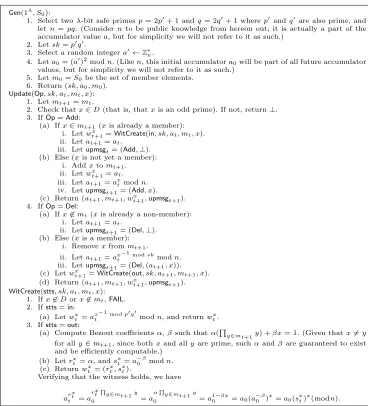
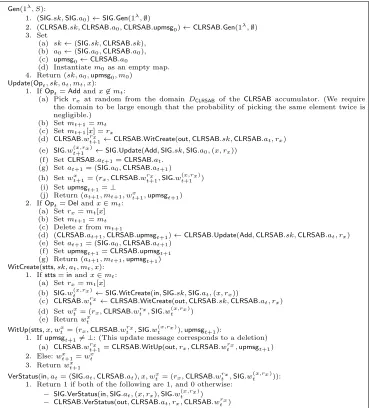
Informally, Braavos0 works as follows. When a new element xis added, a random valuerx is chosen to correspond to it, and the pair (x, rx) is accumulated inSIG. Since
we use a digital signature scheme, no update message is sent. A proof of membership forxconsists of the value rx, a proof of membership of (x, rx) in SIG (which is simply
a digital signature), and a proof of non-membership of rx in CLRSAB. Then, when the
element x is deleted, rx is added to CLRSAB (so a proof of non-membership of rx in
CLRSAB can no longer be produced). Next time x is added, a fresh random value is chosen, and so forth.
Unlike Braavos0, Braavos [BCD+17] uses the same random value every time a given element is re-added, instead of choosing fresh random values. This has the advantage of saving on accumulator manager storage requirements. However, it has the disadvantage that deletions of the same element can all be linked to one another, since the same random value is present in all of the associated update messages. This violates the HUM property8 (but not the add-delete unlinkability property, which is the one Baldimtsiet al.require).
Braavos0is obviously HUM, since it (a) has empty update messages for additions, and (b) has update messages for deletions that are completely independent of the element being deleted. Intuitively, it is secure because if an element was never added then no signature on it exists, and every time an elementxis removed, all random valuesrxthat
have been signed withxare in theCLRSABaccumulator, so no proof of non-membership for any suchrx can be produced.
More formally, letFACC,in,HU Mbe our accumulator functionalityFACCfor a dynamic,
positive, HUM accumulator. That is, FACC,in,HU M is FACC restricted to stts = in, and
requiring the simulator to provideUpdatein two parts, as necessary for HUM (described in Section 3.3). Similarly, let FACC,in,Add be our accumulator functionality FACC for a
7 TheCLRSAB accumulator is actually universal and dynamic, but we only require it to be
negative and additive. 8
positive additive accumulator, and letFACC,out,Add,N A be our accumulator functionality
FACC for a negative additive accumulator that is non-adaptively sound (Section 3.2).
Theorem 2. The Braavos0accumulator described in Figure 6 securely realizesFACC,in,HU M
as long asSIGsecurely realizesFACC,in,Addwith no update messages, andCLRSABsecurely realizesFACC,out,Add,N A.
We can prove Theorem 2 very simply using the fact that both SIG and CLRSAB are UC-secure (that is, by operating in the double-FACC-hybrid model). Before our UC definitions, a proof of security would involve a multi-step security reduction of the new accumulator to one of the old ones.
Proof. The simulator for the new accumulator uses its two inner simulators to obtain algorithms for the inner accumulators, composes them as in Figure 6, and submits those to the ideal functionality. (Since theCLRSABaccumulator is only non-adaptively sound, the simulator also pre-selects the random values that are to be accumulated in the CLRSABaccumulator.)9
In Section 3.3, we described how in order to modify the UC functionality FACC to be HUM, we require that the simulator provide the algorithm Update in two parts: one sub-algorithm (let’s call itUpdate1) which only receives randomness and produces the update message; and a second sub-algorithm (let’s call it Update2) which produces all the other outputs of Update, and is additionally allowed to depend on the state of Update1. If the update being performed is an addition, we do not need Update1 at all, since no update message is necessary; we simply set Update2(Add, sk, at, mt, x) =
Update(Add, sk, at, mt, x). If the update being performed is a deletion, Update1(Del,
sk, at, mt) gets a random pre-selected value and performs a CLRSAB addition on it;
it then passes the random value it added as stateUpdate1 to Update2(Del, sk, at, mt, x,
stateUpdate1) which does the rest of the work.
The views of the environment Z in the real and ideal worlds will be identical in the so-called double-FACC-hybrid model, since the sub-accumulator functionalities guarantee that if an element was never added then no signature on it exists, and every time an element x is removed, all random values rx that have been signed with x are in set
accumulated inCLRSAB, so no proof of non-membership for any suchrxcan be produced.
5.2 Accumulators for Anonymous Credentials
We now informally discuss how our UC definition of accumulators would simplify the security proof of a complex system like anonymous credentials. An ideal functionality that provides all the properties of anonymous credentials including pseudonyms, selective attribute disclosure, predicates over attributes, revocation, inspection, etc. is described by Camenischet al.[CDHK15]. (Baldimtsiet al.[BCD+17] augment this functionality with
revocation.) In this section, to demonstrate the benefits of modularity we concentrate on a simplified version of an anonymous credential ideal functionality with three types of parties: the credential manager or issuer, credential holders, and credential verifiers. Our ideal functionality has the following interfaces for the credential manager:
9 Notice that this works regardless of how the simpler accumulators are implemented (simply
Gen(1λ, S):
1. (SIG.sk,SIG.a0)←SIG.Gen(1λ,∅)
2. (CLRSAB.sk,CLRSAB.a0,CLRSAB.upmsg0)←CLRSAB.Gen(1λ,∅)
3. Set
(a) sk←(SIG.sk,CLRSAB.sk), (b) a0←(SIG.a0,CLRSAB.a0),
(c) upmsg0←CLRSAB.a0
(d) Instantiatem0as an empty map.
4. Return (sk, a0,upmsg0, m0)
Update(Opt, sk, at, mt, x): 1. IfOpt=Addandx6∈mt:
(a) Pickrx at random from the domain DCLRSABof the CLRSABaccumulator. (We require
the domain to be large enough that the probability of picking the same element twice is negligible.)
(b) Setmt+1=mt (c) Setmt+1[x] =rx
(d) CLRSAB.wrxt+1←CLRSAB.WitCreate(out,CLRSAB.sk,CLRSAB.at, rx) (e) SIG.w(t+1x,rx)←SIG.Update(Add,SIG.sk,SIG.a0,(x, rx))
(f) SetCLRSAB.at+1=CLRSAB.at.
(g) Setat+1= (SIG.a0,CLRSAB.at+1)
(h) Setwxt+1= (rx,CLRSAB.wtrx+1,SIG.w (x,rx)
t+1 )
(i) Setupmsgt+1=⊥
(j) Return (at+1, mt+1, wxt+1,upmsgt+1)
2. IfOpt=Delandx∈mt: (a) Setrx=mt[x] (b) Setmt+1=mt (c) Deletexfrommt+1
(d) (CLRSAB.at+1,CLRSAB.upmsgt+1)←CLRSAB.Update(Add,CLRSAB.sk,CLRSAB.at, rx) (e) Setat+1= (SIG.a0,CLRSAB.at+1)
(f) Setupmsgt+1=CLRSAB.upmsgt+1 (g) Return (at+1, mt+1,upmsgt+1)
WitCreate(stts, sk, at, mt, x): 1. Ifstts=inandx∈mt:
(a) Setrx=mt[x]
(b) SIG.w(tx,rx)←SIG.WitCreate(in,SIG.sk,SIG.at,(x, rx))
(c) CLRSAB.wrxt ←CLRSAB.WitCreate(out,CLRSAB.sk,CLRSAB.at, rx) (d) Setwx
t = (rx,CLRSAB.wrxt ,SIG.w
(x,rx)
t )
(e) Returnwx t
WitUp(stts, x, wxt = (rx,CLRSAB.wrxt ,SIG.w
(x,rx)
t ),upmsgt+1):
1. Ifupmsgt+16=⊥: (This update message corresponds to a deletion) (a) CLRSAB.wrxt+1=CLRSAB.WitUp(out, rx,CLRSAB.wrxt ,upmsgt+1)
2. Else:wx t+1=wxt 3. Returnwxt+1
VerStatus(in, at= (SIG.at,CLRSAB.at), x, wxt = (rx,CLRSAB.wtrx,SIG.w
(x,rx)
t )):
1. Return 1 if both of the following are 1, and 0 otherwise:
– SIG.VerStatus(in,SIG.at,(x, rx),SIG.w(tx,rx))
– CLRSAB.VerStatus(out,CLRSAB.at, rx,CLRSAB.wtrx)
Fig. 6.Braavos0 Algorithms. We omit parameters unnecessary for theSIGandCLRSAB accu-mulator algorithms.
1. KeyGen, to set up the scheme parameters.
2. IssueCred(token, property), to issue a credential certifying property to a credential holder who knows the secret corresponding totoken, and
3. RevokeCred(token, property), to revoke an issued credential.
Credential holders only have a single interface —ProveCred, which they use to demon-strate to a credential verifier that they hold a credential certifying some property. Creden-tial holders should be able to use their credenCreden-tials anonymously. The credenCreden-tial verifiers have the corresponding interfaceVerifyCredProof, which allows them to check the proof provided by the credential holder.
Now, imagine that we instantiate our simplified anonymous credential functionality with a combination of the following building blocks: (a) digital signatures, (b) accumula-tors and (c) (non-interactive) zero knowledge (ZK) proofs, as described by Baldimtsiet al.[BCD+17]. A simple instantiation would work as follows:
The signatures are used simply to guarantee the authenticity of updates made by the credential manager.KeyGensets up the parameters for all three primitives.IssueCred adds (token, property) to the accumulator, wheretokenis a value linked to a long-term secret belonging to the user (e.g. token might be a public key), and property is the property the credential certifies (e.g. “citizen”, “member”, “age = 30”, etc.). Similarly, RevokeCreddeletes the appropriate element from the accumulator. Whenever an update happens to the accumulator value, the most recent value (and a corresponding update message) is signed by the credential manager and sent to all system users, who can then bring their accumulator witnesses up to date.
ProveCred would then provide a ZK proof of knowledge of long-term user secret
s, token token and accumulator witness w such that, for the most recent credential-manager-signed accumulator, the conjunction of the following statements is true:
1. sis appropriately linked totoken(through some relationship, e.g.sis the secret key corresponding to tokenwhich is the public key), and
2. the accumulator verification algorithm returns true when given the accumulator wit-nesswand (token, property).
Given that no UC accumulator existed before our work, in order for someone to prove security even of such a simple scheme, a reduction would be required that would reduce the security of the overall scheme to the underlying building blocks. However, we can prove the security of this simplified credential scheme in the UC model using UC secure versions of the underlying building blocks. Such a UC proof would be information theoretic and unconditional, and will hold for any implementation of the underlying primitives, whether they be simple software, distributed computation, hardware, etc.
In order to prove the security of this credential scheme we need to build a simulator that, when run with the ideal functionality, produces an environment view indistinguish-able from that of a real run of the anonymous credentials protocol. The two difficulties in doing so is (1) playing the roles of honest parties without knowing their long-term secrets, and (2) arguing that real adversaries can no more convince verifiers to accept forged credentials than ideal functionality adversaries can. UC zero knowledge proofs address the first concern. Since the use of UC zero knowledge proofs allows the simulator to control the zero knowledge proof ideal functionality (which we review in Appendix B), it can control the verification outcome without actually knowing the values in question, sidestepping this issue. UC accumulators address the second concern.
Acknowledgements
References
[ACJT00] Giuseppe Ateniese, Jan Camenisch, Marc Joye, and Gene Tsudik. A practical and provably secure coalition-resistant group signature scheme. In Mihir Bellare, editor,
CRYPTO 2000, volume 1880 ofLNCS, pages 255–270. Springer, Heidelberg, August 2000.
[BCD+17] Foteini Baldimtsi, Jan Camenisch, Maria Dubovitskaya, Anna Lysyanskaya, Leonid Reyzin, Kai Samelin, and Sophia Yakoubov. Accumulators with applications to anonymity-preserving revocation. In 2017 IEEE European Symposium on Security and Privacy, EuroS&P 2017, Paris, France, April 26-28, 2017, pages 301–315. IEEE, 2017.
[Bd94] Josh Cohen Benaloh and Michael de Mare. One-way accumulators: A decentral-ized alternative to digital sinatures (extended abstract). In Tor Helleseth, editor,
EUROCRYPT’93, volume 765 ofLNCS, pages 274–285. Springer, Heidelberg, May 1994.
[BP97] Niko Bari and Birgit Pfitzmann. Collision-free accumulators and fail-stop signature schemes without trees. In Walter Fumy, editor, EUROCRYPT’97, volume 1233 of
LNCS, pages 480–494. Springer, Heidelberg, May 1997.
[Can01] Ran Canetti. Universally composable security: A new paradigm for cryptographic protocols. In 42nd FOCS, pages 136–145. IEEE Computer Society Press, October 2001.
[Can04] Ran Canetti. Universally composable signature, certification, and authentication. In
Proceedings of the 17th IEEE Workshop on Computer Security Foundations, CSFW ’04, pages 219–, Washington, DC, USA, 2004. IEEE Computer Society.
[CDHK15] Jan Camenisch, Maria Dubovitskaya, Kristiyan Haralambiev, and Markulf Kohlweiss. Composable and modular anonymous credentials: Definitions and practi-cal constructions. In Tetsu Iwata and Jung Hee Cheon, editors,ASIACRYPT 2015, Part II, volume 9453 ofLNCS, pages 262–288. Springer, Heidelberg, November / De-cember 2015.
[CDT19] Jan Camenisch, Manu Drijvers, and Bj¨orn Tackmann. Multi-protocol UC and its use for building modular and efficient protocols. IACR Cryptology ePrint Archive, 2019:65, 2019.
[CF01] Ran Canetti and Marc Fischlin. Universally composable commitments. In Joe Kilian, editor, CRYPTO 2001, volume 2139 of LNCS, pages 19–40. Springer, Heidelberg, August 2001.
[CHKO08] Philippe Camacho, Alejandro Hevia, Marcos A. Kiwi, and Roberto Opazo. Strong accumulators from collision-resistant hashing. In Tzong-Chen Wu, Chin-Laung Lei, Vincent Rijmen, and Der-Tsai Lee, editors,ISC 2008, volume 5222 ofLNCS, pages 471–486. Springer, Heidelberg, September 2008.
[CKS09] Jan Camenisch, Markulf Kohlweiss, and Claudio Soriente. An accumulator based on bilinear maps and efficient revocation for anonymous credentials. In Stanislaw Jarecki and Gene Tsudik, editors,PKC 2009, volume 5443 ofLNCS, pages 481–500. Springer, Heidelberg, March 2009.
[CKS11] Jan Camenisch, Stephan Krenn, and Victor Shoup. A framework for practical uni-versally composable zero-knowledge protocols. In Dong Hoon Lee and Xiaoyun Wang, editors,ASIACRYPT 2011, volume 7073 ofLNCS, pages 449–467. Springer, Heidelberg, December 2011.
[CV02] Jan Camenisch and Els Van Herreweghen. Design and implementation of the idemix anonymous credential system. In Vijayalakshmi Atluri, editor, ACM CCS 2002, pages 21–30. ACM Press, November 2002.
[GOP+16] Esha Ghosh, Olga Ohrimenko, Dimitrios Papadopoulos, Roberto Tamassia, and Nikos Triandopoulos. Zero-knowledge accumulators and set algebra. In Jung Hee Cheon and Tsuyoshi Takagi, editors,ASIACRYPT 2016, Part II, volume 10032 of
LNCS, pages 67–100. Springer, Heidelberg, December 2016.
[Lip12] Helger Lipmaa. Secure accumulators from euclidean rings without trusted setup. In Feng Bao, Pierangela Samarati, and Jianying Zhou, editors,ACNS 12, volume 7341 ofLNCS, pages 224–240. Springer, Heidelberg, June 2012.
[LLX07] Jiangtao Li, Ninghui Li, and Rui Xue. Universal accumulators with efficient non-membership proofs. In Jonathan Katz and Moti Yung, editors, ACNS 07, volume 4521 ofLNCS, pages 253–269. Springer, Heidelberg, June 2007.
[MGGR13] Ian Miers, Christina Garman, Matthew Green, and Aviel D. Rubin. Zerocoin: Anonymous distributed E-cash from Bitcoin. In2013 IEEE Symposium on Security and Privacy, pages 397–411. IEEE Computer Society Press, May 2013.

![Fig. 7. Ideal Functionality for Digital Signatures [Can04]](https://thumb-us.123doks.com/thumbv2/123dok_us/7963371.1320914/26.612.121.491.111.321/fig-ideal-functionality-for-digital-signatures-can.webp)
](https://thumb-us.123doks.com/thumbv2/123dok_us/7963371.1320914/27.612.121.492.176.340/ideal-functionality-digital-signatures-explicit-verication-algorithm-version.webp)