www.ijiset.com
Palmprint Detection and Verification Using ROI and MLBP Method
Snigdha MankarP 1
P
and A.A. BardekarP 2
P
P
1
P
Computer Science and Engineering, Sipna COET, Amravati, 444701, India
P
2
P
Information & Technology, Sipna COET, Amravati, 444701, India
Abstract
Palmprint is one of the most reliable physiological characteristics that can be used to distinguish between individuals. It is well-known for several advantages such as stable line features, low-resolution imaging, low-cost capturing device, and user-friendly. The inner surface of the palm normally contains three flexion creases, secondary creases and ridges. The flexion creases are also called principal lines and the secondary creases are called wrinkles.
In This paper Palmprint verification process is proposed. This system consists of image acquisition, pre-processing, feature extraction, matching and result. One of the most important stages in these methods is pre-processing i.e. detection of palmprint, which contains some operations such as filtering, Region of Interest (ROI) extraction, and normalization. Also, palmprint image is preprocessed in which tangent and bisector method is used for extracting region of Interest from captured image. For recognition process multiscale binary local binary pattern is used to match captured image with database image.
Keywords: palmprint, ROI(region Of Interest), filtering, acquisition, feature extraction.
1. Introduction
There are numerous methods for biometric person identification. Iris recognition, fingerprint recognition, hand geometry face recognition are some of the methods. Palmprint is one of the most reliable features in personal identification because of its stability and uniqueness. The inner surface of the palm normally contains three flexion creases, secondary creases and ridges. The flexion creases are also called principal lines and secondary creases are called wrinkles. Many feature of a palmprint can be used to uniquely identify a person. Six major types of features can be observed on a palm. Palmprint recognition consists of images acquisition in which image is capture with the help of device. Preprocessing is to setup a coordinate system to align palmprint images and to segment a part of palmprint image for palmprint feature extraction. One key
feature in palmprint identification is deciding how the image is to be taken for identification purposes.
Palmprint recognition refers to the process of determining whether two Palmprints are from the same person based on line patterns of the palm. Palmprint is referred to the principal lines, wrinkles and ridges appear on the palm, there are three principal lines on a typical palm, named as heart line, head line and life line, respectively. More importantly, the details of these patterns are permanent. The rich structures of the palmprint offer plenty of useful information for recognition. There are two popular approaches to palmprint recognition. Wenxiong Kang, at.al [1], have proposed that a pose-invariant hand shape recognition method based on the geometry of the fingers. Different segmentation strategies are adopted by researchers. Aimed at hand image constrained by five pegs, applied a mean-shift unsupervised segmentation and a contour following algorithm to compute the shape of the hand.
www.ijiset.com
Reza Safabakhsh[4], Author investigates palmprint recognition using Principal Component Analysis (PCA) and the Adaptive Principal component EXtraction (APEX) which is one of the PCA techniques involving neural network. Through implementing the PCA and APEX algorithms for extracting features and applying them to palmprint recognition with two classifiers, Euclidean distance and Hamming distance, it was made known that APEX algorithm is efficient in palmprint recognition and the rate of recognition given by APEX is way more than PCA.APEX algorithm and its application in palmprint recognition are studied, and the close relationship between the algorithm and statistical PCA is discussed. To accomplish palmprint recognition correctly, APEX algorithm is applied in feature extraction of palm images
.
2. Proposed Method
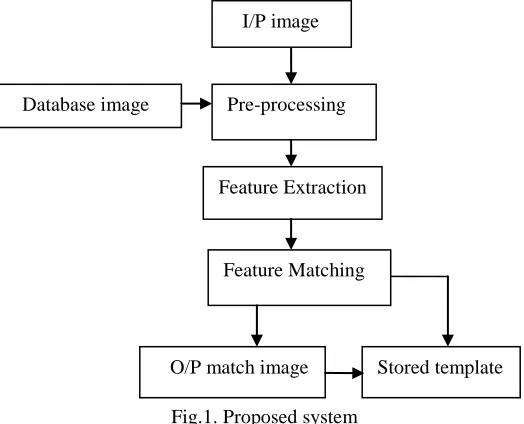
Proposed method deals with different stages which are shown in below
Fig.1. Proposed system
2.1 Database Images
The palmprint data used in the experiments carried out in this study is obtained from Palmprint Database. This database is taken from website of College of Engineering Pune. This database contains 60 palm (8-bit) color images from 10 users, with 6 images from each. The database was collected over a period of one year. The images are named as IMG person number (image number).jpg for example IMG_001 (1).jpg corresponds to person number 1 and his/her 1st image. The images were captured using digital camera with image with resolution of 1600X1200 pixels.
The average interval between the first and the second
session was two months. When palmprints are collected in different sessions, direction and amount of stretching of a palm may vary so that even palmprints from the same palm may have a little rotation and translation
.
2.2 Preprocessing
Preprocessing is used to align different palmprint images and to segment the center for feature extraction. Most of the preprocessing algorithms employ the key points between fingers to set up a co-ordinate system. Preprocessing function of this stage is used to segment the hand image from the background and obtaining a binary image of the hand with known orientation. Preprocessing involves five common steps:
(1) Binarizing the palm images
(2) Extracting the contour of hand and/or fingers (3) Detecting the key points
(4) Establishing a co-ordination system (5) Extracting the central parts.
2.3 Extracting ROI
The finger valleys (depression points present between fingers) are chosen to fix a co-ordinate system with respect to which the palm image can be extracted. The line joining the finger valleys is chosen to be the Y-axis and the X-axis is the line perpendicular to it. Hence, it is very important to find out the finger valley points correctly to reliably match two given palm images. There are different ways for implementing finger valley detection. These can be classified under: a) Tangent-based, b) Bisector-based, and c) Key point finding.
Fig. 2 Extracted ROI after tangent bisector method Database image Pre-processing
Feature Extraction
Feature Matching
www.ijiset.com
2.3 Feature Extraction
After ROI is obtained from preprocessing, we extract
important features from the image for recognition task. In particular, we use Multiscale local binary pattern (MLBP). The subspace projection technique is performed as a two-step process of constructing the subspace basis followed by projecting palm print images into the compressed subspace. New test images are then projected into the same subspace for image matching. It is computationally more efficient to perform image matching in subspaces as the dimensions have been reduced significantly.Multiscale Local binary pattern (MLBP) is a nonparametric descriptor, which efficiently summarizes the local structures of images. In recent years, it has aroused increasing interest in many areas of image processing and computer vision and has shown its effectiveness in a number of applications, in particular for facial image analysis, including tasks as diverse as face detection, face recognition, facial expression analysis, and demographic classification. As a nonparametric method, MLBP summarizes local structures of images efficiently by comparing each pixel with its neighboring pixels. The most important properties of MLBP are its tolerance regarding monotonic illumination changes and its computational simplicity.
2.4 Feature matching
Once the central part of the palm is segmented out, features can be extracted for matching. Verification based algorithms can be classified as line-, subspace- and statistic-based. A detailed study of these has been provided in. These algorithms have been described below.
• Subspace Based Approaches
Subspace-based approaches also called appearance-based approaches in the literature of face recognition. This is the name given to the group of algorithms that use Principal Component Analysis (PCA), Linear Discriminant Analysis (LDA) and Independent Component Analysis (ICA). The features are the subspace coefficients. Various distance measures and classifiers are uses to compare the features. Researchers have also applied wavelets, Gabor, discrete cosine transformation (DCT), and kernels in their methods. In general, subspace based methods do not make use of the prior knowledge available about palmprints.
• Line Based Approaches
Line based approaches either develop edge detectors or use existing edge detection methods to extract palm lines. It uses Canny edge operator to detect palm lines. The orientations of the edge points are passed into four membership functions representing four directions. Finally, Euclidean distance is used for matching employ
Sobel masks to enhance edge information and the statistical information in the processed images is used to estimate an optimal threshold for extracting the edges. Several descriptors of the edges are computed as features for matching.
• Statistical Approaches
These are either local or global in nature. Local statistical approaches divide the image into smaller sub-images in the transformed domain(transformations are usually done to transform the image from time domain to frequency domain or extracting some other features like DCT coefficients etc), and then obtain features on each of these sub-images to create a feature vector. Statistics like mean, variance etc of each of these smaller regions forms the feature vector here. The applied transforms can be Gabor, wavelet etc. Wang et al. have proposed the use of histograms of local binary pattern as features. On the other hand, global approaches compute statistical features at a global level directly from the transformed images instead of dividing the image into smaller sub parts. Moments, center of gravity and density have been used as global statistical features.
3. Implementation and result
U
Binarization of ImageU: Initially color image of person hand is loaded. For gray scale image only one plane of the images considered. This gray scale image is converted into the binary image by considering threshold value of 125.
Fig.3 Binarized Image
U
www.ijiset.com
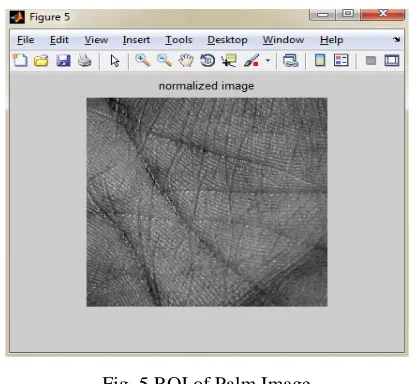
Fig 4: Localization Tangent on Palm image To find out ROI square is form around the centroid of the Palm found out by tangent bisector method. The last procedure in the pre-processing stage is to normalize the palmprint images in order to smoothen the noise and lighting effect. After the well-aligned ROIs are obtained from the preprocessing stage, we extract important features from Fig.5.
Fig. 5 ROI of Palm Image
Finally the extracted ROI image is matched with database image and depending upon matching, database image is shown in output as shown below fig
Fig 6 final palm print verified output
4. Conclusions
In this paper various palmprint recognition system studied Also it is found that palmprint detection is one of the important part of palmprint recognition using image processing. Palmprint is one of the important biometric recognition systems. Multiscale local binary pattern (MLBP) is used feature extract and feature matching process. It is found that MLBP is one of the efficient method that can be palmprint recognition system.
References
[1]
Wenxiong Kang, Pose-Invariant Hand Shape Recognition Based on Finger Geometry Member, IEEE and Qiuxia Wu, Member, IEEE IEEE Transaction system, MAN, AND CYBERNETICS: SYSTEMS, VOL. 44, NO. 11, NOVEMBER 2014.[2] Sneha M. Ramteke and Prof. S. S. Hatkar Segmentation of Palmprint into Region of Interest (ROI): A Survey, International Journal of Computers & Technology www.cirworld.com Volume 4 No. 2, March-April, 2013, ISSN 2277-3061
[3] Yatam Laxmi Malathi Latha , Munaga V. N.K Prasad Extraction of Dynamic Region of Interest (ROI) for Palm print Proc. of Int. Conf. on Advances in Computer Science, AETACS-2013
[4]Azadeh Ghandehari, Reza Safabakhsh; “A Comparison of Principal Component Analysis and Adaptive Principal Component Extraction for Palmprint Recognition”;International conference on hand based biometrics,17-18 Nov 2011.
[5] Raffaele Cappelli, Matteo Ferrara, and Dario Maio A Fast and Accurate Palmprint Recognition System Based on Minutiae IEEE Transaction sys, MAN, AND CYBERNETICS—PART B: CYBERNETICS, VOL. 42, NO. 3, JUNE 2012.
www.ijiset.com
[7]Feng Yuea, WangmengZuoa, DavidZhanga,b,∗, KuanquanWanga, Pattern Recognition 42 (2009) 2841 – 2849 Pattern Recognition 42 (2009) 2841 -- 2849.
[8] Adams Konga, DavidZhangb, MohamedKamelc A survey of palmprint recognition Pattern Recognition 42 (2009) 1408 -- 1418
[9] Zhenhua Guo a, David Zhang a,*, Lei Zhang a, Wangmeng Zuo b Pattern Recognition Letters 30 (2009) 1219–1227.
[10] Tee Connie*, Andrew Teoh Beng Jin, An automated palmprint recognition system Faculty of Information Science and Technology, Multimedia University, Jalan Ayer Keroh Lama, 75450 Melaka, Malaysia Received 13 March 2004; received in revised form 10 November 2004; accepted 14 January 2005.
Snigdha K. Mankar Studying second year of Master of Engineering in SIPNA COET Amravati. Pursued gradutation B.E.computer science and engineering from JDIET,Yavatmal.