Combining Faraday Tomography and Wavelet
Analysis
Dmitry Sokoloff1*, Rainer Beck3, Anton Chupin2,5 ID, Peter Frick2,5, George Heald4, Rodion Stepanov2ID
1 Department of Physics, Moscow University, 119992 Moscow, Russia
2 Institute of Continuous Media Mechanics, Korolyov str. 1, 614061 Perm, Russia 3 MPI für Radioastronomie, Auf dem Hügel 69, 53121 Bonn, Germany
4 CSIRO Astronomy and Space Science, 26 Dick Perry Avenue, Kensington, WA 6151, Australia 5 Perm State National Research University, Perm, Russia
* Correspondence: [email protected]; Tel.: +x-xxx-xxx-xxxx
Abstract: We present an idea how to use long-wavelength multi-wavelength radio continuum observations of spiral galaxies to isolate magnetic structures which were previously accessible from short-wavelength observations only. The approach is based on the RM-synthesis and 2D continuous wavelet transform. Wavelet analysis helps to recognize a configuration of small-scale structures which are produced by Faraday dispersion. We find that these structures can trace galactic magnetic
arms for the case of the galaxy NGC 6946 observed atλ=17÷22 cm. We support this interpretation
by an analysis of a synthetic observation obtained using a realistic model of a galactic magnetic field.
Keywords:galactic magnetic field; RM-synthesis; Faraday depolarization; wavelet analysis
1. Introduction
The main bulk of contemporary knowledge concerning magnetic field configurations in spiral galaxies is obtained based on observations performed at a few wavelengths only. Modern progress in observational techniques allows us to observe galaxies at dozens and hundreds of wavelengths. It is however important to learn how to use this new tool. Some problems which arise in this way
are illustrated at Fig.1. The left panel gives the linearly polarized intensity distribution of NGC
6946 atλ =6 cm from Becket al.[1]. Magnetic spiral arms are clearly seen. Magnetic arms can be
important because they possibly are magnetic reconnection regions [2] or may also be products of
dynamo action [3]. However their origin remains unclear [4]. The middle panel shows the polarized
intensity distribution obtained aroundλ=20 cm in the modern multi-wavelength observations in the
spectral range from 17 to 22 cm. The plot looks almost empty. It happens because of two reasons. On one hand, it is impractical to observe at each spectral channel as long as it was done in observations performed at just one wavelength. On the other hand, depolarization effects by Faraday rotation are
much more pronounced at longer wavelengths rather atλ=6 cm.
One can try resolve the problem in two ways. Firstly, it is possible to sum polarized intensities over
all channels in the rangeλ=17÷22 cm to emulate single-wavelength observations atλ≈20 cm. This
option, however, does not look attractive because it means that we emulate old-fashion results using modern observational technique. Another option is to use RM-synthesis which involves processing data at many wavelengths. Reconstruction of magnetic field even along a single line of the sight
remains a challenging problem [5]. 3D RM-cube data (i.e. maps of polarized intensity at many
wavelengths) can be processed in various ways. A straightforward approach is to pick up maximum
values of Faraday spectra (i.e. the distribution of polarized intensity as a function of Faraday depth) [6].
The resulting distribution ofFmaxis shown in Figure1(c). The signals are much stronger than those
shown in Figure1(b). However, we do not see here the narrow magnetic arms visible in Figure1(a)
because they are suppressed by Faraday depolarization effects atλ=17÷22 cm.
(a) (b) (c)
34′30″ 34′37.50" 34′45″ 34′52.50" 35′0″ 35′7.50" 60◦4′ 60◦6′ 60◦8′ 60◦10′ 60◦12′ 60◦14′
Right ascension(-20h)
Declination
0.6 1.3 2. 2.7 3.4
×102
33′45″ 34′0″ 34′15″ 34′30″ 34′45″ 35′0″ 35′15″ 35′30″ 35′45″ 59◦52′ 59◦56′ 60◦0′ 60◦4′ 60◦8′ 60◦12′ 60◦16′ 60◦20′ 60◦24′
Right ascension(-20h)
Declination
0.6 1.8 3. 4.2 5.4
×103
34′15″
34′30″
34′45″
35′0″
35′15″
35′30″
60◦0′
60◦4′
60◦8′
60◦12′
60◦16′
Right ascension(-20h)
Declination
0.4 1. 1.6 2.2 2.8
Figure 1.(a) Polarized intensity distribution in NGC 6946 atλ=6, (b)λ=20 cm, and (c) peak Faraday
spectraFmaxsynthesised fromλ∈17÷22cm.
We face a difficult choice: to postpone multi-wavelength observations of magnetic arms in spiral galaxies until the forthcoming SKA telescope will be ready for observations in its full extent or to suggest a method which allows to recover magnetic arms from the available multi-wavelength data taken at long wavelengths. The second way looks more attractive. The desired method is described by
Chupinet al.[7]. Technical details of the method are rather bulky. It is why here we present the idea of
the method in a compressed form and illustrate it by an example of the NGC 6946 data obtained by
Healdet al.[6] atλ=17÷22 cm (Section2) and by an artificial example (Section3).
2. Idea of the method applied to the NGC 6946 data
The method under discussion [7] departs from the point that polarized observations performed at
the wavelengthλ∗are most informative for magnetic structures of the scalel∗for whichλ2RM∝λBnel
is comparable withπ. Indeed, contribution from the structures withl l∗is strongly depolarized
due to Faraday rotation while Faraday rotation from the structures withl l∗ is too weak to be
useful. It means that using observations atλ1=20 cm instead of that ones atλ2=6 cm we deal with
magnetic structures that are an order of magnitudes smaller ((λ2/λ1)2≈10). In other words, instead
of detecting magnetic arms by large scales we have to do it by small-scale structures which arise by tangling and randomizing of large-scale structures, in addition to small-scale structures by small-scale turbulent magnetic fields predicted by dynamo theory.
Realization of the idea suggested in [7] is based on wavelet technique. Wavelet functions are
used for an analysis of spatial and temporal data, also in astrophysics[8]. The wavelet transform can
be used as an advance of RM-synthesis to structure analysis at different scales [9,10]. Here wavelets
are used as a spatial-scale filtering tool. We decompose all all maps of polarized intensity at a given
Faraday depth by wavelets of various scales (wl) and then find a peak intensitywmaxalong each line
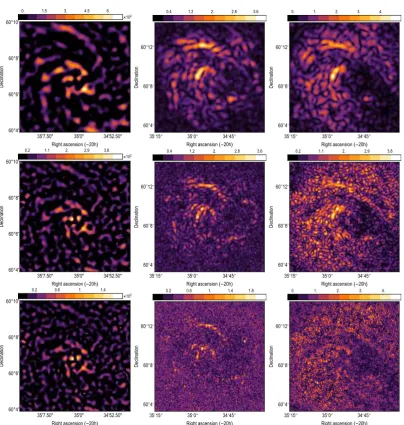
of sight. Results for various scaleslmeasured in arcseconds are shown in the middle row of Figure2.
We recognize small-scale structures at the scale ˆl=16 arcsec that are ordered as arm-like structures.
The structures at smaller and larger scales are less pronounced. In other words, we traced the structure
of magnetic arms known fromλ1 =6 cm using the data obtained atλ2 =20 cm. In a comparison
the result of wavelet decomposition of polarized intensity at 6 cm (left row of Figure2) and the peak
Faraday spectraFmax(right row of Figure2) are much noisier. The technical details of the method are
34'52.50" 35'0"
35'7.50"
60°4'
60°6'
60°8'
60°10'
Right ascension(-20h)
Declination
0. 1.5 3. 4.5 6.
×102
34′45″
35′0″
35′15″
60◦4′
60◦8′
60◦12′
Right ascension(-20h)
Declination
0.4 1.2 2. 2.8 3.6
34′45″
35′0″
35′15″
60◦4′
60◦8′
60◦12′
Right ascension(-20h)
Declination
0. 1. 2. 3. 4.
34'52.50" 35'0" 35'7.50" 60°4' 60°6' 60°8' 60°10'
Right ascension(-20h)
Declination
0.2 1.1 2. 2.9 3.8
×102
34′45″
35′0″
35′15″
60◦4′
60◦8′
60◦12′
Right ascension(-20h)
Declination
0.4 1.2 2. 2.8 3.6
34′45″
35′0″
35′15″
60◦4′
60◦8′
60◦12′
Right ascension(-20h)
Declination
0.2 1.1 2. 2.9 3.8
34'52.50" 35'0"
35'7.50"
60°4'
60°6'
60°8'
60°10'
Right ascension(-20h)
Declination
0.2 0.6 1. 1.4
×102
34′45″
35′0″
35′15″
60◦4′
60◦8′
60◦12′
Right ascension(-20h)
Declination
0.2 0.6 1. 1.4 1.8
34′45″
35′0″
35′15″
60◦4′
60◦8′
60◦12′
Right ascension(-20h)
Declination
0. 1. 2. 3. 4.
Figure 2.Wavelet coefficients of the scales 32, 16, 8 arcsec: (leftcolumn) for PI at 6 cm, (middlecolumn)
wmax, (rightcolumn) forFmax.
3. Synthetic data analysis
We constrain a model magnetic field to demonstrate qualitatively the applicability of our approach
and to support an interpretation of the results. The galactic magnetic field~Bg is modelled as a
superposition of a large-scale component~Band a small-scale turbulent component~b:
~
Bg(~r) =~B(~r) +~b(~r), (1)
where~ris the radius vector in the cylindric coordinate system (r,φ,z). The regular part of magnetic
field is assumed to be of bisymmetric form with two reversals along azimuthal angle:
B(r,φ,z) =B0cos
m
lnr
tanp −φ+φ0
tanh r r0 exp ( − r R0 2) exp ( − z h0 2) , (2)
whereB0is the field amplitude (strength) andφ0is the azimuthal phase of the modem,pis a pitch
term is introduced to suppress a peculiarity near axis at characteristic radiusr0[11]. Then components of regular magnetic field are evaluated by
Br(r,φ,z) = B(r,φ,z)sinp, (3)
Bφ(r,φ,z) = B(r,φ,z)cosp, (4)
∂zBz(r,φ,z)) = −r−1 (∂r(rBr(r,φ,z)) +∂φBφ(r,φ,z)
, (5)
where a latter relation is a result of the incompressibility condition.
The turbulent magnetic field is considered as a divergence-free, random fluctuating field with the
given energy spectraΨand Gaussian spatial distribution with the radiusRtand the vertical scaleht:
~b(r,φ,z) =b0Ψ(r,φ,z)exp
(
−
r Rt
2)
exp
(
−
z ht
2)
, (6)
whereb0is the strength of the turbulent field. The spectral property of the random functionΨare
specified as follows:
|Ψˆ(~k)|2= (
(k/k0)α, k>k0
(k/k0)β, k<k0.
(7)
We adoptα=−5/3 (Kolmogorov scaling),β=2,k0=10h−1t [12].
(a) (b)
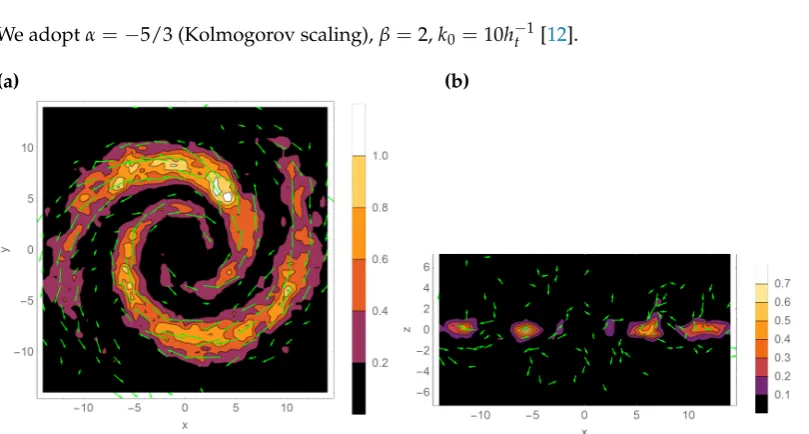
Figure 3.Distribution of model magnetic field: (a) in central horizontal galactic plane, (b) in central vertical plane.
Figure3shows the distribution of galactic magnetic field in three-dimensional numerical domain
14×14×14 kpc3 with resolution 0.4 kpc for a particular choice of parameters: m = 1, p = π/12,
h0=1 kpc,R0=14 kpc,r0=4 kpc,Rt=20 kpc,ht =4 kpc andB0=b0=1. Thermal electron and
cosmic rays densities are adjusted to get qualitative correspondence with the observation. We use simulated magnetic field to calculate an artificial maps of polarized intensity and Fadaray rotation for
λin the observed range from 17 to 22 cm. Then synthetic RM-cube is analysed by the same approach
as NGC 6946 data in the Section2.
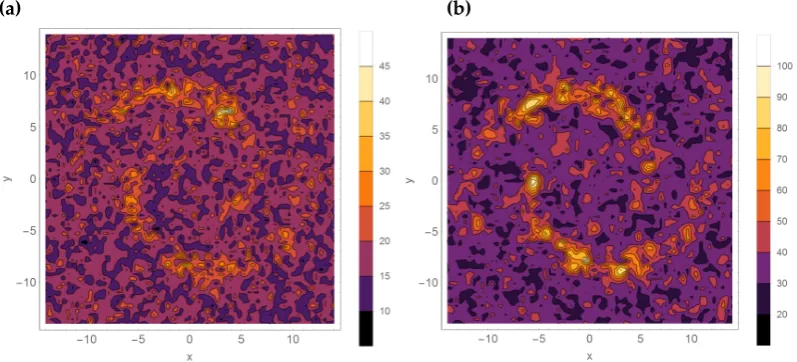
For the case of zero-noise contribution in polarized intensity the distribution of Fmax (see
Figures4(a)) is slightly affected by Faraday depolarization. We note the result does not differ from
the initial distribution in Figure3(a) because the rotation measures are rather moderate (a few tens
emission is considerably scattered over the Faraday depths so that small-scale structures appear in
distribution ofwmax(see Figures4(b)). Nevertheless the large-scale structure of galactic magnetic arm
is well traced bywmax.
(a) (b)
Figure 4.Distributions for a model which consists of large scales and small scales (no noise): (a)Fmax, (b)wmax.
The situation is substantially changed in the case if a white noise of levelS/N =20 is added
to the ideal observations. Figure5shows resulting distribution ofFmaxandwmaxin the presence of
the noise. The galactic signal inFmaxrepresentation is getting much weaker. At the same time the
distribution ofwmaxreveals the magnetic arms with a patchy structure.
(a) (b)
Figure 5.Distributions for a model which consists of large scales, small scales and noise: (a)Fmax, (b)
wmax.
4. Discussion
a galactic magnetic field. The above results demonstrate that the method can be helpful in practice especially in the case of noisy polarization data at an individual wavelength. However, we keep in mind that small-scale structures of a magnetic field may contribute in wavelet coefficients. Existence of such structures was a general expectation from dynamo theory but the previous methods do not allow isolating this. We note that wavelet technique can be successfully combined with modern approaches
like the Faraday tomography [13] and the method based on the synchrotron derivative polarization
gradients [14]. Then one can probe the local interstellar medium in the Galactic foreground towards
some galaxies [15]. Our model of galactic magnetic field may be also useful for validation of processing
results.
Author Contributions: The idea of the method presented here belongs to R.S. and A.Ch., P.F. embedded the method in the general framework of wavelet methods, D.S. is responsible for the link with dynamo studies, R.B. elaborated the link with classical RM-synthesis, the observational data exploited was obtained by G.H.
Acknowledgments: Numerical simulations were performed on the supercomputers URAN and TRITON of Russian Academy of Science, Ural Branch. D.S. is grateful for RFBR project under grant 18-02-00085 and the grant 18-1-1-77-1 from Basis Foundation.
Conflicts of Interest:The authors declare no conflict of interest.
Abbreviations
The following abbreviations are used in this manuscript:
VLA Very Large Array
LOFAR European Low Frequency Array SKA Square Kilometre Array RM Rotation measure
References
1. Beck, R.; Frick, P.; Stepanov, R.; Sokoloff, D. Recognizing magnetic structures by present and future radio telescopes with Faraday rotation measure synthesis. Astron. Astrophys. 2012, 543, A113, [arXiv:astro-ph.IM/1204.5694]. doi:10.1051/0004-6361/201219094.
2. We ˙zgowiec, M.; Ehle, M.; Beck, R. Hot gas and magnetic arms of NGC 6946: Indications for reconnection heating?Astron. Astrophys.2016,585, A3,[1603.00715]. doi:10.1051/0004-6361/201526833.
3. Beck, R. Magnetic fields in spiral galaxies. The Astronomy and Astrophysics Review2015,24, 4,[1509.04522]. doi:10.1007/s00159-015-0084-4.
4. Chamandy, L.; Shukurov, A.; Subramanian, K. Magnetic spiral arms and galactic outflows. Mon. Not. R.
Astron. Soc.2015,446, L6–L10,[arXiv:astro-ph.GA/1408.3937]. doi:10.1093/mnrasl/slu156.
5. Sun, X.H.; Rudnick, L.; Akahori, T.; Anderson, C.S.; Bell, M.R.; Bray, J.D.; Farnes, J.S.; Ideguchi, S.; Kumazaki, K.; O’Brien, T.; O’Sullivan, S.P.; Scaife, A.M.M.; Stepanov, R.; Stil, J.; Takahashi, K.; van Weeren, R.J.; Wolleben, M. Comparison of Algorithms for Determination of Rotation Measure and Faraday Structure. I. 1100-1400 MHz. Astron. J.2015, 149, 60, [arXiv:astro-ph.IM/1409.4151]. doi:10.1088/0004-6256/149/2/60.
6. Heald, G.; Braun, R.; Edmonds, R. The Westerbork SINGS survey. II Polarization, Faraday rotation, and magnetic fields. Astron. Astrophys. 2009,503, 409–435,[arXiv:astro-ph.GA/0905.3995]. doi:10.1051/0004-6361/200912240.
7. Chupin, A.; Beck, R.; Frick, P.; Heald, G.; Sokoloff, D.; Stepanov, R. Magnetic arms of NGC6946 traced in the Faraday cubes at low radio frequencies. Astron. Nachr.2018,[1808.05456]. doi:10.1002/asna.201813488. 8. Schwinn, J.; Baugh, C.M.; Jauzac, M.; Bartelmann, M.; Eckert, D. Uncovering substructure with wavelets:proof of concept using Abell 2744. Mon. Not. R. Astron. Soc. 2018, p. 2446. doi:10.1093/mnras/sty2566.
9. Frick, P.; Sokoloff, D.; Stepanov, R.; Beck, R. Wavelet-based Faraday rotation measure synthesis. Mon. Not.
10. Frick, P.; Sokoloff, D.; Stepanov, R.; Beck, R. Faraday rotation measure synthesis for magnetic fields of galaxies. Mon. Not. R. Astron. Soc. 2011, 414, 2540–2549,[arXiv:astro-ph.GA/1102.4316]. doi:10.1111/j.1365-2966.2011.18571.x.
11. Stepanov, R.; Arshakian, T.G.; Beck, R.; Frick, P.; Krause, M. Magnetic field structures of galaxies derived from analysis of Faraday rotation measures, and perspectives for the SKA. Astronomy and Astrophysics
2008,480, 45–59,[0711.1267]. doi:10.1051/0004-6361:20078678.
12. Stepanov, R.; Shukurov, A.; Fletcher, A.; Beck, R.; La Porta, L.; Tabatabaei, F. An observational test for correlations between cosmic rays and magnetic fields. Mon. Not. R. Astron. Soc.2014,437, 2201–2216, [1205.0578].
13. Ferrière, K. Faraday tomography: a new, three-dimensional probe of the interstellar magnetic field. Journal
of Physics: Conference Series2016,767, 012006.
14. Lazarian, A.; Yuen, K.H. Gradients of Synchrotron Polarization: Tracing 3D Distribution of Magnetic Fields. The Astrophysical Journal2018,865, 59.
15. Van Eck, C.L.; Haverkorn, M.; Alves, M.I.R.; Beck, R.; de Bruyn, A.G.; Enßlin, T.; Farnes, J.S.; Ferrière, K.; Heald, G.; Horellou, C.; Horneffer, A.; Iacobelli, M.; Jeli´c, V.; Martí-Vidal, I.; Mulcahy, D.D.; Reich, W.; Röttgering, H.J.A.; Scaife, A.M.M.; Schnitzeler, D.H.F.M.; Sobey, C.; Sridhar, S.S. Faraday tomography of the local interstellar medium with LOFAR: Galactic foregrounds towards IC 342. Astron. Astrophys.2017,