ISSN Print: 2162-2477
DOI: 10.4236/ojpm.2019.94004 Apr. 30, 2019 29 Open Journal of Preventive Medicine
Development and Evaluation of Innovative
Recycling Intervention Program Using the
Health Belief Model (HBM)
Israel G. Msengi
Health and Kinesiology Department, Lamar University, Beaumont, TX, USA
Abstract
The purpose of this study was to assess the effectiveness of interventions based on health promotion theories in changing the recycling behavior of the targeted population. The study focused on the development and evaluation of innovative recycling education programs that address energy recovery, recy-cling, and waste management. The study applied Health Belief Model-(HBM) as an approach to motivate recycling behaviors and to evaluate the impact of the applied approaches on recycling set-out rates and participation. A total of 102 households from a Midwestern city participated in this study. The study was conducted over a period of six months. A Likert scale questionnaire was used to collect data on recycling and environmental knowledge, skills, beha-vior, and attitudes. The other set of data was the weight of recyclables that was obtained at each participant’s curb four times over the six months period of interventions. Results indicated a significant increase in average set out rates of recyclables among HBM participants (21.34 lbs. pre-test to 59.3 lbs. post-test). It was concluded that HBM educational approaches can be effec-tive in motivating recycling. This study signifies the need for renewed effort in motivating individuals, households or businesses to recycle. Not every community or city significantly participates in recycling. Innovative strategies as well the application of approaches in the theories of behavioral change can positively influence recycling and overall waste reduction behaviors.
Keywords
Recycling, Environmental Health, Health Belief Model (HBM), Theory, Health Behavior
1. Introduction
Recycling today may seem like a by-gone topic but it actually still very relevant. How to cite this paper: Msengi, I.G. (2019)
Development and Evaluation of Innovative Recycling Intervention Program Using the Health Belief Model (HBM). Open Journal of Preventive Medicine, 9, 29-41.
https://doi.org/10.4236/ojpm.2019.94004
Received: February 1, 2019 Accepted: April 27, 2019 Published: April 30, 2019
Copyright © 2019 by author(s) and Scientific Research Publishing Inc. This work is licensed under the Creative Commons Attribution International License (CC BY 4.0).
DOI: 10.4236/ojpm.2019.94004 30 Open Journal of Preventive Medicine A great number of people still do not participate in regular recycling [1][2]. For example, of the 4.38 pounds that an American produces only 1.5 pounds is re-cycled [3]. This is one arena of environmental behavior that has received a lot of attention in recent years but the pace in which people are adopting the recycling behavior is very slow [4][5]. Although recycling is not a new phenomenon, to-day over 75% of solid waste by weight and 90% by volume are product packag-ing related [3][6]. Globally, reports indicate there is a steady increase in Munic-ipal Solid Waste (MSW) globally [7]. For instance, it is estimated that 3 billion tons of MSW were generated by residents in 2012 where each person generates 1.2 kilograms or 2.65 pounds per day. The waste generation trajectory will more than two-times outpace population growth by 2050 [8].
1.1. Literature Review
DOI: 10.4236/ojpm.2019.94004 31 Open Journal of Preventive Medicine indicate that the overall tonnage we create continues to increase [3][9].
It is obvious that households possess the key to sustainable management of solid waste. Waste minimization, reuse, and recycling rates vary substantially among individual households for various reasons, which include; personal va-riables (attitude toward the environment, knowledge, demographic variable, and personality) or situational issues (removal of recycling barriers, prompting, ob-taining commitment to recycle, use of social norms, rewards, and providing feedback) [11]. Hence, only changes in individual attitudes, beliefs, norms to-wards the environment, and the consequential shift in personal behavior, will have the lasting and significant impact on the environment that is badly needed
[12].
1.2. Promoting Recycling by Using Health Education/Promotion
Theoretical Approaches
1.2.1. Theories and Models
Health promotion and health education theories and conceptual models can be very useful in guiding interventions that seek to elicit behavior changes (includ-ing recycl(includ-ing behavior) to minimize the impact of human activities on environ-mental systems [13]. Nonetheless, these theories and conceptual models that are regularly applied to direct health promotion and health education interventions are hardly ever employed to environmental health education issues, including recycling [13]. This indicates that health promotion has been largely absent from the environmental health arena [14]. Thus, successful implementation of inter-ventions in environmental health promotion, including recycling, requires an appreciation of what the field of health promotion has to offer [15]. This study utilized theoretical approaches of health education/promotion while using simi-lar content messages, namely: Intrapersonal (Health Belief Model-HBM) ap-proach.
1.2.2. Health Belief Model (Intrapersonal Approach)
DOI: 10.4236/ojpm.2019.94004 32 Open Journal of Preventive Medicine factors influencing the decision to act [13][18].
The key concepts of the HBM are: perceived susceptibility, perceived severity, perceived benefits, perceived barriers, cues to action, and self-efficacy [13][18]. Based on the review of all HBM studies published between 1974 and 1984, per-ceived barriers, perper-ceived benefits, and perper-ceived susceptibility were identified as significant variables in predicting and explaining health-related behaviors [17]. However, most recent studies indicate self-efficacy as the strongest predictor of health-related behavior [19][20].
The purpose of this study was to assess the effectiveness of interventions based on health promotion theories in changing the recycling behavior of the targeted population. The study focused on the development and evaluation of innovative recycling education programs that address energy recovery, recycling, and waste management. The intervention program design was based upon proven behavior modification strategies utilized in health promotion and health education that are further modified for the delivery of recycling education with the goal of more effective recycling education campaigns. A theory driven approach to tional program implementation and evaluation which draws on health educa-tion/promotion theory and practice (HBM) was modified and applied to this area of environmental health education in order to motivate recycling. This qua-si-experimental study applied selected health promotion theories and models in the case the HBM as an approach to motivate recycling behaviors [21][22]. The impact of the applied HBM approaches on recycling set out rates and participa-tion was evaluated. The outcome of the research program was measured and evaluated on a short- and long-term basis (two and six months) with the goal of realizing a 10-15% shift in recycling participation.
2. Methodology
This was conducted among residents in a Midwestern State city where a total of 102 households participated in the study. The study utilized both quantitative and qualitative approaches (mixed method) during the intervention process [23] [24]. The combination of mixed methods was applied mainly during the inter-vention and community leader informative meetings (school principals, Scout group coordinators, and church ministers).
2.1. Interventions
de-DOI: 10.4236/ojpm.2019.94004 33 Open Journal of Preventive Medicine sign of the educational materials and to their delivery with the intention of catching people’s attention. The appeal of the materials delivered and the persis-tence of the intervention approach were considered key to getting people inter-ested in partaking in the recycling process and programs. Education materials such as brochures, posters, and fliers were used. This was accomplished by both house-to-house visits and mailing of additional useful materials. In addition, follow-up telephone calls, feedback on recycling progress, and direct mailing were used to remind people about recycling. The following combinations of educational intervention strategies were applied.
2.1.1. Modeling Strategy
Educational messages were prepared and communicated to participants crea-tively by applying theoretical approaches of behavioral change (the HBM). Mes-sages disseminated recognized barriers to recycling but at the same time pro-vided a way to overcome the barrier. For example a flier and brochure propro-vided scenarios and solutions for people who find they do not have time to sort mate-rials or lack time to shop for products with less packaging. Demonstrative mes-sages that portrayed the benefits of recycling and stressed that “it is not a hard to do thing” were used to counter time constraint self-talk as a reason not to par-ticipate in recycling activities. Messages designed were simple, easy to under-stand, quick to read, and those that could fit audiences of all socio-economic status.
2.1.2. Feedback Providing Strategy
This innovative educational information delivery approach incorporated mes-sages that provided feedback on how much people were recycling in pounds and whether they needed improvement. This information tied relevant facts directly with the individual’s recycling behaviors. This strategy was applied to pants where communication was initiated directly with an individual partici-pant. The feedback information contained the amount, in pounds, of recyclable that each participant off-set after a specific intervention phase.
2.1.3. Reminders and Prompts Approach
This was another way to motivate recycling participation. The messages in this approach were specifically targeted to overcoming behaviors or barriers such as laziness and forgetfulness. These reminders were timely and specific to the cur-rent recycling situation. Telephone messages, mail cards, text messages, and emails were some of the approaches applied to remind participants to recycle.
2.1.4. The Pledge to Recycle Approach
This method was designed to increase public commitment and encourage people to commit via a signed pledge. This pledge sought to encourage people to take action and continue in recycling.
2.2. Instruments and Data Collection
base-DOI: 10.4236/ojpm.2019.94004 34 Open Journal of Preventive Medicine line and to measure changes of knowledge, awareness, attitude, and behaviors toward recycling following educational interventions. The KSA scale which uses a Likert Scale was adopted from Barr (2002) and modified in order to fit the needs of this study [25]. Barr (2002) designed the scale and utilized it to study knowledge, values, attitudes, and behaviors toward recycling household waste in Exeter, Devon UK. The scale measured environmental attitudes, knowledge, values, and behaviors affecting recycling participation. The modified scale was tested for internal reliability in each of its subscales. A Cronbach’s Alpha relia-bility test for internal consistency of subscale items (recycling activity, know-ledge, attitude, and behavior) was calculated using JMP8.SAS Institute [26]. The Cronbach’s Alpha reliability test was chosen as the best approach due to the fact that it tends to provide a high estimate of reliability. An Alpha coefficient score of α = 0.7 or better suggests a satisfactory degree of reliability [27]. For highly correlated items the coefficient can approach α = 1.0. The Cronbach’s Alpha for activity subscale was α = 0.870; knowledge subscale α = 0.630; attitude subscale α = 0.760; skills subscale α = 0.949; and behavior subscale α = 0.833. The data sets were for the actual recyclable weights that were collected from the curb. One set of weight data was gathered before the educational interventions, while two oth-er weight data sets woth-ere gathoth-ered during the intoth-ervention poth-eriod, and the final weight data set was collected after interventions. These data sets helped to eva-luate the progress of the effectiveness of interventions both in the short and long-term.
2.3. Data Processing and Analysis
Data was coded and entered into the JMP8; SAS Institute statistical package. Various quantitative statistical approaches in analyzing data for this study were employed to determine the impact of interventions on recycling activity, know-ledge, behavior, skills, and attitude of participants. The following statistical tests were performed: univariate statistics such as descriptive statistics. Descriptive statistics were performed to generate percentages, frequencies, means, and case and group summaries. Descriptive statistics provided a description of the sam-ples or distribution characteristics of the variables in recycling activity, know-ledge, behavior, skills, attitude, and waste management strategies.
3. Results
One-hundred-and-two households participated in the project were the HBM model was applied. Twenty nine percent of participants had BA or BS degree, 27.5% had a GED diploma, and 26.8% had a graduate degree.
3.1. Recycled Waste
DOI: 10.4236/ojpm.2019.94004 35 Open Journal of Preventive Medicine
Figure 1. Overall percentages of recycled items and setout percentages before
interven-tion.
(GLS; 67%), newspaper (NPR; 75.2%), food cans (FC; 65.2%), drink cans (DC; 73.03%), and plastic bottles (PB; 75.1%). Other solid wastes recycled were junk mail (JM; 58.2%), cardboard (CRDB; 63.4%), and magazines (MGZ; 69.4%). Foils (56.8%) and textiles (TX; 76.5%) were rarely or never recycled.
3.2. Recycling Rate before and during Interventions
Figure 2 shows the average amount of solid waste setouts in pounds per
house-hold before and after intervention in a biweekly basis. A significant increase in recyclable output was observed after interventions.
As indicated in Figure 2, there was a steady increase in recyclable set-out rates from baseline to the final intervention. Under the HBM intervention approach participants responded to educational interventions by setting out more recyc-lables (59.3 lbs.) biweekly by the end of the intervention period. These innova-tive educational interventions were delivered constantly and were consistently on recycling message.
3.3. Recycling Activity
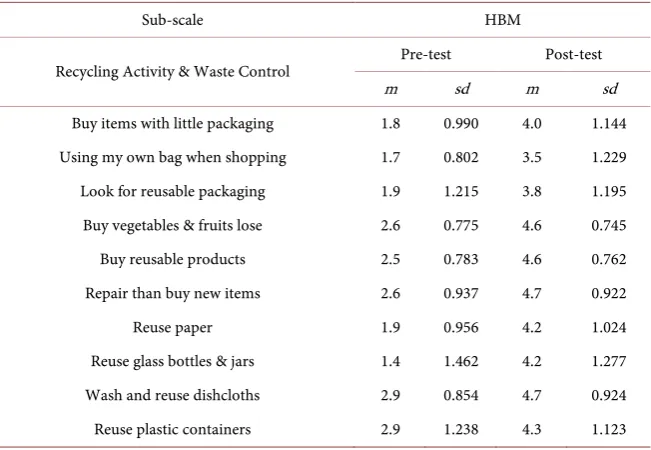
In responding a questionnaire item related to how participants managed recycl-able before interventions a Likert scale of (1 = never, 2 = rarely, 3 = sometimes, 4 = usually, 5 = always) for subscale questionnaire items about recycling activity and waste management was used. Participants reported they never or rarely bought items with little packaging (m = 1.8, sd = 0.990), used their own fabric shopping bags rather than the ones provided by the store (m = 1.7, sd = 0.802), looked for easily reusable packaging (m = 1.9, sd = 1.215), and/or reused papers (m = 1.9, sd = 0.956).
DOI: 10.4236/ojpm.2019.94004 36 Open Journal of Preventive Medicine
Figure 2. Biweekly recyclable outset rate in pounds per individual in various intervention
phases.
Table 1. Pre- and post-test mean responses for HBM group in recycling activity subscale
items.
Sub-scale HBM
Recycling Activity & Waste Control Pre-test Post-test
m sd m sd
Buy items with little packaging 1.8 0.990 4.0 1.144
Using my own bag when shopping 1.7 0.802 3.5 1.229
Look for reusable packaging 1.9 1.215 3.8 1.195
Buy vegetables & fruits lose 2.6 0.775 4.6 0.745
Buy reusable products 2.5 0.783 4.6 0.762
Repair than buy new items 2.6 0.937 4.7 0.922
Reuse paper 1.9 0.956 4.2 1.024
Reuse glass bottles & jars 1.4 1.462 4.2 1.277
Wash and reuse dishcloths 2.9 0.854 4.7 0.924
Reuse plastic containers 2.9 1.238 4.3 1.123
Note. 1 = never, 2 = rarely, 3 = sometimes, 4 = usually, 5 = always.
3.4. Recycling Knowledge
[image:8.595.212.538.334.559.2]DOI: 10.4236/ojpm.2019.94004 37 Open Journal of Preventive Medicine
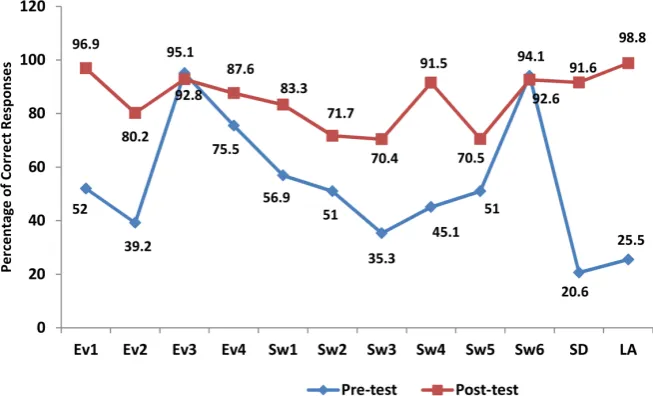
Figure 3. Recycling knowledge before and after intervention. Note. Ev1 = Global
warm-ing is a growwarm-ing health and environmental concern today. Ev2 = Warmwarm-ing in the atmos-phere is due mainly to increased human produced carbon dioxide. Ev3 = Recycling is central to controlling the depletion of natural resources. Ev4 = Road transportation pro-duces few harmful emissions into the atmosphere*. SW1 = One third of total household water supply is used to flush toilets. SW2 = Households produce a minority of the waste handled by the city*. SW3 = Each average household produces 32 lbs. of waste every week. SW4 = Under one-tenth of household waste is recycled. SW5 = Sending waste to a landfill site is only a small part of the way waste is disposed of*. SW6 = Landfill sites are running out of space for more waste. SD = Have you heard of “Sustainable Develop-ment”. LA = Have you heard of “Local Agenda 21”. *indicates participants would receive a point if they responded “NO” to the item.
study. These materials were considered key in increased knowledge as well as motivating them in partaking in the recycling process.
3.5. Change in Attitude and Value for Environment
DOI: 10.4236/ojpm.2019.94004 38 Open Journal of Preventive Medicine well-being was not affected by problems of waste disposal. The post-intervention responses, however, indicated they disagreed or strongly disagreed (m = 4.4, sd = 1.203) that their personal well-being was not affected by the problem of waste disposal.
3.6. Waste Minimization Skills
In terms of Waste Minimization Skills or Willingness to Reduce Waste subscale (1 = Very Willing, 5 = Very Unwilling), participants were asked about whether or not they were willing to reduce waste. A majority of respondents both during pre-test and post-test reported they were neutral or somehow unwilling to adopt waste minimization skills (Ms) such as buying fewer disposable items (m = 3.4, sd =1.225), looking for products with less wrappings (m = 3.0, sd = 1.208) and/or taking old plastic bags for shopping rather than getting new ones at the store (m = 3.3, sd = 1.116). However, the post-test responses indicated a majori-ty of them were willing or strongly willing to wash and reuse certain items before disposing of them (m = 1.5, sd = 0.604).
3.7. Recycling Behavior
The behavior subscale sought to obtain responses regarding participants’ recy-cling behavior in order to determine participants’ intentions reflecting the need to help the environment (1 = Strongly Agree, 5 = Strongly Disagree). The pre-test responses indicated participants were neutral in reporting whether their beha-vior to recycle was influenced by seeing neighbors and friends reuse and recycle things (m = 3.1, sd = 0.820) or whether they needed financial incentives in order to recycle (m = 3.3, sd = 1.235). However, during post-test participants reported they were motivated to recycle when they saw others recycle (m = 1.3, sd = 0.756). Participants also reported they felt guilty for not recycling (m = 2.1, sd = 0.887). Other responses that indicated behavioral change after interventions were that participants agreed or strongly agreed that they were very concerned with waste issues or problems (m = 1.6, sd = 1.078) and realized that participating in recy-cling and managing waste was simple (m = 1.6, sd = 0.963).
4. Conclusions
DOI: 10.4236/ojpm.2019.94004 39 Open Journal of Preventive Medicine norms, attitudes, and beliefs directly affects behaviors, which in turn may even-tually change community policies. 3) Education can change people’s values. En-vironmentally-related values and beliefs, such as recycling, once adopted may be lasting. Hence educational efforts that work along with peoples’ ethics and val-ues can ultimately change people’s attitude and behaviors. 4) It is essential to de-sign educational materials and messages that can effectively communicate the intended factual messages while modeling attitude and behavior shifts of partic-ipants.
However, making information available to participants does not necessarily guarantee that the information will be used. It is essential to use trusted infor-mation sources so that people can consider incorporating it in a new behavioral repertoire. In this study participants indicated that the information sources they trusted the most included the city newsletter, utility newsletters, TV, magazine, word of mouth from friends, Internet, and neighborhood associations or clubs. Education interventions are more effective when combined with other interven-tion strategies, as expressed in the open comments of participants (i.e., doing more than just educating). In the case of recycling participants suggested im-proving services such as changing collection frequency from biweekly to every week. Some participants noted, “Recycling would be easier if it was collected weekly—we us 2+ bins each recycle day.” Similarly, other participants stated, “I would like pick-up to be weekly so I wouldn’t forget.” Another participant said, “I wish that our city’s curbside recycling program would allow more things to be recycled, such as plastic bags, plastic from packing, and paint.”
5. Recommendation
Findings from this study render the following recommendations:
1) Further study should be conducted to explore how other health promotion theories can be used in similar recycling investigations. In this study HBM edu-cational and intervention strategies were applied not the theory’s constructs per se. Findings indicated on an overall these theoretical approaches are effective in increasing recycling participation and increasing recycling skills, waste reduc-tion, attitude, behavioral change, and commitment to protecting the environ-ment.
DOI: 10.4236/ojpm.2019.94004 40 Open Journal of Preventive Medicine they throw everything into a recycling container randomly and employees of the recycling firms sort it. I would like to see disposal of hazardous materials made easier. Rather than dispose of them unsafely… The most recent proposal I’ve heard is that the city is considering eliminating the pick-up of recyclables and requiring residents to drive everything to a drop-off site. I can’t do this; I think it’s a very disturbing proposal.” So it is essential to improve services, and also to listen to concerns that clients have.
3) Knowledge about the community/local values, norms, and behaviors is im-perative. There is a need for interventionists to be very familiar with the culture, norms, and behaviors of the community in which interventions are taking part. Such knowledge is essential for tailoring interventions that can bring about be-havioral change.
Conflicts of Interest
The author declares no conflicts of interest regarding the publication of this pa-per.
References
[1] Ackerman, F. (1997) Why Do We Recycle? Markets, Values, and Public Policy. Isl-and Press, Washington DC.
[2] Achapan, I. (2012) The Reason behind Lack of Household Recycling Participation. A Bangkok Metropolis Case Study. Global Journal of Human Social Science Arts and Humanities, 12, 79-82.
[3] U.S. Environmental Protection Agency (US EPA) (2015) Municipal Solid Waste Generation, Recycling, and Disposal in the United States: Facts and Figures for 2012.
https://www.epa.gov/facts-and-figures-about-materials-waste-and-recycling/studies
-summary-tables-and-data-related
[4] Gamba, R. and Oskamp, S. (1994) Factors Influencing Community Residents’ Par-ticipation in Commingled Curbside Recycling Programs. Environmental and Beha-vior, 26, 587-612. https://doi.org/10.1177/0013916594265001
[5] Hershkowitz, A. (1998) In Defense of Recycling. Social Research, 65, 141-218. [6] White House Task Force on Recycling (2000) Recycling for the Future.
http://www.grrn.org/assets/pdfs/wasting/WRUS.pdf
[7] Hoornweg, D. and Bhada-Tata, P. (2012) What a Waste: A Global Review of Solid Waste Management. Urban Development Series; Knowledge Papers No. 15. World Bank, Washington DC. https://openknowledge.worldbank.org/handle/10986/17388 [8] Kaza, S., Yao, L.C., Bhada-Tata, P. and Van Woerden, F. (2018) What a Waste 2.0: A Global Snapshot of Solid Waste Management to 2050. Urban Development. World Bank, Washington DC. https://doi.org/10.1596/978-1-4648-1329-0
https://openknowledge.worldbank.org/handle/10986/30317
[9] U.S. Environmental Protection Agency (US EPA) Frequent Questions on Recycling.
https://www.epa.gov/recycle/frequent-questions-recycling
Volun-DOI: 10.4236/ojpm.2019.94004 41 Open Journal of Preventive Medicine tary Measures, National Academy Press, Washington DC, 67-82.
[11] Pew Research Center (2016) Perceptions and Realities of Recycling Vary Widely from Place to Place.
http://www.pewresearch.org/fact-tank/2016/10/07/perceptions-and-realities-of-recy
cling-vary-widely-from-place-to-place
[12] Oskamp, S.R., Burkhardt, P.W., Schultz, S.H., Hurin, S. and Zelezny, L. (1998) Pre-dicting Three Dimensions of Residential Curbside Recycling: An Observational Study. Journal of Environmental Education, 29, 37-42.
https://doi.org/10.1080/00958969809599111
[13] Parker, E.A., Baldwin, G.T., Israel, B. and Salinas, M.A. (2004) Application of Health Promotion Theories and Models for Environmental Health. Health Educa-tion and Behavior, 31, 491-509.https://doi.org/10.1177/1090198104265601
[14] Howze, E.H., Baldwin, G.T. and Kegler, M.C. (2004) Environmental Health Promo-tion: Bridging Traditional Environmental Health and Health Promotion. Health Education and Behavior, 31, 429-440.https://doi.org/10.1177/1090198104265591
[15] Kegler, M.C. and Miner, K. (2004) Environmental Health Promotion Interventions: Considerations for Preparation and Practice. Health Education and Behavior, 31, 510-525.https://doi.org/10.1177/1090198104265602
[16] Rosenstock, I.M. (1974) Historical Origins of the Health Belied Model. Health Edu-cation Monogram, 2, 328-335.https://doi.org/10.1177/109019817400200403
[17] Janz, N.K. and Becker, M.H. (1984) The Health Belief Model: A Decade Later.
Health Education Quarterly, 11, 1-47.https://doi.org/10.1177/109019818401100101
[18] Glanz, K., Rimer, B.K. and Lewis, F.M. (2008) Health Behavior and Education: Theory, Research, and Practice. 4rd Edition, Jossey-Bass, San Francisco.
[19] Gillbrand, R. and Stevenson, J. (2006) The Extended Health Belief Model Applied to the Experience of Diabetes in Young People. British Journal of Health Psychology, 11, 155-169.https://doi.org/10.1348/135910705X39485
[20] Lin, P., Simoni, J. and Zemon, V. (2005) The Health Belief Model, Sexual Behaviors, and HIV Risk among Taiwanese Immigrants. AIDS Education and Prevention, 17, 469-483.https://doi.org/10.1521/aeap.2005.17.5.469
[21] Campbell, D.T. and Stanley, J.C. (1973) Experimental and Quasi-Experimental De-signs for Research. Rand McNally College Publishing Company, Chicago. [22] Shadish, W.R., Cook, T.D. and Campbell, D.T. (2002) Experimental and
Qua-si-Experimental Designs for Generalized Causal Inferences. Houghton Mifflin Company, Boston.
[23] Creswell, J.W. (2018) Research Design: Qualitative, Quantitative, and Mixed Me-thods Approaches. Sage Publications, Inc., Thousand Oaks.
[24] Morgan, D.L. (1998) Practical Strategies for Combining Qualitative and Quantita-tive Methods: Application to Health Research. Qualitative Health Research, 8, 362-376.https://doi.org/10.1177/104973239800800307
[25] Barr, S. (2002) Household Waste in Social Perspective: Values, Attitudes, Situation and Behavior. Ashgate Publishing Ltd., Aldershot.
[26] Cronbach, L.J. (1951) Coefficient Alpha and the Internal Structure of Tests. Psy-chometrika, 16, 297-334.https://doi.org/10.1007/BF02310555
[27] Garson, D. (2016) Reliability Analysis.