Security Model for Scady Grid Toolkit
– Analysis and Implementation
Rakesh Bhatnagar
1, Dr. Jayesh Patel
2Asst. Professor, Dept. of MCA, S. K. Patel Institute of Management & Computer Studies, Gandhinagar, Gujarat, India1 Associate Professor, Acharya Motibhai Patel Institute of Computer Studies, Ganpat University, Kherva, Gujarat, India 2
ABSTRACT: Security is the most critical aspect today in distributed computations. Grid computing shares and use resources in dynamic distributed environments. The dynamic nature of Grid environments results in security concerns in high performance applications. Almost all the communications in this distributed sharing environment are done using basic and standard cryptographic algorithms. But these algorithms do not provide the required security. Hence there is a need of new, strong and reliable technical approaches to solve these challenges.
This paper analyzes the GUI Grid toolkit – SCADY (Scady & Dynamic) which is designed by the authors, describes various security approaches and proposes the security mechanism for tasks of SCADY based on the X.509 certification so that high performance applications can be catered.
KEYWORDS: SCADY, X.509, Authentication, Delegation, Certificate
I. INTRODUCTION
Scady [1, 2, 3, 4] is built for the reason that the demand for the use of distributed resources and computing cycles are increasing day by day. Moreover, the power present in the networks (LANs) is not being utilized properly. Scady is based on Alchemi [8, 9, 10] Grid Toolkit which is becoming very popular for catering high performance applications in a grid environment. Grid systems, as are based on distributed resource sharing, uses standard security mechanisms such as authentication, access control, integrity, privacy, and no repudiation. Issues that are required to be taken care as listed in [5] are -
Provision of authentication to verify the user’s access
Information of process which have user’s computation and resources used by the processes to authenticate
Provision to allow local access control mechanisms to be used without change
Idea of number of nodes needed to complete the task
Data sharing and Integritys
Trust relationship policies
Single sign on mechanism
Capability for multiple implementations
To solve these issues, security mechanisms have to be designed to satisfy the above constraints. In this paper, we have discussed the various security implications and proposed the security mechanism using cryptography and certificate authentication for Scady toolkit using which high performance applications can be catered.
The Paper is organized as follows – Literature review is described in the next section. Section 3 highlights the security implications, Section 4 describes the proposed solution that removes the security issues, Section 5 describes the Conclusion, and Last Section contains the references.
II. LITERATURE REVIEW
tools for certificate management and authentication. MyProxy [11, 18] is open source software that manages X.509 security certificates and private keys through Public Key Infrastructure (PKI). GSI-OpenSSH [11, 19] is used to provide support to OpenSSH. It provides authentication and delegation in the way that login to the remote machine can be done without using password. For this it forwards X.509 proxy credential to the remote machine on login for authenticating the client.
UNICORE [12] uses X.509 version 3 certificates and single sign-on mechanism. X.509 certification mechanism is implemented through two steps in UNICORE. First, each client or server presents its certificate that contains public key and provides the private key to prove its identity. Second, private key is used to read the encrypted messages. An encrypted communication channel is established between different users on the Grid in this way. The certification mechanism uses the Secure Sockets Layer (SSL).
Alchemi [8, 9, 10] also works on X.509 certificate authentication. First, a trusted certified communication is set up between two nodes. Then the client node (Executor) is authenticated by the server node (Manager) through Certification and private keys. After authentication, Executor gets full delegation rights and access of applications provided by the framework.
HTCondor (High throughput computing Condor) [13], also uses X.509 Certificate authentication mechanism for security. HTCondor allows authentication of users and daemons, Encryption over the network and Integrity checking over the network. All Condor daemons in pool can share one certificate, or use one certificate per host. The Map file used transforms X.509 distinguished name into an identity.
Security challenges and future prospects are analyzed in [15] and security requirements according to the user behavior are reviewed from [16].
III.SECURITY IMPLICATIONS
Characteristics of Grid Environment as given in [5] can be summarized as –
Dynamic and Large set of Users
Dynamic and Large set of Resources
Dynamic and Large set of Processes
Communication Mechanism
Authentication & Authorization Policies
Credential Management
Issues of Security in Grid Systems are identified in the review findings and are summarized below -
Improper Authentication management
Improper authorization and access control policies
Data sharing and Integrity violation
Open communication protocols
Weak trust relationship policies
Inability of working with less resources
Single sign on mechanism
Proper credential management
Interoperability with local security solutions
Inter-domain Exportability
Capability for multiple implementations
Multiple security mechanisms
Dynamic establishment of trust domains
Proposed Solution
Security in SCADY is provided by using encryption and decryption algorithms and authentication by certification. RSA algorithm is used with SHA as cryptography method using 256 bit key or 512 bit key. For certification, X.509 certificates are used. Security Services [20] offered through the certificate are -
Digital Signature
Data Encipherment
Key Encipherment
Non-Repudiation
Certificate Signing
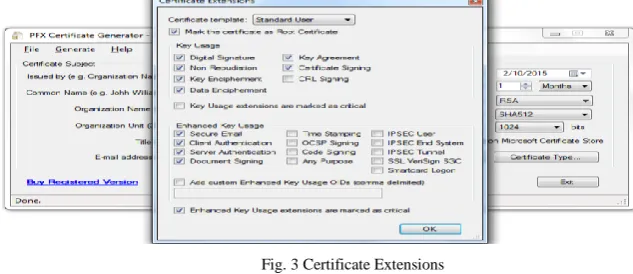
For SCADY User certificate, the services used are: Digital Signature, Non Repudiation, Key Encipherment and Data Encipherment. For the Root Certificate, the service used is Certificate Signing.
Enhanced Key Usage Extension
Enhance key usage extension provided with X.509 certificate generation indicates the use of certificate’s public key. It provides additional information such as whether the certificate is used for client authentication, server authentication, signing the document, IPSec Tunneling, time stamping, Code signing, SSL verification etc.
Additional information used in Scady through Enhanced Key Usage extension are -
Secure Email - The certificate can be used for securing Emails.
Client Authentication - The certificate can be used for authenticating the client.
Server Authentication - The certificate can be used for authenticating the server.
Document Signing - The certificate can be used to sign various documents.
We have created a root certificate as shown in Fig. 1 for the entire organization. Every certificate issued for a client will be signed by this Root Certificate. A Root Certificate (CA certificate) is used to digitally sign other certificates. In order to validate the certificates on other computers, the Root Certificate must be installed on the computers first.
Fig. 1 Certificate Generator
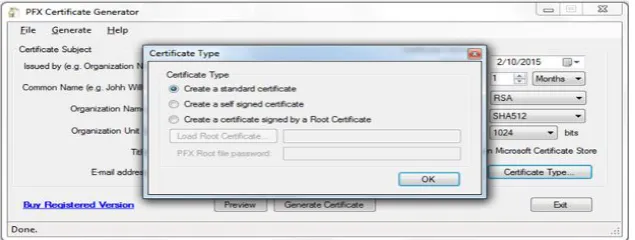
Fig. 2 describes the type of certificate. The available types of certificates are – Standard Certificate, Self Signed Certificate and Certificate signed by Root Certificate.
Next we selected the extensions for the certificate as shown in Fig. 3. These extensions describe the key usage as well as the enhanced key usage of the certificate such as Secure Email, Client Authentication, Server Authentication, IPSEC User, IPSEC Tunnel etc.
Fig. 3 Certificate Extensions
Finally the certificate will be created and will be ready to install for clients as shown in Fig. 4.
Fig. 4 Certificate Information
Issue of the Client Certificate Signed by the Root Certificate
In order to issue certificates signed by this Root Certificate, following steps are taken:
“Standard User” Certificate is selected.
Certificate Subject is filled with data like Issued to, Organization, E-mail address, etc.
Root Certificate is then selected
The present certificate is issued and saved.
For Client Certificates, 1024 bit key is used with RSA and for root certificate 2048 bit key is used. Fig-5, Fig. 6 and Fig. 7 describes how password is set for the certificate, and finally the certificate is generated successfully.
Fig. 6 Saving the Certificate
Fig. 7 Certificate Generator
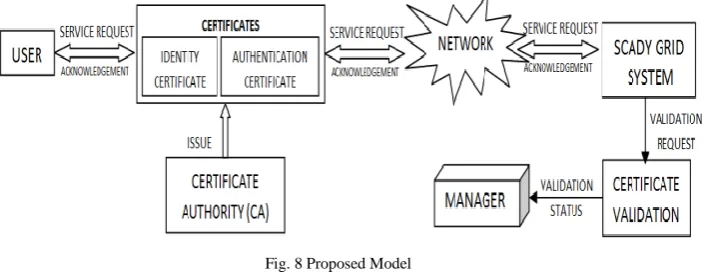
After creating the certificates, they are issued as per the communication request. The proposed model given in Fig-8 is implemented and the application is tested. Initially, a root certificate is created with a validity of one month. The duration can be decided by the organization and as per the requirements of the application. The Proposed model using X.509 certificates throws the light on security model of SCADY.
Fig. 8 Proposed Model
Fig. 9 Use Case Diagram
IV.CONCLUSION
In this paper, we studied Scady toolkit for Grid Computing. We found that even though, Scady is working fine in the grid environment, there was a need of security mechanism to secure and authenticate the communication. To remove this limitation, we proposed a security mechanism based on the review findings. The proposed model use X.509 certificate based delegation model and public key cryptography algorithms like RSA with SHA. Root certificate and client certificates are generated and issued.
We executed the grid toolkit with this certification model and found that the model is providing the required security to the system.
REFERENCES
1. Rakesh Bhatnagar, Dr. Jayesh Patel, Nirav Vasoya, “Implementation of Caching Algorithm in Scady Grid Framework”, 6th IEEE
International Conference on Computing Communications and Networking Technologies ICCCNT - 2015, July 13-15, 2015, Texas, USA.
2. Rakesh Bhatnagar, Dr. Jayesh Patel, Nirav Vasoya, " Dynamic Resource Allocation in SCADY Grid Toolkit", IEEE International
Conference on Computing, Communication and Automation (ICCCA-2015), pp 724 – 728, 2015
3. Rakesh Bhatnagar, Dr. Jayesh Patel, " Scady: A Scalable & Dynamic Toolkit for Enhanced Performance in Grid Computing", IEEE International Conference on Pervasive Computing – ICPC 2015, Advances in Technology, pp 1 – 5, 2015
4. Rakesh Bhatnagar, Dr. Jayesh Patel, "API Specification for a Small Grid Middleware - SCADY", 11th IEEE India Conference –
5. R. Bhatnagar, Dr. J. Patel, “An Empirical study of Security issues in Grid Middleware”, International Journal of Emerging Technology & Advanced Engineering , Volume 4 Issue 1, pp 470-474, 2014
6. Rakesh Bhatnagar, Dr. Jayesh Patel, “Performance Analysis of a Grid Monitoring System - Ganglia”, International Journal of Emerging
Technology & Advanced Engineering, Volume 3 Issue 8, pp 362-365, 2013
7. Rakesh Bhatnagar, Dr. Jayesh Patel, “Performance Analysis of a Grid Monitoring System - Autopilot”, Journal of Sci-Tech Research (KSV
– JSTR), Volume 4, Issue 2, pp 15 – 20, 2013
8. M. Bhardwaj, S. Singh & M. Singh, “Implementation of Single Sign-on and Delegation mechanism in Alchemi.Net based Grid
Computing Framework”, International Journal of Information Technology and Knowledge Management, Volume 4, No. 1, pp 289-292, 2011
9. Akshay Luther, Rajkumar Buyya, Rajiv Ranjan, and Srikumar Venugopal, “Alchemi: A .NET-based Enterprise Grid Computing System”,
Proc. of 6th International Conference on Internet Computing, ICOMP'05, June 2005.
10. Rajkumar Buyya, Akshay Luther, Rajiv Ranjan, and Srikumar Venugopal, “Alchemi: A .NET-based Grid Computing Framework and its
integration into Global Grids”, Technical Report, GRIDS-TR-2003-8, Grid Computing and Distributed Systems Laboratory, University of Melbourne, Australia, 2003
11. NV Kanaskar, U Topaloglu, C Bayrak, “Globus security model for grid environment”, ACM SIGSOFT Software Engineering Notes,
2005 - dl.acm.org, Volume 30 Issue 6, pp 1 – 9, 2005
12. Unicore Client user manual retrieved Jan 10, 2014, from: www.unicore.eu/documentation/manuals/unicore6/RichClient-.3.1.pdf
13. J Frey, T Tannenbaum, M Livny, I Foster and S Tuecke, Condor-G: A computation management agent for multi-institutional grids,
Cluster Computing, Springer, 2002
14. Marcos Dias de Assuncao, Krishna Nadiminti, Srikumar Venugopal, Tianchi Ma, Rajkumar Buyya, “An Integration of Global and
Enterprise Grid Computing: Gridbus Broker and Xgrid Perspective”, Grid and Cooperative Computing - GCC 2005, Springer, Volume 3795, pp 406-417, 2005
15. Maria Leitner, Stefanie Rinderle-Ma, “A systematic review on security in Process-Aware Information Systems – Constitution, challenges,
and future directions”,Elsevier, Information and Software Technology, Volume 56, Issue 3, pp 273–293, 2014
16. J Kołodziej, F Xhafa, “Meeting security and user behavior requirements in Grid scheduling”, Simulation Modeling Practice and Theory,
Elsevier, Volume 19, Issue 1, pp 213–226, 2011
17. GSI C – Globus Toolkit, https://dev.globus.org/wiki/GSI-OpenSSH
18. MyProxy Credential Management Service, http://grid.ncsa.illinois.edu/myproxy
19. GSI-OpenSSH Globus, https://dev.globus.org/wiki/GSI-OpenSSH
20. X.509 Certificate Generator Help Manual, http://www.signfiles.com/manuals/CertificateGeneratorUserManual.pdf
21. D. M Rathod, S. M Parikh and B.V Buddhadev, “Structural and behavioral modeling of RESTful web service interface using UML”,
Proc. of IEEE International Conference on Intelligent Systems and Signal Processing (ISSP), pp. 28-33, 2013
22. Aditya Patel, Pratik Thanawala, Dr. J G Pandya, “Grid Resource Brokering for High Performance Parallel Applications”, International
Journal of Emerging Technology & Advanced Engineering, Volume 3 Issue 4, pp 181-187, 2013
23. R. Nagaraja, Dr. G. T. Raju, “COMMPC - Component Based Middleware for Pervasive Computing”, IJCSNS International Journal of
Computer Science and Network Security, Volume 11 No.9, 2011
24. L. Ramakrishnan, “Securing Next-Generation Grids”, IEEE IT Pro, March/April 2004.
25. WiMax Security 2014 [Online] http://www.topbits.com/wimax-security.html
BIOGRAPHY
Rakesh Bhatnagaris Asst. Prof. in the MCA Department, S. K. Patel College of Management & Computer Studies, Kadi Sarva Vidyalaya University, Gandhinagar, Gujarat, India. He has 13 years of teaching experience. He received M.Tech.(Computer Science) degree in 2006 and M.C.A. degree in 2002. Presently pursuing his research (Ph.D.), his research interest is in Grid Architecture, Middleware and Services.