ISSN(Online): 2320-9801
ISSN (Print): 2320-9798
I
nternational
J
ournal of
I
nnovative
R
esearch in
C
omputer
and
C
ommunication
E
ngineering
(An ISO 3297: 2007 Certified Organization)
Vol. 3, Issue 6, June 2015
Image De-Noising By Fuzzy, DBMF and
Bilateral Filters
Gagandeep Kaur, Gursimranjeet Kaur
Research Scholar, Dept. of E.C.E, GIMET, Amritsar, India
Asst. Professor, Dept of ECE, GIMET, Amritsar, India
ABSTRACT: Within the digital image processing, it is very difficult to determine which noise is present in an image as well as removal of noise. In this paper make use of various efficient filters as the proposed filters such as fuzzy-mean-median filter, alpha trimmed decision based median filter improves the quality of images. These proposed filters can easily remove Gaussian noise, salt and pepper noise and also mixed noise i.e. (Gaussian noise and salt and pepper). Various results of the proposed work are obtained by using parameters such as peak signal to noise ratio (PSNR), mean square error (MSE) and root mean square error (RMSE) which shows better performance.
KEYWORDS: Gaussian noise, impulse noise, Fuzzy-mean-median filter, Alpha trimmed decision based median filter, improved bilateral filter.
I. INTRODUCTION
The noise is the undesirable effects manufactured in the image. During image acquisition or transmission, several
factors are responsible for introducing noise in the image. Depending on the sort of disturbance, the noise can affect the image in order to different extent. Generally our focus is usually to remove certain style of noise. So we identify certain style of noise and utilize different algorithms to clear out the noise. Image noise is usually classified as Behavioral instinct noise (Salt-and-pepper noise), Amplifier disturbance (Gaussian noise), Picture noise, Quantization disturbance (uniform noise), Picture grain, on-isotropic disturbance, Multiplicative noise (Speckle noise) and Periodic noise.A. Impulse Noise (Salt and Pepper Noise)
The term impulse noise is also used for such a noise. Different terms are surge noise, random noise or independent noise. Black and white dots come in the image caused by this noise and as such salt and spice up noise. This noise arises within the image because of sharp and abrupt changes of graphic signal. Dust particles within the image acquisition source or higher heated faulty components can cause such a noise. Image is corrupted to a small extent because of noise. The impulse noise have two gray values: 0 represents white and 1 represents black for 8 bits gray image.
B. Gaussian Noise (Amplifier Noise)
The term normal noise model will be the synonym of Gaussian disturbance. This noise style is additive with nature along with follow Gaussian syndication. Meaning that each pixel within the noisy image is the sum of the true pixel value and also a random, Gaussian spread noise value. This noise is independent of intensity regarding pixel value in each point. The Gaussian noise can be quite common type regarding noise.
C.Poisson Noise (Photon Noise)
ISSN(Online): 2320-9801
ISSN (Print): 2320-9798
I
nternational
J
ournal of
I
nnovative
R
esearch in
C
omputer
and
C
ommunication
E
ngineering
(An ISO 3297: 2007 Certified Organization)
Vol. 3, Issue 6, June 2015
sufficient noise values. At practical argument the photon noise along with other sensor based noise corrupt the indication at different proportions.
D.Speckle Noise
This noise deteriorates the caliber of active radar and also Synthetic aperture radar (SAR) pictures. This noise is originated due to coherent processing associated with back scattered alerts from multiple distributed points. In conventional radar system such a noise is noticed if the returned signal from the object having size lower than or equal to a single image control unit, shows immediate fluctuations. Mean filters are good for Gaussian noise and also uniform noise.
II. RELATED WORK
Ou, Zenggui. [1] made a discussion about how exactly to utilize the sequential characteristic in the span of Web data mining to hold out structural transfer of semi-structured data based promptly effect of data, that's the structuring of Web data, and solve the issues. Zhu, Xiaodong et al. [2] proposed a data mining metadata algorithm with automatic reasoning AR-DMM on the basis of the novel formal logic DLRDM in the description logic family. A proper
reasoning framework is developed to automatically check the consistency of AR-DMM. Famili, A. Fazel. [3] provided an summary of the above mentioned listed knowledge discovery applications. They provided examples where it's possible to demonstrate how small or huge amounts of data, when understood from the real-world data mining perspective and the required data is properly integrated, can lead to novel knowledge discovery case studies.Cao, Longbing et al. [4] summarized general frameworks, paradigms, and basic processes for multi-feature combined mining, multisource Bora, Shital P. [5] explore a few of the ad hoc methods generally used for Data Mining in the scientific community, including things like scientific visualization, and outline how a number of the recently developed products used in the industry. Madraky, Abbas et al. [6] proposed an intermediate data model that could represented ideal for Spatio-Temporal data and performing data mining task easily while facing problem in frequently changing the data. To be able to propose suitable data model, this research also investigate the analytical parameters, the structure. Farid, DewanMd, and Chowdhury Mofizur Rahman [7] proposed a fresh approach for detecting novel class in data stream mining using decision tree classifier. The experiments on real benchmark data evaluate the efficiency of the proposed approach in both detecting the novel class and classification accuracy with comparisons traditional data mining classifiers.
III.FILTERS
The majority of images are affected to some extent by noise, which is unexplained variation inside data: disturbances in image intensity that happen to be either not interpretable or not of interest. Image analysis is often simplified if this noise is usually filtered out. In an analogous way filtration are used in hormones to free beverages from suspended harmful particles by passing them via a layer of mud or charcoal. Engineers working in signal processing have extended this is of the term filter to add in operations which accentuate highlights of interest in files.
The various filters used to remove noises present in the images are as follows:
A.Mean Filter
Mean filtering is merely a simple, intuitive and always easy to implement method of smoothing images i.e.by eliminating the total of intensity alternative between one pixel plus the next. It's often accustomed to reduce noise within images. The notion associated with mean filtering is just to displace every pixel value in the image with the particular mean (`average') worth of its friends, including itself. They have affectation of removing pixel values that happen to be unrepresentative of the particular surroundings.
B.Median Filter
ISSN(Online): 2320-9801
ISSN (Print): 2320-9798
I
nternational
J
ournal of
I
nnovative
R
esearch in
C
omputer
and
C
ommunication
E
ngineering
(An ISO 3297: 2007 Certified Organization)
Vol. 3, Issue 6, June 2015
usually a typical pre-processing step to enhance the outcomes connected with later processing (for example, edge detection while on an image).
C.FMM Filter
With image processing, essentially the most frequent methods tend to be median filter as well as mean filter. With these, an approach to mix both mean separate out and median filter in addition to a modification parameter will be given. This adjustment parameter is merely corresponding to this fuzzy membership function. This novel separate out, fuzzy media-mean (FMM) separate out, is aimed to eliminate the mixed sound. The fuzzy media-mean filter operates using a filtering window.
D.Alpha trimmed decision based median filter
This filter is really a windowed filter about non-linear class. The basic thought behind filter is made for any element while using the signal (image) have a look at its neighborhood, discard by far the most atypical elements in addition to calculate mean value because of the rest of these.
E. Bilateral filter
That filters smooth pictures without effecting sides, by means of a non-linear combination involving nearby image beliefs. In this filtration replaces each pixel through weighted averages involving its neighbor’s pixel. The weight issued to each neighbor pixel decreases with the distance in the image plane along with the distance on the intensity axis. This filter helps us to obtain result faster while compare to various other. While using bilateral filtration we use pre-processing and post processing steps for better results.
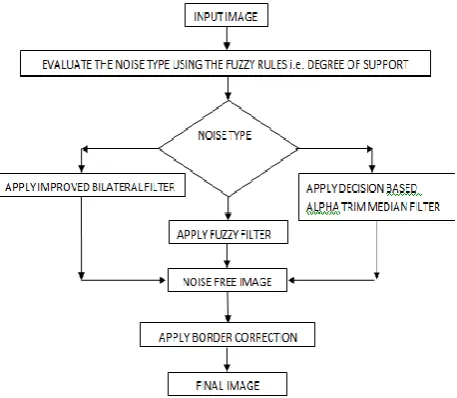
IV.PROPOSED ALGORITHM
The main motive of the proposed algorithm is to get smooth and clear images by using various filters such as fuzzy filter, bilateral filter, and alpha trimmed median filter. Several noises for example: Gaussian noise, impulse noise, speckle noise as well as Poisson noise can be removed after applying these filters. The fuzzy rules are used to identify which noise is present in an image. This proposed algorithm shows the promising results as compare to existing results.This technique continue to be proposed so far to get rid of the noise through digital images within more optimistic way.
ISSN(Online): 2320-9801
ISSN (Print): 2320-9798
I
nternational
J
ournal of
I
nnovative
R
esearch in
C
omputer
and
C
ommunication
E
ngineering
(An ISO 3297: 2007 Certified Organization)
Vol. 3, Issue 6, June 2015
Step 1: Firstly take any input image for example: any medical images.
Step 2: Then apply fuzzy logic to find out which type of noise is present in an image (i.e. Gaussian noise, Impulsive noise, or both, Speckle noise, Poisson noise etc).
Step 3: When noises are identified then various filters are used to remove them. Filters such as fuzzy-mean-median filter are used to remove mix noise (i.e. Gaussian noise and impulsive noise) present in an image, improved bilateral filter and alpha trimmed median filter.
Step 4: After applying filters, noise free image is formed which is same as the original input image.
Step 5: In order to check whether the image formed from filtering technique is exactly equal to the original image, various parameters are used. In border correction, edge preservations can be done.
Step 6: At the end, noise free image is formed as an final image
V. SIMULATION RESULTS
Eliminating the noise coming from digital images is among the most major issue within the digital image
processing. The experimental results are shown by using filters such as fuzzy-mean-median filter, bilateral filter and alpha trimmed median filter. Figure 2 (a) shows the input image taken from any camera or any printing devices. Figure 2 (b) is the noisy image in which various noises are present. Many noises such as Gaussian noise, salt and pepper noise, speckle noise, Poisson noise are added in an image.
Fig 2: (a) Input image (b) Noisy image
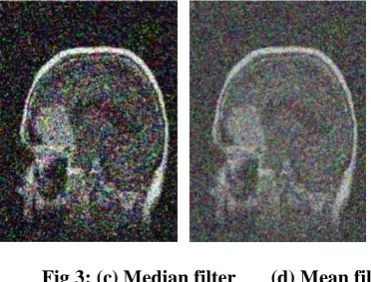
The figure 3 (a) shows the output of the median filter. This median filter is used to remove noises from an image as well as enhance the quality of the noisy image which is further interrupted by various noises. The figure 3 (b) shows the output of the mean filter. This is also used to improve the quality of an image as well as for noise reduction.
Fig 3: (c) Median filter (d) Mean filter
ISSN(Online): 2320-9801
ISSN (Print): 2320-9798
I
nternational
J
ournal of
I
nnovative
R
esearch in
C
omputer
and
C
ommunication
E
ngineering
(An ISO 3297: 2007 Certified Organization)
Vol. 3, Issue 6, June 2015
Fig 4: (e) FMM filter (f) Proposed technique PERFORMNACE EVLAUTAION
1. PSNR (peak signal to noise ratio) - Peak square noise ratio is the ratio of peak signal to noise. It is measured in
decibels (db)[8]. It can be expressed as: PSNR = 10. log10 𝑀𝐴𝑋𝐼2
𝑀𝑆𝐸
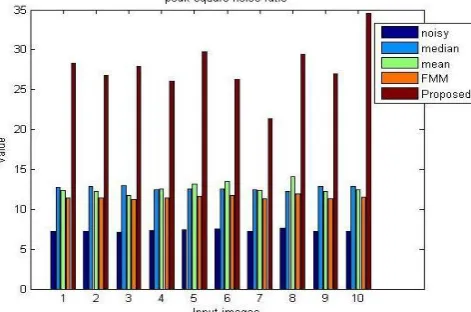
Table 1: This table indicates the values of the parameter PSNR, which is high from existing work. This comparison table shows that the values of the noisy image and various filters such as median filter, mean filter, FMM (fuzzy-mean-median filter) filter and finally proposed filters (i.e. bilateral filter, DBMF and FMM filter) with noise intensity (a) Gaussian noise 0.2 (b) Impulsive noise 0.3
Images Noisy Median Mean FMM Proposed
1. 7.2169 12.7001 12.2864 11.4021 28.2953
2. 7.1997 12.7956 12.2559 11.3726 26.7190
3. 7.0675 12.9827 11.7579 11.2089 27.8368
4. 7.2772 12.4056 12.5533 11.4290 26.0630
5. 7.4006 12.5162 13.1574 11.6620 29.7625
6. 7.4948 12.5031 13.4666 11.7349 26.2990
7. 7.2385 12.4044 12.3181 11.2645 21.3556
8. 7.6173 12.2380 14.0996 11.9365 29.3942
9. 7.2001 12.8791 12.2503 11.3372 26.9664
10. 7.2512 12.8314 12.4841 11.5271 34.5872
Table 1: PSNR values of existing filters and proposed filters
Graph 1: This graph shows that the values of PSNR of proposed work as well as existing work. The values of PSNR of the proposed work show better results than the existing work because the value of PSNR is as high as possible.
ISSN(Online): 2320-9801
ISSN (Print): 2320-9798
I
nternational
J
ournal of
I
nnovative
R
esearch in
C
omputer
and
C
ommunication
E
ngineering
(An ISO 3297: 2007 Certified Organization)
Vol. 3, Issue 6, June 2015
2. MSE (mean square error) - Mean square error is to compute an error signal by subtracting the test signal from the reference, and then computing the average energy of the error signal.It can be expressed as:
MSE =
1
MN
f i, j − f
′
(i, j)
2 Nj=1 M
i=1
Table 2: This table indicates the values of the parameter MSE, which is low from existing work. This comparison table shows that the values of the noisy image and various filters such as median filter, mean filter, FMM (fuzzy-mean-median filter) filter and finally proposed filters (i.e. bilateral filter, DBMF and FMM filter) with noise intensity (a) Gaussian noise 0.2 (b) Impulsive noise 0.3
Images Noisy Median Mean FMM Proposed
1. 12342 3492 3841 4708 96.2826
2. 12391 3416 3868 4740 138.4133
3. 12774 3272 4338 4922 107.0047
4. 12172 3737 3612 4679 160.9839
5. 11831 3643 3143 4434 68.6792
6. 11577 3654 2927 4361 152.4683
7. 12281 3738 3813 4859 475.9099
8. 11255 3884 2530 4163 74.7582
9. 12390 3351 3873 4779 13.7505
10. 12245 3388 3670 4574 22.6133
Table 2: MSE values of existing filters and proposed filters
Graph 2: This graph shows that the values of MSE of proposed work as well as existing work. The values of MSE of the proposed work show better results than the existing work because the value of MSE is as low as possible
Graph 2: MSE graph show results of existing filters and proposed filters
3. RMSE (Root Mean Square Error) -Root-mean-square error is a measure of the differences between values predicted by a model or an estimator and the values actually observed. It can be expressed as: RMSE = MSE
ISSN(Online): 2320-9801
ISSN (Print): 2320-9798
I
nternational
J
ournal of
I
nnovative
R
esearch in
C
omputer
and
C
ommunication
E
ngineering
(An ISO 3297: 2007 Certified Organization)
Vol. 3, Issue 6, June 2015
median filter) filter and finally proposed filters (i.e. bilateral filter, DBMF and FMM filter) with noise intensity (a) Gaussian noise 0.2 (b) Impulsive noise 0.3
Images Noisy Median Mean FMM Proposed
1. 111.0946 59.0931 61.9758 68.6174 9.8124
2. 111.3149 58.4466 62.1932 68.8513 11.7649
3. 113.0221 57.2014 65.8635 70.1612 10.3443
4. 110.3268 61.1310 60.0999 68.4054 12.6879
5. 108.7704 60.3573 56.0625 66.5946 8.2873
6. 107.5965 60.4483 54.1018 66.0382 12.3478
7. 110.8197 61.1392 61.7495 69.7133 21.8154
8. 106.0896 62.3217 50.2991 64.5233 8.6463
9. 111.3104 57.8878 62.2334 69.1326 11.4346
10. 110.6571 58.2065 60.5805 67.6375 4.7553
Table 3: RMSE values of existing filters and proposed filters
Graph 3: This graph shows that the values of RMSE of proposed work as well as existing work. The values of RMSE of the proposed work show better results than the existing work because the value of RMSE is as low as possible.
Graph 3: RMSE graph show results of existing filters and proposed filters
VI.CONCLUSION
Noise is often a random variation associated with image Intensity in addition to visible as grains from the image. It
may produce before capturing or impression transmission. Many noises such as Gaussian noise, salt and pepper noise, speckle noise as well as Poisson noise can make image not easily visible so fuzzy filters, improved bilateral filter and alpha trimmed decision based median filter are used to eliminate these disturbances. The comparison results of proposed work is far better because the values of parameters such as PSNR shows value as high as possible and also MSE and RMSE is as low as possible.REFERENCES
[1] Ou, Zenggui. "Data structuring and effective retrieval in the mining of web sequential characteristic." In Electronic and Mechanical Engineering and Information Technology, 2011 International Conference on, vol. 7, pp. 3551-3554. IEEE, 2011.
[2] Zhu, Xiaodong, Hengshan Wang, Hongcheng Gan, and Chunchang Gao. "Construction and management of automatical reasoning
ISSN(Online): 2320-9801
ISSN (Print): 2320-9798
I
nternational
J
ournal of
I
nnovative
R
esearch in
C
omputer
and
C
ommunication
E
ngineering
(An ISO 3297: 2007 Certified Organization)
Vol. 3, Issue 6, June 2015
[3] Famili, A. Fazel. "Setting up and managing real-world data mining and optimization cases studies: Motivations and challenges." In Data
Mining and Optimization, 2011 3rd Conference on, pp. xii-xii. IEEE, 2011.
[4] Cao, Longbing, Huaifeng Zhang, Yanchang Zhao, Dan Luo, and Chengqi Zhang. "Combined mining: discovering informative knowledge
in complex data. Systems, Man, and Cybernetics, Part B: Cybernetics, IEEE Transactions on41, no. 3 (2011): 699-712.
[5] Bora, Shital P. "Data mining and ware housing." In Electronics Computer Technology, 2011 3rd International Conference on, vol. 1, pp.
1-5. IEEE, 2011.
[6] Madraky, Abbas, Zulaiha Ali Othman, and Abdul Razak Hamdan. "Hair data model: A new data model for Spatio-Temporal data
mining." In Data Mining and Optimization, 2012 4th Conference on, pp. 18-22. IEEE, 2012.
[7] Farid, Dewan Md, and Chowdhury Mofizur Rahman. "Novel class detection in concept-drifting data stream mining employing decision
tree." In Electrical & Computer Engineering, 2012 7th International Conference on, pp. 630-633. IEEE, 2012.
[8] Mahmud Saeidi et al., “Noise Reduction in Image Sequences using an Effective Fuzzy Algorithm”, World Academy of Science,
Engineering and Technology, vol. 2, page. 351-356, 43, 2008
BIOGRAPHY
Gagandeep kaur is a Research scholar in the Electronics and Communication Department, at Global institutes of management and technology, Punjab technical University. Her research interests are in digital image processing. She completed her B.Tech (E.C.E) from Global institutes of management and technology with good remarks.