THE
INTERACTION OF KNOBS AND B CHROMOSOMESOF MAIZE
IN DETERMINING THE LEVEL OF RECOMBINATION1*2C. C. CHANG3 A N D GARY Y. KIKUDOME
Division of Biological Sciences and College of Agriculture, University of Missouri, Columbia, Missouri 65201
Manuscript received November 30, 1973
ABSTRACT
Enhancement of recombination by B chromosomes is influenced by the kind of heterochromatic knob present i n or near the tested region of the A chramo- somes. In homomorphic chromosome 9 bivalents of K S / K S constitution, double
exchanges were increased a t the expense of singles, but in the K * / K s hetero- morphs there was a gain in both single and double exchanges at the expense of no-exchange tetrads. Modification of the B chromosome enhancement in dif- ferent knob compounds was observed only in the megasporocytes.-Different frequencies of recombination are found in plants with odd and even numbers of B Chromosomes; this effect is especially striking in the megasporocytes. The modification in recombination produced by a n odd or even number of B
chromosomes is a function of the interaction of a particular region and the knob constitution. Odd numbers of B chromosomes were more effective than even numbers i n causing increased recombination.-It is concluded that heterochromatic knobs and the essentially heterochromatic supernumeraries may interact in the process of crossing over, with the level of recombination determined in part by knob constitution.
HE
ability of theB
chromosomes of maize to promote recombination has been Tdemonstrated byRHOADES
(1968a, b),
by HANSON (1969), byNEL
(1969, 1973) and by WARD (1972).RHOADES,
HANSON andNEL
each observed a shift in the distribution of exchanges from the distal to the proximal region of the short arm of chromosome 9 i n the presence ofB
chromosomes.NEL
noted that it is the proximal region of the chromosome which responds to the presence of the supernumeraries and that the increase in recombination is either more pro- nounced in or confined to the microsporocytes. Moreover, the enhancement of recombination was accentuated when the abnormal chromosome 10 (K10) was also present. The K10 chromosome possesses an exotic piece of chromatin con- taining a large block of heterochromatin with unusual genetic properties. Not only does K10 interact with B chromosomes to affect crossing over, but it also is able to increase recombination in the absence ofB’s
in certain regions of the genome (RHOADES and DEMPSEY 1957, 1966; NEL 1973).Supported in part by Public Health Senrice Grant GM 12353 to the second author.
Contribution from the Missouri Agricultural Experiment Station, Journal Series No. 6875. Approved by the Director.
a Present address: Department of Human Genetics, University of Michigan Medical School, Ann Arbor, Michigan 48104..
46 C . C . C H A N G A N D G . Y. KIKUDOME
Heterochromatic knobs on chromosome 9 have been shown to influence the crossover increment induced by the K10 chromosome (KIKUDOME 1959). Inas- much as the B chromosome, like the exotic segment of K10, is essentially hetero- chromatic, we wished to ascertain if knobs would similarly modify the recombi- national response induced by
B
chromosomes. The K * and the K” (s = small) terminal knobs of the short arm of chromosome 9 were selected f o r this study. The K * knob is similar in size to the large heterochromatic element which char- acterizes the K10 chromosome and is the largest known knob terminating the short arm of chromosome 9.It
has none of the genetic properties of K10, accord- ing to our tests. The K 5 knob, on the other hand, is similar in size to that found on chromosome 9 in the inbred line KYS and is approximately one-seventh the length of the K + knob.MATERIALS A N D METHODS
Evaluation of the interaction of the knobs of chromosome 9 with B chromosomes was made through analysis of reciprocal testcross data from heterozygotes in two partial sib classes with differing knob combinations and varying numbers of B chromosomes. Since recombination in a given chromosome or chromosomal region can vary, from season to season, the testcrosses were made in the same season to avoid invalid comparisons. The comparison that we would like to have made was between K S / K s and K * / K * homomorphs rather than between a homomorph and a heteromorph. The latter type of comparison introduces the problem of pairing difficulty in the heteromorphs. If pairing in the heteromorphs were severely affected by the dissimilarity in knob size, the comparison would be highly suspect. Inasmuch as the K * / K * homomorphs with varying numbers of B chromosomes are not available, we resorted to the comparison shown below, cognizant of the potential danger confronting such an undertaking.
A.
with OB, lB, 2B’s, 3B’s, 4B’s, 5B’s
K S + + + +
K s y g sh bz wx B
K s + + + + with OB, IB, 2B’s, 3B’s, 4Bs, 5B’s
K* y g sh bz wx
The genetic markers used in our study can be characterized as follows: “Yellow-green” ( y g ) is a seedling and mature plant trait while “shrunken” (sh) is an endosperm marker. “Bronze”
( b z ) and “waxy” (wz) can be used either as mature plant or endosperm markers but are more readily scored in the endosperm.
When heterozygotes are used as males in testcrosses, heterofertilization may occur, resulting in kernels with embryos and endosperms of non-corresponding genotypes. Thus, an error may be introduced into the calculation of recombination values when one character is scored in the endosperm and the other i n the seedling or mature plant. Since the effect of heterofertilization on our data appeared to be negligible, no corrections were made on the recombination values in the (yg-sh) region of chromosome 9. Therefore, the values presented for this region obtained in the backcrosses of heterozygous pollen parents may be somewhat higher than the actual fre- quencies. Recombination between sh, bz, and wz is not affected by heterofertilization since these traits were scored in the endosperm.
RESULTS
M O D I F I E D RECOMBINATION IN M A I Z E TABLE 1
Recombination values from testcrosses of two classes of knob combinations with varying number of B chromosomes
47
Megasporocytes MicrosDorocvtes
Total
No. B’s I I1 I11 Total progeny
Total I11 Total progeny
I I1 A. B. A. B. A. B. A. B. A. B. A. B. OB 1B 2B 3B 4B 5B
23.86 2.47
8.35 1.61
22.08’ 2.32
10.92** 1.69
24.17 2.12
8.12 1.43
21.77* 1.8%
10.41** 2.05
23.47 1.86*
8.97 1.48
23.69 1.85
12.63’ 1.86
15.72 42.05 7934
19.10 29.05 6038
17.27* 41.66 5658
21.39** 34.W** 9539
16.23 42.52 7414
21.%* 30.60 5121
17.44* 41.06 2494
23.44** 35.80** 4430
16.07 41.40 5587
21.94** 32.39** 4202
18.33* 43.87 971
22.77** 37.27** 966
25.58 20.48 23.32 18.16* 26.50 15.94** 24.94 19.23 24.48 18.48 25.83 16.67**
2.46 18.11
2.82 25.17
1.79 20.56*
1.84 25.30
1.44** 17.64
1.88* 25.48
1.70 17.23
1.96* 25.48
1.74’ 17.81
2.44 24.11
1.84 19.80
1.80* 23.94
46.15 2479
4.8.47 3369
46.67 2344
45.3(3* 2285
45.59 2494
43.26** 2973
43.87 2530
46.66 2814
44.03 3734
45.03* 1970
47.48 14Q9
42.41** 1278
*,** denote deviations, significant at the 5% and 1 % levels, respectively, from the “OB” category of the same knob combination.
Crossover regions: K sh bz wx K s / K a = A
K * / K s = B
0
Yg
I I1 I11
short arm of chromosome 9, we obtained the following information concerning the supernumeraries and the heterozygous
K *
knob, respectively (see Table 1 and Figure 1) : (a) In both the proximal (bz-wz) and the distal (yg-sh) regions, regardless of knob constitution, we observed an “odd-even” effect on recombina- tion with increasing numbers of B’s. Each of these regions is adjacent to hetero- chromatin. On the other hand, the interstitial (sh-bz) region showed little if any difference in recombination frequencies with odd or even numbers of B’s. Unlike the distal and proximal regions, this region is f a r removed from heterochromatin.C. C. C H A N G A N D G . I’. KIKUDOME
k - ;
---
- _ _ _ _ _ _ _ -
--
-
--
II0 I 2 3 4 5
0 - C H R O M O S O M E C L A S S
FIGURE 1.-Recombination percentages for three regions of chromosome 9 i n megasporocytes
(A) and microsporocytes (B) of Ks/Ks homomorphs (-) and K * / K S heteromorphs (---)
with zero to five B chromosomes.
Involvement of knobs in the “odd-even” effect of B chromosomes
In
megasporocytes of the homomorphs, an odd number of B’s reduced the fre- quency of recombination in the distal region while a n even number restored it to the original (OB) value (see Table 1 ) . However, in the proximal region, an odd number of B’s resulted i n enhancement in recombination while an even number resulted in the restoration of the OB value. The opposite effect was observed in megasporocytes of the heteromorphs. I n the distal region, odd num- bers of B’s increased recombination while in the proximal region both odd and even numbers of B’s resulted in enhancement, with a n odd number being more effective than a n even number. In contrast to the situation in megasporocytes, there is no clear-cut evidence for the involvement of knobs in the “odd-even” effect of B chromosomes in microsporocytes.M O D I F I E D R E C O M B I N A T I O N I N M A I Z E 49
Involvement of knobs in the modification of exchange frequencies induced by
B’s
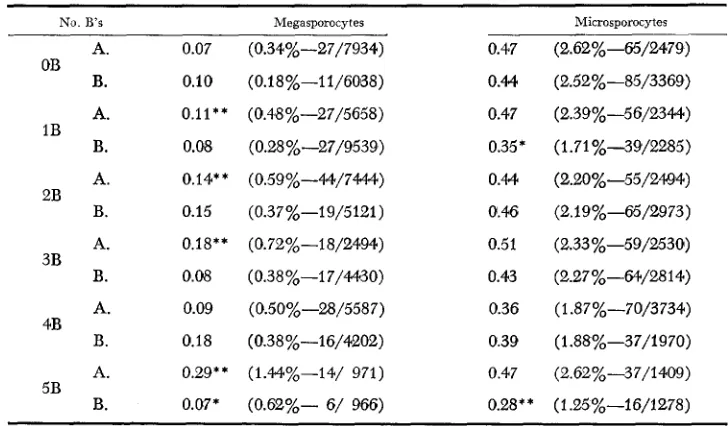
The effect of the supernumeraries on double exchanges was similar in the two knob classes (see Tables 2 and 3 ) . In both classes, increases in combined double exchanges for all regions were realized only in megasporocytes, and the rise in the doubles appears to be correlated with the increase in the number of
B
chromo- somes. The increase in the double exchange frequencies induced by the super- numeraries was approximately the same in the two knobs classes (K S / K 8 :
1 .M.2times and
K * / K 8 :
1.5-3.5 times). However, only the homomorphs show a n enhancement of the1-111
exchanges when those are considered separately, the enhancement being progressively more pronounced with increasing numbers of B’s (Table 2). The calculated percentages of tetrad ranks presented in Table 3reveal that in megasporocytes of the homomorphs the increase in the number of tetrads with double exchanges is at the expense of the single exchange tetrads with double exchanges is at the expense of the single exchange tetrads while in the heteromorphs the single and double exchange tetrads appear to be increased at the expense of the no-exchange tetrads.
When the percentages of single and double exchange tetrads are summed, there is no difference in the homomorphs either between megasporocytes and micro- sporocytes or among the six B-chromosome categories. In contrast to the homo- morphs, megasporocytes of the heteromorphs exhibit an overall increase in the number of tetrads with one or more exchanges when B chromosomes are present;
TABLE 2
Cosincidence values for double crossovers in the yg-sh and bsz-wx (1-111) regions
OB 1B 2B 3B 4B 5B
No. B’s Megasporocytes Microsporocytes
A. 0.07 (0.34%-27/7934) 0.47 (2.62%-65/2479)
B. A. B. A. B. A. B. A. B. A. B. 0.10 0.11** 0.08 0.14** 0.15 0.18** 0.08 0.09 0.18 0.29** 0.07*
(0.18%-I 1/6088)
(0.48%-27/5658)
(0.28 %-27/9539)
(0.59%-44/7444)
(0.37%-19/5121)
(0.72%-18/2494)
(0.38%-I 7/4430)
(0.50%-28/5587)
(0.38%-16/4202)
(1.44%-14/ 971)
(0.62%- 6/ 966)
0.M
0.47
0.35 *
0.M 0.46 0.51 0.43 0.36 0.39 0.47
0.28 * *
(2.52%-85/3369) (2.39%-56/2344) (1.71 %-39/2285) (2.20%-55/2494) (2.19%-65/2973) (2.33 %-59/2530)
(2.27 %-64/28 14)
(1.87%-70/3734)
(1.88%-37/1970)
(2.62%-37/1409)
(1.25%-16/1278)
*,** denote deviations, significant at the 5% and 1% levels, respectively, from the OB category
The percentages and numbers of combined double crossovers in regions I-11,II-I11 and 1-111
of the same knob combination and sex.
are given in parentheses.
50 C. C. C H A N G A N D G. Y. KIKUDOME
TABLE 3
Calculated percentages of exchanges in meiocytes of two classes of knob combinations with varying number of B chromosomes
Rlegasporocytes hlicrosporocytes
Total Total
No B’F None Single Double progeny None Single Double progeny
A. 17.28 81.36 1.36 7934 17.54 72.62 9.84 2479
B. 42.64 56.63 0.73 6038 14.76 75.16 10.08 3369
A. 19.64 79.49 1.91 5658 16.22 74.22 9.56 2344
B. 33.20 65.67 1.13 9539 16.24 76.92 6.84 2285
A. 17.32 80.32 2.36 7444 17.32 74.20 8.48 2494
B. 40.41) 58.12 1.48 5121 22.50 68.50 9.00 2973
A. 20.76 76.43 2.81 2494 21.26 69.74 9.00 2530
B. 29.94 68.53 1.53 4430 15.92 74.84 9.24 2814
A. 19.30 78.70 2.00 5587 19.12 73.72 7.16 3734
B. 36.74 61.83 1.43 4202 18.08 73.80 8.12 1970
OB
1B
2B
3B
4B
A. 18.02 76.22 5.76 971 15.96 73.54 10.50 1409
B. 27.96 69.56 2.48 966 20.18 74.82 5.00 1278
5B
Ks/KS = A K * / K s = B
the “odd-even” effect is clearly evident in the single exchanges. The total per- centages of exchanges in microsporocytes of heteromorphs are consistently higher than in the corresponding megasporocytes, but they show no consistent pattern of variation in the six B-chromosome categories. Further, in the homomorphs, double exchanges are decidedly higher in microsporocytes than in megasporo- cytes, but the single exchanges appear to be somewhat higher in megasporocytes. I n the heteromorphs, both single and double exchanges are higher in micro- sporocytes than in megasporocytes. When one considers the recombination values obtained only in microsporocytes of the two knob classes, they are found to be quite comparable.
DISCUSSION
In maize and in other species, B chromosomes are capable of modifying chiasma formation (JOHN and HEWITT 1965; CAMERON and REES 1967; JONES and REES 1967; AYONOADU and REES 1968; VOSA and BARLOW 1970; SIMCHEN, ZARCHI and HILLEL 1971; EVANS and MACEFIELD 1972) and recombination
(RHOADES 1968a, b; HANSON 1969; NEL 1969, 1973; CHANG and KIKUDOME 1971; WARD 1972). While in the majority of cases, B chromosomes act as pro- moters, in Lolium perenne ( CAMERON and REES 1967), Lolium temulentum X L.
perenne hybrid (EVANS and MACEFIELD 1972), and in Triticum spe2toides ( SIM-
MODIFIED R E C O M B I N A T IO N I N M A IZ E
51
EVANS
andMACEFIELD
is of particular interest i n that theB’s
were observed tosuppress pairing and chiasma formation between homoeologous chromosomes, thereby promoting these activities between homologs.
HANSON
(1969) suggested that segments of maize chromosomes 3 and 9 pos- sessing knob sites were the only regions which exhibited decreased crossing over in the presence of B’s. However, he did not detennine the knob constitution cyto- logically and the observed reduction in crossing over could well have been a consequence of interaction between B chromosomes and knobs.NEL
(1973) reported that B chromosomes increase crossing over in centric o r proximal regions of chromosomes5
and 9 and that the response of these regions to the presence of B’s was greater in microsporocytes than in megasporocytes. I n his chromosome 9 study, NEL found that the distal (c-sh) region was unaffected by the presence of B’s in both types of sporocytes. In addition, he obtained results indicating possible interaction between B’s and the abnormal chromosome 10 (K10) in boosting recombination in the proximal (Lux-gl) region of chromosome 9.NEL’S
studies indicate that qualitative differences may exist between centric heterochromatinor“ the various maize A chromosomes. Whether qualitative differences exist among knobs is still to be determined. Although we observed no obvious differ- ence in pairing between the two knob classes, the modification of recombination observed i n
K * / K s
individuals could still be a structural effect caused by dissimi- larity in knob size and the resulting disturbance in effective pairing. Interaction of a somewhat difference type involving knobs and B chromosomes was described by RHOADES and DEMPSEY (1972a, b).
They reported that B chromosomes could induce breaks in knobbed A chromosomes during the second microspore division and that modifying genes markedly affect the frequency of such breaks. They also showed that in knobbed heteromorphs it is the chromosome with the larger of the two knobs which experiences a higher frequency of breakage (RHOADESand DEMPSEY 1972a). Our data do not indicate that B chromosome-induced breaks occurred at a detectable level in the two knob classes. Nonetheless, we intend to determine the effectiveness of B chromosomes in inducing breaks in chromosomes 9 possessing the K* knob.
AYONOADU and
REES
(1968) noted that the effect of maizeB
chromosomes on chiasma frequencies in microsporocytes was not consistent for all chromosomes and chromosomal segments. HANSON and NEL made similar observations in their recombination studies. While HANSON found the increase in total recombination to be due to a heightening of double exchanges at the expense of single exchanges, we found that the level of recombination can also be raised by a n increase in both double and single exchanges at the expense of the no-exchange tetrads. The par- ticular combination of chiasmata leading to an increase in recombination depends upon the knob constitution. I n the homomorphs, double exchanges were enhanced at the expense of the single, while in the heteromorphs, single and double exchanges were increased at the expense of no-exchange tetrads. It is possible that at least a portion ol the variability in response to B chromosomes found in differ- ent parts of the genome by AYONOADU and REES, by HANSON, and by NEL may52 C. C. CHANG A N D G . Y . K I K U D O M E
I n his chromosome 9 study,
NEL
observed that the proximal (wx-gl) region was the only region to show a significant response to the presence of the super- numeraries and only in microsporocytes. This region includes a major portion of the centric heterochromatin. In our study, the proximal (bz-wx) region does not span the centromere and includes, at best, little of the centric heterochro- matin. This region, however, showed an increase in recombination in megasporo- cytes of heteromorphs and of homomorphs with odd numbers of B’s. The distal(yg-sh) region which we studied lies close to the terminal knob heterochromatin.
It,
too, showed an increase in recombination, but only in megasporocytes of heteromorphs with odd numbers of B’s. In both studies, the region flanked by euchromatin (c-sh and sh-bz) showed no rise i n recombination i n the presence of B’s. It appears from both studies that if a region is to show any significant increase in recombination in the presence of B’s, it must lie sufficiently close to heterochromatin. A partial explanation of the difference between NEL’S and our results lies in the fact that non-identical regions are involved and in the likelihood that the background genotypes involved in the two studies are different. This difference notwithstanding, both studies reveal that different chromosomes and chromosomal segments uniquely respond to the presence of B’s and the manner in which they respond can be profoundly influenced by the “sex” in which 7rossing over is followed.A finding of some interest is the difference in recombination frequencies observed in plants with odd and even numbers of
B
chromosomes. In the distal(yg-sh) region, a n odd number of B’s decreased recombination in the homo-
morphs but increased the level in the heteromorphs. An even number resulted in the reestablishment of the
OB
value in both the homomorphs and the hetero- morphs. I n the proximal (bz-wx) region of heteromorphs, a n odd number was more effective in enhancing recombination than was an even number, although both classes showed increased crossing over. I n the homomorphs, on the other hand, only odd numbers of B’s were effective, even numbers merely reestablish- ing theOB
value.KIRK and JONES (1970) found that the relative amount of total nuclear protein and RNA in rye decreased with increasing numbers of supernumeraries, the values being consistently lower in plants containing odd numbers of these chro- mosomes. The amount of histones increased with additional B’s, and again the plants with odd numbers of B’s showed a greater effect than those with even numbers. They believe that histones produced by the supernumeraries inhibit genetic activity. However, HIMES (1967) found no increase in the histone: DNA ratio when B chromosomes are added to the maize genome. While
JONES
andM O D I F I E D R E C O M B I N A T I O N I N M A I Z E
53
TABLE 4OB IB
Distal region 1.78-
K S / K s Proximal region 1.55+ Total recombination: 42.05 41.66
Distal region 2.57f
K’/Ks Proximal region 2.293-
Total recombination: 29.05 34.00
2B
0.314- 0.514- 42.52
0.23-
1.954-
30.60
3B 4B 5B
2.09- 0.39- 0.17- 1.72+ 0.35+ 2.61+ 41.06 41.40 43.87
2.06+ 0.62+ 4.28+ 4.344- 2.844- 3.674- 35.80 32.39 37.27
The plants with even numbers of B’s consistently show the least effect on recombination. Little or no change in total recombination was observed in K 8 / K s
plants with increasing numbers of
B
chromosomes. I n the homomorphs, the “permissible” level of recombination, it could be argued, is achieved in the absence of the supernumeraries and cannot be increased. Thus, the enhancement induced by B’s in the proximal region is compensated by a decrease in the distal region. On the other hand, in theK * / K s
plants, where the overall level of recom- bination is low due to the presence of theK*
knob, the activity ofB
chromosomes is more readily detected. Thus, in the proximal region, which is considerably removed from the K* knob, both odd and even numbers ofB’s
promote recombi- nation, although even numbers are less effective than odd numbers. In the distal region, where the negative influence of the K* knob is strongest, only odd num- bers of B’s are capable of partially overcoming the suppression of crossing over. The data presented in this paper support the existence of an “odd-even” effect of B chromosomes in maize, similar to that described byJONES
andREES
(1969) and byKIRK
and JONES (1970) in rye, and indicate that knobs also influence recombination. Although the modus operandi ofB
chromosomes, as well as of the heterochromatic knobs, still eludes us, it would appear that these elements are capable of interacting in highly specific ways.We wish to dedicate this paper to PROFESSOR M. M. RHOADES, for whom we have deep affec- tion and respect. To him and MISS ELLEN DEMPSEY, our gratitude, for their critical review of this paper.
L I T E R A T U R E C I T E D AYONOADU, U. W. and H. REES,
CAMERON, F. M. and H. Rees, 1967
CHANG, C. C. and G. Y. KIKUDOME, 1971
EVANS, G. M. and A. J. MACEFIELD, 1972
HANSON, G. P., 1969
HIMES, M., 1967
JOHN, B. and G. M. HEWITT, 1965
1968 The influence of B-chromosomes on chiasma frequencies
The influence of B chromosomes on meiosis i n Lolium.
Is the effect of the B-chromosomes o n recombination
Suppression of homoeologous pairing by B chromo- in Black Mexican sweet corn. Genetica 39: 75-81.
Heredity 22: 446-450.
primarily an additive one? Maize Genetics Cooperation News Letter 45: 134-136.
somes in a Lolium species hybrid. Nature New Biol. 236: 110-111.
B-chromosome-stimulated crossing over in maize. Genetics 63 : 601-609. An analysis of heterochromatin in maize root tips. J. Cell Biol. 35: 175-181.
54
C. C. C H A N G A N D G. Y. K I K U D O M EJONES, R. N. and H. REES, 1967 Genotype control of chromosome behaviour in rye. XI. The influence of B chromosomes on meiosis. Heredity 22: 333-347. - , 1969 An anom- alous variation due to the presence of B-chromosomes in rye. Heredity 24: 265-271.
KIKUDOME, G. Y., 1959 Studies on the phenomenon of preferential segregation in maize. Genetics 44: 815-831.
KIRK, D. and R. N. JONES, 1970 Nuclear genetic activity in B-chromosome rye, in terms of the quantitative interrelationships between nuclear protein, nuclear RNA and histones. Chromo- soma 31: 241-254.
An effect of B chromosomes on crossing over in chromosome 5. Maize Genetics Cooperation News Letter 43: 54-55. - , 1973 The modification of crossing over in maize by extraneous chromosomal elements. Theoret. and Appl. Genetics 43: 196-202.
The induction of crossing over by B chromosomes. Maize Genetics Co- operation News Letter 42 : 79-83. Studies on the cytological basis of cross- ing over. pp. 229-241. In: Replication and Recombination of Genetic Material. Edited by W. J. PEACOCK and R. D. BROCK. Australian Acad. Sci., Canberra.
Further studies on preferential segregation. Maize Genetics Cooperation News Letter 31: 77-80. - , 1966 The effect of abnormal chro- mosome 10 on preferential segregation and crossing over in maize. Genetics 53: 989-1020.
-
, Knob constitution and the rate of chromatin loss. Maize Genetics Cooperation News Letter 4.6: 48-51. -, 1972b On the mechanism of chromatin loss induced by the B chromosomes of maize. Genetics 71 : 73-96.Supernumerary chromosomes in the second
The effect of supernumerary chromosomes on meiosis in
A new observation of the effects of B chromosomes on recombination. Maize NEL, P. M., 1969
RHOADES, M. M., 1968a
-- , 1968b
RHOADES, M . M. and E. Dempsey, 1957
1972a
SIMCHEN, G., Y. ZARCHI and J. L. HILLEL, 1971
VOSA, C. G. and P. W. BARLOW, 1970
WARD, E. J., 1972
outbreeding species of the wheat group. Chromosoma 3 3 : 63-69.
Puschkinia Zibanotica. Chromosoma 30 : 344-355.
Genetics Cooperation News Letter 46: 58-59.