Broadcast Encryption with Random Key Pre-distribution Schemes
Mahalingam Ramkumar
Department of Computer Science and Engineering
Mississippi State University, Mississippi State, MS 39762
Abstract
Broadcast encryption (BE) deals with the problem of establishing a se-cret, shared byg = G−rprivileged nodes, among a set Gnodes. Specifically, a set ofrrevoked nodes are denied access to the secret. Many schemes to address this problem, based on key pre-distribution schemes (KPS), have been proposed in the literature. Most state-of-the-art methods employ tree-based techniques. However, random key pre-distribution schemes (RKPS), which have received a lot of atten-tion in the recent past (especially in the context of ad hoc and sensor network security), also cater for BE. In this paper we analyze the per-formance of BE using RKPSs. While in most tree-based methods the source of the broadcast is assumed to be the root of the tree (unless asymmetric cryptographic primitives can be used), BE using RKPSs caters for BE by peers - without the need for asymmetric cryptography. Furthermore, unlike most BE schemes where the identities of the re-voked nodes have to be explicitly specified, BE using RKPSs allow for protecting the identities of the revoked nodes, which could be a useful property in application scenarios where privacy is a crucial issue.
1
Introduction
Broadcast encryption (BE) [1] provides a means of establishing shared secret betweengprivileged nodes, among of a set ofG
nodes, whereg+r=G, and thernodes which are not provided with the secret are usually referred to a revoked nodes. For situ-ations whereg << Git may be more efficient to set-up a shared secret betweengnodes usinggunicast transmissions. However, for scenarios wherer << G(org ≈ G) such an approach is very inefficient. BE schemes provide a very satisfactory solu-tion for cases wherer << G.
In many application scenarios [2], BE may assume a slightly different form. The universe, or the setU, consists of all nodes
in the system. Out of|U|=Nnodes, there may exist a subset G0 ∈ Uof Gnodes. Typically, theGnodes share a secret (a
priori), privy only to the nodes in the setG0. The problem that
BE needs to address in this case, is the efficient dissemination of a secret to all nodes inG0- except a subsetGR ∈ G0 ofr
nodes. At the end, this results in a new subsetG1 =G0\GR
ofg=G−rnodes, which now share a secret (not available to nodes not inG1).
Typically, BE is realized using some form of key pre-distribution, where a set ofksecrets are distributed to each node in the universe ofNnodes (before the system is deployed). The source of the broadcast then
1. chooses a broadcast secretKb(intended for the setG0),
2. encryptsKbusingnkeysKe1· · ·Ken, and
3. transmitsnvaluesEKei(Kb),1≤i≤n.
The keys Ke1· · ·Ken are chosen in such a way that none of
thernodes inGRcan (using their preloaded secrets) “discover”
any of the keysKe1· · ·Ken, while the remainingG−rnodes
inG1 = G0\GR may be able to discover at least one of the
secretsKe1· · ·Ken, and thereby gain access to the secretKb.
Typically, the source of the broadcast does not care if the nodes inU\G0gain access toKb. For example, if theGnodes shared
a secret KN0 before the broadcast, the shared secret between
the nodes inG1after the broadcast may beKb⊕KN0- which
neither the explicitly revoked nodes inGR or the other nodes
U\G0can gain access to - the former do not have access toKb
and the latter do not have access toKN0.
The efficiency of BE schemes is usually measured in terms of:
1. The bandwidth needed for the broadcast. More specifically, the number of encryptions needed to securely convey the broadcast secret, and overheads, if any.
2. Resilience of the scheme to collusion of revoked nodes. 3. Storage complexity at the receivers of the broadcast. 4. Computational complexity for recovering the broadcast
se-cret for each receiver.
5. Computational complexity involved in choosing the keys
Ke1· · ·Kenby the source of the broadcast.
Efficient solutions to the problem of broadcast encryption has received a lot of attention since the problem was defined by Fiat and Noar in Ref. [1]. Most current state of the art solutions [3] -[8] are tree-based, where the source of the broadcast is assumed to be the trusted authority (TA) at the root of the tree, who dis-tributes the secrets in the first place. However, such schemes can generally be extended to permit broadcast by parties other than the TA - if asymmetric cryptographic primitives are employed.
In this paper we consider BE using random key pre-distribution schemes (RKPS). Though RKPSs can also be deployed in a tree-like hierarchy, we restrict ourselves to a “flat” deployment. We argue that BE using RKPS schemes offers many advantages over the better known tree-based BE schemes for many application scenarios. Specifically, the two primary advantages offered by RKPSs (over tree-based schemes) are:
1. they permit any node to perform BE, without the use of asymmetric cryptographic primitives
2. they permit revocation of nodes without explicitly
specify-ing the identities of revoked nodes - which is potentially
The rest of this paper is organized as follows. In Section 2 we briefly review KPSs, with an emphasis on RKPSs. In Section 3 we provide a quantitative analysis of the efficiency of BE us-ing RKPSs. Discussions, interpretations and comparisons with other BE schemes, and some potential applications is the topic of Section 4. Conclusions are offered in Section 5.
2
Key Pre-distribution
A KPS consists of a trusted authority (TA), andN nodes with unique IDs. The TA choosesPsecretsRand two operatorsf()
andg(). The operatorf(), is used to determine the secretsAthat
are preloaded in nodeA. Two nodes with IDsA andB, with preloaded secretsAandBcan discover a unique shared secret
KABusing a public operatorg()without further involvement of
the TA. The restrictions on the operatorsf()andg()in order to satisfy these requirements can be mathematically stated as follows:
Si = f(R, IDi);
Kij = g(Si, IDj) =g(Sj, IDi)
= f(R, IDj, IDi) =f(R, IDi, IDj). (1)
Asg()is public, it possible for two nodes, just by exchanging their IDs, to executeg() and discover a unique shared secret. As the shared secret is a function of their IDs, their ability to arrive at the shared secret provides mutual assurances toAand
Bthat the other node possesses the necessary secretsBandA,
respectively. The secrets preloaded in each node is referred to as the node’s key-ring. We shall represent byk, the size of the key ring.
The primary advantage of KPSs is their ability to cater for ad hoc authentication without active involvement of a trusted au-thority, and without employing asymmetric cryptography. How-ever, this advantage comes at a price. Note that in KPSs, the keys assigned to different nodes are not independent - they are all de-rived from the same set (TA’s) keysR. Thus an attacker who has exposed keys from a finite number of nodes could compromise the entire system. For conventional key distribution schemes (KDS) (like Kerberos [10], [11] or PKI [12]) however, as the keys assigned to different nodes are independent, this is not the case.
However, for evolving [13] application scenarios (like MANETS [14]) where extensive mutual co-operation of re-source constrained (battery operated) nodes is necessary for their very functioning, compromise of a few nodes could affect the entire deployment. Thus there is a need to take proactive steps to control sizes of attacker coalitions (perhaps by improved tech-nology for tamper resistance / read-proofing of devices [15]). For securing such deployments, conventional KDSes may be an “overkill” (if the entire deployment is affected if a finite number of nodes are compromised, the fact that the KDS is not compro-mised does not help much). Thus KPSs, due to their inherent advantages of low resource consumption (which is also neces-sary as deployments of wireless devices forming MANETS are expected to include resource constrained devices), may be
suffi-cient for securing such networks. This is perhaps the reason for renewed interest in KPSs in the recent past.
2.1
Random Key Pre-distribution Schemes
KPSs based on the concept of pre-loading subsets (say of car-dinalityk) of keys in each node, from a pool of P keys, has been employed by various researchers, for very different cryp-tographic primitives. Perhaps the earliest example is the ma-trix [16] key pre-distribution scheme by Gong et. al. The ap-plications employing preloaded subsets range from discovery of shared secrets for pairwise communications [16] - [23], and more general group communications [22], [24], and broadcast authentication [26], [27], [28].
While the earlier methods based on preloaded subsets favored deterministic allocation of keys to nodes [29] (most of them per-haps motivated by Erdos et. al’s seminal work on intersections of finite sets [25]), Dyer et al [27] was perhaps the first to point out the advantages of random allocation of subsets. A very ele-gant framework for analysis of the security of random preloaded subsets was also presented in [27]. Recent attempts in this di-rection too, [17] - [22] favor random [17], [18], [23] or pseudo-random [19], [22], allocation of keys (in this paper we shall col-lectively refer to them as RPS or random preloaded subsets). While all RPS based methods are essentially similar, the pri-mary advantage of the methods which employ pseudo-random allocation of subsets, is that they provide a simple and elegant way for nodes to determine shared secrets (methods based on purely random allocation on the other hand need a bandwidth intensive shared key discovery process).
Formally, a(P, k)RPS employs a TA who chooses an indexed set ofP keysK1· · ·KP. Each node has a unique ID. The TA
chooses public random functionFRP S(), which when “seeded”
by a node ID, yields the allocation of keys for the node. Thus for a nodeA(node with unique IDA)
FRP S(A) = {A1, A2, . . . , Ak},
A = {KA1, . . . , KAk}. (2)
where 1 ≤ Ai ≤ P, Ai =6 Ajfori 6= j. In other words
FRP S() generates a partial random permutation of{1· · ·P}.
The k-length sequence {A1, A2, . . . , Ak} is the index of the
keys preloaded in nodeA (or node with ID A). A is the set
of secrets preloaded inA. Note that the indexes are public (as the node ID andFRP S()are public).
While KPSs employing random preloaded subsets fall under the category of random KPSs, the first RKPS, LM [30], pro-posed by Leighton and Micali, employs a very different idea. In the(k, L)LM scheme, the TA chooses an indexed set ofk se-cretsK1· · ·Kk, a cryptographic hash functionh(), and a public
random functionFLM(). For a nodeA,
FLM(A) = {a1, a2, . . . , ak},1≤ai≤L∀i.
A = {a1K1,a2K2, . . . ,akKk}. (3)
In other wordsFLM()generates ak-sequence of uniformly
is preloaded withkkeys. Theith preloaded key is nodeAis
derived by repeatedly hashingithTAs keya
itimes. The
param-eterLis the maximum hash depth. The notationiK
jrepresents
the result of repeatedly hashing ofKj,itimes, using a (public)
cryptographic hash functionh().
In HARPS [24], Ramkumar and Memon proposed a RKPS which is a generalization of LM and RPS. In(P, k, L)HARPS, the TA choosesPkeysK1· · ·KP, and each node is loaded with
a hashed subset ofkkeys. The TA has an indexed set ofP se-crets, a cryptographic hash functionh()and a public random functionFHARP S(). For a nodeA,
FHARP S(A) = {(A1, a1),(A2, a2), . . . ,(Ak, ak)},
A = {a1KA1,
a2K
A2, . . . ,
akK
Ak}. (4)
The first coordinate{A1, A2, . . . , Ak} represents the index of
the keys chosen to be preloaded in nodeA, and the second coor-dinate{a1, a2, . . . , ak}, the number of times each chosen key is
hashed (using cryptographic hash functionh()) before they are preloaded in the nodeA.
Note that LM and RPS are actually special cases of HARPS. LM is HARPS withP =k, and RPS is HARPS withL= 0(or keys are not hashed before pre-loading).
3
Broadcast Encryption Using Random
KPSs
As HARPS is a generalization of LM and RPS we shall only consider broadcast encryption using HARPS (the special cases easily follow). For BE using HARPS, the sender employs a sub-set of all secrets not covered by the union of therrevoked nodes. If we represent byRthe entire set of secrets that the source has access to, and bySrthe secrets covered by the union ofrnodes,
each of the independent secrets inR\Srcan be used to encrypt
the broadcast secretKB.
Indexes 1 2 3 4 5 6 7 8
A 4 2 x 1 x 3 x x
B x 3 1 x 3 2 x x
di 3 1 0 0 2 1 4 4
C x 3 4 1 x x 2 x
D 2 x x x 3 1 4 x
Consider the illustrative example above. The TA choosesP = 8
keysK1· · ·K8, andk= 4,L= 4. In other words, each node is
provided with a subset ofk = 4keys and each key has a “hash depth” between 1 and 4 (random and uniformly distributed). In the example, nodeAhas keys with indexesi= 1,2,4,6at hash depths 4, 2, 1 and 3 respectively (or keys4K1,2K2,1K4 and 3K
6). The rowdiis the hash depths the TA can employ for each
1≤i≤P for encryptingKbwhich revokesAandB. TA can
use keys3K1,1K2,2K5,1K6,4K7, and4K7.
Node Ccan use4K7 for decrypting the secret. NodeD can
use3K1or1K6or4K8. While the TA can use0K3and0K4, it
does not serve any purpose - no node can decrypt the broadcast secret encrypted with those keys.
On the other hand, ifCis the source of the broadcast (revoking
AandB)Ccould choose4K
8for encryptingKb.
3.1
Analysis of Efficiency of Broadcast
Encryp-tion
Let us first consider the case of BE by the TA. The TA has access to all secretsK1· · ·KP (at hash depth 0). Each of ther
(to-be-revoked) nodes havek < P keys each. The hash depths of the keys are uniformly distributed between 1 andL. The union of indexes of keys in allrnodes may still not contain some of the
P indexes. Obviously such keys can be used by the TA for en-crypting the broadcast secret (as none of thernodes can decrypt them). For example if the key indexiis not present in the union of r nodes, the broadcast secret can be encrypted safely with
LK i.
Now consider a key indexedi, which however,uof thernodes have. Let us assume that the hash depths of thoseukeys are
d1· · ·du, withdmin = min(d1· · ·du). The TA could still use
keydmin−1K
ito encrypt the broadcast secret. Proceeding in this
fashion, the TA could now use on an average, somenj keys at
each hash depth1≤j ≤L, for encrypting the broadcast secret. With thesen=PL
j=1njkeys the TA hopes to “reach” every
privileged node. Some of the transmitted keys may be useful to many nodes. Most may not be useful for a particular node. Once again, while the TA can encrypt the broadcast secret with keys K1· · ·KP (at hash depth 0), they are not useful for the
purpose of reaching the nodes - none of the nodes can decipher them. Thus key indexes, where the correspondingdmin = 1in
the union of thernodes, cannot be used by the TA for encrypting the broadcast secret.
However, while it is guaranteed that none of thernodes (even if they pool all their secrets together) can decipher the broadcast secret, there is a possibility that some of theg=G−rprivileged nodes too may not be able to decrypt any of thenencryptions. We shall represent bypo, the probability that an arbitrary node
among the group ofgpreviliged nodes cannot use any of then
keys. In such an event, on an average,gpoprivileged nodes may
not be able to decrypt the broadcast secret. As long aspo<< 1g
this may not be a serious issue.
Note that it is also possible to trade-offpofor bandwidth (n,
the number of encryptions needed). For instance, the TA may decide to send only a subset of the encrypted secrets in order to meet a targetpo. For thegponodes (on an average) that may be
missed, the TA could send the broadcast secret using the secret the TA shares with every node (the secret shared between the TA and any node can be a function of allkkeys in the node - as the TA has access to all secrets).
The question now is, how many secrets (on an average) does the TA need to transmit? But prior to that, we need an estimate the number of keysnj,1≤j≤Lthat the TA can use. It is easy
to see that forj = L, thenj keys correspond to the keys that
none of thernodes have (at any hash depth). The probability that any node has a key indexediisξ= Pk. Thus the probability that none of thernodes have keyiis(1−ξ)r. In other words
Now let us evaluate the expression fornj for a generalj. Let
us assume thatu out ofr nodes have some key index i (the probability that exactlyu >0out ofrnodes have theithkey is
r u
ξu(1−ξ)(r−u),1≤u≤r), with corresponding hash depths d1· · ·du. Under this condition, the TA can employ hash depth
j for the keyi ifdmin = min(d1· · ·du) = j+ 1. As each
dl,1≤l≤uis uniformly distributed between 1 andL
Pr{dmin=j+ 1} = Pr{dmin> j} −Pr{dmin> j+ 1}
= (L−j)
u−(L−j−1)u
Lu (6)
Thus the probabilityπj that the TA employs hash depthj for
keyiis
πj = r X u=1 r u
ξu(1−ξ)(r−u)(L−j)
u−(L−j−1)u
Lu , (7)
and
nj =P πj. (8)
In order to decrypt a secret encrypted with key indexiat depth
j, the node should have the secreti(probabilityξ) at depthd≤j
(probabilityLj). Encryption keys that use higher hash depths are thus “more useful.” Thus for a particular encryption key at hash depthj (or any one of thenj keys) the probability of outage is
poi = (1−ξ
j L).
The TA does not have to use alln=PL
j=1njkeys. The TA
may instead only use a subsetm =PL
j=qnj keys. In the case
the probability of outage for any node (or the probability that it cannot decipher any of thePL
j=qnjencryptions) is
p∗o=
L
Y
j=q
(1−ξj L)
nj (9)
The total number of encryption needed to convey the secret to allg=G−rnodes is therefore
ne=
L
X
j=q
nj
+gp
∗
o. (10)
The source (TA in this case) would first try to use all keys at depthj = L. If that does not yield a satisfactory po the TA
would then try adding the keys at depthj =L−1, and so on. Thus if the broadcast uses a minimum depth ofqit implies all possible encryption keys above depthqwill be chosen.
How-ever, it is not generally necessary that all possible Keys at depth
qare chosen. Out of thenqpossible keys onlyn∗q keys may be
chosen.
If the probability of outage is p0o after all possible keys
PL
j=q+1nj, above depthq are chosen (orp0o =
QL
j=q+1(1− ξLj)nj), then the choice ofn∗
q ≤ nq would result in an overall
bandwidth of
ne=
L
X
j=q+1 nj
+n∗q+gp0o poq
n∗q, (11)
wherepoq= (1−ξ
q
L). The optimal choice ofn
∗
q is therefore
n∗q = log
−1
gp0 olog(poq)
log poq
, (12)
resulting in an overall minimum bandwidth (number of encryp-tions of the broadcast secret needed for the broadcast) require-ment of
n∗e=
L
X
j=q+1 nj
+n∗q+gp0o poq
n∗q. (13)
As HARPS is a generalization of RPS [22] and LM [30], ex-tension of the results above to LM and RPS are trivial. For LM,
ξ= 1. Which impliesnL= 0and
nj=
(L−j)r−(L−j−1)r
Lr (for LM scheme) (14)
For RPS, all KPS keys (thePTA’s secrets and theksecrets in each node) have the same hash depth. so only keys that none of thernodes have (which occurs with probability(1−ξ)rcan be used - orn=P(1−ξ)r. The probability of outage in this case ispo = (1−ξ)n. Once again, not allnkeys may be needed.
Onlyq < nkeys may be chosen in order to minimize
n∗e = q+g(1−ξ)q, (15)
Or
q= min
logglog(1−−1 ξ)
log(1−ξ) , n=P(1−ξ)
r
. (16)
Extension of the analysis above to broadcast encryption by
peers is also trivial. Note that if the source is a peer, it may
not be able to use all possiblenj keys at depthj that the TA
can. It can use a key at depthjonly if the source node has the key (probabilityξ) and even if has a key for that index, the hash depth of the key should be less than or at least equal toj. Thus all we need to do is to replacenjin all the equations above by
njp =nj
ξj
L. (17)
4
Performance Evaluation
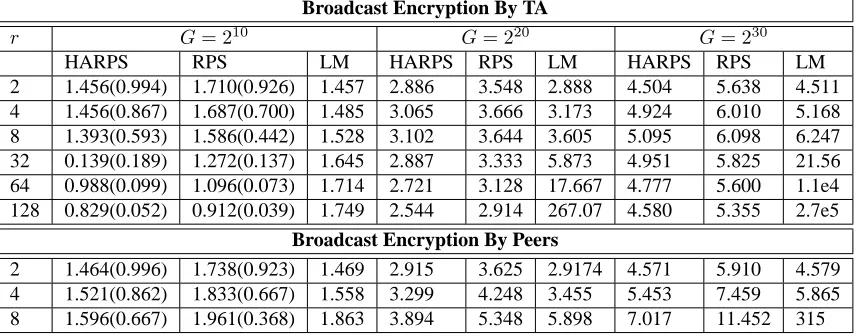
Table 1 shows the performance of HARPS, RPS and LM for broadcast encryption (both by TA and by peers) for 3 different values of the group sizes (roughly a thousand, million and bil-lion) fork = 500. For LM and HARPS,L = 64(the largest hash depth permissible). For HARPS and RPS we assume that an optimal value ofξ= Pk is chosen for each case ((for a given
randG) - the optimal value ofξis also indicated within paren-thesis for the case ofG= 1024.
Table 1: Performance of broadcast encryption in terms of number of encryptions necessary per revoked node) for various values of
rusing random KPSs, for group sizesG= 210,220,230(roughly a thousand, million and billion), fork= 500andL= 512. For
RPS and HARPS the corresponding optimal choice ofξ, are also indicated within parenthesis.
Broadcast Encryption By TA
r G= 210 G= 220 G= 230
HARPS RPS LM HARPS RPS LM HARPS RPS LM
2 1.456(0.994) 1.710(0.926) 1.457 2.886 3.548 2.888 4.504 5.638 4.511 4 1.456(0.867) 1.687(0.700) 1.485 3.065 3.666 3.173 4.924 6.010 5.168 8 1.393(0.593) 1.586(0.442) 1.528 3.102 3.644 3.605 5.095 6.098 6.247 32 0.139(0.189) 1.272(0.137) 1.645 2.887 3.333 5.873 4.951 5.825 21.56 64 0.988(0.099) 1.096(0.073) 1.714 2.721 3.128 17.667 4.777 5.600 1.1e4 128 0.829(0.052) 0.912(0.039) 1.749 2.544 2.914 267.07 4.580 5.355 2.7e5
Broadcast Encryption By Peers
2 1.464(0.996) 1.738(0.923) 1.469 2.915 3.625 2.9174 4.571 5.910 4.579 4 1.521(0.862) 1.833(0.667) 1.558 3.299 4.248 3.455 5.453 7.459 5.865 8 1.596(0.667) 1.961(0.368) 1.863 3.894 5.348 5.898 7.017 11.452 315
Table 2: Performance of HARPS and RPS designed forr= 64,
G = 220, for other values ofr. For HARPS,P = 6080, k =
500, L= 512. For RPSP = 8435, k= 500. The figure repre-sent the total number of encryptions needed to revokernodes.
r 1 2 16 32 64 72 128
nH 145 145 145 145 174 195 375
nR 197 197 197 197 203 1972 8.5e5
1. For small group sizes the efficiency of BE using RKPSs is significantly better than tree-based methods (the most effi-cient of which requires about 1.25 encryptions per revoked node.
2. The same keys can be used for various group sizes with increasing efficiency as group size reduces. For tree-based schemes the number of secrets provided to each node would depend on the maximum possible group size. Even though the same secrets can be used for smaller group sizes, they cannot be used with greater efficiency. In the example above we have used the samek= 500for all group sizes.
However, the efficiency of BE with RKPSs depends on the size ofr. For HARPS and RPS, for eachrwe have chosen the opti-mal value ofξ(the optimal value ofξalso depends on the group sizeG, but to a much smaller extent). For LM (by definition),ξ
is always one. As it is not practical to change the value ofξafter deployment, for any deployment of RPS / HARPS (with some
k, ξ), there would be an optimal choice ofr.
For instance, consider a HARPS deployment optimized for
r = 64withk = 500, P = 6080, L = 64, for a group size of 1 million. While the number of revocations per node is only about 2.721 encryptions per node ifr= 64, in practice smaller sizes ofrneed to be catered for. In general, HARPS or RPS de-signed for largerwould perform very poorly for smallr. Table 2 lists the number of encryptions needed for revokingrnodes forr = 1,2,4,8,16,32,64and 128 (in terms of total number
of encryptions - not number of encryptions per revoked node).
Note that the same number of encryptions are needed for
re-voking 1 to 32 nodes! This is due to the fact that a minimum number of encryptions (145 for HARPS and 197 for RPS in this case) have to be transmitted to achieve the desired probability of outage - irrespective of the number of revoked nodes. The loss in efficiency is very high especially for smallr. However, HARPS designed for somerdegrades much more gracefully for largerrwhen compared to RPS.
While the LM scheme does not have this problem, it does not perform very well for larger(especially for large group sizes). It might appear at first sight that revocation can always be per-formed in smaller batches using LM (where a subset of nodes is revoked in each batch) with small batch sizes, without any loss of efficiency1. However, this is not desirable. While the tree-based schemes by Noar et al [3] and Halevy et al [4], are resis-tant to collusion of all revoked nodes even if they were revoked
in different “batches”, for broadcast encryption using random
KPSs, the system is resistant only to collusion of all nodes in a
batch.
Thus a solution to this problem may be to use many systems in parallel with different values ofξ(in practice 2 systems with
xi = 1 andξ = 0.1 may be sufficient) could be used. For example, we could usek1 =k2 =k3 =k4 = k5 = 200, and P1 = 200, P2 = 400, P3 = 800, P4 = 1600, P5 = 3200), or
effectivelyk= 400×5 = 2000andP = 400 + 800 + 1600 + 3200 + 6400 = 12400). Alternately a system could havePkeys
K1· · ·KP, and the probability that keyiis assigned to any node
could beξi =µf(i)whereµis appropriately chosen such that
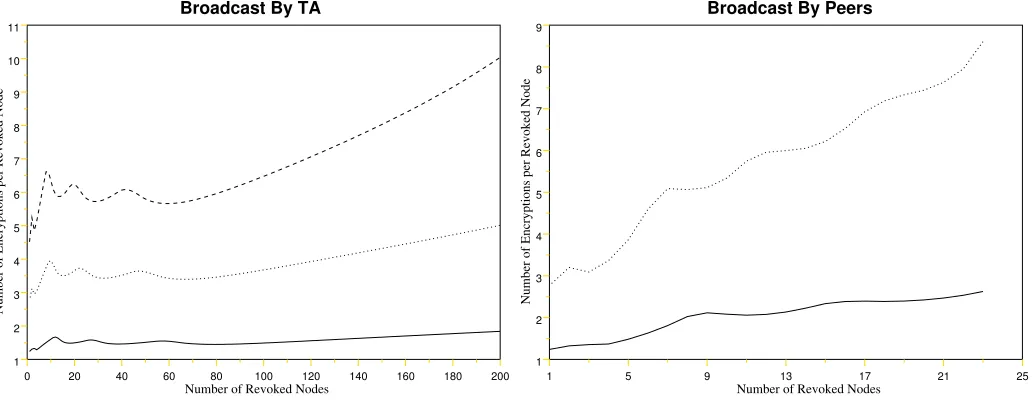
0< µf(i)≤1andf(i)is a monotonic function ofi. Figure 1 (left) plots the bandwidth required vsr(from 1 to 200) for such a hybrid HARPS deployment withk = 200×5 = 1000, and
P = 200 + 250 + 800 + 1600 + 3200 = 6050, andL= 512, for group sizes of roughly a thousand, million and a billion. There is however a soft upper bound on the size ofr(which also depends on the group sizeG). Asrincreases, it may not be possible for the TA to find enough keys to use for encrypting the broadcast,
1The results in Table 1 are in terms of number of encryptions per revoked
and thus will not be able to attain a low enoughpoto ensure that
all intended nodes can be reached.
Figure 1 (right) is the plots for broadcast encryption by peers, for group sizes of a thousand and a million Broadcast encryption by peers is impractical for large group sizes andr- the number of keys a source can employ is substantially less than the number of keys the TA can.
4.1
Overheads
Apart from the encryptions of the secrets, for BE schemes the source should also indicate the identities of the revoked nodes. For revocation using random KPSs (while this can also be done), it is more efficient (both in terms of bandwidth needed and com-putational complexity at the receiver) to instead provide the
in-dexes of the keys used for encryption (and additionally, their
cor-responding hash depths in case of HARPS and LM).
The expression for the overheads can be obtained easily by considering the entropies of the indexes and the hash depths. LetoIbe the entropy of overheads for transmitting indexes of the
subset ofPkeys that are used for encrypting the broadcast secret (neout ofP keys are used). If we defineH(x) =−xlog2(x),
we have
oI =P
H
ne P
+H
P
−ne
P
bits.
LetOd be the entropy of the hash depths for theneencryption
keys used. Or
od=ne L
X
j=q
H
n
j
ne
bits.
Typically, the overheads range between 10 to 40 bits per re-voked node. However, more important than the reduced over-head (compared to tree-based schemes) is the fact that this caters for privacy - by protecting the identities of the revoked nodes.
4.2
Broadcast Authentication
In practice, broadcasts meant for revoking nodes need to be authenticated. This calls for the ability to cater for broadcast authentication. Various techniques for broadcast authentication (without employing asymmetric cryptography2) have been con-sidered in the literature. Such techniques can be divided into two main classes:
1. Instantaneous authentication techniques 2. Authentication using delayed disclosure
With the first class of methods (based on key pre-distribution), broadcast authentication can be achieved by appending many key based message authentication codes (MAC) [27], [26] - [28], - one corresponding to each of thek keys the source node it has in its key ring (all random KPSs cater for broadcast au-thentication). Any verifier may be able to verify a subset of
2If asymmetric cryptography is feasible, broadcast authentication can be
achieved using digital signatures which can be verified by any receiver.
the MACs. However, such approaches have the disadvantage of large bandwidth requirements (the number of appended au-thentication codes,kmay be high).
The second class of methods, based on one-way hash chains [31] have been investigated by various researchers [32] - [34]. With this approach, the source creates a one-way hash chain and uses a value from the hash chain to calculate the message authentication code for a message to be authenticated. Later the pre-image of the value used is made public. At this point the verifiers are assured that the source that transmitted the first message was the one who released the pre-image (as no one else can, in practice compute the pre-image of a disclosed value). However, such methods typically need to be bootstrapped from a pre-authenticated value3.
Thus a satisfactory solution may be to use RKPSs for boot-strapping hash-chain based techniques. In other words, the more bandwidth expensive authentication using RKPSs could be used for the first broadcast to authenticate the “commitment” key in the hash chain, and subsequent broadcasts can be authenticated by releasing pre-images of the commitment.
4.3
Pros and Cons
A summary of advantages and disadvantages of broadcast en-cryption using RKPSs (as opposed to state-of-the-art tree-based schemes in [3] and [4]) are as follows
1. Advantages:
(a) broadcast by peers without the use of asymmetric cryptography
(b) higher efficiency for smaller group sizes
(c) flexible group / universe size - no hard limit on the maximum size of groups or the total number of nodes. (d) ability to protect identity of revoked nodes.
(e) lower bandwidth for overheads
(f) the secrets used for broadcast encryption can also be used for mutual authentication and broadcast authen-tication.
2. Disadvantages:
(a) Limit (though soft) on the size of total number of nodes that can be revoked while still catering for re-sistance against collusion of all revoked nodes. (b) For very large group sizes (say a billion or above) it
may be impractical for the source of the broadcast to
verify if all privileged nodes can decipher the
broad-cast. Thus
i. the source may have to sacrifice the bandwidth efficiency (by using more keys for encrypting the broadcast secret) and target a value of outage probabilitypothat is considerably lower than the
inverse of the group size (po<< G1), in order to
render the probability of such an event very low,
or
3The first class of methods - methods based on key pre-distribution - do not
Number of Encryptions per Revoked Node
Number of Revoked Nodes Number of Revoked Nodes Broadcast By Peers Broadcast By TA
Number of Encryptions per Revoked Node
0 20 40 60 80 100 120 140 160 180 200
1 2 3 4 5 6 7 8 9 10 11
1 5 9 13 17 21 25
1 2 3 4 5 6 7 8 9
Figure 1: Performance of broadcast encryption using a hybrid HARPS scheme employingk= 5×200 = 1000,P = 200 + 250 + 800 + 1600 + 3200 = 6050, andL= 512, for broadcasts by TA (left) and by peers (right). Dashed line (only in the left figure) is forG= 230. Dotted lines and unbroken lines (in both figures) are forG= 220andG= 210thousand respectively.
ii. the system should cater for such “accidentally” missed nodes to approach the source and receive the secret through alternate channels (the sec-ond approach is perhaps more practical for large group sizes).
4.4
Potential Applications
4.4.1 Wireless Ad Hoc Network Security
Security solutions for (wireless) mobile ad hoc networks could benefit greatly if nodes in a vicinity could establish shared se-crets while selectively excluding some nodes. As an example, it could be very useful in many ad hoc routing protocols if nodes could establish a shared secret with all their 2hop neighbors -which are not provided to 1-hop neighbors [35], [36]. This could for instance, help nodes authenticate their messages to their 2-hop neighbors and ensure that one-2-hop neighbors do not modify the contents of the packet they forward. This could be easily realized by a broadcast which “revokes” all one hop neighbors.
In such scenarios, it is more important that the explicitly re-voked nodes are denied access to the secret, than ensuring that all other nodes actually receive the secret. Obviously, the set of excluded nodes need not be based just on hop counts - there may be other reasons to choose the set of revoked nodes. For instance, in scenarios where nodes maintain a “neighborhood watch” [37] and rate the trust-worthiness of each node, nodes may need to exchange information, while shielding it from the node (or nodes) with “questionable morals”.
4.4.2 Publish-Subscribe Systems
In publish-subscribe (pub-sub) [38] systems broadcast encryp-tion will be very useful for distributing secrets to a set of scribers (or more specifically revoking a set of current
sub-scribers by providing continuing subsub-scribers with a new secret). With the possibility of broadcast encryption by peers, any node has the ability to become a publisher, and distribute secrets to other nodes. In pub-sub systems one very important issue is protection of the privacy of publisher-subscriber relationships. Thus tree-based broadcast encryption schemes (even when they are used with asymmetric cryptographic primitives to facilitate broadcasts by peers) which need to explicitly specify the identi-ties of the revoked nodes may not be very suitable for this pur-pose.
5
Conclusions
We discuss the applicability of random key pre-distribution schemes for broadcast encryption and argue that this may be a useful paradigm in many application scenarios. One of the main shortcoming of broadcast encryption using random KPSs is the limit on the number of nodes that can be revoked. While BE can still be performed in batches to overcome this “soft” limit, the collusion resistance holds only for nodes within each batch.
However, in scenarios where privacy is an important issue, and / or it may be infeasible to employ asymmetric cryptographic primitives, BE using random KPSs can be a very useful tool -especially since the same secrets used for BE can also be used for mutual authentication and broadcast authentication.
References
[2] R. Canetti, T. Malkin, K. Nissin, “Efficient Communication-Storage Tradeoffs for Multicast En-cryption,” EUROCRYPT 1999, pp 459–474.
[3] D. Noar, M. Noar, J. Lotspiech, “Revocation and Tracing Routines for Stateless Receivers,” Lecture Notes in Com-puter Science, Advances in Cryptology, Springer-Verlag,
2139, 2001.
[4] D. Halevy, A. Shamir, “The LSD Broadcast Encryption Scheme,” Advances in Cryptology - CRYPTO 2002: 22nd Annual International Cryptology Conference, Santa Bar-bara, California, USA, August 18-22, 2002.
[5] C.K. Wong, M. Gouda, S. Lam, “Secure Group Commu-nications using Key Graphs,” Proceedings of SIGCOMM 98, pp 68–79, 1998.
[6] J. Lotspiech, S. Nusser, F. Pestonoi, “Anonymous Trust: Digital Rights Management using Broadcast Encryption,” Proceedings of the IEEE, 92 (6), pp 898–909, 2004.
[7] Eli Gafni A1, Jessica Staddon A2, Yiqun Lisa Yin, “Effi-cient Methods for Integrating Traceability and Broadcast Encryption,” Advances in Cryptology - CRYPTO’99: 19th Annual International Cryptology Conference, Santa Bar-bara, California, USA, August 1999.
[8] G. Kreitz, “Optimization of Broadcast Encryption Schemes,” Master’s Thesis, Royal Institute of Technology, Sweden, Feb 2005.
[9] D. R. Stinson, “On Some Methods for Unconditionally Secure Key Distribution and Broadcast Encryption,” De-signs, Codes and Cryptography, Kluwer Academic Pub-lishers Norwell, MA, USA, 1997.
[10] B. C. Neuman, T. Ts’o, “Kerberos: An Authentication Service for Computer Networks”, IEEE Communications,
32(9), pp 33–38. September 1994.
[11] R. Needham and M. Schroeder, “Using encryption for au-thentication in large networks of computers,” Communica-tions of the ACM, 21(12), December 1978.
[12] S.Kiran, P. Lareau, S.Lloyd, “PKI Basics - A Techni-cal Perspective,” PKI-Forum (http://www.pkiforum.org), November 2002.
[13] J. Crowcroft, “Scalable and Ubiquitous Computing Sys-tems,” Grand Challenges in Computing (Research), edited by T. Hoare and R. Milner, 2004.
[14] Web Link, http://www.ietf.org/html.charters/manet-charter.html
[15] R. Gennaro, A. Lysyanskaya, T. Malkin, S. Micali, T. Ra-bin, “Tamper Proof Security: Theoretical Foundations for Security Against Hardware Tampering,” Theory of Cryp-tography Conference, Cambridge, MA, February 2004.
[16] L. Gong, D.J. Wheeler, “A Matrix Key Distribution Scheme,” Journal of Cryptology, 2(2), pp 51-59, 1990.
[17] L. Eschenauer, V.D. Gligor, “A Key-Management Scheme for Distributed Sensor Networks,” Proceedings of the Ninth ACM Conference on Computer and Communica-tions Security, Washington DC, pp 41-47, Nov 2002.
[18] H. Chan, A. Perrig, D. Song, “Random Key Pre-distribution Schemes for Sensor Networks,” IEEE Sympo-sium on Security and Privacy, Berkeley, California, May 2003.
[19] R. Di Pietro, L. V. Mancini, A. Mei, “Random Key Assign-ment for Secure Wireless Sensor Networks,” 2003 ACM Workshop on Security of Ad Hoc and Sensor Networks, October 2003.
[20] S. Zhu, S. Xu, S. Setia S. Jajodia, “Establishing Pair-wise Keys For Secure Communication in Ad Hoc Networks: A Probabilistic Approach,” Proc. of the 11th IEEE Interna-tional Conference on Network Protocols (ICNP’03), At-lanta, Georgia, November 4-7, 2003.
[21] W. Du, J. Deng, Y.S. Han. P.K.Varshney, “A Pairwise Key Pre-distribution Scheme for Wireless Sensor Networks,” Proceedings of the 10th ACM Conference on Computer and Communication Security, pp 42–51, 2003.
[22] M. Ramkumar, N. Memon, R. Simha, “Pre-Loaded Key Based Multicast and Broadcast Authentication in Mobile Ad-Hoc Networks,” Globecom-2003.
[23] D. Liu, P.Ning, “Establishing Pairwise Keys in Distributed Sensor Networks,” Proceedings of the 10th ACM Confer-ence on Computer and Communication Security, Washing-ton DC, 2003.
[24] M. Ramkumar, N. Memon, “An Efficient Random Key Pre-distribution Scheme for MANET Security,” IEEE Journal on Selected Areas of Communication, March 2005.
[25] P. Erdos, P. Frankl, Z. Furedi, “Families of Finite Sets in which no Set is Covered by the union of 2 Others,” Journal
of Combinatorial Theory, Series A, 33, pp 158–166, 1982.
[26] N. Alon, “Probabilistic Methods in External Finite Set Theory,” in Extremal Problems for Finite Sets,, pp 39-57, 1991.
[27] M. Dyer, T. Fenner, A. Frieze and A. Thomason, “On Key Storage in Secure Networks,” Journal of Cryptology, 8, 189–200, 1995.
[28] R. Canetti, J. Garay, G. Itkis, D. Micciancio, M. Naor, B. Pinkas, “Multicast Security: A Taxonomy and Some Effi-cient Constructions,” INFOCOMM’99, 1999.
[30] T. Leighton, S. Micali, “Secret-key Agreement without PublicKey Cryptography,”Advances in Cryptology -CRYPTO 1993, pp 456-479, 1994.
[31] L. Lamport, “Password Authentication with Insecure Com-munication,” Communications of the ACM, 24(11):770-772, November 1981.
[32] S. Cheung, ”An Efficient Message Authentication Scheme for Link State Routing”, Proceedings of the 13th Annual Computer Security Applications Conference, San Diego, California, December 1997, pp. 90-98.
[33] R.J. Anderson, F. Bergadano, B. Crispo, J.H. Lee, C. Man-ifavas and R.M. Needham, “ A New Family of Authentica-tion Protocols,” ACM Operating Systems Review, vol. 32, n. 4, pp. 9-20, October 1998, ACM Press.
[34] A. Perrig, R. Canetti, D. Song, D. Tygar, “Efficient and Secure Source Authentication for Multicast,” in Network and Distributed System Security Symposium, NDSS ’01, Feb. 2001.
[35] P-W Yau, C. J. Mitchell, “2HARP: A Secure Routing Pro-tocol for Mobile Ad Hoc Networks,” 5th World Wireless Congress (WWC 2004), San Francisco, USA, May 2004,
[36] X. Du, Y. Wang, J. Ge, Y. Wang, “A Method for Secu-rity Enhancements in AODV Protocol,” 17 th International Conference on Advanced Information Networking and Ap-plications (AINA), Xian, China, 2003.
[37] S. Buchegger, J-Y. Le Boudec, “Nodes Bearing Grudges: Towards Routing Security, Fairness and Robustness in Mo-bile Ad Hoc Networks,” Proceedings of Tenth Euromicro Workshop on Parallel Distributed and Network-based Pro-cessing, 2002.
[38] P.T. Eugster, P.A. Felber, R. Guerraoui, A-M. Kermarrec, “The Many Faces of Publish/Subscribe,” Technical Report, URL citeseer.ist.psu.edu/649723.html.