405 | P a g e
PREVENTION OF FACE SPOOFING ATTACKS AND
ITS DETECTION USING LBP
Mr. Kaustubh D.Vishnu
1,
Dr. R.D.Raut
2, Dr. V. M. Thakare
3SGBAU, Amravati, Maharashtra (India)
ABSTRACT
Preventing personal data from attackers is most challenging task. System which uses face for authentication purpose must be robust against face spoofing attacks. This paper aims to provide a method to detect such attacks and prevent system from spoofing attacks. Proposed method identifies the face from the input image and extracts information and compares the extracted information with database to detect whether input image is authorized or it’s a spoof attack. This paper proposes a technique for face detection using LBP which is
ultimately preventing system from the spoof attack by identifying the authorized face image. The proposed method gives the easy and effective method to detect spoofing attacks and increase security of system.
Index Terms
—
Face detection, LBP, Spoofing attack, Security
I. INTRODUCTION
Security against the spoofing attacks is most needed feature to increase system’s robustness against various
attacks. Face spoofing is one of attacks which threaten the security of system. Preventing the system from spoof
attack is a process of automatically detecting whether two faces are of same person or not. Number of factors
makes this a challenging for computer. Faces in images and video are mostly captured with different cameras
with different imaging properties and also it may be captured at various resolutions, quality, and lighting
conditions. Most of the system uses digital images and video for authentication and processing purposes thus
digital images and videos are important in the multimedia information era. The human face is one of the most
important objects in an image or video. Detecting the location of human faces and then extracting the facial
feature in an image is an important ability with wide range of applications, such as human Face Spoofing,
surveillance systems, human computer interfacing, video-conferencing etc. In process of detecting whether two
faces are of same person or not, the texture features of the images must be taken into consideration[1].Distortion
of image while extracting image properties must be analysed properly to extract more and more information
from the image[2].Obtaining the feature space for coupling spoofing detection and face recognition is done by
encoding the micro-texture pattern of the image using LBP[3].Extracting the useful information from the image
and collecting them to use them for detecting the legal face for access is also a effective method to prevent
406 | P a g e
used to extract useful information from the input image. Dynamic mode description and LBP features makes thesystem data rich which is very useful in preventing system from spoofing attacks[5].
In this paper we have proposed a method for prevention of Face Spoofing that is robust, reasonably simple and
accurate with a relatively simple and easy to understand algorithms and techniques. With the given image, the
goal of face detection algorithm is to detect the face and extract the features from given image and then
extracting LBP patterns and executing LBP matching is done and matching of extracted information is
performed with given database of face images which will be useful to identify real and spoofed image.
II. BACKGROUND
Most of the existing face recognition systems are vulnerable to spoofing attacks. The facial appearance analysis
based methods are referred to as texture or image quality analysis based techniques. Face Spoofing Detection
Using Colour Texture Analysis explore the facial colour texture content using four descriptor which are ,the
local phase quantization(LPQ), the co-occurrence of adjacent local binary patterns(CoALBP), the binarized
statistical image features(BSIF) and the scale-invariant descriptor(SID) Colour texture based approach provides
an in depth analysis on the use of colour texture analysis for face spoofing detection[1].
Real time face spoof detection requires a decision to be made based on a limited numbers of frames. Thus a
method is proposed with a discriminating features that is capable of differentiating between real and fake face
image. Face spoofing detection approach based on Image Distortion Analysis(IDA) is proposed which is
effective in grasping the intrinsic distortions of spoof face images with respect to the genuine face
images[2].Current face biometric system are vulnerable to spoofing attacks, by falsifying data attacker thereby
gains illegitimate access to private information. Such problem of face spoofing detection is handled from texture
analysis point of view. Printing quality defects can be easily detected using texture analysis and local shape
analysis. A method is proposed to analyse the texture and gradient structures of the facial images using a set of
low-level feature descriptors, fast linear classification scheme and score level fusion[3].A method for extracting
temporal and spectral information from face biometric samples, referred to as time-spectral descriptors. The
visual codebook model also referred to as Bag-of-Visual-Word model, for creating a mid-level representation
from time-spectral descriptors, referred to as time-spectral visual words which works best while gathering
important knowledge[4]. The exploitation of the facial dynamic information is a completely data-driven fashion,
rather than using prior knowledge regarding live face images such as eye-blinking and lip-movements. In order
to extract facial dynamic information reliably ,a method gives a modified version of Dynamic Mode
Decomposition (DMD) which helps to detect a print and replay attacks from live (valid) videos containing an
authentic face[5].
This paper presents the brief introduction of face spoofing prevention and its detection in section I. Section II
discusses background. Section III discusses previous work. Section IV discusses existing methodologies.
Section V describes proposed methodology. Section VI discusses analysis and discussion. Section VII discusses
407 | P a g e
III. PREVIOUS WORK DONE
Zinelabidine Boulkenafet et.al (2016) [1] proposed method to detect morphed face while preventing from
spoofing. A statistical analysis is done on datasets and histograms is done for both real and fake image using
texture of image. The proposed method aims to investigate the effectiveness of different texture descriptors
more closely in detecting various kinds of face spoofs by extracting holistic face representation from luminance
and chrominance image in different colour spaces.
Di Wen et.al (2015) [2] proposed method feature set based on image distortion analysis (IDA) with real time
response and better performance in cross database scenario. Proposed method try to capture the face image
quality differences due to the different reflection properties of different materials. Proposed method aims to
design discriminative features that are capable of differentiating between genuine and spoof faces based on a
single frame. Proposed method try to differences genuine face image and fake face image which mainly occurs
in Print photo Attack and Replay Video Attack.
J. Maatta et.al (2012) [3] proposed method which adopts complementary properties of two powerful texture
descriptors, since LBP encodes the micro-texture patterns and Gabor filters more macroscopic information. In
addition, HOG-based local shape description provides additional information to the face description. A
homogeneous kernel mapis applied on each resulting feature vector transforming the data into compact linear
representation and reproducing an accurate approximation of the desired kernel function. This representation
enables then to use fast linear support vector machine (SVM) classifiers. The final decision, whether there is a
live person in front of the camera or not, is based on the score level fusion of the individual SVM outputs.
Extensive experiments on three publicly available database (NUAA Photograph Imposter Database , Yale
Recaptured Databaseand Print-Attack Database ) containing several real and fake faces showed excellent result
compared to many previous works.
Allan Pinto et.al (2015) [4] proposed method can be explained in three proposed forms which are low-level
descriptor extraction, mid-level descriptor extraction, and classification. Low-level descriptor extraction
contains calculations such as calculation of residual noise videos. Next step is mid level descriptor extraction
which involves visual codebook generation , coding which performs point wise transformation and then pooling
which summaries the collected information. After this the classification is done using available functions (PLS)
and (SVM).
Santosh Tirunagari et.al. (2015) [5] proposed method which is concerned with rendering a face recognition
system robust against presentation attacks; and specifically, print attacks based on printed facial images, and
replay attack that is carried out by replaying a video sequence using a tablet or a mobile phone. Proposed system
is pipelined, consisting of DMD, LBP and SVM. This combination is ideal because DMD captures the visual
dynamics in the form of a fixed-size image, LBP can effectively capture the dynamic patterns, and SVM is
known to be an ideal general-purpose classifier that minimizes the empirical risk of classification error.
IV. EXISTING METHODOLOGY
There are various approaches proposed by various researchers for image based Face Spoofing. Description of
408 | P a g e
A. Colour Texture Analysis Approach:Comparison of performance of the colour texture features and gray scale counterparts is basic of colour texture
analysis approach. The model parameters are trained and tunes using a subject-disjoint cross validation on
training sets and the result is reported in terms of Equal Error Rate (EER).Then combine complementary facial
colour texture representation to form the final face description used in anti-spoofing method and compares its
performance. Cross database testing improves reliability of method.
B. Distortion Feature Extraction Approach:
Image distortion feature extraction is done using four different features such as Specular reflection Feature,
Blurring Feature, Chromatic moment Feature, Colour Diversity Feature. Concatenation of feature happens. It is
desirable to have a efficient classifier for the extracted IDA features. Construction of group of training samples
firstly divides spoof samples into K training sets according to attack type then a specific training set is
constructed by combining all genuine samples and a single group of spoof samples .Multi-Frame fusion is then
executed.
C. Texture and Local Shape Analysis Approach:
Low-level feature extraction and Classification are the basic execution modules of Texture and Local Shape
Analysis approach. In low level feature extraction The LBP texture analysis operator is defined as a gray scale
invariant texture measure derived from local image neighbourhood. In addition to the LBP-based texture
analysis, this method also uses Gabor wavelet features to enhance the texture representation of the facial image.
The basic idea is to extract features at multiple scales and orientation using a Gabor wavelet decomposition. For
classification purposes, a feature vector is constructed using the mean and standard deviation of the magnitude
of the transform coefficients at different scales and orientations. The local shape characteristics are introduced to
the face representation using HOG which captures the edge or gradient structures of the facial image. HOG
representation is invariant to local geometric transformations if translations or rotations are much smaller than
the local spatial or orientation bin size. And in classification section the desired kernel can be approximated to a
very good level by linear ones using suitable explicit feature map which transform the data into a compact linear
representation. SVM classifier and conventional Z-score normalisation technique and weighted score level
fusion are used for combining the outputs of the individual SVMs to determine whether the input image
corresponds to a live face or not.
D. Spectral Temporal Cubes Approach:
Low-level descriptor extraction, mid-level descriptor extraction, and classification are the three execution forms
of the spectral temporal cubes approach. This approach performs the analysis which are done usingLow-Level
Descriptor Extraction Parameter Analysis (LGF and M) and Mid-Level Descriptor Extraction Parameter
Analysis (CS, SDD, DS, and CP) and Classification Step Parameter Analysis (C).Algorithm takes advantage of
noise and artifacts added to the synthetic biometric samples during their manufacture and recapture is improving
the performance of an approach.
E. Visual Dynamics Approach:
Visual Dynamics Approach presents the pipeline mechanism of method which consist of DMD, Local Binary
Pattern histogram and kernel based SVM. This approach processes a image or video using the DMD algorithm
409 | P a g e
histogram features are processed for dynamic mode image. And finally the produced LBP code is fed into atrained SVM classifier in order to classify whether the processed video is a valid access or spoof.
V. ANALYSIS AND DISCUSSION
Lot of researchers have worked on effectiveness of face recognition techniques and methods to detect and
prevent spoofing attacks. Most of the current Face Spoofing systems presume that faces are readily available for
processing. However, in reality, we do not get images with just faces. We need a system, which will detect the
face in image, so that this detected face can be given as input to Face Spoofing systems. The goal of a face
detection algorithm is to identify the location and scale of all the faces in image. The task of face detection is so
trivial for the human brain, yet it still remains a challenging and difficult problem to enable a computer to do
face detection. This is because the human face changes with respect to internal factors like facial expression,
beard and moustache, glasses etc and it is also affected by external factors like scale, lightning conditions,
contrast between face and background and orientation of the face. Digital images and video are becoming more
and more important in the multimedia information era. The human face is one of the most important objects in
an image or video. Detecting the location of human faces and then extracting the facial feature in an image is an
important ability with wide range of applications, such as human Face Spoofing, surveillance systems, human
computer interfacing, video-conferencing etc
Effectiveness of detecting faces using a view based approach is implemented. The neural networks are powerful
tool to solve pattern recognition problems, and can potentially be applied at each stage of a Face spoofing
system. Firstly the pre-processing of face image is gone through the various steps like enhancement of image,
segmenting the image, then these pre-processed images are fed to the trained neural network. After that the
initial network connection weights are optimized. In testing process, this neural network tests the input images
with the given or template images. If it is matched then show the accurate face and display their characters,
otherwise test will continue. If all images are scanned, then end otherwise scanning will be continue. It gives the
correct recognition rate
Face spoof detection and prevention
technique
Advantages Disadvantages
Colour Texture Analysis Approach
1.conducts a cross database
evaluation with stable performance.
1.Sensors must be powerful and
effective.
2.expensive or impractical
requirements
Distortion Feature Extraction Approach
1.Low Cost of launching.
2.Result within a single frame of
image.
1.HTER increases under
410 | P a g e
Texture and Local Shape AnalysisApproach
1.robust and does not require user
co-opration.
1.It requires high resolution input
image.
2.Low cost devices does not gives
accurate results.
Spectral Temporal Cubes Approach
1.Low cost solutions for spoofing
detections.
2.Does not rely on user interaction or
on extra hardware.
1.Attacks with high quality
samples are hard to detect.
Visual Dynamics Approach
1.Pipeline of DMD+LBP+SVM
proves to be efficient, convenient to
use and effective.
1.Co-ordinating complexities of
the outputs of pipelined
classifiers.
Table 1: Comparison Between Different Anti Face Spoofing Techniques
VI.PROPOSED METHODOLOGY
A method of Face Spoofing that is fast, robust, reasonably simple and accurate with a relatively simple and easy
to understand algorithms and techniques. Given an image, the goal of face detection algorithm is to detect the
face and extract the features from given image and to recognize the detected face with given database of face
images which finally help to decide whether the input image is of same person or not which ultimately helps to
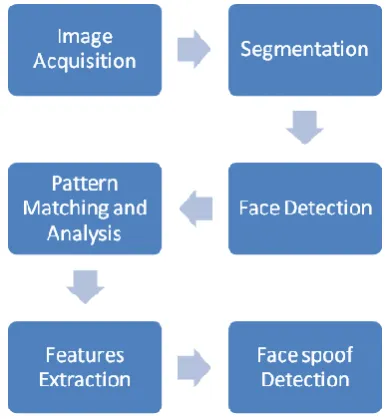
prevent system from spoofing attacks. Effective use of available resources is making the method more
co-operative to implement. Framework of proposed method can be understood using following diagram
411 | P a g e
Algorithm proposed is as follows:Algorithm:
1. Input Face
2. Detect Skin Colour from input Face
3. If Skin Colour Present then algorithm will go for face detection else discard input image.
4. Face Detection will be done where features are detected with reference distance .
5. if face present , face features like (eyes, nose, mouth) will be extracted else input image discarded.
6. Selected Face Features play an important role in Face Spoofing
Face recognition is important part of spoof detection and proposed method uses efficient way to detect face
portion within the image and extracts information from that selected portion only so that unnecessary extraction
gets eliminated from execution. Then discriminate analysis is performed along with information extraction.
Available database is used for information matching purpose. This complete execution helps to detect genuine
and fake face used for authentication, which prevents system from spoof attack.
VII. POSSIBLE OUTCOMES AND RESULT
Effectiveness of detecting faces using a view based approach is implemented. Various techniques are used to
propose a method to solve pattern recognition problems, a technique for face detection and recognition using
LBP is proposed which is expected to produces reliable and robust outcomes against face spoof attack.
Proposed method excludes unnecessary portion from information extraction process, which definitely improves
response time. And simple execution of proposed method reduces complexities in proposed method. Less
complications and quicker response time gives the best result for proposed method.
VIII. CONCLUSION
This paper proposed a method which explains the effectiveness of first detecting face region from the image and
then extracting the information from image to match the faces for preventing system from spoof attacks.
Objective of this method is that it gives a simple and robust method to detect face and checks for spoof attacks.
Using LBP techniques this method helps system to prevent from face spoofing attacks.
With less user interaction and less complex execution proposed method gives more user friendly experience.
Proposed method does not demands for external hardware supports or costly sensors thus cheaper execution
model is proposed.
REFERENCES
[1] Zinelabidine Boulkenafet, Jukka Komulainen, and Abdenour Hadid, “Face Spoofing Detection Using Colour
Texture Analysis” IEEE Transactions On Information Forensics and Security. Volume 11, Issue No. 8, PP
1-13 August 2016
[2] Di Wen, Hu Han and Anil K. Jain, “Face Spoof Detection With Image Distortion Analysis” IEEE
412 | P a g e
[3]J. Maatta, A. Hadid, M. Pietikainen, “Face spoofing detection from single images using texture and localshape analysis” Published in IET Biometrics. Volume 1, Issue No. 1, PP 3-10 February 2012
[4] Allan Pinto, Helio Pedrini, William Robson Schwartz and Anderson Rocha, “Face Spoofing Detection
Through Visual Codebooks of Spectral Temporal Cubes” IEEE TRANSACTIONS ON IMAGE
PROCESSING. Volume 24,No 12,PP 4726-4740 December 2015
[5] Santosh Tirunagari, Norman Poh, David Windridge, Aamo Iorliam, Nik Suki, and Anthony T S. Ho,
“Detection of face spoofing using visual dynamics”. IEEE Transactions On Information Forensics and
Security. Volume 10, Issue No. 4, PP 762-777, April 2015