1118 | P a g e
PCA Algorithm for Human Face Recognition
Mr. Rahul M. Ohol
1,
Mrs. Shilpa R. Ohol
2ABSTRACT
As a Biometric, facial recognition is a form of computer vision that uses faces to attempt to identify a person or
verify a person’s claimed identity. Principal Component Analysis (PCA) is used for data classification and
dimensionality reduction. PCA is a technique that can be used to simplify a dataset; more formally it is a
transform that chooses a new coordinate system for the data set such that the greatest variance by any
projection of the data set comes to lie on the first axis (called the first principal component), the second greatest
variance on the second axis and so on. PCA can be used for reducing dimensionality in a dataset while
retaining those characteristics of the dataset that contribute most to its variance by eliminating the later
principal components. The important fact which is considered is that although these face images have high
dimensionality. So instead of considering whole face space with high dimensionality, it is better to consider only
a subspace with lower dimensionality to represent this face space. This approach gives us efficient way to find
this lower dimensional space. The other main advantage of PCA is that once you have found these patterns in
the data, and you compress the data, ie. by reducing the number of dimensions, without much loss of
information. This technique is used in image compression.
Keywords:
Biometric, PCA, Face Recognition
I. INTRODUCTION
In an increasingly digital world, reliable personal authentication has become an important human computer
interface activity. National security, e-commerce, and access to computer networks are some examples where
establishing a person’s identity is vital. Existing security measures rely on knowledge-based approaches like
passwords or token-based approaches such as swipe cards and passports to control access to physical and virtual
spaces. Though these methods are easy and widely acceptable but they are not very secure. Tokens such as
access cards may be shared or stolen. Passwords and PIN numbers may be stolen electronically. Furthermore,
they cannot differentiate between authorized user and a person having access to the tokens or knowledge.
Biometrics such as face, fingerprint, iris, retina scan and voice print offers means of reliable personal
authentication that can address these problems and is gaining citizen and government acceptance.
II. Why Face Recognition?
Among the biometrics, the face is the most natural physiological characteristic to recognize each other. Hence,
people consider face a “good” biometric for automatic identity recognition systems.
There are a number of reasons to choose face recognition. These are as follows
It is non-intrusive and requires no physical interaction on behalf of the user. The acquisition process can be performed with a limited person cooperation. It is accurate and allows for high enrolment and verification rates.
1119 | P a g e
It can use the existing hardware infrastructure i.e. existing cameras and image capture devices. It is the only biometric technology that allows you to perform passive identification in a one-to-many
environment.
Although the concept of recognizing someone from facial features is intuitive, facial recognition,
as
a biometric, makes human recognition a more automated, computerized process. What sets apart facialrecognition from other biometrics is that it can be used for surveillance purposes. For example, public safety
authorities want to locate certain individuals such as wanted criminals, suspected terrorists, and missing
children. Facial recognition may have the potential to help the authorities with this mission. For any biometric
system to operate, it must have records in its database against which it can search for matches. Facial
recognition is able to leverage existing databases in many cases.
III. STEPS FOR FACE RECOGNITION
As a biometric, facial recognition is a form of computer vision that uses faces to attempt to identify a person or
verify a person’s claimed identity.
Regardless of specific method used, facial recognition is accomplished in a five step process.
1. First, an image of the face is acquired. This acquisition can be accomplished by digitally scanning an existing
photograph or by using a web camera to acquire a live picture of a subject.
2. Second, software is employed to detect the location of any faces in the acquired image. This task is difficult,
and often generalized patterns of what a face “looks like” (two eyes and a mouth set in an oval shape) are
employed to pick out the faces.
3. Once the facial detection software has targeted a face, it can be analyzed. Facial recognition analyzes the
spatial geometry of distinguishing features of the face.
Thus, specific details on the methods are proprietary. The most popular method is called Principle Components
Analysis (PCA), which is commonly referred to as the eigenface method. PCA has also been combined with
neural networks and local feature analysis in efforts to enhance its performance. Template generation is the
result of the feature extraction process. A template is a reduced set of data that represents the unique features of
an enrollee’s face. It is important to note that because the system uses spatial geometry of distinguishing facial
features, they do not use hairstyle, facial hair, or other similar factors.
4. The fourth step is to compare the template generated in step three with those in a database of known faces. In
an identification application, this process yields scores that indicate how closely the generated template matches
each of those in the database. In a verification application, the generated template is only compared with one
template in the database that of the claimed identity.
5. The final step is determining whether any scores produced in step four are high enough to declare a match.
The rules governing the declaration of a match are often configurable by the end user, so that he or she can
determine how the facial recognition system should behave based on security and operational considerations.
The requirements for a useful, commercial face recognition and identity logging system for small groups of
known individuals in busy, unconstrained environments, such as domestic living rooms or offices, can be split
1120 | P a g e
IV. PRINCIPAL COMPONENT ANALYSIS
The proposed problem consists of verifying if a new face image belongs to one of the individuals, whose images
were stored in a database in a similar way, aiming the person's identity in case of recognition.
A new face is compared with well-known faces stored in a database, being classified as a well known
individual's face or as an unknown In statistics, principal components analysis (PCA) is a technique that can be
used to simplify a dataset; more formally it is a transform that chooses a new coordinate system for the data set
such that thegreatest variance by any projection of the data set comes to lie on the first axis (then called the first
principal component), the second greatest variance on the second axis and so on. PCA can be used for reducing
dimensionality in a dataset while retaining those characteristics of the dataset that contribute most to its variance
by eliminating the later principal components. PCA aims at
Reducing the dimensionality of the data set. Identifying new meaningful underlying variables.
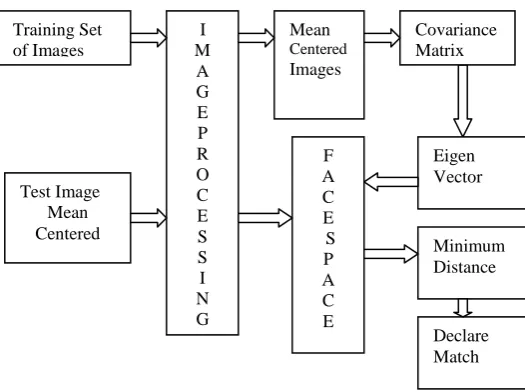
Figure 1 Block Diagram of system
The system can be divided in to 2 parts training & testing. In the training part images from the database are
trained. First images are mean centered. The purpose of mean centering the images is to reduce the error due to
lighting conditions and background. By subtracting the mean image from each training image, images are mean
centered.
Once the images are centered they are combined into a data matrix of size N X M. M is the number of training
images and each column is a single image. From this data matrix covariance matrix is calculated. From the
covariance matrix eigenvalues and eigen vectors are calculated. Each of the training image is projected into
facespace by taking the dot product of the image with each of the ordered eigen vector. Test image is also mean
centered and projected to the face space. Minimum distance between test image and each of the training image
in face space declare a match.
Training set of images
Let the training set consists of M images. Each of these images can be represented in vector form.
1121 | P a g e
1,
2,
3...
.
Mean centered images
The mean image of the set is
M
i
i M 1
1
The mean image is a column vector such that each entry is the mean of all corresponding pixels of the training
images. Each face image differs from the mean image of the distribution, and this distance is calculated by
subtracting the mean image from each face image. This gives us new image space.
i
i
( i =1,… M )
Formation of Covariance Matrix
From this new image space of M
i images (each with dimension N x 1), the matrix A is formed withdimension N x M by taking each of image vectors
i and placing them in each column of matrix A.
1
2
M
Using matrix A, it is important to set up the covariance matrix C. This can be given by product of matrix A with
matrix AT. The dimension of such covariance matrix will be N x N.
C
T
Calculate Eigenvalues and Eigenvectors
As the dimension of this matrix is N x N , which means it will result in N eigenvalues and N eigenvectors. Since
the value of N is very large, say 65536 as in above example, it would be better to reduce this overhead by
considering matrix L = ATA . The dimension of this matrix will be M × M.
L
T
The covariance matrix is symmetric. The N eigenvalues obtained from C are same as M eigenvalues with
remaining N - M eigenvalues equals zero. Also if x is eigenvector obtained from C then the eigenvectors of L
are given by
y
Tx
We can make use of this relationship to obtain eigenvalues and eigenvectors of AAT by calculating eigenvalues
and eigenvectors for ATA . The eigenvectors for C (Matrix U ) are obtained from eigenvectors of L ( Matrix V )
as given below:
U = A V
The matrix V, with dimension ( M × M ), is constituted by the M eigenvectors of L and matrix U, with
dimension ( N × M ), is constituted by all the eigenvectors of C, and the matrix A is the image space, with
dimension ( N × M ).
Projecting Face Class Images
All the images from training set are projected to this eigenspace. These can be represented by linear
combination of the eigenfaces, that have a new descriptor as a point in a great dimensional space. This
projection is constructed in the following way:
1122 | P a g e
where (i = 1, . . . , M)
As the projection on the eigenfaces space describes the variation of face distribution, it is possible to use these
new face descriptors to classify them.
Initialization for input image
When a new face image is given as input to check for face recognition, then it can be classified in one of these
image classes. Also it can be compared for match with any of the existing images in database. Say new image is
. This can be represented as column vector of dimension N ×1. This new image is mean centred bysubtracting mean image
.Each of such new face submitted to the face recognition is projected into the face space, obtaining the vector
, also known as face key for this image, by using following equation.
U
T
Classification of input image
This vector
with dimension (M×1), is compared with each vector
irepresenting face keys for each ofclass images. If the distance found among
and any
i is inside threshold of the class and is the smallestfound distance, then there is a facial recognition of
belonging to class image i. This Euclidian distancebetween two face key vectors can be calculated using square minimal method given by following equation.
d(X1,X2) = | | X1 - X2 ||
Face Recognition
This image can also be checked for match with one of the existing images in the database. As the database will
store the face keys for each of the images, by finding Euclidian distance between this new image face key vector
a
with face key vector
b which represents one of the images in database, the match can be checked. Thisis very efficient technique as databases are of large sizes, checking for this Euclidian distance between face key
vectors is simple method for face recognition.
V. RESULTS
The two datasets used are
(1) ORL Dataset
The dataset of ORL (Olivetti Research Laboratory) consists of 40 persons having 10 images of each person.
Total images in the dataset are 400.
Out of these 3,4,5 images of each person are trained and all images are tested.
(2) Self Prepared Dataset
Total number of persons are 18. 4 images of each person. Total 72 images.
Out of these 2 images of each person are trained and total 72 images are tested.
1123 | P a g e
Table 1 Comparative Results
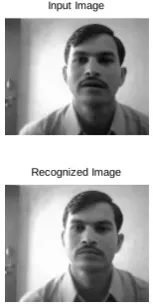
Also the system can be tested for online recognition purposes.
On Line Recognition
Input Image
Recognized Image
Figure 2 Given test input image matches with any one training
image
VI. CONCLUSION
The results obtained by PCA algorithm are good.
PCA is based on the sample covariance which characterizes the scatter of the entire data set, irrespective of
class-membership.
(i) Lighting conditions,
(ii) Image quality,
(iii) Pose orientation plays an important role in face recognition system.
System can be tested for online recognition purposes and the results obtained are good.
Dataset Algorithm Training
images
of each
person
Correct
identified
images
False
identified
images
Result
(%)
ORL PCA 5
images
384 16 96
4
images
380 20 95
3
images
368 32 92
Self
prepared
PCA 2
images
1124 | P a g e
REFERENCES
[1] A tutorial on Principal Component Analysis by Lindsay I Smith February 26,2002
[2] M. A. Turk, A.P. Pentland, “Face Recognition Using Eigenfaces,” Proceedings of the IEEE Conference on
Computer Vision and Pattern Recognition, Maui, Hawaii, USA, pp. 586-591,3-6 June 1991.
[3] M. Turk and A. Pentland, “Eigenfaces for Face Recognition,” Journal of Cognitive Neuroscience, Vol.3,
No.1, 71-86 (1991).
[4] Gian Luca Marcialis and Fabio Roli, “Decision - level fusion of PCA and LDA-based face recognition