Scholarship@Western
Scholarship@Western
Electronic Thesis and Dissertation Repository
3-6-2014 12:00 AM
A Vector-Based Approach to Virtual Machine Arrangement
A Vector-Based Approach to Virtual Machine Arrangement
Nicholas Cerilli
The University of Western Ontario
Supervisor
Dr. Hanan Lutfiyya
The University of Western Ontario Graduate Program in Computer Science
A thesis submitted in partial fulfillment of the requirements for the degree in Master of Science © Nicholas Cerilli 2014
Follow this and additional works at: https://ir.lib.uwo.ca/etd
Part of the Other Computer Engineering Commons
Recommended Citation Recommended Citation
Cerilli, Nicholas, "A Vector-Based Approach to Virtual Machine Arrangement" (2014). Electronic Thesis and Dissertation Repository. 1910.
https://ir.lib.uwo.ca/etd/1910
This Dissertation/Thesis is brought to you for free and open access by Scholarship@Western. It has been accepted for inclusion in Electronic Thesis and Dissertation Repository by an authorized administrator of
(Thesis format: Monograph)
by
Nicholas Cerilli
Graduate Program in Computer Science
A thesis submitted in partial fulfillment of the requirements for the degree of
Master of Science
The School of Graduate and Postdoctoral Studies The University of Western Ontario
London, Ontario, Canada
ii
Abstract
Cloud based data centres benefit from minimizing operating costs and service level
agreement violations. Vector-based data centre management policies have been shown to
assist with these goals. Vector-based data centre management policies arrange virtual
machines in a data centre to minimize the number of hosts being used which translates to
greater power efficiency and reduced costs for the data centre overall. I propose an improved
vector-based virtual machine arrangement algorithm with two novel additions, namely a
technique that changes what it means for a host to be balanced and a concept that excludes
undesirable target hosts, thereby improving the arrangement process. Experiments conducted
with a simulated data centre demonstrate the effectiveness of this algorithm and compares it
to existing algorithms.
Keywords
Virtualization, Vector, Virtual Machine, Arrangement, Data Centre Simulation, Policy,
Multiple Resource Management, Power Efficiency, Placement
iii
Acknowledgments
I would like to acknowledge the assistance of Dr. Hanan Lutfiyya for her supervisorial role in
the creation of this thesis. Additionally, I would like to acknowledge and thank Gastón Keller
and Michael Tighe for allowing the use of their simulator to complete the experiments
iv
Table of Contents
Abstract ... ii
Acknowledgments... iii
Table of Contents ... iv
List of Tables ... vii
List of Figures ... viii
List of Appendices ... ix
Chapter 1 ... 1
1 Introduction and Problem Identification ... 1
1.1 Data Centre Managers... 2
1.2 Resource Management ... 2
1.3 Virtual Machine Arrangement and Bin Packing ... 3
1.4 Thesis Focus... 6
Chapter 2 ... 7
2 Related Works ... 7
2.1 Static and Dynamic Resource Management ... 7
2.2 Virtual Machine Arrangement Techniques ... 9
2.2.1 Techniques Involving Forecasting ... 10
2.2.2 Techniques Involving Genetic Algorithms ... 11
2.2.3 Techniques Involving Integer Linear Programming ... 12
2.2.4 Techniques Involving Greedy Algorithms ... 14
Chapter 3 ... 18
3 A Novel Algorithm for VM Arrangement ... 18
3.1 Existing Vector-based Techniques ... 18
v
3.4 The New Vector-Based Algorithm ... 26
Chapter 4 ... 30
4 Experimental Design and Results ... 30
4.1 Simulator ... 30
4.2 Traces ... 30
4.3 Virtual Machine Arrival, Departure, and SLAs ... 31
4.4 Utilization Levels ... 31
4.5 Evaluation Metrics ... 32
4.6 Experiment 1 ... 32
4.6.1 Virtual Machines Used ... 32
4.6.2 Policies ... 32
4.6.3 Slope and Theta Region Values ... 33
4.6.4 Experiment 1 Results ... 33
4.6.5 Experiment 1 Discussion ... 35
4.7 Experiment 2 ... 37
4.7.1 Virtual Machines Used ... 37
4.7.2 Policies ... 38
4.7.3 Slope and Theta Region Values ... 38
4.7.4 Experiment 2 Results ... 39
4.7.5 Experiment 2 Discussion ... 40
4.8 Experiment 3 ... 41
4.8.1 Virtual Machines Used ... 41
4.8.2 Policies ... 42
4.8.3 Slope and Theta Region Values ... 42
vi
Chapter 5 ... 47
5 Future Work and Conclusions ... 47
5.1 Future Work ... 47
5.2 Conclusions ... 50
Appendices ... 58
Appendix A - Statistical Analysis ... 58
vii
List of Tables
Table 1 – Experiment 1 Tabulated Results ... 35
Table 2 – Experiment 2 Tabulated Results ... 40
viii
List of Figures
Figure 1 – Valid VM Arrangement ... 5
Figure 2 – Invalid VM Arrangement ... 6
Figure 3 – A Host's Resource Utilization Vector ... 18
Figure 4 – A VM Resource Utilization Vector added to a Host Resource Utilization Vector 19 Figure 5 – Balance and Rejection Resource Utilization Vectors ... 20
Figure 6 – Different Arrangement Choices Result in Different Number of Hosts Required . 21 Figure 7 – Altered Balance Vector ... 23
Figure 8 – The Theta Region ... 25
Figure 9 – The New Vector-Based Algorithm ... 27
Figure 10 – Experiment 1 Results ... 33
Figure 11 – Experiment 2 Results ... 39
Figure 12 – Experiment 3 Results ... 43
Figure 13 – The New Vector-Based Algorithm in 3D ... 48
ix
List of Appendices
Appendix A - Statistical Analysis ... 58
Chapter 1
1
Introduction and Problem Identification
Cloud infrastructures may consist of one or more data centres. These data centres consist
of large amounts of computing resources e.g., storage space, memory, and processing
power. A possible business model for a cloud infrastructure provider is to rent computing
resources to clients that wish to have their applications executed without having to incur
the costs associated with buying and maintaining the hardware needed to execute the
applications [1]. Such a business model is referred to as infrastructure as a service.
Infrastructure as a service has many benefits that make it an appealing option for client
businesses. IT systems are able to be obviated and outsourced when one opts to utilize the
infrastructure as a service industry. With this streamlining of IT, clients will no longer
have to incur costs associated with hardware acquisition, testing, maintenance, and
staffing devoted solely to the aforementioned processes. Instead, a client pays a
subscription fee associated with utilizing the infrastructure present within the cloud [1].
Security, testing, maintenance, uptime, and other requirements now become the
responsibility of the cloud provider. Furthermore, the diverse range of hardware present
within the cloud makes it possible to run different types of applications. From web
servers and email servers to databases, a client company may request the execution of a
variety of applications without having to worry about wildly disparate hardware
requirements as, once again, the responsibility of hardware procurement falls to the cloud
provider.
One of the challenges that a cloud provider has is using the resources within the cloud as
efficiently as possible. This is accomplished in part by hosting a client’s application in a
virtual machine. Virtual machines consist of software that encapsulates a client’s
application and provides all of the operating system and hardware requirements that
would normally be provided by a physical machine [1]. A virtual machine allows
computing resources to be allocated to it that are a fraction of the computing resources
physical machine. A physical machine that is underutilized can have additional virtual
machines placed on it. If the demand for an application increases then additional
resources can be allocated. If a physical machine is overloaded it is possible to suspend a
virtual machine, move it to another physical machine and restart from the state that the
virtual machine was suspended in. This is referred to as migration. Effectively using
cloud resources using virtual machines has been investigated e.g., [2] [3] [4] [5].
1.1
Data Centre Managers
Data centre managers provide the mechanism through which decisions can be made and
virtual machines can be reorganized within a data centre to utilize resources more
efficiently. The effectiveness of the data centre manager is directly tied to the
effectiveness of the policies it implements to determine arrangements of virtual machines
on the physical hosts [6]. It should be noted that in much of the literature, arrangements
of virtual machines are simply referred to as placements. However, to avoid ambiguity
with the initial placement of virtual machines, the locations of the virtual machines within
a data centre at any point will be referred to as an arrangement.
1.2
Resource Management
Effective utilization of cloud resources requires the allocation of resources to virtual
machines that satisfies the run-time requirements of the application running in the virtual
machine. The static approach to resource allocation for an application assigns the
maximum amount of resources needed by the application. This approach ensures that an
application’s resource demands are met as long as the resource requirements are
accurately calculated. This represents an overcommittment of resources [2] [3] [7] [8].
This strategy may result in an underutilization of resources [9] [5] [10] [4]. For example,
consider a particular application that had a lifetime of 100 hours and for 90 of those hours
only requires 10 units of resource A. For the remaining 10 hours, the application requires
500 units of resource A. With static allocation, 500 units of resource A would be allotted
to the application for the entire 100 hours of the application’s execution time. Clearly the
Static allocation works best when the resource requirements of an application are not
highly variable. Another approach allows for the oversubscription of a host’s resources
[11]. This assumes that applications have highly variable demands and that the set of
applications (and hence VMs) varies over time. Dynamic resource management takes
advantage of migrating a VM from a physical machine to a host machine that is not
overloaded. Migration results in a new arrangement.
1.3
Virtual Machine Arrangement and Bin Packing
The data centre manager selects the physical host to place each virtual machine. This is a
non-trivial task since the resource requirements of each virtual machine and the
availability of resources of host machines must be considered [12] [13] [14]. Determining
an arrangement when only one resource is considered is analogous to the one
dimensional bin packing problem, which has been shown to be NP-hard [15]. However
determining an arrangement when multiple resources are to be considered is not the same
as the multidimensional bin packing problem, and thus existing methods for the
multidimensional bin packing problem do not apply [16] [17].
Essentially virtual machine arrangement is a problem that with one resource is analogous
to the one dimensional bin packing problem, but with multiple resources it is more
complex than the multidimensional bin packing problem. The rest of this section
discusses this in more detail.
Virtual machine arrangement design is analogous to the bin packing problem where only
one resource is considered. In the bin packing problem, items of varying weight are to be
placed in bins. Each of the bins has a maximum weight. The objective is to achieve an
arrangement where the minimum number of bins is used without exceeding the maximum
weight of any one bin. Virtual machine arrangement design mirrors this task as the
objectives are quite similar and approaches to solving the bin packing problem can be
utilized to great effectiveness [18]. For example, a data centre may take only one resource
under consideration, CPU usage. In this situation, the virtual machines represent the
weight and the maximum CPU capabilities on a given host represent the maximum
weight each bin may hold. The objective would be to satisfy all of the CPU needs for
each of the applications while using the least number of physical hosts and maximizing
the satisfaction of service level agreements. By minimizing the number of hosts, the data
centre avoids underutilization and operates at increased efficiency [18]. Thus, power
efficiency is maximized and the operating costs associated with powering a data centre
are minimized [4] [19]. A variety of algorithms exist for approximating solutions to the
bin packing problem. These algorithms can also be used by a data centre manager.
Although the basic bin packing problem and its approaches are suitable for utilization in a
data centre management policy where only one type of resource is considered, the
similarities do not extend into higher dimensions and multiple resources [20] [16].
Multidimensional bin packing algorithms consider each dimension to be like an edge on
an n-dimensional object. For example, in two dimensions length and width are considered
in calculations. If items are thought to be represented by rectangles, a valid arrangement
would be one where the rectangles are placed beside each other. This would result in
reducing the “amount of width” remaining in a bin but the “amount of length” taken up
would be the same as if only one rectangle were placed in a bin. In a virtual machine
arrangement, virtual machines cannot be placed “beside” each other. Every additional
virtual machine placed in a host must subtract some of the available resources from the
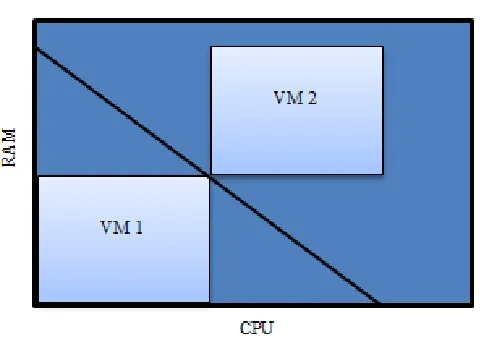
host’s total across every dimension. Figure 1 demonstrates the only valid arrangement for
two virtual machines in a host where two resources, RAM and CPU, are considered. The
axes represent the amount of each respective resource that the host may allocate to the
virtual machines. The lightly coloured rectangles represent, through the lengths and
widths, the amount of each respective resource the virtual machines require. The diagonal
black lines represent areas that cannot be occupied by virtual machines because that
would imply the arrangement of a virtual machine with insufficient resources being
Figure 1 – Valid VM Arrangement
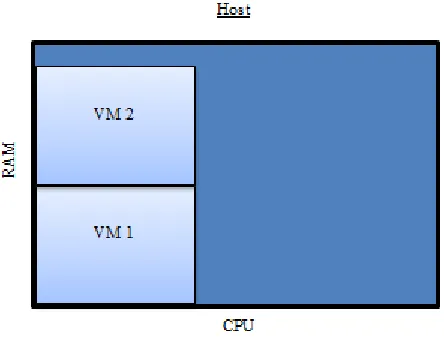
Figure 2 illustrates a virtual machine arrangement that may be furnished by a solution
that appropriates techniques from a two dimensional bin packing methodology.
Nevertheless, such an arrangement is invalid for use in the virtual machine arrangement
problem. This diagrammatic explanation was independently developed by this researcher
however similar explanations, including similar diagrams, can be found in the literature,
in particular [21]. It is because of the fact that a valid bin packing arrangement does not
necessarily correspond to a valid virtual machine arrangement that the multiple resource
virtual machine arrangement problem is not analogous to multidimensional bin packing.
Consequently, the algorithms and solutions developed for that problem domain cannot be
utilized for a data centre’s management policy, at least not without heavy modifications
Figure 2 – Invalid VM Arrangement
1.4
Thesis Focus
The focus of this thesis is to examine a novel technique for virtual machine arrangement
that considers two resources. A valid technique will be one that allows all of the resource
requirements of a series of applications to be met while minimizing service level
agreements violations [2]. First, in chapter 2, a series of existing techniques for virtual
machine arrangement will be enumerated. Next, in chapter 3, a novel virtual machine
arrangement technique will be presented, with a special focus on the concepts and
techniques that make the process as a whole novel. In chapter 4, a series of experiments
will be presented where the results support the claims that the novel aspects of the new
technique are effective when compared to existing, similar techniques and that the new
technique overall may perform similarly when compared to said existing techniques.
Lastly, in chapter 5 further improvements upon the novel algorithm and suggestions for
future work will be discussed as well as any conclusions that can be drawn from the
Chapter 2
2
Related Works
When solving the problem of creating suitable virtual machine arrangements within a
data centre, one may approach the problem in different ways and with different
techniques. First, the data centre manager must be designed to create either static or
dynamic virtual machine arrangements within a data centre. Static arrangements are those
that seek to place each virtual machine in the data centre once for the duration of its
execution. This is known as performing an initial placement of a virtual machine.
Typically, information pertaining to the application’s resource requirements is known beforehand and arrangements are constructed with an application’s peak resource
requirements in mind. This is demonstrated when one utilizes the practice of
overcommitting resources [22]. In contrast, dynamic arrangements are those that have the
additional ability to migrate virtual machines to other physical hosts should the need arise
for a virtual machine to be given more resources than are available on its current physical
host [7]. These migrations can occur in the form of virtual machine relocation and
consolidation. The method by which a suitable arrangement is calculated can utilize a
variety of techniques, e.g. forecasting, genetic algorithms, greedy algorithms, in order to
construct valid static and dynamic virtual machine arrangements within a data centre [18]
[10] [23].
2.1
Static and Dynamic Resource Management
One of the key considerations for any data centre manager is whether the resource
requirements of the applications on the virtual machines are to be considered static or
dynamic. Resource requirements for applications generally fluctuate [7] [24]. If one
wishes to treat the resource requirements of the applications as static regardless, certain
assumptions must be made. Generally this consists of placing virtual machines such that
their peak resource requirements are met. This can be very wasteful as a virtual
machine’s peak resource requirements may only be necessary for a relatively short period
dynamic resource management techniques are seen as an overall improvement in the way
data centre managers construct their arrangements [25] [24]. When constructing an
arrangement to be used by the data centre with dynamic resource management, three
operations are available. First, the data centre manager performs a placement operation
when the virtual machine is first created. This placement operation is necessary for data
centre managers that handle both static and dynamic resources. Metrics for resource
requirements are used to place the newly created virtual machine based on information
pertaining to each virtual machine’s resource usage. This information could be the virtual
machine’s peak resource usage (as is the case with static arrangements), average resource
usage, or typical resource usage. This information is then used as input for an
arrangement technique, such as forecasting, integer linear programming, genetic
algorithms, or a greedy technique. The output is a valid virtual machine arrangement
within the data centre. The second and third operations available to a data centre manager
used for dynamic resource management are relocation and consolidation. Virtual machine
relocation occurs when the data centre manager has determined that a more efficient
virtual machine arrangement can be attained by moving existing virtual machines from
one host to another [3]. This is a result of the resource requirements of one or more
virtual machines on a host increasing above and beyond the point at which it was when
said machines were placed on the hosts, thereby causing the host to enter a stressed state.
Typically, a poll of the hosts within a data centre or event driven programming is used to
discern when a host enters such a state and relies on existing definitions of what it means
for a host to be stressed, partially utilized, and underutilized. Such definitions are
assumed to have been supplied to the data centre manager a priori. Finally, virtual
machine consolidation occurs when the data centre manager has determined that a more
efficient virtual machine arrangement can be attained by vacating all of the virtual
machines from an underutilized host, moving said virtual machines to new hosts, and
powering off the original host [3]. This is a result of the resource requirements of one or
more virtual machines on a host decreasing below the point at which it was when said
machines were placed on the hosts (including the possibility of one or more hosts
completing their execution), thereby causing the host to enter an underutilized state. Once
discern when a host enters such a state and this process relies on existing definitions of
what it means for a host to be stressed, partially utilized, and underutilized. The data
centre manager then compensates by once again computing a valid data centre
arrangement, often by using the same technique that was used for placement, and
migrating the relevant virtual machines in order to implement the new arrangement. The
ability to dynamically compensate for the fluctuations in the resource requirements of the
virtual machines residing on the many hosts within the data centre allows for more
efficient use of the data centre’s resource complements and as such has been found to be
a superior approach when compared to static arrangements [7] [8] [25]. In summary,
dynamic relocation and consolidation of virtual machines in response to dynamic
resource requirements allows for a more efficient usage of the data centre as a whole.
2.2
Virtual Machine Arrangement Techniques
There exist several broadly defined techniques for virtual machine arrangement. Each
technique uses a certain unique concept to decide on which hosts each virtual machine
should be placed, relocated, or consolidated within a data centre. Each of these
techniques may be used in either a static or dynamic policy. To implement a technique
for a static policy, only the initial placement of a virtual machine need be considered. In
order to implement a dynamic policy, relocation and consolidation of virtual machines
must be considered as well. One such method is called forecasting and it refers to a broad
range of techniques where previous arrangements are examined and trends are used to
predict appropriate arrangements in the future [2] [26]. Also, techniques that involve the
use of genetic algorithms may also be used to define valid virtual machine arrangements
[10]. Furthermore, integer linear programming may be incorporated into data centre
management policies [26]. Lastly, greedy algorithms have been utilized to provide valid
virtual machine arrangements for data centre management policies [18]. Forecasting,
genetic algorithms, integer linear programming, and greedy algorithms may all be used to
2.2.1
Techniques Involving Forecasting
Forecasting is a method for establishing virtual machine arrangement. Forecasting, as the
name suggests, attempts to predict which suitable virtual machine arrangement will be
most effective in the future [27] [28] [29]. This is accomplished by examining past and
current arrangements and attempting to discern which initial conditions resulted in said
arrangements [28]. Once the initial conditions are identified, they are catalogued and
stored. From then on, software that is specifically designed to examine the state of the
data centre records statistics pertaining to the state. If at any time the state of the data
centre matches, to some degree, one of the recorded states that the data centre has already
encountered, the data centre manager is notified. The data centre manager will then place,
relocate, and consolidate virtual machines as necessary to either match previously
successful arrangements or avoid unsuccessful arrangements [23]. As mentioned
previously, the success or failure of a given arrangement can be measured via metrics that
take into account the number of hosts needed, the overall power consumption, and the
ability of the data centre to adhere to service level agreements. Forecasting can most
definitely be an effective tool in solving the virtual machine arrangement problem [27]
[28].
Forecasting based data centre management policies have varying success depending on
the workload. The ideal workload would be one in which the resource usages are periodic
or at least have some element of repetition to their traces. The reason behind this being
that these repetitions basically train the forecasting software such that it is better able to
recognize trends in the workload [23]. Additionally, repetitive workloads give the data
centre manager the opportunity to compare slightly different arrangements stemming
from the same initial conditions [23]. The logic being that the more candidate
arrangements a data centre manager has to choose from, the better chance the manager
will have of selecting a successful arrangement. Periodic workloads can occur as a result
of external periodic factors. For example, consider an application that runs 24 hours a
day, but experiences its heaviest workload during the workday. A forecasting based data
centre manager might take this into account by storing one arrangement for the hours
traces that are random, have difficult to discern patterns, or are simply too short for the
software to properly examine will surely cause problems for a forecasting based data
centre manager. For example, data centres that execute a variety of applications ranging
from CPU intensive HTTP servers to RAM intensive database management systems
might not ever encounter similar states twice. Consequently, there will be no opportunity
to utilize previously implemented arrangements and the efficiency of the data centre
could possibly degrade [28]. All in all a forecast based data centre management strategy
works best when the workload traces are such that similar states are often repeated.
2.2.2
Techniques Involving Genetic Algorithms
Another technique for creating virtual machine arrangements is through the use of genetic
algorithms [30]. Genetic algorithms replicate the natural phenomenon of survival of the
fittest and apply it to complex problems [30]. Genetic algorithms have been shown to be
successful in solving said complex problems by trying many solutions, combining those
that were successful to make new combinations, and discarding those that
underperformed [10] [31]. One such area of success for genetic algorithms is path finding
algorithms. It is not incomprehensible that one might expect genetic algorithms to
produce desirable results for the virtual machine arrangement algorithm. The task is
relatively straightforward. A pool of candidate arrangements is generated. The
effectiveness of these arrangements are then rated using some metric [31]. For example,
the number of hosts any given arrangement required would be said to be inversely related
to its effectiveness. Then, a subset of the arrangements would be selected to move on to
the next generation and the rest would be discarded. Finally, those arrangements that
made it to the next generation would have their arrangements divided in some way, and
crossed over with other candidate solutions [30]. The hope is that through enough
generations, the arrangements will only pass on qualities that were successful, thereby
resulting in a near optimal arrangement at the end of the evolutionary process.
Additionally, random mutations could be included into every generation to account for
arrangements that were not present in the original candidates. In theory, it is reasonable to
expect genetic algorithms to be able to provide suitable solutions to the virtual machine
In practice, the use of genetic algorithms did not provide solutions to the virtual machine
arrangement problem that sufficiently outperformed other techniques. There are many
variables that can be altered when constructing a genetic algorithm. The size of the initial
pool of candidate solutions, the point of crossover, the rate of mutation, and the number
of generations can all be altered to provide different results and, consequently, different
levels of effectiveness when implementing a genetic algorithm. Nevertheless, the
particular genetic algorithms that have been constructed to solve the virtual machine
arrangement problem have not outperformed other methods [10]. Although the use of
genetic algorithms has proven to be successful in the arenas of complex combinatorial
problems, the virtual machine arrangement problem has so far left them performing
poorer when compared to other load balancing techniques and forecasting techniques
[10]. It should be noted that genetic algorithms have been shown to outperform simple
greedy algorithms [10]. This may be because an ideal arrangement changes as virtual
machines enter and leave the data centre. As mentioned before, data centres can host
virtual machines that have dynamic resource requirements and perhaps this concept is
difficult to integrate into a genetic algorithm. Furthermore, unlike a path finding
algorithm, there is no logical or intuitive was to establish a crossover point for an
arrangement. The success of any given arrangement of a virtual machine is inherently
dependent on the arrangements that came before it. Contrast this with path finding
algorithms where a movement towards the end goal is always considered improvement,
regardless of other movements that occurred in the grand scheme of the path. In
summary, despite the proclivity for genetic algorithms to solve complex combinatorial
problems, they have shown to be suboptimal with respect to the virtual machine
arrangement problem.
2.2.3
Techniques Involving Integer Linear Programming
Yet another method to solving the virtual machine arrangement problem encompasses
techniques that utilize integer linear programming. Integer linear programming refers to
solving a problem where some or all of the variables are restricted to integers [15] [30]
[31]. Additionally, the constraints on the variables are linear. That is, there are no
context of the virtual machine arrangement problem, the number of hosts must obviously
be an integer value. Furthermore, the resource values used when placing the virtual
machines can also be expressed as integers [30]. The problem of placing virtual machines
suggests utilizing integer linear programming [31]. In conjunction with limiting the
values of the problem domain to integers, said techniques incorporate a brute force
component where every combination of virtual machine arrangements is explored, to a
certain depth [31]. Such an approach can be best described in the context of a decision
tree with every node representing a different combination of arrangements [15]. The logic
behind this technique is that if the data centre manager tries every possible combination
for the current arrangement as well as a certain number of anticipated future
arrangements, the data centre manager can make the decision as to which course of
actions would be the best to follow [31]. The technique is not unlike those implemented
by chess playing computers. That is, the objective is to reach a state with a certain
optimal value but there are multiple ways in which to proceed. Every possible path is
then computed and ranked by some metric. Then the first step in the best performing path
is taken. The process is repeated at each step.
Integer linear programming techniques are prohibitively expensive when applied to the
virtual machine arrangement problem. As mentioned before, there is a brute force
element to this approach where every combination of a subset of the hosts and virtual
machines are explored. In even a small data centre this can lead to the problem of state
space explosion. That is, even if the number of hosts is on the order of 100, the total
number of possible orderings of these hosts would take too much time to explore. As a
result, this technique is restricted in its applications [15]. However, this technique can be
shown to provide better orderings as every single possible combination is explored [31].
Additionally, efforts have been made to reduce the time complexity of such techniques by
utilizing branch and bound mechanisms. That is to say, paths are checked quite early in
their traversal to find if they will result in an optimal ordering and if they are determined
to result in a less than optimal ordering, they are excluded from further investigation [15].
This is known as pruning. Nevertheless, the time complexity of implementing such
linear programming based approaches allow for the discovery of optimal arrangements,
but are useless in some applications due to their prohibitive time complexity.
2.2.4
Techniques Involving Greedy Algorithms
In addition to the previously discussed methods, the virtual machine arrangement
problem can be effectively solved using greedy algorithms. In contrast to forecasting or
integer linear programming which both try to anticipate the future needs of the data
centre, greedy algorithms choose the best possible choice given the immediate situation.
It is the hope that by repeatedly choosing the local optimal solution, a global optimal
solution will be the end result [18] [21]. Furthermore, the task of constructing virtual
machine arrangements is difficult when one considers a single resource, let alone
multiple resources. Greedy algorithms provide a way to combine multiple resource values
into a single criterion so that they may factor into the creation of a virtual machine
arrangement. The key differentiator between greedy algorithms then becomes the criteria
with which the local solution is chosen. In the virtual machine arrangement problem there
exist multiple ways to rank the hosts and virtual machines if only one resource is
considered. A ranking system with such stipulations would simply consist of two parts.
The first part would be a metric with which to rank the hosts, usually the resource value
under scrutiny and the second part would simply be whether the ordering was increasing
or decreasing. One such ranking system is “first fit decreasing” where the hosts are
associated with a scalar value based on some metric and then organized from highest to
lowest. This ordering has been shown to be effective however alternate orderings exist
such as “first fit increasing” where the order of the hosts is reversed from the
aforementioned method, as well as methods that divide the target hosts into subsets based
on their utilization [18]. When only one resource is under consideration, the scalar value
is simply the raw value for whatever resource was chosen. For example, if CPU usage is
the only resource to be factored into the arrangement, each host may be ranked according
to its percentage of CPU resource currently being used. There have been studies on the
effectiveness of ranking hosts in such a way, namely [18]; however the purpose of this
thesis is to examine more than one resource requirement and integrate that information
Consequently, the matter of how to determine a scalar metric when more than one
resource is to be considered becomes an issue. That is to say, there a several ways to
combine multiple resource values. Some examples include, summing the values,
computing the product, calculating the dot product, and finding a ratio between values
[15]. Of particular interest to this thesis are specific summation, product, and ratio
methods.
2.2.4.1
Greedy Metric Type 1 – Summation and Product Methods
One way to combine resource values is to simply sum them together. CPU utilization,
RAM requirements, and bandwidth usage are common data centre attributes used when
deciding how to place virtual machines [30]. For example, if the resources one wishes to
consider are the CPU utilization, the RAM requirements, and the bandwidth usage, these
three raw values for a given host may simply be summed together. It is up to the data
centre management policy designer to decide whether the resource values should be raw
values, percentages, or weighted values [15]. A possible equation for use in a summation
based management strategy might be as follows: ( ) ∑ . This
equation was inspired by the one discussed in [15]. The resource values of every resource
under considerations are simply summed together. The value of alpha can be altered to
reflect a weight if one resource should be considered more heavily in the ordering
process. A similar method to the summation method is one where the resource values are
multiplied together rather than having their sum calculated. Once again, it is up to the
data centre management policy designer to decide whether the resource values should be
raw values, percentages, or weighted values [15]. A possible equation for use in a product
based management strategy might be as follows: ( ) ∏ . Once
again, this equation was inspired by the one discussed in [15]. The resource values of
every resource under considerations are simply multiplied together. The value of alpha
can be altered to reflect a weight if one resource should be considered more heavily in the
ordering process. All in all, summation and product methods have been used effectively
2.2.4.2
Greedy Metric Type 2 – Ratio Method
Yet another method of combining multiple resources is one that takes the ratio of the
resources under consideration. Now, multiple resources could theoretically be used in this
manner however research into this method has been limited to two resources only.
Specifically the CPU utilization resource and the RAM requirements resource were
considered and the ratio of CPU to RAM was the only combination considered. The
equation used to reach the scalar value when only CPU and RAM resource levels are
considered is as follows: ( ) [15]. It should be noted that the
assignment of numerator and denominator to their respective resources could be altered
and indeed could provide alternate results. Nevertheless, this was the assignment
described in the related work, and the assignment used in experiments mentioned in this
thesis.
Greedy algorithms are effective when it comes to the virtual machine arrangement
problem for several reasons. First, any algorithm that uses a “first fit” methodology has
been shown to use no more than twice the number of hosts that the optimal solution
would use [15]. The proof of this is trivial and as such is omitted. In addition to this, it
has been shown that the number of hosts needed is actually no more than 11/9 times the
number of bins that the optimal ordering would use, plus one more bin when one uses a
“first fit decreasing” methodology [31]. Additionally, the time complexity for such
algorithms is quite favourable. The dominant operation in these types of orderings is the
sort used to reach the final ordered state. Due to the fact that the ordering involves
comparing pairs of values, the time complexity of the sort can be found to be n*log(n).
This is much more desirable than say the integer linear programming technique which
experiences time complexities on the order of exponentials [15]. The drawbacks to using
such greedy methods are evident when considering multiple resources. They occur when
the raw values of the resources are on different orders or a wildly disparate. For example,
if the CPU utilization is on the order of thousands, but the RAM utilization is on the order
of millions, any summation or product would be dominated by the RAM component.
Additionally, using the aforementioned greedy techniques is somewhat naïve as one
should be able to place virtual machines such that a host’s individual resource limits are
used most effectively. When combining multiple resource value into one metric, this
information is lost. For example, consider a data centre that considers two resources,
CPU and RAM, and utilizes the summation strategy. Imagine a host that is then assigned
a scalar value of 10. This value of 10 could be the result of several combinations of CPU
and RAM values. 9 CPU units and 1 RAM unit, or 5 CPU units and 5 RAM units both
satisfy the equation. Thus it is in the combining of the resources that one loses
information pertaining to individual resource needs. One can no longer place virtual
machines in such a way to compensate for individual resource disparity. All things
considered, greedy algorithms are effective due to their simple equations and their low
time complexity, but may not be ideal due to their ability to obfuscate individual resource
Chapter 3
3
A Novel Algorithm for VM Arrangement
This chapter describes a new algorithm that builds upon the vector-based approach. The
first novel contribution to existing vector-based approaches is the use of a balance vector
that does not assume resources should be used in equal proportions. The second novel
contribution is one of excluding some viable hosts from the list of potential target hosts to
make a more intelligent selection.
3.1
Existing Vector-based Techniques
The basis of a vector-based technique is the use of a vector where each element
represents a resource usage. Vectors can be used to represent the resource utilization of
hosts and virtual machines [21]. Resource utilization is expressed as a percentage of the
host’s total complement for that resource. Vector-based approaches consider all
utilizations as percentages. This is to ensure that the algorithm is extensible to
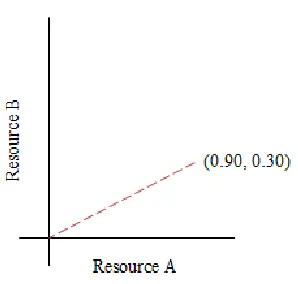
environments where resources can differ by orders of magnitude. Figure 3 illustrates the
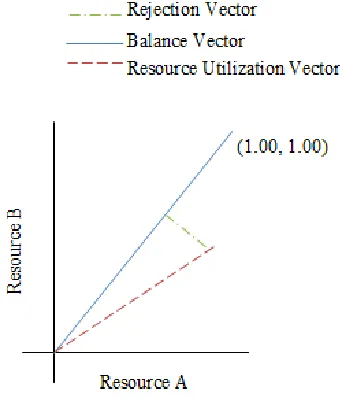
concept of a resource utilization vector that has a dimension of two. Resource A is 90%
utilized and resource B is 30% utilized.
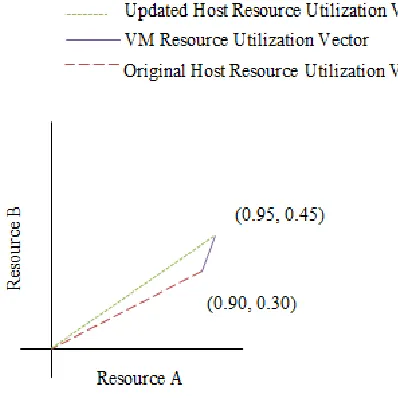
When a virtual machine is placed on a host, the vector addition of the virtual machine’s
resource utilization vector and host machine’s resource utilization vector results in a new
host resource utilization vector. Placing a virtual machine on an existing host is illustrated
in figure 4. Vector addition is performed on the virtual machine and host vectors.
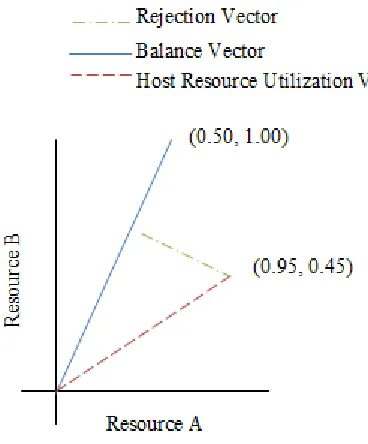
Consequently, the host’s resource utilization vector changes from (0.90, 0.30) to (0.95,
0.45). Placing the virtual machine on the host machine resulted in a 5% point increase in
the utilization of ‘resource A’ and a 15% point increase in the utilization of ‘resource B’.
The ‘Updated Host Resource Utilization Vector’ now represents the utilization levels of
the host machine.
Figure 4 – A VM Resource Utilization Vector added to a Host Resource Utilization
Vector
The resource utilization vector of the virtual machine may result in the updated host’s
resource vector’s slope changing. With a vector-based approach, a virtual machine is not
necessarily assigned to the first host that can accommodate it. Placement makes use of a
balance vector, which represents the ideal utilization of a host machine. A virtual
machine is assigned to a host that has the smallest magnitude of the updated host’s
rejection vector on the balance vector. The vector rejection of a vector vi on vj is a vector
shortest distance between the end of one vector to another vector. Figure 5 illustrates the
concept of the rejection and balance vectors. The rejection vector has one end at the
terminus of the host resource utilization vector and the other end meeting the balance
vector at a right angle. In Figure 5, the balance vector used represents equal utilization of
each resource. Basically, virtual machines are placed on hosts in order to equalize
resource usage across all resources and bring host resource utilization closer to what an
ideal host’s resource usage should be as represented by the balance vector. In contrast to
other techniques that simply place a virtual machine onto the first host onto which it will
fit, vector-based techniques utilize a best fit concept. A virtual machine’s theoretical
arrangement is considered on all possible target hosts, and the host that produces the best
arrangement, that is the one resulting in the smallest rejection vector, is the one that is
selected to house the virtual machine [21].
Figure 5 – Balance and Rejection Resource Utilization Vectors
For example, if a host is overutilized with respect to ‘resource A’ but underutilized with
respect to ‘resource B’, a virtual machine with the opposite resource characteristics, that
is one that is underutilized with respect to ‘resource A’ and overutilized with respect to
‘resource B’, could be placed on the host so that the host resource utilization is closer to
allow for more virtual machine arrangements on the same host as the ability to single out
particular resources should allow for arrangements that would otherwise be overlooked.
The idea behind this approach is that it should result in fewer hosts used overall [21].
This concept is illustrated using Figure 6 which considers four available hosts each with
different levels of their RAM and CPU complements utilized. Now consider five
additional virtual machines to be placed with varying levels of RAM and CPU
requirements. Different arrangements are possible that result in a different number of
hosts being needed. Note that the arrangement that utilized the fewest hosts was one that
placed virtual machines with the intent of using equal amounts of each resource,
percentage wise.
Figure 6 – Different Arrangement Choices Result in Different Number of Hosts
Required
One drawback to this approach is that it is a best fit algorithm rather than a first fit. The
vector-based approach must compare the VM resource utilization vector with all target
host resource utilization vectors. Although an additional series of comparisons is needed,
The sorting can use any algorithm that sorts based on a comparison of pairs of values
such as the quick sort or merge sort. The possible target hosts are sorted in increasing
order of how far away the host resource utilization vector is from the balance vector. The
total time complexity is on the order of V*n*log(n) where V is the number of virtual
machines to be moved and n is the number of target hosts. In summary, vector-based
approaches preserve individual resource requirements of virtual machines and hosts in an
attempt to balance resource utilizations across all resources in a single host.
3.2
Changing the Balance Vector
Current work that uses vector-based approaches uses a balance vector with a slope of
one. This assumes that the ideal host utilization is one with equal usage of the host’s
resources [21] i.e., for each resource the percentage of resource utilization is the same.
This assumption may not always result in the best utilization of the data center resources.
It may be the case that there are virtual machines that have applications that have a
disparately higher need for CPU resources when compared to RAM resources. In this
case it is not feasible to assume that all hosts should strive to use both resources equally.
The slope of the balance vector could reflect an ideal host resource utilization that does
Figure 7 – Altered Balance Vector
We will represent the slope by the ratio of ideal memory usage to the CPU usage. By
choosing a balance vector with a slope of 0.50:1.00 rather than 1.00:1.00, the data centre
manager will strive to arrange virtual machines such that ‘resource B’ is used twice as
much as ‘resource A’. This should counterbalance the resource utilization vector of the host shown which clearly uses a much higher complement of ‘resource A’ than it does ‘resource B’ at the current state of execution. The data centre manager will be inclined to place only those virtual machines that have a high ‘resource B’ requirement onto the host
in question. The task then becomes one of finding the ideal slope to use in a given
environment. Currently, it is not known what an ideal slope for an environment would be.
We acknowledge that a single slope implemented on every host might not be ideal either.
It could be the case that it might benefit a large data centre to have several racks or
clusters of hosts each with their own respective slopes. Virtual machines could then be
assigned to appropriate racks or clusters based on resource requirements. However,
whether one considers a single rack, a cluster, or an entire data centre, we believe that a
will be most effective. For example, if the resources required by the virtual machines are
such that the amount of ‘resource A’ within the data centre is routinely exhausted, then an ideal slope favours arrangements that use ‘resource B’ as much as possible, while using
as few hosts as possible. Once found, a more intelligent selection of target hosts can be
made by the data centre manager. The hope is that this will allow for more efficient
virtual machine arrangements and fewer hosts used overall. In summary, the first novel
concept is the introduction of an unequal balance vector to counteract a data centre’s
natural tendency to use resources unequally.
3.3
Theta Regions
The second novel component to the algorithm presented in this thesis is the inclusion of a
method to exclude possible target hosts. Vector-based approaches use a best fit method to
derive the target host on which a given virtual machine is to be placed [21]. However,
there is often only a subset of the possible targets that would benefit from the addition of
another virtual machine. Consequently, if the set of possible targets was narrowed down
then it would speed up the assignment of a VM to a host machine. Existing vector-based
approaches employ some method to accomplish this. This usually involves graphing
vectors on a plane that represents the utilization of each resource and then selecting hosts
that are in a region that is diametrically opposed to the region in which the virtual
machine’s vector resides [21]. This technique does not take into account the fact that
some suitable hosts are in a severely underutilized state and would be better off being
powered down and having their virtual machines consolidated on another host. As such,
better opportunities to balance the resource utilizations of certain hosts may be omitted.
For example, consider a data centre with two identical hosts. The first host is severely off
balance with 90% of its CPU complement in use and 5% of its RAM complement in use.
The second host is slightly off balance with 10% of its CPU complement in use and 5%
of its RAM complement in use. A virtual machine that would use 10% of a host’s CPU
complement would be exhausted. Additionally, 80% of the second host’s CPU
complement would be rendered unusable. (A virtual machine cannot utilize only CPU
resources.) Consequently, preference as a target should be given to off balance hosts.
The algorithmic construct that has been designed to achieve this is referred to as the
“theta region”. It is so named because the region takes on the shape of an isosceles
triangle (when utilized in two dimensions) and the size of the triangle can be uniquely
identified by the angle that the balance vector makes with one of the equal sides of the
triangle. By overlaying this triangle, or theta region, on a Cartesian plane populated by
vectors representing the resource utilizations of hosts, it has the effect of partitioning the
set of available target hosts into those that are balanced and those that are off balanced.
This can be seen in figure 8. The physical machines can be sorted by their degree of
imbalance and achieve the same effect by considering a subset of the resulting list.
Figure 8 – The Theta Region
The challenge is determining the size of the theta region to reach a subset of target hosts
that is small enough to include only the pertinent hosts but large enough to account for
the possibility of a host not being able to accommodate an incoming virtual machine. In
the set of possible target hosts such that a more intelligent host can be selected to receive
a given virtual machine.
3.4
The New Vector-Based Algorithm
The new vector-based algorithm outlined in this thesis builds on existing algorithms [21].
It contains the novel additions outlined above that should provide a more economic
assignment of virtual machines to data centre hosts. First, it should be mentioned that in
order to implement this algorithm in a data centre, it must be replicated in three different
instances. The algorithm must be implemented with respect to virtual machine placement,
virtual machine relocation, and virtual machine consolidation operations.
Virtual machine placement refers to placing an incoming virtual machine on a host
machine [3]. When placement occurs, virtual machines are considered individually, one
at a time, as they are created from the pool of incoming client applications. Virtual
machine relocation occurs when the data centre manager has determined that a virtual
machine arrangement that can execute more virtual machines without powering on
additional hosts can be attained by moving existing virtual machines from one host to
another [3]. Periodically the data centre manager classifies all hosts as stressed, partially
utilized, and underutilized. Virtual machines may be migrated from a stressed host to a
host that is not stressed. The definition of stressed, partially utilized and underutilized has
been made a priori and is outside of the scope of the algorithm described in this section.
The periodicity with which these classifications are made, as well as the resource
utilization levels associated with stressed, partially utilized and underutilized states are
experimental parameters that are listed in chapter 4. Finally, virtual machine
consolidation occurs when the data centre manager has determined that a virtual machine
arrangement that can execute the same number of virtual machines on fewer hosts can be
attained by vacating all of the virtual machines from an underutilized host, moving said
virtual machines to new hosts, and powering off the original host [3]. Relocation and
consolidation may also be triggered by other factors, such as SLA violations. In the end,
the decision as to whether or not a physical host should be part of a relocation or
However, proper utilization levels and minimization of SLA violations are most
definitely examples of such goals. It should also be noted that a key difference between
placement and relocation or consolidation is observed. Whereas placement only involves
a single virtual machine, relocation and consolidation handle a set of virtual machines for
which new target hosts must be found. The policies used by the three individual
operations combine to form a single data centre policy [3]. It should be noted that the
algorithm assumes that a suitable balance vector slope and a theta region have been
determined a priori. Once the decisions regarding the periodicity of the aforementioned
processes and the definitions of stressed, partially utilized, and underutilized have been
assigned, the algorithm is then run to create a suitable virtual machine arrangement. The
algorithm is run each time there is a need for the data centre manager to perform a
placement, relocation, or consolidation operation.
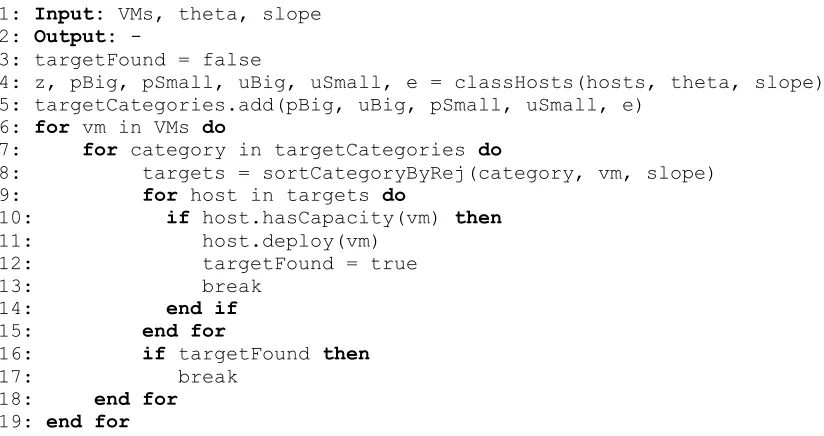
1: Input: VMs, theta, slope 2: Output: -
3: targetFound = false
4: z, pBig, pSmall, uBig, uSmall, e = classHosts(hosts, theta, slope) 5: targetCategories.add(pBig, uBig, pSmall, uSmall, e)
6: for vm in VMs do
7: for category in targetCategories do
8: targets = sortCategoryByRej(category, vm, slope) 9: for host in targets do
10: if host.hasCapacity(vm) then
11: host.deploy(vm) 12: targetFound = true 13: break
14: end if
15: end for
16: if targetFound then
17: break 18: end for
19: end for
Figure 9 – The New Vector-Based Algorithm
First, existing hosts must be categorized. There are a total of five categories into which a
host may fall. The first category is for hosts that are partially utilized and whose resource
is inside the theta region. This category is represented by the variable ‘pSmall’. The
fourth category is for hosts that are underutilized and whose resource vector’s terminus is
inside the theta region. This category is represented by the variable ‘uSmall’. The fifth
and final category is that of empty hosts. This category is represented by the variable ‘e’.
For the sake of completion, it should be noted that stressed hosts are never considered
valid target hosts for any virtual machine movement operation. This category is
represented by the variable ‘z’. This can be seen in lines 4 and 5 of the algorithm. Next,
for every virtual machine that is to undergo some sort of movement, a suitable target
must be found. This is seen in the loop that starts at line 6 in the algorithm. This is
accomplished by inspecting the categories one by one in the order that they were
described above. This order was chosen as it best replicated the order and successes
found in [18]. This order was successful in that it allowed the data centre to achieve the
best utilization levels while incurring few SLA violations when compared to other
permutations of the above categories. This success stemmed from the fact that a new host
was turned on only after all other hosts were checked and deemed unfit to house an
incoming virtual machine. That is, turning on another host was only done so as a last
resort. The loop that accomplishes this occurs at line 7. Within each category of potential
target hosts, each target host is checked to see if placing a virtual machine on it will make
the host’s resource utilization vector trend more towards the balance vector. The terminus
of the newly created vector is calculated and its rejection from the balance line is
computed. The category of potential target hosts is then sorted by the magnitude of said
rejection in increasing order. This occurs at line 8 in the algorithm through the calling of
the sortCategoryByRej function. This gives the effect of placing the virtual machine onto
the host whose state will then be closest to being balanced as a result of hosting the
virtual machine undergoing the movement. Next, each host in the category is inspected in
the order described above and the first host onto which the virtual machine will fit is
selected as the target. The sort combined with the fact that the targets are inspected in
order results in a best fit heuristic. This process begins at line 9 of the algorithm. If the
target can accommodate the incoming virtual machine with respect to its resource needs,
the movement is recorded, set to be executed at the end of the derivation of the
selected host cannot accommodate the virtual machine, the next target host in the
category is inspected. This is accomplished in lines 10-17 of the algorithm. This process
repeats until the subset of target hosts is exhausted or until an appropriate target can be
found. If the category of hosts is exhausted, the algorithm sorts and inspects the next
category of hosts in the manner described above. This process continues until all
categories have been exhausted and either results in a new host being turned on or the
data centre simply cannot hold another virtual machine. It should be noted that as is the
case with other data centre manager policies, conditions are in place to ensure that the
source host for a given machine cannot be the same as its destination during relocation
and consolidation operations, for obvious reasons. This was seen in the experiments
conducted in [2]. In summary, the new vector-based algorithm organizes possible hosts
into 5 categories, considers said categories one by one, and sorts potential target hosts in
increasing order of the magnitude of the rejection of the vector made by the sum of the
host’s resource vector and the virtual machine’s resource vector with respect to the
Chapter 4
4
Experimental Design and Results
This chapter investigates the effectiveness of the new vector-based approach described in
Chapter 3. Section 4.1 describes the simulator used in the experiments. Section 4.2
describes the workload traces. Section 4.3 presents the utilization levels used to define
underutilized, partially-utilized and stressed hosts. Section 4.4 describes the metrics used
to evaluate the different virtual machine arrangements. In sections 4.5 to 4.7, three
experiments are presented.
4.1
Simulator
The simulator used in the experiments is DCSim [3] [2]. The simulated data centre
configuration used in the experiment, DCSim, consisted of 200 host machines, of which
there were an equal number of two types of hosts. The first type of host was modeled
after the HP ProLiant SL380G5, with 2 dual-core 3Ghz CPUs and 8GB of RAM. The
other type of host was modeled after the HP ProLiant SL160G5 with 2 quad-core 2.5GHz
CPUs and 16 GB of RAM. The power consumption of both hosts is calculated using the
SPECPower benchmark. The power efficiency of the first type of host was
46.51cpu/watt. The power efficiency of the second type of host was 85.84cpu/watt.
4.2
Traces
The five workload traces used consisted of traces from Clarknet, EPA, SDSC, and two
Google cluster data traces. These traces consist of HTTP server requests. The traces were
sampled over a fixed time interval and the number of requests during the interval spurred
the creation of virtual machines. A greater number of requests resulted in a virtual
machine being created with higher resource requirements and a smaller number of
requests caused virtual machines to be spawned with lower resource requirements [3].
Five random seeds were chosen as the five starting points in each of the workload traces