http://dx.doi.org/10.4236/jamp.2014.24004
Bessel Function and Damped Simple
Harmonic Motion
Masoud Asadi-Zeydabadi
Department of Physics, University of Colorado Denver, Denver, USA Email:[email protected]
Received 5 February 2014; revised 5 March 2014; accepted 9 March 2014
Copyright © 2014 by author and Scientific Research Publishing Inc.
This work is licensed under the Creative Commons Attribution International License (CC BY).
http://creativecommons.org/licenses/by/4.0/
Abstract
A glance at Bessel functions shows they behave similar to the damped sinusoidal function. In this paper two physical examples (pendulum and spring-mass system with linearly increasing length and mass respectively) have been used as evidence for this observation. It is shown in this paper how Bessel functions can be approximated by the damped sinusoidal function. The numerical method that is introduced works very well in adiabatic condition (slow change) or in small time (independent variable) intervals. The results are also compared with the Lagrange polynomial.
Keywords
Bessel Function; Simple Harmonic Motion; Damped Sinusoidal Function; Lengthening Pendulum; Spring-Mass System; Lagrange Polynomial
1. Introduction
A brief view of the graphs of Bessel and sinusoidal functions shows they are very similar. Bessel functions look like damped sinusoidal functions. Sinusoidal functions are well known for all of us and we have seen the foot prints of them almost everywhere. We knew them from trigonometry but Bessel functions are new for college students and seem more complicated and the students get familiar with them usually in differential equation. Bessel and sinusoidal functions are solution of Bessel and harmonic differential equations. We know these dif-ferential equations belong to the family of Sturm-Liouville equation. Bessel and sinusoidal functions are ortho-gonal function and they appear in the solution of some partial differential equations. The type of orthoortho-gonal function that appears in the solution depends on the geometry, physics (the form of the differential equation) and the boundary conditions. In spite of the similarity between them still for the students dealing with Bessel func-tion is more difficult than sinusoidal funcfunc-tion.
physical examples. Basically this is an attempt to understand the mathematics through physics. This method is based on the similarity between the form of Bessel and sinusoidal functions and their similarity has been inter-preted by these examples. This paper is not aiming to discuss or prove fundamental similarities or differences between these two groups of functions. Basically our observation shows Bessel functions behave like sinusoidal functions with decreasing amplitude and varying period. In this paper two examples are given to understand the root of these behaviors. These examples are the lengthening pendulum and spring-mass system with variable mass. Both length and mass in the pendulum and the spring-mass system respectively increase linearly with time. Finally for these examples the results of the exact solution (Bessel function) are compared with the approxima-tion method (damped sinusoidal funcapproxima-tion).
In addition to this pedagogical method (physical perspective of Bessel equation) the damped sinusoidal func-tion is a good numerical approximafunc-tion for Bessel funcfunc-tion. It is compared with the Lagrange polynomial fitting; this method provides results better than the Lagrange polynomial fitting.
2. The Lengthening Pendulum
The lengthening pendulum which is known also as Lorentz’s pendulum is similar to a simple pendulum with in-creasing length
(
l= +l0 vt)
at constant rate(
v>0)
, with initial length of l0 [1]-[8]. Its equation of motion is2
2
d 2 d
sin 0. d
d
v g
l t l
t
θ + θ+ θ =
(1)
where θ is the pendulum angle relative to the vertical axis and g is gravitational acceleration. By changing variable from t to l and by using the small angle approximation (1) becomes:
2
2 2
d 2 d
0. d
d
g l l
l v l
θ+ θ+ θ =
(2)
The solution of (2) is given by Bessel function as following
( )
( )
1 1
J u Y u
A B
u u
θ = + (3)
where u 2 gl v
= . If θ θ= 0 and θ = 0 at t=0 then the constants are given by
( )
20
0 2 0 π
2 u
A= − θY u and
( )
2 0
0 2 0 π
2 u
B= θ J u where u0 is the initial value of u. If l0 and v are related to each other such that
0 0
2 gl u
v
= is a zero of J2
( )
u0 then the solution is( )
1 J u C
u
θ = (4)
where
( )
0 0 1 0 . u C J u θ =To understand the solution in terms of the sinusoidal function, Equation (1) for the small angle approximation can be written as
( )
( )
2 2 0 2 d d 2 0. ddt t t t
θ + γ θ+ω θ =
(5)
where
( )
t v lγ = and 2
( )
0g t
l
ω = . Notice that since l is time dependent, γ
( )
t and ω0( )
t are functions of time. If an adiabatic condition (slow change) is considered or if small time intervals are chosen then γ( )
t and( )
0 tω are almost constant and the equation of motion is similar to damped simple pendulum. Then its solution for under damped condition
(
2 2)
0
n
t can be written in terms of the conditions of the pendulum at tn−1:
( )
(
)
(
( )
)
1
1, 1 1 2, 1 1
e n t sin cos
n c n n t c n n t
γ
θ − −∆ ω ω
− − − −
= ∆ + ∆ . This solution shows how Bessel functions can be re- lated to the damped sinusoidal solution.
The equation of motion can also be written in terms of u 2 gl v
= which is a dimensionless variable as fol- lowing:
2
2 d 3 d
0. d
du u u
θ + θ θ+ =
(6)
In this case the damping coefficient is
( )
3 2 uu
γ = . Again under adiabatic condition the solution at the
neighborhood of un is e sin
(
)
nu
n n n
A γ u a
θ≅ − ω +
, where 3 2
n n
u
γ = , ωn2 = −1 γn2 and for γnωn we have
1
n
ω ≅ . Therefore for large u the period approaches to 2π like sinusoidal function. By comparing with the exact solution (Bessel function) at the neighborhood of un we have:
( )
(
)
1
e nusin
n n n
J u
C u
u
γ ω β
−
≅ + where
n
C and βn are given by the condition of the problem at un. This is an observation based on the solution of
the lengthening pendulum and it is not a mathematical proof and depends on two constant (Cn and βn) that
should be determined by the condition at un.
3. Spring-Mass System with Linearly Increasing Mass
In this case the mass is increased in steady rate: m=m0+αt where m0 is the initial mass and α >0 is the rate of change of the mass. The same treatment as previous case has been used. The equation of motion is:
2 2 d d 0. d d
x x k
x
m t m
t
α
+ + = (7) where k is the spring constant. By changing variable from t to m in (7) we have
2
2 2
d 1 d
0. d
d
x x k
x m m
m + +α m = (8) The solution of (8) is given by Bessel function as following:
( )
( )
0 0
x=AJ u +BY u (9)
where u 2 km
α
= . The initial conditions of x
( )
0 =x0 and x( )
0 =0 give( )
00 1 0 π
2 u
A= − x Y u and
( )
0 0 1 0 π
2 u
B= x J u where u0 is the value of u at t=0. If m0 and α are adjusted such that
0 0 2 km u α =
is a zero of J u1
( )
0 then the solution is( )
0x=CJ u (10) where
( )
0 0 0. x C
J u
= Equation (7) can be written as
( )
( )
2 2 0 2 d d 2 0 d d x xt t x
t
t + γ +ω = , (11) where
( )
2 t
m
α
γ = and 2
( )
0k t
m
are almost constant then the equation of motion is similar to damped harmonic motion. Then its solution for un- der damped condition
(
γ2 <ω02)
is( )
(
( )
)
(
( )
)
1 2
eγt t c sin t t c cos t t
θ = − ω + ω
where angular frequency of the motion is ω2 =ω02−γ2 and it is function of time.
The equation of motion in terms of u 2 km
α
= which is dimensionless is 2
2 d 1 d
0. d d x x x u u
u + + = (12) In this case the damping coefficient is
( )
12 u
u
γ = . Again under adiabatic condition the solution at the
neighborhood of un is e sin
(
)
nu
n n n
x≅A −γ ω u+a , where 1 2
n n
u
γ = , ωn2 = −1 γn2 and for γnωn we have
1
n
ω ≅ . For large u the period approaches to 2π like sinusoidal function. By comparing with the exact solu- tion (Bessel function) at the neighborhood of un we have 0
( )
e sin(
)
nu
n n n
J u ≅C −γ ωu+β where Cn and βn
are given by the conditions of the system at un. This is physical evidence based on observation and it is not a
mathematical proof.
4. The Quadratic Lagrange Polynomial for Numerical Comparison
In general the damped sinusoidal function provides a good approximation for Bessel functions. It can be com-pared with the quadratic Lagrange polynomial fitting which is given by [9] [10]
( )
1 1
N
j i
i j N i j
j i
u u
x u x
u u = ≤ ≤ ≠ − = −
∑ ∏
(13)For the quadratic case N =3 and three points,
(
u x1, 1) (
, u x2, 2)
and(
u x3, 3)
, are needed.5. Results and Discussion
In this section some results are shown for both cases. The numerical values are used are not based on any physi-cal reason and they are used just for comparison of these two methods.
In both of these problems there are two independent variables (
( )
θ,l for pendulum and(
x m,)
for spring-mass system). Change in the momentum is due to both variables. Appearance of the first derivatives (θ and x for pendulum and spring-mass system respectively) make them different from the simple harmonic mo-tion. This is because of the change of the momentum due to the second independent variable(l for the pendu-lum and m for the spring-mass system). Mathematically this first derivative plays the role of the damping term that causes the amplitude decay. In reality there is no drag force like air resistance in these two cases but they are not conservative system their energies depend on time [1]. The total mechanical energy is the sum of the ki-netic and the potential energy and for the pendulum case the energy density (energy per unit mass) is(
2 2 2)
(
2 2 2) (
2)
1 1
cos 1 2
2 2
E
l l gl l l gl
m= + θ − θ≅ + θ − −θ . By substitution of (4) into this expression the energy density is given by
(
( )
( )
)
2
2 2 2 2
1 2
1
2 8
E C
v gl J u J u v
m= − + + . The last (Bessel’s) term is proportional to 2 v
(like kinetic energy). This term decays down and the energy density approaches to 1 2
2v −gl. Since l in- creases with time the energy decreases. The power density is given by
( ) ( )
( ) ( )
2
1 0 2 3
1 d
d 8
p E v C g
gv J u J u J u J u
m=m t = − + l − . Again the Bessel’s term decays and the power densi- ty converges to −gv= −F vT <0 where FT is the string tension at this limit (at large value of time). Therefore
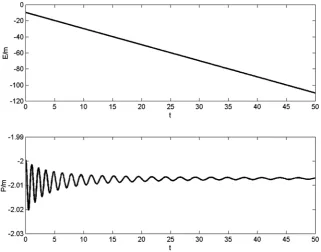
based on the damped oscillation. Figure 1 shows the energy density and power density for the case of ν = 0.2048 m/s. It shows power density is negative and it decreases with time and approaches to −gv= −2.007 W/kg.
The amplitude decays as e−γnu but
n
γ is inversely proportional to un therefore the rate of the change of
the amplitude decreases. The angular frequency ωn = 1−γn2 increases as un increases and approaches to 1,
(
lim 1)
nn
u →∞ω = , therefore the period is inversely related to u (it decreases as u increases). This means for
large u the amplitude and frequency converge to almost constant values or the solution behaves like simple
harmonic motion. We know u by itself is function of time (u 2 gl v
= and u 2 km
α
= ) and it increases by time and consequently the period increases by time. This can be clarified by giving the frequencies in terms of (l and m) which are functions of time. The frequencies in terms of t for the pendulum and the spring-mass
system are
( )
2
2
g v
t
l l
ω = − and
( )
2
2 4 k t
m m
α
ω = − respectively. For large value of time (large l and m)
they approach to g l and
k
m. That means they get smaller and the periods become larger as time increases.
Figure 2 shows the results of two methods. For these results the small time intervals (less than the local period) have been used. This is a good criterion for the time step size in adaptive numerical method. Figure 2 shows the approximation method (damped sinusoidal method) agrees very well with the exact solution (Bessel function) for small time intervals. One can observe from this figure the period increases with time.
Suppose the pendulum problem has been solved exactly for some initial conditions. This solution is given in (4) by Bessel functions and at a given un the exact conditions of the motion, (θn and θn), can be found and
substituted into, e nusin
(
)
n n n
A γ u a
θ ≅ − ω +
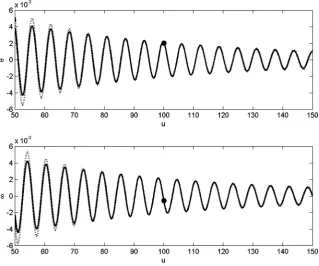
, to find An and an. Figure 3 shows this solution for u0 =5.13562 (the first zero of J2
( )
u ) with initial conditions of θ0=10
and θ0 =0. The solution corresponding to 100
n
u = has been shown by a dot on the graph. At this point the exact and the approximation solutions should
Figure 1. Energy density and power density for the lengthening pendulum: u0 = 30.571 0.2048
[image:5.595.153.475.435.687.2]Figure 2. The results of exact (Bessel) and the approximation (damped sinusoidal) solu-tion for the lengthening pendulum (u0=30.571, v=0.2048 m/s, θ0=5 and θ0=0). Since the small time interval has been used the results of both methods are quite agree with each other (no differences can be seen).
Figure 3. The results of the exact solution, Bessel function (solid line), and the approxi-mation method, damped sinusoidal solution (dot line), for the lengthening pendulum: l0 = 1 m, u0=5.13562, 10 , 0, θ0= θ0=
100,
n
u = θn=0.002 radand 4 5.6811 10
n
θ = − × −
[image:6.595.154.474.400.666.2]match with each other through the condition at un (i.e. θn and θn). Using these conditions from the exact
[image:7.595.153.476.415.671.2]solution and impose them on the approximation (damped sinusoidal) method gives us the approximation solu-tion at the neighborhood of this point. Figure 3 shows the results agree with each other particularly near this point. One can see the deviation of the approximation method from the exact solution away from this point es-pecially for small u. In this case we are not using small time interval and the figure shows the results over sev-eral periods.
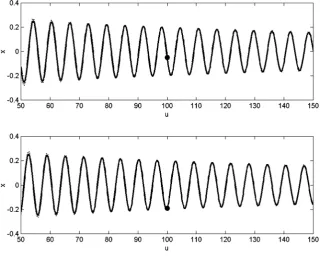
Figure 4 shows the same results as Figure 3 but for the spring-mass system, in this case the exact solution is given in terms of J0
( )
u . Again the results of the exact solution and the approximation method are quite similar. The deviation of these two methods at small u is shown in Figure 5. Again we can observe for u>un theresults are matched very well.
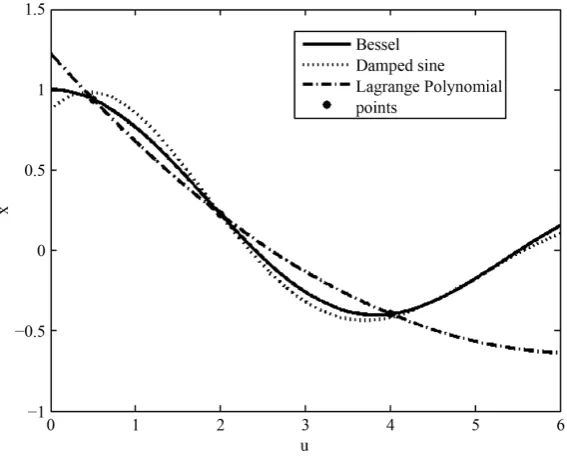
In the Lagrange polynomial fitting three points are needed but for the damped sinusoidal function only the value of Bessel function and its derivative at a point are needed. This is a big advantage of this method compare to the Lagrange polynomial fitting. The Bessel function is oscillatory therefore the order of polynomial in a large interval should be higher and more points are needed. Figure 6 shows the comparison of these two tech-niques with the exact Bessel function.
The results from Figure 6 shows the damped sinusoidal function is a better approximation compare to the Lagrange polynomial fitting. It is obvious for the larger interval the quadratic polynomial is not a reasonable ap-proximation and higher order polynomial with more points are needed. The results of this paper shows in long interval the damped sinusoidal is good numerical approximation.
6. Conclusions
The graphs of Bessel functions are similar to the damped sinusoidal solution. In this paper this observation has been investigated by two physical examples. The Bessel’s equation has been compared with the equation of the damped simple harmonic motion. The solutions of these methods are compared at the neighborhood of an arbi-trary point. The results are shown the approximation method works very well particularly when u is large (i.e. for large value of independent variable for example time in this paper for two examples). The damped sinusoidal
Figure 4. The results of the exact solution (Bessel function, solid line) and the approxi-mation method (damped sinusoidal solution, dot line) for the mass-spring system: m0 = 1 kg, u0 = 3.832, x0 = 1 m, un = 100, xn = −0.0496 m and xn= −0.1915 m/s. The solution
Figure 5. The results of the exact solution (Bessel function, solid line) and the approxi-mation (damped sinusoidal, dot line) method for the mass-spring system: m0 = 1 kg, u0 = 3.832, x0 = 1 m, un = 10, xn = 0.6106 m and xn=0.1079 m/s. The solution
correspond-ing to un = 10, has been shown by a dot on the graph.
Figure 6. Bessel function, x = J0(u), the damped sinusoidal function, and the quadratic Lagrange polynomial. The given points for Bessel function, J0(0.5) = 0.9385, J0(2.0) = 0.2239 and J0(4.0) = −0.3971, are shown in figure.
[image:8.595.172.456.401.631.2]In this paper we use two physical examples but this method can be generalized for any Bessel’s equation. The
general form of Bessel’s equation is
( )
(
)
22 2 2
d d
1 1 0
d d
y y
u p u y
u u
+ + − = . Again by using the appropriate ini- tial value for u the final solution can be given in terms of either Jp
( )
u or Yp( )
u . The damped sinusoidalsolution at the neighborhood of a given point
( )
un is given by ( e sin(
)
nu
n n n
y≅ A −γ ωu+a ) where n 1 n
u
γ =
and
(
2 2)
(
2 2)
1 1
n p u n p u
ω = − −γ ≅ − . The values of Bessel function and its derivative at un are used to
find An and an. This method can be considered as a good perturbation method for the problems that are
in-volved Bessel function. This method can improve numerical techniques for some particular equations. In the same way we can look at other functions like Legendre polynomial. The Legendre differential equation is given
by
(
)
(
)
2 2
2
d d
1 2 1 0
d d
y y
u u y
u u
− − + + = with − ≤ ≤1 u 1. We can write the differential equation in the form
damping harmonic oscillation 2
2 2
d d
0 d
d
y y
y u
u −γ +ω = with
(
2)
2 1u
u
γ =
− and
(
)
(
2)
11 u
ω= + −
. In this case the so-
lution is growing up and the ω increases by . Notice that the polynomial is defined in region of − ≤ ≤1 u 1.
References
[1] Werner, A. and Eliezer, J.C. (1969) The Lengthening Pendulum. Journal of Australian Mathematical Society, 9, 331- 336. http://dx.doi.org/10.1017/S1446788700007254
[2] Littlewood, J.E. (1963) Lorentz’s Pendulum Problem. AnnalsofPhysics, 21, 233-249. http://dx.doi.org/10.1016/0003-4916(63)90107-6
[3] Littlewood, J.E. (1964) Adiabatic Invariance III. The Equation x= −Vx
(
x,ω)
. AnnalsofPhysics, 29, 1-12. http://dx.doi.org/10.1016/0003-4916(64)90188-5[4] Littlewood, J.E. (1964) Adiabatic Invariance IV: Note on a New Method for Lorentz’s Pendulum Problem. Annalsof Physics, 29, 13-18. http://dx.doi.org/10.1016/0003-4916(64)90189-7
[5] Littlewood, J.E. (1964) Adiabatic Invariance V. Multiple Periods. AnnalsofPhysics, 30, 138-153. http://dx.doi.org/10.1016/0003-4916(64)90307-0
[6] Brearley, M.N. (1966) The Simple Pendulum with Uniformly Changing String Length. Proceedings of the Edinburgh Mathematical Society (Series 2), 15, 61-66.
[7] Sánchez-Soto, L.L. and Zoido, J. (2013) Variations on the Adiabatic Invariance: The Lorentz Pendulum. American Journal of Physics, 81, 57. http://dx.doi.org/10.1119/1.4763746
[8] Boas, M.L. (2006) Mathematical Methods in the Physical Science. 3rd Edition, Wiley, 598-599. [9] Gil, A., Segura, J. and Temme, N. (2007) Numerical Methods for Special Functions. SIAM.
http://dx.doi.org/10.1137/1.9780898717822