A Modeling of Wind and Solar Hybrid System
Using Multi Rectifier Stage
Anup M. Gakare1, Subhash Kamdi2
P.G. Student, Dept of Electrical Engineering, Rajiv Gandhi College of Engineering, Research & Technology, Chandrapur, Maharashtra, India1.
Assistant Professor, Dept. of Electrical Engineering Rajiv Gandhi College of Engineering, Research & Technology, Chandrapur, Maharashtra, India2.
Abstract: This paper presents power-control strategies of a grid-connected hybrid generation system with versatile power transfer. The hybrid system allows maximum utilization of freely available renewable sources like wind and photovoltaic energies. This paper presents a new system configuration of the multi input rectifier stage for a hybrid wind and photovoltaic energy system. This configuration allows the two sources to supply the load simultaneously depending on the availability of the energy sources maximum power from the sun when it is available. An adaptive MPPT algorithm with a standard perturbs and observed method will be used for the Photo Voltaic system. The main advantage of the hybrid system is to give continuous power supply to the load. The gating pulses to the inverter switches are implemented with conventional and fuzzy controller. This hybrid wind-photo voltaic system is modeled in MATLAB/ SIMULINK environment. Simulation circuit is analyzed and results are presented for this hybrid wind and solar energy system.
Keywords: Renewable energy, Cuk converter, SEPIC converter, MPPT.
I.INTRODUCTION
Recent developments and trends in the electric power consumption indicate an increasing use of renewable energy. Virtually all regions of the world have renewable resources of one type or another. By this point of view studies on renewable energies focuses more and more attention. Solar energy and wind energy are the two renewable energy sources most common in sue. Wind energy has become the least expensive renewable energy technology in existence and has peaked the interest of scientists and educators over the world [9]. Photovoltaic cells convert the energy from sunlight into DC electricity. PVs offer added advantages over other renewable energy sources in that they give off no noise and require practically no maintenance [15]. Hybridizing solar and wind power sources provide a realistic form of power generation. Many studies have been carried out on the use of renewable energy sources for power generation and many papers were presented earlier. The wind and solar
energy systems are highly unreliable due to their
is unavailable, then the other source can compensate for it. The Cuk-SEPIC fused converters have the capability to eliminate the HF current harmonics in the wind generator. This eliminates the need of passive input filters in the system. These converters can support step up and step down operations for each renewable energy sources. They can also support individual and simultaneous operations. Solar energy source is the input to the Cuk converter and wind energy source is the input to the SEPIC converter. The average output voltage produced by the system will be the sum of the inputs of these two systems. All these advantages of the proposed hybrid system make it highly efficient and reliable.
II. PHOTOVOLTAIC (PV) SYSTEM
Photovoltaic (PV) technology involves converting solar energy directly into electrical energy by means of a solar cell. For a PV system, the voltage output is a constant DC whose magnitude depends on the configuration in which the solar cells/ modules are connected. On the other hand, the current output from the PV system primarily depends on the available solar irradiance. The main requirement of power electronic interfaces for the PV systems is to convert the generated DC voltage into a suitable AC for consumer use and utility connection. Generally, the DC voltage magnitude of the PV array is required to be boosted to a higher value by using DC-DC converters before converting them to the utility compatible AC. The DC-AC inverters are then utilized to convert the voltage to 50/60 Hz. AC. The process of controlling the voltage and current output of the array must be optimized based on the weather conditions. Specialized control algorithms have been developed called maximum power point tracking (MPPT) to constantly extract the maximum amount of power from the array under varying conditions. The MPPT control process and the voltage boosting are usually implemented in the DC-DC converter, whereas the DC-AC inverter is used for grid-current control.
1. A Modeling of a Solar Cell
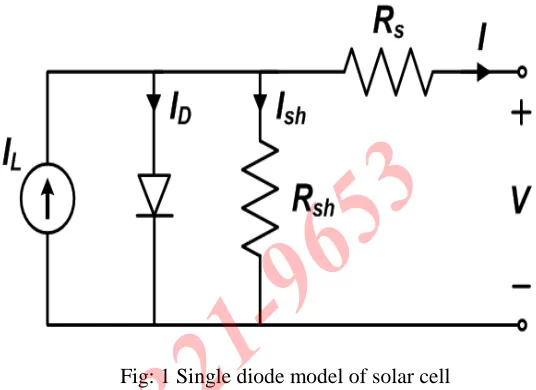
[image:3.612.303.571.117.312.2]A solar cell is the building block of a solar panel. A photovoltaic module is formed by connecting many solar cells in series and parallel. Considering only a single solar cell; it can be modeled by utilizing a current source, a diode and two resistors. This model is known as a single diode model of solar cell. Two diode models are also available but only single diode model is considered as shown in fig 1.
Fig: 1 Single diode model of solar cell
The characteristic equation for a photovoltaic cell is given by:
I = Iph–Id–Ish
I = Iph–I0–[exp {q (V+RsI) / (A KBT)} –1]–(V+RsI)/Rsh
Where,
Iph= photocurrent,
Id–diode current,
I0= saturation current,
A = ideality factor,
q = electronic charge 1.6 X 10⁻⁹,
KB= Boltzmann’s gas constant (1.38 x 10 -23
), T = cell temperature,
Rs= series resistance,
Rsh= shunt resistance,
I = cell current, V = cell Voltage
The characteristic equation of a solar module is dependent on the number of cells in parallel and number of cells in
series. It is observed from experimental results that the current variation is less dependent on the shunt resistance and is more dependent on the series resistance.
I = Iph–I0–[exp {q V /KT}–1] (1)
[image:3.612.300.566.122.505.2]Fig:2 VI and PV characteristics of solar cell
III. WIND ENERGY
Wind turbines convert kinetic energy in the wind into mechanical power that can be converted into electrical energy with a generator. Power is normally generated either with an induction generator or with a synchronous generator. Synchronous generators are typically interconnected to the grid through power electronics converters. Power output is typically between 10KW to 2.5 MW and wind power is captured using a blade that is connected to the rotor of a generator. The power is generated only when the wind blows. Like PV systems, there are no fuel costs, but periodic maintenance of the wind turbines is required the basic equation of rather power of the wind in an area A, perpendicular to the wind blowing direction is given by :
P = (pACpV3) / (2)
Where P is the power, p is the air density, V is the wind speed and Cp is the power coefficient, which describes the fraction of the wind captured by a wind turbine. Fig. 3 shows
a steady wind speed – power curve, which reflects the
regulated power achievable from the wind turbine,. At very
low wind speeds the generated power is too low to be utilized.
Fig: 3 Power from wind turbine
IV. DC –DC CONVERTERS
DC-DC converters can be used as switching mode regulators to convert an unregulated dc voltage to a regulated dc output voltage. The regulation is normally achieved by PWM at a fixed frequency and the switching device is generally BJT, MOSFET or IGBT.
1. Cuk Converter
The Cuk converter is a type of DC-DC converter that has an output voltage magnitude that is either greater than or less than the input voltage magnitude.
Fig: 4 Cuk Converters
It has the capability for both step up and step down operation. The output polarity of the converter is negative with respect to the common terminal. This converter always works in the continuous conduction mode. The Cuk converter operates via capacitive
energy transfer. When M1 is turned on, the diode D is reverse
delivered to the load. When M1 is turned off, D becomes
forward biased and the capacitor C is recharged. The voltage conversion ratio Mcuk of the Cuk converter is given by:
V0= - Vin[D/(I-D)] (3)
2. SEPIC Converter
Single-ended primary-inductor converter (SEPIC) is a type of DC-DC converter allowing the voltage at its output to be greater than, less than, or equal to that at its input. It is similar to a buck boost converter. It has the capability for both step up and step down operation. The output polarity of the converter is positive with respect to the common terminal.
Fig: 5 SEPIC converter
The capacitor C1blocks any DC current path between the
input and the output. The anode of the diode D1is connected
to a defined potential. When the switch M1 is turned on, the
input voltage, Vin appears across the inductor L1 and the
current ILIincreases. Energy is also stored in the inductor L2
as soon as the voltage across the capacitor C1appears across
L2. The diode D1 is reverse biased during this period. But
when M1turns off, D1 conducts. The energy stores in L1 and
L2is delivered to the output, and C1is recharged by L1for the
next period. The voltage conversion ratio MSEPIC of the
SEPIC converter is given by:
V0= Vin[D/(I-D)] (4)
3. Cuk-SEPIC Fused Converter for hybrid energy system
A hybrid wind-solar energy system is shown in Fig. 6 where one of the inputs is connected to the output of the PV array and the other input connected to the output of a wind
generator. The fusion of the two converters is achieved by reconfiguring the two existing diode from each converter and the shared utilization of the Cuk output inductor by the SEPIC converter
Fig: 6 proposed rectifier stage for hybrid wind/PV system
If the turn on duration of M1 is longer than M2, then the switching states will be state I, II, IV. Similarly, the switching states will be state I, III, IV if the switch conduction periods are
vice versa. In the following, [PV is the average input current from
the PV source; Iw, is the RMS input current after the rectifier
(w3ind case) and Idcis the average system output current.
V dc= (d1/ (1-d1) V pv+ (d2/ I –d2) V w (6)
State I (M1on, M2on):
I L1= IPV+ VPV/ L1t o < d1Ts (7)
I L2 = Idc+ (Vct+ Vc2) / t o < t <d1Ts (8)
I L3= Iw+ Vw/ L3t o < t < d1Ts (9)
State II (M1on, M2off):
If only the PV source is available, then D1 turns off and D2 will always be on and the circuit becomes a Cuk converter as shown in the input to output voltage relationship is given by equation (3). In both cases, both converters have step-up/down capability.
State III (M1off, M2on):
when only the wind source is available. In this case, D2 turns off and D1 turns on; the proposed circuit becomes a SEPIC converter and the input to output voltage relationship is given by equation.
ILI= IPV+ ((VPV- VCI)/ L1) t d1Ts <t<d2Ts (10)
I L2 = Idc+ (Vct/ L2) t d1Ts < t <d2Ts (11)
I L3= Iw+ (Vw/ L3) t d1Ts < t < d2Ts (12)
State IV (M1 off, M2 off):
The converter configuration in the event when no source is available.
ILI= IPV+ ((VPV- VCI)/ L1) t d2Ts <t<Ts (13)
I L2 = Idc+ (Vc2/ L2) t d2Ts < t < Ts (14)
I L3= Iw+ (Vw-VC2-Vdc)/L3) t d2Ts < t < Ts (15)
V. MAXIMUM POWER POINT TRACKING (MPPT)
The MPPT control process and the voltage boosting are usually implemented in the DC-DC converter. In this paper Perturb and Observe (P&O) method is used for maximum power point tracking. In P & O method, the MPPT algorithm is based on the calculation of the PV output power and the power change by sampling both the PV current and voltage. The tracker operates by periodically incrementing or decrementing the solar array voltage. If a given perturbation leads to an increase (decrease) in the output power of the PV, then the subsequent perturbation is generated in the same (opposite) direction. So the duty cycle of the DC-DC converter is changed and the process is repeated until the maximum power point has been reached.
VI. THREE PHASE INVERTER
The inverter plays an important role in safe and reliable grid connection operation. It is also necessary to generate high power quality to grid with reasonable cost. A standard three-phase self-commutated inverter is shown in Fig. 11 consisting of six controlled switches such as IGBT. Self-commutated inverter can be current source or voltage source type. The inverters can be voltage controlled or current controlled. The inverters are voltage controlled to control
grid voltage whereas current controlled inverters reduce the total harmonic distortion (THD) in the current fed to grid and regulate the ac voltage at desired value.
VII. RESULTS AND DISCUSION
The hybrid grid connected system with Cuk-SEPIC fused converter is simulated using MATLAB/SIMULING. The wind-solar hybrid
system model using fused Cuk –SEPIC converter is shown in Fig.
12. The results for the three operating modes: both sources acting
together (Cuk – SEPIC mode), solar alone (Cuk mode) and wind
alone (SEPIC mode) are shown.
Model I –(wind and PV hybrid)
0 1 2 3 4 5 6 7
x 104 -15
-10 -5 0 5 10 15
Fig: 7 Injected three phase generator current of wind turbine when simultanious opration with wind and
PV source (fusion of Cuk & SEPIC Converter)
0 1 2 3 4 5 6 7
x 104 0
500 1000 1500 2000 2500 3000 3500
Mode II –(Solar alone)
0 0.5 1 1.5 2 2.5 3 3.5 4 4.5 5
x 104 0
100 200 300 400 500 600
Fig: 9 Output Power of PV source (Cuk converter)
0 1 2 3 4 5 6 7
x 104 -10
0 10 20 30 40 50 60
Fig: 10 Solar MPPT (PV output current)
Mode III –(Wind alone)
0 0.5 1 1.5 2 2.5 3 3.5 4 4.5
x 104 -15
-10 -5 0 5 10 15
F ig : 1 1 I n j e c te d th r e e p h a s e g e n e r a to r c u r r e n t o f w i n d tu r b i n e
0 0.5 1 1.5 2 2.5 3 3.5 4 4.5 5
x 104 0
200 400 600 800 1000 1200 1400 1600 1800
Fig: 12 Output Power of Wind turbine (SEPIC Converter)
0 1 2 3 4 5 6 7
x 104 0
500 1000 1500 2000 2500 3000
Fig: 13 Wind MPPT (Wind turbine Generator Output current)
VIII. CONCLUSION
systems, the third to ninth harmonic are less than 4% and eleven, thirteenth are less than 2% of the fundamental component of ac side current in all the three modes.
REFERENCES
(1) Chen et al., “Multi-Input Inverter for Grid-Connected
Hybrid PV/Wind Power System”, IEEE Transactions on Power Electronics, vol. 22, May 2007.
(2) A. Bakhashal et al., “A Hybrid Wind – Solar Energy
System. A New Rectifier Stage Topology”.
(3) R. Bharanikumar and A. Nirmal Kumar, “Analysis of
Wind Turbine Driven PM Generator with Power
Converters”, International Joural of Computer and
Elecrical Engineering. Vol 2 (4), August 2010.
(4) R. Billinaton and R. Karki, “Capacity Expansion of Small Isolated Power Systems Using PV and Wind
Energy”, IEEE Transactions on Power Systems, vol.
16 (4), November 2001.
(5) D.C. Drago and G. Adrian, “Modeling of renewable
hybrid energy sources”, Scientific Bulletion of the Petru
Major University of Tirgu Mures, Vol. 6, 2009.
(6) J. Hui, “An Adaptive Control Algorithm for Maximum
Power Point Tracking for Wind Energy Conversion
Systems”:, Department of Electrical and Computer Engineering, Queen’s University, December 2008.
(7) S. Jain and V. Agarwal, “An Integrated Hybri9d Power Supply for Distributed Generation Applications Fed by
Nonconventional Energy Sources”, IEEE Transactions
of Energy Conversion, vol. 22 (2). June 2008.
(8) Kim et al., “Dynamic Modeling and Control of a Grid -Connected Hybrid Generation System with Versatile
Power Transfer”, IEEE transactions on industrial
electronics, VOL. 55(4), April 2008.
(9) E. Koutroulis and K. Kalaitzakis, “Design of a Maximum Power Tracking System for
Wind-Energy-Conversion Applications”, IEEE Transactions on
Industrial Electronics, vol. 53 (2), April 2006.
(10) V. Lorentz, “Bidirectional DC Voltage Conversion for
Low Power Applications”, University
Friedrich-Alexander of Erlangen – Nuremberg 2009. Electrical
and Electronics Engineering An International Journal (EEEU) Vol. 1. No. 2, August 2012.
(11) Mahmoud et al, “A Simple Approach to Modeling and
Simulation of Photovoltaic Modules”, IEEE
Transactions on Sustainable Energy, vol. 3 (1), January 2012. (12) S. Nath and S. Rana, “The Modeling and Simulation of Wind
Energy Based Power System using MATLAB”, International Journal of Power System Operation and Energy Management, Vol 1, 2011.
(13) S.K. Pradhan and D. Das, “Modeling And Simulation of PV
Array with Boost Converter: An Open Loop Study”, National
Institute of Technology, Rourkela, 2011.
(14) Z.M. Salameh and F. Giraudand, “Steady – State
Performance of a Grid-Connected Rooftop Hybrid
Wind-Photovoltaic Power System with Battery Storage”, IEEE
transactions on energy conversion, vol,. 16(1), March 2001.
(15) Shu-Hung et al, “A Novel Maximum Power Point Tracking
Technique for Solar Panels Using a SEPIC or Cuk
Converter”, IEEE Transactions on Power Electronics, vol. 18 (3), May 2003.
(16) Sridhar et al., “Modeling of PV Array and Performance
Enhancement by MPPT Algorithm”, International Journal of
Computer Applications, Vol. 7(5), September 2010.
(17) Wies et al., “Simulink Model for Economic Analysis and Environmental Impacts of a PV with Diesel- Battery System
for Remote Villages”, IEEE transactions on Power Systems,
vol. 20 (2), May 2005.
(18) F. Valenciaga and P.F. Puleston, “Supervisor Control for a Stand-Alone Hybrid Generation System Using Wind and
Photovoltaic Energy”, IEEE transactions on energy