International Journal of Emerging Technology and Advanced Engineering
Website: www.ijetae.com (ISSN 2250-2459,ISO 9001:2008 Certified Journal, Volume 4, Issue 2, February 2014)
866
Service-Oriented Field Inspection Integration Model
Ibrahim S Abdullah
1, Abdullah M Basahel
21,2Management information systems department, King Abdulaziz University
Abstract-- Field inspection is one of the core operations of municipalities. There are over ten types of field inspection in a typical municipality, including inspection of building, road digging, food sales, food processing services, ad signs, malls, city development projects, cattle slaughterhouses, lodging services, and the inspection team itself. Inspection activities are carried out either periodically, randomly, or in response to complaints. The number and variety of inspections make inspection complex. Therefore, managing it manually is inefficient. Another aspect of complexity is the amount of integration required with other systems. To function properly, every type of inspection needs to integrate with several other systems. Building inspection requires integration with the building licenses system; food sales shops inspection requires integration with the shop licenses system, and so on. In addition, all types of inspections need to integrate with core systems, such as those of human resources, finance, violation management, and citizens’ database. The objectives of this research is a component-based integrated architecture that efficiently manages field inspection in municipalities, robust communication between management team and task force, optimal use of resources based on geographical information, and elimination of data duplication or redundancy.
Keywords—SOA, Municipality, Field Inspection, E-government, Software Architecture, Holy Makkah.
I. INTRODUCTION
Municipalities are government agencies that have a mission to manage the city and improving the quality of life for its citizens and visitors. Most of their services are related to citizens’ food, health, street maintenance and occupancy safety. Most field inspections are related to businesses activities. We notice that most municipalities try to automate these inspections and keep them independent of each other. One major reason for this is that these services are related to different independent management departments. This situation has created fragmented data models, redundancy, and difficulties in integration and reporting.
Currently, the field inspection system (FIS) process in the Makkah municipality is a manually operated standalone system in individual sections and departments for each type of inspection [1]. This is a gross redundancy and waste of skills and resources. Every inspection process includes an inspection check list and pass/fail decision. In the case of failure, the process produces an inspection report showing the violations.
Violations have to be addressed either by fixing problems or paying penalties. Some types of violation require a follow up inspection visit to confirm the closing of the issue. Therefore, violation categories and payment system is an integral part of the FIS [6].
Enterprise architecture (EA) is a methodology by The Open Group, consisting of hundreds of professional organizations. Its mission is to create a boundless information flow through global interoperability [10]. EA helps enterprises align IT with business strategies, making both more efficient, increasing return on investment, and reducing investment risk [8].
This research is intended to design and develop enterprise architecture for field inspection at a municipality case study. The targeted enterprise architecture should unify and consolidate the process of field inspection. This should not only eliminate redundancy but also improve the efficiency and performance of field inspection. In addition, our proposed design will provide a focus on service, efficiently manage the system and eliminate waste. The research would provide proper indicators and mechanisms for monitoring, planning, and decision-making. The findings of this research can also be applied to similar cases nationwide, and perhaps to the entire Arab world [9].
II. BUSINESS REQUIREMENTS
Managing any quickly-developing city is not an easy job. Holy Makkah is also a religious city with 20 million visitors during pilgrimage (Hajj) and the month of Muslim fasting (Ramadan). That number is climbing quickly and the Saudi Government has initiated several megaprojects to accommodate city needs in infrastructure, housing, transportation, and safety services.
An FIS plays an important role in city management, which provides a quality of life. Often, several government organizations share the responsibility of field inspection, however, municipalities bear far more responsibility than anyone else, conducting the many types of inspections mentioned earlier. Figure 1 shows the business architecture of field inspection.
International Journal of Emerging Technology and Advanced Engineering
Website: www.ijetae.com (ISSN 2250-2459,ISO 9001:2008 Certified Journal, Volume 4, Issue 2, February 2014)
867 Land use affects the regulations of building design and consequently affects building inspections. Slaughterhouses may be investment sites. Waste management interacts with pest control and some types of pollution.
Field Inspection Management
Real Estate Development
Investment Activities: Ad sings, sites rental, car parking lots. Roads
Development Roads
Maintenance DiggingRoad
Building Inspection Land Use Inspection
Hajj housing Inspection
Environment Protection
Health and Food Aspects Food
Processing, Retail, Distribution
Slaughterhouses Inspection
Barbershops, Beauty Salon.
Pest Control
Waste management
[image:2.612.327.560.137.246.2]Pollutions
Figure 1: Field Inspection Business View
On top of all of these types of inspection, a second level of inspection controls the quality and effectiveness of the inspection itself. Its quality is monitored by managers or external consultants, and by reviews of inspection reports or random sample inspections. One indication of inspection quality, although not a certain one, is number of received complaints.
III. FISSYSTEM ARCHITECTURE
Analysis of the procedures of the FIS produced five major components: visits scheduling module, reporting module, violation module, approval module, and payment module. These modules need support from administrative tools that provide security, authorization, and activities monitoring. For better flexibility and efficiency, the proposed system requires mobile and RFID technologies. Figure 2 shows the proposed FIS’s system architecture.
The visits scheduling module schedules manpower and other resources required in the visits such as cars, trucks and equipment. It optimizes the process depending on several factors, such as task sensitivity, type of inspection, availability of resources and season of the year. Tasks vary in their sensitivity depending on their relation to the safety of human lives. Visits are of three types: routine, random, and complaint-based. Efficiency of manpower scheduling depends on information availability and the matching of manpower capabilities to inspection type.
Visits Seched.
Module
Visit Report Module
Violation Module
Approval Module
Payment Module
Integration: GIS, e-services, HR, Sadad
Administration, reports, security, authorization, monitoring
Tech: Mobile, RFID code
Figure 2: Field Inspection System Architecture
Once a task is assigned to an inspector, the visit reporting module controls the activities related to the site visit. This part of the system operates on smart mobile devices and accesses RFID cards. The RFID identifies the locations or sites, such as shops, buildings, and ad boards. The visit reporting module also has to be able to work online or offline since a connection may be possible or lost. The visit management module produces a report for every visit. The report contains a list of the violation, if any.
The violation module takes as input the visit report and checks the listed violations. Depending on the type of violation, this module fires some actions, such as holding the licence of operation of the site, penalizing the owner of the site, or ordering the fixing of some problems at the site. The engine of the violation module contains all types of violations that may be found at a site and required actions or penalties. Sometime this module may generate a request for a second visit.
The output of the violation module has two classes of violations. The first is automatically approved and brings small penalties. Larger penalties may require managerial approval.
With the approval module, all major violations and conflict resolutions are handled by department managers, top management, special conflict resolution committees, or the legal department if external government agencies such as the justice department need to be involved. On the other hand, the customer may appeal against violations in his or her visit report.
[image:2.612.61.288.188.349.2]International Journal of Emerging Technology and Advanced Engineering
Website: www.ijetae.com (ISSN 2250-2459,ISO 9001:2008 Certified Journal, Volume 4, Issue 2, February 2014)
868 The architecture is also supported by administration, integration, and technology layers. These layers provide common services to the other modules. The objectives of these common services are to reduce redundancy, avoid conflicts, and improve system control. For instance, scattered authorizations within each vertical module would be very cumbersome to deal with. Management and monitoring services from a single point of view provides better control for system administrators.
The administration layer provides common services, such as reports, security, authorization and monitoring of the activities of the architecture. The integration layer, integrating services with other external systems, includes GIS services, access to e-licenses, human resources, and payment systems gateways. The following section will address integration architecture in more detail. The third group of common services accesses technologies, such as mobile devices and RFID read/write devices [2].
Administration services control the behaviour of the six vertical modules in terms of who has right to access what. Starting up a service or shutting it down is also a matter of administration. Monitoring services help monitor services’ performance and use. The reports greatly help top management in terms of tracking the performance and productivity of manpower and other system resources. An example of a critical management service is the escalation of a late task or activity up to top management so they can solve the problem properly.
IV. INTEGRATION ARCHITECTURE
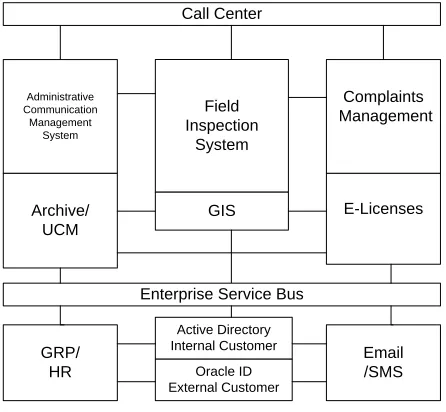
The FIS operation depends on information exchanged to and from several systems: complaints management (CMS), administrative communication management (ACMS), municipality e-licenses, archives, GIS, ERP, HR, identity management, email and SMS gateways. On top of all these systems, the FIS also integrates with the call centre. Often, the integration is mandatory in real-time; however, in some cases it may be in batch mode, as with email, SMS gateways, and archives. Figure 3 shows the FIS integration architecture.
The CMS has several integration points with FIS. Customers report complaints by calls or emails either directly to the CMS or through the call centre follow up on complaint tickets, and inquiry about details of violation cases. Complaints often lead to a field inspection visit for verifications and eventually may lead to violation reports and further repair and maintenance. The two systems exchange the required information about the reported case including relevant customer and GIS.
The CMS also accesses the FIS to produce top management reports about the status and any delays or overdue cases.
Most FIS processes depend on location, therefore GIS is considered as a basic layer of FIS. The GIS contains several layers of maps of the city, including roads, buildings, malls, shops, schools, and utilities. The GIS informs all movements of the task force, such as identifying sites for inspection, recoding coordinates of complaints’ location, planning inspections, tracking actual field inspection routs, monitoring teams distribution, and analysis of potential sources of problems in the city [3,4].
In our GIS design, every site has an identifier loosely coupled with location coordinates. This is important because it is impossible to use the GIS coordinate system to identify sites. Available GIS technologies have a range of error between 10 cm to 50 meters depending on the accuracy of their devices, maps, and GPS signals. Our proposed identifier maps every location to its site owner information. In our design the site identifier is unique and permanent for the site. This approach helps the system track a site’s history of activities and ownership changes. We found it very hard to identify a shop by GIS coordinates because there is no easy way to figure out coordinates of the corners or centre of the shop polygon. Therefore, we have chosen to use the postal code to identify shops and correlate it with the coordinates of the shop’s front sides to relate the shop location to its identifier.
During visit planning and visits, the FIS needs access to the database of e-licenses. This database contains information about all types of licenses issued by the municipality, such as buildings, shops, health and food processing workers, and other activities of investment sites. The inspectors need to access this information to make sure these sites and activities comply with bounded policies and regulations. CMS also has access to these databases to help inspectors relate complaints to a specific site or activity.
Some citizen services require more than a single government agency. When a customer raises a case to the court appealing a violation, the court often consults the municipality for opinion. Therefore, the FIS connects to the ACMS to manage communication with other systems external to the municipality. It tracks the movements of documents in and out and monitors the security and delay of access of the external world to the proper documents.
International Journal of Emerging Technology and Advanced Engineering
Website: www.ijetae.com (ISSN 2250-2459,ISO 9001:2008 Certified Journal, Volume 4, Issue 2, February 2014)
869 It also provides a protocol of conversion for application integration, transparently translating between communication protocols (e.g., HTTP, XML, FTP, REST, SOAP, JSON, DCOM, and CORBA). The FIS also uses ESB to integrate with services, such as email, SMS gateway, active directory services, identity management services (IDS), and the Government Resource Planning GRP system [5].
Field Inspection
System
E-Licenses
GRP/
HR Oracle ID
External Customer
Email /SMS Complaints Management Call Center
GIS Archive/
UCM
Enterprise Service Bus
Active Directory Internal Customer
Administrative Communication
[image:4.612.57.280.233.439.2]Management System
Figure 3: FIS Integration Architecture
The FIS uses emails and SMS to communicate the status of its services or applications to its customers. Customers can also log into their accounts in the municipality and review visit reports, if they authenticate themselves with the identity management system. A centralized database stores users, avoiding redundancy and making it easy for them to access all services through one account. Internal users are the municipality employees and contracted consultants, external users are citizens and businesses that have a need for municipality services.
HR is a core module in GRP. It gives FIS awareness of the availability of human resources. When setting up the schedule of field visits, FIS users need to check the availability of inspectors in case of vacations, new hires, transfer, business travel, training, or other personnel changes. GRP also has a point of integration with the violation module to finalize payments when a customer has to pay penalties. In some cases also customer may win a case against the municipality for a fine, necessitating a refund or readjustment.
The archive system in our architecture is based on a universal content system (UCM). A UCM supports all types of documents, such as reports, pictures, and videos, in many formats, recorders, reports and multimedia. Our use of UCM makes it easy to store and retrieve all of these.
V. FISDATA MODEL
At the heart of the FIS data model is customer and land parcel information. Both are connected into many-to-many mode. All other objects relate to an internal or external customer or land parcel directly or indirectly. Figure 4 shows a high-level data model, hiding most of the details for simplicity. Shaded boxes in the data model are related to FIS: inspectors, inspection resources, inspection tasks, inspection types, violations, and violation policies. Inspectors’ data tables register information about inspectors and their capabilities. The FIS only holds an inspector’s ID and capabilities, other information about the inspector should be maintained in the HR system. Therefore, the FIS benefits from integration with HR to retrieve needed information about an inspector and his availability.
Land
Parcels Customer
Buildings Malls Hajj Housing Land
Blocks Roads
Shops
Road Projects
Investment Activities
Slaughter houses Inspectors
Violations Inspection
resources
Inspection Tasks
Violation Policies Inspection
[image:4.612.347.547.386.601.2]Types
Figure 4: FIS Data Model
International Journal of Emerging Technology and Advanced Engineering
Website: www.ijetae.com (ISSN 2250-2459,ISO 9001:2008 Certified Journal, Volume 4, Issue 2, February 2014)
870 The inspection tasks data object manages task assignment to inspectors. This involves scheduling inspections according to inspectors and resources available, and routing plans and policies. Tasks assignment also involves GIS information to produce effective inspection schedules that covers as many sites as possible in the shortest path. The inspection tasks data object also contains policies that control task assignment, such as maximum or minimum site visits per inspector per week or frequency of site visit depending on the inspection type or season.
The violation data object stores detailed instances of violation recorded during inspection. Violations are issued according to the rules and polices listed in a specific data object as shown in figure 4. Those violation polices are updated periodically according to government regulations. Violation tickets associate violations with a customer, site, type of violation, and policy or rule. The site involved in a violation may be just a land parcel, a building, a mall, a shop, a hajj house, a slaughterhouse, or just a road. That is way the violation data object has a relation with many data objects in Figure 4.
VI. FISOPERATION MODEL
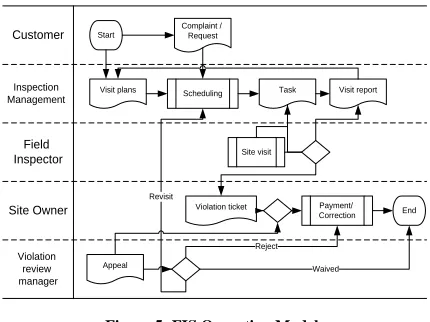
Figure 5 shows the operation model of the FIS. The operation starts with input into scheduling from customer complaints and/or inspection management. The inspection management team provides the FIS with input as either routine or random visit plans. The scheduling process contains rules about times, dates, maximum frequency of visits per site varied by activity type, and types of racecourses needed according to visit type. Based on these rules, the scheduling process tries to optimize the inspection schedule.
Every inspector receives a task list of visits to certain sites. Each task also describes resources needed during the inspection. The task identifies the exact location of the site using address and GIS coordinates. The GIS address is used for locations with access to GPS signals and the description of the address is used where GPS signals are blocked. Every inspector uses a handheld device to report the visit. These devices can work online and offline, adapting to locations with and without Internet connections.
The handheld contains an FIS client application. The FIS client software has a checklist according to the visit type. This checklist guides the inspector through the visit to produce an accurate report. If the site fails to comply with some items in the checklist, it produces a violation or a warning depending on the severity of the failure.
At the end of the visit, the system generates a report and tickets for violations. Inspection managers review and approve the report. Its revision may lead to second visit for double-checking and quality purposes.
Customer
Inspection Management
Field Inspector
Site Owner
Complaint / Request
Scheduling Task
Site visit
Violation ticket
Visit report
Payment/ Correction
Appeal
End
Violation review manager
Reject Revisit
Waived Visit plans
[image:5.612.338.553.185.346.2]Start
Figure 5: FIS Operation Model
Site owners who receive violation tickets may accept them or appeal against them. If they accept, they have to take necessary correction actions and may pay some penalties. In some cases they have to expect a follow-up visit to check whither correction has been made properly. If they have made payment and taken proper correction actions, the case is closed. Otherwise, a decision is made about the appeal and either the violation is waived or appeal is rejected. If the violation is waived, the case is closed; otherwise, the site owner has to make the necessary correction and pay the penalties. The appeal revision may also recommend a second visit to the site to verify the case and collect more information.
VII. RELATED WORK
An example of related work is the system developed by the building department of at New York City, called PIPES. The goal of the system is to help schedule and perform plumbing inspections [3]. Modelling work for the field inspection process based on XML in found in [5]. Similarly, the work is in [4]; however it is based on Web services and GIS. In [6], another work focuses on civil systems inspection.
International Journal of Emerging Technology and Advanced Engineering
Website: www.ijetae.com (ISSN 2250-2459,ISO 9001:2008 Certified Journal, Volume 4, Issue 2, February 2014)
871 VIII. CONCLUSIONS
Field inspection is one of the major operations in municipalities. This operation relates to almost all other municipal services such as issuing licences, carrying out city development projects, responding to complaints, and protecting health and environment operations. Therefore, improving the quality and performance of field inspection benefits those services. This research provided an IT solution that unifies, integrates, and streamlines field inspections to ensure efficient communication among stakeholders, higher performance, and better management controls. The solution is currently under implementation in a case study at Holy Makkah. We believe this solution will help other municipalities, especially those of similar government structure, and authorities in the Middle East.
REFERENCES
[1] Yamin, M, Abdullah, I. and Basahal, A., 2003, “E-Governance in Developing World: Design of BPR Model for Makkah Municipality eServices.” International Journal of Computer and Communication, Vol. 2, No. 6, pp 674-679.
[2] Martinez, D., 2003, System & Method for Performing Field Inspection, Patent No. US 2003/0069716 A1.
[3] Best Practice: Electronic Buildings Inspection Scheduling System, New York City Global Partners report, 2010.
[4] Kanaparthy, V., and O’Hara C., 2004, “A Web services solution for work management operations,” 24th Annual ESRI User Conference Proceedings.
[5] Sunkpho, J., J. H. Garrett, Jr., and S. McNeil, 2005 “XML-Based Inspection Modeling for Developing Field Inspection Support Systems,” ASCE Journal of Infrastructure Systems.
[6] Sunkpho, J., Garrett, J. 2003, JIF: A Framework for Developing a Field Inspection Support System for Civil Systems Inspection. ASCE Journal of Computing in Civil Engineering, Vol. 17 No. 4. [7] Seppanen, V. ; Univ. of Jyvaskyla, Jyvaskyla, Finland ; Heikkila,
J. ; Liimatainen, K., 2009 “Key Issues in EA-Implementation: Case Study of Two Finnish Government Agencies.” IEEE Conference on Commerce and Enterpise Computing, CEC’09, pp. 114-120. [8] Josey, A. 2011, “TOGAF version 9.1 Enterprise Edition, An
Introduction”, The Open group, white paper, http://www.opengroup.org/togaf/.
[9] Vasconcelos, Mira da Silva, M., Fernandes, A., Tribolet, J., 2004, “An information system architectural framework for enterprise application integration.” Proceedings of the 37th Annual Hawaii International Conference on System Sciences.
[10] The Open Group, http://www.opengroup.org/aboutus