International Journal of Emerging Technology and Advanced Engineering
Website: www.ijetae.com (ISSN 2250-2459,ISO 9001:2008 Certified Journal, Volume 4, Issue 2, February 2014)
648
A Comprehensive Study on Various Visual cryptography
Schemes with an Application
Madhuri Ghuge
1, Prof.Kanchan Doke
21,2Deparment of Computer Engineering, Mumbai University, Navi Mumbai
Abstract—This paper is study of the different kinds of Visual cryptography schemes and it focuses on all the techniques together as a literature survey. It intends an extensive experimental study of various available Visual Secret Sharing techniques. Also focuses on the encryption techniques that are used in each scheme. Visual cryptography (VC) is a powerful technique that combines the notions of perfect ciphers and secret sharing in cryptography with that of raster graphics. Intent of this paper is study and performance analysis of the visual cryptography schemes on the basis of pixel expansion, number of secret images, image format and type of shares generated.
Keywords— Cover image, evident Image, sharing matrices, Sha matrices, VC schemes.
I. INTRODUCTION
Recent advancement in Internet technology has enabled information sharing and has brought the world closer. At the same time security concern has grown proportionally. This makes organizations, institutions and spending excessive amounts of money to secure their data. Instead of the security of sharing secret information, people usually conceal the secret data with symmetric or asymmetric cryptography, these cryptographic methods should require high computation cost in encryption and decryption processes. Therefore, many visual cryptography schemes were proposed. Visual cryptography is an efficient secure method for hiding a secret image by dividing it into shares and any one can decode it easily by the human visual system. The main concept of the original visual cryptography scheme is to encrypt a secret image into n meaningless share images. It does not leak any information of the shared secret by any combination of the n share images except for all of images. Having the ability to hide information such as personal details is very desirable.
When the data is hidden within separate images (known as shares), it is completely unrecognizable. While the shares are separate, the data is completely unintelligible.
Each image holds different pieces of the data and when they are brought together, the secret can be recovered easily. They each rely on one another in order to obtain the decrypted information. There should be no way that anyone could decipher the information contained within any of the shares. When the shares are brought together, deciphering is possible when the shares are placed over one another. At this point, the information becomes instantly available. No computational power is required at all in order to decrypt the information. All decryption is performed by the human visual system (HVS). This kind of problem is formally referred to as a secret sharing problem.
II. LITERATURE SURVEY
Visual cryptography needs only the characteristics of human vision to decipher the encoded images. It does not need any cryptographic knowledge or any kind of complex computation to decipher the encoded image. Mainly this visual cryptography focuses on the security aspects to uphold the secret image from two or more cover images so that any attacker cannot retrieve any data. Naor and Shamir proposed the basic model of the visual cryptography, starting from their many visual cryptographic methods evolving day by day. Hence to uphold good confidentiality in transmitting of secret data via images in internet, selection of good visual secret sharing scheme is necessary. Therefore it is necessary to study all the recent technologies that are evolved and written as a literature to understand the concept of visual cryptography in a better way. Most secret sharing schemes are based on cryptography such that the
encryption and decryption processes need high
International Journal of Emerging Technology and Advanced Engineering
Website: www.ijetae.com (ISSN 2250-2459,ISO 9001:2008 Certified Journal, Volume 4, Issue 2, February 2014)
649 Distribution
[image:2.612.92.201.146.278.2]Stacking
Fig.1 Visual Cryptography scheme
Fig.1 shows distributions of original secrete image on two different shares and then their stacking to get original image. Image sharing is a division of secret sharing because it works as a unique approach to the general secret sharing problem. The secrets in this case are masked images. Each secret is treated as a number, this permits a exact encoding scheme supplied for each source of the secrets. Without the inverse conversions, the digits may not be interpreted correctly to represent the true meaning of the secret sharing. In (k, n) image sharing, the image that carries the secret is split up into n shares and the decryption is totally unsuccessful unless at least k shares are collected and stacked. Visual cryptography was originally invented and pioneered by Moni Naor and Adi Shamir in 1994 at the Euro crypt conference. Visual cryptography is ―a new type of cryptographic scheme, which can decode covered images without any cryptographic calculation‖ [1]. As the name suggests, visual cryptography is related to the human
visual system. When the k shares are stacked together, the
human eyes do the decryption. This allows anyone to use the system without any knowledge of cryptography and without performing any computations whatsoever. This is another advantage of visual cryptography over the other popular conditionally secure cryptography schemes. The mechanism is very secure and very easily implemented. An electronic secret can be shared directly; alternatively the secrets can be printed out onto transparencies and stacked, revealing the secret. Naor and Shamir’s initial implementation believes that the image or message is a collection of black and white pixels, each pixel should be handled individually and it should be noted that the white pixel represents the transparent color. One shortcoming of this is that the decryption process is lossy, the area that suffers due to this is the contrast. Contrast is very important within visual cryptography because it determines the clarity of the recovered secret by the human visual system.
The relative difference in Hamming weight between the representation of white and black pixels signify the loss in contrast of the recovered secret. The Hamming weight is explained further at a later stage. Newer schemes that are discussed later deal with grayscale and color images which attempt to minimize the loss in contrast [2] by using digital halftoning. Halftoning allows a continuous tone image, which may be made up from an infinite range of colors or grays to be represented as a binary image. Varying dot sizes and the distance between those dots create an optical illusion. It is this illusion which allows the human eye to blend these dots making the halftone image appears as a continuous tone image. Due to the fact that digital halftoning is a lossy process in itself [6], it is impossible to fully reconstruct the original secret image.
(a) (b)
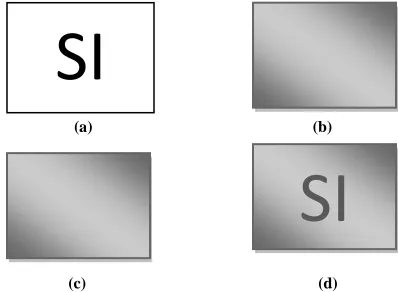
(c) (d) Fig 2: (a) Secret Image (b) Share 1 (c) Share 2 d) Recovered Image
Fig.2 shows how recovered image (d) will look alike after stacking two shares (b) and (c) which are obtained from original secret image(a).The main benefit of Random Grids is there is no pixel expansion during encryption or decryption. Also codebook is used for encryption process.
In decryption process, the receiver has to stack minimum two cipher-grids without any computation that resulted in getting good recognizable secret image by the human visual system. [3] The same authors have revisited the same paper called Visual secret sharing by random grids to enhance it to the extent of basic 2-out-of-2 scheme to the n-out-of-n scheme also 2-n-out-of-n scheme to calculate the performance of this scheme resulted in a good value when using the random grids [4]. Jen-Bang Feng et al has proposed a technique called Visual secret sharing for multiple secrets [5].In this method, the graph of the stacking process of the secret image and share images generated for the encryption phase. Hence the secret images were got from the two share images at the aliquot stacking angles.
Share1 Share2
Secret Image
Revealed Secret Image
SI
[image:2.612.354.553.318.464.2]International Journal of Emerging Technology and Advanced Engineering
Website: www.ijetae.com (ISSN 2250-2459,ISO 9001:2008 Certified Journal, Volume 4, Issue 2, February 2014)
650 Therefore, this paper proves the secret distortion ratio is directly related to the share destruct ratio. To prove this statement, 15% and 20% of the random distortions is added purposefully on the share image. Resulted in, the secret information is recognizable at good rate by visual system.[6] Zhongmin Wang, Gonzalo R. Arce and Giovanni Di Crescenzo have jointly proposed a technique called Halftone Visual Cryptography via Error Diffusion. Halftone conversion techniques are used for error diffusion process. Error diffusion has the low complexity but can support the halftone share images to good extent of image quality. [7] Another Visual cryptography scheme was proposed by Ching-Nung Yang using probabilistic method. In this proposal, the frequency of the white pixels was used for showing the color contrast of the recovered secret image. Also this method uses pixel operation with absolute non expansion of pixels.[8] Tsung-Lieh Lin et al have jointly designed a framework for visual secret sharing scheme (VSS) with multiple secrets without the pixel expansion. In this framework, the visual secret sharing methods has been dealt in a different way, which is used along with the two binary secret images on two rectangular share images that promotes non expansion of pixels leads to high image quality. The main advantage of this method is multiple secrets were used. As the result of this, the framework has very good quality in recovering the secret image.[9] A multi level visual secret-sharing scheme with no size expansion of pixels was put forth by Yung-Fu Chen et al. here the visual secret sharing scheme selects a block of secret image in correspondence to the same sized block in each of the share images with no pixel size expanding. In this proposal, histogram width equalization (HWE) and histogram depth equalization (HDE) were the two techniques that were used for generating the corresponding share images. That results in the increase in the quality of the reconstructed secret image when comparing with other techniques.[10] An another color visual secret sharing scheme using non-expanded meaningful shares with authentication was proposed by Der-Chyuan Lou et all .In this proposal, visual secret sharing scheme for hiding the secret image into two meaningful cover images are used those are the share images without any pixel expansion. At the same time, this method embeds an extra confidential image in the share images. Whoever combines both the share images can reveal the secret image by super imposing them one on another without any complex computation. When one of the share images is shifted for n/2 units, the extra confidential image has been revealed. [11] A new visual cryptography scheme by using the smooth looking decoded images of different sizes for the grey level images was designed by Tua, S.F. Houb, and Y.C.
The paper addresses the problem of pixel expansion and improvement of quality of the stacked image. Here Halftoning is used for grey scale conversion [12].
III. VISUAL CRYPTOGRAPHY APPLICATION
Practical use for visual cryptography comes in the form of watermarking, fingerprints, biometric. Memon and
Wong[15] proposed various techniques to apply
International Journal of Emerging Technology and Advanced Engineering
Website: www.ijetae.com (ISSN 2250-2459,ISO 9001:2008 Certified Journal, Volume 4, Issue 2, February 2014)
651 One of the ways to hide a secret data within natural image is by typically employing visual cryptography based on halftone techniques. The perfect scheme is extremely practical and can reveal secrets without computer participation. Recent state of the art watermarking [24] can hide a watermark in documents which require no specific key in order to recover it. Removing the need for a key is quite important because it further increases the security of the watermarking process. Hou and Chen executed an asymmetric watermarking scheme based on visual cryptography. Two shares are generated to hold the watermark. One is embedded into the cover-image and another is kept as a secret key for the watermark extraction. The watermark is extracted using traditional stacking properties of visual cryptography. The watermark is robust. In that it is difficult to change or remove and can withstand a number of attacks.
A.Hiding data in host Image
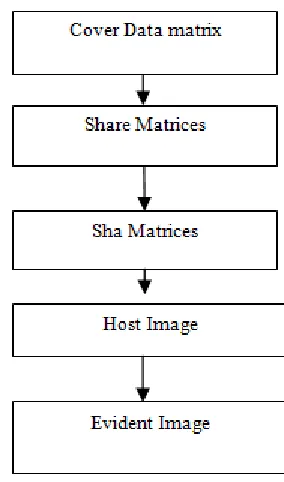
Fig 3 shows flow from cover image to evident image using binary encoding method. Cover data is first encoded. Then two share matrices are formed from VC system of cover data matrix by using sha matrix. The Encoding processes for deriving share matrices from cover data matrix are shown below:
First, map the pixels of cover data matrix to form a pixel string according to a specified order. Then, take every pixel in string to form the elements of two new sequences. And then, transform the pixels of sequences into two share matrices. When the sha-matrix dimension codes are all equal to 1, the size of each share matrix is the same as the size of the cover data without any expansion. The reconstructing VC System processes from two share matrices to a cover image are introduced below.
The four parameters are all known in advance for this case. First, transform two share matrices into two sequences according to a specified order .Then, execute the exclusive OR operation between these two sequences to form a row string and then, transform the row string to form a matrix of cover data according to a specified order (from the first row to the last row and from the first column to the last column for the same row). First, transform two share matrices into sequence matrices according to a specified order. Then, execute the AND operation between two sequences to form a matrix. And then, execute the specific rule for this matrix to form row string. Finally, transform the row string to form a cover matrix according to a specified order (from the first row to the last row and from the first column to the last column for the same row).
Fig 3. Flow from Cover to evident Image
B.Producing Overt Image
[image:4.612.369.511.135.376.2]International Journal of Emerging Technology and Advanced Engineering
Website: www.ijetae.com (ISSN 2250-2459,ISO 9001:2008 Certified Journal, Volume 4, Issue 2, February 2014)
652 IV. CONCLUSION
Security has gained lot of importance as information technology is widely used. Visual cryptography scheme promotes some level of security. Hence to know more about different kinds of visual cryptography schemes and its performance, the Literature has been done in this paper. To conclude, all the techniques are different and used for different usages in real time. Some techniques are sensible, because they suit for appropriate places but not in all the places. Everyday new Visual cryptography techniques are introduced. Hence selection of the fast and secure Visual cryptography technique will always be useful mainly in terms of security issues. An application that has been discussed in this paper holds a binary encoding which promotes good level of security in revealing the extra confidential image.
REFERENCES
[1] 11. Naor, M., Shamir, A.: Visual cryptography. In: De Santis, A. (ed.) EUROCRYPT 1994. LNCS, vol. 950, pp. 1–12. Springer, Heidelberg (1994)
[2] Blundo, C., D’Arco, P., De Santis, A., Stinson, D.R.: Contrast optimal threshold visual cryptography schemes. SIAM Journal on Discrete Mathematics 16(2), 224–261 (2003)
[3] Du-Shiau Tsai , Gwoboa Horng , Tzung-Her Chen c, Yao-Te Huang ― A novel secret image sharing scheme for true color images with size constraint‖ Information Sciences, vol. 179, pp. 3247–3254, 2009.
[4] T.H. Chen, K.H. Tsao, ―Visual secret sharing by random grids revisited‖, Pattern Recognition, vol. 42, no.9, pp.2203–2217, 2009. [5] J.B. Feng, H.C. Wu, C.S. Tsai, Y.F. Chang, Y.P. Chu, ―Visual secret
sharing for multiple secrets‖, Pattern Recognition, vol.41, no.12, pp. 3572–3581 , 2008.
[6] Z. Wang, G.R. Arce, G.D. Grescenzo, ―Halftone visual cryptography via error Diffusion‖, IEEE Transactions on Information Forensics and Security, vol. 4, no.3, pp. 383-396, 2009.
[7] C.N.Yang, ―New visual secret sharing schemes using probabilistic method‖, Pattern Recognition Letters, vol.25, no.4, pp. 481–494, 2004.
[8] Tsung Lieh Lin et al, ―A novel visual secret sharing (VSS) scheme for multiple secrets without pixel expansion‖, Expert Systems with Applications, vol. 37, pp. 7858–7869, 2010.
[9] Yung-Fu Chen , Yung-Kuan Chan , Ching-Chun Huang , Meng-Hsiun Tsai c, Yen-Ping Chu ―A multiple-level visual secret-sharing scheme without image size expansion‖, Information Sciences, vol. 177 , pp. 4696–4710, 2007.
[10] Der- Chyuan Lou, Hong-Hao Chen, Hsien-Chu Wu, Chwei Shyong Tsai, ―A novel authenticable color visual secret sharing scheme using non-expanded meaningful shares‖, Elsevier on Displays,vol.32,pp.118-134,2011
[11] Tua, S-F,Houb, Y-C, ―Design of visual cryptographic methods with smooth looking decoded images of invariant size for grey-level images‖, Imaging Science,vol.55,pp.90-101,2007
[12] Memon, N., Wong, P.W.: Protecting digital media content. Communications of the ACM 41(7), 35–43 (1998)
[13] Van Schyndel, R.G., Tirkel, A.Z., Osborne, C.F.: A digital watermark. In: ICIP(2),pp. 86–90 (1994)
[14] Braudaway, G.W., Magerlein, K.A., Mintzer, F.: Protecting publicly available images with a visible image watermark. In: van Renesse, R.L. (ed.) Society of Photo-Optical Instrumentation Engineers (SPIE) Conference Series, March 1996.
[15] Society of Photo-Optical Instrumentation Engineers (SPIE) Conference Series,vol. 2659, pp. 126–133 (1996)
[16] Luo, H., Pan, J.S., Lu, Z.M.: Hiding multiple watermarks in transparencies of visual cryptography. Intelligent Information Hiding and Multimedia Signal Processing 1, 303–306 (2007)
[17] Hwang, R.J.: A digital image copyright protection scheme based on visual cryptography.Tamkang Journal of Science and Engineering 3(2), 97–106 (2000)
[18] Hassan, M.A., Khalili, M.A.: Self watermarking based on visual cryptography.Proceedings of World Academy of Science, Engineering and Technology 8, 159–162 (2005)
[19] Sleit, A., Abusitta, A.: A visual cryptography based watermark technology for individual and group images. Systemics, Cybernetics And Informatics 5(2), 24–32
[20] Chuang, S.C., Huang, C.H., Wu, J.L.: Unseen visible watermarking. In: ICIP(3),pp. 261–264. IEEE, Los Alamitos (2007)
[21] Hassan, M.A., Khalili, M.A.: Self watermarking based on visual cryptography. Proceedings of World Academy of Science, Engineering and Technology 8, 159–162 (2005)
[22] Hou, Y.C., Chen, P.M.: An asymmetric watermarking scheme based on visual cryptography. In:WCCC-ICSP 5th International Conference on Signal Processing Proceedings, vol. 2, pp. 992–995 (2000)
[23] Hersch, R.D., Chosson, S.: Band moir´e images. In: ACM SIGGRAPH 2004, pp.239–247. ACM, New York (2004)