International Journal of Emerging Technology and Advanced Engineering
Website: www.ijetae.com (ISSN 2250-2459, ISO 9001:2008 Certified Journal, Volume 4, Issue 5, May 2014)
Performance of Concrete with Different Ingredients at Elevated
Temperature-An Experimental Study
Dr. Shailesh Choudhary
1, Dr. Ravi Saxena
21Assistant Professor, Department of Structural Engineering, J.N.V.U. Jodhpur 2Associate Professor, Department of Civil Engineering, J.N.V.U. Jodhpur
Abstract— In the present work, the residual strengths of Cement Concrete cubes and weight losses were evaluated in cold state after exposing them to elevated temperature for 1, 1.5 and 2.0 hour. The cubes were heated for 200oc, 400oc,
600oc and 800oc. The effect of elevated temperature is recorded for different types of mixes with different ingredients. Crushed bricks and grinded insulator were used and their performances at elevated temperature were compared.
Keywords— Crushed bricks, Grinded insulator, elevated temperature.
I. INTRODUCTION
Thermal properties of concrete are more complex than for most materials because not only is the concrete a composite material whose constituents have different properties but its properties also depends on moisture and porosity. Exposure of concrete to elevated temperature affects its mechanical and physical properties. Elements could distort and displace and under certain conditions the concrete surfaces could spall due to the buildup of steam pressure. Because thermally induced dimensional changes, loss of structural integrity and release of moisture and gases resulting from the migration of free water could adversely affect safety.
To dispose the waste of construction industries like broken and damaged pieces of bricks and ceramic insulators is a big challenge for the environment. In this experimental work these waste products have been used and their performance at elevated temperatures has been examined. the residual strengths of Cement Concrete cubes and weight losses were evaluated in cold state after exposing them to elevated temperature for 1, 1.5 and 2.0
hour. The cubes were heated for 200oc, 400oc, 600oc and
800oc. The effect of elevated temperature is recorded for
eleven types of mixes with different ingredients. After getting results from basic test of concrete ingredients like cement, sand, course aggregate etc. one mix was designed as per IS 10262-2009 to achieve M-20 grade of concrete.
To determine the effect of elevated temperature on concrete, the ingredients were changed keeping the ratio same. The objective of this study was to provide an overview of the effects of elevated temperature on the behavior of concrete materials.
II. EXPERIMENTAL PROGRAM
2.1 Material Characterisation
2.1.1 Cement
[image:1.612.315.573.412.553.2]Ordinary Portland cement (OPC) 43 grade conforming IS-8112-1989 manufactured by ACC LIMITED is used. Cement is tested as per IS codes and results are as follows:-
Table 1
Test results of Ordinary Portland cement 43 grade
(1) Specific gravity of cement 3.14
(2) Consistency of cement 26%
(3) Initial setting time 40 min.
(4) Final setting time 115 min.
(5) Compressive strength of cement at 7 days 28.45 N/mm2
(6) Compressive strength of cement at 28 days 44.47 N/mm2
(7) Fineness of cement(90 micron sieve) Residue 6.5%
(8) Soundness of cement (le-chaterlier) 1 mm
2.1.2 Water
Water used for mixing and curing was clean and free from injurious amount of oils, acids, alkalis, salts, sugar, organic materials or other substances of pH 6.80 >6.0.
2.1.3 Aggregates
International Journal of Emerging Technology and Advanced Engineering
[image:2.612.43.297.157.283.2]Website: www.ijetae.com (ISSN 2250-2459, ISO 9001:2008 Certified Journal, Volume 4, Issue 5, May 2014)
Table 2
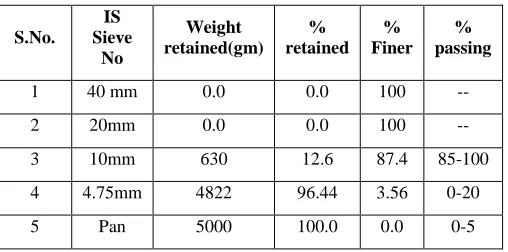
Sieve analysis of 10 mm size aggregate
S.No. IS Sieve No Weight retained(gm) % retained % Finer % passing
1 40 mm 0.0 0.0 100 --
2 20mm 0.0 0.0 100 --
3 10mm 630 12.6 87.4 85-100
4 4.75mm 4822 96.44 3.56 0-20
5 Pan 5000 100.0 0.0 0-5
With the help of IS-2386(part I) 1963 aggregate was found 10 mm single size.
Table 3
Sieve analysis of 20 mm size aggregate
S.No. IS Sieve No Weight retained(gm) % retained % Finer % passing
1 40 mm 0.0 0.0 100 100
2 20mm 743 14.86 85.14 85-100
3 10mm 4930 98.60 1.40 0-20
4 4.75mm 4995 99.90 0.10 0-5
5 Pan 5000 100.0 0.0 --
With the help of IS-2386(part I) 1963 aggregate was found 20 mm single size.
Table4
Specific gravity and void ratio for coarse aggregate.
Type of coarse aggregate Specific gravity void ratio
20 mm single size. 2.64 42.82%
10 mm single size. 2.64 44.12%
(B) Fine aggregates from local river (Binawas) have been used.
Table 5
Specific gravity and void ratio for fine aggregate.
Specific gravity
void ratio
Fine aggregate 2.65 28.33%
Table 6
Sieve analysis of fine aggregate.
S.No. Sieve No Weight retained(gm) % retained % Finer Grading Zone III
1 4.75
mm 0.0 0 100.0 90-100
2 2.36
mm 35 3.5 96.5 85-100
3 1.18
mm 178 17.8 82.2 75-100
4 600
micron 343 34.3 65.7 60-79
5 300
micron 604 60.4 39.6 12-40
6 150
micron 956 95.6 4.4 0-10
7 Pan 1000 100.0 0
Silt contents in F.A. was 0.6%<2% and With the help of IS-2386-1963(Part I) fine aggregate was found of Zone III.
2.1.4 Crushed bricks and insulator
Bricks of class A and insulators of high tension line were crushed up to desired size and grading.
(i) Water absorption of bricks = 12.25%
(ii) Water absorption of grinded insulator = 1.2 %
Brick powder and grinded insulators have been replaced with equivalent size (grading) fine aggregate by weight.
2.1.5 Chemical Admixtures
A water reducing agent and super plasticizer for promoting accelerated hardening and free flowing concrete Sikament-170 complies with IS 9103-99, also conforms to ASTM C494/C494M-99a Type –F and BS 5075 Part-3 has been used as chemical admixture.
2.1.6 Fibers
Recron 3s Fibers are engineered Micro Fibers with a unique ―Triangular‖ Cross-section, used in Secondary Reinforcement of Concrete. Recron 3s Fibers are manufactured by RIL in an ISO 9001:2000 facility to be used in Concrete as a ―Secondary Reinforcement‖ at a rate of dosage varying from 0.1% to 0.4% by volume (0.9 KGs/Cu.M – 3.60Kgs/Cu.M).
2.2 Development Of Concrete Mixes
After getting results from basic test of concrete ingredients like cement, sand, coarse aggregate etc. one mix was designed as per IS 10262-2009 to achieve M-20 grade of concrete. To study the effect of elevated temperature on cement concrete, the ingredients altered
International Journal of Emerging Technology and Advanced Engineering
Website: www.ijetae.com (ISSN 2250-2459, ISO 9001:2008 Certified Journal, Volume 4, Issue 5, May 2014)
Water cement ratio 0.45
Cement 389 kg/m3
Water 175 kg/m3
Fine aggregates 542 kg/m3
Coarse aggregates 1233kg/m3
Mix (A-1)
Proportion of 20mm and 10mm size coarse aggregate is taken as (60%+40%) and rests were kept same.
Mix (A- 2)
Proportion of 20mm and 10mm size coarse aggregate is taken as (40%+60%) and rests were kept same.
Mix (A- 3)
Only 20mm size coarse aggregate are used and rests were kept same.
Mix (A-4)
Proportion of 20mm and 10mm size coarse aggregate is taken as (60%+40%) and 20% of fine aggregate has been replaced with crushed bricks in saturated surface dry condition. Same grading has been of fine aggregate maintained by using IS sieves of 1.18mm, 600 micron, 300 micron and 150 micron and rests were kept same.
Mix (A-5)
Proportion of 20mm and 10mm size coarse aggregate is taken as (60%+40%) and 30% of fine aggregate has been replaced with crushed bricks in saturated surface dry condition. Same grading of fine aggregate has been maintained by using IS sieves of 1.18mm, 600 micron, 300
micron and 150 micronand rests were kept same.
Mix (A-6)
Proportion of 20mm and 10mm size coarse aggregate is taken as (60%+40%) and 40% of fine aggregate has been replaced with crushed bricks in saturated surface dry condition. For maintain same grading of aggregate IS sieves of 1.18mm, 600 micron, 300 micron and 150 micron has been used and rests were kept same.
Mix (A-7)
Proportion of 20mm and 10mm size coarse aggregate is taken as (60%+40%) and 20% of fine aggregate were replaced with crushed insulator saturated surface dry condition. Same grading of fine aggregate is maintained by using IS sieves of 2.36 mm, 1.18mm, 600 micron and 300 micron and rests were kept same.
Mix (A-8)
Proportion of 20mm and 10mm size coarse aggregate is taken as (60%+40%) and 30% of fine aggregate were replaced with crushed insulator saturated surface dry condition. Grading is maintained same of fine aggregate by using IS sieves of 2.36 mm, 1.18mm, 600 micron and 300 micron and rests were kept same.
Mix (A-9)
Proportion of 20mm and 10mm size coarse aggregate is taken as (60%+40%) and 40% of fine aggregate were replaced with crushed insulator saturated surface dry condition. Grading is maintained same of fine aggregate by using IS sieves of 2.36 mm, 1.18mm, 600 micron and 300 micron and rests were kept same.
Mix (B-1)
Proportion of 20mm and 10mm size coarse aggregate is taken as (60%+40%) and recron 3s fiber has been used as per suggested by manufacturer and rests were kept same.
Mix (B-2)
Proportion of 20mm and 10mm size coarse aggregate is taken as (60%+40%) and 0.5% of supper plasticizer to achieve workability has been used and rests were kept same.
2.3 Casting Of Cubes
All required raw materials were populated at laboratory. Moulds for cube of 100mmx100mmx100mm were made with the help of recycled plastic of 30mm thickness to avoid any deflection during casting. Burnt oil was applied on sides of moulds for easy de-molding of cubes.
Electrically operated mixer as per IS 1791:1968 and
vibrator as per IS 2505:1980 were used for casting.
2.4 Curing
Each set of cubes were demoulded after 24 hrs. of casting and placed in water curing tank for 28 days. Curing of concrete was at laboratory temperature. Cubes were taken out and kept in laboratory after 28 days curing period.
2.5 Heating Of Cubes
After curing for 28 days cubes were heated in Furnace for 60 minutes, 90 minutes and 120 minutes. Temperature
to which cubes were exposed was 200oc, 400oc, 600oc and
800oc. (temperature was rose according to time temperature
curve). It was noted that the variation in temperature of Furnace after reaching to desired temperature was +/-
International Journal of Emerging Technology and Advanced Engineering
Website: www.ijetae.com (ISSN 2250-2459, ISO 9001:2008 Certified Journal, Volume 4, Issue 5, May 2014)
The temperature was controlled by controlling oil in the furnace and by air blower control. Cubes were placed in staggered pattern with a maximum of four rows. Diameter of this furnace was 600 mm and height was 900 mm.
2.6 Testing Of Specimens
After exposed to temperature cubes were cooled down to laboratory temperature and compressive strength was determined.
2.6.1 Compressive Strength Test
Compressive strength of cubes was determined with the help of gradual loading by a calibrated compression testing machine. Make of this compression testing machine was ―BENISON, SAML DENISON & SON LTD, ENGLAND. Loading capacity of this machine was 200,000 Kgs and model no was TI B/MC.
2.6.2 Weight loss
Weight of cubes was taken before and after heating for 60 minute duration for finding loss in weight. Loss in weight of the cubes which are heated 90 and 120 minute duration could not be found due to chipping of concrete.
2.6.3 Water Absorption Test
Water absorption of cubes was done with the help of oven.
(Compressive Strength Test) (Insulator)
(moulds for cubes) (Grading of crushed bricks)
(Curing of cubes) (Crushed Insulator)
(Heating of cubes ) (Heating of cubes )
III. RESULTS
Into this study eleven types of different mix were used. These concrete cubes were than exposed to elevated
temperature of 2000c, 4000c, 6000c and 8000c for 60, 90
and 120 minute heating duration. The results from this study are:
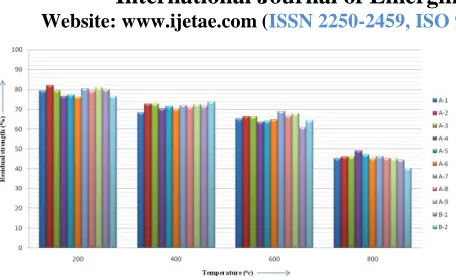
Mix having crushed bricks replaced 30% and 40%
with fine aggregate gave similar residual strength as mix having 20mm coarse aggregate for temperature
up to 6000c for 60 minute heating duration. As
reduction in percentage of crushed bricks to 20%, results reduction in performance. Residual strength decreases in lesser amount as heating duration increases with comparison to normal mix concrete.
Effect of aggregate size was found at elevated
temperature. Mix having coarse aggregate only of 20 mm size perform better than mix having graded 20 mm and 10 mm size coarse aggregate. Residual strength was almost same for graded coarse aggregate
for temperature 2000c to 8000c for 60 minute heating
International Journal of Emerging Technology and Advanced Engineering
Website: www.ijetae.com (ISSN 2250-2459, ISO 9001:2008 Certified Journal, Volume 4, Issue 5, May 2014)
Mix casted with crushed insulator replaced 30% with
fine aggregate perform better at 2000c. For the
temperature range of 4000c to 8000c there was no
major effect of percentage of crushed insulator used. Crushed insulator reduces the effect of size of coarse aggregate and gave better results with graded coarse aggregate. Its better performance than normal mix with increase heating duration was found.
Lowest performance was recorded for mix casted with
recron fibre at elevated temperature but loss in residual strength was found less than other mixes as duration of heating was increased.
Increase in cement content and use of plasticizer
improves the grade of concrete but the residual strength was less than lower grade of concrete mix at elevated temperature for 60 minute heating duration. But perform better as duration of heating is increased.
With respect to material selection, the performance of the concrete materials can be improved by following ways: (1) Minimizing the moisture content through aggregate gradation, placement techniques, or use of extended-range water-reducing agents.
(2) Utilizing aggregates having good thermal stability and low thermal expansion characteristics such as crushed brick or crushed insulator materials; and
(3) Incorporating fibrous reinforcing materials to provide increased ductility, dynamic strength, toughness, tensile strength, and improved resistance to spalling.
(4) Another possible approach is to design the concrete mix for higher strength so that any losses in properties resulting from long-term thermal exposure will still provide adequate design (safety) margins.
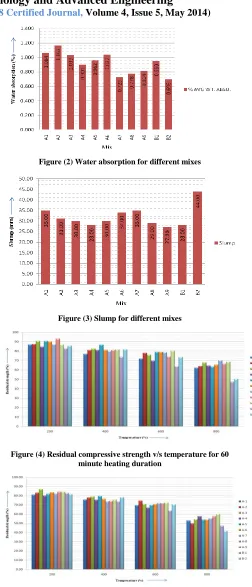
Figure (1) Compressive strength at roomtemperature of same mix ratio
Figure (2) Water absorption for different mixes
Figure (3) Slump for different mixes
Figure (4) Residual compressive strength v/s temperature for 60 minute heating duration
[image:5.612.324.576.112.699.2] [image:5.612.52.282.524.677.2]International Journal of Emerging Technology and Advanced Engineering
Website: www.ijetae.com (ISSN 2250-2459, ISO 9001:2008 Certified Journal, Volume 4, Issue 5, May 2014)
Figure (6) Residual compressive strength v/s temperature for 120 minute heating duration
REFERENCES
[1 ] U.S. Bureau of Reclamation, (1953) ―A 10-Year Study of Creep Properties of Concrete‖, Concrete Laboratory Report No. Sp-38 Denver Colorado.
[2 ] Troxell, G. E., (1968) ―Composition and Properties of Concrete‖, 2nd Ed., McGraw-Hill, New York.
[3 ] Harmathy, T. Z., (1970) ―Thermal Properties of Concrete at Elevated Temperatures,‖ Journal of Materials 5, 47–74.
[4 ] Neville, A. M., (1970) ―Properties of Concrete‖, Pitman, London.
[5 ] Waubke, N. V. (1973) ―On One Physical Aspect of Strength Loss of Portland Cement Concretes at Temperatures up to 1000oc‖,
Technical University Braunschweig, Germany.
[6 ] Harmathy, T. Z., Allen, L. W. (1973) ―Thermal Properties of Selected Masonry Unit Concretes‖, American Concrete Institute 70, 132–142.
[7 ] ―Standard Test Method for Splitting Tensile Strength of Cylindrical Concrete Specimens‖, (1975) Part 14 of Annual Book of ASTM Standards, ANSI/ASTM C78-75, American Society for Testing and Materials, West Conshockon, Pennsylvania.
[8 ] Quon, D. H. H., (1980) ―Phase Changes in Concrete Exposed to Sustained High Temperatures‖, Division Report MRP/MSL 80-111(TR), Mineral Sciences Laboratories, CAANMET, Ottawa, Canada.
[9 ] Schneider, U., Diererichs, C., Ehm, C., (1981) ―Effect of Temperature on Steel and Concrete for PCRV’s‖, Nuclear Engineering and Design.
[10 ]Ramachandran, V. S., Feldman, R. F. and Beaudoin, J. J. (1981) ―Concrete Science—A Treatise on Current Research‖, Hey and Son, London.
[image:6.612.57.285.114.254.2]