N e a r-u n i ty q u a n t u m yi el d s f r o m
c hl o ri d e t r e a t e d C dT e c olloi d al
q u a n t u m d o t s
P a g e , RC, E s pi n o b a r r o-Vel a z q u e z, D, L e o n ti a d o u , M , S m i t h , C,
L e wi s, EA, H a i g h , SJ, Li, C, R a d t k e , H , P e n g p a d , A, Bo n di n o, F,
M a g n a n o , E, Pi s, I, F l a v ell, WR, O 'B ri e n , P a n d Bi n k s, DJ
h t t p :// dx. d oi.o r g / 1 0 . 1 0 0 2 / s m ll. 2 0 1 4 0 2 2 6 4
T i t l e
N e a r-u n i ty q u a n t u m yi el d s fr o m c h lo ri d e t r e a t e d C dT e
c olloi d al q u a n t u m d o t s
A u t h o r s
P a g e , RC, E s pi n o b a r r o-Vel az q u e z, D, L e o n ti a d o u , M , S m i t h ,
C, L e wi s, EA, H a i g h , SJ, Li, C, R a d t k e , H , P e n g p a d , A,
Bo n d i n o , F, M a g n a n o , E, Pi s, I, Fl av ell, WR, O 'B ri e n , P a n d
Bi n k s , DJ
Typ e
Ar ticl e
U RL
T hi s v e r si o n is a v ail a bl e a t :
h t t p :// u sir. s alfo r d . a c . u k /i d/ e p ri n t/ 5 0 8 3 4 /
P u b l i s h e d D a t e
2 0 1 5
U S IR is a d i gi t al c oll e c ti o n of t h e r e s e a r c h o u t p u t of t h e U n iv e r si ty of S alfo r d .
W h e r e c o p y ri g h t p e r m i t s , f ull t e x t m a t e r i al h el d i n t h e r e p o si t o r y is m a d e
f r e ely a v ail a bl e o nli n e a n d c a n b e r e a d , d o w nl o a d e d a n d c o pi e d fo r n o
n-c o m m e r n-ci al p r iv a t e s t u d y o r r e s e a r n-c h p u r p o s e s . Pl e a s e n-c h e n-c k t h e m a n u s n-c ri p t
fo r a n y f u r t h e r c o p y ri g h t r e s t r i c ti o n s .
full papers
www.MaterialsViews.com
Near-Unity Quantum Yields from Chloride Treated CdTe
Colloidal Quantum Dots
Robert C. Page , Daniel Espinobarro-Velazquez , Marina A. Leontiadou ,
Charles Smith , Edward A. Lewis , Sarah J. Haigh , Chen Li , Hanna Radtke ,
Atip Pengpad , Federica Bondino , Elena Magnano , Igor Pis , Wendy. R. Flavell ,
Paul O’Brien , and David J. Binks *
1. Introduction
Colloidal quantum dots have a number of important opto-electronic applications, including light emitting diodes [ 1 ] and
photovoltaic (PV) cells. [ 2–4 ] Their advantages include
cost-effective synthesis, solution processibility and tunable band
DOI: 10.1002/smll.201402264
C
olloidal quantum dots (CQDs) are promising materials for novel light sources and solar
energy conversion. However, trap states associated with the CQD surface can produce
non-radiative charge recombination that signifi cantly reduces device performance. Here
a facile post-synthetic treatment of CdTe CQDs is demonstrated that uses chloride ions
to achieve near-complete suppression of surface trapping, resulting in an increase of
photoluminescence (PL) quantum yield (QY) from ca. 5% to up to 97.2
±
2.5%. The
effect of the treatment is characterised by absorption and PL spectroscopy, PL decay,
scanning transmission electron microscopy, X-ray diffraction and X-ray photoelectron
spectroscopy. This process also dramatically improves the air-stability of the CQDs:
before treatment the PL is largely quenched after 1 hour of air-exposure, whilst the
treated samples showed a PL QY of nearly 50% after more than 12 hours.
Photoluminescence
D. Espinbarro-Velazquez, Dr. M. A. Leontiadou, C. Smith, H. Radtke, A. Pengpad, Prof. W. R. Flavell, Dr. D. J. Binks
School of Physics and Astronomy and Photon Science Institute University of Manchester Manchester M13 9PL , UK
E-mail: [email protected] R. C. Page, Prof. P. O’Brien
FRS, School of Chemistry University of Manchester Manchester M13 9PL , UK E. A. Lewis, Dr. S. J. Haigh School of Materials University of Manchester Manchester M13 9PL , UK
Dr. F. Bondino, Dr. E. Magnano, Dr. I. Pis IOM CNR, Laboratorio Nazionale TASC Area Science Park – Basovizza
S.S. 14 Km. 163, 5 I-34149 , Basovizza , (TS) , Italy Dr. C. Li
Department of Chemistry Vanderbilt University
Nashville, TN, 37235 USA and Oak Ridge National Laboratory 1 Bethel Valley Road , Oak Ridge , TN 37831–6071 , USA
gaps. [ 3,4 ] However, the large surface-area-to-volume ratio of
CQDs can result in a high concentration of surface trap states with associated non-radiative recombination pathways. This unwanted recombination reduces PL and electrolumines-cence QY, charge extraction effi ciency and carrier mobility, and thereby limits device effi ciency. [ 5,6 ]
This is an open access article under the terms of the Creative Commons Attribution License, which permits use, distribution and reproduction in any medium, provided the original work is properly cited.
1549
www.small-journal.com
© 2014 The Authors. Published by Wiley-VCH Verlag GmbH & Co. KGaA, Weinheim
ligands have been used to passivate CQDs, i.e. bond with these surface atoms and thus prevent trap formation, but steric hin-drance for these bulky molecules results in incomplete coverage of the CQD surface so that some traps remain. Furthermore, long aliphatic ligands act as barriers for charge carrier injec-tion or extracinjec-tion, inhibiting potential performance in many optoelectronic devices. [ 8 ] Charge can be kept away from surface
traps by growing a shell of wide-band gap material around the CQD to act as barrier layer. Whilst this can result in high PL QY, [ 9–11 ] it also reduces charge extraction and transport which
again inhibit device performance. [ 12 ] In an effort to reduce
sur-face-trapping without introducing a signifi cant barrier to charge transport, CQDs passivated by short-chain organic ligands have been investigated, and used to sensitize PV cells. However only limited improvements in solar cell effi ciencies have so far been achieved using this strategy. [ 13 ] Density functional theory has
shown that steric hindrance prevents complete passivation even by small molecules, which are unable to penetrate the inter-cation trenches on the surface of the CQDs. [ 2 ]
Recently passivation of the surface of some CQD types by chloride ions has been demonstrated to be an effective method of suppressing surface traps without inhibiting charge transport, leading to a record effi ciency of 8.55% for a CQD-based solar cell. [ 14 ] Chloride ions are suffi ciently compact to
avoid steric hindrance and to bind to hard-to-reach inter-cation sites. [ 5 ] PL QY is a direct measure of surface
passiva-tion and to date values of up to 60% [ 15 ] have been reported
for chloride-passivated CQDs. Chloride treatment not only effectively suppresses surface traps but also increases the sta-bility of the CQDs in air, a benefi t of particular importance for the heavier chalcogenides (Se and Te). [ 16 ]
Several routes to chloride passivation have been reported using species of varying reactivity. Commonly used examples are molecular chlorine, [ 16 ] alkylchlorosilanes [ 8,17,18 ] and ionic metal
chloride salts. [ 2,19 ] The majority of examples of such treatment,
to date, have been applied to PbX and CdX (X = S, Se) CQDs. An attempt to passivate PbTe CQDs using molecular chlorine proved unsuccessful as the high reactivity of PbTe towards Cl 2 led
to decomposition and precipitation of the material. [ 16 ] Chloride
passivation of CdTe CQDs has only once been reported previ-ously. [ 8 ] In that case, propyltrichlorosilane, a less reactive reagent
than molecular chlorine, was used and resulted in improved pho-tocurrent in CQD fi lms; however, the effect on PL QY was not investigated. We report an alternative and facile chloride treat-ment of CdTe CQDs using cadmium chloride that results in almost complete passivation, as seen by the observation, for the fi rst time, of a near-unity PL QY in this material. This process also signifi cantly improves stability to air-exposure, increasing the suitability of these CQDs for exploitation in practical devices. [ 20 ]
2. Results and Discussion
2.1. Size, Structure, and Composition
CdTe CQDs were synthesized using a previously reported method. [ 9 ] Varying the growth time between 30 s and 6 mins
the absorption edge (see Supporting Information, SI). The surfaces of these CQDs were treated with chloride ions by injecting a 0.33 mol.dm −3 solution of CdCl
2 in oleylamine
containing tetradecylphosphonic acid (TDPA) into a solu-tion of CQDs in toluene at 60 °C, with this temperature held for 15 mins. The quantity of CdCl 2 injected was increased to
allow for the greater surface area of larger CQDs; this calcu-lation is detailed in the SI (see S3).
Absorption and emission spectra before and after treat-ment were taken and showed a small shift in peak position that depended on the reaction time (see Figures S2 a,b in SI) but without any signifi cant change in peak width. For the optimized treatment time and CdCl 2 concentration used here (see SI), this was typically a shift of a few nm ( Figure 1 a), indicating that there is little net effect on the band gap, which is ∼2.1 eV for the example shown. The small change in band gap that is observed is likely to be due to the combined effect of several mechanisms, including the change to the CQD size and confi nement potential produced by the addition of chloride ions to the CQD surface. The powder X-ray diffraction patterns before and after treat-ment both agree with that expected for CdTe with a zinc blende structure, confi rming that the crystalline nature of the CQDs is unchanged by the treatment (Figure 1 b). High angle annular dark fi eld (HAADF) scanning transmission electron micro-scope (STEM) images show no signifi cant change in size of the CQDs upon treatment (Figures 1 c,d and Supplementary Infor-mation S7), consistent with the bonding of chloride ions to the surface atoms of the CQD without the accumulation of a sig-nifi cant CdCl 2 overlayer. A similar process has previously been shown to result in the effective passivation of PbSe CQDs. [ 16 ]
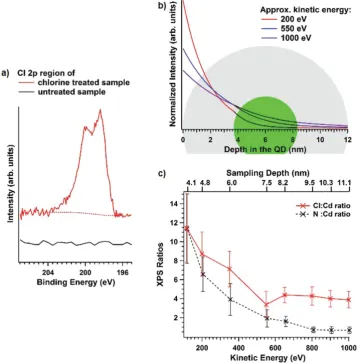
Synchrotron-excited X-ray photoelectron spectroscopy (XPS) was used to confi rm the presence of chloride ions on the surface of the treated CQDs. Upon chloride treatment, a Cl 2p doublet peak appears in the spectrum that is not pre-sent for the untreated samples ( Figure 2 a). The depth sensi-tivity of this feature was investigated by varying the exciting photon energy, which changes the photo electron inelastic mean free pathlength (and hence the XPS sampling depth) over distances commensurate with the CQD size. Figure 2 b indicates schematically the change in sampling depth rela-tive to the diameter of a typical QD, including an outer layer of organic ligands. The thickness of the ligand layer was calcu-lated from the depth dependence of the core and ligand XPS signals, as described in the SI. The variation in intensity of the Cl 2p signal (and the N 1s signal of the oleylamine ligand used in the chloride treatment reaction), relative to the Cd 3d signal, with photo electron kinetic energy is shown in Figure 2 c. It can be seen that the Cl and N signals are strongest (relative to Cd) at the lowest kinetic energy used (115 eV), suggesting that the Cl and N are present largely at the surfaces of the QDs, and strikingly, they are present in roughly equal amounts. This observation is in accordance with previous suggestions that the halide etches the chalcogen at the CQD surface, while the organic ligands remain co-ordinated to the metal. [ 2,16 ] The
spectra therefore provide confi rmation of this model, and sug-gest that it extends to Cd-containing QDs. Photo emission was also used to investigate the effect of chloride passivation on the
full papers
valence band edge, as described in detail in the SI. A signifi cant increase in the number of fi lled band edge states was observed on chloride treatment, consistent with the passivation of surface traps by donation of electrons from chloride anions. This fi lling of trap states will not only reduce non-radiative recombination but will also act to narrow the band gap somewhat. This nar-rowing effect will combine with the infl uence of change in CQD size and confi nement potential on the band gap to produce the net shift in peak PL wavelength observed on chloride treatment.
2.2. Photoluminesence Quantum Yield and Decay
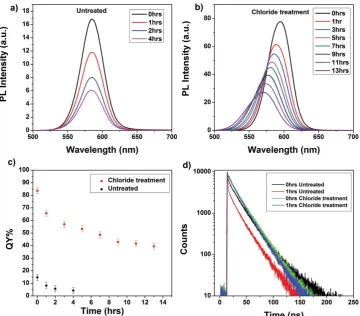
All samples showed immediate increase in PL intensity upon treatment with CdCl 2, in some cases by a factor of
20 ( Figure 3 a). The PL QY for as-synthesized CdTe CQD samples were typically <5%, consistent with similar Cd-based CQDs. [ 11 ] These low PL QYs indicate that non-radiative
pathways dominate carrier recombination, consistent with the presence of a signifi cant number of surface traps resulting from incomplete surface passivation.
Upon CdCl 2 treatment these PL QYs rose dramati-cally, typically to greater than 80%, with the best example reaching 97.2 ± 2.5%, not signifi cantly different from unity (Figure 3 b). These results demonstrate that non-radiative recombination is almost entirely suppressed, and that the surface of the CQD can be nearly completely passivated by the CdCl 2 treatment. Previous examples of near-unity
PL QYs of CQDs have been achieved through the growth of a thick inorganic shell to reduce surface defects. This
process is potentially advantageous for light emitting diodes (LED) devices, [ 11 ] but detrimental in PV cells because the
thick inorganic shell acts as a barrier to charge extraction, reducing PV effi ciency. [ 12 ]
The effect of surface passivation can also be observed using transient PL spectroscopy. The additional recombination pathway afforded by the presence of surface traps not only increases the overall rate of recombination and hence reduces the PL lifetime, but also produces a PL decay transient that is not mono-exponential. [ 21 ] Before
chloride treatment, the PL transient for all samples was made up of a number of components with differing decay times, including a rapid initial decay component of large relative amplitude, requiring a bi-exponential (or higher order) fi t (Figure 3 c). After treatment, the PL transient was mono-exponential over three decades of decay (Figure 3 c) and the PL lifetime was signifi cantly increased; the PL life-time of a number of samples before and after treatment are compared in Figure 3 d. These results, particularly the mono-exponential form of the PL transient, further dem-onstrate the effectiveness of this chloride treatment and are consistent with the near-complete passivation of the surface. The increased carrier lifetime resulting from sup-pression of surface-trap related recombination allows more time for photo-generated charges to be extracted and increases carrier mobility, both of which are likely to improve device performance. Similar signifi cant increases in carrier lifetimes have previously been shown to correlate with performance improvements in inorganic based solar cells. [ 22 ]
[image:4.595.123.485.59.326.2]1551
www.small-journal.com
© 2014 The Authors. Published by Wiley-VCH Verlag GmbH & Co. KGaA, Weinheim 2.3. Effect of Oxygen Exposure
CdTe CQDs are susceptible to oxidation, with short air-expo-sure typically leading to nearly complete quenching of the PL. [ 23 ] Similarly, we observe a large decrease in PL intensity
when the untreated samples were exposed to the atmosphere ( Figure 4 a). When the chloride-treated samples were exposed in the same way, the rate of decrease in PL intensity was sig-nifi cantly slower (Figure 4 b).
For the untreated sample with the highest pre-expo-sure PL QY (15%), this value decreased to about 5% after 4 hours of exposure (Figure 4 c). In contrast, after treatment this sample had a pre-exposure QY of 85% and this was still nearly 50% after 14 hours of exposure. This decay in QY on air-exposure is in contrast to chloride-treated samples kept under inert conditions, which retain their initial QY for many months after synthesis. Interestingly, the PL spectra of the Cl-treated samples also showed a 24 nm blue-shift on exposure to the atmosphere, not seen in the untreated
samples, equivalent to a 90 meV increase in band gap. There is a corresponding shift in the absorption edge (Figure S5) which, if it is assumed that the band gap increase is purely due to a reduction in CQD size, can be used to calculate a change in average diameter of 0.16 nm (see SI). However, the band gap could also be affected by the build-up of a wide-band gap oxide layer that increases quantum confi ne-ment, and the re-introduction of trap states near to the band edge, as evidenced by the declining QY and is discussed in the SI.
The reduced vulnerability to air-exposure of the treated samples is also evident in the transient PL measurements. The decay transient for the untreated samples showed a sig-nifi cant change after 1 hr air-exposure, with the sharp initial decline accounting for a greater proportion of the total ampli-tude (Figure 4 d), and consequently a reduced PL lifetime and an even greater deviation from the mono-exponential PL decay associated with trap-free recombination. In contrast, after the same time open to the air, the treated sample still
small 2015, 11, No. 13, 1548–1554
[image:5.595.116.474.65.429.2]full papers
exhibits a mono-exponential decay transient with only small increase in the rate of decay (Figure 4 d), indicating that far fewer trap sites have been formed by oxygen exposure.
3. Conclusions
We have presented a facile CdCl 2 treatment which can lead to
the almost complete passivation of CdTe colloidal quantum dots. This treatment results in near-unity PL QYs being achieved routinely without the formation of a thick inorganic shell. The chloride was shown to reside largely on the surface of the quantum dots, and does not affect crystallinity. The sur-face passivation of the quantum dots results in non-radiative decay pathways being almost entirely supressed, producing mono-exponential PL decay traces and longer-lived charge carriers as well as ∼100% QY. The suppression of unwanted surface-related recombination promises to lead not only to improved device performance, but will also help further the understanding of charge dynamics in CQDs, the study of which has, up to now, been hindered by the sample-specifi c contribution of surface processes. The chloride treatment also signifi cantly increased the stability of the CdTe quantum dots
when exposed to the air, which will facilitate their inclusion in many optoelectronic devices.
4. Experimental Section
All synthetic methods were carried out using standard Schlenk techniques, with anhydrous solvents and an N 2 atmosphere used throughout the study. Cadmium oxide (CdO, Aldrich, 99.5%), tet-radecylphosphonic acid (TDPA, Aldrich, 97%), oleylamine (Acros, 90%), octadecene (ODE, Acros, 90%), trioctylphosphine (TOP, Aldrich, 97%), tellurium (Aldrich, 99.8%) and anhydrous cadmium chloride (Fluka, >99%) were used without further purifi cation.
CdTe CQDs were synthesized using a previously published method [ 9 ] using growth times of 30–360 s to produce CdTe CQDs
of sizes ranging between 3.2 nm and 4.9 nm, capped with TDPA and TOP ligands. These as-prepared CdTe QDs samples were diluted with dry toluene and stored under N 2 .
A 0.33 M stock CdCl 2 solution was made by dissolving CdCl 2 (0.30 g, 1.64 mmol) and TDPA (0.033 g, 0.12 mmol) in oleylamine (5.0 mL). The solution was degassed at 100 °C for 30 min and cooled to 60 °C under N 2 for the reaction. A toluene solution of CdTe CQDs was held at 60 °C, into which a predetermined amount
1553
www.small-journal.com
© 2014 The Authors. Published by Wiley-VCH Verlag GmbH & Co. KGaA, Weinheim
small 2015, 11, No. 13, 1548–1554
of CdCl 2 stock solution, equating to 96 Cl − ions/nm 2 of CdTe
sur-face area, was quickly injected. The reaction was left for 15 min at 60 °C before being cooled to room temperature and stored as synthesized under N 2 for further studies.
Absorbance measurements were taken of the samples in a toluene solution using a Thermo Spectronic Heλios β spectrom-eter. The same solution was used to measure their PL using a Gilden pλotonics fl uroSENS fl uorimeter after excitation at 400 nm.
X-ray diffraction patterns were measured using a Bruker D8 diffractometer. The samples were prepared by depositing a con-centrated hexane solution on glass slides and allowing the sample to dry in air. This was repeated until a thick fi lm was deposited suitable for X-ray measurements.
Samples were prepared for scanning transmission electron microscope (STEM) analysis by drop-casting a suspension of the CQDs onto a holey carbon support fi lm which was then washed with several drops of methanol. High resolution TEM (HRTEM), high angle annular dark fi eld (HAADF) STEM images, and energy disper-sive X-ray (EDX) spectrum images were acquired using a probe side aberration corrected FEI Titan G2 80–200 kV operated at 200 kV with a convergence angle of 26 mrad and a HAADF inner angle of 52 mrad. Further HAADF STEM imaging and electron energy loss spec-troscopy (EELS) was performed using an aberration corrected NION UltraSTEM200 equipped with a Gatan Enfi nium EEL spectrometer and operated at 200 kV. Cd M 45 , and Te M 45 edges were used for the EELS elemental maps. Before imaging in the UltrasSTEM200,
the samples were baked in vacuum at 160 °C for 8 hours to remove surface ligands. Particle size analysis was performed by applying a threshold to the HAADF STEM images using ImageJ software. Over 200 particles from each sample were measured.
For XPS measurements, CQD samples were examined both with and without the Cl passivation treatment. In the case of the latter, the initial TOP and oleylamine ligands were ligand-exchanged for n -butylamine, in order to avoid charging in XPS. [ 24 ]
The CQD samples were deposited from solution in methanol onto ITO (tin-doped indium oxide) glass slides, and mounted on the sample holders for UHV (ultrahigh vacuum) experiments using carbon tape and silver-loaded UHV-compatible paint. XPS was performed using the BACH beamline (35<hυ<1600 eV), which is equipped with a 135 mm hemispherical electron energy analyzer (Scienta R3000, VG Scienta), at the Elettra synchrotron in Trieste, Italy. XPS spectra were recorded at room temperature at a total instrumental resolution of 201 meV (at 320 eV photon energy) to 1.42 eV (at 1490 eV photon energy). Data were fi tted with product (70% Gaussian/30% Lorentzian) curves and a Shirley-type background was subtracted, except for the Cl 2p region at 200 eV KE where a linear background was chosen. Binding ener-gies of spectra were calibrated to literature values for the CdTe Cd 3d doublet. Spin-orbit separations for the Cd 3d, Te 3d and Cl 2p doublets were set as 6.75 eV, [ 25 ] 10.38 eV [ 25 ] and 1.6 eV [ 26 ]
respectively, and the chemical shift between the two Cl 2p compo-nents was fi xed to 1.22 eV.
[image:7.595.114.475.56.372.2]full papers
PL transients for CQD samples in toluene were recorded using the time correlated single photon counting technique. A mode-locked Ti:sapphire laser (Mai Tai HP, Spectra-Physics) was used to produce ∼100 fs pulses at 80 MHz repetition rate and a wave-length of 820 nm. This rate was reduced to 2 MHz by an acousto-optic pulse picker (Pulse Select, APE) before the wavelength was converted to 410 nm via second harmonic generation (APE Har-monic Generator). These pulses were used to excite the sample contained in a quartz cuvette, sealed under nitrogen. The resultant emission was passed through a monochromator (Spex 1870c) tuned to the PL peak before detection by a multi-channel plate (Hamamatsu R3809U-50). The time correlation of the detected photons was performed using a TCC900 PC card from Edinburgh Instruments.
PL QY for the CQD samples in toluene was measured using a spectrofl uorometer (FluoroLog 33–22iHR, Jobin-Yvon) with a built-in built-integratbuilt-ing sphere (F-3018, Jobbuilt-in-Yvon). The excitation wave-length was set to 450 nm with a bandwidth of 1.3 nm. To verify the procedures used, the QY was also measured for 4 different dye standards emitting at similar wavelengths and similar effi ciency to the QDs under study. The QY values for Rhodamine 6G (Lambda Physik), Oxazine 1 (Lambda Physik), Pyromethene 580 (Exciton Inc) and Pyrromethene 605 (Exciton Inc.) were measured to be 97.6%, 13.0%, 90.1% and 72.9%, respectively. The standard error calculated for 5 repeats of these measurements was 2.5% and so these results agree well with the literature values i.e 95%, [ 27 ]
14.1%, [ 28 ] 90% [ 29 ] and 74%, [ 29 ] respectively.
Supporting Information
Supporting Information is available from the Wiley Online Library or from the author.
Acknowledgements
This work was funded by the EPSRC under grant EP/K008544/1. The experimental work at Elettra was also funded under The Euro-pean Community’s Seventh Framework Programme (FP7/2007– 2013) under grant agreement no. 226716. We thank the BACH beamline technician, F Salvador, for his assistance. We thank the BACH beamline technician, F Salvador, for his assistance. S.J.H. acknowledges funding from the Defence Threat Reduction Agency (DTRA) USA (grant number HDTRA1–12–1–0013). The Titan
80–200kV ChemiSTEM TM was funded through HM Government (UK)
and is associated with the University of Manchester Nuclear Manu-facturing (NUMAN) capabilities. The NION UltraSTEM is supported by funding from the Materials Science and Engineering Division, Oak Ridge National Laboratory, Offi ce of Basic Energy Sciences, U.S. Department of Energy.
[1] Y. Shirasaki , G. J. Supran , M. G. Bawendi , V. Bulovic , Nat Photon
2013 , 7 , 13 .
[2] A. H. Ip , S. M. Thon , S. Hoogland , O. Voznyy , D. Zhitomirsky , R. Debnath , L. Levina , L. R. Rollny , G. H. Carey , A. Fischer , K. W. Kemp , I. J. Kramer , Z. Ning , A. J. Labelle , K. W. Chou , A. Amassian , E. H. Sargent , Nat Nano 2012 , 7 , 577 .
[3] E. H. Sargent , Nat Photon 2012 , 6 , 133 . [4] P. V. Kamat , J. Phys. Chem. Lett. 2013 , 4 , 908 .
[5] K. Katsiev , A. H. Ip , A. Fischer , I. Tanabe , X. Zhang , A. R. Kirmani , O. Voznyy , L. R. Rollny , K. W. Chou , S. M. Thon , G. H. Carey , X. Cui , A. Amassian , P. Dowben , E. H. Sargent , O. M. Bakr , Adv. Mater.
2014 , 26 , 937 .
[6] D. Zhitomirsky , O. Voznyy , S. Hoogland , E. H. Sargent , ACS Nano
2013 , 7 , 5282 .
[7] S. M. Thon , A. H. Ip , O. Voznyy , L. Levina , K. W. Kemp , G. H. Carey , S. Masala , E. H. Sargent , ACS Nano 2013 , 7 , 7680 .
[8] M. Zanella , L. Maserati , M. Pernia Leal , M. Prato , R. Lavieville , M. Povia , R. Krahne , L. Manna , Chem. Mater. 2013 , 25 , 1423 . [9] J. Wang , Y. Long , Y. Zhang , X. Zhong , L. Zhu , ChemPhysChem
2009 , 10 , 680 .
[10] A. B. Greytak , P. M. Allen , W. Liu , J. Zhao , E. R. Young , Z. Popovic , B. J. Walker , D. G. Nocera , M. G. Bawendi , Chem. Sci. 2012 , 3 , 2028 .
[11] A. Saha , K. V. Chellappan , K. S. Narayan , J. Ghatak , R. Datta , R. Viswanatha , J. Phys. Chem. Lett. 2013 , 4 , 3544 .
[12] N. McElroy , R. C. Page , D. Espinbarro-Valazquez , E. Lewis , S. Haigh , P. O’Brien , D. J. Binks , Thin Solid Films 2013 .
[13] N. Zhao , T. P. Osedach , L.-Y. Chang , S. M. Geyer , D. Wanger , M. T. Binda , A. C. Arango , M. G. Bawendi , V. Bulovic , ACS Nano
2010 , 4 , 3743 .
[14] C.-H. M. Chuang , P. R. Brown , V. Bulovic´ , M. G. Bawendi , Nat. Mater. 2014 , 13 , 796 .
[15] J. Zhang , J. Gao , E. M. Miller , J. M. Luther , M. C. Beard , ACS Nano
2013 , DOI 10.1021/nn405236k .
[16] W. K. Bae , J. Joo , L. A. Padilha , J. Won , D. C. Lee , Q. Lin , W. Koh , H. Luo , V. I. Klimov , J. M. Pietryga , J. Am. Chem. Soc. 2012 , 134 , 20160 .
[17] J. S. Owen , J. Park , P.-E. Trudeau , A. P. Alivisatos , J. Am. Chem. Soc.
2008 , 130 , 12279 .
[18] N. C. Anderson , J. S. Owen , Chem. Mater. 2012 , 25 , 69 .
[19] J. Tang , K. W. Kemp , S. Hoogland , K. S. Jeong , H. Liu , L. Levina , M. Furukawa , X. Wang , R. Debnath , D. Cha , K. W. Chou , A. Fischer , A. Amassian , J. B. Asbury , E. H. Sargent , Nat Mater 2011 , 10 , 765 . [20] J. T. Stewart , L. A. Padilha , M. M. Qazilbash , J. M. Pietryga , A. G. Midgett , J. M. Luther , M. C. Beard , A. J. Nozik , V. I. Klimov ,
Nano Lett. 2011 , 12 , 622 .
[21] P. H. Sher , J. M. Smith , P. A. Dalgarno , R. J. Warburton , X. Chen , P. J. Dobson , S. M. Daniels , N. L. Pickett , P. O’Brien , Appl. Phys. Lett. 2008 , 92, 101111 .
[22] A. K. Rath , M. Bernechea , L. Martinez , F. P. G. de Arquer , J. Osmond , G. Konstantatos , Nat Photon 2012 , 6 , 529 .
[23] M. Amelia , C. Lincheneau , S. Silvi , A. Credi , Chem. Soc. Rev. 2012 ,
41 , 5728 .
[24] J. Akhtar , M. Azad Malik , P. O’Brien , K. G. U. Wijayantha , R. Dharmadasa , S. J. O. Hardman , D. M. Graham , B. F. Spencer , S. K. Stubbs , W. R. Flavell , D. J. Binks , F. Sirotti , M. El Kazzi , M. Silly , J. Mater. Chem. 2010 , 20 , 2336 .
[25] H. S. White , A. J. Ricco , M. S. Wrighton , J. Phys. Chem. 1983 , 87 , 5140 . [26] A. Barrie , I. W. Drummond , Q. C. Herd , Int. J. Theor. Exp. Asp.
Elec-tron Spectrosc. 1974 , 5 , 217 .
[27] D. Magde , R. Wong , P. G. Seybold , Photochem. Photobiol. 2002 ,
75 , 327 .
[28] K. Rurack , M. Spieles , Anal. Chem. 2011 , 83 , 1232 .
[29] J. H. Boyer , A. M. Haag , G. Sathyamoorthi , M.-L. Soong , K. Thangaraj , T. G. Pavlopoulos , Heteroat. Chem. 1993 , 4 , 39 .