Munich Personal RePEc Archive
The effect of energy consumption on
countries’ economic efficiency: a
conditional robust non parametric
approach
Halkos, George and Tzeremes, Nickolaos
University of Thessaly, Department of Economics
2011
Online at
https://mpra.ub.uni-muenchen.de/28692/
The effect of energy consumption on countries’
economic efficiency: a conditional robust non
parametric approach
by
George Emm. Halkos
1and Nickolaos G. Tzeremes
Department of Economics, University of Thessaly, Korai 43, 38333, Volos, Greece
Abstract
This paper investigates the effect of energy consumption on countries’ economic efficiency. By using a sample of 18 EU countries for three census years (1980, 1990 and 2000) the paper employs conditional and unconditional robust nonparametric frontiers in order to establish such a relationship. By using probabilistic approaches it conditions the effect of energy consumption on the obtained countries’ economic efficiencies. With the use of nonparametric regressions the paper calculates the effect of energy consumption. The results reveal that lower levels of energy consumption increase countries’ economic efficiencies to a point where the effect of energy consumption on countries’ economic efficiency is neutral.
Keywords: Energy consumption; economic growth; robust efficiency estimators; conditional nonparametric techniques.
JEL Classification: Q43, O13, C6, C67
1
Associate Professor George Halkos Director of Postgraduate Studies Department of Economics, University of Thessaly,
Korai 43, 38333, Volos, Greece. http://www.halkos.gr
1. Introduction
The energy-growth relationship has been a popular topic for ‘old’ growth
theory and a on going debate for ‘new’ growth theory (van Zon and Yetkiner, 2003).
According to Moon and Son (1996) endogenous growth literature treats energy as
physical resource in an indirect ‘fashion’ which links higher economic growth with an
increased demand on energy. However several authors suggest that there is an
ongoing debate among the energy economists whether energy consumption can
stimulate economic growth and in which way (Gkali and El-Sakka, 2004;
Wolde-Rufael, 2005; Chontanawat et al., 2008). According to Stern (1993) and Beaudreau
(2005) energy is an essential factor of production. Moon and Sonn (1996) explain that
energy consumption increases productivity of other productive inputs in the
production process thus enhances economic growth. In contrast when energy
increases the investment in physical capital is decreased because the increased energy
use lowers the disposable income of the representative agent (p.194). Therefore, there
is a dynamic effect between these two forces which have an effect on energy
economic growth relationship. There have been many empirical studies explaining
this dynamic relationship in aggregated energy consumption (Soytas and Sari 2006,
2007) and in disaggregated levels (Shiu and Lam, 2004; Zhou and Chau, 2006) but
have presented mixed results. According to Yuan et al. (2008) the mixed results
which are reported in the literature are due to the fact that different countries are in
different developing stages. As such the developing process will have a different
impact on the relationship between energy consumption and economic growth. In an
extensive literature review Lee and Chang (2008) suggest that earlier studies have
examined the energy consumption – income/ output relationship mostly based in the
with Stern (1993, 2000) and Oh and Lee (2004) emphasizing that studies are based on
single countries or in small samples. As have been reported most of the studies, have
used panel data techniques and time series techniques such as cointegration and vector
error correction modeling in different countries for different time periods (Soytas and
Sari, 2006). In contrast, with those studies this paper adopts a different approach for
investigating the causal relationship between energy consumption and economic
growth. For the first time (to our knowledge) this paper uses robust non-parametric
frontiers (order-a) (Daouia and Simar, 2007) and its conditional form (Daraio and
Simar, 2005, 2007a,b) in order to establish the effect of energy consumption on
countries economic efficiency. By contributing to the existing literature this study
provides a framework of how the new advances in efficiency analysis can be applied
in order to for such a dynamic relationship to be investigated.
2. Literature review
Most of empirical studies examining the relationship between energy
consumption and economic growth in an aggregated and disaggregated level have
been inspired by the pioneered work by Kraft and Kraft (1978). By using data for a
time period of 1947 -1974 for the United States they found a unidirectional causality
from gross national product GNP to energy consumption. As such any energy policy
innervations wouldn’t affect GNP growth. However, Kraft and Kraft suggested that
this outcome was due to the selected time period. Similarly, Schurr (1982) examining
the period 1920 -1953 found that that in the United States the energy intensity of
production was falling while the country’s productivity was rising. However, for the
time period of 1953 -1973 energy intensity was stable while evidence indicated that
research remains to be done until will be able to establish the relationship between
energy utilization in productivity growth.
More recently, Lee and Chang (2008) examined the relationship between
energy consumption and real GDP within a multivariate framework which included
capital stock and labor as inputs for a sample of 16 Asian countries for the time period
of 1971-2002. By applying panel unit root, heterogeneous panel cointegration and
panel –based error correction models they found a long-run unidirectional causality
running from energy consumption to economic growth. In addition Mishra et al.
(2008) by testing for Granger causality and using panel cointegration techniques
examined the relationship between energy consumption and GDP for the Pasific
Island countries for the time period 1980-2005. Their evidence support that there is a
positive impact between energy consumption and GDP. In addition many studies have
used Granger causality tests in order to establish the link between energy and income
(Abosedra and Baghestani, 1991; Akarca and Long, 1980; Bentzen and Engsted,
1993; Hwang and Gum, 1992; Yu and Choi, 1985; Yu and Hwang, 1984). However,
the results reported are varying according to the country and the time period under
examination. Erol and Yu (1987) support this view by providing mixed results of a
sample of six countries. Similarly Stern (1993) found no evidence supporting that
gross energy use causes GDP. However, recent studies by adopting new time series
methodologies such as cointegration and vector error correction modelling couldn’t
establish a causal relationship between energy consumption and GDP growth. (Oh
and Lee, 2004; Soytas and Sari, 2006, 2007; Stern, 1993, 2000). Furthermore, van
Zon and Yetkiner (2003) reported that rising real energy prices tend to slow down
growth. Smulders and de Nooij (2003) developed a growth model in which growth is
found that energy conversation policies studied reduce per capita income levels. They
also found that in the long run energy policies which reduce energy tend to reduce
long run growth. According to Lee and Chang (2008) different sample data, different
techniques and different time periods have yield to inconsistent results of the energy –
economic growth relationship.
The problem of establishing the role of energy in the production process and
thus its causality relationship with GDP is a non ending academic debate over the last
three decades. Berndt and Wood (1975, 1979) using a time series data for US
economy have argued that energy and capital are compliments and energy and labour
are substitutes. In the same lines Hudson and Jorgenson (1974) and Solow (1987)
have also in favor of energy – capital complementarity. However Griffin and Gregory
(1976) and Joregenson and Wilcoxen (1990) have obtained results proving that
energy and capital are substitutes. In addition Smulders and de Nooij (2003) suggest
that labour and energy inputs are gross complements and are being combined with
specific complementary intermediate inputs which in turn are interpreted as capital in
the production function.
As such in contrast with the rest of the studies analysing the relationship
between energy consumption and economic growth, this paper for the first time uses
nonparametric techniques in order to establish the effect of energy consumption on
the economic efficiency of 18 EU countries for the period of three census years
(1980,1990 and 2000). In our paper we model and we measure countries’ economic
efficiency by adopting robust non-parametric frontiers (order-a) as has been
introduced by Daouia and Simar (2007). According to Daraio and Simar (2007a) the
use of robust frontiers are more robust to extreme values and outliers and thus we can
their determinist nature. In addition robust frontiers are not suffering from
dimensionality problems thus we can work with samples of small/ moderate sizes.
According to Daraio and Simar (2007a) order-a frontiers (used in this study) are more
robust to extremes than the order-m frontiers developed by Cazals et al. (2002). After
measuring countries’ economic efficiency levels we condition them to their energy
consumption levels for the examined period by using conditional robust frontiers
(Daraio and Simar, 2005, 2007b). The main advantage of robust ratios is that they can
show us the impact of energy consumption on countries’ economic efficiencies even
if we have in our sample some extreme observations (caused by countries’
heterogeneity). As such by treating energy consumption as an environmental factor
which influences countries’ process of economic activity we will be able to determine
robust conditional measures (conditioned to energy consumption) and thus to evaluate
if countries’ energy consumption levels for the examined periods had any effect on
their economic efficiencies.
3. Data
In the literature nonparametric techniques have been used to measure
countries’ environmental performance based on the production process (Färe et al.,
1989a,b; Chung et al., 1997; Zaim and Taskin, 2000; Taskin and Zaim, 2000; Zaim et
al., 2001; Zaim, 2004). However, non of the above studies have examined the
energy-GDP relationship using non parametric techniques. Following Halkos and Tzeremes
(2009a, b) we measure countries economic efficiency based in production of two
inputs and one output. We use data for three census years 1980, 1990 and 2000 for 18
European countries2. The inputs used are Total Fixed Investment (TFI) (excluding
stockbuilding) in volumes and Labour Force (LF) whereas the output used is the
2
Gross Domestic Product (GDP) (market prices) in volumes. The inputs/ output used
have been obtained from Economics Web Institute (EWI, 2009). The external variable
used is Primary Energy Consumption (PEC). Primary energy comprises commercially
traded fuels only. The energy consumption quantities have been obtained from BP
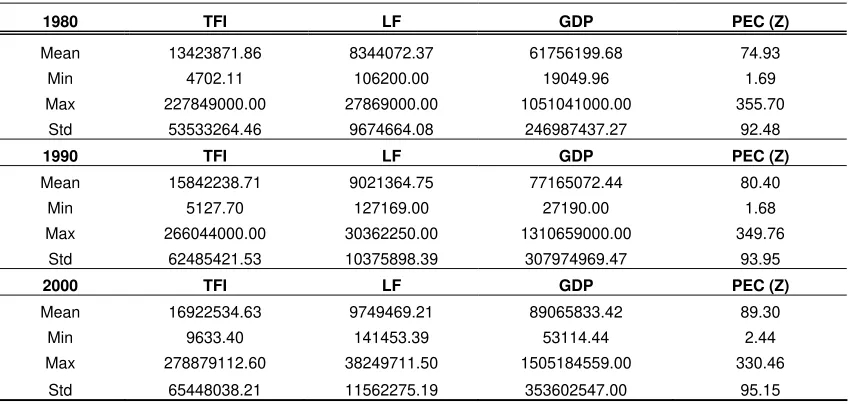
Statistical Review of World Energy (2007). Table 1 provides the descriptive statistics
of the inputs/ output used. As can be realised the energy consumption of the examined
countries have been examined over the years. Furthermore, the descriptive statistics
indicate that there are heterogeneities between the 18 countries. The heterogeneities
reported in GDP, labour and total fixed investment makes the methodology adopted
more appropriate since robust frontiers can accommodate samples with extreme
values.
Table 1 about here 4. Methodology
4.1Probabilistic approach to efficiency measurement
Daraio and Simar (2005) following extending the ideas of robust
measurements introduced by Cazals et al. (2002) introduced a probabilistic approach
of production process. Following the notation by Daraio and Simar (2007a) the
production set Ψ defined as a set of p inputs and q outputs in a Euclidean space R+p+q
as:
( )
⎭ ⎬ ⎫ ⎩
⎨
⎧ ∈ ∈
=
Ψ x,y x R+p,y R+q,(x,y) is feasible (1),
where x is the input vector y the output vector. Then the production process can be
described by the joint probability measure of (X,Y) on R+pxR+q. Then the knowledge of
) , ( Pr ) ,
(x y ob X x Y y
HXY = ≤ ≥ (2).
Then for the input oriented case the efficiency score θ(x,y) for (x,y)∈Ψcan be
defined as:
{
( ) 0} {
inf ( , ) 0}
inf ) ,
(x y =
θ
FXYθ
xy > =θ
HXYθ
x y >θ
(3).A nonparametric estimator can be defined by replacing FXY(xy)by its empirical
version:
∑
∑
= = ∧ ≥ ℑ ≥ ≤ ℑ = n i i ni i i
n Y X y Y y Y x X y x F 1 1 , ) ( ) , ( )
( (4),
where ℑis the indicator function. Under the free disposal assumption the FDH
estimator of θ(x,y)developed by Deprins et al. (1984) coincides with the input
efficiency score for a given point (x,y) (Cazals et al., 2002):
⎭ ⎬ ⎫ ⎩ ⎨ ⎧ > = ⎭ ⎬ ⎫ ⎩ ⎨
⎧ ∈Ψ
= ∧ ∧ ∧ 0 ) ( inf ) , ( inf ) ,
(x y x y FDH FXY,n xy
FDH θ θ θ θ
θ (5).
4.2 The formulation of Order-a frontiers
Following Daouia and Simar (2007) an order- α nonparametric estimator can
be calculated as:
⎭ ⎬ ⎫ ⎩
⎨
⎧ > −
= ∧ ∧ a y x F y
x XYn
n
a, ( , ) inf θ , (θ ) 1
θ (6).
According to Daraio and Simar (2007a) order-α quantile frontiers benchmark
the unit at (x,y) against the input level not exceed by (1-α) x 100% of the countries
among the population of units producing output levels of at least y. When, a→1 then
( )
x y FDH( )
x yn
a, , ,
∧ ∧
→θ
θ (5). The estimator a,n(x,y)
∧
θ can take values >,< and = to 1.
When )a,n(x,y
∧
inputs by a factor θα(x,y) to reach the same frontier. If θα(x,y)=1 then the countries is
said to be efficient at the level a x 100% since it is dominated by countries
producing more outputs than y with a probability 1-α. If θa(x,y)<1, then the country
(x,y) has to reduce its input to the level θa(x,y)x to reach the input efficient frontier
of level a x 100%.
4.3 Conditional Order-a frontiers
As has been described by Daraio and Simar (2005) different variables
(exogenous to the production process) Ζ∈ℜr can be used to explain the efficiency
variations of the production process. The idea is to condition the production process to
a given value of Z =z. The joint distribution (X,Y) conditional on Z =zdefines the
production process if Z = z. Then a nonparametric estimator θm(x,yz) is provided
by plugging the non parametric estimator:
∑
∑
= = ∧ − ≥ ℑ − ≥ ≤ ℑ = ni i i
n
i i i i
n Z Y X h z z K y y h z z K y y x x z y x F 1 1 , , ) / ) (( ) ( ) / ) (( ) , ( ) ,
( (7),
where K(.) is the kernel and h is the bandwidth of appropriate size. We have used
kernel with compact support (Epanechnikov) as suggested by Daraio and Simar
(2005). Furthermore, for the calculation of bandwidth we used the two stage data
driven approach as proposed by Daraio and Simar (2006). As a first step we used the
likelihood cross validation criterion based on K-NN method (Silverman, 1986). As a
second step we take into account for the dimensionality of x and y, and the sparsity of
points in larger dimensional spaces we expand the local bandwidths hZi by a
factor1+n−1/(p+q), increasing with (p + q) but decreasing with n. In the second step
Similarly, following Daouia and Simar (2007) a conditional order-a nonparametric
⎪ ⎪ ⎪ ⎩ ⎪⎪ ⎪ ⎨ ⎧ − = < − ≤ < − ≤ = + + ∧ . 1 ,..., 1 1 1 0 ) ,
( 1 1
1 ) 1 ( , y k k y k y n a M k l a l if X l a if X z y x
θ (8).
According to Daraio and Simar (2007a, 2007b) the global influence of Z on
the production process can be obtained by comparing the conditional order-a frontiers
to their unconditional equivalents. In a univariate case of Z a scatter-plot of the ratios
) , ( ) , ( , y x z y x Q a a z a ∧ ∧ = θ θ
against Z and its smoothed nonparametric regression line would
indicate the global effect of Z o the production process. If the smoothed
nonparametric regression is increasing it indicates that Z is unfavourable to efficiency
and when this regression is decreasing then is favourable to efficiency. Finally, we
use a nonparametric regression estimator introduced by Nadaraya (1964) and Watson
(1964):
∑
∑
= = ∧ − − = n i i n i i h Z z K Q h Z z K z g 1 1 ) ( ) ( )( (9).
4.4 Decomposition of conditional efficiency
We decompose the conditional efficiency obtained as suggested by Daraio and
Simar (2006). The conditional efficiency CEz(x,y)obtained for every country can be
decomposed in to three main indicators. The first indicator is the indicator of
unconditional efficiency UE(x,y) or countries’ internal efficiency. The second is the
value of the ratios Qa,z given the value of z owned by the country. It is given by the
nonparametric fitted value of Qa,z obtained by some appropriate nonparametric
regression of Qa,z on Z:
(
)
(
(
)
)
(
)
(
)
∑
∑
= = ∧ − − = = n i i ni azi i
z a h z z K h z z K Q z Z Q E 1 1 , , / / (10).
Where K(.)is the Kernel and h an appropriate bandwidth. Finally, the third
indicator is the individual index IIz(x,y) and can be defined as:
(
Q Z z)
E
Qaz az = ∧
,
, / (11).
The individual index measures country’s intensity in catching the
opportunities or threats by the external factor.
The formulation of the three index can be defined as:
) , ( * ) , ( * ) , ( ) ,
(x y UE x y EI x y II x y
CE = z z (12).
The decomposition of conditional efficiency give us the possibility for
analysing individual and localized effects of external factors (in our case energy
consumption) and interpret them together with their global influence on countries’
economic efficiency.
4. Empirical results
The analysis has been conducted in two stages for 1980, 1990 and 2000. As
such the conditional and unconditional measures have been obtained. The value of α
used in our analysis was 0.9. With values of α greater than 0.9 the efficiency scores
of order-a frontiers quickly converge to the estimates obtained by FDH frontier (see
equation 5). According to Daraio and Simar (2007a) when the order-a values are close
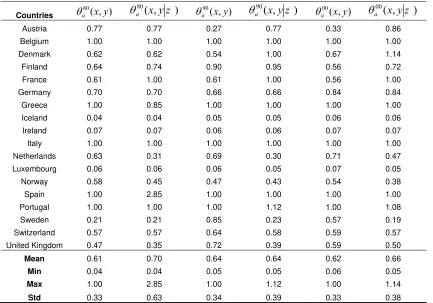
obtained from our analysis. For the year 1980 we realize the countries with higher
economic efficiency are Belgium, Greece, Italy, Spain and Portugal. The lowest
efficiency scores have been observed for Luxemburg, Iceland and Ireland. When we
took into account the effect of energy consumption for that year then countries’
economic efficiency scores have changed (for some cases). For instance Finland has
increased its economic efficiency performance from 0.64 to 0.74. Furthermore, Spain
has dramatically increased its economic performance from 1 to 2.853. Similarly,
France has also been increased its economic efficiency from 0.61 to 1. In contrast
with Greece which under the influence of energy consumption its economic efficiency
has been decreased from 1 to 0.85. The same stands for Netherlands which had a
decrease from 0.63 to 0.31.
Table 2 about here
Continuing in the same way our analysis for 1990 we realise that in some
cases the effect of energy consumption caused an increase of countries’ economic
efficiencies and in some cases caused even a decrease of their economic efficiencies.
However as have been also reported for year 1980 when examine countries
efficiencies of 1990, we realise that in some cases energy consumption hadn’t any
effect on countries economic efficiency performances. For instance Germany in both
years is reported to have the same economic efficiency score regardless the effect of
energy consumption. The same goes for Iceland, Belgium and Ireland. Lee and Chang
(2008) suggest that the findings of no causality in either direction is called ‘neutrality
hypotheses’ and signifies no effect of energy consumption on countries growth. In
addition for the year of 1990 we can observe for the case of Austria a high increased
of its economic efficiency (from 0.27 to 0.77). The same goes for Denmark which had
3
an increase of its efficiency from 0.54 to 1.However, the highest decreases of
countries economic efficiencies have been reported for Sweden (from 0.85 to 0.23)
and the United Kingdom (from 0.72 to 0.39). Finally, when looking the results
obtained for the year 2000 we can realise that in some cases countries’ efficiency
scores haven’t been affected by the countries’ energy consumption levels (Belgium,
Germany, Iceland, Ireland, Italy and Spain). Again for some cases we observe an
increase of their economic efficiency scores (Austria, Denmark, Finland, France, and
Portugal) and for some we observe a decrease (Netherlands, Luxembourg, Norway,
Sweden, Switzerland and the United Kingdom). As can be realised the effect of
energy consumption on countries’ economic efficiency is change over the years under
examination and among the countries themselves. Even though our sample contains
phenomenically same countries (EU members) we observe that the effect of energy
consumption in some cases changes rapidly even if we examine the same country (see
for instance the case of Austria, Sweden, Finland and the United Kingdom). In fact
this phenomenon explains the dynamics between energy demand and economic
growth which have a counteracting relationship (Monn and Sonn, 1996).
Figure 1 about here
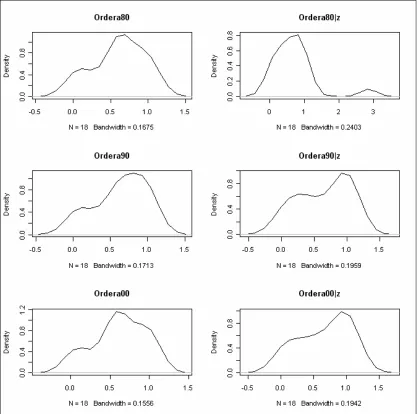
In an aggregative way figure illustrates the density of the conditional and
unconditional efficiency scores of the 18 EU countries. As can be realised for the year
1980 countries’ energy consumption seem to have a positive effect on their economic
efficiencies concentrating their economic efficiency levels around unity. However,
when looking the year of 1990, we realise that the effect of energy consumption had
rather a negative/ neutral effect forcing countries’ economic efficiency scores away
from unity (left asymmetry, i.e. the median is greater than the mean). The same can be
scores is observed indicating that the effect of energy consumption is neutral and in
some cases negative. According to Monn and Son (1996) the increased energy use
lowers the disposal income of the representative agents, thus a decrease on investment
of physical capital is observed which in turn has a negative effect on countries’
economic efficiencies.
Table 3 about here
In order to analyse further the effect of energy consumption on countries’
economic efficiencies we decompose the conditional efficiency as have been
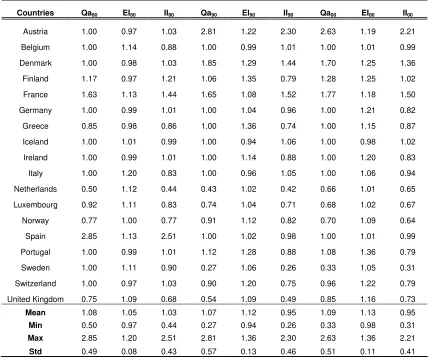
proposed by Daraio and Simar (2006). Table 3 provides the results of the conditional
efficiency decomposition in its components (see equation 12). The index Qa is the
ratio of
) , (
) , (
y x
z y x
a a
∧ ∧
θ θ
and can take values >,<,=1. As such when Qa is equal 1 indicates
that energy consumption has a neutral effect on country’s economic efficiency.
However, when the values are greater than 1 then the effect is positive and when are
lower than 1 the effects are negative. As can be observed for 1980 for the majority of
countries (Austria, Belgium, Denmark, Germany, Iceland, Ireland, Italy, Portugal,
Sweden and Spain) the energy consumption had a neutral effect on their economic
efficiency. In addition the externality index (EI) when takes values above 1 means
that the country works at a energy level with an expected Qa >1. The opposite occurs
when EI takes values below1. As can be realised for the year 1980 the countries with
EI greater than unity are reported to be Belgium, France, Iceland, Italy, Netherlands,
Luxembourg, Spain, Sweden and the United Kingdom. However, in some cases the
effect of the energy consumption is not (as expected) positive. For instance Belgium
externality index is 1.12 but the value of Qa is 0.5 indicating a negative effect of
energy consumption on country’s economic efficiency. This is maybe to
differentiations of energy prices among the observed countries or to different
consumption patterns and various sources of energy (Soytas and Sari, 2007). Finally,
the individual index (II80) analyses how the country performed in respect to the
expected value of its performance. For instance if individual index is greater than 1
then the effect of energy consumption on the efficiency score of the country under
consideration is higher with respect to its expected value. In contrast, if II <1 we are
considering a country for which the environmental externality (energy consumption)
is lower then what expected for its level of energy consumption. As such countries
with the expected higher influence (relative to their energy consumption) are reported
to be Austria, Denmark, Finland, France, Germany, Ireland, Spain, Portugal and
Switzerland. However, this expected influence is not reflected on their economic
efficiency scores. If continue our analysis in the same fashion for year 1990 we realise
that five countries have been positively influenced by their energy consumption, six
of them have been negatively influenced and seven of them had a neutral effect of
energy consumption on their economic efficiency. In addition when looking the year
2000 we realise that five countries have increased their economic efficiency as a
result of their energy consumption, whereas six of them have reduce their economic
efficiency scores. Finally, energy consumption appeared to have a neutral effect on
seven countries’ economic efficiencies. Again the disparities and differentiations of
energy prices, energy consumption patterns, macroeconomic policies and economic
process appeared to be a major obstacle for identifying a global effect of causality
between energy consumption and economic efficiency.
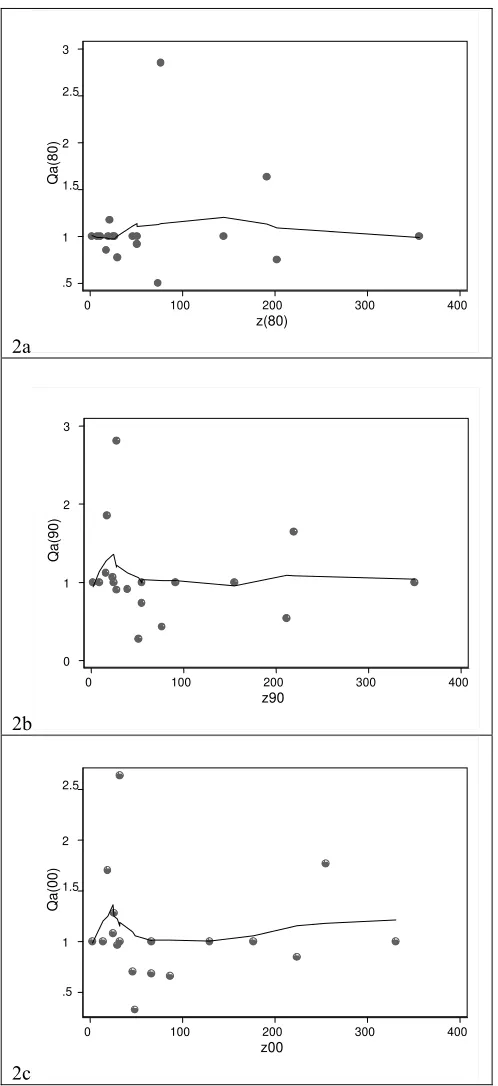
As described previously figure 2 illustrates the effect of energy consumption
on countries’ economic efficiency for the years 1980, 1990 and 2000 (subfigures
2a,b,c additionally). For instance subfigure 2a examines the influence of energy
consumption on countries’ economic performance for the period of 1980. It represents
a scatter plot of the ratios n
(
x,yz)
/ n( )
x,y∧ ∧
θ
θ against countries’ energy consumption
levels and its smoothed nonparametric regression line in order to define this influence.
As the regression line is almost flat it specifies that energy consumption has a rather
neutral effect to the countries’ economic efficiencies. Accordingly for the year 1990
we realise at lower levels of energy consumption the effect is negative to the
countries’ economic efficiency levels bust when the energy consumption increases
again we realise that the effect is neutral. Finally, for the year 2000 we realise that in
lower levels of energy consumption the effect is negative but as the energy
consumption increases countries’ economic efficiencies are also increasing to a point
where the effect of energy consumption on countries’ economic efficiency is neutral.
As such our findings fully support previous studies by Lee and Chang (2008) and
Moon and Son (1996) which mention the difficulties and the dynamic nature of the
energy consumption-economic growth relationship.
5. Conclusions
As has been highlighted by several scholars (van Zon and Yetkiner, 2003;
Stern, 1993, 2000; Beaudreau, 2005; Smulders and de Nooij, 2003) the
energy-economic growth relationship is an ongoing debate among the energy economists. As
such any measures and techniques adopted must be critically evaluated and applied
before establishing the causality of such a dynamic relationship. To our knowledge
for the first time conditional and unconditional measures have been used in order to
well known studies employing advanced panel and time series techniques in
aggregated and disaggregated level (Soytas and Sari 2006, 2007; Shiu and Lam, 2004;
Zhou and Chau, 2006; Lee and Chang, 2008; Yuan et al., 2008; Stern, 1993 2000; Oh
and Lee, 2004, among others) this study uses order–a frontiers as introduced by
Daouia and Simar (2007). The results reveal that lower levels of energy consumption
have a negative effect on countries economic efficiency. This finding comes along
with the view by Smulders and Nooij (2003) suggesting that cuts in energy can have a
seriously affect on GDP and economic growth. Furthermore, the results reveal that
when the energy consumption values increase significantly can have a negative effect
on countries’ economic efficiencies. However, from a point onwards the effect of
energy consumption on countries’ economic efficiency is neutral. Lee and Chang
(2008) suggest that this finding is in the favour of the ‘neutrality hypothesis’ whereas
the negative effect on countries’ economic efficiencies may be as a result of a
decrease of disposable income of the representative agent due to increase in energy
prices of the countries under examination (Moon and Sonn, 1996).
As a limitation of the research provided may be the fact that we are examining
only three census years and having a sample of only 18 EU countries. In fact this must
be a direction for a future research; however, our intension was to highlight the
dynamics of the energy-economic growth relationship using the new advances in
nonparametric techniques. In contrast with the studies mentioned previously this
technique (especially with the decomposition of conditional efficiency) can provide us
with useful information of the insides and the structure of the energy consumption –
economic growth relationship in such a way that we will be able to overcome the
problems of countries’ dissimilarities.
6. References
Abosedra S, Baghestani H. Newevidence on the causal relationship between United
States energy consumption and gross national product. Journal of Energy and
Development 1991;14;285–292.
Akarca AT, Long TV. On the relationship between energy and GNP: A
reexamination. Journal of Energy and Development 1980; 5; 326–331.
Beaudreau BC. Engineering and economic growth. Structural Change and Economic
Dynamics 2005; 16; 211–220.
Bentzen J, Engsted T. Short- and long-run elasticities in energy demand. Energy
Economics 1993; 15; 9–16.
Berndt ER, Wood DO. Technology, prices and the derived demand for energy.
American Economic Review 1975; 56; 259–268.
Berndt ER, Wood DO. Engineering and econometric interpretations of energy capital
complementarity. American Economic Review 1979; 69; 342–354.
BP Statistical Review of World Energy June; 2007. Data can be obtained from
http://www.bp.com/statisticalreview (accessed September 13, 2009).
Cazals C, Florens JP and Simar L. Nonparametric frontier estimation: a robust
approach. Journal of Econometrics 2002; 106; 1-25.
Chontanawat J, Hunt LC and Pierse R. Does energy consumption cause economic
growth?: Evidence from a systematic study of over 100 countries. Journal of Policy
Modeling 2008; 30; 209–220.
Chung YH, Färe R and Grosskopf S. Productivity and undesirable outputs: a
directional distance function. Journal of Environmental Management 1997; 51; 229–
Daouia A, Simar L. Nonparametric Efficiency Analysis: A Multivariate Conditional
Quantile Approach. Journal of Econometrics 2007; 145; 375-400.
Daraio C, Simar L. A robust nonparametric approach to evaluate and explain the
performance of mutual funds. European Journal of Operational Research 2006; 175;
516–542
Daraio C, Simar L. Introducing Environmental Variables in Nonparametric Frontier
Models: a Probabilistic Approach. Journal of Productivity Analysis 2005; 24; 93-121.
Daraio C, Simar L. Advanced robust and nonparametric methods in efficiency
analysis. Springer Science: New York; 2007a.
Daraio C, Simar L. Conditional nonparametric frontier models for convex and
nonconvex technologies: a unifying approach. Journal of Productivity Analysis
2007b; 28; 13-32.
Deprins D, Simar L and Tulkens H 1984. Measuring labor-efficiency in post offices.
In Marchand M, Pestieau P and Tulkens H (Eds), The Performance of public
enterprises - Concepts and Measurement. North-Holland: Amsterdam, 1984. p. 243-
267.
Erol U, Yu ESH. On the causal relationship between energy and income for
industrialized countries. Journal of Energy and Development 1987; 13; 113–122.
EWI. Economics Web Institute; 2009. Data can be obtained from
http://www.economicswebinstitute.org (accessed September 13, 2009).
Färe R, Grosskopf S, Lovell CAK and Pasurka C. Multilateral productivity
comparisons when some outputs are undesirable. The Review of Economics and
Färe R, Grosskopf S and Pasurka C. The effect of environmental regulations on the
efficiency of electric utilities: 1969 versus 1975. Applied Economics 1989b; 21; 225–
235.
Ghali KH, El-Sakka MIT. Energy use and output growth in Canada: A multivariate
cointegration analysis. Energy Economics 2004; 26; 225–238.
Griffin JM, Gregory PR. An intercountry translog model of energy substitution
responses. American Economic Review 1976; 66; 845-847.
Halkos G, Tzeremes N. Measuring regional economic efficiency: the case of Greek
prefectures, The Annals of Regional Science 2009a; doi: 10.1007/s00168-009-0287-6.
Halkos G, Tzeremes N. Exploring the existence of Kuznets curve in countries'
environmental efficiency using DEA window analysis. Ecological Economics 2009b;
68; 2168-2176.
Hudson EA, Jorgenson DW. U.S. energy policy and economic growth, 1975-2000.
Bell Journal of Economics 1974; 5; 461-514.
Hwang DBK, Gum B. The causal relationship between energy and GNP: The case of
Taiwan. The Journal of Energy and Development 1992; 16; 219–226.
Jorgenson DW. The role of energy in productivity growth. American Economic
Review 1984; 74; 26-30.
Jorgenson DW, Wilcoxen PJ. Environmental regulation and US economic growth.
Rand Journal of Economics 1990; 21; 314–340.
Kraft J, Kraft A. On the relationship between energy and GNP. Journal of Energy
Development 1978; 3; 401-403.
Lee CC, Chang CP. Energy consumption and economic growth in Asian economies:
A more comprehensive analysis using panel data. Resource and Energy Economics
Mishra V, Smyth R and Sharma S. The energy-GDP nexus: Evidence from a panel of
Pacific Island countries, Resource and Energy Economics 2008;
doi:10.1016/j.reseneeco.2009.04.002
Moon YS, Sonn YH. Productive energy consumption and economic growth: An
endogenous growth model and its empirical applications. Resource and Energy
Economics 1996; 18; 189-200.
Nadaraya EA. On estimating regression. Theory of Probability Applications 1964; 9;
141-142.
Oh W, Lee K. Energy consumption and economic growth in Korea: testing the
causality relation. Journal of Policy Modeling 2004; 26; 973–981.
Schurr S. Energy efficiency and productive efficiency: Some thoughts based on
American experience. Energy Journal 1982; 3; 3-14.
Shiu A, Lee LP. Electricity consumption and economic growth in China. Energy
Policy 2004; 32; 47–54.
Silverman BW. Density estimation for statistics and data analysis. Chapman and Hall:
London; 1986.
Smulders S, de Nooij M. The impact of energy conservation on technology and
economic growth. Resource and Energy Economics 2003; 25; 59–79.
Solow JL. The capital energy complementarity debate revisited. American Economic
Review 1987; 77; 605–614.
Soytas U, Sari R. Can China contribute more to the fight against global warming?
Journal of Policy Modeling 2006; 28; 837–846.
Soytas U, Sari R. The relationship between energy and production: evidence from
Stern DI. Energy and economic growth in the U.S.A. Energy Economics 1993; 15;
137–150.
Stern DI. Multivariate cointegration analysis of the role of energy in the U.S.
macroeconomy. Energy Economics 2000; 22; 267–283.
Taskin, F., Zaim, O., 2000. Searching for a Kuznets curve in environmental efficiency
using kernel estimations. Economics Letters 68, 217–223.
van Zon A, Yetkiner IH. An endogenous growth model with embodied energy-saving
technical change. Resource and Energy Economics 2003; 25; 81-103.
Watson GS. Smooth regression analysis. Sankhya Series A 1964; 26; 359-372.
Wolde-Rufael Y. Energy demand and economic growth: The African experience.
Journal of Policy Modeling 2005; 27; 891–903.
Yu ESH, Hwang BK. The relationship between energy and GNP: Further results.
Energy Economics 1984; 6; 186–190.
Yu ESH, Choi JY. The causal relationship between energy and GNP: An international
comparison. Journal of Energy and Development 1985; 10; 249–272.
Yuan JH, Kang JG, Zhao CH, Hu ZG. Energy consumption and economic growth:
Evidence from China at both aggregated and disaggregated levels. Energy Economics
2008; 30; 3077–3094.
Zaim O. Measuring environmental performance of state manufacturing through
changes in pollution intensities: a DEA framework. Ecological Economics 2004; 48;
37–47.
Zaim O, Färe R, Grosskopf S. An economic approach to achievement and
improvement indexes. Social Indicators Research 2001; 56; 91–118.
Zaim O, Taskin F. A Kuznets curve in environmental efficiency: an application on
Zhou G, Chau KW. Short and long-run effects between oil consumption and
Table 1:Descriptive statistics of the variables used
1980 TFI LF GDP PEC (Z)
Mean 13423871.86 8344072.37 61756199.68 74.93
Min 4702.11 106200.00 19049.96 1.69
Max 227849000.00 27869000.00 1051041000.00 355.70
Std 53533264.46 9674664.08 246987437.27 92.48
1990 TFI LF GDP PEC (Z)
Mean 15842238.71 9021364.75 77165072.44 80.40
Min 5127.70 127169.00 27190.00 1.68
Max 266044000.00 30362250.00 1310659000.00 349.76
Std 62485421.53 10375898.39 307974969.47 93.95
2000 TFI LF GDP PEC (Z)
Mean 16922534.63 9749469.21 89065833.42 89.30
Min 9633.40 141453.39 53114.44 2.44
Max 278879112.60 38249711.50 1505184559.00 330.46
Std 65448038.21 11562275.19 353602547.00 95.15
Table 2: Conditional and unconditional efficiency scores
Countries ( , ) 80
y x
a
θ θa80(x,yz ) 90( , )
y x
a
θ θa90(x,yz ) 00( , )
y x
a
θ θa00(x,yz )
Austria 0.77 0.77 0.27 0.77 0.33 0.86
Belgium 1.00 1.00 1.00 1.00 1.00 1.00
Denmark 0.62 0.62 0.54 1.00 0.67 1.14
Finland 0.64 0.74 0.90 0.95 0.56 0.72
France 0.61 1.00 0.61 1.00 0.56 1.00
Germany 0.70 0.70 0.66 0.66 0.84 0.84
Greece 1.00 0.85 1.00 1.00 1.00 1.00
Iceland 0.04 0.04 0.05 0.05 0.06 0.06
Ireland 0.07 0.07 0.06 0.06 0.07 0.07
Italy 1.00 1.00 1.00 1.00 1.00 1.00
Netherlands 0.63 0.31 0.69 0.30 0.71 0.47
Luxembourg 0.06 0.06 0.06 0.05 0.07 0.05
Norway 0.58 0.45 0.47 0.43 0.54 0.38
Spain 1.00 2.85 1.00 1.00 1.00 1.00
Portugal 1.00 1.00 1.00 1.12 1.00 1.08
Sweden 0.21 0.21 0.85 0.23 0.57 0.19
Switzerland 0.57 0.57 0.64 0.58 0.59 0.57
United Kingdom 0.47 0.35 0.72 0.39 0.59 0.50
Mean 0.61 0.70 0.64 0.64 0.62 0.66
Min 0.04 0.04 0.05 0.05 0.06 0.05
Max 1.00 2.85 1.00 1.12 1.00 1.14
Table 3: Decomposition of the conditional efficiencies scores
Countries Qa80 EI80 II80 Qa90 EI90 II90 Qa00 EI00 II00
Austria 1.00 0.97 1.03 2.81 1.22 2.30 2.63 1.19 2.21
Belgium 1.00 1.14 0.88 1.00 0.99 1.01 1.00 1.01 0.99 Denmark 1.00 0.98 1.03 1.85 1.29 1.44 1.70 1.25 1.36
Finland 1.17 0.97 1.21 1.06 1.35 0.79 1.28 1.25 1.02
France 1.63 1.13 1.44 1.65 1.08 1.52 1.77 1.18 1.50
Germany 1.00 0.99 1.01 1.00 1.04 0.96 1.00 1.21 0.82
Greece 0.85 0.98 0.86 1.00 1.36 0.74 1.00 1.15 0.87
Iceland 1.00 1.01 0.99 1.00 0.94 1.06 1.00 0.98 1.02
Ireland 1.00 0.99 1.01 1.00 1.14 0.88 1.00 1.20 0.83
Italy 1.00 1.20 0.83 1.00 0.96 1.05 1.00 1.06 0.94
Netherlands 0.50 1.12 0.44 0.43 1.02 0.42 0.66 1.01 0.65 Luxembourg 0.92 1.11 0.83 0.74 1.04 0.71 0.68 1.02 0.67
Norway 0.77 1.00 0.77 0.91 1.12 0.82 0.70 1.09 0.64
Spain 2.85 1.13 2.51 1.00 1.02 0.98 1.00 1.01 0.99
Portugal 1.00 0.99 1.01 1.12 1.28 0.88 1.08 1.36 0.79 Sweden 1.00 1.11 0.90 0.27 1.06 0.26 0.33 1.05 0.31 Switzerland 1.00 0.97 1.03 0.90 1.20 0.75 0.96 1.22 0.79
United Kingdom 0.75 1.09 0.68 0.54 1.09 0.49 0.85 1.16 0.73
Mean 1.08 1.05 1.03 1.07 1.12 0.95 1.09 1.13 0.95
Min 0.50 0.97 0.44 0.27 0.94 0.26 0.33 0.98 0.31
Max 2.85 1.20 2.51 2.81 1.36 2.30 2.63 1.36 2.21
Figure 2: The Global effect of energy consumption on countries’ economic efficiencies
2a
2b
2c
.5 1 1.5 2 2.5
Qa(00)
0 100 200 300 400
z00 .5
1 1.5 2 2.5 3
Qa(80)
0 100 200 300 400
z(80)
0 1 2 3
Qa(90)
0 100 200 300 400