2017 2nd International Conference on Computer, Mechatronics and Electronic Engineering (CMEE 2017) ISBN: 978-1-60595-532-2
An Efficient Multipath Routing Algorithm
Hai-jun GENG
School of Software Engineering, Shanxi University, China
Keywords: Multipath Routing, Shortest path tree, OSPF.
Abstract. This paper studies how to employ the incremental shortest path first algorithm to reduce the computational overhead of the DC (Downstream Criterion) implementation, and proposes an efficient Intra-domain routing protection algorithm based on i-SPF (ERPISPF). Theoretical analysis indicates that the time complexity of ERPISPF is less than that of constructing a shortest path tree. The experiment results show that ERPISPF reduce more than 93% computation overhead compared to the DC, and can provide the same protection ratio with DC.
Introduction
With the rapid development of the Internet, more and more real-time and mission- critical applications are deployed. Since these applications are more sensitive to network delay, which impose more strict requirements on network reliability. However, network failures are common in the Internet. Whereas, the convergence time for the current deployed intra-domain routing protocol is the order of seconds. Therefore, network outage may be occurred when network component fails. The slow convergence of the current deployed intra-domain routing protocols cannot meet the reliability requirements of real-time applications. Therefore, improving the Internet routing availability has become an urgent problem. In particular, our contributions can be summarized as follows:
We propose an efficient Intra-domain routing protection algorithm based on i-SPF (ERPISPF).
Theoretical analysis indicates that the computation complexity of ERPISPF is less than that of constructing a shortest path tree.
An efficient incremental deployment method is provided for ERPISPF.
Theoretical analysis and experiments results indicate that ERPISPF can provide the same network availability as DC.
Background
Nowadays, network failures have become routine events rather than exceptions [1]. Many schemes have been proposed to deal with this problem from different aspects, from physical level methods such as optical routing protection, to IP level approaches.
Graph (DAG) for each destination to avoid loops, More next-hops can be found at the cost of increasingly sophisticated DAGs, but there is no guarantee to find an alternate next-hop for each destination (or each link).
Network Model and Problem Description
In this section, we will first describe the network model and then formulate the problem. A network can be expressed as an undirected graph G= (V, E), where V and E respectively denote the set of nodes and the set of edges in the network. We use N (v) to denote the neighbors of node v, Tc represent a shortest path tree rooted at c, D(Tc, v) are the descendants of node v in Tc, Cc(v) is the cost from node c to node v in Tc. Each link (i, j) has a weight L(i, j) and a failure probability r(i, j).
Each node independently computes its next-hops for all destinations, so in the rest of the paper, our algorithm will be described with respect to a particular node c that performs such kind of computation. This node builds a shortest path tree Tc rooted at itself, containing all the nodes in the network as potential destinations. The object of c is to compute a candidate set of next-hops Nc(v) for each destination v, so that when a packet destined to v arrives at c, c can select a next-hop from Nc(v) and forward this packet to . In particular, we use Bc(v) to represent the best/default candidate, which lies along the shortest path from c to v. Since Tc is a shortest path tree, Cc(v) is the lowest cost from c to v in the network, leading to the following lemma.
Lemma 3.1. The Best Next-Hop Rule
Theorem 3.1. For packets destined to a destination v, node c can forward them to its any neighboring node x as long as Cx(v) < Cc(v), and there will be no forwarding loop in the induced forwarding path.
Lemma 3.2.CBc(v)(v) < Cc(v).
Algorithm
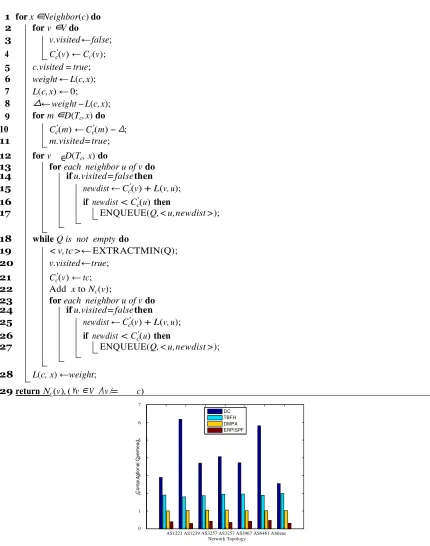
The Algorithm 1 describe how our MNP-e works.
Performance Evaluation
To evaluate our algorithm, we use the real Abilene network (11 nodes, 14 links), and four other ISP topologies inferred by Rocketfuel [11], including Exodus (79 nodes, 147 links), Telstra (108 nodes, 153 links), Tiscali (161 nodes, 328 links) and Sprint (315 nodes, 972 links).For similarity, we use a simple model to characterize link failure events. The fail probability of each link e is randomly generated in the range from 0 to 0.02. All the simulations are conducted on a PC with Intel i5 CPU at 1.7GHz and 1.5G Memory.
Computation Complexity
In order to further verify the computational performance, we make simulations on different topologies. In this section, we evaluate the computational overhead of different algorithms. In order to avoid the uncertain factors impact the algorithms performance. The computational overhead of an algorithm is defined as the ratio of computation time of the algorithm to that of SPF.
Fig. 1 indicates the computational overhead obtained by different algorithms on Abilene and Rocketfuel topologies. From the Fig. 1, we can see that ERPISPF has the lowest computation overhead among all the algorithms. The computation overhead of ERPISPF is less than build a SPT, while DMPA need to construct a SPT and TBFH need to compute two SPTs. The computation overhead of DC is proportionally to the degree of the network average node degree.
Algorithm 1: MNP-e Input: Network graph G= (V, E) Input: Node c running the algorithm Output: Nc(v),
( , ) ( )=
( ( )) ( , ) c
c c
v p c v c
B v
B p v p c v c
=
≠
∈
1 for x ∈ N eighbor(c) do
2 for v ∈ V do
3 v.visited ← f alse; 4 Cc′
(v) ← Cc(v);
5 c.visited = true;
6 weight ← L(c, x); 7 L(c, x) ←0;
8 △← weight − L(c, x);
9 for m ∈ D(Tc, x) do 10 Cc′
(m) ← Cc′
(m) − △;
11 m.visited = true;
12 for v D(Tc, x) do
13 for each neighbor u of v do
14 if u.visited = f alse then
15 newdist ← Cc′
(v) + L(v, u);
16 if newdist < Cc′(u) then
17 ENQUEUE(Q, < u, newdist >);
18 while Q is not empty do
19 < v, tc >←EXTRACTMIN(Q);
20 v.visited ← true;
21 Cc′
(v) ← tc;
22 Add x to Nc(v);
23 for each neighbor u of v do
24 if u.visited = f alse then
25 newdist ← Cc′(v) + L(v, u);
26 if newdist < Cc′ (u) then
27 ENQUEUE(Q, < u, newdist >);
28 L(c, x) ← weight;
29 return Nc(v), (∀v ∈ V ∧ v ≠ c)
7 6 5 4 3 2 1 0
[image:3.612.85.515.56.602.2]AS1221 AS1239 AS3257 AS3257 AS3967 AS6461 Abilene Network Topology
Figure 1. Computation time on real and measured topologies.
Network Availability
[image:3.612.89.310.68.445.2]We formally define the network availability A(tt) as follows , and use it as a main metric to evaluate the protection capability of different schemes.
Table 1. Network availability for real and measured topologies.
Network ERPISPF Network Availability(%) DC TBFH DMPA
Real Abilene 97.12 97.12 94.45 96.89
Exodus 91.25 91.25 86.76 90.01
∏
Measured Telstra 93.23 93.23 87.34 92.11
Tiscali 92.65 92.65 84.45 90.89
Sprint 93.25 93.25 83.45 90.13
The end-to-end availability of a source-destination (s-d) pair is defined as the probability that the packets can be correctly forwarded from s to d. Assume that there exist n different forwarding paths from s to d, the i-th which is denoted by pi(s, d). We also use Pi(s, d) to represent the set of links on the pi(s, d). Further, let the event that pi(s, d) works be denoted by Ai(s, d), whose probability can be expressed as:
P (Ai) = r(m, n)
∀(m,n)∈Pi(s,d)
According to the Inclusion-Exclusion principle, the end-to-end availability of a source-destination pair can be expressed as:
n
A(s, d) = (−1)(k−1)Sk
k=1
Then, the network availability can be computed as:
Table 1 provides the network availability provided by each protection scheme, on the real and measured topologies. From the results, we can see that ERPISPF has a clear advantage over TBFH and DMPA, and has the same perform as DC.
Conclusion
This paper deeply studies the shortcomings of existing schemes, and proposes an efficient routing protection scheme based on i-SPF. The scheme only needs to be based on the shortest path Tree based on the link weight changes dynamically adjust the tree, and then in the new shortest path tree based on the calculation of backup routing. Therefore, ERPISPF is suitable for deploying in the actual network. The experiment results show that ERPISPF can provide the same protection ratio with DC while has a lower computation overhead, which provides an efficient solution for the ISP to solve the Internet route availability problem.
Reference
[1] A. Markopoulou, G. Iannaccone, S. Bhattacharyya, C.-N. Chuah, Y. Ganjali, and C. Diot, “Characterization of failures in an operational ip backbone network,” IEEE/ACM Transactions on Net- working, vol. 16, no. 4, pp. 749 – 762, 2008.
[2] J. Moy, “Rfc 2328: Ospf version 2,” Internet Society (ISOC), 1998.
[3] E. A. Atlas and E. A. Zinin, “Basic specification for ip fast reroute: Loop-free alternates, rfc 5286,” 2008.
[4] P. M´erindol, P. Francois, O. Bonaventure, S. Cateloin, and J. J. Pansiot, “An efficient algorithm to enable path diversity in link state routing networks,” Comput. Netw., vol. 55, no. 5, pp. 1132–1149, Apr. 2011.
[5] Y. Ohara, S. Imahori, and R. Van Meter, “Mara: Maximum alternative routing algorithm,” in Proceedings - IEEE INFOCOM, 2009, pp. 298–306.
[6] H. Q. Vo, O. Lysne, and A. Kvalbein, “Routing with joker links for maximized robustness,” in IFIP Networking Conference, 2013. IEEE, 2013, pp. 1–9.
∑
,
( , ) ( )
| | (| | 1|) s d V
A s d A G
V V
∈
∗ −
[image:4.612.184.431.65.102.2][7] X. Yang and D. Wetherall, “Source selectable path diversity via routing deflections.” in SIGCOMM. ACM, 2006, pp. 159–170.
[8] S. Nelakuditi, S. Lee, Y. Yu, Z.-L. Zhang, and C.-N. Chuah, “Fast local rerouting for handling transient link failures,” IEEE/ACM Transactions on Networking, vol. 15, no. 2, pp. 359–372, 2007.
[9] K.-W. Kwong, L. Gao, R. Guerin, and Z.-L. Zhang, “On the feasibility and efficacy of protection routing in ip networks,” in IEEE/ACM Transactions on Networking, vol. 19, no. 5, 2011, pp. 1543–1556.
[10] H. Q. Vo, O. Lysne, and A. Kvalbein, “Permutation routing for increased robustness in ip networks,” 2012, pp. 217 – 231.