DESIGNING L2-BASED COMMUNICATION STRATEGIES TEACHING FOR SPEAKING CLASS
(A Thesis)
By
NUH SUNYOTO
MASTER IN ENGLISH EDUCATION STUDY PROGRAM LANGUAGE AND ARTS EDUCATION DEPARTMENT
TEACHER TRAINING AND EDUCATION FACULTY LAMPUNG UNIVERSITY
ABSTRACT
DESIGNING L2-BASED COMMUNICATION STRATEGIES TEACHING FOR SPEAKING SKILLS
By Nuh Sunyoto
This research is intended (1) to investigate students’ speaking skills after being taught L2-based communication strategies (CSs), (2) to find out students’ frequency of using CSs, and (3) to introduce the procedure of CSs implemention. CSs consist of three components of strategies namely, approximation, circumlocution, and appeal for assistance.
This research uses quasi-experimental design, and is planned and conducted on the first Semester of Academic Year 2016/2017, at Public Senior High School Two Gadingrejo, it is situated in Regional Government of Pringsewu, Lampung Province. In this case, to be a group of learners as research participants are the students of grade twelve (third year graders) of Physics Science Two. It consists of 36 participants. The reason is that grade twelve of Physics Science Two is assumed that it has the similarity level of spoken English. The data were analyzed using repeated measure t-test.
DESIGNING L2-BASED COMMUNICATION STRATEGIES TEACHING FOR SPEAKING CLASS
By:
NUH SUNYOTO
A Thesis
Submitted in a Partial Fullfillment of the Requirements for Obtaining S-2 Degree
MASTER IN ENGLISH EDUCATION STUDY PROGRAM LANGUAGE AND ARTS EDUCATION DEPARTMENT
TEACHER TRAINING AND EDUCATION FACULTY LAMPUNG UNIVERSITY
CURRICULUM VITAE
The writer was born on January 26, 1962 in Regional Government of Jember, East Java, he is the second son among five children of a lovely couple, Sukorno and Mrs. Sukasi. He has one elder brother, two younger brothers and one sister.
He graduated from Elementary School (SD Negeri 1) Sindang Anom, Central Lampung in 1975, Junior High School (SMP Negeri 2 ) Poncowati, Central Lampung in 1979, Private Teacher Training School (SPG-PGRI) Poncowati Central Lampung in 1982, and attended Lampung University in 1983/1984, and graduated on March 16, 1989. Since then, he was appointed as headmaster of private vocational school of STM Budi Karya South Lampung for four years Then the writer has been a teacher of English for almost nineteen years, fourteen years serving for SMP Negeri 1 Pardasuka, after that reciting to SMA Negeri 2 Gadingrejo until now.
The writer also attended Lampung University in 2014, for gaining Master Degree of English Education Study Program, Language and Arts Education Department Teacher Training and Education Faculty, and graduated in 2017
MOTTO
ACKNOWLEDGEMENTS
Thank Allah SWT the Greatest, the Almighty and Merciful God, for blessing the writer with faith, health, and opportunity to finish this research entitled “Designing L2-based Commmunication Strategies Teaching for Speaking Class.” This research is submitted as a compulsory fulfillment of the requirements for
obtaining S-2 Degree of Postgraduate English Education Study Program at Lampung University.
In this occasion, the writer would like to express his appreciation and sincere gratitude to the followings :
1. His first advisor, Prof. Ag. Bambang Setiyadi, M.A., Ph.D., for his guidance, encouragement, and valuable suggestion.
2. His second advisor, Dr. Muhammad Sukirlan, M.A., for not only his sincere concern, guidence, but also, his interest, and patience shown him during the accomplishment of his thesis.
3. His first examiner Prof. Dr. Cucu Sutarsyah, Dip.TESL, M.A., for his attention and valuable suggestion.
4. His second examiner, Hery Yufrizal, M.A., Ph.D., for his attention and valuable suggestion.
5. All of his honorable lecturers of English Education Study Program, Language and Arts Education Department, Teacher Training and Education Faculty, Lampung University
6. Hi. Drs. Daryanta, M.Pd., Headmaster of SMA Negeri 2 Gadingrejo, Regeional Government of Pringsewu, Lampung Province who allowed him to attend Lampung University for gaining Master Degree in English Education Study Program.
8. His greatest love and thankfulness would forever be dedicated to his beloved spouse Hida Nuh, his handsome sons, Ayi and Dito, and his lovely daughter Lia who is well known as Dede. It is truly undoubted that loves, cares, and timeless prayers during days and nights, patience and willingness to wait for their Dad’s graduation are very precious for him.
9. His beloved brothers and sister; Hari, Rudy, May, and Endah, for their pride of him.
10. All of his closed friends of MPBI of Academic Year 2014, Arief Aprizal, Didi Pitoyo, Dita Yusmelita, Efi Litaria, Endah Dwi Rahmawati, Ernaini, Fais Nurul Hadi, Febriyanti, Fellicia Agustine, Ferayani Ulrica, Fitri Agustine, Fitri Susmiati, Harits Setiawan, Intan Trinei Chodijah, Iswahyudi, Lutfan Adli, Meutia Febriyani, M. Iqbal Arram, Muhammad Riza, Nining Yasrida, Novita Sari, Nur Arifah Hanafiah, Panji Wisastra, Rizqi Fitria Mulyadi, Septy Ayuningtiyas, Sulastri, Titis Arsiwi, Uswatun Khoiriyah, Vivian Agustine, Wendy Wirawan, Yuli Anita Pahpahan, for being stick together and having such a nice moment.
Last but not least, the writer hopes that this research would give a positive contribution to the development of study field and to the reader.
Bandar Lampung, 29 March, 2017 The writer,
DEDICATION
This greatest work is enterily dedicated towriter’s beloved figures; 1. Hida Nuh , spouse
CONTENTS
ABSTRACT TITLE APPROVAL CURRICULUM VITAE MOTTO ACKNOWLEDGEMENT DEDICATION CONTENTSI. INTRODUCTION ... 1
1.1 Background ... 1
1.2 Research Questions ... 6
1.3 Objectives ... 6
1.4 The Uses of Study ... 7
1.5 The Scopes ... 7
1.6 Definiton of Terms ... 7
II. FRAME OF THEORIES... 10
2.1 Target Language. ... 10
2.2 The Goal of English Teaching. ... 12
2.3 The Problems of Teaching and Learning English. ... 13
2.4 The Nature of Communication Strategies. ... 14
2.5 Taxonomy of Communication Strategies... 19
2.6 L2-based Communication Strategies. ... 22
2.6.1 Basic Definition... 27
2.6.2 Teaching Materials ... 29
2.6.3 Teaching of L2-based Communication Strategies ... 30
2.7 Implementing of L2-based CSs Teaching Activities ... 34
2.7.1 Building Knowledge of Field (BKF) ... 35
2.7.2 Modeling of Text (MT) ... 36
2.7.3 Joint Construction of Text (JCT) ... 38
2.7.4 Independent Construction of Text (ICT)... 39
2.8 Implementing of L2-based CSs in the Lesson Plan ... 40
2.8.1 Pre-activities... 40
2.8.2 Main Activities ... 43
2.8.3 Post-activities ... 45
2.9 The Expected Model ... 46
2.10 Hypotheses ... 47
III. RESEARCH METHOD ... 48
3.1 The Design of the Research... 48
3.2 Data Collecting Technique... 49
3.3 Research Instruments. ... 50
3.4 Validity and Reliability.of the Test Instruments ... 52
3.4.2 Reliability of the Test Instrument. ... 53
3.5 Data Analysis. ... 53
3.6 How to Conduct the Research. ... 53
IV. RESULT AND DISCUSSION... 56
4.1 Result ofStudents’ Speaking Achievement ... 56
4.1.1 Pre-test ... 56
4.1.2 Treatment... 60
4.1.3 Posttest... 61
4.1.4 T-test... 64
4.2 Students’ L2-based CSs Frequency... 68
4.2.1 Approximation (Apx)... 68
4.2.2 Circumlocution (Cir)... 68
4.2.3 Appeal (App)... 69
4.2.4 Communication Strategies which Students Used ... 71
4.2.4.1 Approximation (Apx) ... 71
4.2.4.2 Circumlocution (Cir) ... 73
4.2.4.3 Appeal (App) ... 75
4.3 The Procedure of Implementing L2-based CSs ... 76
4.3.1 Introduction to Strategies ... . 76
4.3.2 Implementation of Strategies. ... 79
4.3.3 Practice of Expected Model. ... 80
4.4 Discussion. ... 87
4.4.1 Students’Speaking Achievement. ... 88
4.4.2 Frequency of CSs Student Used. ... 88
4.4.3 The Proposed Procedures in Using L2-based CSs. ... 89
4.4.3.1 Introduction ... 90
4.4.3.2 Implementation... 91
4.4.3.3 Practice of Expected Model... 92
1) Picture Slide Show. ... 92
2) Evaluation. ... 94
a) Speaking Achievement. ... 94
b) L2-based CSs Frequency... 95
c) The Newly Designed Procedure. ... 95
V. CONCLUSIONS AND SUGGESTIONS ... 107
5.1 Conclusions... 107
5.2 Suggestions. ... 108
APPENDIXES ...
Appendix 1. Elicitation Test ... 114
Appendix 2. Test Item of Speaking ... 117
Appendix 3. Oral English Rubrics ... 118
Appendix 4. Matrix of L2-based Comunication Strategies. ... 119
Appendix 5. Classroom Setting. ... 121
Appendix 6. Taxonomy of Communication Strategies. ... 122
Appendix 7. Matrix of the Procedure of Implementing L2-based 128 Appendix 8. Lesson Plan. ... 130
TABLES...
Table 1. Frequency of the Students’Speaking Score on Pre-test . 164
Table 2. Cronbach’s Alpha Criteria... 164
Table 3. Correlation of Tested Instrument on Pre-test... 164
Table 4. Frequency of the Students’Speaking Score on Posttest . 165 Table 5. Correlation of Tested Instrument on Posttest ... 165
Table 6. The Score of Pre-test and Posttest ... 165
Table 7. Paired Sample Statistics... 166
Table 8. Paired Sample Correlation ... 166
Table 9. Paired Sample Test ... 166
Table 10. L2-Based CSs. Frequency in General ... 166
Table 11. Paired Sample Test of Approximation... 167
Table 12. Paired Sample Test of Circumlocution ... 167
Table 13. Paired Sample Test of Appeal... 167
Table 14. Paired Sample Test of CSs. Before–After ... 167
Table 15. Speaking Score on Pre-Test by Rater 1 ... 170
Table 16. Descending Speaking Score on Pre-Test by Rater 1 .... 171
Table 17. Speaking Score on Pre-Test by Rater 2 ... 172
Table 18. Descending Speaking Score on Pre-Test by Rater 2 .... 173
Table 19. Average Speaking Score on Pre-test by Rater 1 and 2. 174 Table 20. Composite Score on Pre-Test by Rater 1 and 2 ... 175
Table 21. Descending Composite Score on Pre-Test by R1,and 2 176 Table 22. Speaking Score on Posttest by Rater 1 ... 177
Table 23. Descending Speaking Score on Posttest by Rater 1... 178
Table 24. Speaking Score on Posttest by Rater 2 ... 179
Table 25. Descending Speaking Score on Posttest by Rater 2... 180
Table 26. Average Speaking Score on Posttest by Rater 1 and 2 . 181 Table 27. Composite Speaking Score on Posttest by Rater 1 and 2 182 Table 28. Descending Composite Score on Posttest by Rater 1,2. 183 Table 29.The Student’s L2-based CSs Gain in General ... 184
Table 30.The Students’ L2-based CSs Frequency individually... 187
Table 31. The Frequency of Approximation Used Before and After 188 Table 32. The Frequency of Circumlocution Used Before and After 189 Table 33. The Frequency of Appeal Used Before and After ... 190
GRAFICS... 193
Graphic 1. Frequency of Speaking Score on Pre-test ... 194
Graphic 2. Frequency of Speaking Score on Posttest ... 194
I. INTRODUCTION
1.1 Background
By tens of years ago, the most favorite teachers’ technique in teaching was lecturing. Nowadays it is still in use because, too simple and easy, without much complicated preparation. So it becomes much used by the teachers, as the result of the sole teachers’ technique mastery. Undeniably, the technique is still in use, even though it is considered out of date or not effective any more. In teaching English, there are several well known techniques which can be used to teach more effectively such as; Grammatical technique, Aural technique, English-Only Technique, Translative Technique, Immersive Technique, to students who are learning the language for the first time, each with their own unique process and conditions. Depending on the teaching situation, setting, and resources available, any one of these English teaching techniques could be right for the teacher and the students
In accordance with the case, Setiyadi, et al. (2007) points out that a person who finishes high school must have a very substantial knowledge of English, but this is not the case with most of Indonesian students. After three years at junior high school and three years at senior high school, the English proficiency of the students is very limited. The students have difficulties in reading textbooks written in English and they cannot communicate in English in both spoken and written forms.
A great deal of practice and training is beneficial for the students to be familiar with communication strategies. In addition, a teacher who communicates effectively with his/her students is a good teacher. In teaching and learning, there must be interaction between the teacher-student and the student-teacher, so they build a good communication. It is necessary to take a note that communication strategies are needed by both teacher and students. In the process of communication, Sukirlan (2013), points out that the speaker always attempts to deliver the message to the interlocutors in many ways possible to compensate for the gaps between what he/she intends to express and the available linguistic resource. The ways the speaker uses to succeed communication also belong to communication strategies. Maleki in Sukirlan (2013) a communication strategy is defined as an individual’s attempt to find a way to fill the gap between their communication effort and immediate available linguistic resources. Ellies in Sato (2005) states that communication strategies (CSs) are what learners use to overcome the inadequacies of their interlanguage resources.
Communication is one of the essential bases of human existence; communication is the activity of communicataing; the activity of conveying information, yet most people overlook the need to enhance their communication skills. In fact, effective communication skills are a must whether it is individual or a group. It means that the successfulness of communication is main point. Communication is more than speaking. Speaking is an important aspect of communicating but this is not the only tool. Speaking clearly and effectively is much more important than merely speaking. In communication there are some barriers, such as the speakers may speak incomplete sentences or transmit unclear messages, the speakers may not do name-calling properly, and many interruptions as well. To overcome the barriers which emerge in speaking, the speaker needs some strategies, so communication strategies are the prime determinants in speaking.
In Indonesia, why English as target language at schools is often ineffective? So far English is as compulsory major at any level of education, such as; elementary school, primary school, and through at University, and it is taught at both private and public education. It is just for the reason that language is as a means of international communication. Indonesian National Education Ministry-Permendikbud (2014) states that; “ English teaching at school is expanded in order to reach communicative competence, not only mastering listening, speaking, reading and writing skill, but also doing social function, by using English skillfully both spoken and written language correctly.
Unfortunately, the objective of teaching English as target language is ineffective. Karimnia (2007) states that there have been a lot of complain made about the weakness of school graduated in English. After three years at junior high school and three years at senior high school, the English proficiency of the students is very limited (Setiyadi, 2007). In other words, their English is very low. It is a big problem, so by having inappropriate English they cannot communicate successfully.
That is why for the sake of knowledge development, this research just discusses about the usage of three sub-types of communication strategies, namely: approximation, circumlocution, and appeal for assistance, based on Karimnia’s work (2007). Some benefits of CSs are; it is light to be used in promoting students speaking skills. In the implementation, the teacher does not need to take a long time for it. It also has clear strategies pattern, and is easy to be implemented by the students. Therefore, in this research, designing L2-based CSs teaching materials will be developed in this research.
1.2 Research Questions
As it is discussed above, the research focuses just on designing L2-based communication strategies teaching material for promoting students’ speaking skill. In accordance with this, the questions may come up;
1. Is there any difference of students’ speaking skills after being taught L2-based Communication Strategies?
2. How is the students’ frequency of using Communication Strategies?
3. What is the procedure of implementing L2-based Communication Strategies teaching materials?
1.3 Objectives
The objectives of the research are:
1. To find out whether the students’ speaking skills can be increased or not after being taught with L2-based Communication Strategies.
3. To introduce the procedure of L2-based Communication Strategies teaching material.
1.4 The Uses of Study
This research is designed in order to obtain:
1. Practical uses, the teacher can apply L2-based communications strategies (L2-BCSs) design for promoting students’ speaking skills.
2. Theoretical uses, it is useful to develop students’ language skills, especially spoken language based on communicative strategies.
1.5 The Scopes
This research is mainly focused on three answers of the research questions, i.e.; first of all, the students’ speaking skills before and after being taught L2-based Communication Strategies (CSs), second, students’ frequency of using Communication Strategies before and after treatment, and the last one is the procedure of implementing L2-based Communication Strategies teaching materials in the classroom. These scopes will be discussed on the next chapters. This research is conducted at State Senior High School 2 Gadingrejo
1.6 Definition of Terms
In this research, there are some well known terms, such as: a. Teaching Material
In other words teaching materials are not only printed book, but also instruction sheet, worksheet, information sheet are teaching materials.
b. Target Language
Target Language is the language which the teacher and the students want to learn or the language learners are studying and also individual items of language that they want to learn, or the teacher wants them to learn.
c. Teaching Speaking
Teaching speaking is to help students and develop their communicative competence. It means that teaching speaking is teacher’s activity in the classroom which is intended to help students communicate in a variety of contexts. In this research it deals with teaching speaking of English. In other words, teaching speaking" is to teach ESL learners to: produce the English, and use English quickly and confidently with few unnatural pauses, which is called as fluency.
d. Communication Strategies
e. L2-based Communication strategies.
L2-based Communication Strategies (L2-b CSs) refer to the the way that L2 English learners try to communicate in the target language which enables them to communicate successfully.
L2-based Communication Strategies consist of Approximation, Circumlocution, Appeal for Assistance.
1) Approximation; one of the communication strategies whereby the speaker uses a single target language vocabulary item or structure, which the speaker knows is not correct, but which shares enough semantic features in common with the desired item.
2) Circumlocution; saying in many words what may be said in few words. More specifically, circumlocution is defined as a change in preverbal message involving more than single chunk.
3) Appeal for Assistance; An assistance used in order to maintain the flow of communication, the speaker appeals for assistance
II. FRAME OF THEORIES
Since English is seen as a means of international communication, many people all over the world try to communicate in both spoken and written English, so English is essential to be learnt. Many schools provide English as compulsory subject, and state it in National Curriculum. In any discussion of linguistics, English is often appointed or called it as target language (TL). Even though the word Target Language (TL) gets issued in all the discussions, but it seems hard to define what target language really is, and are not enough definitions available.
2.1 Target Language
According to McCoLL (2010) the target language can be said to be used‘forreal purposes’ when it is used to communicate what people in the classroom need and/or want to say anyway. In other words, during language learning sessions, teacher and pupils attempt to use the language for all necessary purposes, even if they are not, strictly speaking, part of the language lesson. In the classroom, the learners should be exposed as much as possible to the target language. Dickson (1996) states that the medium of instruction in the language classroom should,
without qualification; be the target language, and there has been little dispute,
among language teachers and others concerned with foreign language education,
over theprinciple thatlearners in school should be exposed as much aspossible to
thetargetlanguage (TL) in use.
According to both points of view above, the definitions of target language is the language learners are studying, and also the individual items of language that they want to learn, or the teacher wants them to learn or a language that someone is learning, or a language into which a text has to be translated. An example of a target language is Japanese for a native born Indonesian who is just moving to Japan.
In the case of Target Language, Ministry of Education and Culture-Mendikbud issues that English is compulsory subject and attached it in the list of subjects which must be taught at school (see Permendikbud 2014).
2.2 The Goal of English Teaching
The goal of English teaching is to enable the students to develop their communicative competence in the forms of both spoken and written intelligibly. Furthermore, Permendikbud (2014) the goal is not to understand and implement the concept, but to actualize English as social function. It means that language is a means of communication. So far teaching English is centralized to the teacher in which the students learn English based on the teacher’s explanation, do exercise at school, and do homework. Following time, technique of learning English must go naturally and like the process of learning anything in daily life.
Undeniably, In case of learning language, many language learners regard speaking ability as the measure of knowing a language. Even though speaking is constructed by the aspects; pronunciation, grammar, vocabulary, fluency, and comprehension. They regard speaking as the most important skill they can acquire, and they assess their progress in terms of their accomplishments in spoken communication.
In communication, they need communication skill; communication skill is the set of skills that enables a person to convey information so that it is received and understood by interlocutor, as well as they need communication strategies (CSs) to make understanding between the speaker and the interlocutor. Many researchers (e.g. Ogane, 1980; Tarone, 1981; Paribakht, 1984; Karimnia, 2010; Sukirlan, 2013) donate their ideas about Communication Strategies (CSs). Basically, they argue CSs are the ways which are closely related with how non-Native English speakers to communicate in English well at the end. In other words, non-native English speakers are able to reach the ultimate goal of learning English, they communicate in English well in the real situation. Karimnia (2007) states that the goal of English teaching is to develop the learners’ communicative competence which will enable them to communicate successfully in the real world. It means that the learners are able to communicate in English successfully, and they can transport the message to the interlocutors skillfully.
2.3 The Problems of Teaching and Learning English
Unfortunately, the effort to reach the objective of teaching never makes a whole. There are a lot of problems which make the technique of teaching and learning English are not effective namely; teacher’s technique is out of date. The teacher merely tends to use lecturing technique, both teacher and students are lack of supporting media, readings and the like. So by facing such problems, the objective of teaching still cannot be reached maximally. In other words, at the end of course the students are still not able to communicate in English
In accordance with Setiyadi, et al. (2007) a person who finishes high school must have a very substantial knowledge of English, but this is not the case with most of Indonesian students. After three years at junior high school and three years at senior high school, the English proficiency of the students is very limited. The students have difficulties in reading textbooks written in English and they cannot communicate in English in both spoken and written forms. Following these point of views, it can be said that the objective of teaching English at school is ineffective, and is necessary to find strategies.
2.4 The Nature of Communication Strategies
It is a process, by which a communicator conveys meaning and tries to create understanding. Berelson and Steiner in Razmjou. et.al. (2013) argued that “Communication: the transmission of information, idea, emotion, skills, etc., by
the use of symbols-words, pictures, figures, graphs, etc. It is the act or process of transmission that is usually called communication”. Communication involves at least two people: the sender and the receiver.
According to Thao in Hua (2012) communication is simply defined as a process in which a message is sent from senders to receivers. Technically, it is said that the sender encodes a message and the receiver decodes it. In other words, communication is the activity of communicating or conveying information, and it involves between two or more people to create understanding. As a matter of fact, the activity of communicating or conveying information does not run well. In short, people who create understanding in their communication often go through the problem or gap, communication becomes breakdown, and the purpose what they communicate does not make a whole, so it is necessary to send or convey the message successfully.
It means that to enhance their communication skill people need to learn about communication. It is necessary that the speaker and interlocutor try to seek the easiest ways for communicating the purpose of what they communicate, such as using gesture, sounds, body movement, and the like. The usage of gesture, sounds, body movement, and the like are assumed as strategy to solve their communication problems. And such easiest ways are, here, called with Communication Strategies (CSs)
Ogane (1998) defined communication strategy as a technique that is used to solve problems in reaching communicative goal. Communication strategies are used to reach a certain communication goal, that is, to tell the other person(s) what you really want or need to say.
In early works, Huang (2010) regarded communication strategies as language learners’ problem-solving behavior in process of target language communication.
Language learners employed Communication Strategies (CSs) to compensate for their linguistic shortcomings in order to achieve a particular communicative goal. Selinker in Huang (2010) Communication Strategies (CSs) was defined as a learner’s attempt to express meaning in spontaneous speech through a limited target language system. Furthermore, Sukirlan (2013) stated Communication Strategies are seen as attempts to bridge the gap between the linguistic knowledge of the speaker and the linguistic knowledge of the interlocutor.
Williams and Burdon in Sener (2013) defined communication strategies as “strategies used by speaker when they come across a difficulty in their communication because of a lack of adequate knowledge of the language.” It is
great possible that the speaker and interlocutor come across the problem during performing communication. It can be summarized that in case to communicate, the role of strategies is required by both speaker and interlocutor urgently.
Following the experts’ point of views above, they have some similarities to
Tarone’s Communication Strategy (hereafter; CSs) as a mutual attempt of two interlocutors to agree on meaning (1981), Paribakht’s CSs as vehicle to solve the problem (1984) Ogane’s CSs as a technique which is used to solve the problem
(1988), Dőrnyei’s CSs was the way people use, such as; use hands, imitate the sound or movement of things, mix language, create new words to describe they do not know the word for (1995), Huang’s CSs as a process to compensate for their linguistic shortcomings in order to achieve a particular communication goal (2010), Sukirlan’s CSs as a attempt to bridge the gap, it means to make communication run well (2013), Williams and Burdon in Sener’s CSs as strategies used by speaker when they come across a difficulty in their communication (2013), Selinker in Huang’s CSs as a learner’s attempt to express meaning in spontaneous speech through a limited target language system (2010). Even though the phrase “Communication Strategy” get used all the time in linguistic study, it may be surprisingly hard to pinpoint what Communication Strategy really is.
2.5 Taxonomy of Communication Strategies
This sub-chapter discusses about some taxonomies of Communication Strategies. There have been a number of proponents of communication strategies who have the typologies of communication strategies. They tried to clasify the strategies and the features which the speaker and interlocutor used. In some occasions, it is great possible that communication comes across breakdown, as the result of a shortage of linguistic knowledge. In other words, the gap was available between speaker and interlocutor; it often happens that both speaker and interlocutor try to avoid the communication breakdown. These efforts are defined as Reduction Strategies. According to Færch and Kasper in Ellis (1985) states that Reduction Strategies attempts to do away with a problem. They involve the learner giving up part of his original communicative goal.
Færch and Kasper in Ellis (1985) classifies Reduction Strategies is divided into two types of features namely; 1) Formal reduction strategies - these strategies involve the avoidance of L2 rules of which the learner is not certain (i.e. tentative hypotheses) or which he cannot readily gain access to. Example; He made him to go … He asked him to go … According to the example; the idea of
The learners misunderstand about diction, they seem lack of vocabularies. Taxonomy of Communication Strategies based on Færch and Kasper in Ellis. 1985, (see Appendix 6).
In case to avoid the communication breakdown, both speaker and interlocutor also often use sub-features which well known as Word Coinage. see Færch and Kasper in Ellis (1985), and Word Coinage of Yarmohammadi & Seif in Ogane 1998. Tarone in Sukirlan (2013).The followings are the similarities and the difference between Word coinage of Færch and Kasper in Ellis, and Word Coinage of Yarmohammadi & Seif in Ogane.
The similarities between Færch and Kasper in Ellis (1985), and Yarmohammadi & Seif in Ogane (1998) are to discuss about Word coinage which discuss about replacement of strategies in expressing target language; Example; ‘gallery’ ‘picture place.’ And Word Coinage of Yarmohammadi & Seif in Ogane (1998) example; balloon–plastic ball
Halliday, et.el. in Karimnia (2007) states that oral mastery depends on practicing and repeating the patterns produced by a native speaker of the foreign language. It is the most economical way of thoroughly learning a language. When one has such a control of the essentials of a language; he can almost automatically produce the usual patterns of that language. Based on this point of view, it seems that learners need a great deal of practice and use through the patterns of English intelligibly, so both speaker and interlocutor communicate automatically and successfully.
2.6 L2-based Communication Strategies
This sub-chapter discusses a lot about L2-based communication Strategies to encounter communication problem between the speaker and the interlocutor, and it is as main frame of theories in this research. What is L2-based Communication Strategy really? It is as difficult as to find a rigorous definition of communication strategies. Based on the features of L2- based CSs before and after discussion which are available, it is assumed that L2-based Communication Strategy is the way that L2 English learners try to communicate in the target language (TL) successfully. It consists of three features which are discussed a lot below.
Karimnia (2007) states that L2-based Communication Strategies consists of three features namely; Approximation ( A use of a L2 word which shares the essential feature of the target word e.g. “Old objects” for “antique”) enables the speaker to produce synonym, antonym, and hyponym. Circumlocution ( A use of a L2 phrase to describe the property, function, characteristics, duty, its purpose or an example of it,). Basically, this strategies has a lot of features of strategies e.g.“It is used to write”[pen, pencil], “They have long, flat heads with rounded snouts, scaly skin,
bowed legs, and huge, muscular tails” [Komodo Dragon], “Something you put your food in to make it cold” [refrigerator], Appeal (An appeal for assistance either implicit or explicit), e.g. “What do you call this in English?” “It’s ah ah ah…”
features of L2-based CSs which Sukirlan issued. And those features would be patterns for the students practicing spoken English in the classroom, and as the frame of theories in this research. issues twelve features of Communication Strategies. Three of them are Approximation, Circumlocution, and Appeal.
Sukirlan (2014) states that Approximation serves as one of the communication strategies whereby the speaker uses a single target language vocabulary item or structure, which the speaker knows is not correct, but which shares enough semantic features in common with the desired item. Furthermore, the implementation of approximation, is deal with features used before and after teaching;
Before teaching, approximation was characterized by 2 types of features, i.e. expectancy and hyponymy relation. In case of expectancy the students acomodate relationship of the strategies, e.g.; place and function. The student produces “This object is used in children’s head to arrange their hair.” The student approximates the word “hair band” with location it is normally place, i.e. “head” and and its function, i.e. “to arrangetheirhair”.
The shovel is the type of tool. Other features such as; “It is a kind of vihicle to transport”. The student approximates the word “plane”. The plane is a kind of vehicle. Or “It belongs to large animal.” When the student is describing “elephant”.Elephant is a hyponym of animal because it has some animal qualities. Whilesynonymy relation is “It is a sweeper ...to clean the rubbish from the floor”. The student approximates “palm-rib broom” with “sweeper”
Sukirlan (2014) states that Circumlocution is saying in many words what may be said in few words. More specifically, circumlocution is defined as a change in preverbal message involving more than single chunk. In theses strategies, many features can be used by the speaker to encounter communication problem. Actually, they could expand in accordance with the topic such as; material, location, elaboration, color, shape, function, size, taste, Ingridients, price, time, parts, price.
While Appeal for Assistance is used in order to maintain the flow of communication, the speaker appeals for assistance. The speaker uses expression signaling direct appeal when encountering communication problem. The speaker usually produces utterances not only in the target language (L2) like “Do you know how to say this in English?” but also in the native language (L1) like “Apa
Based on those L2-based Communication Strategies above, It is necessary to restate that these strategies are valuable to be implemented in increasing students’ speaking skills. So far there have been a lot of complaints made about the weakness of school graduates in English (Karimnia, 2007). Undeniably, most of observers and practitioners blamed that educated people cannot communicate in English successfully. It has also been pointed out that a person who finishes high school must have a very substantial knowledge of English, but this is not the case with most of Indonesian students. After three years at junior high school and three years at senior high school, the English proficiency of the students is very limited. The students have difficulties in reading textbooks written in English and they cannot communicate in English in both spoken and written forms. (Setiyadi, et al., 2007)
L2-based Communication Strategies (L2-b CSs) refer to the the way that L2 English learners try to communicate in the target language which enables them to communicate successfully. Maldonado (2016) states that L2-b CSs is the way that L2 English learners try to communicate in the target language (TL), and thus to the communication strategies used to overcome the difficulties which arise when attempting to produce the language.
L2-b CSs consists of three features, namely; approximation, circumlocution, and appeal for assisstance. They are based on both Karimnia’s work (2007) and Sukirlan’s (2014), and can be seen in the following matrixs;
Matrix 1.
No Strategy Description Examples of Discourse Makers
1 Approximation a use of a L2 word which shares the essential feature of the target word
e.g. “old objects” for “antique”
2 Circumlocution
A use of a L2 phrase to describe the property,
function, characteristics, duty, its purpose or an example of it
e.g. “Something you put your food in to make it cold” (refrigerator).
3 Appeal An appeal for assistance either implicit or explicit
e.g. “What do you call this in English?” “It’s ah ah ah…”
L2-based Communication Strategies adopted from Karimnia, 2007 Communication Strategies; English Language Department in Iran.
Matrix 2
No Strategy Description Examples of Discourse Makers
1
Approximation One of the communication strategies whereby the speaker uses a single target language vocabulary item or structure, which the speaker knows is
1. The synonym; Drone (a flying robot, UAV) autonomous
(self-directed, self reliant, independent) 2. The antonym ; military (civil)
not correct, but which shares enough semantic features in common with the desired item
3. The hyphonym; drone ( aircraft)
2 Circumlocution
Saying in many words what may be said in few words. More specifically,
circumlocution is defined as a change in preverbal message involving more than single chunk.
1. Size, e.g.: big, large, small, 2. Color, e.g.; magenta, purple 3. Function, it isused to transport… 4. Location. e.g.; restricted area, war
zone, public area
5. Shape, e.g.: square, hexagon, pentagon, triangle
6. Material,. e.g.: it is made of metal 7. Elaboration, e.g.; it is very
common in daily life
3 Appeal
An assistance used in order to maintain the flow of
communication, the speaker appeals for assistance
1. What is….in Indonesian word? 2. Can you describe…..?
3. How to operate….? 4. What does ‘……..” mean?
L2-based Communication Strategies which is developed and adapted from Sukirlan,. 2014. Teaching Communication strategies in an ELF Class of Tertiary Level.
2.6.1 Basic Definition
After examining those L2-b CSs features, the following basic definitions of words; synonym, antonym, hyponym are often used in the discussion, especially for the approximation strategies, and much more terms like; size, color, location, are also often used in the discussion of circumlocution strategies. They are all interchanged one another. The definitions are common in daily life, and could be derived from any readings like dictionary.
And hyponym or subordinate is the word that includes the meaning of a more general notion, word. i.e.; Dog is a hyponym of animal because it has some animal qualities.“Desk, table are hyponyms of furiture”, “red, blue, yellow are hyponyms of color”, “catfish, golden fish, gianat travely are hyponyms of fish.”, “Orchid, rose, coconut palm are hyponyms of plant”.
Those synonyms, antonyms, and hyponyms are implanted to describe features of Approximation in the discussion like; “It has the same meaning as…” or “The elephant is large animal, but rabbit is small”, “It belong to plant, animal, food, clothes.” Or “It is a kind of instruments”, “It is a type of tools.”
Some of the following terms are often used in the circumlocution strategies like; size, [mass noun] the relativeextent of something; a thing’soverall dimensions or magnitude; how big something is: a building of vast size, fairly large. Color, 1 [mass noun] The property possessed by an object of producing different
sensations on the eye as a result of the way it reflects or emits light: the lights flickered and changed colour.
According to the colors; blue, green, red yellow are kinds of colors. Function, practical use or purpose in design: building designs that prioritize style over function. Location, a particular place or position: the property is set in a
Material is the matter from which a thing is or can be made: goats can eat more or less any plant material. It can be of physical need; material needs, e.g.; food and
warmth. Elaboration is the process of developing or presenting a theory, policy, or system in further detail: his work led to the elaboration of a theory of evolution the concept needs more elaboration than a short essay allows. These words are
often frequently used.
2.6.2 Teaching Materials
Once in the classroom, teacher and students do a communication. It is designed to build activities which is well known as teaching and learning process. In this process, the teacher transports information from teaching materials, such as; samples of student writing, video, model clay, story book, projector transparancies, magazines, newspaper, games So what are teaching materials ? It is anything which is used by teachers or learners to facilitate the learning. Teaching materials are the resources a teacher uses to deliver instruction. In other words, they are all of resources which are used by both teacher and students to reach the objectives of teaching and learning.
Here are others examples, when learning the concept of theme, a literature textbook can provide numerous reading materials. In the same way, workbooks can give some useful basic practice activities for a new vocabulary words or even writing activities that might be difficult for students.
2.6.3 Teaching of L2-b Communication Strategies
Here are the procedures of teaching L2-based Communication Strategies ;
1. Procedure of teaching Approximation
It is constructed with teaching synonym, teaching antonym, and teaching hyponym, so the students are provided with such discourse makers, and the discourse maker are underlined in order to indicate that the underlined words or phrases belong to L2-b CSs. They look like, as follows;
a. Materials of Teaching Synonyms
It is provided with the following phrases, or/and an example list of synonyms as follows;
. is another word for . . .
. . . means the same thing as . . .
. . . is a synonym for . . .
Example ;
- The party last night was great. (great is another word for wonderful or (great means the same thing as splendid) or (great is a synonym for fantastic)
- A list of synonym word pairs; Almost and nearly,
Applicable and relevant, Awful and terrible, Begin and start, etc.
b. Materials of Teaching Antonyms
The students will be leaded to creat sentenceslike the teacher’s models, or an example list of antonym such as;
- Cat is small animal but elephan is big animal.
- Lia did not find her pen on the desk because it fell under the desk. - A List of antonym word pairs;
Absent- present, Admit–deny, Awake–asleep,
Bottom–top, Always–never, etc
c. Material of Teaching Hyponyms
The students are taught with a list of hyponyms for the words such as; - Table, sofa, cupboard (furniture), examples;
Table is a kind of furniture. Sofa is a kind of furniture.
- Squirrel, elephant, fox (mammal) Squirrel is a kind of mammal
- Scarlet, purple, magenta (color), examples; Scarlet is a kind of color.
Purple is a kind of color.
2. Procedure of Teaching Circumlocution
In this step, the students are called on producing the sentences like teacher’s models, as the following teaching materials;
- Size
Sizes; big, large, small, long, short, medium, huge, high, wide, and narrow, e.g.; It is big - it is large - it is small - this school is big - the school yard is large. it could also be replaced by saying the possessive adjective e.g.; my, his, her, their…. my dictionary is small, the sea is wide, the sky is high .
- Color
Colors; red, white, blue, green, yellow,, magenta, etc. e.g.; Indonesian flag is red and white, the sky is blue, my favorite color is blue.
- Function;
- Location;
Locations; in public area, in the bush, etc., e.g.; it is located in public area, it can be found in the bush, etc.
- Shape
Shape; bumpy, triangle, square, pentagon, e.g.; jackfruit is bumpy, soccer field is square.
- Material;
Materials; metal, wood, plastic, e.g.; plane is made of metal, furniture is made of wood, some of appliances are made of plastic, etc.
- Elaboration;
Elaborations; common in daily life, most of people,e.g.; kissing adults’ hand by kid are very common in Indonesian daily life, most of people in my village are famers.
likes it, etc.
3. Procedure of Teaching Appeal
In this step, the students are familirized with the expressions how to ask appeal, and the teaching material as follows;
a. What is a synonym/antonym for....? b. What is another word for...?
2.7. Implementing of L2-based CSs Teaching Activities
At the beginning, it is clearly stated that L2-based Communication Strategies Teaching Materials are designed for promoting the students’ speaking skills, so it is necessary to introduce Communication Strategies to the students.
Kayi (2006) stated that; today’s world requires that the goal of teaching speaking should improve students’ communicative skill, because, only in that way, students can express themselves and learn how to follow the social and cultural rules appropriate in each communicative circumstance. There are various activities, such as; discussion, role-play, information gap, brainstorming, storytelling, interview, story completion, reporting, playing card, picture narrating, picture describing, find the difference, which can be applied in this discussion. Speaking class can not be seperated from communication. In communication, the students need strategies. In this research, therefore, the teaching materials of speaking class must be developed on L2-based Communication Strategies (CSs).
By considering such various activities which can be applied to promote the students’ speaking skills, some steps are preferably recommended to be done, namely;
Suppose, it is the first time for the teacher to attend her first meeting for her class, she wants to introduce herself and her family to the class, so she needs to tell some information about herself and family by addressing some key phrases and words related to the topic of introduction, such as; age, occupation, relatives, education and the like. Addressing some key phrases and words by teacher are intended to provide the students with vocabulary they need in speaking activities. Levy (2011) states that it seems elementary, but it is often forgotten that the students may not be participating because they do not have the vocabulary to enter specific conversation.
In accordance with the example of teacher’s performance above, she may address one or two (approximation or circumlocution) strategies. It is a great possible for her to address all of typologies of L2-based Communication strategies (CSs); approximation, circumlocution, and appeal one. In other words, approximation, circumlocution and appeal for assistance may go together. In this event, the usages of typologies are underlined. Here the steps go;
2.7.1 Building Knowledge of Field (BKF)
It is strongly recommended that the teacher must be on the track. It means that all teaching materials address features of L2-b CSs, and they are highlighted by underlining or thicking.
Example 1; Model of the text
“Hi, I’m Regita, R-E-G-I-T-A. (Regitaspelt her name) I’m your English teacher. I’m thirty years old. I come from Pringsewu. I live in a small (not large) village
with my parents. My Dad is Carpenter. Do you know what carpenter is?
Carpenter is aa..a.. workman who makes and repairs (esp) the wooden part of
building and other structures of wood, and my mom is a housewife.
After school hours, I go home at once, then take a nap (sleep in the afternoon), afterword I do other activities.”
2.7.2 Modeling of Text (MT)
Modeling of Text (MT) is meant to introduce both spoken and written text which relate ith the topic of discussion (Depdiknas, 2004). According to the research, the teacher introduces features of L-2 b CSs which are written on the white board to the students. To make interesting discussion, the teacher here points and asks a student (trained and under-covered student) in turn to introduce oneself to the class as the teacher did. Here the introduction of a student names Lita.
Example 2; Model of the Text (MT)
Hi guys! I’m Lita. I live in… (Pardon? What’s your name? Teacher interrupts
Then she carry on by saying; I’m Lita. I live in Way Lima with my parents. My Dad (Dad is a synonym for father) is a.. aa.. farmer and my mom (mom is
another word for mother) isa…, ahousewife.That’s all thank you.
By doing those introduction; teacher’s and Lita’sperformance above, are intended to foster students’ bravery to speak freely and easily. It is necessary to take a note what kinds of Communication Strategies (CSs) are available on the teacher’s
performance,? It can be seen on the utterances;
1. “… in small (not large) village….” Mime as well as Approximation of CSs are played by the teacher with moving about her hands to convey meaning such as point her little finger for small size, middle finger stands for long size, and thumb stands for big size. In this case, what the teacher has done belongs to Circumlocution of Communication Strategies.
2. “Do you know what carpenter is? Carpenter is aa..a…” an Appeal for Assistance of CSs played the role here. And, …workman (workman is an
antonym for workwoman) who makes and repairs (esp) the wooden part of
building and other structures of wood.” Circumlocution of CSs played L2 phrase to describe characteristic of Carpenter.
While on the side of Lita’s performance,what kinds of Communication Strategies are available? And what does teacher want on it?
1. Teacher calls on Lita to introduce herself as an opening of more activities. Kayi (2006) stated that; in this way, not only will the teacher address students’ speaking ability, but also get attention of the class. In addition, the teacher wants to attract more students’ attention for making next activities easier.
2. Lita is a model, what Lita did is intended for other participants to do the same thing or even more than Lita did.
3. Lita played and designed an appeal of CSs to express the word “farmer, and housewife” by pausing; a pause of pauses filler, such as “uh.., er.” It is intended to attract the participants to give an input.
4. Teacher introduces features of L2-b Communication Strategies before applying next strategies for the next activities.
2.7.3 Joint Construction of Text (JCT)
1. Ways to signal a conversation that they do not understand a particular word and to ask for an explanation; what’s the word? / What do you say..? I’m sorry, what does … mean? / Excuse me, what is…?”
2. Ways to take time when they think of what to say; just a moment, please. / Give me a moment.
3. Ways to check or confirm if their partner understood or how to confirm their partners’ understanding; Do you understand? / Do you know what I mean?/ Can you understand me? /Do you mean…? / ….? Is that what you mean? 4. Ways to signal either they understand the explanation or not; I see / I
understand, / I’m sorry, I don’t understand
2.7.4 Independent Construction of Text (ICT)
In this step, the students are expected to be able to communicate or do monologue by themselves intelligibly and spontaneously (Depdiknas, 2004). The teacher asks participants to do monologue based on a given task, and then participants are persuaded to manipulate any L2-b CSs in many ways which they gain based on three previous steps by using the Discourse Makers they know.
However, the Discourse Makers of the strategies above need simplicity to agree with the selected topics of curriculum contents in the form of lesson plan teaching material. In this research, those discourse makers are implemented in the Lesson Plans of three meetings namely;
1. The 1stmeeting; Drone, with the exercise topic; “Buskers”
After being implemented in such a way; L2-based Communication Strategies are assured to produce better result, and more productive in communication.
2.8 Implementing of L2-based CSs in the Lesson Plan
Approximation, circumlocution, and appeal for assistance of L2-based Communication Strategies can/cannot go together in many ways such as in teaching English language. Cyclically, Teaching activities are divided into three phases, namely; pre-activity, main activity, and post activity.
Here is; “Drone,” an example for teaching material, and how those L2-based Communication Strategies can be implemented in teaching activities.
The Lesson Plan Topic : Drone
Content : Students will recall the discourse makers of L2-based Communication Strategies while expanding their vocabulary. It is intended that the students will better understand the strategies.
2.8.1 Pre-activities
It is then model of the assignment for the class based on L2-based CSs, then the teacher produces utterances, such as; they are uttered in the following process:
a. Picture Displayed
Look at the picture (the picture is displayed) and be prepared to answer the questions about it.
Teacher’s questions:
1. Do you know what this is? ( Yes / No question) 2. What is it? (Approximation)
3. Describe what thing is, and how it works (Approximation) 4. How does it look like? Size, color. (Circumlocution) 5. Where can it be found? (Appeal for assistance)
b. What points are expectedfrom teacher’s question? 1. Question number one
The students’ possible answers of number one are; “Yes I do,” or “No, I don’t.” It
2. Question number two
It is great possible for the students to answer question number two by giving answers like; flying object (object which can fly/ be flown), flying robot, and the like. In short, it means that the students automatically produce approximation of Communication Strategies.
3. Question number three
It is almost the same as the goal of question number 2,” and is intended to foster the students to answer the question broadly. e.g.: “it is operated by remote control.”
4. Question number four
The students are intended to produce simple sentence pattern, e.g.; “It is made
of…..,” Its color is….,” and the like. In case of question number four, the students are simply to produce circumlocution of Communication Strategies. There are some features of circumlocution used by the students, i.e. material, locational. elaboration, color, shape, function, and size. (Sukirlan, 2014 )
5. Question number five
The main objective of question is to lead the students who come across the
2.8.2 Main Activities
2.8.2.1 Modeling of Text (MT)
i. The teacher asks the students to pay attention to the picture what they will discuss about.
ii. The teacher describes “The Drone” Based on L2-based Communication strategies (CSs); approximation, circumlocution, and appeal for assistance, to the students by writing key phrases or words which are needed on the white board
Examples;
1. Approximation;
a) The synonym; “Drone is the same meaning as a flying robot, Unmanned Aerial Vehicle/UAV)..” “ autonomous is the same meaning as self-directed, self reliant, independent”
b) The antonym ;“the antonym ofmilitary is civil,…..” c) The hyponym;“the hyponym ofdrone is aircraft…”
2. Circumlocution
a) Material of drone; “It is made of metal.”
b) Size of Drone ;“The size of Drone is small, big…” c) Color of Drone ;“Its color is green,…..”
d) Function of Drone ;“It is used bymilitary, personal device…” e) Location;“It is operated inrestricted area, war zone, public area..”
b) Can you describe deep more about Drone? c) How to operate Drone?
d) What does“embedded systems”mean?
iii. The teacher provides the students with a Descriptive Text of “Buskers”. The teacher asks the students to underline some key phrases and words in the text which have to be discussed and answered by the students based on L2-based Communiation Strategies (CSs) in many ways, such as to produces orally the terms synonyms, antonym or hyponym.
The underlined key phrases and words which is based on the text will be used by the students to practice monologue two three times or more. In short, the students should do question and answer or do monologue. The students are divided in pairs or into groups. The following text can be used by the student for JCT
Buskers
Street performance or busking is the act of performing in public places for gratuities, though "busking" is particularly associated with singing or playing music. In many countries the rewards are generally in the form of money but other gratuities such as food, drink or gifts may be given. Street performance is practiced all over the world by men, women and children and dates back to antiquity. People engaging in this practice are called street performers or buskers.
https://en.wikipedia.org/wiki/Street_performance
2.8.2.2 Joint Construction of Text (JCT)
The students create orally sentences with the same, or opposite meanings. Then the teacher calls on the students to describe thetopic “Buskers”
2.2.1 The description which is included, namely; a. What is busker?
b. How does s/he look like? c. Where does s/he do her/his job?
d. What does s/he get [earn] from her/his job?
2.2.2 Based on the description which is included, the model would be as below;
Busker is a kind of profession. S/he looks a mess.
S/he does her/his job at bus station [in front of supermarket, bakso vendor, on the road, etc].
S/he gets money, food, drink or gifts
Following the model above, it can here be showed at least three kinds of strategies namely; profession [hyponym of approximation] in line 1, at bus station [location of circumlocution] in line3, and [elaboration of Circumlocution] in line 2, 5.
2.8.3 Post-activities
a) The teacher calls for two or three students randomly to produce spoken language in order to foster students’ speaking skill.
b) The teacher and students conclude about the material they have learnt.
c) The teacher introduces CSs deeply to bridge the gap in the communication. To be remind that not all of L2-based Communication Strategies go together in an occation.
d) The teacher introduces some beneficial key phrases and words which relate with the passage, and the students must practice them. So they are familiar with L2-based Communication Strateges well.
e) Ask the students to prepare a monolog of descriptive texts which is given by the teacher, or they find in accordance with their own choice, and it will be presented in the next meeting (as a home work)
f) The following meeting, the students are asked to present their task, and it is recorded by the teacher. Audio visual recording is then displayed to discuss together to get feedback, and comment among the students.
The full construction of Lesson Plan teaching materials of this research can be seen in the appendix of this research.
2.9 The Expected Model
a. After discussing L2-based CSs both in teaching activities and in the lesson plan, It is expected that the students’ speaking skills will be increasing quantitatively.
2.10 Hypothesis
In this research, the hypotheses testing are intended to see the significant difference ofstudents’speaking competence,students’ use of Approximation, Circumlocution, and appeal for help between before and after being taught L2-based Communication Strategies. They are stated as follows:
2.10.1 Students’ speaking skill
Ho: There is no significant difference ofstudents’speaking skills before and after being taught L2-based Communication Strategies.
H1: There is significant difference ofstudents’speaking skills before and after being taught L2-based Communication Strategies. 2.10.2 Students’ frequency ofCSs
Ho: There is no significant difference of students’ frequency of CSs before and after the treatment.
III. RESEARCH METHOD
The research is planned and conducted on the first Semester of Academic Year 2016/2017, at Public Senior High School Two Gadingrejo, it is cited in Regional Government of Pringsewu, Lampung Province.
3.1 The Design of the Research
This research uses quasi-experimental design. Suryabrata (1983) stated that it does not show all of the relevant variables which concern with the experiment as the true experimental research does. In other words, it is designed to know the probable influence of a technique. As it is stated in the previous elaboration that the research is intended to implement the design of L2-based Communication Strategies teaching material, so it needs to elaborate deeper about how the research is conducted. These studies are generally based on the students’ oral performance or speaking activities, these are needed to investigate a central research question or a hypothesis. To prevent continues interruptions in the process of communication caused by a low level of English proficiency, it needs to be familiar with the participants’ L1, which can be used as one of the strategies
in communication.
probability or chance as the other to be informer. In this case, to be a group of learners as research participants for this L2-based CSs are the students of grade twelve (third year graders) of Physics Science Two. It consists of thirty six participants. In additions, there are four of grade twelve, (Physics Science One, Two, and Social Studies One and Two). The reason is that grade twelve of Physics Science Two is assumed that it has the similarity level of spoken English.
3.2 Data Collecting Technique
The objective of the data collection is to gather information which is used to answer the research questions. In this research, oral communication is the main tool which is used to investigate participants’ performance and perception of L2-based CSs, and it is L2-based on Karimnia (2007), and Sukirlan (2014) L2-L2-based Communication Strategies (CSs) e.g. ; approximation, circumlocution, and appeal for assistance (hereafter; app, cir, apl). To make sure how well the students understand oral communication, it is necessary to do a test.
For the purpose of answering the research questions, such as; “Is there any difference of students’ speaking skills after being taught L2-based
In case of doing monolog, the students are asked to describe a given picture which is provided by the teacher. (see Appendix; 2).
The picture which is provided by the teacher is based on the result of pre-research activities, such as; elicitation test by labeling picture of objects. The results of the test are analyzed to determine what the students should describe orally in front of the class, and it is based on the object that the students mislabeled.(see Appendix 1).
All the sessions of the participants’performances were audio visual recorded and transcribed. Audio recording is intended to record every word (and other audio events) during the L2 interaction between the participants, and visualization can be used to investigate how well English spoken work. The main source of data in this research is the audio recording of a series of communication events in which each participant describes different topics.
3.3 Research Instruments
To obtain the information needed, it is necessary to optimize research instruments, such as; tripot, handy-cam, notebook, sound sistem, projector. They are needed to prepare an excited classroom management (see appendix 5).
It is last but not least, the research instruments must be provided with the main instruments , namely;
3.3.2 Providing posttest, it is used to measure the students’ last speaking skill. The posttest is almost the same as pre-test (see appendix 2)
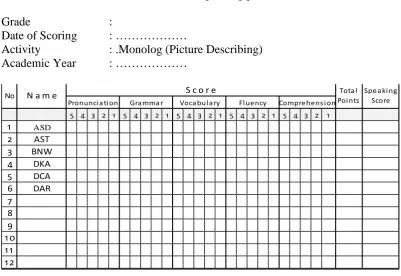
3.3.3 Both Pre-test and Posttest consist of speaking test and L2-based Communication Strategies used, and are rated by two Raters (see appendix 2,4)
3.3.4 The next step, both pretest and posttest are compiled to see what the avarage resultof students’speaking scores. (see Table 19, 26)
3.3.5 Here is the way how to conduct pre and posttest of speaking skills. The teacher provides a set of directions, and the students do what are in accordance with the directions, as follows;
Directions:
1. Look at the picture.
2. Describe the picture in English Orally. 3. You have only 2 minutes to do so. 4. Be careful and Feel confidence.