Virtual Experiments in Control Laboratory
Ignatius Agung Wibowo, Ngieng Siew Ching Kolej Universiti Teknologi Tun Hussein Onn
Abstract
Recent advancement in computer multimedia has brought in a new teaching media for laboratory experimentations. The extensive application of computers and the availability of software convey motivation to develop virtual experiments in control laboratory. These virtual experiments demonstrate the experiments of basic position control system and help students to discover the theories learned in the classroom. This may be realized through some interactive animation of the experiments. These supplementary virtual experiments may minimize the problem of inflexible learning time and place, large size of class and limited functional equipments in a conventional control laboratory. In addition, these virtual experiments offer performance almost like the real experiments because they are developed using the same concept like the real experiments. As a result, students are possible to interact with equipments in the virtual experiments without applying any programming on a computer and they learn basic concept of a position control system at their own pace. Hence, the approach of virtual experiments has significant contribution in the engineering education system.
1. Introduction
Engineering education has been traditionally imparted through the lecture-tutorial-laboratory paradigm. A very common problem in a lecture-tutorial-laboratory in an education institution, especially in developing countries, is that the size of class attending practical work in the laboratory is very large while the number of functional apparatus is not enough. So, many of them do not have a chance to involve actively in each experiment. Since the class is too large, the students are difficult to get the guidance from instructor when they are facing a problem while doing an experiment. Besides, a conventional laboratory is also facing shortage of man power, which one instructor has to handle many students in the practical work. Furthermore, another problem of the conventional laboratory is inflexible of learning time and place. For example students have to attend the practical work in the laboratory three hours per week. The schedule is very tight. Thus, time and place for doing experiments are limited.
2. Virtual Laboratory
The term virtual laboratory is relatively new in the e-learning. So, there is no specific definition for the term virtual laboratory. Some people define virtual laboratory as virtual experiments in laboratory whilst some of them describe virtual experiments as an element of virtual laboratory. Since both ideas involve experiments in laboratory, so both ideas can be accepted.
Nowadays, virtual laboratories accessible via an Internet (or local area network) connection are becoming a popular way to reduce equipment costs and bring laboratory concepts into courses where it would be otherwise infeasible. The idea of a laboratory available over a computer network to every one interested in appeared in the beginning of 1990s.
The concept is to be able to give students full and complete access to equipment, be it pc, server or other electronic equipment, for the purpose of “hands-on” learning by doing. “It is most often modeled after the traditional IT classroom environment, where students will learn a concept through first hearing a lecture from an instructor, then see a demonstration of the concept and finally be able to do the task on the computer, thus proving to themselves and the instructor that they understand Error! Reference source not found..” In other words, every interested scientist or student could take a part in an experiment. May observe and also control, change its conditions, share concepts and discuss the results right after they are achieved no matter where she or he resides. Computer science and telecommunication technologies development make it possible to realize the idea of the virtual laboratory in distributed scientific environment nowadays, especially when unique or expensive research equipment is used.
Nowadays, there are several popular virtual laboratories can be accessed through Internet, such as Physics Virtual Laboratory and Chemistry Virtual Laboratory. However, there are only few of virtual control laboratories. The virtual control laboratory turns the student active through interactivity and it performs the experiments with additional phenomena which are too abstracted to explain without the animation.
An important part of control engineering is the combination of theoretical knowledge with practical experience. The first is conventionally taught during the lectures and exercises and based on lectures notes or textbook. The practical experience is obtained during the separate laboratory courses which are resource intensive and thus it can take time and money to have innovative control experiments. “According to Chr. Schmid Error! Reference source not found., the student must be able to learn modeling of systems in order to develop controllers.” The design process together with simulations and observing the dynamics of a physical implementation gives student a valuable insight.
Chr. Schmid Error! Reference source not found. considered two kinds of approach in virtual control laboratory. A remote lab approach includes a control software development tool, a video and audio interface together with a collaboration tool. This is necessary for giving the remote user the feeling of being in the laboratory. Another approach is to help student to discover the application of theories learned in the classroom. This may be realized by the simulation of real world systems and animation of experiments. Thus, the virtual control lab uses virtual worlds to visualize the laboratory plant to be analyzed or controlled.
A supplementary virtual laboratory during the conventional lab course and within the additional distance education in the form of a course offered across the Web will fully engage the students in the learning process through an interactive, dynamic environment involving the students.
Understand the concept of the experiment
Choose the components
Place and interconnect the components in order to build up the desired circuit
Analyze the results
“Except the first step which is mainly a reflection activity, the three could be realized virtually Error! Reference source not found..” Models are introduced to facilitate the understanding and the calculation. The Virtual Control Laboratory approach is interesting because the virtual elements enhance the understanding in comparison with the theoretical exercises.
3. The Development of Virtual Experiments in Control Laboratory
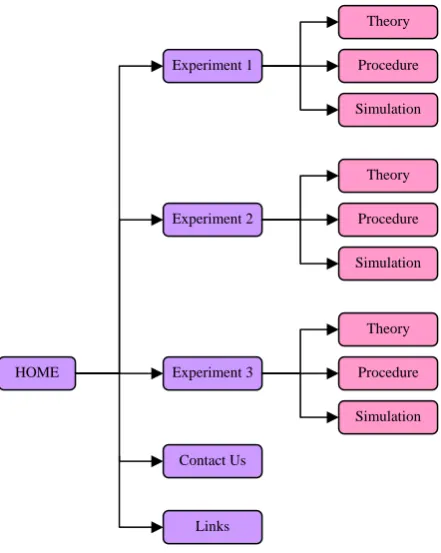
Virtual Experiments in Control Laboratory has three main features, such as external links, contact details and experiments with theory, procedure and simulation. It has a total of 12 web pages. It also includes 20 pop up window browsers. 17 out of the 20 pop up window browsers show the actual photos of the equipments. 3 pop up window browsers show the connection in each experiment. Figure 1 shows the overall structures of the web pages in Virtual Experiments in Control Laboratory.
HOME
Experiment 1
Experiment 3 Experiment 2
Contact Us
Links
Procedure Theory
Simulation
Procedure Theory
Simulation
Procedure Theory
[image:3.595.182.403.360.637.2]Simulation
Figure 1: Overall structures in Virtual Experiments in Control Laboratory
(a) Experiment 1: Open loop position control system (b) Experiment 2: Closed loop position control system
(c) Experiment 3: Reducing overshoot using the effect of magnetic brake
Each of the experiments has a theory, procedure, and simulation part. In the theory part, students can briefly read some definitions or theorems and view the block diagram related to the experiment. The procedure part briefly explains about the guidelines or steps to carry out the experiments. Furthermore, students can interact with animated apparatus in the simulation part by adjusting some parameters like when they perform a real experiment.
Virtual Experiments in Control Laboratory was developed using Macromedia Dreamweaver MX 2004 and Macromedia Flash MX 2004 Professional. The program in the simulation part was written using action script in Macromedia Flash MX 2004 Professional. Macromedia Dreamweaver MX 2004 was used to create the theory and procedure part, and also to integrate all of the web pages.
3.1. Building the Physical Layout of Each Experiments
Physical layout of the each experiment was drawn using drawing utility in Macromedia Flash MX 2004 Professional. The equipments were designed based on 2D animation using the drawing toolbox, such as line, paint, free transform, circle, and rectangular. The effect of the graphic can be enhanced by using color mixer, alignment or using items from the common library such as buttons.
Several graphical interfaces of equipments had been designed and created. For experiment 1, several equipments were built, as follows:
Power Supply Module PS150E
Servo Amplifier Module SA150D
Direct Current Motor Module DCM150F
Attenuator Unit Module AU150B
Tacho Unit Module GT150X
Input Potentiometer Module IP150H
Output Potentiometer Module OP150K
While for experiment 2 and experiment 3, extra components were built, as listed below:
Operational Amplifier Unit Module OA150A
Pre-Amplifier Unit Module PA150A
Signal Generator
3.2. Detailed Specification of Equipments
K = 4.775. p
K = vary from 0 to 1 1
KaK = s 1420
s 5 . 0 1
K Ka s
+ s
1
θi(s)
Vi(s) Ve(s)
Vo(s)
) s (
o
Ω
30 1 Kp
θo(s)
K1
Kp
+
[image:5.595.75.509.102.262.2]-
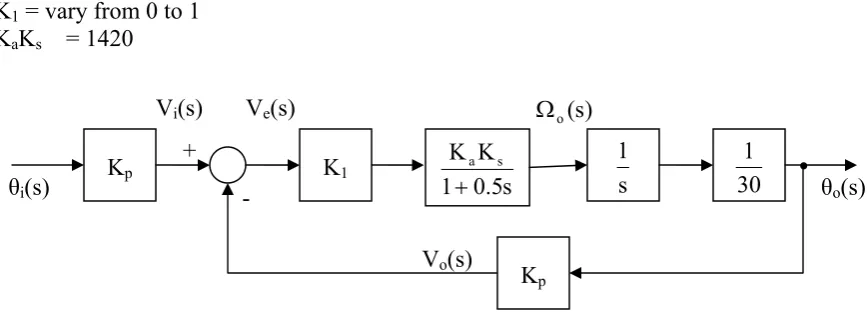
Figure 2: Block diagram of closed loop position control system
Furthermore, block diagrams of open loop and closed loop system are very important in identifying the detailed of the system specification. Figure 2 shows the block diagram of closed loop position control system, which has the position feedback.
Analyzing the above block diagram, the input–output relation of the system is found to be
(
6.647t cos 0.15)
(t) sin9887 . 0
e 1 ) t
( t 1 i
o ⎥θ
⎦ ⎤ ⎢
⎣ ⎡
+ −
=
θ − −
This equation is used in the codes to display the graph of output position versus time.
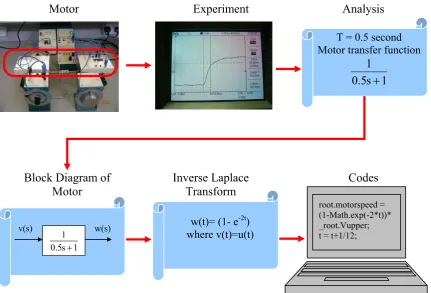
How to identify the detailed specification of the direct current motor is illustrated in Figure 3. First, an experiment should be carried out on the real direct current motor in control laboratory. 0.1 Hz, 1V peak to peak square wave was applied to input 1 of the servo amplifier and terminal 2 of the Tacho Unit was connected to the storage oscilloscope. The output waveform was obtained. The time constant, T of motor could be measured from the time to reach 0.632 times the steady state.
T = 0.5 second Motor transfer function
1 s 5 . 0
1 +
Motor Experiment Analysis
Block Diagram of
Motor Inverse Laplace Transform Codes
v(s) w(s)
1 s 5 . 0
1
+
w(t)= (1- e-2t) where v(t)=u(t)
root.motorspeed = (1-Math.exp(-2*t))* _root.Vupper; t = t+1/12;
Figure 3: The process of getting the detailed specification of the direct current motor and programming it on the computer
1. Comparison between Virtual Experiments in Control Laboratory and Real
Experiments
The graphical interface of equipments in Virtual Experiments in Control Laboratory is compared to the real equipments. Furthermore, the connections are also compared to that of the real experiment. Finally, the result of an experiment in Virtual Experiments in Control Laboratory is compared to that in a real experiment.
1.1. Comparison of the Graphical Interface of Equipments
Figure 4 shows that the graphical interface of equipments in Virtual Experiments in Control Laboratory are quite similar to the real equipments in conventional control laboratory in KUiTTHO. There were some differences in color of the equipments. Each of animated equipment offers performance almost like real equipments so that students can learn the usage of the equipments. For example students can rotate the input potentiometer in virtual experiment as in the conventional control laboratory. Besides, students can also press the ON/OFF button in the virtual experiments in order to provide the power supply to entire circuit. In addition, the upper and lower scale in attenuator can also be adjusted like real attenuator unit in the laboratory. The tacho unit in virtual experiments can also display either voltage or speed in rpm like the real tacho unit.
[image:6.595.91.523.87.380.2]The output potentiometer will not move if the angle of input potentiometer is zero and power button is switched off. This means that when the output potentiometer is rotating towards a desired angle, the input potentiometer must be rotated to zero immediately. This scenario is almost same like the real experiment done in the laboratory. Thus, students can practice using these equipments to do experiments.
(a) (b)
Figure 4: Direct Current Motor Module DCM150F and Tacho Unit Module GT150X:
(a) Real equipments
(b) Animated equipments
1.2. Comparison of the Connections between Equipments in Virtual Experiments in Control Laboratory and Real Experiments
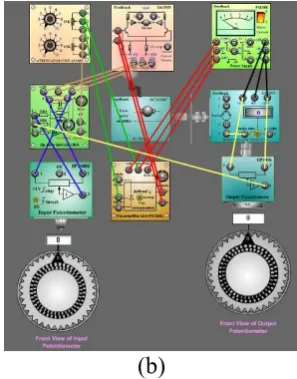
The connections done in virtual experiments are same as connections done in real practical works in Control Laboratory. In fact, the connections in position control system are little bit messy because the connections involve many wires. However, connections done in Virtual Experiments in Control Laboratory are tidier than that of the actual practical works. Students can click on a certain terminal of the equipment to make a connection. Thus, it is easier and is not confusing for students to practice using Virtual Experiments in Control Laboratory. The connection for experiment 2 is shown in Figure 5.
[image:7.595.348.497.506.696.2](a) (b)
Figure 5: Comparison of connections for Experiment 2: (a) Actual experiment
[image:7.595.112.260.508.624.2]1.3. Comparison of the Experiment Results between Virtual Experiments in Control Laboratory and Real Experiments
The final result of each experiment in Virtual Experiments in Control Laboratory and actual practical works are compared. Take an example from experiment 2. The graphs obtained in virtual experiment 2, closed loop position control system were almost the same as the graphs obtained from the oscilloscope in control laboratory. These are shown in Figure 6. Both results showed that when the gain or scale of attenuator unit increases, the response of the system become faster, overshoot and oscillation increase.
Since the shapes of waveforms in virtual experiments are nearly similar to the actual results in control laboratory, students can use Virtual Experiments in Control Laboratory as tool for practicing position control experimentations.
(a) (b) Figure 6: (a) Graphs obtained from a real digital oscilloscope for experiment 2
(b) Animated graphs for virtual experiment 2
2. Analysis on the Overall Performance of Virtual Experiments in Control Laboratory
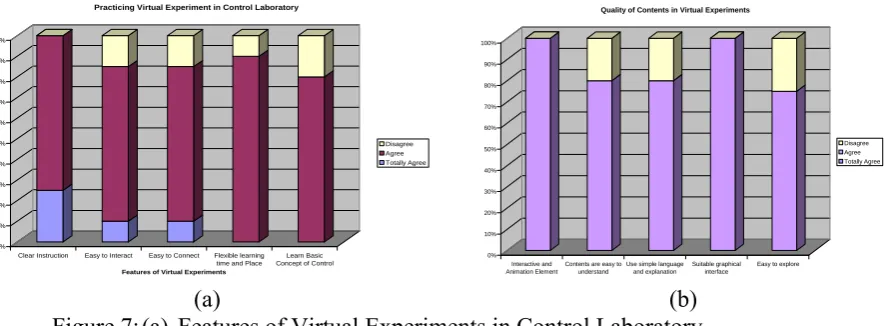
A survey was conducted among 20 students of Faculty of Electrical and Electronics Engineering in KUiTTHO in order to evaluate the performance of Virtual Experiments in Control Laboratory. The survey results are shown in Figure 7.
Majority of the students satisfied with the performance and ideas of Virtual Experiments in Control Laboratory. They agreed that they could easily interact with the animated apparatus to practice the position control system and learn basic concept of control system. Besides, they could practice control experiments using Virtual Experiments in Control Laboratory at anytime and place without require installing extra software and learning any programming technique.
Thus, the problems of large numbers of students attending laboratory course, inflexible learning time and place could be minimized.
0% 10% 20% 30% 40% 50% 60% 70% 80% 90% 100%
Clear Instruction Easy to Interact Easy to Connect Flexible learning time and Place
Learn Basic Concept of Control
Features of Virtual Experiments
Practicing Virtual Experiment in Control Laboratory
Disagree Agree Totally Agree 0% 10% 20% 30% 40% 50% 60% 70% 80% 90% 100% Interactive and Animation Element
Contents are easy to understand
Use simple language and explanation
Suitable graphical interface
Easy to explore
Quality of Contents in Virtual Experiments
Disagree Agree Totally Agree
(a) (b) Figure 7: (a) Features of Virtual Experiments in Control Laboratory
[image:8.595.104.507.246.371.2] [image:8.595.82.526.579.742.2]3. Conclusions
As conclusions, virtual experiments in Control Laboratory have been carried out successfully using Macromedia Flash MX 2004 Professional and Macromedia Dreamweaver MX 2004. Besides, the objectives of the project are also been achieved. Through these supplementary virtual experiments, students can interact with the animated equipments and practice doing basic experimentations in position control system without learning programming difficult technique or codes and installing extra software such as MATLAB and Labview. Virtual Experiments in Control Laboratory provides flexible learning place and time and economic solution to practice control experiments compare to real experiments in control laboratory. Furthermore, Virtual Experiments in Control Laboratory can be uploaded over the internet or distributed easily for practicing it, making it is highly suitable and convenient for distance learning. Finally, Virtual Experiments in Control Laboratory may bring in diversity and students may enjoy in practicing control experiments.
References
[1] G.D. Allen, “A Survey of Online Mathematics Course Basics,” College Mathematics Journal, 2002.
[2] Andreas Andi Suciadi, Menguasai Pembuatan Animasi Dengan Macromedia Flash MX, 1st Edition, PT Elex Media Komputindo, Jakarta, Indonesia, 2003.
[3] Chr. Schmid, “The Virtual Control Lab VCLab for Education on the Web,” in Proceedings of the American Control Conference, Philadelphia, Pennsylvania, June 1998, pp.
1314-1318.
[4] Christoph M. Hoffman, Elias N. Houstis, John R. Rice, Ann Christine Catlin, Margaret Gaitatzes, and Sanjiva Weerawarana "SoftLab - A Virtual Laboratory for Computational Science," Mathematics and Computers in Simulation, vol. 36, pp. 479-491, 1994.
[5] Dean Hardy “Virtual Labs: The Definition and Difference between Simulation Physical PC Lab and Virtual PC Lab Delivery,” Hatsize Learning Corporation, July 2002.
[6] Didik Wijaya, Tip dan Trik Macromedia Flash 5.0 Dengan ActionScript, 2nd Edition, PT
Elex Media Komputindo, Jakarta, Indonesia, 2002.
[7] E. Zysman, “Multimedia Virtual Lab in Electronics,” in Proceedings of the 1997 International Conference on Microelectronics Systems Education, Switzerland, April
1997, pp. 151-152.
[8] Katsuhiko Ogata, Modern Control Engineering, 3rd Edition, Prentice Hall, Upper Saddle,
N.J., 1997.
[9] Lunetta and Hofstein, Simulation and Laboratory Practical Activity, Open University
Press, Miltonkeynes, PA, 1991.
[10] R.C.H . Cheng and J.D. Lamb, “Interactive Implementation of Optimal Simulation
Experiment Designs.” in Proceedings of the 1998 Winter Simulation Conference, 1998, pp.