Development and Application of a Validated HPLC
Method for the Determination of Clindamycin Palmitate
Hydrochloride in Marketed Drug Products: An
Optimization of the Current USP Methodology for Assay
Geoffrey K. Wu1, Abhay Gupta2, Mansoor A. Khan2, Patrick J. Faustino2
1Office of Generic Drugs, Food and Drug Administration, Rockville, USA; 2Division of Product Quality Research, Office of Phar-maceutical Science, Food and Drug Administration, Silver Spring, USA.
Email: [email protected]
Received September 7th, 2013; revised October 8th, 2013; accepted October 19th, 2013
Copyright © 2013 Geoffrey K. Wu et al. This is an open access article distributed under the Creative Commons Attribution License, which permits unrestricted use, distribution, and reproduction in any medium, provided the original work is properly cited.
ABSTRACT
A simple efficient isocratic reversed-phase HPLC method was developed and validated for the determination of clin-damycin palmitate hydrochloride (CPH) and its commercially available oral solution products. Separation was achieved on a Phenomenex Zorbax (Luna) cyano column (150 × 4.6 mm, 5 μm) with a Phenomenex cyano guard cartridge (4 × 3.0 mm) on Agilent 1050 series HPLC system. CPH and its resolution standard lincomycin were eluted isocratically at a flow rate of 1 mL/min with a simplified mobile phase (potassium phosphate buffer (5 mM, pH 3.0)—acetonitrile—tet-rahydrofuran (20:75:5, v/v/v)) and detected at 210 nm. The column was maintained at 25˚C. The method was validated according to USP category I requirements. Robustness and forced degradation studies were also conducted. CPH mar-keted drug products were obtained from a drug distributor and assayed for potency using the validated method. Valida-tion acceptance criteria were met in all cases. The analytical range for CPH was 15 - 500 μg/mL and the linearity was r2
> 0.999 over three days. The method was determined to be specific and robust. Both accuracy (92.0% - 103.8%) and precision (0.67% - 1.52%) were established across the analytical range for low, intermediate and high QC concentra-tions. Method applicability was demonstrated by analyzing two marketed products of CPH, in which results showed potency >98%. The method was determined to be an enhancement over the current USP methodology for assay as a result of increased efficiency, reduced organic solvents and the elimination of matrix modifiers. This method was suc-cessfully applied for the quality assessment of: 1) currently marketed drug products and 2) will in future assess the product quality of novel dosage forms of CPH for pediatric use.
Keywords: Clindamycin Palmitate Hydrochloride (CPH); HPLC; Method Validation; Pediatric Dosage Form
1. Introduction
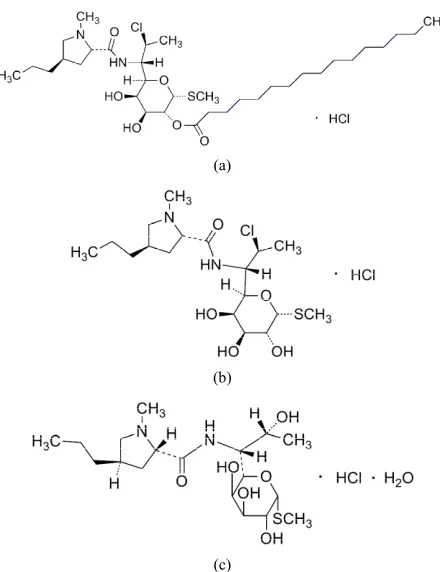
Clindamycin palmitate hydrochloride (CPH, methyl 7- chloro-6,7,8-trideoxy-6-(1-methyl-trans-4-propyl-L-2-py rrolidinecarboxamido)-1-thio-l-threo-α-d-galactoocto- pyranoside monohydrochloride, Figure 1(a)), is an ester
of clindamycin and palmitic acid. Clindamycin (Figure 1(b)) is a lincosamide antibiotics first synthesized in
1967. It is active against gram-positive aerobes and highly active against both gram-positive and negative anaerobes [1]. CPH is a white to off-white crystalline so- lid with a melting point from 168˚C - 178˚C, CPH has a molecular formula of C34H63ClN2O6S·HCl and a mo-
lecular weight of 699.85. CPH is a white to off-white amorphous solid with a pKa of 7.6.
(a)
(b)
[image:2.595.61.281.91.377.2](c)
Figure 1. Chemical structures of clindamycin palmitate hydrochloride (a), clindamycin hydrochloride (b) and lin- comycin hydrochloride (c). (a) Clindamycin palmitate hy- drochloride (CPH). (b) Clindamycin hydrochloride. (c) Lin- comycin hydrochloride monohydrate.
bacterial endocarditis.
In contrast to the other two clinically available clin-damycin salts (i.e., clindamycin hydrochloride and clin-damycin phosphate), there are only two HPLC analytical methods reported for CPH analysis and neither of them is ideal to implement or simple in their execution. Both methods required complex mobile phase compositions, with high organic content while both yielding longer re- tention times. The first method is a compendial method from the United State Pharmacopoeia using a C18 re-versed-phase chromatographic column with refractive index (RI) detector, and with a mobile phase containing ~92% of methanol with a total run time of 30 min [3]. This is an adaptation from a method first published in 1978 by Brown [4]. The method is still being widely used by other researchers with minor modifications [5]. However, the use of RI detector can significantly com-promise method robustness since the detector is sensitive to various environmental factors, such as small changes to ambient temperature, and operational factors such as flow rate, column pressure and non-compatibility with gradient elution and ultimately difficult to implement. The second method reported by Raju and colleagues [6] was an isocratic HPLC method using UV detector (210
nm) also using methanol as a major (90%, v/v%) compo- nent in the mobile phase. However, the mobile phase did not have buffering capacity and triethylamine (TEA) was used as ion pairing agent complicating the mobile phase preparation. TEA acts as a base causing the mobile phase pH to increasee, which negatively impacts the robustness of non-buffer mobile phase systems. Additionally TEA can not be easily washed out of reverse phase columns typically requiring 100 - 200 column volumes, thereby li- miting column use and ultimately column lifetime.
Developing a practical HPLC method for CPH is chal- lenging due to its amphiphlic nature and highly pH-de-pendent solubility in aqueous medium [7]. In its free base form, when pH is close to or above its pKa (7.6), CPH is extremely insoluble. For instance at pH 7.4 it has an aqueous solubility of <0.0002 mg/mL. Once the pH drops to around 4, its solubility increases to 0.238 mg/ mL; if micelle formation is considered, its solubility can increase to 50 mg/mL at pH 3.6. Such a solubility varia-tion was observed in our laboratory studies. This solubil-ity phenomenon is significantly different from the widely used hydrochloride salt where solubility is reported to be greater than 500 mg/mL in water [8]. Additionally the ionic strength and the presence of a high concentration of inorganic salts also have a significant impact on reducing CPH aqueous solubility. However, CPH is freely soluble in methanol and acetonitrile [5,9].
In order to optimize the USP method and provide a more robust means for assessing product quality (e.g., content uniformity and dissolution) control, a novel HPLC-UV method with well controlled mobile phase pH, low ionic strength, robust performance, and ease of sys-tem setup was developed and validated here. To demon-strate the system suitability, lincomycin, the synthesis starting material and major impurity, was used in our study as a resolution and impurity standard [5,9]. Other possible impurities in CPH drug substance include clin-damycin hydrochloride which was assayed in our system. Sample detection was performed by a UV detector at 210 nm wavelength; phosphate buffer (pH 3.0) was employed to precisely control the acidity of the mobile phase; and no ion pairing agent was required for chromatographic selectivity or resolution. The method can selectively de-tect CPH and its related impurities with acceptable reso-lution. This simple and robust method will be a substan-tial improvement to the current USP method to evaluate product quality and drug stability.
2. Experimental
2.1. Materialsdards were purchased from the United States Pharmaco- peia (Rockville, MD). Clindamycin palmitate hydrochlo-ride drug substance was purchased from RIA Interna-tional LLC (East Hanover, NJ). Clindamycin HCl was purchased from TCI (Tokyo, Japan). Clindamycin pal- mitate hydrochloride drug products were purchased from Bradley Drug-Washington Wholesale Drug Exchange (Bethesda, MD). Nylon syringe filters were purchased from Sun SRI (Rockwood, TN). HPLC grade monobasic potassium phosphate and ACS grade phosphoric acid were purchased from Fisher Scientific (Fairlawn, NJ). HPLC grade acetonitrile was purchased from Burdick and Jackson (Muskegon, MI). HPLC ready 18 MOhm water was obtained, in-house, from a Milli-Q Gradient A-10 water purification system, Millipore Corp. (Bedford, MA).
2.2. Instrumentation and Chromatographic Conditions
Hewlett Packard 1050 series (Agilent Technologies, Wil- mington, DE) HPLC system was used for the analysis. It is equipped with a quaternary pump, online degasser, co- lumn heater, autosampler, and diode array detector (DAD). ChemStation software (Agilent Technologies, Wilming-ton, DE) was used to perform data collection and analy-sis. Separation was achieved on a Phenomenex Luna cyano column (150 × 4.6 mm, 5 µm) in series with a Phenomenex cyano SecurityGuard column (4.0 × 3.0 mm, Phenomenex, Torrance, CA). The elution was isocratic with a mobile phase of 5 mM KH2PO4 (pH
3.0)—ace-tonitrile—tetrahydrofuran (20:75:5, v/v/v). The column temperature was maintained at 25˚C. The injection vol-ume was 30 µL with UV detection at 210 nm.
2.3. Preparation of Standard Solutions
CPH stock solution I of 10 mg/mL was prepared in phos- phate buffer (5 mM, pH 3.0) using the USP reference standard. Calibration standard solutions at seven levels were prepared by serially diluting the stock solution I with the HPLC mobile phase to concentrations of 15, 25, 50, 100, 250, 375, and 500 μg/mL over the analytical range of 15 - 500 μg/mL.
CPH stock solution II of 10 mg/mL was prepared in phosphate buffer (5 mM, pH 3.0) using USP reference standard. Quality control (QC) standard solutions were prepared daily by diluting the stock solution II with the HPLC mobile phase to the final QC concentrations of 15, 100 and 500 μg/mL.
Lincomycin stock solution I of 10 mg/mL was pre-pared in phosphate buffer (5 mM, pH 3.0) using the USP reference standard. This solution was later used to pre-pare a mixture of CPH and lincomycin for daily system suitability tests. Clindamycin hydrochloride stock
solu-tion of 10 mg/mL was prepared in the same way.
2.4. Sample Preparation from the Marketed Products
Two CPH products (brand-name and generic), both in a powder form for oral solution for pediatric patients, were designated as A- and B-powder respectively and assayed for potency. For each product, powder equivalent to about 5 mg of CPH was accurately weighed on an ana-lytical balance and transferred to a 10 mL volumetric flask. About 8 mL of HPLC mobile phase was added to the flask and the content was sonicated for 5 min. Addi-tional mobile phase was added to adjust the volume to 10 mL. The resulting solution was filtered via a 0.20 μm nylon filter into standard analytical glass vials. The fil-trate, containing ~500 μg/mL CPH, was further diluted in mobile phase to 250 and 125 μg/mL. All three concentra-tions (125, 250 and 500 μg/mL) were injected into the HPLC for potency measurements.
2.5. Method Validation
The method was validated according to the United States Pharmacopeia requirements for Category I for assay [10]. The following validation characteristics were evaluated: linearity, range, accuracy, precision, specificity, limit of quantitation and robustness.
System suitability standard solution which contained 100 μg/mL CPH and 10 µg/mL lincomycin as a resolu-tion standard was prepared by diluting and mixing CPH and lincomycin stock solutions with mobile phase. Sys-tem suitability was determined from six replicate injec-tions of the system suitability standard before sample analysis. The acceptance criteria were: relative standard deviation (RSD) for peak area less than 2.0%, greater than 2000 plates per column (13,333 plates per meter), a peak width at half height of less than 0.25 minute, a resolution for CPH and lincomycin greater than 1.5, a USP tailing factor less than 2.0. Equation for calculating resolution (R) is list below:
22 11
1 18 t t
R .
W W
where t2 and t1 were respective retention times for CPH
and lincomycin, and W2 and W1 were the peak widths at
half height. Acquired results were used to evaluate criti-cal operational parameters of the chromatographic sys-tem to ensure adequate resolution and reproducibility im- mediately prior to sample analysis.
The resultant standard curves were evaluated for intra- and inter-day reproducibility.
Accuracy and precision of the method were deter-mined for the drug substance by analyzing QC standard samples at three concentrations levels of CPH (15, 100, and 500 μg/mL) over the analytical range. The method precision was established by injecting five standard QC samples at each concentration level for the intra-day pre-cision and on three days for the intermediate prepre-cision. Precision was expressed by the relative standard devia-tion (RSD, %) of the analyte peak areas. Accuracy was expressed as percent recovery (%) by comparing the amount determined from the quality control standards against the respective nominal values. Accuracy of the method was also tested on two drug products at three concentrations with 3 replicates at each level, using the ICH Q2R1 approach of standard addition [11]. In this approach the following changes were made to the proce-dures described in section 2.4: only 50% of the nominal amount of drug product was placed in the flask and then the drug product was spiked with CPH stock solution III up to the target concentrations. The target concentrations were 125, 250 and 500 μg/mL of CPH in total; in addi-tion, samples containing only 50% of the nominal amount of drug product without spiking were prepared and analyzed at three corresponding levels. Percent re-covery (%) of CPH was calculated by comparing the known spiked amount of CPH to the amount CPH detec- ted after subtracting the un-spiked (50% product) sam-ples.
Method robustness was evaluated by analyzing the system suitability standard and evaluating system suit-ability parameters after varying the HPLC pump flow rate (± 2.5%), auto-sampler injector volume (± 10%), column compartment temperature (± 2˚C), mobile phase pH (± 0.1) and organic composition (20% regarding tet-rahydrofuran content), respectively.
Method specificity was evaluated by analyzing a mix-ture of CPH drug substance and lincomycin (a major synthetic precursor of CPH), and two drug products ver-sus sample blank. In addition, CPH standards were sub-jected to forced degradation under different conditions: elevated temperature (55˚C for 24 hours), light (365 nm for 24 hours at room temperature), 10% peroxide (for 24 hours at room temperature), acidic (0.1 M HCl for 4 hours at room temperature), and basic (0.1 M NaOH for 4 hours, room temperature). Resulting HPLC chroma-tograms were compared to determine if CPH was co- eluting with lincomycin or other degradation products or excipient. Full spectrum (200 - 560 nm) chromatograms were acquired and Agilent ChemStation peak purity al-gorithms were also used to evaluate specificity.
3. Results and Discussion
3.1. Optimization of HPLC Method
Similar to other derivatives of lincomycin, CPH has a relatively weak UV absorption with an absorbance peak maxima around 206 nm. Different from the other linco-mycin derivatives, CPH is an amphiphilic molecule due to the hydrophobicity of palmitate (14 carbon chain) and the basic nature of clindamycin. Its amphililicity leads to an anomalous solubility feature: it can only be reasona-bly dissolved in aqueous medium at a pH below 3.7 (53.2 mg/mL) because of micelle formation; above this pH, it is practically insoluble (e.g., 0.001 mg/mL at pH 5.8) [7]. During solubility studies there was difficulty dissolving CPH in aqueous medium and micelle formation was ob-served. These observations were contradictory to most of the publications and even USP material safety data sheet (MSDS), which claimed that CPH is freely soluble [12]. Both matters complicate developing a simple and robust HPLC method for CPH. This may explain why there are only two major groups of analytical methods available for CPH in the scientific literature.
The first group of methods is represented by the com-pendial method recorded in USP36/NF31 (CPH mono-graph); other similar methods were developed following minor modifications to this USP method. Acetate organic salts were used to constitute the mobile phases in these methods and this rendered RI detector as the only choice due to the high UV cutoff (~230 nm) of these salts. How- ever, the well-known disadvantages of RI detector are its sensitivity to environmental influence, and long equili-bration periods which may negatively impact routine operations. Recently another HPLC method was reported using UV detector at 210 nm for CPH analysis, in which the mobile phase did not possess any buffering capacity [6]. A common feature for all the aforementioned meth-ods is that a high percentage (>90%) of methanol was used in mobile phase. Unfortunately like acetate salts, methanol has a UV cutoff around 210 nm, which is the chosen detection wavelength in the last method. There-fore, an HPLC method void of these problems is neces-sary to best assess the product quality of CPH. To this end, our goal was to develop a simple and robust HPLC method, ideally possessing buffering capacity and using UV detection at the absorbance maxima.
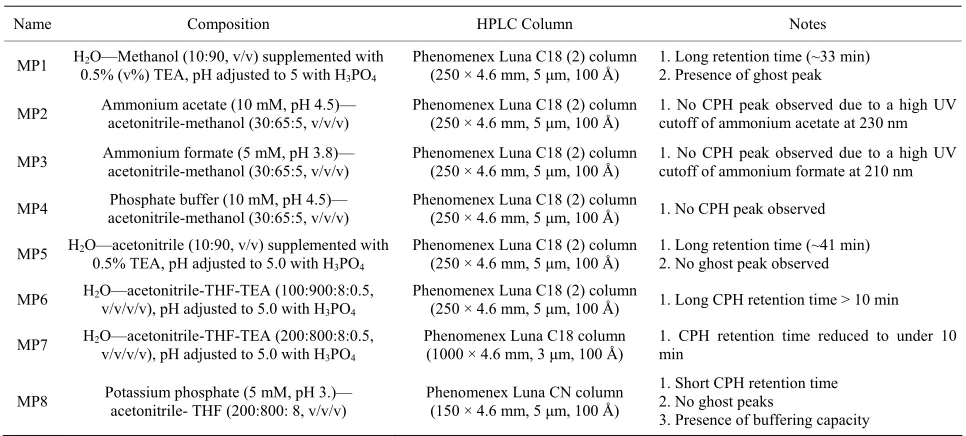
Initially a C18 column, used in all the published me- thods, was chosen and a series of mobile phase scree- ning was conducted (Table 1). The mobile phase (MP1),
composed of H2O/methanol (10:90) supplemented with
Table 1. List of major mobile phases and HPLC columns screened.
Name Composition HPLC Column Notes
MP1 H2O—Methanol (10:90, v/v) supplemented with
0.5% (v%) TEA, pH adjusted to 5 with H3PO4
Phenomenex Luna C18 (2) column (250 × 4.6 mm, 5 μm, 100 Å)
1. Long retention time (~33 min) 2. Presence of ghost peak
MP2 Ammonium acetate (10 mM, pH 4.5)— acetonitrile-methanol (30:65:5, v/v/v) Phenomenex Luna C18 (2) column (250 × 4.6 mm, 5 μm, 100 Å) 1. No CPH peak observed due to a high UV cutoff of ammonium acetate at 230 nm
MP3 Ammonium formate (5 mM, pH 3.8)— acetonitrile-methanol (30:65:5, v/v/v) Phenomenex Luna C18 (2) column (250 × 4.6 mm, 5 μm, 100 Å) 1. No CPH peak observed due to a high UV cutoff of ammonium formate at 210 nm
MP4 acetonitrile-methanol (30:65:5, v/v/v) Phosphate buffer (10 mM, pH 4.5)— Phenomenex Luna C18 (2) column (250 × 4.6 mm, 5 μm, 100 Å) 1. No CPH peak observed
MP5 H2O—acetonitrile (10:90, v/v) supplemented with
0.5% TEA, pH adjusted to 5.0 with H3PO4
Phenomenex Luna C18 (2) column (250 × 4.6 mm, 5 μm, 100 Å)
1. Long retention time (~41 min) 2. No ghost peak observed
MP6 H2O—acetonitrile-THF-TEA (100:900:8:0.5,
v/v/v/v), pH adjusted to 5.0 with H3PO4
Phenomenex Luna C18 (2) column
(250 × 4.6 mm, 5 μm, 100 Å) 1. Long CPH retention time > 10 min
MP7 H2O—acetonitrile-THF-TEA (200:800:8:0.5,
v/v/v/v), pH adjusted to 5.0 with H3PO4
Phenomenex Luna C18 column (1000 × 4.6 mm, 3 μm, 100 Å)
1. CPH retention time reduced to under 10 min
MP8 Potassium phosphate (5 mM, pH 3.)— acetonitrile- THF (200:800: 8, v/v/v) Phenomenex Luna CN column (150 × 4.6 mm, 5 μm, 100 Å)
1. Short CPH retention time 2. No ghost peaks
3. Presence of buffering capacity
× 4.6 mm, 5 um, 100 Å) with a flow rate of 1 mL/min at ambient temperature. More importantly, ghost peaks had been observed and the source of these peaks was highly possible the mobile phase components, where the sample elution may have been incomplete. Following the re-ported preparation, pH (5.0) of the mobile phase was simply adjusted by titrating the mixture using phosphoric acid, although this procedure is not recommended since a pH meter generally does not measure properly in the presence of a large amount of organic solvent. This is also important, suggesting that ionization from TEA can significantly increase the pH of the MP and the pKa of CHP is 7.6.
In order to introduce buffering capacity and eliminate the ghost peaks, aqueous buffers were used to replace DI water and acetonitrile was employed to substitute metha- nol. The additional mobile phases that were screened include: ammonium acetate (10 mM, pH 4.5)—acetoni-trile—methanol (30:65:5, v/v/v, MP2) and ammonium formate (5 mM, pH 3.8)—acetonitrile—methanol (30:65: 5, v/v/v, MP3); no major peak of CPH could be observed since these two buffers have high UV cutoffs at 230 and 210 nm, respectively. Phosphate buffer is generally rec-ognized as the most ideal buffer with a low UV cutoff < 200 nm. Therefore a mobile phase (MP4), composed of phosphate buffer (pH 4.5, 10 mM)—acetonitrile—metha-nol (30:65:5, v/v/v) was examined; however, no CPH peak was observed either. These mobile phases were not supplemented with triethylamine (TEA), which could be critical to the successful elution of CPH on C18 columns.
So TEA was reintroduced and the following mobile phase combinations were tested. The first one (MP5) consisted of H2O—acetonitrile (10:90, v/v)
supple-mented with 0.5% TEA with pH 5.0 adjusted by phos-phoric acid. Comparing against the published mobile phase, the only difference was that acetonitrile was used to replace methanol. Results showed that a major peak of CPH could be observed around 41 min when isocrati-cally eluted at a flow rate of 1 mL/min at 30˚C; more importantly, no ghost peaks were observed since acetoni-trile has low UV cutoff (~190 nm). Using MP5 while increasing column temperature to 35˚C; surprisingly this only shortened the retention time from 41 to 40 min. In order to further reduce the retention time, tetryhydrofu-ran (THF), an organic modifier, was added to the current mobile phase. The influence of THF content was exam-ined and the volume percentages screened of were 1%, 2%, 5%, 8% and 10%. And the CPH retention time was reduced to 37, 35, 26, 17 and 19 min, respectively. Therefore, 8% of THF supplement was found appropriate; however, TEA seemed indispensible for efficient elution. Thus a more promising mobile phase (H2
O—acetoni-trile-THF-TEA, 100:900:8:0.5, v/v/v/v, MP6) was identi-fied; but the percentage of acetonitrile was too high. So the ratio was adjusted to 200:800 (H2O—acetonitrile, v/v,
MP7); and this new mobile phase combination resulted in a more efficient CPH retention time around 22 min. Using this new mobile phase as a working reference, we migrated to a shorter Phenomenex Luna C18 column (100 × 4.6 mm, 3 μm, 100 Å) aiming to reducing CPH retention time to under 10 min. With this HPLC condi-tion, CPH was eluted out at 8.6 min. Further adjustment of H2O—acetonitrile to 100:900 and 300:700 was
a buffering capacity.
To better address these issues, the optimization of the stationary phase and HPLC column selection were per-formed. As observed, CPH bound to C18 stationary phase tightly so that TEA was necessary to form an ion pair to achieve efficient elution. A major factor contrib-uting to this strong interaction is the fourteen carbon chain of palmitate. In order to reduce the affinity of CPH to the column, a cyano stationary phase with lower hy-drophobicity was selected since it is more suitable for efficient elution of basic amines. To ensure the consis-tency, a Phenomena Luna CN column (150 × 4.6 mm, 5
μm, 100 Å) was selected. Stationary phase change al-lowed for significant modifications to the mobile phase composition: DI water was replaced by buffer with a ratio to acetonitrile as 200:800 (v/v) and TEA was eli- minated; while 8% of THF was kept as an organic modi-fier. Given the low UV-cutoff at 200 nm, potassium phosphate buffer (5 mM, pH 3.0) was employed and re-sults showed that this mobile phase could provide better peak symmetry and less baseline noise. Under the current chromatographic condition, CPH had a retention time of 5.5 min when isocratically eluted with a flow rate of 1 mL/min at 25˚C.
Therefore, to decrease the chromatographic elution time we chose to analyze CPH at an acidic pH (pH = 3.0) due to the hydrophobicity of palmitate and the basic na-ture of clindamycin. At this pH, CPH is positively char- ged and relatively easier to be eluted off a reverse phase column. Additionally, this pH is >4 units away from the pKa of CPH ensuring the constant composition of the ionic species. The selection of a cyano stationary phase further facilitated the efficient elution of CPH with an ideal elution time and a lower organic content.
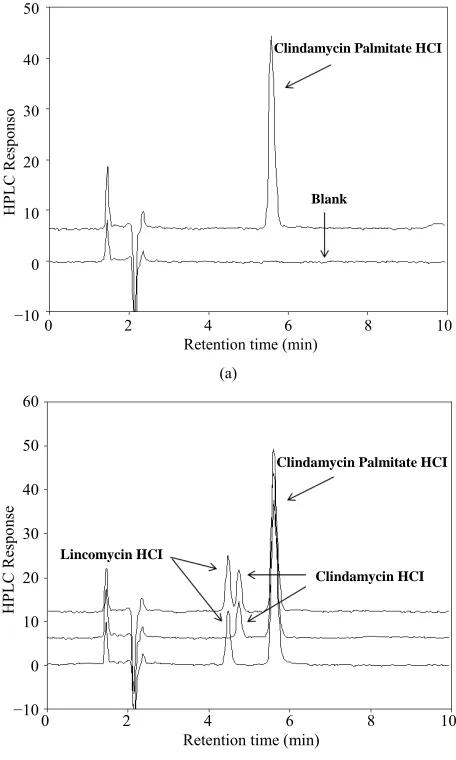
In summary, a novel HPLC analysis method for CPH is established on a Phenomenex Luna CN column (150 × 4.6 mm, 5 μm, 100 Å) performed at 25˚C. After minor adjustment, the mobile phase was composed of phos-phate buffer (5 mM, pH 3.0)—acetonitrile—tetrahydro-furan (20:75:5, v/v/v). CPH was eluted isocratically at a flow rate of 1 mL/min with a run time of 10 min; its re-tention time was around 5.6 min, detected at 210 nm (Figure 2(a)). This method was a significant
improve-ment over the previous methods. First, a simple mobile phase was formulated without using ion pairing agent (e.g., triethylamine). Second, it possessed a buffering capacity to ensure the ionized state of CPH and retention time reproducibility. Third, the commonly available UV detector, instead of RI detector, was adopted to ensure the robustness of the analysis. Fourth, acetonitrile with a low UV cutoff (~190 nm) was employed to replace methanol (UV cutoff @ 240 nm) so that the interference from the mobile phase was minimized. Lastly, this
50
40
30
20
10
0
−10
HPL
C Responso
0 2 4 6 8 10 Retention time (min)
Blank
Clindamycin Palmitate HCI
(a)
60
50
40
30
20
10
0
−10
HPL
C
Respo
nse
0 2 4 6 8 10 Retention time (min)
Clindamycin Palmitate HCI
Clindamycin HCI Lincomycin HCI
[image:6.595.309.537.98.478.2](b)
Figure 2. HPLC chromatograms of blank mobile phase and clindamycin palmitate hydrochloride USP reference stan-dard (a), and system suitability samples (b). Retention times for lincomycin, clindamycin HCl and clindamycin palmitate hydrochloride were 4.47, 4.74 and 5.60 min, respectively.
method had enhanced selectivity over CPH and its re-lated synthetic impurity and is a potential analytical tool to evaluate product stability.
3.2. Method Validation
The following method validation characteristics were addressed for CPH: accuracy, precision, specificity, line- arity, range, and robustness. The method validation for CPH meets the requirements for USP Category I [10].
3.3. System Suitability
in-terest. All critical parameters tested met the acceptance criterion on all days, as listed in Table 2. Adequate
reso-lution of >1.5 between CPH and lincomycin demon-strated the method specificity in the presence of its syn-thetic precursor, as shown in Figure 2(b). Clindamycin
HCl, another possible impurity, was also well separated from CPH.
3.4. Linearity and Range
Linearity of the method was confirmed by preparing standard curves for the analytical range of 15 - 500 μg/ mL for CPH for three days. The results, summarized in
Table 3, demonstrated an excellent correlation between
analyte peak area and concentration over the analytical range with r2≥ 0.999 using a least squares linear
regres-sion function.
3.5. Accuracy and Precision
Accuracy and precision was established across the ana-lytical range for CPH. The intra- and inter-day accuracy and precision were calculated from the QC samples for CPH. Results for the intra-day accuracy and precision of CPH were summarized in Table 4. In order to meet the
experimental requirements, the acceptance criterion for low concentrations was set to be ± 10%, and ± 5% for medium and high concentrations. In the future use of this method, this design would allow us to capture the very early dissolution time points for pediatric dosage forms. The above analytical range will be necessary to achieve our analytical objectives and able to successfully and
accurately analyze these dosage forms to best evaluate their release characteristics. Moreover, we were aware that even small increase of the lower limit of quantitation would significantly impact the accuracy in a positive manner.
The accuracy results for CPH in the two drug products were summarized in Table 5. Results for the accuracy of
CPH tested in drug products A- and B- powder at three concentrations levels (125, 250 and 500 μg/mL) by the technique of standard addition ranged from 100.62% to 104.82%. The recovery was within 100 ± 5% for all samples.
3.6. Robustness
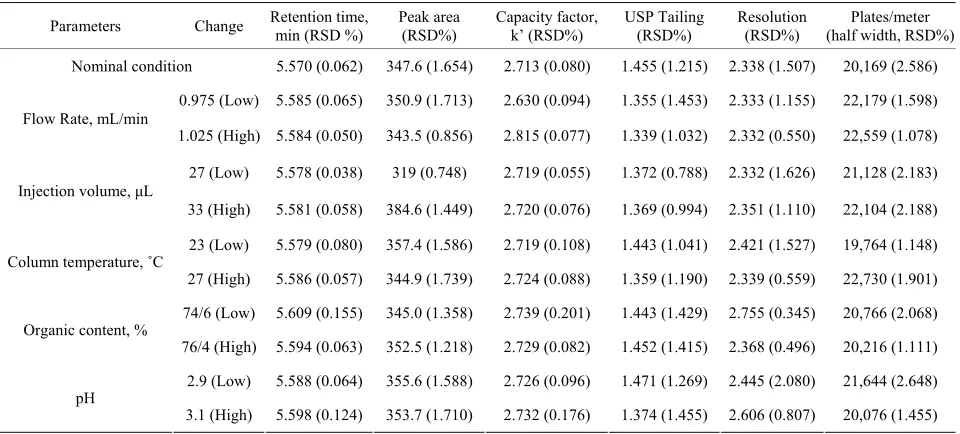
To ensure the HPLC method insensitive to minor chan- ges in the experimental conditions, it is important to de- monstrate robustness of the method. As pointed out by Dejaegher and colleagues [13], the following responses were evaluated: CPH retention time, peak area, capacity factor, USP tailing, resolution between CPH and linco-mycin, and theoretical plate numbers. Results were sum- marized in Table 6 and none of the alterations caused a
significant change in these responses and all responses met the acceptance criteria for system suitability. There-fore the method is robust and reliable to quantitate CPH.
3.7. Specificity and Forced Degradation
Full spectrum data acquisition was performed for system suitability standard (Figure 2) and two products as well
to examine for co-eluting peaks (Figure 3). After peak
Table 2. System suitability test (n = 6).
USP Criteria Specification Day 1 Day 2 Day 3 Pass/Fail
Retention time RSD ≤2.0% 0.047% 0.113% 0.130% Pass
Capacity factor k’ > 1.0 2.674 2.694 2.686 Pass
Symmetry > 0.50 0.659 0.827 0.626 Pass
Area RSD ≤2.0% 1.53% 1.23% 1.51% Pass
Theoretical plates/meter > 13,333 (2000/column) 21,501 21,461 21,909 Pass
USP tailing < 2.0 1.384 1.109 1.293 Pass
Resolution > 1.5 2.39 2.27 2.37 Pass
Table 3. Parameters and linearity of clindamycin palmitate hydrochloride calibration curves.
Standard curve Analytical range (μg/mL) Calibrators Slope y-intercept R2 value
Day 1 15 - 500 7 3.89 8.87 0.9996
Day 2 15 - 500 7 3.83 8.74 0.9999
Table 4. Clindamycin palmitate hydrochloride accuracy and precision: drug substance (% recovery, n = 5).
Validation solutions (μg/mL)
15 100 500
Day 1 92.3 100.5 99.5
Day 2 92.0 103.3 101.8 Accuracy
(% recovery)
Day 3 94.0 103.8 101.3
Day 1 0.67 1.52 0.73
Day 2 1.07 0.83 0.91
Day 3 0.97 0.89 0.99 Precision
(% RSD)
Intermediate 1.18 1.18 1.21
[image:8.595.60.288.341.408.2]Note: The acceptance criteria for accuracy: not more than 10% at the low QC levels, and 5% at the medium and high levels.
Table 5. Clindamycin palmitate hydrochloride recovery: drug product (% recovery, n = 3) via standard addition test.
50% weight product spiked to Product
125 μg/mL 250 μg/mL 500 μg/mL
A-powder 104.8 103.5 103.2
B-powder 100.8 100.6 104.4
purity analysis, results demonstrated that no co-eluting peaks of CPH and lincomycin was observed; no impuri-ties were detected in CPH peak; and excipients from the products were determined not co-eluted with CPH by observation following a spectral peak purity CPH evalua- tion. Under the current stress-test conditions, CPH was
stable under the stress conditions of heat, light and oxi- dation but labile in presence of acid and base. However, no co-eluting peaks were observed from these stressed samples. Together with all the aforementioned observa-tions, we determined that this method is specific for CPH analysis.
3.8. Analysis of the Marketed Products
In the market there is only one solid dosage form avail-able for CPH, flavored granules for oral solution with a single dose strength of 75 mg/5 mL upon reconstitution. Currently, there are one brand-name and two generic products being marketed. To ensure the representative-ness, both brand-name (one product) and generic product (one of the two) were purchased and analyzed by this validated method. Representative chromatograms were shown in Figure 3. Results for CPH potency are
summa-rized in Table 7. All products had a potency of >98%.
Although only two drug products were tested due to the limited number of products available, this method dem-onstrated strong applicability for product potency analy-sis.
In addition, this method has been proved applicable for potency analysis of novel CPH formulations prepared in house. It also demonstrated an applicability to quantitate CPH release from these novel formulations during dis-solution testing (data not published).
4. Conclusion
[image:8.595.59.539.520.737.2]A simple and efficient and robust reverse-phase HPLC method for clindamycin palmitate hydrochloride was found to be accurate, precise, specific, and linear across
Table 6. Robustness test results for the HPLC method for clindamycin palmitate hydrochloride analysis.
Parameters Change Retention time, min (RSD %) Peak area (RSD%) Capacity factor,k’ (RSD%) USP Tailing (RSD%) Resolution (RSD%) (half width, RSD%)Plates/meter
Nominal condition 5.570 (0.062) 347.6 (1.654) 2.713 (0.080) 1.455 (1.215) 2.338 (1.507) 20,169 (2.586)
0.975 (Low) 5.585 (0.065) 350.9 (1.713) 2.630 (0.094) 1.355 (1.453) 2.333 (1.155) 22,179 (1.598) Flow Rate, mL/min
1.025 (High) 5.584 (0.050) 343.5 (0.856) 2.815 (0.077) 1.339 (1.032) 2.332 (0.550) 22,559 (1.078)
27 (Low) 5.578 (0.038) 319 (0.748) 2.719 (0.055) 1.372 (0.788) 2.332 (1.626) 21,128 (2.183) Injection volume, μL
33 (High) 5.581 (0.058) 384.6 (1.449) 2.720 (0.076) 1.369 (0.994) 2.351 (1.110) 22,104 (2.188)
23 (Low) 5.579 (0.080) 357.4 (1.586) 2.719 (0.108) 1.443 (1.041) 2.421 (1.527) 19,764 (1.148) Column temperature, ˚C
27 (High) 5.586 (0.057) 344.9 (1.739) 2.724 (0.088) 1.359 (1.190) 2.339 (0.559) 22,730 (1.901)
74/6 (Low) 5.609 (0.155) 345.0 (1.358) 2.739 (0.201) 1.443 (1.429) 2.755 (0.345) 20,766 (2.068) Organic content, %
76/4 (High) 5.594 (0.063) 352.5 (1.218) 2.729 (0.082) 1.452 (1.415) 2.368 (0.496) 20,216 (1.111)
2.9 (Low) 5.588 (0.064) 355.6 (1.588) 2.726 (0.096) 1.471 (1.269) 2.445 (2.080) 21,644 (2.648) pH
0 2 4 6 8 10 Retention time (min)
80
70
60
50
40
30
20
10
0
−10
H
P
LC Response
(a)
0 2 4 6 8 10 Retention time (min)
80
70
60
50
40
30
20
10
0
−10
HPLC Respon
se
[image:9.595.60.287.94.473.2](b)
Figure 3. HPLC chromatograms of clindamycin palmitate hydrochloride products: A-powder (a) and B-powder (b). CPH had a retention time of 5.60 min.
Table 7. HPLC results of clindamycin palmitate hydrochlo-ride products (n = 3).
Product Dose strength CPH potency, % (RSD %)
A-powder 75 mg 103.5 (0.85)
B-powder 75 mg 101.9 (1.12)
the analytical range. The significant advantages of this method, over existing methods including the current USP methodology, were the simplicity of mobile phase pre- paration, buffering capacity, reduced consumption of or- ganic solvents and avoidance of ion pairing agents. The method was robust and demonstrated to be selective for the determination of CPH in the presence of its primary synthetic impurity in drug substance and products. The current method represents a significant improvement over the current USP methodology for CPH (USP CPH
monograph). The method was successfully applied for the assessment of product quality of various marketed CPH dosage forms. It is also promising to be further de-veloped into a selective stability indicating method if im- purities standards are readily available [14].
5. Acknowledgements
This study was supported in part by the NIH pediatric formulation initiative and intramural FDA research funds. The authors would like to acknowledge Gretchen White-sell’s editorial assistance.
REFERENCES
[1] A. A. Forist, R. M. DeHaan and C. M. Metzler, “Clinda-mycin Bioavailability from Clinda“Clinda-mycin-2-Palmitate and Clindamycin-2-Hexadecylcarbonate in Man,” Journal of Pharmacokinetics and Biopharmaceutics, Vol. 1, No. 2, 1973, pp. 89-98. http://dx.doi.org/10.1007/BF01059623 [2] M. Cimbollek, N. Nies, A. Liebendorfer, et al., “The
Potential of the Prodrug Clindamycin Palmitate as an Im-plantable Slow Release form of the Antibotic Clindamy-cin for Heart Valves,” Journal of Controlled Release, Vol. 33, No. 1, 1995, pp. 47-53.
http://dx.doi.org/10.1016/0168-3659(94)00061-X
[3] United States Pharmacopeia, “Clindamycin Palmitate Hy- drochloride,” United States Pharmacopeia (36) and Na-tional Formulary (31), 2013, pp. 3028-3029.
[4] L. W. Brown, “High-Pressure Liquid Chromatographic As- says for Clindamycin, Clindamycin Phosphate, and Clin-damycin Palmitate,” Journal of Pharmaceutical Sciences, Vol. 67, No. 9, 1978, pp. 1254-1257.
http://dx.doi.org/10.1002/jps.2600670917
[5] C. Bharathi, P. Jayaram, J. S. Raj, et al., “Identification, Isolation and Characterization of Impurities of Clindamy-cin Palmitate Hydrochloride,” Journal of Pharmaceutical and Biomedical Analysis, Vol. 48, No. 4, 2008, pp. 1211- 1218. http://dx.doi.org/10.1016/j.jpba.2008.08.011 [6] C. B. V. N. Raju, G. Panda, G. N. Rao, et al., “HPLC-UV
Assay Method for Clindamycin Palmitate Hydrochloride as Drug Substance and Oral Solution,” Analytical Letters, Vol. 41, No. 11, 2008, pp. 2033-2043.
http://dx.doi.org/10.1080/00032710802209334
[7] E. L. Rowe, “Anomalous Solution Behavior of 2-Pal- mitate Esters of Lincomycin and Clindamycin,” Journal of Pharmaceutical Sciences, Vol. 68, No. 10, 1979, pp. 1292-1296. http://dx.doi.org/10.1002/jps.2600681025 [8] L. W. Brown and W.F. Beyer, “Clindamycin
Hydrochlo-ride,” In: K. Florey and G. Rafik Bishara, Ed., Analytical Profiles of Drug Substances, Acedemic Press, Inc., Lon-don, 1981, pp. 75-91.
[image:9.595.57.287.552.605.2]899-906. http://dx.doi.org/10.1002/rcm.3935
[10] United States Pharmacopeia, “General Information <1225> Validation of Compendial Procedures,” United States Pharmacopeia (36) and National Formulary (31), 2013, pp 983-988.
[11] “Guidance for Industry Q2B Validation of Analytical Procedures: Methodology,” International Conference on Harmonization of Technical Requirements for Registra-tion of Pharmaceuticals for Human Use (ICH), 1996. [12] United States Pharmacopeia, “Materials Safety Data
Sheet: Clindamycin Palmitate Hydrochloride,” 2007.
http://www.usp.org/pdf/EN/referenceStandards/msds/113 7005.pdf
[13] B. Dejaegher and Y.V. Heyden, “Ruggedness and Ro-bustness Testing,” Journal of Chromatography A, Vol. 1158, No.1-2, 2007, pp. 138-157.
http://dx.doi.org/10.1016/j.chroma.2007.02.086
[14] M. Bakshi and S. Singh, “Development of Validated Sta-bility-Indicating Assay Methods—Critical Review,” Jour- nal of Pharmaceutical and Biomedical Analysis, Vol. 28, No. 6, 2002, pp. 1011-1040.