http://dx.doi.org/10.4236/ojm.2013.34019
Black Holes—Information Models
Igor Gurevich
The Institute of Informatics Problems of the Russian Academy of Sciences, Hetnet Consulting Corp., Moscow, Russia Email: [email protected]
Received July 25, 2013; revised August 25, 2013; accepted September 2, 2013
Copyright © 2013 Igor Gurevich. This is an open access article distributed under the Creative Commons Attribution License, which permits unrestricted use, distribution, and reproduction in any medium, provided the original work is properly cited.
ABSTRACT
Estimation of the volume of information in black holes is necessary for generation of restrictions for their formation, development and interconversion. Information is an integral part of the Universe. By its physical essence information is heterogeneity of matter and energy. The universal measure of physical heterogeneity of information is the Shannon in- formation entropy. It is important to note that the Neumann entropy cannot be applied as the universal measure of het- erogeneity because it is equal to zero for structured pure state. Therefore information is inseparably connected with matter and energy. The informatics laws of nature are: the basic law of Zeilinger’s quantum mechanics postulates that the elementary physical system (in particular, fundamental particles: quarks, leptons,…) bears one bit of information, the law of simplicity of complex systems, the law of uncertainty (information) conservation, the law of finiteness of complex systems characteristics, the law of necessary variety by W. Ashby, and the theorem of K. Gödel. The law of finiteness of complex systems characteristics and the principle of necessary variety by W. Ashby impose restrictions on the topology and symmetry of the universe. The author’s works testify about the practicality of information laws simul-taneously with physical rules for cognition of the Universe. The results presented in this paper show the effectiveness of informational approach to studying the black holes. The article discusses the following questions: The volume of infor- mation in the black hole, Emission and absorption of usual substance by a black hole, Formation and development (changing) of black holes, Black hole merger. Black hole is called optimal if information content is minimal at the Uni- versity region. Optimal black holes can exist when at least the two types of substance are available in the Universe: with non-linear and linear correspondence between information content and mass. Information content of optimal black hole is proportional to squared coefficient correlating information content with mass in usual substance and in inverse pro-portion to coefficient correlating information content with black hole mass. Concentration of mass in optimal black hole minimizes information content in the system “usual substance—black holes”. Minimal information content of the Uni-verse consisting of optimal black holes only is twice as less as information content available of the UniUni-verse of the same mass filled with usual substance only. An information approach along with a physical one allows obtaining new, some-times more general data in relation to data obtained on the ground of physical rules only.
Keywords: Black Holes; Usual Substance; Information; Models; Volume; Restrictions; Universe
1. Introduction
Estimation of the volume of information in cosmological objects, including stars of the Sun type, neutron stars, white dwarfs and black holes, is necessary for generation of restrictions for their formation, development and inter- conversion. Information is an integral part of the Uni- verse. The basic law of Zeilinger’s quantum mechanics postulates that the elementary physical system (in par- ticular, fundamental particles: quark, electron, photon) bears one bit of information. By its physical essence in- formation is heterogeneity of matter and energy. There- fore information is inseparably connected with matter
only physical laws. The author’s works, testify about the practicality of information laws simultaneously with physical rules for cognition of the Universe. The esti-mates cited below are based on the foundational principle of Zeilinger quantum mechanics i.e. “an elementary sys-tem carries one bit of information” and prove it. The elementary systems are fundamental particles (quarks, leptons, photons).
2. The Informatics Laws of Nature
The informatics laws of nature are [1-3]:
ThemainprincipleofquantummechanicsbyA. Zeil- inger: Elemental physical systems contain (carry) one bit
of information.
Thelawof simplicityofcomplexsystems. Such vari-
ant of complex system is realized, survives which pos- sesses the minimum complexity.
The law of simplicity of complex systems is realized by nature in a number of constructive principles:
“Occam Razor”; hierarchical modular construction of complex systems; symmetry; simmorfoz, stability; field interaction (interaction through the carrier or interactions through space-time status, for example, curvature of space- time); extreme uncertainty (functions of characteristics distribution have extreme uncertainty).
Thelawofconservationofuncertainty (information).
Uncertainty (information) of the isolated (closed) sys- tems is saved at physically realized transformations and only at physically realized transformations.
The lawof finiteness of information characteristics of complex systems. All kinds of interaction between systems, their parts and elements have final speed of dis- tribution. Speed of change of system states of elements is limited also.
In any system of coordinates information on event is always final. Duration of signal is always more than zero . Information on coordinates of physi- cal systems in our Univerce is limited by 333 bits.
T
T 0
Thelawof necessaryvarietybyW. Ashby. For effec-
tive functioning of system a variety of operating body should no be less then variety of management object.
Uncertainty (information) is the basic characteristic of a variety of systems. The law of necessary variety by W. Ashby is also realized in a number of concrete principles: Shannon theorems, Kotelnikov theorem, Kholevo theo- rem, Brillouin theorem, theorem of Margolis-Levitin.
Gödeltheoremofincompleteness. In enough rich theo-
ries (containing on arithmetic) there are always the unprovable true assertions.
The law of systems complexity growth. During sys- tems evolution its uncertainty (systems information) grows.
LeChatelier Principle. External influence discompos-
ing system, calls in it the processes, aspiring to weaken results of this influence.
3. The Volume of Information in the Black
Hole
The basic law of Zeilinger’s quantum mechanics postu- lates that the elementary physical system (in particular, fundamental particles: quark, electron, photon) bears one bit of information [1]. The volume of information in physical systems is estimated the information entropy
[4,5]. The information volume of a black hole of mass
Чд
M is equal to 2 2
Bh
G
Bh
I M
c
nat, or
2 2
ln 2
Bh
G
Bh
I M
c
bit [6,7]. The information volume contained in the black hole is proportional to its squared mass. How to explain it? Let us assume that a black hole contains pairwise interacting particles (q-bits). Then the quadratic dependence of the volume of information in the black hole on its mass can be explained by the fact that each interaction forms 1 bit of information. The black hole is described with the wave function
n
1 2 1 2
1
0 0 0 1 1 1
2
n n
n . As mentioned
earlier the volume of information in the system described with the present given function is equal to
1
2
n
n n
I bit. At n1 the volume of information in the black hole is proportional to the black hole squared
mass 2
2
n
n
I . A black hole consisting of particles n contains the information, which is bit larger than a black hole consisting of
n 1
n particles:
1
1 1
2 2
n n
n n n n
I I n
.
Let us compare the estimates of squared mass of a
black hole: 2 ln 2 2
Bh
c
Bh
M I
G
(from cosmological
formula [6-8]) and 2 2 0
Bh
2
M n m (squared mass of the particles composing the black hole). We have
n
2 2 2
0
ln 2 2
Bh B
c
h
M n m I
G
. As far as
2
2
чд
n
I , then
2 2 2
0
ln 2
2 2
c n
n m
G
, or 2 0
1 ln
4 c m
G
2.
Eventually we obtain the estimate of mass of particles being part of the black holes:
0
ln 2 ln 2
g 2
2 2
c h
m
G G
c
magnitude with Planck mass 2.17 10 g5
Pl
c m
G
:
6 0
ln 2 0.23 5.09 10 g
2 Pl
c
m m
G
.
Therefore, a black hole is the aggregate of particles (let us call them black particles) each having a mass equal to 0.23th of Planck mass) and interacting with all other black particles that form a black hole. Characteris- tics and models used in the paper are taken from [9-16] and [13-24].
4. Emission and Absorption of Usual
Substance by a Black Hole
Suppose that at the initial instant of time a black hole consisting of n black particles has the mass of
0
n
M n m and contains
1
2n
n n
I bit of infor- mation. The black hole mass changes (increases or de- creases) by black particles (quanta) Mm0
m. As far as each black hole has the sub-Planck mass 0, then the change in energy of a black hole in such a case is equal to . In the event of the loss of emission of one black particle the mass of a black hole becomes
equal to n 0
2 0
E mс
1
M n m . In this case the volume of information remaining in the black hole is
1
1 2
n
n n
I
bit. Change (loss) of information in the
black hole comes to n bit.
For further estimates we implement the law of conser- vation of uncertainty (information) [2,3] and energy con- servation principle. According to the law of conservation of uncertainty (information) a change in the system “a black hole with the mass Mn n m0
n
—external envi- ronment” on emission of one black particle must be balanced by the occurrence of particles containing 1 bit each: InIn1n bit. It can believed that n photons of frequency and energy h emerged.
In virtue of energy conservation principle 2
0
n h m c
and
2 0
m c n h
. Because 0 ln 2 2
c m
G
, then the
frequency of emitted photon must be equal to
5 4
1 ln 2 4.34 10 1
2
c с
n h G n
2
. Because
44 5 5.41 10
Pl
G
t c
c
, then 1 ln 2
2 Pl
n t
. Let
us denote
5
43 0
ln 2 1 ln 2
0.43 10 1
2 Pl 2
c
c
t G
.
Then 0
n
In the case of a black hole containing one black parti- cle the radiation frequency is maximal and in inverse proportion to Planck time unit. Similar dependences are true for absorption of photons by black holes.
Note 1. In the general case, there must appear n pho- tons having the frequency of i and aggregated energy
2 0 1
n
i i
h m
c equal to bit. nNote 2. In the general case, there must appear k parti- cles with aggregated information equal to bit and aggregated energy .
n
2 0
m c
Note 3. In the general case, there must be absorbed photons having the frequencies
n
i
and the aggregated
energy 2equal to bit.
0 1
n
i i
h m
c nNote 4. In the general case, there must be absorbed particles with aggregated information equal to n bit and aggregated energy .
k
2 0
m c
Identical dependencies are true for cases when photons are absorbed by black holes. In virtue of the law of conservation of uncertainty (information), the changes in the system “a black hole with the mass
1 1
n 0
M n m —external environment”, when the mass of a black hole is increased by the mass of one black particle, must be determined by absorption of n particles containing 1 bit each: InIn1n bit. Suppose that there had been absorbed n photons of fre-quency and energy
n h . By virtue of energy con-servation principle . The frequency of each absorbed photon must be equal to
2 0
m c
5 42
1 ln 2 4.34 10 1 sec
2
c
n G n
. At the formation
of a black hole consisting one black particle the absorp- tion frequency is maximal and inversely proportional to Planck time unit.
Having the estimates of black holes distribution by mass one can calculate the intensity of aggregated distri- bution of black holes radiation by frequencies and com- pare them with the experiment results. From the obtained radiation frequency expression one can draw the estimate of black hole radiation temperature. We calculate the temperature of the radiation of a black hole. The thermal radiation of a black body is related to the average energy
of radiation h 2.7kT, or
2.7 h T
k
. Since
2 2 3 0
2
ln 2 8
m c c
M h M
G , then
3 3
2
ln 2 ln 2
2.7 2.7 8 4 2.7
h h c c
T
k k M G k M
G
. The
use
1
8 1076 2n n
radiation quanta. perature, which coincides up to a factor 2ln 20.51
2.7
with an estimate of Hawking tion energy is on the order of 10It is known that during supernova explosion the radia- 50 erg, the maximum 1054 erg. Whereas the average radiation frequency is 1018 Hz, then the supernova explosion generates
3
8
H
c T
k G M
.
5. Formation and Development (Changing)
Le lack hole of mass
50 54
59 63 27 18
10 10
10 10
10 10
N
of Black Holes
t us assume that a b
radiation quanta. Assum- 0
n
M n m on). As me
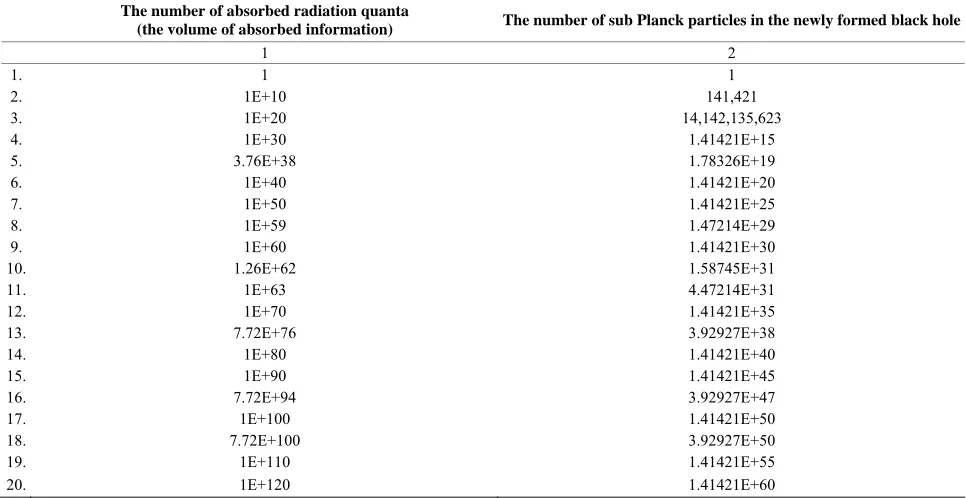
is formed from the usual substance (radiati n- tioned earlier, such a black hole contains
ing that ≈100% radiation quanta is used for black hole formation, then the mass of a black hole would be equal to about
1 bit
2 for its for-
mation are needed n n
I of information. Therefore, 29 6 24
0
2 4.47 10 5 10 2.3 10
M N m
1
2 n n
particles of usual substance
each of t
(radiation quanta), hem containing 1 bit. For formation of a black hole of the mass equal to M kg it
is necessary to form 0 M
n sub Planck particles d
m an
use
2 0 0
2 0
1 1
2 2 2
M M
m m
n n M
m
radiation qu
Thus, for formation of a black hole with the mass of t anta.
he Sun equal to 2 10 kg30 , it is necessary to form
33
38 6
0
4 10 5 10
m
2 10
c
M
n sub Planck particles and
g
Table 1. (Columns 1, 2). Information characteristics of bl holes of different masses; (Columns 3, 4). Information (a)
The number of absorbed radiation quanta
The number of sub Planck particles in the newly formed black hole
. The Table 1 (columns 1 - 4) present information characteristics of black holes of different masses.
From the above chart it follows that:
The mass of a black hole formed during the super- nova explosion is close to the mass of an optimal black hole in the system “a black hole—radiation”. One can expect that during the supernova explosions the black holes be formed having the masses under which the information volume in the adjacent space is close to minimum.
For formation of the black holes with the mass equal to million masses of the Sun the volume of informa- tion exceeding the volume of information of the Uni- verse (1090 bit) is required [2,3,25]. Significant vol- umes of information are needed for formation of the black holes with the same mass as of the Sun’s. In
ack characteristics of black holes of different masses.
(the volume of absorbed information)
1 2
1. 1 1
2. 1E 0 14 1
14, 23
3
7
7
7
+1 1,42
3. 1E+20 142,135,6
4. 1E+30 1.41421E+15
5. .76E+38 1.78326E+19
6. 1E+40 1.41421E+20
7. 1E+50 1.41421E+25
8. 1E+59 1.47214E+29
9. 1E+60 1.41421E+30
10. 1.26E+62 1.58745E+31
11. 1E+63 4.47214E+31
12. 1E+70 1.41421E+35
13. .72E+76 3.92927E+38
14. 1E+80 1.41421E+40
15. 1E+90 1.41421E+45
16. .72E+94 3.92927E+47
17. 1E+100 1.41421E+50
18. .72E+100 3.92927E+50
19. 1E+110 1.41421E+55
[image:4.595.56.539.486.735.2](b)
The mass of a newly formed black hole Note
kg
3 4
1. 5.09E−09 Characteristics of the minimal black hole 2. 0
haracteristics of the optimal black hole in the system “hydrogen (protons)—black hole)
8. 2.28E+21 Characteristics of a black hole generated during the supernova explosion of radiation rate of 1050 erg
9. 7.2E+21
haracteristics of the optimal black hole in the system “radiation—black hole”.
11. 2.28E+23 Characteristics of a black hole generated during the supernova explosion of radiation rate of 1054 erg
12. 7.2E+26
haracteristics of a black hole having the mass of the Sun
haracteristics of a black hole of 106 of the masses of the Sun
haracteristics of a black hole of 109 of the masses of the Sun
haracteristics of the maximum black hole .000719832
3. 71.98347 4. 7.2E+06
5. 1.78E+11 C
6. 7.2E+11 7. 7.2E+16
10. 9.09E+22 C
13. 2E+30 C
14. 7.2E+31 15. 7.2E+36
16. 2E+36 C
17. 7.2E+41
18. 2E+39 C
19. 7.2E+46
20. 7.2E+51 C
76 such case the volume of information of about 10 is
6. Black Hole Merger
onsisting of the two black required. It means that locally (in the zone of black hole formation) there must take place the intensive physical processes of radiation formation. For in- stance, the supernova explosions and accelerated mo- tion of relativistic particles.
Let us consider a system c
holes. Suppose that the black holes have the mass of 1 1 0
M n m , M2n m2 0 (m0—the minimal black hole nd c ntain the volume of infor-
mation e
mass, n n1, 21, 2,) a o
qual to n n1 1 1
1 2
I and I n n2
2 1
2 2
.
The mass of the system is equal to M1 2
n1n m2
0m is
, the volume of information in the syste
1 1 1 2 2 1
n n n n
I1 2 ble that a blac
2 2
. Is it possi k
hole is formed as a result o
new black hole must be equal to the sum of the masses of
the original black holes
f the two given black holes merger and only two given black holes? The mass of a
1 2 1 2 0
M M n n m . The volume of information in the new black hole must be
equal to
1 2
1 2 1
2n n n n
I s that
under no masses of the original black holes the volume . It is obviou
tion in the newly form e total volume o
of informa ed black hole would
coincide with th f information in the original black holes
2 2
1 2 1 2 1 1 2 1 1 2 2 2
2 2
1
2 2
n n n n n n n n n n n n
I
1 1 2 2
1 1 2 2
1 2
1 1
.
2 2 2
n n n n
n n n n
I I
Let us consider the following example. Suppose that the mass of the black holes is
1 2 0
M M m
ion equal to
and they contain the volume of informat I1I21. The mass of the system is M1 2 2m0, the volume of information in the system is I1 2
Is it possible that a black hole is formed as f merging the two black holes of inimal mass and only the two given black hole al
1 1 2 .
a result o the m
mass of a new black hole must be equal to the sum of masses of the original black holes M M1 2 2m0. The volume of information in a new black hole must be equal
to
1 1 1 1 1
3 2I . Apparently e of information in a new black hole does not coincide with
the volum
aggregated volume o
rged. Let us suppose that the black holes be
the f information in the original black holes.
We give a system of equations for estimation of the mass of a black hole under formation when the two black holes are me
fore merging possess the mass of M1n m1 0,
2 2 0
M n m (m05.09E 09 kg —is the minimum mass
of the black hole n n1, 21, 2,) and contains the vol-
ume of info atrm ion equal to 1
1 1
2 n n and
1 I
2 2 2
2 . As a result of th black ho 1
n n
I e original les a
black hole and usual substance are created. The mass of the black hole after the merger is equal to M1 2 nm0, rmation in the newly formed black hole the mass of info
is equal to 1 2
1 2 n n I
. A number of partic e f
usual substance that have been formed after the merger is l s o
equal to x. of information in the usual substance is eq
The volume
ual to IUs x. The average mass of a
particle of usual substance is equal to m.
From th law of conservation of uncertainty (informa- tion) it follows:
e
1 1 2 2 1 2
1
2 2 2
n
1 2 Us.
1 1
n n n n n
I I x
I I
We believe that the main energy of black holes and usual substance is concentrated in the mass. Then m the energy conservation principle it follows:
fro
1 2 1 2 0 0
M M n n m nm xm. 1) Thus we have a two-equations system
1 1 1 2 2 1 1
2 2 2
n n n n n n
x
with three unknowns
,
n1n m2
0 nm0xm, n, x, m. x0. Hence,
1 1 1 2 2 1 1
2 2
2 2 2
2 n n n n n n
,
or at (restriction on the mass of the black
2) Next we have 1
n
ho 1 2
n n n le after merging).
2
1 1 2 2 2
n n n2n n2 n x,
n n m
nm xm.1 2 0 0
3) And
2 2 2
1 1 2 2
2
n n n n n n x ,
1 2
0
1 2
0
2 2 2
1 1 2 2
2
n n n m n n n
m m
x n n n n n n
.
4) At n1 m 2m0 n
.
The following assertions are valid.
ion 1. black h cannot be created by means of merging the two black holes and only two black holes.
M ly with the absorp-
tio
tra absorption and em
s through absorption of us
Assert A ole
erging of black holes can occur on n and emission of usual substance.
Assertion 2. A black hole cannot be created by means of merging k black holes and only k black holes. Merging of black holes can occur only with ex
ission of usual substance.
Assertion 3. A black hole can reduce its mass through emission of usual substance and only it into space. A black hole can increase its mas
ual substance and only it from space. During the two black holes merger one of them should emit usual sub- stance into space while another one should absorb usual substance from space.
Assertion 4. During the merger of two black holes having the masses M1n m1 0, M2n m2 0 , without using any additional usual substance, the mass of a newly formed black hole is less than
2 2 2 21 2 1 1 1 2 2 1 0 1 2 0 1 2
M n n n m n n M M . During the merger of two black holes having the same masses
n m
0
1 2
M M nm , the mass of a newly formed black hole is less than
2
1 2 2 0 0 2 2 1 2 2
M n m nm M M . The mass of a black rmed as a result of the merger of 2 black holes of the sa
hole that was fo
me masses without using any additional usual substances is 2 times
rge
less than the sum of masses of merging black holes. The remaining mass is dissipated in the space.
Assertion 5. During the me r of k black holes having the mass of Mi n mi 0 without using any addi- tional usual substance, the mass of a new formed black ho
ly le is less than
2 21 2 0 1 0
k k k
k i i i i
1 1 1
i i i
M m
n n m
n
M .
During the merger of black holes of the same masses
k 0
i
M nm M bstance, the mass
without of a
using any additio usual su newly formed black hole is les
nal
than 2
1 2 k 0 0
M kn nm k k M . The
mass of t was formed as a result of the merger of k black holes having the same masses is
m
a black hole tha
k
times less holes.
A system consisting of the two black holes usual substance. Let us consider a system consisting of the two black holes and usual substance. The bl
and ack holes possess the same mass M1,0 nm0, M2,0 nm0 and
contain the same volume of information 1,0
1 2 n n I
and 2,0 2
I . The usual substance is represen
E
1 n n
ted
by the photons having different frequencies (energy) h
them according to the foundational princi uantum mechanics contains one
, each of ple of Zeilinger q
Asse
bit of information.
rtion 6. During the merger of
k
black holes having the same masses M1nm0 and M2nm0 and containing the same volumes of information
1
1 2 n n
I and 2
1 2 n nI the ab r black hole must absorb by n2 bit information more
, so bing than
contained in the absorbed black hole 2
1 n n I2
—
the absorbing black hole must absorb additionally n2 containing t
ng particles of usual substance, each of them ne bit of informa ion.
o
Assertion 7. The merger of the two black holes havi the masses of M1n m1 0 and M2n m2 0 and con-
taining the volumes of information 1
1
12
I n n 1 and
2 2 2
2
I resulting in one bl ,
of usual substance each of them con- information.
1 n n
ack hole formation requires the usage of extra radiation quanta
particles one bit of
ne can theoretically dem- ack holes that minimize ry region of the Universe
the Universe square-law ass) of the
1 2
f
n n n -n n1 2
taining
7. Optimal Black Holes
By using informatics approach o onstrate the existence of bl information content of arbitra
and place lower bound limitations on information content of the Universe. The origin and cause of optimal black holes existence is the occurrence of substance of two different types: with square-law and linear-law dependence of information content on mass. In the presence of substance of only one type, the optimal black holes do not exist. Following tasks are solved. The direct task: to discover an information minimum in system “usual sub- stance—black a hole” at the given mass of usual sub- stance and a black hole. The dual task: to discover a mass maximum in system “usual substance—black a hole” at the given information in usual substance and a black hole. We examine optimal black hole characteristics in the systems “radiation (photons)—black holes”, “hydrogen (protons)—black holes” and in the system “several types
of usual substance—black holes” [16-24].
7.1. Definition of Optimal Black Holes Let us estimate the information content of region of mass MUn rgn under the arbitrary
relation between information and energy (m black hole 2
bh bh
I M and arbitrary linear-law rela- tion between inf on and energy (mass) of usual substance us us
ormati
I M (under arbitrary non-negative coefficients , ). Agg
black
regated information content of the Universe region of mass MUn rgn, consisting of usual substance a hole is equal to
2
2
Un rgn bh us us
bh Un rgn
I I I M M
M M M
.
nd one
Let us find a condition for the minimum:
bh
bh
2
2 0.
bh Un rgn bh
Un rgn bh us
bh bh bh
M M M
bh
M M M
I I I
M
Assertion 8.
2
Opt bh
M
is black hole mass, under
which information content of the Universe region of mass g of usual su
mal.
tion co
isting of usual substance and one black hole.
to coef
Un rgn consistin bstance and one black hole
M is mini
Let’s call the black hole optimal under which informa- ntent is minimal at the University region of mass
Un rgn
M , cons
Black hole mass does not depend on the mass of the Universe region. Optimal black hole mass is proportional
ficient correlating information content with usual substance mass and in inverse proportion to coefficient correlating information content with black hole mass.
Note 5. Optimal black holes can exist when at least the two types of substance are available in the Universe: with non-linear (for instance, I M under 0, 1) an
content o al black hol
ent with mass in usual substance and in in
d linear correspondence between information content and mass.
Assertion 9. Information f optim e is proportional to squared coefficient correlating infor- mation cont
verse proportion to coefficient correlating information content with black hole mass:
2
4
Opt bh
I
bits.
Note 6. We will observe a dual task of definition of the maximum mass MUn rgn of system “usual substance
—a black hole” at t information content of
he given
ning t
Un rgn
the Universe region. Let’s size up mass MUn rgn in the
Universe region contai he given information content
Un rgn
M at the arbitrary square link between the mation and energy (mass) of black hole 2
bh bh
I
2 1
bh bh
M I
Mbh 1 Ibh
, and the arbitrary linear link between the information and energy (mass) of usual
substance Ius Mus or Mus 1 Ius (at the arbitrary
nonnegative coefficients , ). The information of the Universe region consisting usual substance and one black hole is equal to
of
Un rgn bh us
I I I . The mass
Un rgn
M of the Universe r consisting of usual sub-stance and one black hole, is equal to
egion
1 1
1 1
Un rgn bh us bh us
bh Un rgn bh
M M M I I
I I I
.
We will discover an optimality requirement:
1 1
1 1 1
0. 2
Un rgn bh us
bh bh
I I
bh Un rgn bh
bh
bh
M M M
I I I
I
I
As 2
2 2
1 1
0 4
Un rgn
bh bh
M
I I
3 the given require-
ment is a maximum requirement.
her we have:
Furt 1 1 1
2 Ibh
, 2 Ibh
lack hole of optimum
ma
and the information content in a b
ss is equal
2
I 4
bh
. The mass of a black hole at
ation
al to
which mass MUn rgn of region the Universe is maximum
at the given inform content of the Universe region
Un rgn
I , is equ
2
1 1
4 2
Opt bh Ibh
M
.
Assertion 8.a. The Information content in a black hole at wh e Universe region consistin of usual substance and one black hole aining the gi
ation
ich mass of th MUn rgn g and cont
ation c
ven information content IUn rgn, it is proportional to a
square of coefficient linking an inform ontent with mass in usual substance and inversely proportional to coefficient linking an inform content with mass in a black hole:
2
bits. 4
Opt bh
I
Assertion 9.a. The mass of a black hole at which the
mass of field of Universe containing the given information content maximum, consisting of usu
Un rgn
M
n is Un rg
I
al substance and one black hole, is equal to
2
Opt bh
M
at the so-lution of a direct task (a minimi ion of information content in system “usual substance—a black hole” at the give
.
Information contents and the masses gained sat
n mass of system—assertions 8, 9) and a dual task (a maximisation of mass of system “usual substance—a black hole” at the given information content) assertions 8.a, 9.a), coincide. Thereby concept of an optimum black hole is identical and all subsequent assertions and rela-tionships also are identical.
As far as the black hole mass under which information content is minimal at the Universe region consisting of black hole and common substance does not depend nei-ther on aggregated mass of the Universe (the Universe), nor on usual substance mass in the region under study, then the minimal information content of the Universe region (the Universe) can be reached if the Universe region (the Universe) consists of optimal black holes only. The maximum number of optimal black holes of the Universe region (the Universe) is equal to
2
Un rgn
Opt Un rgn Un rgn
Opt bh
M
N M
M
,
2
Un
M
Opt bh Un Un
Opt bh
N M
M
.
The minimal information level of the Universe region (the Universe) consisting of black holes on is equal to ly
2 2
4 2
Un bh Opt bh Opt bh Un
I N I M MUn
.
Note 7. Hereafter for brevity sake we’ll speak about the Universe, though the assertions and expressio e also true for arbitrary regions of the Universe.
ns ar
Assertion 10. Minimal information content of the Universe consisting of optimal black holes only is twice as less as information content available of the Universe of the same mass filled with sual substance only: u
bits. 2
Un Un bh
M I
Assertions 8 - 10 are true for any kind of linear de-pendence of information volume on usual substance mass. The important agents of usual substanc radiation and hy
e are
7.2. Universe Filled with Radiation
Let’s consider the Universe filled with usual substance (radiation). The energy required for transfer, retrieval,
can record of one bit under the temperature T than the value E kTln 2. In accor
not be less dance with the min
Einstein equation, the mass required for transfer, retrieval, record of one bit under the temperature T can not be less than the value
2min ln 2
M kT c . It is easily seen that for record of 1 bit under T = 1 K the mass no less than
2 10 23 joule 9 10 m s16 2 2 1040 kg
bit bit
M E c
is needed.
As far as 2 ln 2 c
, and for radiation G
2
ln c k T
2 , then
3
2 4
Opt bh
c M
G k T
and
in content of op ed in the
system “black hole + radiation” is equal to formation timal black hole form
2 5
2 2 bit
4 8 G k T ln 2
obtained result as the following assertion.
Opt bh
I
. Let’s expres
Assertion 11. Concentration of mass c
s the
3
4 M
G k T c
on content in
black hole that
em k hole” is in
ck holes , in th
of optimal black hole minimizes informati the system “photons—black holes”.
We note that the mass of optimal erged in the system “radiation—blac inverse proportion to radiation temperature.
The total number of optimal bla NOpt bh
e Universe of mass MUn consisting of radiation and black holes is equal to
3
Opt bh Un Un
N M M
c
Assertion 12. minimal possible information content of the Univ
2 4 TG k .
The
erse of mass MUn of the Universe of
mass MUn consisting of radiatio d blac holes is eq
n an k
ual
2
2 ln 2
Un
M
k T
to c
min Un bits.
Un Opt bh Opt bh
M I I N
2
, the minimal possible information content of the Universe of the Universe of mass
Thus
Un
M consisting of radiation and black holes is proportional to the mass of the Universe, the speed of light squared, inversely pro-portional to Boltsman constant and the temperature of the Universe.
Assertion 13. The Universe of mass MUn, consisting of radiation and black holes, containing
3 4
Opt bh
G k T
N M black holes of mass
3
4
Opt bh
c M
G k T
, while only each of the black holes
of the given mass contain nforma-tion content equal to
s the minimal possible i
2
min Un bits.
c M
2 k T ln 2
The minimal possible information content of the Uni-verse of mass
Un
I
Un
M , consisting of radiation and black holes is proportional to the energy of the Universe, in-versely proportional to Boltsman constant the tem-pe
te
and
rature of the Universe. It is notable that the minimal information con nt in the Universe does not depend neither on gravitation constant nor Plank constant
3
25 22
9.09 10 g 9.09 10 kg. 4
Opt bh
с
M
G k T
The mass of black hole under which the information minimum is gained in the Universe of mass MUn c onsist-ing of radiation and black holes does not depend on the gross mass of the Universe and is equal to 9.09 × 10²² kg. It is approximately one seventieth of the Earth mass which is equal to 6 10 kg 24 . Information content of
optimal black hole is equal to 1.26 10 bits62
Opt bh
I .
Our Universe can contain about 1029 black holes. The minimal information content in the Universe of the mass equal to the mass 52 f our Universe, consisting
of 1029 optimal black holes, and only of these l to
10 kg o
, s equa
2
91
min 1.56 10 bits
2 ln 2
Un Opt bh
c
I N I
k T
.
At 2.7 10 K0 n the mass of an optimum black hole
is ap
Opt bh
l , the information
volum oximately eq
to (the nucleosy
-, the informat
on tion content o T
proximately equa e in an optimum
62n bits. So at
beginning) ma
22
9.09 10 n kg black hole is appr
0 10
2.7 10 K
T ualn
10
thesis ss of an optimum black hole is ap-proximately equal 1013 kg ion volume in an optimum black hole is approximately equal to 1052 bits.
Asserti 14. Informa f the Universe of mass 10 kg52
Un
M consisting of radiation and black holes ranges within 1091 10120bits
Un M
I
.
Assertion 15. Information content available in the Universe of mass MUn, consisting of radiation and black
holes ranges within
2
2 2
2 ln 2 ln 2
Un Un Un
M I M
k T c
.
7.3. The Universe
c G
Filled with Hydrogen (Protons)
Let us consider the Universe filled with usual substance (hydrogen). Wave function of proton with upward-di-
Un
rected spin
1 1
, 2
2 18
2 2
z
P s p n p
p p n n p p
.
p p n p n p
p n p n p p
n p p p p n
Uncertainty (information content) of proton structure is equal to 2837 bit. Having in mind the uncertainty of spin orientation it is necessary to add 1 bit - 3837 bit. Information content in quarks (1 bit in each) - 3 bit. C
olour information content—2585 bit. The total uncer- tainty (information content) of proton is contained in the proton structure, qurks and colour and equal to 9422 bit.
Hydrogen atom in the ground state
2 IV
contains 11.422 bit (1 bit in atomic structure, 9422 bit in
proton and 1 bit in electron). As far as 2 G ln 2 c
,
and for hydrogen atoms 11.422 11.422
в p
m m
, then
11.422 ln 2 c
M and infor
content of optimal black system
2 4
Opt bh
p
m G
mation
hole formed in the “black hole + hydrogen” is equal to
22
2 11.422 ln 2
bits c
. 4 8m Gp
Let us define the obtained resul
Opt bh
I
t as the following assertion.
Assertion 16. Concentration of mass 11.422 ln 2
4
Opt bh
p
m G minimizes
c
M in the optimal black hole
information content in the system “hydrogen— bl
The total number of o the Universe of mass
ack holes”.
ptimal black holes NOpt bh, in
Un
M consisting of hydrogen at-oms and blck holes is equal to
4 2
11.422 ln 2
Un p
Opt bh Un
M m G
c
N M
.
ss
Assertion 17. The minimal possible information con-tent of the Universe of ma MUn,
equal
consisting of hydro-gen atoms and black holes is to
min Un2
Un Opt bh Opt bh
I I N
11.422
5.7 bits. 2
Un Un
p p
M
m m
M
Thus, the minimal possible information c of the Universe, of the Universe of mass
ontent
Un
M consisting of hydrogen atoms and black holes is tional to the Universe mass and inversely proportional to two masses of
propor
hydrogen atom (proton).
Assertion 18. The Universe of mass MUn, consisting of hydrogen atoms and black holes, containing
4
11.422 ln 2
Un p Opt bh Un
M m G
N M
c
black holes of mass 11.422 ln 2
4
Opt bh
p
c M
m G
and only each of the black
holes of the given mass conta information content equal to
ins the minimal possible
min 5.7 Un bits. M
Un
I
m
ass
p
The minimal possible information content of the Uni-verse, of the Universe of m MUn, consisting of
hy-drogen atoms and black holes is r onal to the mass of the Universe, inversely proportional to hydrogen mass (p
propo ti
roton). It is important to note that the minimal informa-tion content of the Universe consisting of hydrogen at-oms and black holes does not depend on gravity constant, the speed of light and Plank constant.
Let us evaluate the mass of optimal black hole
14 11
11.422 ln 2
1.78 10 g 1.78 10 kg. 4
Opt bh
p с
M
m G
Black hole mass, under which the minimum info n is gained at the Universe, the Universe
rma-
tio of mass
Un
M consisting of hydrogen atoms and black holes, not depend on the gross mass of the Universe and is does
equal to 1.776 10 kg. 11 This is about the boundary
mass of primary black hole equal to 10 kg12 .
Information content of optimal black hole is equal to
22
38 2
11.422 ln 2
3.76 10 bits.
Opt bh
p
c I
m G
There can be about 1041 optimal black holes in o r Universe. The minimal information content of the Un
4 8
u i- verse whose mass is equal to mass of our Universe of , consisting of 1041 optimal black holes d
52
10 kg on
an ly of these, is equal to
79 min 5.7 Un 3.31 10 bits
Un
p
M I
m
.
on 19. Information content of the Universe of mass 10 kg52
Un
M , cons Asserti
isting of hydrogen atoms and
black range
rmation of
M
holes lies in the
Assertion 20. Info
79 120
mass MUn, consisting of hydrogen atoms black
holes the range
and lies in
2 2
.7 bits.
ln 2
Un
Un Un
M G
I M
m c
5
p
7.
nformation content is available at the Universe if the latter looks l e one black hole of
mass
4. Maximum Information Content of the Universe
The maximum possible i
ik
Un
M : 2
max
2 bits
ln 2
Un Un Un
G
I M M
c
. The
opor-tiona mass of the Universe, gravity constant,
axim
t of Universe represented by one blac maximum information content of the Universe is pr
l to squared
inversely proportional to Plank constant, the speed of light and does not depend on Boltsman constant and the temperature of the Universe. The m um information
conten the k hole
whose mass is equal to mass of our Universe
10 kg
, is equal to 120max 10 bits
Un
I .
Note 8. Under the radiation temperature 52
2
1.555 E 12 K ln 2 9.422
p
c T m
k
the mass of op-
timal black holes that emerged in the systems “radiation —black hole” is equal to the mass of optimal s
that emerge “h
black hole d in the systems ydrogen (protons)—black
ho en atoms do
not exist under high temperatures, then in such case the calculations have been done with respe
y
From informatics point of view, various types of usual le”. By virtue of the fact that stable hydrog
ct to protons. Note 9. In the period of transition from the Universe with predominant radiation to the Universe with pre-dominant substance (104 > T > 103), the mass of optimal black hole in the system “radiation—black hole” changes from 2.45E + 19 kg to 2.45E + 20 kg.
7.5. The Systems Consisting of Black Holes and Several Types of Usual Substance
Let us consider the s stems consisting of black holes and several types of usual substance, for instance, of various kinds of particles.
substance differ in coefficient i standing for the use of
per 1 bit of information i i
mass I M. i—denotes
l
information content of the given type of usual substance. Assertion 21. The mass of optimal black hole in the system “sereval type of usual substnce—black holes” under which information content of the system under consideration is getting minimized, is defined by the minimal factor of proportiona ity i0mini i . The
optimal black hole corresponds to the system “usual substance of type 0i —black holes”.
Assertion 22. The mass of black hole under which information content is minimal, meaning information
under which information content is minimal in the system “several type of usual substance—black holes”, is equal to
0
i Opt bh
M
2 .
Assertion 23. Information content of optimal black hole in the system “several types of usual substance- black holes” is proportional to squared minimal coeffi- cient correlating information content with mass in dif- ferent types of usual substance and inversely propor- tional to coefficient correlating in tion content with
m
forma
ass in black hole:
2 0 bits.
4
i Opt bh
I
As the black hole mass under which information con-tent is minimal in the system “several types of usual substance—black holes”, does not depend on neither on the total mass of the system
M , M, nor on the mass of usual substance, then the minimum information content of the Universe is gained if the system consists ofoptimal black holes only. The maximum number of optimal black holes in the system “several types of usual substance— black holes”
0 2
Opt bh
Opt bh i
M
N M
M
.
The minimum information content in the system “sev-eral types of usual substance—black holes”, consisting of black holes only is equal to
2
0
2 i
M Opt bh opt bh
M
I N I M
4 2
.
24. If optimum black ho are formed of va
.
8. Conclusions
in the black hole is square of the mass black hole, and n characteristics of black holes of di
Assertion les
rious types of atoms of usual substance or a mix of various types of atoms of usual substance masses of optimum black holes and volumes of the information in them are approximately identical
1) A black hole is the aggregate of particles (black particles) each having a mass equal to 0.23th of Planck mass) and interacting with all other black particles that form a black hole.
2) The volume of information proportional to the
presents informatio fferent masses.
3) The temperature of the radiation of a black hole co-
incides up to a factor 2ln 20.51 with an estimate of 2.7
Hawking
3
8
H
c T
k G M
.
bl
nce. r of two bl
masses 0
ack holes can occur only with the absorption and emission of usual substa
5) During the merge ack holes having the
1 1
M n m , M2n m2 0 tance, t a
, without using any s ss of a newly formed black
additional usual sub he m hole is less than
1 2 1 1 2 2 0
2 2 2 2
1 2
1 1
.
0 1 2
M n n n n m
n n m M M
6) The occurrence of substance of two types: with
square-la dence of information
content on mass—is the origin and cause of optimal black holes existence th
w and linear-law depen
at minimize information content in the arbitrary region of the Universe as well as of the Universe as a whole.
7) Considers the characteristics of optimal black holes in the systems “radiation (photons)—black holes”, dr
“hy-ogen (protons—black holes” and in the systems “sev-eral types of usual substance—black holes”.
8) Black hole mass under which the minimum infor-mation content is gained at the Universe of mass MUn consisting of radiation and black holes, does not depend on the gross mass of the Universe and is e
inimu
the gross mas
. The mini
pproximat
rgi G
NCES
Communication and Management Systems,” Ecos, Moscow, 1989, 60 p. [3] I. M. Gurevic Basis of a Struc-
ture and Cogn ms,” 2nd Edition,
echnical Journal, Vol. 27, 1948, pp.
omputers:
peror’s New Mind,” Oxford Univer-nd V. P. Frolov, “The Physics of Black
of the Universe,” The St.
Pe-he Physics of Compact Not Want to Fit into the /Structure/Star m/gamma
ize Volume of Information as a Whole,”
volume of the
infor-170 p.
rsul, “Information—The
gen-p. qual to
ter
22
09 10 kg . It is approximately one seventieth of the Earth mass. Information content of optimal black hole is equal to 1.26 10 bits 62 . Our Universe can contain
about 1029 such optimal black holes. The m 9.
for
m in- Theory. http://elementy.ru/news/430418 [13] http://crydee.sai.msu.ru/~mir/Star_Life.site mation content of the Universe is equal to 10 bits91 .
9) Black hole mass under which the minimum information content is gained at the Universe consisting of hydrogen atoms and black holes, does not depend on s of the Universe and is equal to 1.78 × 10¹¹ kg. Information content of optimal black hole is equal to
38
3.76 10 mum information content of
the Universe whose mass is equal to the mass of our Universe that is 10 kg52 , consisting of a ely
of _
bits
10
[17] 41 optimal black holes and only of these, is equal to
79
10 bits
.
10) The maximum possible information content is available at the Universe if the latter appears to be one black hole. In this case it is equal to 10120 bits.
9. Acknowledgements
The author thanks N. Kardashev, I. Novikov, I. Sokolov, S. Sho n, K. Collin, V. Sinitsin, V. Lipunov, L.
indilis, M. Abubekerov, and especially A. Panov for the shown interest and support of this direction, and also for useful discussions of stated ideas.
REFERE
[1] A. Zeilinger, “A Foundational Principle for Quantum Mechanics,” Foundations of Physics, Vol. 29, No. 4,
1999, pp. 631-643.
[2] I. M. Gurevich, “Law of Informatics—A Basis of Resear- ches and Designing of Complex
h, “Informatics Laws—A itive of Complex Syste Torus Press, Moscow, 2007.
[4] C. A. Shannon, “Mathematical Theory of Communica- tion,” Bell System T
379-423,623-656.
[5] R. L. Stratonovich, “Information Theory,” Soviet Radio, Moscow, 1975.
[6] L. Brillouin, “Science and Information Theory,” Fizmat-giz, Moscow, 1960, 392 p.
[7] K. A. Valiev and A. A. Kokin, “Quantum C
Hope and Reality,” Scientific and Publishing Center, Moscow-Izhevsk, 2004, p. 320.
[8] R. Penrose, “The Em sity Press, 1989, 466 p. [9] I. D. Novicov a
Holes,” Science, Moscow, 1986, 328 p. [10] A. N. Vasiliev, “Evolution
sburg state University, 1996.
[11] S. L. Shapiro and S. A. Teucolsky, “Black Holes, White Dwarfs, and Neutron Stars,” T
Objects, Cornell University, New York, 1983. [12] June Gamma-Ray Burst Did
models/Dwarfs/wdmod.htm [14] http://elementy.ru/posters/spectru
[15] I. M. Gurevich, “Information Model of a Black Hole,” Proceedings of the Conference, VAK-2007, Kazan, 2007. [16] I. M. Gurevich, “Of Information Models in Cosmology.
Systems and Tools of Computer Science,” Vol. 17, IPI RAN, Moscow, 2007, pp. 164-183.
I. M. Gurevich, “Optimal Black Holes Are the Cosmo- logical Objects, Which Minim
in Areas of the Universe and in the Universe 2010. http://arxiv.org/abs/1008.0947
[18] I. M. Gurevich, “Structure of the Universe with the Minimum Information,” Works of Conference ВАК-2007, Kazan, 2007, pp. 432-434.
[19] I. Gurevich, “About restrictions on
mation in the Universe,” 58th International Astronautical Congress, 2007.
[20] I. M. Gurevich, “Information Characteristics of Physical Systems,” Cypress, Sevastopol, 2009,
[21] I. M. Gurevich, “Information Characteristics of Physical Systems,” 2nd Edition, Cypress, Sevastopol, 2010, 260 p. [22] I. M. Gurevich and A. D. U
eral Property of Matter. The Characteristics. The Estima-tions. The RestricEstima-tions. The Consequences,” LIBRO-KOM, 2011, 312
p. demic Publishing GmbH & Co. KG, 2012, 288
[24] I. Gurevich, “Some Works on Physical Informatics,” LAP Lambert Academic Publishing, 2012, 276 p.