© 2018, IRJET | Impact Factor value: 6.171 | ISO 9001:2008 Certified Journal | Page 617
Smart Home Security Using Internet of Things
Laxmi Jadhav
1, Prof. Vidya Pai
21M. Tech I Year, Dept. of Computer Science and Engineering, BMSIT & M, Yelahanka, Bangalore - India 2Professor, Dept. of Computer Science and Engineering, BMSIT & M, Yelahanka, Bangalore - India
---***---Abstract -
The Internet of Things (IoT) is an emergingconcept where interconnected devices and services collect, exchange and process data in order to adapt dynamically to a context. In the context of “Smart Home Environments” both IoT and traditional devices and services integrate in a home to enhance the quality of life of citizens. This allows improvements in several domains such as energy efficiency, health monitoring… New Smart Home devices and services appear at a fast pace, from various manufacturers, which may have a limited experience of cyber security. Yet, it is often necessary to integrate these devices in the “Home Area Network” in order to provide connectivity for data exchange and to perform their operations. In this paper, we present a Smart Home security system using Intel Galileo that employs the integration of cloud networking, wireless communication, to provide the user with features like gas leak detection, window and door break detection, motion detection through camera, smoke detection and smart lock etc. The system will automatically change based on sensors’ data. This system is designed to be low cost and expandable allowing a variety of devices to be controlled. The designed system not only monitors the sensor data, like smoke, gas, lock, door, window, motion sensors, but also actuates a process according to the requirement, for example sending alert when gas leak detected. It also stores the sensor parameters in the cloud in a timely manner. This will help the user to analyze the condition of various parameters in the home anytime anywhere.
Key Words: Internet Of Things (IOT), Home Area Network (HAN),
1.INTRODUCTION
Smart Home Environments integrate multiple IoT devices and services that collect, process and exchange data. They provide users several possibilities to control and adapt the status of their home, either manually or automatically. For that purpose, Smart Home devices and services exchange data with internal and external actors. These interactions take place with mobile applications on an end-user’s equipment (smartphone) and also with remote services in the Cloud. Due to their interconnected nature, Smart Home devices are subject to a number of security threats either from remote attackers or from inside the Home Area Network (HAN). Moreover, these threats have an impact not only on a user’s data but also on his/her health and safety: this changes the accepted idea that the home is
usually a safe place to live in. Smart Home Environments being an emerging domain and because the liabilities are not well defined, it becomes important for all actors to develop adapted security measures to prevent cyber threats. For that purpose, there is a need to secure Smart Home Environments and effectively reduce the threats.
1.1 Motivation
During the past few years, Internet was known as a big mass that we can acquire data from. Embedding mobile transceivers to everyday items and gadgets enabled new forms of bi-directional communication between people with other people, and people with things. That paradigm, known as Internet of Things that was first introduced in 1998 by Kevin Ashton has received recently more attention in the academia and industry, and this would add a new dimension to the world of Information and communication technology. While that paradigm is growing and have high positive impact on many aspects of our lives, challenging issues arise, that should be considered and addressed. The central issues are guaranteeing security and privacy of users and their data. Another issue is fully achieving smartness of interconnected devices by enabling their interaction. Exchanging data and autonomous behaviour is the key to achieving the latter. IoT has different definitions from different perspectives, however, they all revolve around” things” generally, collecting, exchanging and communicating data with each other’s and with people through the” internet”. IoT helps in decision-making and secure almost everything around us. The smarter life IoT vision promises soon through various applications, made smart Home Security possible, starting from basically monitoring different parts of home, to actually controlling them. Integration of IoT and Home Security, made it possible to monitor and secure homes from different parts of the world. Some examples of applications to this are: leakage or smoke detection and notification, monitoring home through surveillance camera or car inside the house while the person is away, or remote central locking, and many other applications.
1.2 Aim and Objectives
© 2018, IRJET | Impact Factor value: 6.171 | ISO 9001:2008 Certified Journal | Page 618 while the person is away, or remote central locking, and
many other applications., which helps ensuring and maximizing safety and security of homes.
2. RELATED WORK
This section provides the possible methods suggested by the researchers in the past in the field of home automation. Wook-SungYoo and Sameer Ahamed Shaik in their work have presented an application of home automation using Bluetooth [1].
Pooja N.Pamar et al. have presented a method to control the home appliances through Internet and Arduino controller[2]. While C S Tyagi et al. have developed a Home Automation method where appliances are controlled through voice commands using Arduino and Android OS[3]. Similarly the method suggested by Sriskanthan and Karande operated the Home appliances through a RS232 network using Bluetooth module[4].
Baris Yuksekkaya et al. have developed an Home appliances automation using GSM, Internet and speech. Microprocessor is used to process the signals from RF antenna[5]. Rajeev Piyare and Tazil M. have developed a Home appliances automation method using PC/Laptop or Android cell phone[6]. Sandeep Kumar and Mohammed A Qadeer developed a method using Bluetooth module[7]. H Kanma et al. developed a home appliances control system using Separate Bluetooth module without android OS[8]. S Tharishny et al. have developed using Bluetooth and Internet which supports password protection to control the appliances. The detailed survey on home controlled automation using GSM and Bluetooth considering parameters of efficiency, Android apps, Microcontrollers and Communications has provided avenues to explore other alternative and efficient method for home appliance control system[10].
3. SYSTEM ARCHITECTURE
In this section, there is a description of the overall proposed system, which is going to cover architecture overview of the proposed solution.
3.1 Problem Definition
Many people are always on the move from place to place due to business demands. Some people can spend a couple of days away from their home leaving all their household appliances without any kind of monitoring and control. Some devices are left plugged into power sockets whereas others are supposed to be plugged into and out of power sockets at different intervals depending on the time of the day. When you look at your family, and your home, you know you want them to be safe, always out of harm’s way. When you leave for work, you expect to come back to a
smiling family, and to a home that is secure. But as they say, hope is not a strategy. The growing crime rates across cities reflect the bitter reality. Many people overlook, ignore, and underestimate the need of taking appropriate home security measures. Therefore, we propose to design an Internet based home security system, which will alert user about risks involved with home anywhere, anytime.
3.2 Architecture
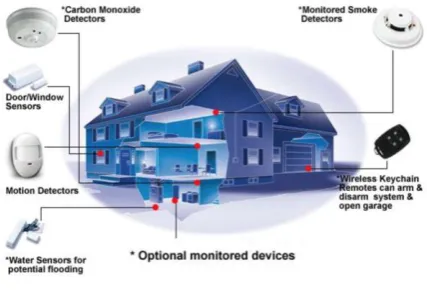
[image:2.595.323.537.409.554.2]The proposed system is a distributed home security system, consists of server, sensors. Server controls and monitors the various sensors, and can be easily configured to handle more hardware interface module (sensors). The Intel Galileo development board, with built in Wi-Fi card port to which the card is inserted, acts as web server. Security System can be accessed from the web browser of any local PC in the same LAN using server IP, or remotely from any PC or mobile handheld device connected to the internet with appropriate web browser through server real IP (internet). Wi-Fi technology is selected to be the network infrastructure that connects server and the sensors. Wi-Fi is chosen to improve system security (by using secure Wi-Fi connection), and to increase system mobility and scalability.
Fig 3.1system architecture
© 2018, IRJET | Impact Factor value: 6.171 | ISO 9001:2008 Certified Journal | Page 619 there is a leakage of gas in the house alarm is raised giving
the alert sound. Similarly if some one breaks or opens door or window without you knowledge then notification is triggered immediately. In case of motion detected at your door when you are out of station, then alert message is sent to your phone so that you can access motion camera connected to door and take a look of surrounding.
4. IMPLEMENTATION
4.1 Use Cases
The proposed home security system has the capabilities to control the following components in users home and monitor the following alarms:
Smoke detection: In this application, light in the house is going to control based on eve and dawn. The system is also going to detect the motion of the human in that room. If no human detected in the room, then light will totally off. If there is human detected in the room, then light will on but the brightness of the light will depend on the outside light. The room light is inversely proportional to the outside light.
Gas Leak Detection : There are many gas sensors available to be used with Intel Galileo. Each gas sensor is able to detect a specific gas. Some sensors detect the levels of carbon monoxide, methane, propane, and alcohol in the air. It helps you to detect any rise in the level of dangerous gases so that you can take precautions immediately to prevent any accident. MQ-9 gas sensor, which is sensitive to carbon monoxide, methane, and liquid petrol gas. Changes in the level of the given gases affect the conductivity of the sensor. A change in conductivity results in the output voltage of the sensor increasing. MQ-9 is an analog sensor, and so we need to use analog pins in Intel Galileo to read voltage changes.
4.2 Software Specification
This section covers the required software and their specifications, which are going to be used in the proposed system.
TeraTerm:
Tera Term is a freebie program, which is used as a terminal in the windows operating system. It is open source, software implemented program. It follows different types of computer terminals. It also supports secure shell (SSH) 1 and 2, serial port connection and Telnet.
Intel Arduino : It is an IDE, which is used to write code and assemble that code to the board. It can be run on Linux, Mac OS X and Windows. It is open source software. It is the recommended version to work with Galileo. You
can download this version at
[image:3.595.301.572.107.403.2]https://communities.intel.com/community/makers/drive rs.
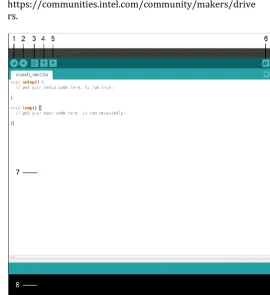
Fig 4.1 Intel Arduino IDE
Fig 4.1 shows the IDE components, you can find:
1. Verify: This button will be your best friend. It will help you compiling your sketch and troubleshooting any issues or syntax errors.
2. Upload: It will verify your code and, if it has no errors, it will upload your program to the board. • New: It creates a new sketch.
3. Open: This opens an existing sketch.
4. Save: It saves your sketch. The saved sketches have the file extension .ino.
5. Serial monitor: This opens the serial monitor window, which displays serial data
from
Galileo. This monitor window also allows you to send messages to your board.6. Your sketch: This is where you will write your code.
© 2018, IRJET | Impact Factor value: 6.171 | ISO 9001:2008 Certified Journal | Page 620 4.4 Connecting sensor to Intel Galileo
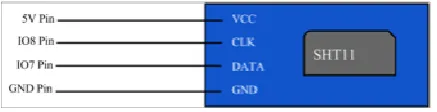
Let's connect our sensor to Intel Galileo before coding. The SHT11 sensor has four pins to be connected: the VCC, GND, clock (SCK), and data (DAT) pins.
[image:4.595.53.272.272.328.2]As Shown in Fig 4.2 We will use 5V for VCC since it is operational with 5V and produces more accurate data. The GND Pin can easily be seen on the Intel Galileo pinout. For the clock and data, we picked two GPIO pins IO7 and IO8 to send 0 and 1 to the sensor. IO7 on the board will be the data line and IO8 will be the clock line of the SHT11 sensor. The following fgure basically represents the pin connections of SHT11 to the corresponding pinout on Intel Galileo.
Fig 4.2 Connecting sensor to Intel Galileo
4.5 Gas Leakage Detection with Intel Galileo
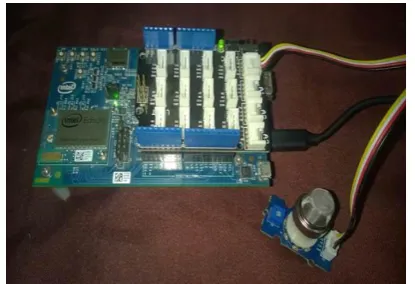
Here, we have an example of a MQ-9 gas sensor, which is sensitive to carbon monoxide, methane, and liquid petrol gas. Changes in the level of the given gases affect the conductivity of the sensor. A change in conductivity results in the output voltage of the sensor increasing. MQ-9 is an analog sensor, and so we need to use analog pins in Intel Galileo to read voltage changes.
1. First, we need to set the Intel Galileo GPIO pin to 37 low to be able to read analog values from analog input 0. Our main function will look like this:
#define PINMUX 37 #define ANALOGPIN 0 /**
* Analog Device File Operations */
int open_analog_device(int pin_number); int read_analog_device_value(int device_file); float read_voltage_scale(int pin_number); int main(void) {
// Read from Analog 0, mux GPIO Pin 37 to read voltage
values
if (gpio_set_mode(PINMUX, OUTPUT) < 0) { printf("Can't Set GPIO Mux Pin Mode\n");
return EXIT_FAILURE; }
if (gpio_set_value(PINMUX, LOW) < 0) { printf("Can't Set GPIO Mux Pin Value\n"); return EXIT_FAILURE;
}
printf("Pin Mux Successful\n"); // Read Digital Value Scale
float v_scale = read_voltage_scale(ANALOGPIN); printf("Voltage Scale is %f\n", v_scale);
// Open Analog Device
int analog = open_analog_device(ANALOGPIN); if (analog > -1) {
printf("Analog IO File Opened Successfully\n"); }
}
// Read Voltage Values from Analog 0 while (1) {
printf("Voltage : %d \n", read_analog_device_value(analog));
usleep(1000 * 1000); }
close(analog); return 0; }
2. Let's run the application on the Intel Galileo. We get the following output from our gasdetector application:
root@laxmijadhav:~/apps# ./gasdetector Pin Mux Successful
Voltage Scale is 1.220703 Analog IO File Opened Successfully
Voltage : 650 Voltage : 748 Voltage : 776
© 2018, IRJET | Impact Factor value: 6.171 | ISO 9001:2008 Certified Journal | Page 621 Fig 4.3 Intel Galileo connected to gas Sensor
5. CONCLUSIONS
The home security using Internet of Things has been experimentally proven to work satisfactorily by connecting simple appliances to it and the appliances were successfully controlled remotely through internet. The designed system not only monitors the sensor data, like temperature, gas, light, motion sensors, but also actuates a process according to the requirement, for example switching on the light when it gets dark. It also stores the sensor parameters in the cloud (Gmail) in a timely manner. This will help the user to analyze the condition of various parameters in the home anytime anywhere.
REFERENCES
[1] http://ieeexplore.ieee.org/document/8226143/
[2]https://www.lifewire.com/best-smart-home-security-systems-4034626
[3]http://in.pcmag.com/surveillance- cameras/99815/guide/the-best-smart-home-security-systems-of-2018
[4]https://www.arduino.cc/en/ArduinoCertified/IntelGali leo
[5] https://www.apress.com/in/book/9781430268390